Abstract The European light dosimeter network of over 40 stations has been established in Europe and other con-tinents equipped with three-channel filter dosimeters to measure solar radiation in three channels, UV-B (280–315 nm), UV-A (315–400 nm) and photosyntheti-cally active radiation (PAR). The recorded data have been evaluated, and the monthly doses in all three chan-nels show a strong latitudinal dependence from northern Sweden to the Canary Islands. There are a few remark-able exceptions such as the data recorded at the high mountain station on the Zugspitze (German Alps) and unequal doses at stations at comparable latitudes which indicate the impact of local weather conditions and mean sunshine hours. While generally peak values are record-ed in the months of June and July, the UV-B maxima are shifted later into the year, which is due to the antagonis-tic functions of decreasing solar angles and increasing transparency of the atmosphere as the total column ozone decreases in the second half of the year for the Northern Hemisphere. This is supported by comparison with modelled total column ozone and satellite-based measurements. Also the ratios of UV-B:UV-A and UV-B:PAR as well as UV-A:PAR peak during the sum-mer months, with the exception of the northernmost sta-tion at Abisko (north Sweden) where the UV-A:PAR ra-tio peaks in the winter months which is due to the specif-ic photoclimatspecif-ic conditions north of the polar circle. The
penetration of solar radiation into the water column was found to strongly depend on the transparency of the wa-ter column. In Gran Canaria more than 10% of the sur-face UV-B penetrated to 4–5 m depth. The path of the solar eclipse on 11 August 1999 could be followed in several stations with different degrees of occlusion of the sun disk.
Keywords European light dosimeter network (ELDONET) · High-altitude stations · Photosynthetic active radiation · Solar ultraviolet radiation · Underwater measurements
Introduction
Solar radiation affects all forms of the biota on our plan-et, and scientists studying these effects need reliable measurements of this irradiation. In the first studies spo-radic monitoring of solar radiation was established, and later systematic monitoring, to satisfy this need. Since specific wavelength bands induce different responses, it became important to measure spectrally resolved data. After the discovery of stratospheric ozone depletion caused by anthropogenic pollution, scientists became concerned as to what effects the resulting increased UV-B radiation [280–315 nm, Commission Internationale d’Eclairage (CIE) definition] has on the earth’s biota (Acevedo and Nolan 1993; UNEP 1998). One of the first concerns was an increase in certain forms of human skin cancers (van der Leun 1993). In addition, UV-B is sus-pected to cause cataracts, affect the human immune system and to be responsible for other health effects in humans and animals (Noonan and de Fabo 1990; De Fabo et al. 1990; Longstreth et al. 1998).
Other concerns about adverse UV-B effects focus on reduced productivity, decreased food quality and other changes in terrestrial plants, with respect to both wild and crop plants (Panagopoulos et al. 1989; Björn 1989; Bornman 1991; Caldwell et al. 1998). Solar UV radia-tion impairs photosynthesis (Strid et al. 1990; Renger et Communicated by K. Lüning
D.-P. Häder (
✉
) · M. LebertInstitut für Botanik und Pharmazeutische Biologie, Friedrich-Alexander Universität, Staudtstrasse 5, 91058 Erlangen, Germany
e-mail: [email protected] Tel.: +49-9131-8528216, Fax: +49-9131-8528215
G. Colombetti
C.N.R. Biofisica, Via S. Lorenzo 24/28, 56100 Pisa, Italy
F. Figueroa
Universidad de Malaga, Departamento de Ecologia, Facultad de Ciencias, Campus Universitario de Teatinos, 29071 Malaga, Spain
DOI 10.1007/s101520000059
O R I G I N A L A R T I C L E
D.-P. Häder · M. Lebert · G. Colombetti · F. Figueroa
European light dosimeter network (ELDONET): 1998 data
al. 1991), stomatal movement (Negash 1987; Negash et al. 1987), and the growth and development of a large percentage of plants investigated so far (Teramura et al. 1990a, 1990b; Cen and Bornman 1990).
The third area of research concentrates on adverse ef-fects of enhanced solar UV-B radiation on aquatic eco-systems (Smith et al. 1992; Häder et al. 1995; Gerber et al. 1996; Jiménez et al. 1996; Häder et al. 1998; UNEP 1988) which are responsible for the production of about 50% of the biomass on our planet and, in addition, play a decisive role in global carbon fluxes (Sarmiento and Le Quéré 1996). Primary aquatic producers dwell in the top layers of the water column and have been found to be very sensitive to UV radiation (Cullen and Lesser 1991; Raven 1991; Häder 1997; Häder and Worrest 1997).
In order to estimate the effects of the various wave-length bands of solar radiation, a network of monitoring stations is needed. A number of networks monitoring so-lar radiation have been installed or are in the planning stage. One network is the Brewer network which uses spectroradiometers (Diffey 1996; Webb 1998). The Um-weltbundesamt and the Bundesamt für Strahlenschutz have installed a network consisting of four stations (Offenbach, Schauinsland, Neuherberg, Zingst). This German network measures solar radiation at high spec-tral resolution (0.5–5 nm) as well as the integral of the total UV spectrum. A major drawback is that in principle the data are available to interested scientists, but current-ly there is oncurrent-ly limited personnel available to evaluate the data and the bureaucratic obstacles to actually re-ceive and use them seem to be difficult to overcome. Other European initiatives are the SUVDAMA (Spectral UV DAta and MAnagement) project initiated by Seck-meyer (Fraunhofer Institut für atmosphärische Umwelt-forschung, Garmisch-Partenkirchen, Germany) and the investigation of processes affecting UV-radiative transfer using simultaneous spectroradiometry with a set of well-defined instruments (Webb, Reading, England). Another project has been proposed by Bais (University of Thessaloniki, Greece) which is based on the intercom-parison of data from existing spectroradiometers. All these projects plan to use spectrally resolved radiation data.
Some networks aim specifically at the UV-B band to monitor stratospheric ozone depletion. The Robertson-Berger network has been measuring UV-B irradiance at eight stations in the United States since 1974. The wave-length range (290–330 nm) covers the wavewave-length range associated with erythemal sensitivity which does not co-incide with the CIE definition of UV-B (280–315 nm). Several other UV measuring networks have been in-stalled worldwide using both terrestrial and satellite-based instruments (Booth and Lucas 1994; Kerr 1997; Lubin and Jensen 1997). Therefore, the European light dosimeter network (ELDONET) was installed. The ELDONET stations are arranged along a north-south transect from north Sweden (Abisko, 69°N) to the Canary Islands (Gran Canaria, 28°N) and extend east to west from Greece (Korinth, 24°E) to the Canary Islands
(16°W) to cover the major light climate areas in Europe (Häder et al. 1999). In addition, stations have been in-stalled in Africa, India, South America and New Zea-land. Other stations can easily join the network, since the hardware and installation costs are comparatively low. The data are transferred to the central server of the net-work in Pisa on a regular basis and are available on the internet (http://power.ib.pi.cnr.it:80/eldonet) free of charge for non-commercial use (Marangoni et al. 2000).
Accurate and reliable, but low-cost, three-channel do-simeters were developed with filter functions corre-sponding to the UV-B (280–315 nm, CIE definition), UV-A (315–400 nm) and photosynthetically active radia-tion (PAR; 400–700 nm) wavelength ranges. The mea-sured values can be compared with any biological filter function (e.g. DNA or plant sensitivity) to determine the biological effectiveness of the radiation. In addition to the more than 40 terrestrial stations, seven underwater stations have been installed in the North Sea, Baltic Sea, Kattegat, Mediterranean and Atlantic. The underwater stations are operated in conjunction with terrestrial in-struments so that the attenuation in the water column can be determined. Two high-altitude stations have been in-stalled in the European Alps (Zugspitze) and the Spanish Sierra Nevada.
Materials and methods
Hardware
The dosimeters connected in the network are three-channel broad-band filter instruments. The entrance optic consists of an integrat-ing Ulbricht sphere with an internal barium sulphate coatintegrat-ing (Khanh and Dähn 1998). Large-area silicon photodiodes (BPX60 for the PAR range and SFH291 for the two UV ranges, both Sie-mens, Germany) are used in combination with custom-made filters to select the wavelength ranges for UV-B, UV-A and PAR. A me-chanical shutter is used to close the UV-B channel to determine the dark value at regular intervals in order to eliminate age- and temperature-related drifts of the photodiodes. The dark values of the other two channels are stable, so that it is not necessary to de-termine them frequently. The instruments are housed in weather-proof cases with internal metallic shielding and thermal insulation. The internal temperature is kept at an elevated value of above 35°C. All instruments have identical optical and electrical proper-ties in order to warrant intercomparison between the different sites. Only the optical entrance configuration is different in the un-derwater instruments to account for the immersion effect under water. The underwater instruments are bolted on heavy rocks or concrete slabs and have been shown to withstand even strong cur-rents during winter storms. The internal temperature in the under-water instruments is not controlled since the under-water mass around them limits the temperature range. They have a calibrated pressure sensor to measure the depth of the water column above the instru-ment.
Software
time offset to universal standard time. Internally the software cal-culates in Greenwich mean time but displays the local time for convenience. The measured data are averaged over 1-min intervals and stored once every hour on the hard disk drive of the computer as ASCII files which facilitates further analysis of the data by the analysis program (WinData) developed for this purpose.
The central server of the network has been installed in Pisa to collect the data from all stations (Marangoni et al. 2000). The data are transferred either automatically by file transfer process, mo-dem or manually. The data sets are checked for validity and integ-rity before being entered into the database. The data are available in graphical form and can be downloaded in numerical form from the server.
Calibration
Each instrument is accurately calibrated against a 1,000-W quartz halogen calibration lamp operated with a highly stabilized power supply (SL 1,000 W, Powertronic 710 D). The temperature depen-dence of the dark value is calibrated for each instrument between 20°C and 60°C. All calibration factors are stored in the individu-al.INI file. The absolute calibration was performed in an intercom-parison of several spectroradiometers and the ELDONET instru-ment in September 1997 in Garmisch-Partenkirchen (southern Germany). Intercomparison of instruments to measure solar radia-tion is a vital tool for quality control and documentaradia-tion (Seck-meyer et al. 1994; Leszczynski et al. 1998). All instruments are re-calibrated at least every year.
Results
Figure 1A shows a measurement at Ljubljana (Slowenia, 46°N and 15°E) on 11 August 1999. In addition to some scattered clouds, the solar eclipse with a covering of 96.6% at around 12:48 hours is clearly visible in all spectral channels. Figure 1B represents the data for an almost clear day in Gran Canaria (Canary Islands, 28°N and 16°W) on 19 February 1998. PAR reaches almost 370 W m–2 during local noon in this station and UV-A amounts to 58 W m–2. The UV-B irradiance peaked at about 1.8 W m–2. The terrestrial instrument is located on the roof of a larger building with an almost unobstructed view of the horizon. A second instrument is located in the harbour less than 100 m away, so that the local weather conditions are comparable. Figure 1C shows the irradiances in the three channels at a depth of 4.3–5.3 m during the tidal cycle. PAR irradiance peaked at about 145 W m–2 and UV-A reached a maximal value of 17 W m–2. The UV-B channel recorded a maximum at 0.25 W m–2. During this time of the year the water is very clear while it becomes more turbid later in the year. At that time the measured values decrease to <25% of the ones reported for early spring (data not shown).
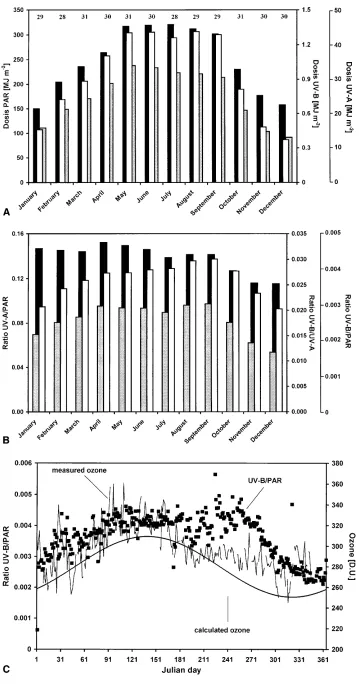
When the daily doses are added to calculate the monthly doses a broad peak is found for Gran Canaria during the summer months reaching 320 MJ m–2 in the PAR channel, 48 MJ m–2in the UV-A and 1.3 MJ m–2in the UV-B channel (Fig. 2A). The number of measured days in each month is indicated numerically above each set of columns. A few missing measurement data are in-terpolated from the existing data. The UV-B irradiance strongly depends on the solar angle and thus on the time
of the year. In addition, it is affected by the total ozone column. In order to eliminate the effect of the changing cloud cover the ratio of UV-B:PAR and UV-B:UV-A can be calculated for all cumulative daily doses in the year (Fig. 2B). It is interesting to note that the UV-B:UV-A ratio peaks in early autumn rather than in the summer. This is also obvious when the UV-B:PAR ratios are cal-culated for every day (Fig. 2C). The autumn peak corre-sponds with lower ozone values as measured by the TOMS instrument on the NASA Earth Probe satellite. Also the predicted ozone concentration calculated on the basis of Green’s model (Green and Chai 1988) with a computer program shows higher Dobson units in spring than in autumn. Gran Canaria is the southernmost station of ELDONET in Europe (but not of other continents).
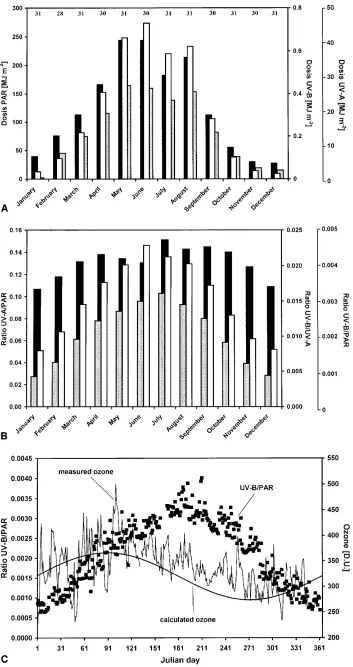
Erlangen (Germany, 50°N, 11°E) represents a typical central European station. The cumulative monthly doses reach about 244 MJ m–2 for PAR during the summer (Fig. 3A), but in July a higher cloud cover was observed during June or August. The peak in UV-A and UV-B ir-radiances was observed during June as predicted from the monthly mean solar angles. Also the ratio UV-B:UV-A peaks in June while the ratios B:PAR as well as UV-A:PAR have their maximum in July (Fig. 3B). Also, plotting the UV-B:PAR ratios on a daily basis indicates a clear maximum in July which correlates with decreasing total ozone column values and the ozone values mea-sured from the NASA satellite (Fig. 3C). The peak posi-tion is controlled by the antagonistic funcposi-tions of the de-creasing total ozone column values and the inde-creasingly lower solar angles in autumn.
Lisbon (Portugal, 39°N, 9°W) shows a typical south-ern European (Mediterranean) light climate with highest irradiances in June with about 380 MJ m–2 in the PAR, 54 MJ m–2 in the UV-A and 1.4 MJ m–2 in the UV-B range (Fig. 4A). The A:PAR, B:PAR and UV-B:UV-A ratios also peak in June (Fig. 4B).
Also the northernmost station of the network (Abisko, north Sweden, 69°N, 19°E) showed maximal irradiances in June (Fig. 5A). This station is located above the Nor-dic polar circle, and during winter the sun does not rise above the horizon resulting in extremely low irradiances. However, it is interesting to note that the PAR peak dos-es in summer exceed those measured in Erlangen, which is due to the fact that in this month the sun does not sink below the horizon at the Arctic circle and the doses are effectively accumulated over 24-h periods. The ratios for Abisko are surprising (Fig. 5B): While UV-B:PAR and UV-B:UV-A peak in July, an opposite trend is found for UV-A:PAR, which has a maximum in December and January. This may be due to the higher amount of diffuse skylight during the winter months in comparison to the direct radiation which increases with longer wave-lengths.
Helgo-Fig. 1 Solar radiation on
11 August 1999 at Ljubljana (Slowenia, 46°N, 15°E) (A) in the ultraviolet (UV)-B (fine
line), UV-A and
Fig. 2 A Monthly doses for
Gran Canaria (Canary Islands, 28°N, 16°E) in 1998 in the UV-B (white columns), UV-A (grey
columns) and PAR (black col-umns) ranges calculated for
30 days month–1from the mea-sured daily data indicated by the numbers above each set of
columns and B the UV-A:PAR
(black bars), UV-B:PAR (grey
bars) and UV-B:UV-A ratios
Fig. 3 A Monthly doses for
Er-langen (Germany, 50°N, 11°E) 1998 in the UV-B (white
col-umns), UV-A (grey columns)
and PAR (black columns) rang-es calculated for 30 days month–1from the measured daily data indicated by the
numbers above each set of col-umns and B the UV-A:PAR
(black bars), UV-B:PAR (grey
bars) and UV-B:UV-A (white bars) ratios. C Daily ratios of
Fig. 4 A Monthly doses for
Lisbon (Portugal, 39°N, 9°W) 1998 in the UV-B (white
col-umns), UV-A (grey columns)
and PAR (black columns) rang-es calculated for 30 days month–1from the measured daily data indicated by the
numbers above each set of col-umns and B the UV-A:PAR
(black bars), UV-B:PAR (grey
bars) and UV-B:UV-A (white bars) ratios. For abbreviations,
see Fig. 2
land (island in the German bight, 54°N, 8°E) shows comparatively higher doses than Rostock (on the south-ern coast of the Baltic Sea, 54°N, 12°E) even though the latitude is comparable. Karlsruhe (Germany, 49°N, 8°E) also has higher doses than Erlangen, which reflects the statistically higher number of clear days during the year in the former city.
The high mountain station on the Zugspitze (German Alps) has higher irradiances than other stations with a similar latitude, underlining the altitude effect and clear sky conditions in pristine Alpine locations. As expected, Gran Canaria has the highest yearly doses in all three wavelength bands.
Discussion
High-precision measurements of solar radiation are af-fected by several problems. Using highly accurate
tech-nology and taking extreme care during calibration can minimize these errors. The resolution and detection lim-its of the instrument are <0.1 W m–2for PAR, <0.01 W
m–2for UV-A and <0.0005 W m–2for UV-B. All
current-ly available tools for quality control and documentation are used to ensure a high standard of precision. During their lifetime up to now – some instruments have been in use for over 5 years – the deviation from high-precision calibrated spectroradiometers was found to be <10% for the UV-B, 5% for the UV-A and 2% for the PAR chan-nel.
Fig. 5 A Monthly doses for
Abisko (north Sweden, 69°N, 19°E) 1998 in the UV-B (white
columns), UV-A (grey umns) and PAR (black col-umns) ranges calculated for
30 days month–1from the mea-sured daily data indicated by the numbers above each set of
columns and B the UV-A:PAR
(black bars), UV-B:PAR (grey
bars) and UV-B:UV-A (white bars) ratios. For abbreviations,
see Fig. 2
Fig. 6 Yearly doses for 1998 at
eventually explained in part by the fact that most Robertson-Berger meters were installed at meteorologi-cal stations in the neighbourhood of airports, so that the increasing atmospheric pollution due to higher air traffic offset the increase in UV-B reaching the ground. As a consequence the Robertson-Berger readings were in con-tradiction to the predicted UV-B and ozone data, both in their numerical values and even in the sign of the trend (Kennedy and Sharp 1992). In addition, a significant temperature sensitivity of the Robertson-Berger meters as well as drifts both in wavelength accuracy and absolute irradiances due to aging were found which were larger than and offset the actual increases in UV-B reaching the ground (Johnson and Moan 1991; DeLuisi et al. 1992; Frederick and Weatherhead 1992). For the ELDONET instruments the reproducibility over several years was measured to be 1.4±1.0% for the PAR chan-nel, 1.9±1.5% for UV-A and 3.8±3.8% for UV-B, based on a total of 41 instruments, indicating a long-term sta-bility of the instruments (Häder et al. 1999).
Generally speaking, high-precision measurements can be obtained with spectroradiometer networks. However, both the price of the instruments and the large invest-ment in maintenance prohibit the installation of a dense European or global network. One of the advantages of the ELDONET instruments is the low cost (about 2,300 Euros) which allows the number of instruments in the network to be easily increased. A disadvantage is that there is no spectral resolution within the channels, but the measured values can be converted with a given biological weighting function. In contrast to the net-works described above, the aim of the ELDONET was to develop an instrument which satisfies the specific inter-est and needs of the scientific community involved in the study of the effects of solar radiation.
The measured monthly doses show a strong depen-dence on the latitudinal gradient within ELDONET. However, there are a few remarkable exceptions due to local weather conditions, indicating that the ELDONET is a solid approach to establishing data on European pho-toclimatology. The monthly total doses for a given sta-tion reflect the expected annual changes with peak val-ues in June and July which correspond with the highest solar angles for northern latitudes.
The ratio of UV-A:PAR follows a general pattern for all stations with maximal values in the summer. Howev-er, there is one noticeable exception: the northernmost station in Abisko. Here the ratio peaks during the winter, which may be accounted for by the specific conditions north of the polar circle. During winter the sun does not rise above the horizon for several months, so that only the diffuse skylight is measured but no direct solar radia-tion. Since, according to Rayleigh, scattered shorter-wavelength radiation has a higher proportion in diffuse skylight, UV-A is favoured more than the longer-wave-length PAR. This phenomenon does not hold for UV-B probably because of the strong attenuation of UV-B in its long pathway through the atmosphere at low solar an-gles.
There are only seven stations which measure solar ra-diation in the water column and they have not all been active for the whole measuring period, but there are suf-ficient reliable data. Penetration of solar radiation into the top layers of the water column strongly depends on the turbidity of the water. While in the coastal waters off Helgoland solar UV-B could not be measured below 1 m of water, the penetration is much stronger in the Atlantic station in Gran Canaria. Especially during the winter months the transparency is very high, and >10% of the surface radiation penetrates through 4–5 m of water, de-pending on the tide.
Another interesting feature is the effect of the solar eclipse which was recorded by several stations along the path of this phenomenon. It could be observed by the stations in Plymouth, Karlsruhe, Erlangen, Zugspitze, Lubljana, Athens, Pisa and Cairo to a various extent be-cause of the different cloud cover at the respective sta-tions.
Acknowledgements This work was supported by the European
Union (Environment programme, EV5V-CT94–0425; DG XII). The authors acknowledge A. Gaberscik, J. Pinchetti, and A. Pircher for running the ELDONET stations and thank L.-O. Björn for sup-plying a version of the computer program to model solar radiation and the ozone layer thickness. The authors thank M. Schuster for excellent technical assistance and R. Marangoni for managing the ELDONET server.
References
Acevedo J, Nolan C (1993) Environmental UV radiation. Com-mission of the European Communities, Directorate-General XII for Science, Research and Development, Brussels Björn LO (1989) Consequences of decreased atmospheric ozone:
effects of ultraviolet radiation on plants. In: Schneider T (eds) Atmospheric ozone research and its policy implications. Else-vier, Amsterdam, pp 261–267
Björn LO, Murphy TM (1985) Computer calculation of solar ul-traviolet radiation at ground level. Physiol Veg 23:555–561 Booth CR, Lucas TB (1994) UV spectroradiometric monitoring in
polar regions. In: Biggs RH, Joyner MEB (eds) Stratospheric ozone depletion/UV-B radiation in the biosphere. ASI Series, vol 18. Springer, Berlin Heidelberg New York, p 237
Bornman JF (1991) UV radiation as an environmental stress in plants. J Photochem Photobiol B 8:337–342
Caldwell MM, Björn LO, Bornman JF, Flint SD, Kulandaivelu G, Teramura AH, Tevini M (1998) Effects of solar ultraviolet ra-diation on terrestrial ecosystems. J. Photochem Photobiol B 46:40–52
Cen Y-P, Bornman JF (1990) The response of bean plants to UVB radiation under different irradiances of background visible light. J Exp Bot 41:1489–1495
Cullen JJ, Lesser MP (1991) Inhibition of photosynthesis by ultra-violet radiation as a function of dose and dosage rate: results for a marine diatom. Mar Biol 111:183–190
De Fabo EC, Noonan FP, Frederick JE (1990) Biologically effec-tive doses of sunlight for immune suppression at various lati-tudes and their relationship to changes in stratospheric ozone. Photochem Photobiol 52:811–817
DeLuisi J, Wendell J, Kreiner F (1992) An examination of the spectral response characteristics of seven Robertson-Berger meters after long-term field use. Photochem Photobiol 56: 115–122
Frederick JE (1992) An assessment of the Robertson-Berger ultra-violet meter and measurements: introductory comments. Pho-tochem Photobiol 56:113–114
Frederick JE, Weatherhead EC (1992) Temporal changes in sur-face ultraviolet radiation: a study of the Robertson-Berger me-ter and Dobson data records. Photochem Photobiol 56:123– 131
Gerber S, Biggs A, Häder D-P (1996) A polychromatic action spectrum for the inhibition of motility in the flagellate
Eugle-na gracilis. Acta Protozool 35:161–165
Green AES, Chai S-T (1988) Solar spectral irradiance in the visible and infrared regions. Photochem Photobiol 48:477– 486
Häder D-P (1997) Impact on marine ecosystems. In: Zerefos CS, Bais AF (eds) Solar ultraviolet radiation. Modelling, measure-ments and effects. NATO ASI series, vol I 52. Springer, Berlin Heidelberg New York, pp 209–231
Häder D-P, Worrest RC (1997) Consequences of the effects of in-creased solar ultraviolet radiation on aquatic ecosystems. In: Häder D-P (ed) The effects of ozone depletion on aquatic eco-systems. Environmental Intelligence Unit. Academic Press, Landes, Austin, Tex., pp 11–30
Häder D-P, Worrest RC, Kumar HD, Smith RC (1995) Effects of increased solar ultraviolet radiation on aquatic ecosystems. AMBIO 24:174–180
Häder D-P, Worrest RC, Kumar HD, Smith RC (1998) Effects on aquatic ecosystems. J Photochem Photobiol B 46:53–68 Häder D-P, Lebert M, Marangoni R, Colombetti G (1999)
ELDONET – European light dosimeter network hardware and software. J Photochem Photobiol B 52:51–58
Jimenez C, Figueroa FL, Aguilera J, Lebert M, Häder D-P (1996) Phototaxis and gravitaxis in Dunaliella bardawil: influence of UV radiation. Acta Protozool 35:287–295
Johnson B, Moan J (1991) The temperature sensitivity of the Robertson-Berger sunburn meter, model 500. J Photochem Photobiol 11:277–284
Kennedy BC, Sharp WE (1992) A validation study of the Robertson-Berger meter. Photochem Photobiol 56:133–141 Kerr JB (1997) Observed dependencies of atmospheric UV
radia-tion and trends. In: Zerefos CS, Bais AF (eds) Solar ultraviolet radiation modelling, measurement and effects. Nato ASI series I 52. Springer, Berlin Heidelberg New York, p 259
Khanh TQ, Dähn W (1998) Die Ulbrichtsche Kugel. Theorie und Anwendungsbeispiele in der optischen Strahlungsmesstechnik. Photonik 4:6–9
Leszczynski K, Jokela K, Ylianttila L, Visuri R, Blumthaler M (1998) Erythemally weighted radiometers in solar UV moni-toring: results from the WMO/STUK intercomparison. Photo-chem Photobiol 67:212–221
Leun JC van der, Gruijl FR de (1993) Influences of ozone deple-tion on human and animal health. In: Tevini M (ed) UV-B ra-diation and ozone depletion. Lewis Publishers, Boca Raton, Fla., pp 95–123
Longstreth J, Gruijl FR de, Kripke ML, Abseck S, Arnold F, Slaper HI, Velders G, Takizawa Y, Leun JC van der (1998) Health risks. J Photochem Photobiol B 46:20–39
Lubin D, Jensen EH (1997) Satellite mapping of solar ultraviolet radiation at the earth’s surface. In: Zerefos CS, Bais AF (eds) Solar ultraviolet radiation modelling, measurements and ef-fects. Nato ASI series I 52. Springer, Berlin Heidelberg New York, pp 95–118
Marangoni R, Barsella A, Gioffré D, Colombetti G, Lebert M, Häder D-P (2000) ELDONET – European light dosimeter net-work. Structure and function of the ELDONET server. J Pho-tochem Photobiol B (in press)
Negash L (1987) Wavelength-dependence of stomatal closure by ultraviolet radiation in attached leaves of Eragrostis tef: action spectra under backgrounds of red and blue lights. Plant Physiol Biochem 25:753–760
Negash L, Jensen P, Björn LO (1987) Effect of ultraviolet radia-tion on accumularadia-tion and leakage of 86Rb+ in guard cells of
Vicia faba. Physiol Plant 69:200–204
Noonan FP, De Fabo EC (1990) Ultraviolet-B dose-response curves for local and systemic immunosuppression are identi-cal. Photochem Photobiol 52:801–810
Panagopoulos I, Bornman JF, Björn LO (1989) The effect of UVB and UV-C radiation on Hibiscus leaves determined by ultra-weak luminescence and fluorescence induction. Physiol Plant 76:461–465
Raven JA (1991) Responses of aquatic photosynthetic organisms to increased solar UVB. J Photochem Photobiol B 9:239–244 Renger G, Rettig W, Gräber P (1991) The effect of UVB
irradia-tion on the lifetimes of singlet excitons in isolated photo-system II membrane fragments from spinach. J Photochem Photobiol B 9:201–210
Sarmiento JL, Le Quéré C (1996) Oceanic carbon dioxide uptake in a model of century-scale global warming. Science 274: 1346–1350
Scotto J, Cotton G, Urbach F, Berger D, Fears T (1988) Biologi-cally effective ultraviolet radiation: surface measurements in the United States, 1974 to 1985. Science 239:762–764 Seckmeyer G, Mayer B, Erb R, Bernhard G (1994) UV-B in
Germa-ny higher in 1993 than in 1992. Geophys Res Lett 21:577–580 Smith RC, Prézelin BB, Baker KS, Bidigare RR, Boucher NP,
Coley T, Karentz D, MacIntyre S, Matlick HA, Menzies D, Ondrusek M, Wan Z, Waters KJ (1992) Ozone depletion: ul-traviolet radiation and phytoplankton biology in antarctic wa-ters. Science 255:952–959
Strid A, Chow WS, Anderson JM (1990) Effects of supplementary ultraviolet-B radiation on photosynthesis in Pisum sativum. Biochim Biophys Acta 1020:260–268
Teramura AH, Sullivan JH, Lydon J (1990a) Effects of UVB radi-ation on soybean yield and seed quality: a 6-year field study. Physiol Plant 80:5–11
Teramura AH, Sullivan JH, Ziska LH (1990b) Interaction of ele-vated ultraviolet-B radiation and CO2on productivity and pho-tosynthetic characteristics in wheat, rice, and soybean. Plant Physiol 94:470–475
UNEP (1998) Environmental effects of ozone depletion. United Nations Environmental Programme, Nairobi