I N N O V A T I O N
Open Access
Distributed Simulation as a modelling tool
for the development of a simulation-based
training programme for cardiovascular
specialties
Tanika Kelay
1*, Kah Leong Chan
1, Emmanuel Ako
2, Mohammad Yasin
1, Charis Costopoulos
3, Matthew Gold
3,
Roger K. Kneebone
1, Iqbal S. Malik
1,3and Fernando Bello
1Abstract
Aims and background:Distributed Simulationis the concept of portable, high-fidelity immersive simulation. Here, it is used for the development of a simulation-based training programme for cardiovascular specialities. We present an evidence base for how accessible, portable and self-contained simulated environments can be effectively utilised for the modelling, development and testing of a complex training framework and assessment methodology. Iterative user feedback through mixed-methods evaluation techniques resulted in the implementation of the training programme.
Approach: Four phases were involved in the development of our immersive simulation-based training programme:(1) initial conceptual stage for mapping structural criteria and parameters of the simulation training framework and scenario development (n= 16), (2) training facility design usingDistributed Simulation, (3) test cases with clinicians (n= 8) and collaborative design, where evaluation and user feedback involved a mixed-methods approach featuring (a) quantitative surveys to evaluate the realism and perceived educational relevance of the simulation format and framework for training and (b) qualitative semi-structured interviews to capture detailed feedback including changes and scope for development. Refinements were made iteratively to the simulation framework based on user feedback, resulting in (4) transition towards implementation of the simulation training framework, involving consistent quantitative evaluation techniques for clinicians (n= 62). For comparative purposes, clinicians’initial quantitative mean evaluation scores for realism of the simulation training framework, realism of the training facility and relevance for training (n= 8) are presented longitudinally, alongside feedback throughout the development stages from concept to delivery, including the implementation stage (n= 62).
Findings:Initially, mean evaluation scores fluctuated from low to average, rising incrementally. This corresponded with the qualitative component, which augmented the quantitative findings; trainees’user feedback was used to perform iterative refinements to the simulation design and components (collaborative design), resulting in higher mean evaluation scores leading up to the implementation phase.
Conclusions:Through application of innovative Distributed Simulation techniques, collaborative design, and consistent evaluation techniques from conceptual, development, and implementation stages, fully immersive simulation techniques for cardiovascular specialities are achievable and have the potential to be implemented more broadly.
Keywords:Distributed Simulation, Immersive simulation, Training, Collaborative design, Evaluation, Mixed-methods, Implementation
* Correspondence:[email protected]
1Imperial Centre for Engagement and Simulation Science, Imperial College
London, 3rd Flr Chelsea and Westminster Hospital (Academic Surgery), 369 Fulham Road, London SW10 9NH, UK
Full list of author information is available at the end of the article
Introduction
Background
This paper explores the use of Distributed Simulation [1] as a modelling tool for the development and imple-mentation of an immersive simulation-based training programme for cardiovascular specialities. Here, we identify gaps in the current provision of training provision for cardiovascular specialties, and in doing so outline the requirements of an immersive training programme which we addressed through the effective utilisation of Distributed Simulation.
The ICCESS (Imperial College Centre for Engagement and Simulation Science) team have developed the concept of Distributed Simulation (DS), involving realistic, access-ible and portable simulated environments in recognition of various limitations involved in traditional medical simu-lation techniques. Drawbacks include practical issues such as the cost and expense of dedicated high-fidelity simula-tion centres, accessibility, and moving beyond the use of bench-top simulators that focus primarily on technical skills training [2], to more contextualised immersive train-ing environments that can trigger a range of responses in clinicians, allowing team-based training to include human factors components, e.g. teamwork, communication, lead-ership and cooperation. Distributed Simulation can also allow for other innovations to be introduced such as em-bedding simulated patients [3, 4], thus augmenting the human interaction aspects and realism, serving to enhance the training experience further.
To date, the Distributed Simulation concept has in-volved several applications, from surgical training [5–8], clinician engagement workshops [9] and patient/public engagement forums [10–12]. The concept extends fur-ther through its vision to provide an approach to learn-ing, which can be tailored to the needs of groups, and it can be used to underpin collaborative user-based design to drive forward innovations in training for emerging specialities that have to date been lacking in terms of robust development [1].
We describe how innovative concepts such as Distributed Simulation can be used as a collaborative engagement tool, involving accessible, portable and self-contained simulated environments that can be effectively utilised and applied for the modelling, development and testing of a complex training framework and assessment methodology. Iterative user feedback through mixed-methods evaluation techniques in the design process supports the concept that innovations and collaborative user-based design are key to the successful development and delivery of medical simulation training. Here, innovation and participation are inherently linked, where novel simulation techniques and tools serve to facilitate collaborative design.
The requirements of an immersive cardiovascular training programme
complication—all against a stressful clinical backdrop with a steady inflow of emergency patients requiring life-saving treatment. A successful training programme for cardiovascular specialties would therefore require:
(a) A structured curriculum with clearly defined procedural and team-based learning objectives across physician experience levels in order to avoid‘one size fits all’approaches;
(b)A realistic and novel simulated training facility for individual practitioners and multidisciplinary (MDT) catheterization laboratory (cath-lab) teams, with integrated interventional simulator, and embedded patient (actor) to represent the conscious patient, actual clinical setting and team activities;
(c)Inclusion of a behavioural team-based framework mapped according to realistic clinical activities and engagement with patients;
(d)Authentic clinical scenarios for basic, intermediate and advanced level physicians that mirror real-life encounters and cases, based on the core cardiology-training curriculum [32];
(e) Selection and testing of training assessment tools for technical and non-technical skills;
(f ) Accessibility for clinicians to test and provide evaluation feedback about the design of the simulated framework for collaborative design purposes.
Distributed Simulation as a modelling tool for the development of an integrated cardiovascular training programme
Given the requirements for a holistic training programme, the novel training facility would need to cater for the needs of structured interventional procedures, combined with team-based learning objectives across trainee compe-tency levels. The design would require iterative develop-ment, testing and refinedevelop-ment, and collaborative design and engagement would need to be central to the concep-tual and physical development of the training programme. Multiple benefits associated with using the DS concept would allow flexibility for the programme to be iteratively designed and tested by clinicians in close proximity to their actual clinical workplace, without the need of an ex-pensive one-off reproduction of a static angio-suite. According to Kneebone, central to the DS concept is the notion of‘active design’, whereby key elements of the clin-ical environment are initially closely observed and identi-fied by design teams and recreated through processes of ‘selective abstraction’[33]. Here, the aim is not to faithfully recreate the entire clinical environment for simulation purposes but to recreate a functional setting that will serve to engage users—in this case as a simulation test bed to introduce, test and refine innovations in cardiovascular training techniques. In practical terms, the essential
premise of DS is to effectively utilise simulation facilities that are‘good enough’to engage participants that are low-cost and portable and can be assembled in clinical or non-clinical locations. Accordingly, a DS angio-suite was purposely designed to capture the key components of the cath-lab (described in further detail below).
Method
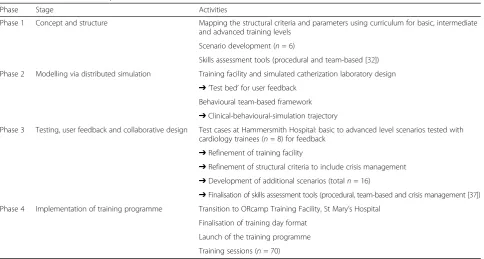
An overview of the four phases is shown in Table 1. Phases 1, 2 and 3 are presented here as they constitute the bulk of the development, mapping largely to steps 1–4 of the well-known Kern [33] framework for curricu-lum development, whilst phase four, corresponding pri-marily to steps 5 and 6, is included in the “Results” section below.
Phase 1: concept and structure: the integrated cardiology simulation framework and components
The integrated conceptual framework of the simulation training programme featured an embedded patient (actor), interventional VR simulator (Mentice VIST®,Gothenburg, Sweden), and behavioural team-based practices to enable performance and assessment of procedural and team-based skills concurrently via a portfolio of pre-tested scenarios.
Mapping the structural criteria and parameters for simulation-based cardiovascular training
Scenario development
Scenarios incorporated a range of human-factors com-petencies (e.g. teamwork, communication, leadership, decision-making and cooperation [34]). They were as-sembled by experienced cardiologists, tailored and struc-tured according to the skills sets of basic, intermediate and advanced level trainees, based on realistic, authentic clinical cases, involving both routine and emergency procedures. They were also developed according to NICE, ALS and ESC guidelines in order to support exist-ing curricula identified in the initial mappexist-ing stages.
Phase 2: DS as a‘test bed’for user feedback and collaborative design
The DS angio-suite served as the‘test bed’to consolidate the following two phases of programme development in terms of testing, user feedback and collaborative design. This would allow refinements and finalisation of the concept and structure, prior to implementation of the training programme (phase 4).
Training facility design
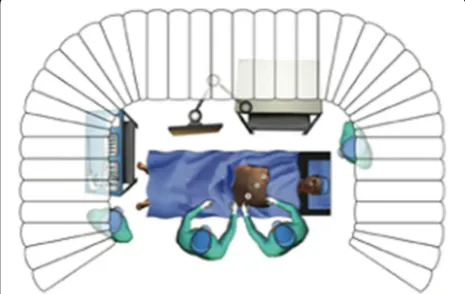
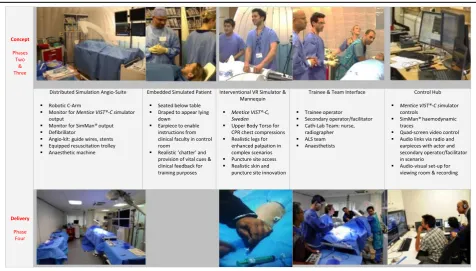
The DS angio-suite was designed to be integrative in order to support the technical and team-based educa-tional and training requirements. It included a robotic c-arm, a table and chair that would allow a simulated pa-tient (actor) to be fully embedded under a mannequin during the intervention (Fig. 1). The innovative embed-ded patient design concept is central to the novel design of the programme, where patient-focused simulation
combines trained actors within simulated environ-ments [3]. Most cardiovascular procedures are rou-tinely performed on conscious patients. Thus, effective communication with the patient and team is crucial before, during and after procedures and should be a vital component in skills training. Professional actors have previously been implemented in hybrid simula-tion and skills training, where embedding a ‘real pa-tient’in a training environment added to the demands of clinical performance [35, 36].
The facility also featured an endovascular VR simula-tor (Mentice VIST®), SimMan® haemodynamic monitors, and key clinical apparatus and ‘props’ specific to the cath-lab, as well as space for an MDT team-interface (in-cluding nurses, physiologists, radiographers, anaesthe-tists and ALS team), all contained within an enclosed space with an ambience akin to that of the actual clinical
Table 1Overview of the four phases
Phase Stage Activities
Phase 1 Concept and structure Mapping the structural criteria and parameters using curriculum for basic, intermediate and advanced training levels
Scenario development (n= 6)
Skills assessment tools (procedural and team-based [32])
Phase 2 Modelling via distributed simulation Training facility and simulated catherization laboratory design ➔‘Test bed’for user feedback
Behavioural team-based framework ➔Clinical-behavioural-simulation trajectory
Phase 3 Testing, user feedback and collaborative design Test cases at Hammersmith Hospital: basic to advanced level scenarios tested with cardiology trainees (n= 8) for feedback
➔Refinement of training facility
➔Refinement of structural criteria to include crisis management ➔Development of additional scenarios (totaln= 16)
➔Finalisation of skills assessment tools (procedural, team-based and crisis management [37]) Phase 4 Implementation of training programme Transition to ORcamp Training Facility, St Mary’s Hospital
Finalisation of training day format
Launch of the training programme
Training sessions (n= 70)
environment (Figs. 2 and 3). The angio-suite also featured a separately designated control desk to avoid distracting participants from the immersive simulated setting. The interventional procedure was managed from the control desk via Mentice VIST® software, with haemodynamic traces controlled and manipulated according to the prede-fined scenarios using SimMan®software.
Setting and location
In order to test the integrated conceptual framework of the simulation training programme, the DS angio-suite was housed in portable format at Hammersmith Hos-pital, Imperial College Healthcare NHS Trust with easy access to the 24-h Heart Attack Treatment Centre, thus allowing for a series of test cases to be scheduled with staff members.
Phase 3: testing and collaborative design
Test cases: collaborative and iterative design via clinician involvement and feedback
The test cases commenced in November 2013. The sce-narios were tested with basic, intermediate and advanced cardiology specialty trainees. A total of eight cardiology trainees (three basic, three intermediate and two ad-vanced) were recruited across training levels from Ham-mersmith Hospital. Sessions typically took place in evenings after clinical hours.
Test case format and tasks performed
Trainees were allocated scenarios according to their experi-ence level in advance of the sessions. On arrival, they were briefed that they would perform two to three scenarios, each lasting approximately 20–30 min, that their feedback about the test cases would inform the broader development and design of a novel, structured simulation-based training programme and that they would have the opportunity to provide detailed feedback at the end of the sessions.
Prior to commencing the scenarios, all participants re-ceived initial one-to-one instruction from an experienced
interventional clinician trained in the use of the Mentice VIST®, in order to familiarise themselves with the device and apparatus, including the use of guidewires and stents. All trainees also performed an initial basic test run for fa-miliarity purposes. The ‘cath-lab team’for the initial test cases were played by members of the research team as passive ‘plants’ to fill in the roles of nurse and radiog-rapher, providing simulated responses when requested by cardiology operators/participants. The actors prepared in advance using the scenario material and were provided additional training about the clinical‘symptoms’and cues to communicate in the scenarios. They were also fitted with a discrete earpiece to receive prompts.
All scenarios started with the initial case history about the patient. Thereafter, trainees were required to follow up on the most appropriate course of action in terms of diagnosis, decision-making and type of procedure. Whilst engaged in the procedure, the simulation faculty introduced haemodynamic complexities and difficulties from the control desk, simultaneously instructing the actor to report corresponding cues via microphone and earpiece. Scenarios were not scripted but were designed to evolve according to trainees’ decisions and actions. All scenarios were video recorded.
Evaluation and user feedback
A mixed-methods approach was employed to evaluate user feedback, involving a quantitative survey featuring scale items (1 = strongly disagree, 5 = strongly agree) to evaluate the realism of the integrated simulation frame-work and components, and perceived educational rele-vance, including feasibility of using the simulation format and framework for training purposes.
A semi-structured interview was also conducted at the end of the sessions in order to capture more detailed feed-back about the realism and utility of the simulation framework and components, including proposed changes and scope for further development for training purposes. The semi-structured interview schedule was developed
Fig. 2Overview of Distributed Simulation concept
according to a pre-defined thematic framework using evaluative framing questions to explore:
(a) Realism of the integrated simulation training framework: scenarios, technical procedure, simulated patient, multidisciplinary team and behavioural components, case flow and crisis management, the simulated angio-suite and overall experience
(b)Educational relevance of the training programme: overall utility across training levels, relevance to junior, intermediate and senior trainees and overall educational relevance.
Findings
Quantitative feedback about the integrated simulation framework and components
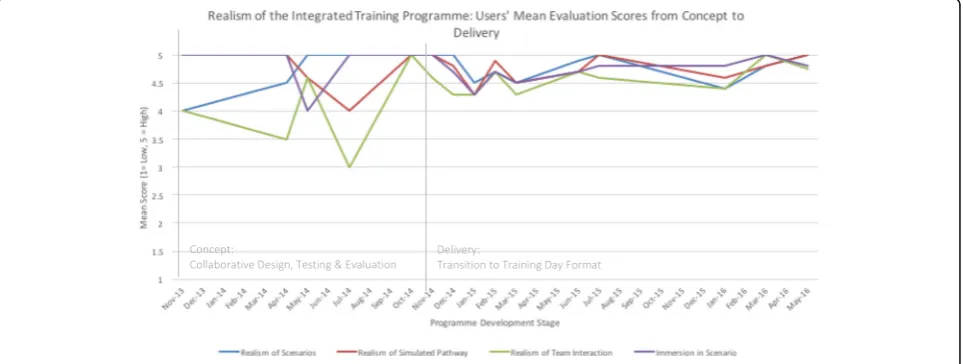
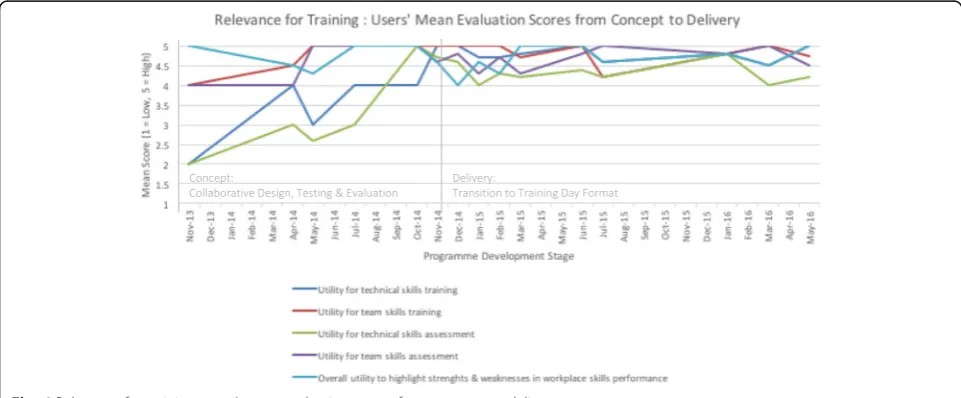
The users’ mean evaluation scores for realism of the simulation training framework, realism of the simulation training facility and relevance for training are presented in Figs. 4, 5 and 6. Given that refinements were made it-eratively based on initial test cases (n= 8) and user feed-back over time, mean scores are presented alongside feedback throughout the development stages from con-cept to delivery (Nov 2013–May 2016), including imple-mentation stages of the training programme (n = 62, who had enrolled and participated in the programme) for comparative purposes.
Although mean score ratings ranged between average and high for realism of the simulation training frame-work, realism of the training facility and relevance for training, the lower and fluctuating mean scores were given during the initial testing and refinement phases through to the implementation phase, with incremen-tally higher ratings after implementation. In terms of components, the scenarios, team interaction and realism of the pathway demonstrated scope for improvements,
although this did not appear to detract from overall immersion. Similarly, the realism of the training facility was scored average to high for realism of the simulated environment and equipment, with markedly lower rat-ings for the simulated procedure and comparisons to the actual cath-lab. In the initial testing phase, the lower rat-ings about the realism of the procedure were reinforced in terms of overall perceived utility of the framework for training and assessment of technical skills, while ratings for training and assessment of team skills were higher. However, participants felt that the overall format had good potential to highlight their strengths and weak-nesses in workplace skills performance.
Qualitative feedback about the integrated simulation framework and components
The qualitative user feedback data was coded according to a pre-determined, a priori thematic framework, de-rived from the research aims and structured interview schedule, whereby feedback was classified according to themes [37]. Alignment of the coding with the themes was independently checked by a second researcher expe-rienced in qualitative research methods, with perfect agreement of 100%.
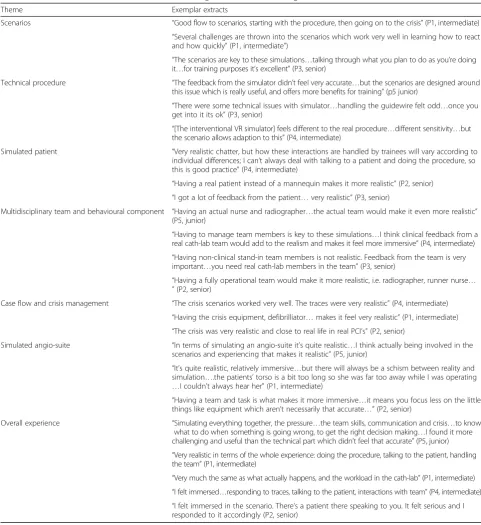
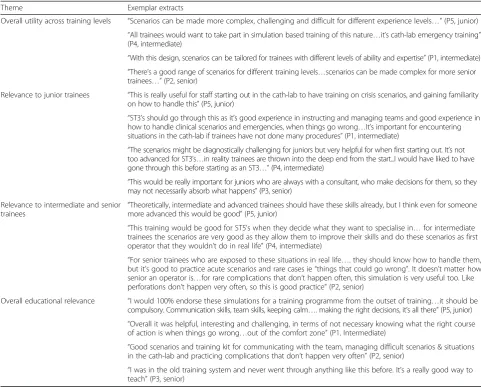
The qualitative feedback served to augment the quanti-tative evaluation, providing further clarity as to the realism and relevance of the training framework and facility. Ex-emplar extracts are presented by theme in Tables 2 and 3.
Realism of the simulation training framework, components and facility
From the outset, users expressed that they had felt very immersed in the simulations owing to the scenarios themselves, which they felt were well designed in terms of case flow and clinical realism through the manipula-tion of haemodynamic traces. Overall, feedback for the
holistic and integrated design of the simulations was very positive—trainees felt that ‘everything was happen-ing together’as in the actual clinical environment. How-ever, senior trainees recognised that the interventional simulator and technical components, e.g. haptics and feedback did not feel realistic, but they felt engaged enough in the simulations as there were multiple layers of activity such as the ‘chatting’ patient and dynamic haemodynamic changes. Junior trainees, however, felt more engaged in the technical procedure and indicated that it felt realistic. Senior trainees felt that the con-straints posed by the technical procedure may not ne-cessarily detract from the simulation experience as scenarios and team-based elements had been designed around this issue. They reflected that, with the limita-tions of the interventional simulator in mind, the focus of the simulations should be less on procedural
components and more on team-based elements, particu-larly crisis, emergency training and ‘what to do when something goes wrong’.
Trainees stated that the simulated patient was extremely realistic, akin to the real clinical context in which patients are typically conscious during proce-dures. They felt that inclusion of a‘live’ patient was key to executing the simulations as opposed to a mannequin; they indicated that at times they felt distracted from the technical parts of the procedure by the patient’s‘chatter’ as in real clinical cases, whilst others noted that the pa-tient provided cues as to her/his clinical status and well-being, which is a vital issue in real case handling and de-cision making. However, although inclusion of the ‘live’ patient received highly positive feedback, trainees indi-cated that the overall set up was not realistic, as the patient’s torso was extremely long due to the original
Fig. 5Realism of the simulated training facility: users’mean evaluation scores from concept to delivery
design of the table and placement of the simulator, which did not resemble a real patient. Furthermore, in supporting the team-based relevance of the simulations, trainees felt that having real cath-lab team members within the scenarios would enhance the training experi-ence considerably as they would provide realistic clinical feedback, as opposed to having ‘stand-in’ plants un-versed in the correct clinical parlance.
Relevance of the integrated simulation framework for training purposes
Users felt that the simulation framework was excellent for training purposes, and particularly relevant to crisis and emergency training through the introduction of dif-ficulties and challenges. They felt that the design itself was overall highly innovative and could be tailored and applied to the skills sets and experience levels of trainees.
Table 2Qualitative user feedback for realism of the integrated simulation training framework
Theme Exemplar extracts
Scenarios “Good flow to scenarios, starting with the procedure, then going on to the crisis”(P1, intermediate) “Several challenges are thrown into the scenarios which work very well in learning how to react and how quickly”(P1, intermediate”)
“The scenarios are key to these simulations…talking through what you plan to do as you’re doing it…for training purposes it’s excellent”(P3, senior)
Technical procedure “The feedback from the simulator didn’t feel very accurate…but the scenarios are designed around this issue which is really useful, and offers more benefits for training”(p5 junior)
“There were some technical issues with simulator…handling the guidewire felt odd…once you get into it its ok”(P3, senior)
“[The interventional VR simulator] feels different to the real procedure…different sensitivity…but the scenario allows adaption to this”(P4, intermediate)
Simulated patient “Very realistic chatter, but how these interactions are handled by trainees will vary according to individual differences; I can’t always deal with talking to a patient and doing the procedure, so this is good practice”(P4, intermediate)
“Having a real patient instead of a mannequin makes it more realistic”(P2, senior) “I got a lot of feedback from the patient…very realistic”(P3, senior)
Multidisciplinary team and behavioural component “Having an actual nurse and radiographer…the actual team would make it even more realistic” (P5, junior)
“Having to manage team members is key to these simulations…I think clinical feedback from a real cath-lab team would add to the realism and makes it feel more immersive”(P4, intermediate) “Having non-clinical stand-in team members is not realistic. Feedback from the team is very important…you need real cath-lab members in the team”(P3, senior)
“Having a fully operational team would make it more realistic, i.e. radiographer, runner nurse… ”(P2, senior)
Case flow and crisis management “The crisis scenarios worked very well. The traces were very realistic”(P4, intermediate) “Having the crisis equipment, defibrilliator…makes it feel very realistic”(P1, intermediate) “The crisis was very realistic and close to real life in real PCI’s”(P2, senior)
Simulated angio-suite “In terms of simulating an angio-suite it’s quite realistic…I think actually being involved in the scenarios and experiencing that makes it realistic”(P5, junior)
“It’s quite realistic, relatively immersive…but there will always be a schism between reality and simulation….the patients’torso is a bit too long so she was far too away while I was operating …I couldn’t always hear her”(P1, intermediate)
“Having a team and task is what makes it more immersive…it means you focus less on the little things like equipment which aren’t necessarily that accurate…”(P2, senior)
Overall experience “Simulating everything together, the pressure…the team skills, communication and crisis…to know what to do when something is going wrong, to get the right decision making…I found it more challenging and useful than the technical part which didn’t feel that accurate”(P5, junior) “Very realistic in terms of the whole experience: doing the procedure, talking to the patient, handling the team”(P1, intermediate)
In doing so, trainees provided recommendations for add-itional scenario components and clinical cases worthy of inclusion in the training programme. Therefore, overall, junior, intermediate and senior trainees recognised the utility and relevance of the training framework for them-selves and their peers, with senior trainees reflecting that they would have certainly benefitted from such a training experience earlier on in their training.
Refining the integrated simulation framework and training facility
The user-based evaluation informed the next stages of programme development, to refine key components of the simulation framework and physical set up, as well as the development of 10 additional scenarios for inclusion in the implementation phase of the programme (n= 62).
Refinements to team-based elements
Based on user feedback, cath-lab nurses and radiographers were recruited for the simulation test cases to enhance
realism in terms of clinical dialogue and feedback during scenarios. The team-based interface was also extended to incorporate ALS resuscitation teams and anaesthetists at critical stages of the crisis scenarios [38].
Refinements to the embedded patient, simulator and mannequin torso set up
User feedback from the early test cases indicated that the patient set up did not reflect an actual human shape, with some distance between the patient’s head and the operating position. This issue was due primarily to the overall design and length of theMentice VIST®simulator, the placement of which meant that the sheath entry point was some distance away from the patient. There-fore, the more slimline and compact Mentice VIST-C® simulator was procured and integrated with the DS angio-suite. In order to develop the crisis-components of scenarios as recommended by the user feedback, a mannequin torso was also integrated within the DS angio-suite to allow CPR during training. The DS
Table 3Qualitative user feedback for educational relevance of the training programme
Theme Exemplar extracts
Overall utility across training levels “Scenarios can be made more complex, challenging and difficult for different experience levels…”(P5, junior) “All trainees would want to take part in simulation based training of this nature…it’s cath-lab emergency training” (P4, intermediate)
“With this design, scenarios can be tailored for trainees with different levels of ability and expertise”(P1, intermediate) “There’s a good range of scenarios for different training levels…scenarios can be made complex for more senior trainees…”(P2, senior)
Relevance to junior trainees “This is really useful for staff starting out in the cath-lab to have training on crisis scenarios, and gaining familiarity on how to handle this”(P5, junior)
“ST3’s should go through this as it’s good experience in instructing and managing teams and good experience in how to handle clinical scenarios and emergencies, when things go wrong…It’s important for encountering situations in the cath-lab if trainees have not done many procedures”(P1, intermediate)
“The scenarios might be diagnostically challenging for juniors but very helpful for when first starting out. It’s not too advanced for ST3’s…in reality trainees are thrown into the deep end from the start...I would have liked to have gone through this before starting as an ST3…”(P4, intermediate)
“This would be really important for juniors who are always with a consultant, who make decisions for them, so they may not necessarily absorb what happens”(P3, senior)
Relevance to intermediate and senior
trainees “
Theoretically, intermediate and advanced trainees should have these skills already, but I think even for someone more advanced this would be good”(P5, junior)
“This training would be good for ST5’s when they decide what they want to specialise in…for intermediate trainees the scenarios are very good as they allow them to improve their skills and do these scenarios as first operator that they wouldn’t do in real life”(P4, intermediate)
“For senior trainees who are exposed to these situations in real life…. they should know how to handle them, but it’s good to practice acute scenarios and rare cases ie“things that could go wrong”. It doesn’t matter how senior an operator is…for rare complications that don’t happen often, this simulation is very useful too. Like perforations don’t happen very often, so this is good practice”(P2, senior)
Overall educational relevance “I would 100% endorse these simulations for a training programme from the outset of training…it should be compulsory. Communication skills, team skills, keeping calm…. making the right decisions, it’s all there”(P5, junior) “Overall it was helpful, interesting and challenging, in terms of not necessary knowing what the right course of action is when things go wrong…out of the comfort zone”(P1, Intermediate)
“Good scenarios and training kit for communicating with the team, managing difficult scenarios & situations in the cath-lab and practicing complications that don’t happen very often”(P2, senior)
mannequin legs were replaced to provide more realistic palpation for trainees). When fully draped, these refine-ments enhanced the realism of the human-like body with embedded patient and integrated simulator, with improvements to the sheath entry point and operating position. As the test cases progressed, further in-novations were introduced including realistic skin and puncture site in order to allow trainees to check the puncture site during complications in complex cases such as retroperitoneal bleeding.
The physical simulation model was refined iteratively as further innovations were introduced. For example, the DS approach allowed anaesthetic team-based compo-nents to be tested, and subsequently the upper body of the SimMan 3G® was incorporated into the physical set up, adding realistic breathing, as well as an advanced air-way head for anaesthetic training purposes if required.
Phase 4: transition to training day format and implementation of simulation-training framework
After the test cases, due to geographical convenience and space availability, the implementation of the training programme involved a transition period from Hammer-smith Hospital to the Surgical Innovation Centre, St Mary’s Hospital, involving use of the ORcamp (Orzone AB, Gothenburg, Sweden) facility. This relocation allowed space provision for the training day format, in-cluding a separate debrief room where trainees and con-sultant assessors could view simulations and provide subsequent feedback and assessment. The move required each portable component of the pre-tested DS model to be transferred to the ORcamp simulation training facility (Table 4). In addition, the DS control desk was upscaled into a‘control hub’in order to successfully cater for the expanding requirements of the training day format. It is important to emphasise that the simulation setup and scenarios are not restricted to any particular location, having been subsequently used in other settings such as conference venues.
The Imperial Cardiovascular Simulation Training Programme (iCAST) was launched in November 2014. Twelve training days have been successfully delivered between November 2014 and May 2016, with 70 trainees to date (8 reported test cases; 62 trainees have enrolled and have participated in the training programme).
Training day format
Each training day involves 6–8 trainees. Scenarios are pre-allocated to trainees according to their skills level. Trainees undergo simulation scenarios followed by a structured debrief lead by consultant assessors, where trainees reflect on their technical performance and their interactions with the cath-lab team and simu-lated patient.
Integrated performance and skills assessment
Within the training format, procedural skills are assessed in conjunction with team-based skills (communication, leadership, team-working and decision-making) and cri-sis management skills. All assessment tools used have been validated in previous studies [13, 34, 39].
Discussion
In this paper we have described the effective use of the in-novative Distributed Simulation concept to: (a) recreate the coronary context for simulation purposes and (b) as a collaborative engagement tool through clinician-based user feedback to develop, test, model, refine and imple-ment an integrated, fully immersive simulation-based training programme for frontline healthcare staff. The programme aims to enhance existing training by providing an integrative approach to the practice and assessment of clinical procedural skills, team-based skills and crisis man-agement. The resulting simulation programme has re-ceived positive feedback in its pilot phase [40] and has been deemed applicable to various levels of skill develop-ment and training, as well as practitioner experience from basic to advanced levels.
with users for successful collaborative design and outputs is the consistent inclusion of structured mixed-methods evaluation techniques from the outset, including qualita-tive interviews to contextualise and augment quantitaqualita-tive survey findings, which may not fully capture the true meaning and depth of responses, particularly about inte-grative designs. For example, although the scenarios ini-tially received low mean ratings, the interviews revealed them in a positive manner. Therefore, they remained unchanged and were subsequently successfully used.
Through close collaboration and engagement with the clinical community we have been able to understand and assimilate complex knowledge structures in order to identify learning needs. Although technological solutions are often considered to be the key drivers advancing simulation, our user-based evaluation feedback suggests that the interventional VR simulator may not always feel realistic amongst senior practitioners, yet this did not detract from the immersive scenarios or the broader context of ‘everything happening together’as in the ac-tual cath- lab environment. In reality, clinicians work in complex environments and need to integrate several skills sets. The novel simulation-training framework derived by this research was designed to provide this hol-istic approach to simulation training and skills assessment, drawing together the multiple strands of technology, team-based interactions, patient perspective and patient interaction. Thus, whilst technical simulation solutions are vital to keeping pace with rapid advancements in
cardiovascular procedures, our user evaluation evidence suggests that there is a need and scope for technical simu-lators to be contextualised through innovative approaches such as DS. By aligning technology, simulator develop-ment and behavioural interaction with educational design, the simulation learning experience can effectively cater for complex learning needs. Our incorporation of a real per-son as a simulated patient alongside an interventional VR simulator is very innovative—interacting and conversing with a‘real’patient whilst performing a complex technical procedure can trigger a range of responses from trainees that are vital for training [3], with multiple implications for skills assessment and designing interventions for ef-fective communication. A further learning need that the simulation framework serves is that of effective communi-cation and teamwork, particularly in multidisciplinary team contexts, where our work has identified gaps in current training provision for anaesthetists who have re-ported negative experiences in the cath-lab, often due to issues related to teamwork and communication [38].
With regards to future implementation and relevance for education and training, applications of the integrated simulation-training framework are wide-ranging: to date, it has been successfully applied to the skills sets of individ-ual cardiologist practitioners with passive teams (e.g. indi-vidual skill development decision making) and entire consultant cardiologist-led MDT teams (e.g. team skill development and decision making). In terms of cross-speciality application, we propose that the robust
simulation training framework can be successfully tailored and applied to other vascular specialities through collaborative-engagement and design, e.g. endovascular, neurovascular and interventional radiology.
Conclusions
Although technical skills training for procedures and technological solutions are often considered to be key to advancing simulation for cardiovascular training, our novel and innovative exemplar shows that for the users themselves, immersion in realistic team environments that reflect their actual clinical settings—including technical skills performance—is deemed most relevant for training. Through the application of innovative Distributed Simula-tion techniques, collaborative user-based design, and consistent evaluation techniques from conceptual, devel-opment, delivery and implementation stages, we have shown that fully immersive simulation techniques for car-diovascular specialities is achievable and has the potential to be implemented across vascular specialities.
Acknowledgements
The authors would like to acknowledge all participants and faculty members including Norma Jones, cath-lab teams and consultants in cardiology and anaesthesia at Imperial College Healthcare NHS Trust. Thank you also to the Studiohead design team, Matthew Harrison and Cian Plumbe, for the initial angio-suite and Sharon Marie Weldon, Imperial College Centre for Engagement and Simulation Science, for her input in the qualitative data component. Special thanks are owed to Lord Ara Darzi and Tony Tarragona-Fiol for the use of facilities at the Surgical Innovation Centre, Imperial College London; Ken Spearpoint, Gillian Treanor and Team for the use of facilities at Hammersmith Hospital, ICHNT; and Dr Ruth Brown, Associate Medical Director of Education, ICHNT and Dr Sadie Syed, Postgraduate Simulation Lead, ICHNT for their continued support for the project.
Funding
This work was supported in part by the London Deanery Simulation and Technology-enhanced Learning Initiative (STeLI); Imperial College Healthcare NHS Trust Medical Education Directorate; and St Mary’s Coronary Flow Trust.
Availability of Data and Materials
The data sets for this study are available from the corresponding author on reasonable request.
Authors’contributions
The conception, design, co-ordination of the study, analysis of data and writing and preparation of the manuscript was led by TK. RK, FB and IM were involved in the overall conception of the study. KC and MG participated in the technical simulation design and implementation of the study. EA led the design of clinical scenarios and relevance to clinical curricula. EA, MY and CC participated in the testing and implementation of the study. All authors read and approved the final manuscript.
Ethics approval and consent to participate
This study was deemed as exempt by the Imperial College Research Ethics Committee. All participants provided verbal consent.
Consent for publication Not applicable.
Competing interests
The authors declare that they have no competing interests.
Publisher’s Note
Springer Nature remains neutral with regard to jurisdictional claims in published maps and institutional affiliations.
Author details
1Imperial Centre for Engagement and Simulation Science, Imperial College
London, 3rd Flr Chelsea and Westminster Hospital (Academic Surgery), 369 Fulham Road, London SW10 9NH, UK.2Barts and The London NHS Trust, London, UK.3Imperial College Healthcare NHS Trust, London, UK.
Received: 12 January 2017 Accepted: 11 September 2017
References
1. Kneebone R, Arora S, King D, et al. Distributed simulation—accessible immersive training. Med Teach. 2010;32:65–70.
2. Kneebone RL, Kidd J, Nestel D, et al. Blurring the boundaries: scenario-based simulation in a clinical setting. Med Educ. 2005;39:580–7.
3. Kneebone R, Nestel D, Wetzel C, et al. The human face of simulation: patient-focused simulation training. Acad Med. 2006;81:919–24.
4. Kneebone R, Kidd J, Nestel D, Asvall S, Paraskeva P, Darzi A. An innovative model for teaching and learning clinical procedures. Med Educ. 2002;36:628–34. 5. Brewin J, Tang J, Dasgupta P, et al. Full immersion simulation: validation of
a distributed simulation environment for technical and non-technical skills training in Urology. BJU Int. 2015;116:156–62.
6. Brunckhorst O, Shahid S, Aydin A, et al. Simulation-based ureteroscopy skills training curriculum with integration of technical and non-technical skills: a randomised controlled trial. Surg Endosc. 2015;29:2728–35.
7. Kassab E, Kyaw Tun J, Kneebone RL. A novel approach to contextualized surgical simulation training. Simul Healthc. 2012;7:155–61.
8. Brunckhorst O, Shahid S, Aydin A, et al. The relationship between technical and nontechnical skills within a simulation-based ureteroscopy training environment. J Surg Educ. 2015;72:1039–44.
9. Tang J, Maroothynaden J, Kneebone RK, Bello F. The use of innovations in medical education: a workshop to maximise effectiveness. Med Teach. 2012; 34:998–9.
10. Kneebone R, Weldon S, Bello F. Engaging patients and clinicians through simulation: rebalancing the dynamics of care. Adv Simul. 2016;1:19. 11. Huddy JR, Weldon SM, Ralhan S, et al. Sequential simulation (SqS) of clinical
pathways: a tool for public and patient engagement in point-of-care diagnostics. BMJ Open. 2016;6:e011043.
12. Weldon S, Kneebone R, Bello F. Collaborative healthcare remodelling through Sequential Simulation (SqS): a patient and front-line staff perspective. BMJ Simul Technol Enhanc Learn. 2016;2:78–86.
13. Van Herzeele I, Aggarwal R, Choong A, Brightwell R, Vermassen FE, Cheshire NJ. Virtual reality simulation objectively differentiates level of carotid stent experience in experienced interventionalists. J Vasc Surg. 2007;46:855–63. 14. Aggarwal R, Tully A, Grantcharov T, et al. Virtual reality simulation training can improve technical skills during laparoscopic salpingectomy for ectopic pregnancy. BJOG. 2006;113:1382–7.
15. Van Herzeele I, O'Donoghue KG, Aggarwal R, Vermassen F, Darzi A, Cheshire NJ. Visuospatial and psychomotor aptitude predicts endovascular performance of inexperienced individuals on a virtual reality simulator. J Vasc Surg. 2010;51:1035–42.
16. Willaert WI, Aggarwal R, Daruwalla F, et al. Simulated procedure rehearsal is more effective than a preoperative generic warm-up for endovascular procedures. Ann Surg. 2012;255:1184–9.
17. Van Herzeele I, Aggarwal R, Neequaye S, et al. Experienced endovascular interventionalists objectively improve their skills by attending carotid artery stent training courses. Eur J Vasc Endovasc Surg. 2008;35:541–50. 18. Van Herzeele I, Aggarwal R, Malik I, et al. Validation of video-based skill
assessment in carotid artery stenting. Eur J Vasc Endovasc Surg. 2009;38:1–9. 19. Van Herzeele I, Aggarwal R, Malik I. Use of simulators in vascular training.
Heart. 2009;95:613–4.
20. Aggarwal R, Balasundaram I, Darzi A. Training opportunities and the role of virtual reality simulation in acquisition of basic laparoscopic skills. J Surg Res. 2008;145:80–6.
22. Voelker W, Maier S, Lengenfelder B, et al. Improved quality of coronary diagnostics and interventions by virtual reality simulation. Herz. 2011;36:430–5. 23. Kendrick DE, Gosling AF, Nagavalli A, Kashyap VS, Wang JC. Endovascular
simulation leads to efficiency and competence in thoracic endovascular aortic repair procedures. J Surg Educ. 2015;72:1158–64.
24. Wiggins GP. Assessing student performance : exploring the purpose and limits of testing. San Francisco: Jossey-Bass. p.xix, 316; 1999.
25. Lingard L, Espin S, Whyte S, et al. Communication failures in the operating room: an observational classification of recurrent types and effects. Qual Saf Health Care. 2004;13:330–4.
26. Kassab E, Tun JK, Arora S, et al.“Blowing up the barriers”in surgical training: exploring and validating the concept of distributed simulation. Ann Surg. 2011;254:1059–65.
27. Rudarakanchana N, Van Herzeele I, Desender L, Cheshire NJ. Virtual reality simulation for the optimization of endovascular procedures: current perspectives. Vasc Health Risk Manag. 2015;11:195–202.
28. Fox KF. Simulation-based learning in cardiovascular medicine: benefits for the trainee, the trained and the patient. Heart. 2012;98:527–8.
29. British Cardiovascular Society. Working Group Report on Simulation Based Learning. 2011.
30. van Merriënboer JJG, Clark RE, de Croock MBM. Blueprints for complex learning: The 4C/ID-model. Educ Technol Res Dev. 2002;50:39–61. 31. Vandewaetere M, Manhaeve D, Aertgeerts B, Clarebout G, Van Merrienboer
JJ, Roex A. 4C/ID in medical education: How to design an educational program based on whole-task learning: AMEE Guide No. 93. Med Teach. 2015;37:4–20.
32. Joint Royal Colleges of Physicians Training Board. Speciality Training Curriculum for Cardiology. 2010. https://www.jrcptb.org.uk/sites/default/files/ 2010%20Cardiology%20Curriculum%20%28amendments%202016%29.pdf. 33. Kneebone R. Simulation, safety and surgery. Qual Saf Health Care. 2010;
19(Suppl 3):i47–52.
34. Sevdalis N, Davis R, Koutantji M, Undre S, Darzi A, Vincent CA. Reliability of a revised NOTECHS scale for use in surgical teams. Am J Surg. 2008;196:184–90. 35. Kneebone RL, Nestel D, Moorthy K, et al. Learning the skills of flexible
sigmoidoscopy - the wider perspective. Med Educ. 2003;37(Suppl 1):50–8. 36. Black SA, Nestel DF, Kneebone RL, Wolfe JH. Assessment of surgical
competence at carotid endarterectomy under local anaesthesia in a simulated operating theatre. Br J Surg. 2010;97:511–6.
37. Pope C, Ziebland S, Mays N. Qualitative research in health care. Analysing qualitative data. BMJ. 2000;320:114–6.
38. Ward P, Arora M, Kelay T, et al. The cardiac catheterisation laboratory: anaesthetic trainees’experiences. R Coll Aneasthetists Bull. 2016(19):50–52. https://www.rcoa.ac.uk/system/files/Bulletin99_1.pdf.
39. Walker S, Brett S, McKay A, Lambden S, Vincent C, Sevdalis N. Observational Skill-based Clinical Assessment tool for Resuscitation (OSCAR): development and validation. Resuscitation. 2011;82:835–44.
40. Costopoulos C, Kelay T, Ako E, et al. Novel-simulation-based training in cardiology: trainee feedback and evaluation of a pilot study. Cardiology. 2015;131:70.
• We accept pre-submission inquiries
• Our selector tool helps you to find the most relevant journal
• We provide round the clock customer support
• Convenient online submission
• Thorough peer review
• Inclusion in PubMed and all major indexing services
• Maximum visibility for your research
Submit your manuscript at www.biomedcentral.com/submit