R E S E A R C H
Open Access
Invariance and optimality in the regulation
of an enzyme
Ed Reznik
1, Stefan Yohe
1and Daniel Segrè
1,2*Abstract
Background:The Michaelis-Menten equation, proposed a century ago, describes the kinetics of enzyme-catalyzed biochemical reactions. Since then, this equation has been used in countless, increasingly complex models of cellular metabolism, often including time-dependent enzyme levels. However, even for a single reaction, there remains a fundamental disconnect between our understanding of the reaction kinetics, and the regulation of that reaction through changes in the abundance of active enzyme.
Results:We revisit the Michaelis-Menten equation under the assumption of a time-dependent enzyme concentration. We show that all temporal enzyme profiles with the same average enzyme level yield identical substrate degradation–a simple analytical conclusion that can be thought of as an invariance principle, and which we validate experimentally using aβ-galactosidase assay. The ensemble of all time-dependent enzyme trajectories with the same average concentration constitutes a space of functions. We develop a simple model of biological fitness which assigns a cost to each of these trajectories (in the form of a function of functions,i.e. a functional). We then show how one can use variational calculus to analytically infer temporal enzyme profiles that minimize the overall enzyme cost. In particular, by separately treating the static costs of amino acid sequestration and the dynamic costs of protein production, we identify a fundamental cellular tradeoff.
Conclusions:The overall metabolic outcome of a reaction described by Michaelis-Menten kinetics is ultimately determined by the average concentration of the enzyme during a given time interval. This invariance in analogy to path-independent phenomena in physics, suggests a new way in which variational calculus can be employed to address biological questions. Together, our results point to possible avenues for a unified approach to studying metabolism and its regulation.
Reviewers:This article was reviewed by Sergei Maslov, William Hlavacek and Daniel Kahn.
Background
Cells regulate enzyme levels and activities to address specific metabolic demands. Despite the availability of large metabolic and transcriptional data sets, under-standing the logic and dynamics of metabolic regulation remains a fundamental ongoing challenge [1,2,3]. This is partly due to the fact that metabolic regulation depends on the complex interplay between transcription, transla-tion, post-translational modifications, and feedback from metabolism itself [3,4]. While significant strides in this field are increasingly being made at the level of
genome-scale models of metabolic and regulatory networks [5,6], one may wonder whether new insight can still be found in the study of individual biochemical reactions. To this end, we investigate how the rate of a biochemical reac-tion is affected by the control and modificareac-tion of its crucial component, the catalyzing enzyme. We do so by re-examining the classical Michaelis-Menten (MM) en-zyme catalysis mechanism in conditions where the total enzyme concentration changes over time.
While enzyme levels can change dramatically through-out the lifetime of a cell, most mathematical models of metabolism in which MM equations are used assume constant enzyme levels. This assumption is often justi-fied by the fact that enzyme levels change much slower than the typical relaxation times of metabolic network dynamics. Importantly, a number of authors have * Correspondence:[email protected]
1Department of Biomedical Engineering, Boston University, 44 Cummington
Mall, Boston, MA 02215, USA
2Bioinformatics Program and Department of Biology, Boston University, 44
Cummington Mall, Boston, MA 02215, USA
addressed the question of how the MM equation would be modified, under different assumptions of a time-dependent enzyme concentration (for example, the deg-radation of enzyme) [7-15]. In addition, models simul-taneously accounting for enzyme kinetics, enzyme protein synthesis/degradation and genetic regulation have been constructed for a number of specific biochem-ical networks (for example, see [16-19]). However, a deep understanding of the complex interplay between these levels of biological organization still represents a fundamental challenge.
In this work we show how certain properties of a bio-chemical reaction with time-dependent enzyme concen-tration can be summarized and explored through a very simple analytical re-elaboration of the classical MM equation. In particular, we show that the apparent diver-sity of behaviors ensuing from different enzyme trajec-tories can be reduced to the extreme simplicity of an invariance principle. This principle analytically relates the amount of substrate consumed in a given period of time to the average enzyme level during that interval, ir-respective of the specific enzyme level trajectory. We analytically illustrate how this simple dependence may be extended to more complex single-enzyme reactions, and experimentally verify the invariance to average en-zyme levels using a β-galactosidase assay. In the final section, using variational calculus, we apply this invari-ance principle to ask whether specific enzyme trajector-ies may be optimally advantageous to the cell under different assumptions on the relative costs associated with producing large amounts of enzyme slowly, versus producing modest amounts of enzyme quickly. Using classical concepts from optimal control theory and vari-ational calculus, we show how such questions may be answered analytically.
Results
Michaelis-Menten kinetics depends on average enzyme levels
Consider an enzymatically-catalyzed biochemical reac-tion, in which a substrate S is degraded to a product Pthrough the action of an enzymeE:
EUþS →
k1
←k1
Ck2→
PþEU ð1Þ
When the total concentration of enzyme E = EU + C
(the sum of unbound enzyme EU and enzyme-substrate
complex C) remains low throughout the course of the reaction (i.e. E << KM + S, where KM = (k−1+k2)/k1),
Michaelis-Menten (MM) kinetics can be used to model the reaction (i.e. by applying the quasi-steady-state as-sumption, see [20]). We further assume that E changes at a characteristic rate that is much slower than the
rapid equilibration ofC, but we do not assume that it is constant. Instead, as is often done in modeling of hybrid metabolic-genetic circuits [21,22], we explicitly treat the concentration of enzyme as a function of time, E(t). Then, the resulting dynamics of S can be described by the modified MM equation:
dS
dt¼
k2E tð ÞS
KMþS ð
2Þ
with initial conditions E(t0) = E0, S(t0) = S0. The main
question we ask is: how does substrate dynamics depend on the details of E(t)? To answer this question, we re-arrange Equation (2), so as to isolateS(t) andE(t) on op-posite sides of the equation:
KMþS k2S
dS¼−E tð Þdt ð3Þ
This equation can be easily integrated between t=t0
andt=tf, giving rise to
− 1
k2Δt KMln
Sf S0þ
Sf−S0
¼E ð4Þ
where Sf =S(tf),Δt= tf– t0, and E¼Δ1t∫
tf
toE tð Þdt. The
right hand side of this equation ð ÞE represents the aver-age amount of enzyme in the system during the time interval Δt, and the left hand side is a monotonic func-tion of the boundary condifunc-tions forS.
Eq. (4) states thatgiven an initial amount of substrate, the amount of substrate consumed during a given time interval Δt depends only on the average enzyme level during that interval, and not on the specific, time-dependent enzyme trajectory. Any two time-course profiles of E en-countering the same initial substrate concentration S0
and exhibiting identical average amounts of enzyme E will degrade precisely the same amount of substrate in a given time interval. The temporal dynamics of the en-zyme does not play any role in the final concentration of substrate: the metabolic process is solely a function of the average enzyme level.
average enzyme level entirely determines the final con-centration of the substrates given their initial concentra-tion. These two results highlight the key feature which renders MM kinetics (and a broad category of other bio-chemical rate laws) invariant to time-dependent enzyme profiles with the same average enzyme concentration: the separability of the rate law into terms corresponding exclu-sively to enzyme and substrate. In other words, it must be possible for the rate law to be written as dS/dt =E ∙f(S). While it is unlikely that this dependency on average enzyme levels will directly generalize to larger networks of metabolic reactions (where such separability is in general no longer possible), the notion of finding and exploiting conserved dynamical quantities in such systems may be a prominent route for future work.
As far as we can tell, the invariance of MM kinetics to the time-dependent details of enzyme trajectories with identical average concentrations seems not to have been explored in the enzyme kinetics and computational biol-ogy literature, despite its simplicity. In the next section, we describe an experiment aimed at verifying the validity of this analytically derived result. Then, we illustrate how this invariance principle may be used to probe the nature of metabolic regulation.
Experimental validation
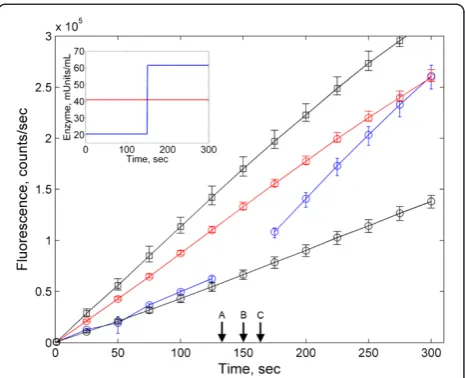
We sought to directly obtain direct experimental con-firmation of the validity of our analytical predictions. Towards this goal, we implemented a simple set of assays based on the enzyme β-galactosidase and its synthetic fluorescent substrate 4-methylumbelliferyl β-D-galactopyranoside (MUG). The product of the hydrolysis of MUG by β-galactosidase is fluorescent at 460nm when excited at 360 nm. In one experi-ment, MUG was exposed to a constant amount of 0.125 U of β-galactosidase for 5 minutes. In a second experi-ment, the time-profile ofβ-galactosidase was designed to be a step function, with a concentration of 0.0625U for the first 2.5 minutes, and a concentration of 0.1875 units for an additional 2.5 minutes. Thus, the two assays contained precisely the same average enzyme concentra-tion, but starkly different temporal enzyme profiles. The results of the experiment are shown in Figure 1. As pre-dicted, the concentration of the product (measured by fluorescence) is identical for the two experimental con-ditions at 5 minutes, i.e. precisely at the moment when their average enzyme levels match.
Enzyme dynamics as a variational problem
The invariance principle demonstrated above for meta-bolic reactions indicates that there are infinitely many ways for the cell to modulate enzyme levels to bring substrate from a particular initial concentration to a par-ticular final concentration in a given time interval. The
sole common characteristic among these distinct en-zyme time courses is the average enen-zyme level. The next question we ask is whether, given this degeneracy among enzyme time courses, we may expect the cell to use a specific enzyme profile in time. In many cases, cellular regulation of enzyme levels may have evolved so as to perform metabolic tasks with minimal energetic effort, e.g.minimal cost of enzyme production and degradation. Hence, we reason that by using appropriate optimization criteria it may be possible to search, among the degener-ate enzyme trajectories, for the one that minimizes a given cost function.
What do we expect this cost function to look like? First, notice that we want to pose this question over a time interval (i.e. the time window (t0, tf) ). The total
costCTto be minimized will therefore be the integral of
an instantaneous cost c(t). This instantaneous cost c(t) should depend on the shape of the functionE(t). An in-stantaneous cost with pure linear dependence on E would lead to a total costCTidentical for all trajectories,
due to the invariance to average enzyme levels. However, previous work [25] has highlighted the nonlinear nature of individual enzyme cost. This nonlinearity follows from
assuming that fitness is a saturating function of common cellular resources, and that these resources are seques-tered in proportion to the enzyme concentration. Fur-thermore, the possible enzyme trajectories may differ significantly in the extent of enzyme production and degradation, which are typically both costly. For ex-ample, an average of four high energy phosphate bonds are necessary to add an amino acid to an enzyme being translated [26,27]. Additional energy resources would then need to be devoted to proteases involved in the degradation process [28]. In what follows we will explore how different assumptions on the cost of enzyme pro-duction and degradation lead to different optimal enzyme profiles.
Based on the above considerations, we model the cost of an enzyme trajectory by extending the model pro-posed in [25]. Specifically, we take into account two dis-tinct components which we call the “static” and “dynamic” cost. The static cost is due to the presence of a given amount Eof total enzyme, which causes the se-questration of enzyme building blocks (resourceRS, e.g.
amino acids), leading to a nonlinear dependence on E (see Materials and Methods). The dynamic cost takes into account the fact that faster transcription-translation (i.e. larger E_) implies increased use of other resources RD (such as ribosomes). We assume that the dynamic
cost is symmetric in its dependence on production and degradation, and hence a function of E_2. Furthermore, when the cell is not dedicating any dynamic resources to the maintenance of protein levels, the dynamic cost reaches a minimum. At this minimum, protein levels are only subject to the effects of cellular dilution, which oc-curs at a rate μ. Thus, the dynamic cost should attain a minimum precisely at E_ ¼−μ, and the dynamic cost should take the form E_ þμ2. Upon writing an explicit cost function that combines the static and dynamic com-ponents, and performing a Taylor expansion (see Mate-rials and Methods for further details), we obtain an effective instantaneous cost.
c tð Þ ¼α1E tð Þ þα2E2ð Þt
z}|{Static Cost
þα3 E t_ð Þ þμ
2
z}|{Dynamic Cost
ð5Þ
where theαparameters are strictly positive and quantify the relative importance of the static cost to the dynamic cost. Thus, the cost function diverges for very large en-zyme levels and production/degradation rates, and achieves a minimum at zero enzyme level and a degrad-ation rate E_ ¼−μ. While this cost function constitutes an approximation of the full expression, it has the ad-vantage of being analytically tractable (see below), and of capturing the essential nonlinearities inE and E_. In the Additional file, we provide details on how to solve the
variational problem for a different type of cost function which is asymmetric with respect to E ._ Importantly, the fitness of an enzyme trajectory would in principle also depend on thebenefitderived from metabolizing a given amount of substrate with the available enzyme. Here, we focus only on solving the problem of minimizing the cost of an enzyme trajectory for a target average enzyme level (in other words, for a fixed benefit). As discussed in the Conclusion section, the more general problem of maximizing the difference between the benefit and cost of an enzyme trajectory constitutes an interesting open question.
Our problem of cost minimization along enzyme tra-jectories can be now posed as a variational problem, in which the invariance relative to average enzyme levels plays a key role. Under the constraint that S(0) = S0,
S(tf)= Sf, we ask what time-course profileE(t) minimizes
the total cost incurred throughout this time interval. This total cost CT is dependent on the choice of
the function E(t), and can be therefore expressed as a functional:
CT E;E_
¼t∫f
t0
α1E tð Þ þα2E2ð Þ þt α3 E t_ð Þ þμ
2
dt
ð6Þ
To solve the problem of minimizing CT, we employ
variational calculus. Variational calculus is an optimization technique which finds minima and maxima of functionals. It has had extremely deep impacts in fields such as mechanics (Lagrangian mechanics) and control theory (optimal control), and we refer the reader to [29] for a thorough introduction.
Due to the invariance to average enzyme levels, if we know the appropriate boundary conditions for S (i.e. how much substrate must be degraded in a certain amount of time), then there must exist a particular aver-age value of enzymeE (givenKMandk2) which will
sat-isfy these boundary conditions. Hence, our minimal cost problem can be expressed as
minCT E;E_
S:T:∫ tF
t0
E tð Þdt¼ E ð7Þ
If we letF¼α1Eþα2E2þα3 E_ þμ
2
andG=E, then we can pose the optimization problem stated in Eq. (7) in a more familiar form. In particular, minima of this variational problem must satisfy the Euler-Lagrange equation, which takes the form
dF dEþλ
dG dE−
d dt
dF dE_ þλ
dG dE_
¼0 ð8Þ
2α3E€ ¼2α2Eþλþα1 ð9Þ
Solving this, we find
E tð Þ ¼−λ−α1 2α2 þ
C1et
ffiffiffi α2 α3
p
þC2e−t
ffiffiffi α2 α3
p
ð10Þ
where the constantsC1andC2and Lagrange multiplier
λ can be calculated using the boundary conditions and auxiliary constraint:
Eð Þ ¼0 E0;E tf ¼Ef;∫ tf
0Edt¼E
Eq. (10) provides the enzyme time profile that mini-mizes the total cost, for a given relative importance of the static versus dynamic cost of protein expression, de-scribed by the parameters αi. Notably, the ratio of static
to dynamic costs depends only onα2/α3, while the
mag-nitude of α1 simply rescales the Lagrange multiplier λ.
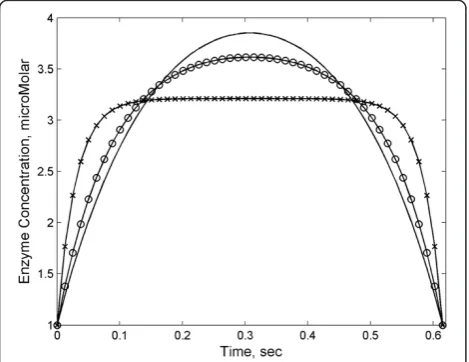
Different time-dependent enzyme profiles for different values of α2/α3are plotted in Figure 2. Whenα2/α3
be-comes large, the cost is entirely static, and the cell pays no price for synthesizing or degrading the enzyme very quickly. At the same time the nonlinear dependence of the cost on E penalizes any unnecessary deviation from the average level E. Hence, as shown in Figure 2, in this case the optimal profile approaches a rectangular shape where enzyme rapidly reaches the necessary average
level and remains there for most of the time course. At the opposite extreme (α2/α3is small, CTeE_2), there is a substantial cost associated with the production and deg-radation of enzyme. Under these conditions, the cell will try to make the smoothest transitions possible compat-ible with the average enzyme constraint, leading to an optimal enzyme profile that approaches a gradual para-bolic shape. The transition of enzyme time courses from rectangular profile to parabola reflects the need to bal-ance the costs incurred by using both static and dynamic resources to produce enzyme in the cell.
It should be noted that, for certain choices of parame-ters, the solution to the variational problem may not sat-isfy the conditions required for the validity of MM kinetics. There are two specific conditions which need to be verified: (i) that the time scale ofE is significantly longer than the time scale ofC, so that the quasi-steady-state assumption used to derive MM kinetics in [20] may still be applied, and (ii) that the concentration of E is sufficiently small so that E << KM +S. As detailed in
the SI Text, one can derive bounds on the enzyme tra-jectory in Eq. (10) which ensure that these two condi-tions are both satisfied. While all solucondi-tions presented in Figure 2 satisfy these conditions under a realistic choice of parameters, one should be aware, in future work, that optimal solutions of the variational problem may have to be further screened for these criteria.
Discussion
The metabolic equivalence of enzyme trajectories with identical average enzyme levels Implies that the cell has potentially many ways of achieving a given metabolic goal. At one extreme the strategy is to maintain enzyme level very high, with no need for fast response capabil-ities. The opposite strategy is to maintain a minimal en-zyme level, but be able to respond quickly. All strategies in between these two extremes give rise to the same net metabolic behavior. One may see this spectrum of possi-bilities as a fundamental tradeoff between the supplies invested in the enzyme itself (static resources) versus the investment necessary for fast enzyme production and degradation (dynamic resources). Such a tradeoff was in-deed recently suggested by the analysis of mRNA and protein levels and half-lives in mammalian cells [30]. In particular, it was found that different cellular subsystems exhibited different ratios of resting levels (referred to as "stability") of proteins and mRNAs. For example, en-zymes for metabolic subsystems which are frequently used, such as glycolysis, tend to be maintained at high stable levels, compatible with a high usage of static re-sources, but minimal usage of dynamic ones. Conversely, subsystems which are less frequently used but must react quickly tend to have stable mRNA but unstable
Figure 2Optimal enzyme profiles for the cost functional defined in Eq. (10).The boundary conditions were chosen to be
E0=Ef= 1μM, andĒ= 3μM, based on substrate parametersS0=15
μM,Sf=2.4μM, k2=1000 sec-1,k-1=1000 sec-1,k1=2μM-1sec-1,
KM= 1000μM,Δt= 0.6 sec. In inset, different lines correspond to different values ofα: solid line (α1=α2= 0.933,α3= .067), circles
(α1=α2= 0.981,α3= .019) and crosses (α1=α2= 0.998,α3= .002). For
the trajectory with the fastest rate of change of enzyme (α1=α2= 0.998,
proteins, consistent with low sequestration of static re-sources but a high demand on dynamic rere-sources.
Looking forward, a prospect for future studies will be assessing whether the invariance to average enzyme levels may be generalized to biological conditions in vivo. We suggest that two approaches may be taken to-ward addressing this question. First, current high-throughput technologies are beginning to enable the quantification of temporal variation in enzyme dance arising naturally within the cell. Changes in abun-dance are affected by a variety of distinct processes, from phosphorylation and dephosphorylation cycles to enzyme translation and degradation. By concurrently monitoring the amount of metabolite converted by a re-action and the dynamical changes of the corresponding active enzyme pool, it may be possible to assess the val-idity of our findings in a living system. A second ap-proach may arise from newly developed techniques in synthetic biology, where the expression of a single en-zyme may be precisely and arbitrarily controlled over time. In particular, in analogy with the previously pub-lished analysis of yeast’s response to a nutrient supply “signal” that oscillates at a given frequency [31], it may be possible to study the input–output properties of reac-tions and pathways based on signal processing tech-niques. For example, one could explore whether the insensitivity to certain enzyme changes demonstrated here could be explained in terms of a low pass filter. In-deed, such behavior was observed in [31], where very fast variations in periodic changes of the carbon source were ignored by the yeast population.
Our analysis highlights the existence of a spectrum of resource utilization strategies and ensuing tradeoffs in enzyme dynamics. It will be interesting to more directly assess whether the choice of specific strategies for meta-bolic regulation could be a direct target of evolutionary adaptation. As pointed out in [30], mRNA and protein levels for different subsystems may be explainable as op-timal strategies for energy usage, specifically targeted by different evolutionary pressures. The invariance to aver-age enzyme levels allows one to address this question in a general way, namely by asking what enzyme profile minimizes a given combination of static and dynamic enzyme-associated cost. For certain categories of cost functions, the problem can be solved analytically, using variational calculus. We focused specifically on the case of a cost function that is inspired by a previously experimen-tally validated cost-benefit model [25]. In this case, the op-timality principle provides specific enzyme trajectories whose dependence on enzymatic parameters is amenable to future experimental testing. Importantly, the timescales of enzyme change predicted by the variational principle may overlap with timescales of substrate kinetics, suggesting that our findings should be interpreted under
the assumption that enzyme changes may result from a combination of slow (e.g., transcription-translation and degradation) and fast (e.g., allosteric regulation, or phos-phorylation) processes.
The use of symmetry principles and variational calcu-lus in physics is widespread and has led to very import-ant conceptual and practical insight. Some progress has been made in applying similar variational principles to biological problems, usually in the framework of optimal control theory using numerical optimizations (for ex-ample, [21,32]). It will be interesting to see whether vari-ational approaches like the one we are proposing can be used to rederive some of the results from [21,32] analyt-ically. Variational calculus has also been applied to me-tabolism in a very different context, namely the study of thermodynamic constraints on metabolic fluxes [33].
Conclusions
A major open challenge in systems biology is to model metabolic and regulatory networks in a unified mathem-atical framework. At present, there is a tendency to de-velop models for larger-scale and more detailed representations of cellular networks, whose complex dy-namic behavior is measurable with high throughput exper-iments. In contrast, we focus here on enzyme regulation for a single metabolic reaction and suggest that new insight can still be obtained by studying this fundamental building block of biochemical networks, the “hydrogen atom”of metabolism. Despite the apparent complexity of dealing with time-dependent enzyme concentrations, we show that for a category of problems there is an under-lying simplicity. The fact is that, in simple metabolic reac-tions, different enzyme trajectories with identical average levels yield the same substrate flux over a given time inter-val. A standard enzyme assay allowed us to experimentally confirm the validity of this result.
Given the potential insight into metabolic regulation from invariance laws and variational calculus, we conclude by posing two challenges for future research, whose reso-lution would substantially increase the impact of this approach.
First, suppose that the benefit that the cell obtains from metabolizing a given amount of substrate, ΔS, in a time interval,Δt, can be described by a function B=B(ΔS,E, Δt). Then, extending previous work (e.g. [21,25,34]) one could try and solve through variational calculus the bio-logically more accurate problem of maximizing the differ-ence between such benefit, and the enzyme-associated cost described by Eq. (6). Under reasonable assumptions
on B, i.e. B i:e: ∂B
∂ΔS>0;∂
2B
∂ΔS2<0
, do general strategies
Second, the relevance of our variational approach to deeper biological questions is contingent on the feasibil-ity of extending this formalism to larger metabolic sys-tems. In particular, is it possible to find invariant quantities, relating enzyme levels to net changes in sub-strate concentrations, for systems comprised of more than one reaction, i.e. metabolic networks? Can such invariant quantities be exploited to understand strategies for the regulation of whole pathways or even larger modules?
Irrespective of whether these questions can be solved analytically, thinking about metabolic regulation in terms of dynamical optimization of trajectories may pave new ways of understanding how living systems gather their regulatory machinery to respond to environmental changes, and in turn guide synthetic biology efforts for the design of engineered organisms.
Methods Enzyme Assay
For the enzyme assay, 6.9 mg of 4-methylumbelliferyl β-D-galactopyranoside (MUG) was diluted in 50 mL of buffer containing 100 mM sodium phosphate, 1 mM MgCl2, and 50 mM beta-mercaptoethanol. β-galactosidase
dilutions were made fresh daily from a stock of 250 U/mL with deionized water to 2.5 U/mL. Enzyme was kept on ice during use. Fluorescence (corresponding to the concentra-tion of MUG) was monitored every second over the length of the study, by excitation at 360 nm and measuring emission at 460 nm. Samples were maintained at 37°C during measurements. In the first experiment, 50μL of β-galactosidase were added to 3 mL of MUG solution and monitored for 5 minutes for fluorescence. For the second experiment, 25μL ofβ-galactosidase were added to 3mL of MUG solution and fluorescently monitored for 2.5 minutes, followed by an additional injection of 50 μL of β-galactosidase, and again monitored for 2.5 minutes. The net difference in working volume between the two experimental conditions was 25μL out of 3 mL, or approximately 1%, and was deemed to be negligible in contrast to other sources of error in the system. Two controls were used for the experiment. In the high enzyme control, 75μL ofβ-galactosidase were added to 3 mL of MUG solution and monitored for 5 minutes. In the low enzyme control, 25 μL of β-galactosidase were added to 3 mL of MUG solution and monitored for 5 minutes.
All the enzyme used in the experiment was prepared ahead of time, and placed in ice to prevent denaturation. We performed each of the nine replicates in the experi-ment (3 replicates for each time course × 3 time courses = 9 total replicates) one after the other. The total time for the experiments was approximately two hours, and in this time we observed negligible loss of catalytic activity.
Derivation of instantaneous enzyme cost function
To identify, among all possible equivalent enzyme time courses, the ones of potential biological significance, we need to estimate the cost associated with each trajectory. We model the cost of a trajectory by extending the model proposed in [25]. Specifically, we assume that the cost a cell incurs upon producing an enzyme can be cal-culated as the reduction in the cell’s fitness due to the utilization and sequestration of resources. Extending the previous model, we take into account two distinct components of fitness which we call the “static” and “dynamic” fitness (associated with resources RS and RD
respectively). We assume a symmetric cost of both pro-ductionE_ >0and degradationE_ <0of enzyme, so that the dynamic cost is dependent on E_2. Furthermore, cellular growth results in the dilution of cellular re-sources at a rateμ.Thus, the minimum dynamic cost (at which the cell is not expending dynamic resources) oc-curs whenE_ ¼−μ. Then, following [25], the total fitness in the presence of enzyme level E and enzyme change rateE_ is expressed as
f E ;E_¼ RS−E KþRS−E∙
RD− E_ þμ
2
KþRD− E_ þμ
2 ð11Þ
The cost can then be computed as
c E ;E_¼f E;E_
−fð0;0Þ fð0;0Þ
¼C1EþC2 E_ þμ
2
þC3E E_ þμ
2
C4−C5E
ð Þ C6−C7 E_ þμ
2
ð12Þ
where theCiparameters can be inferred from Eq. (11). The
resulting expression in Eq. (12) is not directly amenable to analytical calculations. However, we can capture the main nonlinearity of this cost function (such as its linear depend-ence with respect toEwhen isEis sufficiently small, and its rapid divergence when E is large) in a simplified version, obtainable through a Taylor expansion about zero. In particular, we assume the sequestration of static and dynamic resources to be small in comparison to the total amount of resources in the cell (i.e.bothE and E_ þμ2
are sufficiently small so that theEandE_ þμ2terms dom-inate over other terms in a Taylor expansion), and that the coupling between static and dynamic costs (captured by the C3E E_ þμ
2
term in the numerator of Eq. (12)) is suffi-ciently small so as to be negligible. This yields the instantan-eous costc tð Þ ¼α1E tð Þ þα2E2ð Þ þt α3 E t_ð Þ þμ
2
, where theαiare positive constants. More accurate approximations
lead to analytically intractable dynamic optimization problems.
Reviewer comments Reviewer 1: Dr. Sergei Maslov
Comment: I liked the conceptual idea of this study according to which organisms are solving a dynamical optimization problem that in addition to static terms in-troduced in Ref.[25]also includes dynamic terms. These terms quantify energy and sequestration costs of operat-ing ribosomes as well as other (smaller) costs associated with protein production and active degradation. I also liked the fact that authors confirmed their mathematical results with a dedicated experimental data.
Response: We are grateful to the reviewer for the posi-tive feedback, and very helpful comments, which we ad-dress in detail below.
Comment: I found the application of this conceptual idea somewhat less convincing. Figure 2 shows an opti-mal enzyme profiles for different relative weights of static and dynamic terms. The biological relevance of the optimization problem solved in this study is not well explained. Indeed, why should an organism care to find the best E(t) for given <E> and S_f/S ? Should not it be that both S_f/S as well as E(t) need to be optimized to get the best fitness? I would be much more interested if au-thors ’formalism could quantify what they stated in the discussion section: “… enzymes for metabolic subsystems which are frequently used, such as glycolysis, tend to be maintained at high stable levels, compatible with a high usage of static resources, but minimal usage of dynamic ones. Conversely, subsystems which are less frequently used but must react quickly tend to have stable mRNA but unstable proteins, consistent with low sequestration of static resources but a high demand on dynamic re-sources.”To quantify this tradeoff authors need to apply their optimization formalism to multiple (periodic?) cy-cles of nutrient availability as opposed to a single cycle considered in this study.
Response: We thank the reviewer for giving us the op-portunity to clarify and elaborate on the biological rele-vance of the cost functional we use in the variational problem. We addressed this issue in multiple ways:
First, we moved the explicit derivation of our cost function from the Additional file 1 SI to the Materials and Methods section. This derivation, now expanded for increased clarity, shows in detail how we arrive at our cost functional based on previously proposed models of protein cost, and on simplifying assumptions.
Second, in presenting the cost function, we now expli-citly mention that fitness of the cell would in principle depend both on the cost of enzyme production, as well as on the benefit derived from metabolized a given amount of substrate (in between Eqs. (5) and (6)).
However, the solution of an optimization problem using a cost functional (a function of functions of time) is quite different, and substantially harder to solve, than previous optimization problems using cost functions, which depended simply on two variables (such as sub-strate and enzyme levels in [25]). Our approach is in it-self a novel way of expressing a problem of metabolic regulation, making it possible to use variational calculus for obtaining exact analytical solutions.
Third, as far as we can tell, the only way to explicitly account for the benefit derived from metabolizing sub-strate using our current framework (other than solving a much more complicated and potentially intractable vari-ational problem with two dependent functions E(t), and S(t) ) would be to invert Eq. (4), and express substrate consumed as a function of <E>, using the Lambert W function. Doing so renders the variational problem, which now contains the W function in the objective, analytically intractable. However, the reviewer raises a very compelling and challenging question, which we now pose as an open problem for future research at the end of our Conclusion section. Notably, a special case of our proposed problem would be the situation where a substrate is subject to multiple, periodic inflows over a time interval.
Comment:For a constant growth rate \mu maintaining E_dot =0 requires constant production to compensate for dilution term. Thus E_dot=0 is not the minimum and the minimum should be reached at E_dot=-\mu. Would that modify authors’conclusions?
Response: We thank the reviewer for the insightful point. Indeed, when the cell is not dedicating any dy-namic resources to maintaining protein levels, these levels should experience a dilution effect. We have accounted for this effect in our calculations in the main text, as shown in Eqs. (5) and (6). This modification does not modify the outcome of the optimization problem, or our conclusions.
Comment: Dimensionality of Eq. (6) is confusing. Ap-parently E is made dimensionless so that E+E^2 makes sense and time is also made dimensionless. These nor-malizations should be better explained. Perhaps they contain some information on the typical value of alpha.
Comment: For the sake of completeness the expression for K_M in terms of k_1 and k_{-1} and k_2 needs to be written.
Response: Thank you for the suggestion. We have ex-plicitly indicated immediately following Eq. (2) the rela-tionship between KM and the underlying mass-action
rate constants.
Comment:Use brackets under the integral in Eq. (6). Response: Thank you for the comment. We have modified the notation in Eq. (6) in line with the re-viewer’s recommendation.
Reviewer 2: Dr. William Hlavacek
Comment: The authors consider a system in which the level of an enzyme can vary with time. The kinetics of the reaction catalyzed by the enzyme E+S<->(ES)->E+P is as-sumed to be governed by the Michaelis-Menten rate law. The authors show that the amount of substrate consumed over a given period of time depends only on the average level of enzyme. The derivation of this result is straightfor-ward. I have not seen the result discussed before. It is con-ceivable that the result is already in the literature, somewhere. In any case, it is probably fair to say that the result is not well known. The authors validate the result experimentally, which is interesting. Because there are many trajectories E(t) that yield the same average enzyme level, the authors investigate optimality. For certain as-sumptions and a cost function taken from the literature, the authors solve an optimization problem and derive a formula for the optimal time-dependent enzyme level. The cost function could be explained in a little bit more detail and more clearly in the manuscript, although it is not ab-solutely necessary, because a reference is given. The au-thors are careful to think about and/or check various assumptions upon which their derivations are based and to show how the analysis extends to rate laws more com-plex than the Michaelis-Menten rate law. The manuscript is well written, and the work appears to be technically sound. The report could be useful to researchers who are interested in how time-dependent enzyme levels (varying because of gene regulation) influence metabolic reactions.
Response: We are grateful to the reviewer for the posi-tive feedback and useful comments. We were indeed surprised ourselves not to find the dependence on the average enzyme anywhere in the literature, not even as a simple exercise in textbooks. To reflect the reviewer’s suggestion that it may have been written somewhere be-fore, we modified accordingly the paragraph immediately preceding the section on Experimental Validation. We also added a new sentence to clarify the definition of the cost function, right after its definition. In addition, we now mention more explicitly that a detailed derivation and additional comments on the biological significance
of this cost function are presented in the Supplementary Materials.
Comment: A possible nice way to improve the manu-script, which might increase its potential impact a little bit, would be to extend the analysis to consider a (small) metabolic network, meaning a system with more than one reaction.
Response: We thank the reviewer for pointing to this in-teresting challenge, which we had ourselves wondered about. Our ability to derive analytical results for this system largely depended on relating changes in substrate levels to average enzyme levels via an invariance principle. It re-mains unclear to us whether such invariance principles exist for larger, more complicated metabolic systems. In light of this comment, we have added at the end of our Conclusion section an explicit mention of this idea, and of the associated mathematical challenge. By making the community aware of the difficulty of this problem and of the potential insight to be gained (i.e. the possibility of un-derstanding metabolic regulation through variational calcu-lus), we hope to catalyze a route to its resolution.
Reviewer 3: Dr. Daniel Kahn
This reviewer provided no comments for publication.
Additional file
Additional file 1:SI Text: Supplementary information referenced in main text.
Competing interests
The authors declare that they have no competing interests.
Authors’contributions
ER and DS conceived the study, completed the analysis, and wrote the manuscript. SY and ER performed the experiment. ER, SY and DS read and approved the final manuscript.
Acknowledgements
We would like to thank Erik Sherwood for thoughtful discussions, and Dean Tolan and Qasim Beg for advice on the experimental testing. We are especially grateful to Gene Wayne for helping to bring the invariance principle to the light of day. E.R. and D.S. were partially supported by grants from the Office of Science (BER), U.S. Department of Energy (DE-SC0004962), the Army Research Office under MURI award W911NF-12-1-0390, the NIH (R01 GM089978) and the National Science Foundation NSF DMS-0602204 EMSW21-RTG Biodynamics at Boston University.
Received: 17 December 2012 Accepted: 5 March 2013 Published: 22 March 2013
References
1. van Rijsewijk BRB H, Nanchen A, Nallet S, Kleijn RJ, Sauer U:Large-scale 13C-flux analysis reveals distinct transcriptional control of respiratory and fermentative metabolism in Escherichia coli.Mol Syst Biol2011,7:477. 2. Youk H, Van Oudenaarden A:Growth landscape formed by perception
and import of glucose in yeast.Nature2009,462:875–879.
3. Grüning N-M, Lehrach H, Ralser M:Regulatory crosstalk of the metabolic network.Trends Biochem Sci2010,35:220–227.
5. Orth JD, Thiele I, Palsson BØ:What is flux balance analysis?Nat Biotechnol
2010,28:245–248.
6. Lewis NE, Nagarajan H, Palsson BO:Constraining the metabolic genotype-phenotype relationship using a phylogeny of in silico methods.Nat Rev Microbiol2012,10:291–305.
7. Piedrafita G, Montero F, Morán F, Cárdenas ML, Cornish-Bowden A:A simple self-maintaining metabolic system: robustness, autocatalysis, bistability.PLoS Comput Biol2010,6:9.
8. Frieden C:Slow transitions and hysteretic behavior in enzymes.Annu Rev Biochem1979,48:471–489.
9. Frieden C:Kinetic Aspects of Regulation of Metabolic Processes. The hysteretic enzyme concept.J Biol Chem1970,245:5788–5799. 10. Laget PP:Hysteretic properties of soluble F1 ATPase from Escherichia
coli. II. Nucleotide effects on the slow changes of the enzyme kinetic behaviour.Arch Biochem Biophys1979,192:474–481.
11. Roussel M:Slowly reverting enzyme inactivation: a mechanism for generating long-lived damped oscillations.J Theor Biol1998,195:233–244. 12. Roussel MR:The use of delay differential equations in chemical kinetics.J
Phys Chem1996,100:8323–8330.
13. Schnell S, Hanson SM:A test for measuring the effects of enzyme inactivation.Biophys Chem2007,125:269–274.
14. Waley SG:Kinetics of suicide substrates.Biochem J1980,185:771–773. 15. Cornish-Bowden A:Fundamentals of Enzyme Kinetics.Weinheim:
Wiley-Blackwell; 2012.
16. Collins SB, Reznik E, Segrè D:Temporal expression-based analysis of metabolism.PLoS Comput Biol2012,8(11): e1002781.
17. Reznik E, Kaper TJ, Segrè D:The dynamics of hybrid metabolic-genetic oscillators.Chaos2013,23:013132.
18. Karr JR, Sanghvi JC, Macklin DN, Gutschow MV, Jacobs JM, Bolival B, Assad-Garcia N, Glass JI, Covert MW:A whole-cell computational model predicts phenotype from genotype.Cell2012,150:389–401.
19. Smallbone K, Simeonidis E, Swainston N, Mendes P:Towards a genome-scale kinetic model of cellular metabolism.BMC Syst Biol2010,4:6. 20. Segel LA, Slemrod M:The quasi-steady-state assumption: a case study in
perturbation.SIAM Rev1989,31:446.
21. Wessely F, Bartl M, Guthke R, Li P, Schuster S, Kaleta C:Optimal regulatory strategies for metabolic pathways in Escherichia coli depending on protein costs.Mol Syst Biol2011,7:155.
22. Fung E, Wong WW, Suen JK, Bulter T, Lee S, Liao JC:A synthetic gene-metabolic oscillator.Nature2005,435:118–122.
23. Yuan J, Doucette CD, Fowler WU, Feng X-J, Piazza M, Rabitz HA, Wingreen NS, Rabinowitz JD:Metabolomics-driven quantitative analysis of ammonia assimilation in E. coli.Mol Syst Biol2009,5:302.
24. Rondelez Y:Competition for catalytic resources alters biological network dynamics.Phys Rev Lett2012,108:018102.
25. Dekel E, Alon U:Optimality and evolutionary tuning of the expression level of a protein.Nature2005,436:588–592.
26. Nelson DL, Cox MM, Freeman WH:Lehninger Principles of Biochemistry, Fourth Edition [Hardcover].4th edition. 2004:1100.
27. Wagner A:Energy constraints on the evolution of gene expression.Mol Biol Evol2005,22:1365–1374.
28. Kenniston JA, Baker TA, Fernandez JM, Sauer RT:Linkage between ATP consumption and mechanical unfolding during the protein processing reactions of an AAA+ degradation machine.Cell2003,114:511–520. 29. Gelfand IM, Fomin SV:Calculus of Variations.Mineola: Dover Publications; 2000:240. 30. Schwanhäusser B, Busse D, Li N, Dittmar G, Schuchhardt J, Wolf J, Chen W,
Selbach M:Global quantification of mammalian gene expression control. Nature2011,473:337–342.
31. Bennett MR, Pang WL, Ostroff NA, Baumgartner BL, Nayak S, Tsimring LS, Hasty J:Metabolic gene regulation in a dynamically changing environment.Nature2008,454:1119–1122.
32. Bartl M, Li P, Schuster S:Modelling the optimal timing in metabolic pathway activation-use of Pontryagin’s Maximum Principle and role of the Golden section.Bio Systems2010,101:67–77.
33. Fleming RMT, Maes CM, Saunders MA, Ye Y, Palsson BØ:A variational principle for computing nonequilibrium fluxes and potentials in genome-scale biochemical networks.J Theor Biol2012,292:71–77. 34. Chiu H-C, Marx CJ, Segrè D:Epistasis from functional dependence of
fitness on underlying traits.Proc Biol Sci Roy Soc2012,279:4156–4164. doi:10.1186/1745-6150-8-7
Cite this article as:Rezniket al.:Invariance and optimality in the
regulation of an enzyme.Biology Direct20138:7.
Submit your next manuscript to BioMed Central and take full advantage of:
• Convenient online submission
• Thorough peer review
• No space constraints or color figure charges
• Immediate publication on acceptance
• Inclusion in PubMed, CAS, Scopus and Google Scholar
• Research which is freely available for redistribution