3764
Multiple Parameter Based Efficient Cluster Head
Selection In Heterogeneous Network.
Satyanarayan K. Padaganur, Jayashree D. Mallapur, P.S. Patil.
Abstract: Cluster based heterogeneous network is catering many services of wireless multimedia network. In the cluster based network, s election of Cluster Head (CH), deployment of CH and withdrawal of CH is more complicated issue bec ause CH will act as a very essential node. Selection of CH will affect thrAoughput of network and which influence the efficiency of network. Whenever CH goes down for any reason, the whole communicati on comes to a halt. Therefore, we have come with an alternative solution for selection of CH based on multiple parameters like stability, energy and distance. By doing this, the network recovery rate becomes far better than earlier solutions. Hence, this proposed scheme pro vides with more network stabilization, maximum throughput, optimized delay and energy.
Index Terms: Cluster Head Dynamism, Heterogeneous Network, Network stabilization, Optimization, and Network Stabilization. —————————— ——————————
1.
INTRODUCTION
It has been concluded from the user survey that usage of wireless network now a days becomes the part of daily lifecycle. However, by having several wireless technologies in heterogeneous network, user can access internet seamlessly. Heterogeneous network, extract the features from different technologies present in it. Hence, heterogeneous network offer ubiquitous communication and provide high speed seamless connection. In the proposed cluster based heterogeneous network, we consider integration of MANET and cellular network. Power consumption, mobility, scalability, stability and optimal delay are very important designed factors for measuring the system performance. Energy consumption and saving is the key design issues, which is non-renewable resource. In cluster based heterogeneous network, different clusters are communicated through cluster head (CH). CH segregates all data from different nodes and sends to other clusters. If CH itself becomes inactive or move away from cluster, then entire cluster communication will stop. However the cluster will select new CH for future communication, which is very big challenging for cluster. In our proposed work, the selection criterion for new CH is based on optimization. The optimization is done with respect to node stability, node residual energy and shortest distance from sink node.
2
RELATED
WORK.
In most of the survey articles, the optimization is done with respect to distance and remaining energy of the node. But in our work, we added one more important parameter i.e. node stability. In article [1], the authors are presented about how the energy of the nodes is utilized effectively and efficiently. In WSN the main parameters to consider for design is power management. In this paper [2], a novel method efficient energy utilization for cluster head for multilevel heterogeneous WSN is expressed. The dynamic cluster head selection scheme is
proposed in [3]. The authors proposed new scheme of distributed energy scheme for cluster head selection in [4]. In article [5], the authors proposed single hop cluster-based energy efficient scheme, which increase the network performance. The authors in [6] introduced new scheme of energy efficient scheme to prolong the network lifetime. In this article [7] the effect of traffic on WSN is discussed. The proposed work is also giving the solution to avoid energy draining hotspot. In [8,9] re-view of different WSN routing protocols are discussed. The author also proposed new modified method for CH selection, which will enhance the lifetime of the network. The author of article [10] is discussed about dynamic selection routing in heterogeneous network. The scheme may help to handle fault tolerance in the network. In [11] the authors reported on how mobility estimation is done based on node stability. The new scheme is also calculates the stability of neighbor nodes. GPS accuracy and resolution is given in [12]. The author of [13] is reported on how energy is utilized by using node-swapping scheme.
3.
PROPOSED WORK.
In the proposed cluster based heterogeneous network, the network utilizes the important features of MANET and cellular network. In the cluster based MANET, if CH of cluster die out or move away from cluster, then network will select new CH. In the related articles mentioned, only two parameters, node energy and distance are consider for selecting new CH. But in the proposed work, new scheme for stability of node is used. The over-all optimization method is carried out for new CH, based on maximum node stability, highest residual energy and shortest distance from sink node. This will improve throughput and stabilization of network.
A. Selection of CH.
Initially, after cluster formation, CH is selected based on maximum residual node energy among the member of cluster. CH will act as both normal node and router for data communication. Every inter-cluster communication must happen through CH. The CH is selected based on threshold value T(n) as given in equation (1)
(1) ————————————————
Associate professor, Electronics and Communication Department. V.P. Dr. P.G.H. College of Engineering. & Technology, Vijayapur, India. [email protected]
Electronics and Communication Department.
Basaveshwar Engineering College,
Bagalkot, India. [email protected]
3765 Where n is node, p is probability of cluster head and r is
present round of data transmission. Every node will generate a random-number, then the generated random-number is less than T(n), then that node will select as cluster-head.
B. Mobility of CH
If the CH of cluster is move away from parent cluster or goes down, then cluster will lose its communication ability. However selection of new CH is done in such a way that it will provide maximum throughput and minimum delay with high node stability. So network selects new optimized CH based on stability of node, residual-energy and optimal distance from sink node. So this new optimized CH will enhance the network performance.
C. Optimization of new CH
Optimization of new CH is computed based on three factors namely node stability, residual energy of the node and optimal distance from sink node.
I. Computation of Node stability:
Computing node stability [11] is with respect to node mobility is as follows
Figure 1. Node stability
Let us consider the diagram as shown in figure 1 for node stability, where nodewith coverage range „r‟ moved from (Xr, Yr) to new allowed position (Xn, Yn) specified by network. In order to measure the node stability, following equation (2) is used
= (2)
Based on movement of node with time t, node stability, S(i) can be calculated using equation (3),
S ( (3)
If dt
i is less than r/4, then those nodes are considered as stable nodes.
For high degree of node stability, reduce r/4 to r/8. However there is limitation in node stability calculation based on GPS resolution and accuracy. For good results, it will be estimate with maximum resolution and accuracy of GPS[12]. Our method extracts only node with high stability. Node with highest stability factor is considered for good candidates to be selected as one of CH.
II.
COMPUTATION
OF
RESIDUAL
NODE
ENERGY:
Residual energy of the node is computed with node remaining energy. The node having highest remaining energy ER is selected as new CH [1], which is given by equation (4)
ER = EI - EC (4)
Where EI is initial energy, EC is consumed energy and ER is the residual energy.
III COMPUTATION OF OPTIMUM DISTANCE:
Among high energy nodes, our proposed scheme adapts node with optimal distance from sink node D(i) has to be considered for selecting new CH.
Algorithms: In this proposed work, we are developing four types of algorithms for optimal CH selection. The proposed work will start with main algorithm. The second algorithm will select node with highest node stability. Third algorithm is designed and developed for selecting node with high residual energy. Last algorithm is designed to calculate optimal distance from sink node.
[Nomenclature: S(i) = Node stability, Sth = Stability threshold value, E(i) = Node energy, Eth = Energy threshold value, D(i) = Optimal distance of node from sink node]
Algorithm 1: Main program Begin:
Step 1 Create cluster based heterogeneous network. Step 2 Initialize energy to all nodes.
Step 3 Repeat until movement of CH away from cluster Step 4 Check for node stability to select new CH Step 4 Call Algorithm 2
Step 5 go to Step 3 End.
Algorithm 2: Node stability calculation.
Begin
Step-1 Read number of nodes = n Step-2 Initialize variable i= 1, k=0 Step-3 Repeat the step until i = n
3.1 Calculate stability of S(i) 3.2 if S(i) >= Sth
3.3 k = k+1 3.4 i = i+1
Step-4 Display number of nodes with stability „k‟ Step-5 if multiple nodes are selected with high stability Step-6 Call algorithm 3
End.
Algorithm 3: Computation for residual energy of node.
Begin
Step-1 Read number of nodes with high stability= k Step-2 Initialize variable i= 1, j=0
Step-3 Repeat the step until i = k
3.1 Compute residual energy of node, E(i) 3.2 if ER(i) >= Eth
3.3 j = j+1 3.4 i = i+1
Step-4 Display number of nodes with energy j Step-5 if multiple nodes are selected with
maximum residual energy. Step-6 Call algorithm 4
3766 Algorithm 4: Optimization.
Begin
Step-1 Read number of nodes with maximum energy=j Step-2 Initialize variable i= 1
Step-3 Repeat the step until i = j
3.1 Compute distance between node & sinknode 3.2 if D(i) ≤ D(i+1)
3.3 then Optimal CH=D(i) 3.4 else Optimal CH = D(i+1) 3.4 i = i+1
Step-4 Display optimal cluster head selection = CH End.
The overall optimization is carried out for selecting new CH is given in below equation.
Optimized CH (i) = {(max S(i)) AND (max E(i)) AND (min D(i))}
4.
WORKING
SCENARIO.
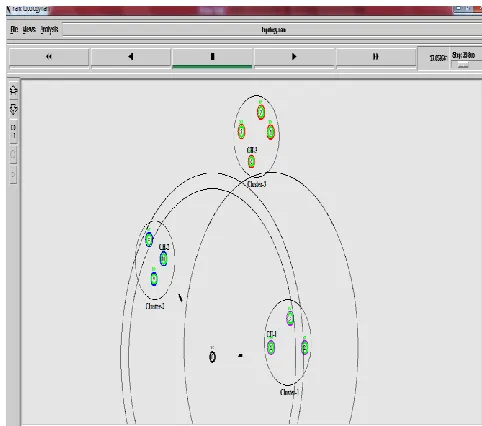
In the proposed network topology, heterogeneous network, consisting of cluster based MANET and cellular network. In the working scenario, we consider the three clusters with a single sink node (base station) for inter-cluster communication.
Figure 2 Initially 3 clusters are formed in the network.
Cluster based heterogeneous network has been generated as shown in figure 2. In the network architecture, we consider three cluster of manets with single sink node as base station.
Figure 3 Mobility of CH-1 from Cluster-1
CH1 of cluster-1 is moved away as shown in figure 3, which produces radio link breakage and loose communication of cluster-1. Then cluster-1 will be in search of new CH.
Figure 4 Inter-cluster Communication through optimized CH-1
In our proposed work, we select the optimized new CH as shown in figure 4. The optimization is done with respect to node stability, node residual energy and optimal distance from sink node.
5.
RESULT AND DISCUSSIONIn this section, the simulation is carried out for cluster based heterogeneous network. Simulation is done using NS-2. The following results-parameters are measured and computed using tcl, tr and awk files of NS-2.
TABLE-1. SIMULATION FACTORS
No. Parameter Value
3767 2. Number of clusters 3
3. Total mobile nodes 10
4. Radio Transmission Model
Two Way model
5. Antenna Type Antenna/Omni Antenna
6. Type of channel Wireless Channel
7. Total Simulation Time 160 sec
A) Throughput analysis:
TABLE 2 THROUGHPUT ANALYSIS
Simulation time in sec
Present System Throughput (%)
Proposed System Throughput
(%)
5 10 20
10 23 35
15 35 50
20 45 63
25 60 79
30 70 95
Figure 5 Throughput analysis of network.
Analysis of throughput of the network is shown in figure 5. From the figure 5 it is observed that, throughput related to new optimized new CH is very much improved than the normal new CH.
B) Energy consumption analysis
TABLE 3 ENERGY CONSUMPTION ANALYSIS
Simulation time in sec
Energy consumption in present system
Energy consumption in proposed system
0 0 0
1 1.62 1.40
2 2.92 2.82
3 3.70 3.24
4 4.4 4.2
Fig. 6 Energy consumption analysis.
Figure 6 represents about the energy consumption of two different CH. Normal selection of CH will consume more energy than the optimized new CH.
C) Delay analysis:
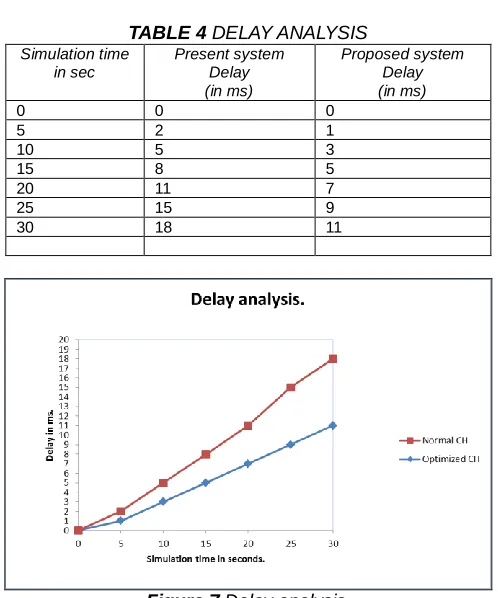
TABLE 4 DELAY ANALYSIS
Simulation time in sec
Present system Delay (in ms)
Proposed system Delay (in ms)
0 0 0
5 2 1
10 5 3
15 8 5
20 11 7
25 15 9
30 18 11
Figure 7 Delay analysis.
3768
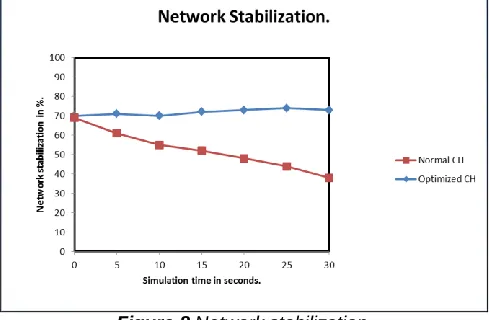
Figure 8 Network stabilization.
Network stabilization analysis is shown in figure 8. The analysis illustrates that, network performance is stable for complete simulation time, because of new optimization scheme for selecting new CH.
6.
CONCLUSION
The proposed work is implementing cluster based heterogeneous network. The leach algorithm has proved the best algorithm for cluster based network, but it has major issue with CH selection, CH deployment and CH withdrawal. In our proposed work, we have developed new scheme for optimized CH selection. The scheme proposes optimization of the CH, based on node stability, node residual energy and optimal
distance. The new optimized
CH selection shows better throughput, less energy consumption and minimum end-to-end delay. It also improves network stabilization.
REFERENCES:
[1] M. S. Fareed et al., “Optimal Number of Cluster Head Selection for Efficient Distribution of Sources in WSNs” Seventh International Conference on Broadband, Wireless Computing, Communication and Applications, 2012 [2] Ru Gao et al., “A power efficient cluster head selection
Algorithm based on affinity propagation In heterogeneous sensor networks”, IC-NIDC2010
[3] Dongyao Jia, Huaihua Zhu, Shengxiong Zou, and Po Hu “Dynamic Cluster Head Selection Method for Wireless Sensor Network”, IEEE SENSORS JOURNAL, VOL. 16, NO. 8, APRIL 15, 2016
[4] Benyin Xie and chaowei wang “An Improved Distributed Energy Efficient Clustering Algorithm for Heterogeneous WSNs”, IEEE Wireless Communications and Networking Conference (WCNC), 2017
[5] Somasekhar Kandukuri et al “Cluster-Head Techniques for Single-hop Routing protocol in Energy E_cient Wireless Sensor Networks.” IEEE Radio and Antenna Days of the Indian Ocean (IEEE RADIO 2015), IOP Publishing
[6] Divyanshu Gupta and Rajesh Verma “An Enhanced Cluster-Head Selection Scheme for Distributed Heterogeneous Wireless Sensor Network”, International Conference on Advances in Computing, Communications and Informatics (ICACCI), 2014
[7] Deepak sharma et al., “A traffic aware cluster head selection mechanism for hierarchical Wireless sensor networks routing” IEEE PDGC 2016
[8] Anurag chatap and sumedha sirsikar “Review On Various
Routing Protocols For Heterogeneous Wireless Sensor Network” International conference on I-SMAC (IoT in Social, Mobile, Analytics and Cloud) 2017.
[9] Qazi ali et al., “Reconfigurable Cluster Head Selection Protocol (RCH) for Heterogeneous Wireless Sensors”, IEEE International Conference on Frontiers of Information Technology. 2017
[10] Satyanarayan K. Padaganur, Jayashree D. Mallapur. “Neural embedded smart link generation scheme for heterogeneous network”. Heliyon 4 (2018) e01089. doi: 10.1016/j.heliyon.2018. e01089
[11] P. I. Basarkod, S. S. Manvi, D.S.Albur “Mobility Based Estimation of Node Stability in MANETs” IEEE International Conference on Emerging Trends in Computing, Communication and Nanotechnology (ICECCN), 2013
[12] www.gps.gov/systems/gps/performancy/accuracy: accessed on 15 September 2018