Heuristics For Testing Steps Of The General
Search Engine Optimization Process
Dr. Mehul Patel, Mr. Mitesh Patel, Dr. R. D. Modi, Mr. Premal Soni, Mr. Jaydeep Patel
Abstract :This paper presents general guidelines that can be used for preparing various test cases for the General Search Engine Optimization (GSEO) process to check whether the GSEO steps have been carried out properly or no longer for an assortment of search engines used on the web. An strive is made to discover test cases distressing steps during the GSEO process on well-liked search engines like Google, Yahoo, Bing, etc. Moreover, discusses the significance of various test cases useful in improving GSEO process steps.
Keywords: General Search Engine Optimization (GSEO), Test Cases, On-page GSEO, Off-page GSEO
————————————————————
1.
INTRODUCTION
Every business needs promotion management for its website to get top position in the results produced by various search engines to satisfy different search queries of users. General Search Engine Optimization (GSEO) is a process of getting good rank in results produced by different available search engines. By steps of GSEO process we can send details of a website or a web page to web crawler of a search engine and the web crawler sends website or web page information to a search engine database. Search Engine Optimization (SEO) techniques usually come back beneath the scrutiny relating to their viability and moral acceptance within the net community. Ever since web promoting and net analytic became key parts of promoting budget of a business, getting higher ranking within the computer programme Result Pages (SERPs) has become extremely essential and consequently outsourced to skilled corporations [7]. GSEO highlights a step wise procedure to get better rank in search engine results. GSEO can be divided into steps like: competitor analysis, keyword analysis, title creation
for web page, meta tags for web page, head tag adjustment in a web page, preparation of a unique content for a web page, ALT tag for images available in a web page, search engine submission, directory submission, promotion in social media, social bookmarking, link building, article generation, article submission, blog creation, blog submission, etc. During the searching activity, a SEO professional not only concentrate on keywords but also on the behavior of searching query is equally relevant [10]. According to SEOmoz and analysis leading SEO factors, the
foremost vital ranking factors
(http://www.seomoz.org/article/search-ranking-factors) are: mistreatment keywords within the title tag, anchor text of incoming links, international authoritative links on the web site, web site age, the recognition of link at intervals the inner structure of the web site, thematically relevant incoming links, quality of links on the web site within the thematic community, mistreatment key words within the text body and recognition of world links on websites that link to website‖ [15].
LITERATURE REVIEW
Researchers have found that a focused crawler traverses the net, choosing out relevant pages for a predefined topic and neglecting those out of concern. Collection domain specific documents mistreatment centered crawlers has been thought-about together of the foremost necessary ways to seek out relevant data [3].Researchers have identified three major categories of SEO: White hat SEO, Black hat SEO, and Grey hat SEO. Individuals working in the academic sector have studied design of search engines and the concept of search engine optimization through many approaches to SEO campaign website analysis like competitive analysis, proper keyword usage, content development, on-page optimization, off-page optimization, etc. In studies within the area of search engine optimization, the most important on-page SEO techniques embody optimized titles and descriptions, correct URL structures, easy navigation, optimized internal links, text data formatting use of H1, H2, bold, etc., image improvement - image size, image names, use of elevation tag, easy pages, quick loading pages, Google authorship verification for all pages, high-quality contemporary content, external links, etc. The foremost necessary off-page SEO techniques include link building, social media promotion, social bookmarking, etc [11]. Web ranking algorithmic programs like hits algorithmic ————————————————
Author name is Dr. Mehul Patel, Assistant Professor in C P Patel & F H Shah Commerce College, Anand, Sardar Patel University, Vallabh Vidyanagar, India, PH-08200593797. E-mail: [email protected]
Co-Author name is Mr. Mitesh Patel Assistant Professor in S.P. University, India, PH-09825354066.
E-mail:[email protected]
Co-author name is Dr. R. D. Modi, Principal of C P Patel & F H Shah
Commerce College, Anand, India, PH-09898211089. E-mail:[email protected]
Co-Author name is Mr. Premal Soni Assistant Professor in S.P. University, India, PH-09428543564.
E-mail:[email protected]
Co-author name is Mr. Jaydeep Patel, Assistant Professor, S.P.University, India, PH-09574159950.
program and linguistics similarity algorithm square measure enforced so as to match these techniques and analyze their results chiefly in terms of net ranking [13]. Researchers have printed particulars regarding all the foremost search engines like Google, Yahoo, Ask, Bing, etc. to rank web-pages supported bound factors that have an effect on its ranking. SEO intend at creating the correct sorts of signals on the online pages [9]. therefore conifer State of things that play a crucial role whereas doing keyword analysis and contestant analysis in page ranking embody identification of the $64000 competition, competitive rankings, keywords review, keywords used within the foundation name, web site style of the domain, keywords used anywhere at intervals the title tag, page meta robots tags, keywords used as a result of the initial word, existence of substantive, distinctive content on the page, language of the content used on the placement, keywords used anywhere at intervals the H1 headline tag, keywords used as a result of the initial word(s) at intervals the H1 tag, etc. thanks to the character of the online, there'll continually be some SEO technique that may prove effective with relation to ranking in search engines. After all, search engines don't have the flexibility to get fashionable content, but search engines solely acknowledge it with the utilization of bound factors and trade. Provided that AN SEO approach identifies numerous factors, it strives to use them the maximum
GSEO PROCESS STEPS WITH TEST CASES
Figure 1. The General SEO process steps
The GSEO process is divided into two parts (A) ON-PAGE SEO AND (B) OFF-PAGE SEO
On-Page SEO Step 1: Competitor Analysis
The first step of On-Page SEO is competitor analysis. In this competitor analysis, mostly we find competitors of related services or products having better rank in different search engines. For example, assume that we do GSEO for website W1 for keyword A1 by typing the keyword A1 in search engine. If we obtain as results the websites W2, W3, W4,.. Then W2, W3, W4, etc. are competitors of W1 for the keyword A1.Here are general guidelines to perform competitor analysis for identifying your competitors, visit competitor’s sites and analyze them: Check which keywords were used by competitors. Make list of the competitor’s back links, Check competitor’s page ranks in Google and also how do they perform in other search engines like Yahoo, Bing and in other search engines. Find number of indexed pages the sites of competitors have with search engines. Evaluate competitor's presence on social media, etc.
Step 2: Keyword Analysis
Effective keyword research is at the heart of GSEO. At the beginning stage of the process of website development, the developers have to choose those keywords that will be critical to the success of the website [6]. First objective is to choose the low competition long tail keyword with the help of useful tools, such as ―Google Keyword Planner Tool‖ to get fast indexing in the Google search results
[14]. Keyword analysis is to find the keywords and phrases in web content that make it possible for people to find a web site via search engines easily.Here are some general guidelines to perform keyword analysis: Check the list of important keywords, relevant keywords and keyword phrases. Make a mix of head terms and long-tail keywords. Ensure that how competitors are ranking for those keywords, using suitable tools like Google Ad Words tool, keyword planner, cut down your keyword list for single page. Check and find the keyword; for home page and product pages. Check the keyword in Google keywords tools to high, low and medium bids. Check keyword having a low difficulty score from keyword tool. Check the keywords are in anchor text on site. Make sure that the keywords have been used in first 100-150 words.
Step 3: Title Tag
the title tags are maximum 66-70 characters including space, place top performing keywords in descending order.
Example of www.solex.in:
<Title>Solar Panel Manufacturers, SOLAR pv products manufacturers in India, BIPV, Water Heaters, SOLAR POWER PLANT </title>
Step 4: Meta Tag
Meta tags are only one small element tags, used to present meta keyword <meta name=‖keyword‖> and meta description <meta name=‖description‖>. The meta keywords tag is used to emphasize the keyword phrases by using it a page is described. The meta report tag may be made up of a few sentences forming a paragraph that uses various keywords and describe the page information [1].Here are some of the general guidelines for using Meta tag: Check whether the meta descriptions are given or not. Ensure that the meta descriptions are maximum 140-150 characters in size. Check whether the duplicate meta descriptions are frequently overlooked or not, Google will flag these quickly. Check whether the target keywords are included in the Meta descriptions. If the keywords of your search query are found in your description, then they are displayed in bold text. Also ensure that the keywords found in the meta description should be elaborated in web pages or articles.
Example of www.solex.in:
<meta name="description" content="Solar Panel Manufacturers, Solar pv products manufacturers in India, solar panel production in Gujarat, Solar home System in V U Nagar, Solar home lighting system in Anand, BIPV, Water Heaters, SOLAR POWER PLANT, Solar Geyser, Street Lights, Lanterns, Solar home System, Solar Hot Water system, Charge Controller, SOLAR POWER PLANT, Solar Street Lighting system, Solar pv panel, Solar Garden Light, solar path light"/>
<meta name="keywords" content="Solar pv products manufacturers in India, solar panel production in Gujarat ,Solar home System in V U Nagar, Solar home lighting system in Anand, BIPV, Water Heaters, Solar Power Plant, PV Panels, Charge Controller, Lanterns, Solar home System, Solar power generating systems, Solar battery Chargers"/>
Step 5: Header Tags (H1, H2, H3, H4 etc.)
HTML heading tags h1, h2, h3… and so on… are very important for search engines. Different search engines see header tags as titles of topics. Text of heading tags is very effective if it is similar to given targeted keywords of web page. Heading tags are used by crawlers to emphasize important content of a web page.
Here are some of the general guidelines for using header tags: Use only one H1 header per page. Target similar keyword phrases as the ones targeted when writing the page title. Make sure that the headings (h1,h2) are significant and restricted in HTML code. Check the header font size. Ensure that the headlines that are clear, interesting and make use of rich keywords. Check the proper tag hierarchy when tagging headlines H1 - main titles, H2 – subtitle since it is important to maintain a
well-structured information. Verify that text contents of the <h1> tag also represent a description of the main theme of the page.
Step 6: Alt with images
Images with content are a great way to make a web site more visual. Image with <ALT> and description is more useful for GSEO process. <ALT> option is used to describe the image with keyword.
Here are some general guidelines for images: Confirm that the images are <ALT> text in HTML code. Check that the image descriptions are available in HTML code. Check whether uploaded image path is proper or not. Check image upload functionality with image files of different extensions. Check image upload process with image size greater than the max allowed size. Ensure that at least one image file name includes your target keyword and that target keyword is part of image <ALT> text.
Step 7: Keyword Density
Keyword Density means number of words and phrases which include keyword place into single web page. If the keyword density is effective enough in a web page which describe proper information then it will definitely benefit to locate or ―index‖ a web page with the use of ―spiders‖ or ―crawlers‖ to get a high rank in search engine results page (SERP). If the total number of words in a web page is pn (that is page numbers) and total number of keywords in web page is kn (that is keyword numbers) then percentage(%) = kn/pn. Here are some general guidelines for usage of keyword density: Ensure that the total percentage (%) of keywords is not more than 3% to 5% on the page. Check whether the number of linked words for keywords are proper or not. Check the number of non- linked words of keyword. Check the number of stop words or very short words used in the non-linked text or not. Check whether keyword is part or the URL or not.
Step 8: Unique Content
Unique content is not content that appears on the Internet in more than one web site or web page but it is a key point for GSEO process. Without unique content on web page GSEO process becomes lengthy and harder. To get a higher rank in search engine unique content plays a vital role. Here are some general guidelines for unique content: Check whether same content appears on the Internet at more than one places? Check that the unique page content efficiently communicates the topic of the page's content. Check that the structure of URL is simple to understand and conveys the unique content information easily. Check the unique content’s grammar and spelling mistake. Check whether the content is proper website relevant unique content or not. Check whether consistency is maintained when unique content words are linked internally throughout a website. Make sure the website adds a link back to the original page content properly. Reduce similar content at minimum. Remove duplicate content from search engines, and also indexes by no indexing with meta robots or through removal via webmaster tools[8].
Step 1: Content Quality
Content quality in terms of GSEO means that content should be easily understandable and it should be based on target keywords. Duplicate or similar content on more than one website is not good also duplicate content can be checked using plagiarism tools. Here are some general guidelines and points to be taken care of for ensuring content quality: Check whether the page provides a reason for people to spend more time to reading page information. Check does a page offer real information. Information on web page are something important to page viewers, that is unique and useful or not? Check that the page contents successfully describe the subject of the page's content. Check the proper site related content, which should be understandable.
Step 2: Link Building
Link building means, links set to web pages internally on same URL and also links to other URL web pages. The total number of web pages linked to another website. This has been a huge determining factor on how search engines determine a site’s position in the search results [6]. Here are some general guidelines for link building: Make sure that the HTML snippets created for other person link for web page on URL. Check link that is editorial. Check content should be of good quality so that it earns more organic or natural links. Make sure that the link is not manipulative otherwise it will be spam.
Step 3: Search Engine Submission
Each and every web site needs to submit in different search engines like Google, Yahoo, Bing, etc because by submitting website search engine can review the website in easy and fast manner. There are different ways to submit website to search engines like for Google link is
https://www.google.com/webmasters/tools/submit-url?continue=/addurl&pli=1, and also submit your site map to Google via their webmaster tools, for Bing link is http://www.bing.com/toolbox/webmaster etc. Here are some general guidelines for search engine submission: Check that the website can be found in Google or other search engine. Verify website using webmaster tools. Checks URL error during search engine submission.
Step 4: Directory Submission
Directory submission is a very important step of the GSEO process because most of search engines finds result of search queries in niche directories. By regularly doing directory submission in different directories will give good index to website on targeted keyword phrase. Here are some general guidelines for directory submission: Check whether the website is submitted in appropriate category and good directory. Check directory is not spam website before submit the submission of website. Check provided corporeal address or blog stats. Check and not prefer put forward to a site that necessitate reciprocal link back or banners on web site or web page.
Step 5: Article Submission
Article submission is one of the important steps of Off-page optimization. If authors write articles themselves, then they can submit them to standard article directory sites like; Ezine, Go Articles, Now Public, etc. this could
facilitate drive traffic to web site, and additionally gain some links to web site from others. Here are some general guidelines for article submission: Check links in the body of the article or not. Make sure company promoted in the body of the article or not. Check plagiarizes of article content. Check something repeated many time in article. Check misspellings or grammatical errors of article content and submit it in article submission websites.
Step 6: Social Media Optimization (SMO)
Social media optimization is outlined by the distribution of social objects and their ability to rise to the highest of any connected search question, wherever and once it’s performed [2]. SMO encourages social media engagement and content sharing through the leading social networking sites that represent users learning and analysis environments [5]. Here are some general pointers for social media optimization: make certain on clicking variety button. User ought to be re-directed to the corresponding Facebook page, User ought to ready to just like the page. Make certain the quantity of likes gets incremented. Make certain once feeling that activity is obtaining displayed on user's profile page. Make certain the user is in a position to in contrast to the page. Check the quantity of likes gets decremented or not. Make certain on clicking the twitter button user gets directed to the twitter's page, User is in a position to share that page or tweet it. Check the count gets incremented by clicking on the twitter button. Make certain on clicking the Google and button, user is re-directed to the corresponding Google page and by language in user are ready to share page. Make certain by sharing, the forecast the Google and button will increase. Check if the positioning is shared with social media sites or not.
Step 7: Social Bookmarking
Social bookmarking is the technique of encouraging website. Put forward newest blog posts and pages to the most admired bookmarking sites like Tumblr, Reddit, StumbleUpon, MetaFilter, Delicious, Digg, etc. Search engines find these types of sites because the content on these sites is updated.
Here are some general guidelines for social bookmarking: Check the work in high PR social bookmarking or not. Check whether the work to blog title in social bookmarking is appropriate or not. Check the bookmarking on blog to short description. Check the bookmarking to proper link to blog. Check the how to put in meta keyword on social bookmarking.
Step 8: Blog
result on the general public, (iii) ―Community blogs which might offer the worth of communication and interaction to let individuals share freely on the Internet‖ [12]. Here are some guidelines for blog: Check that the blog content should be the minimum 300-350 words. The blog should have unique title. Ensure that the anchor text is easy to convey the contents linked to blog. Make sure that the blog is uploaded into the best site. Blog URLs for these posts did not change. Check whether each blog post shows the publishing date on blog page.
Step 9: Forum
Forum posting is off-page GSEO technique which is effective to get quality back links in GSEO process. Find similar appropriate forums and join in those forums and
related forum with high authority, register and create a profile with all information. Use the signature option carefully to get back links. Post new information or reply to others’ questions to get back links and make relationship with others.Here are some guidelines for forum: Check the posting if encounter issues, remove some keywords from the signature of forum. Check the posting if we only have forum back links, it can be decrements rankings. Check the forum to see if a link to website is from lawful and honest participation in a web forum. Check the forum posting if we wants articles and forum posts to be efficient. Make sure need to respect the guidelines of the medium we are posting on – otherwise risk articles and forum posts are deleted instantly.
Case Study
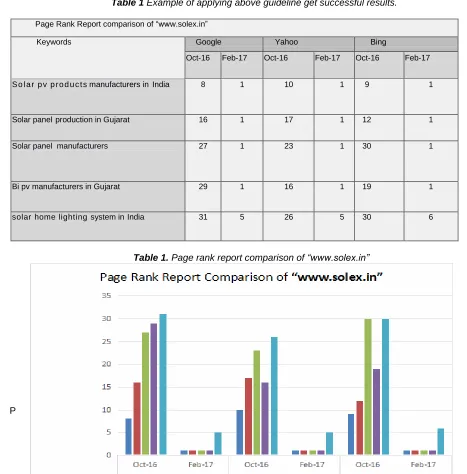
Below table 1 represents page rank report of ―www.solex.in‖. Below chart describes comparison of different keywords which are used in different search engines. Generally when visitors of website search any keyword, they always go for first or may be second page
links, after that they close it. In oct-16 the page rank was very poor, so the visitors did not reach to the website. Because when visitors enter the keyword in search engine the link is shown on lasts pages
.
Table 1 Example of applying above guideline get successful results.
Page Rank Report comparison of ―www.solex.in‖
Keywords Google Yahoo Bing
Oct-16 Feb-17 Oct-16 Feb-17 Oct-16 Feb-17
S o l a r p v p r o d u c t s manufacturers in India 8 1 10 1 9 1
Solar panel production in Gujarat 16 1 17 1 12 1
Solar panel manufacturers 27 1 23 1 30 1
Bi pv manufacturers in Gujarat 29 1 16 1 19 1
solar home lighting system in India 31 5 26 5 30 6
Table 1. Page rank report comparison of “www.solex.in”
a
g
e
Figure 2. Page rank comparison of “www.solex.in”
CONCLUSION
This paper presents a set of general guidelines to be followed during the general search engine optimization process steps. There are two categories of GSEO: On-page SEO and Off-On-page SEO. On-On-page SEO is divided into 8 steps: Competitor Analysis, Keyword analysis, Title tag, Meta Tag, Header Tags, ALT with Images, Keyword Density, Unique Content and Off-page SEO is divided into
9 steps: Content quality, Link building, Search engine submission, Directory Submission, Article Submission, Social Media Optimization, Social Bookmarking, Blog, Forum. Here in each and every step we have mentioned some major guidelines. We hope that a set of additional guidelines will be found in future.
REFERENCES
[1] Aaron Matthew Wall, ―Search Engine Optimization Book‖, Page 11
[2] Alexandra cojocaru,
http://www.slideshare.net/tlmdlocal-digitalunit/social-media-optimizationpdf, uberUV, May 2010
[3] Ayar Pranav et al, ―Efficient Focused Web Crawling Approach for Search Engine‖ International Journal of Computer Science and Mobile Computing, Vol.4 Issue.5, May- 2015
[4] Ayush Jain, ―The Role and Importance of Search Engine and Search Engine Optimization‖, International Journal of Emerging Trends & Technology in Computer Science (IJETTCS), Volume2, Issue3, May-June 2013
[5] Doralyn Rossmann and Scott W.H. Young, ―Social media optimization:making library content
shareable and engaging‖,
www.emeraldinsight.com/0737-8831.htm, 16-Sep-2015
[6] Edgar Damian Ochoa, ―An analysis of the application of selected search engine optimization (SEO) techniques and their effectiveness on google’s search ranking algorithm‖, A thesis submitted in partial fulfillment of the requirements For the degree of Master of Science In Computer Science, California State University, Northridge, Page.53, May, 2012
[7] Harsha Sharma, ―Viability of Search Engine Optimization (SEO) Techniques‖, International Journal of Advanced Research in Computer and Communication Engineering Vol. 5, Issue 1, January 2016
[8] https://moz.com/learn/seo/duplicate-content [9] Khalil ur Rehman et al, ―The Foremost Guidelines
for Achieving Higher Ranking in Search Results through Search Engine Optimization‖, International Journal of Advanced Science and Technology Vol. 52, March, 2013
[10] Krishna Choudhari, ―Video Search Engine Optimization Using Keyword and Feature Analysis‖, Procedia Computer Science 58 ( 2015 ) 691 – 697, Second International Symposium on Computer Vision and the Internet (VisionNet’15), Elsevier, 2015
[11] M. Usha, Dr. N. Nagadeepa, ―On-Page and Off-Page Optimization Techniques for Search Engine Results Page (SERP)‖,
International Journal of Advanced Research in Computer Science and Software Engineering, Volume 5, Issue 1, January 2015
[12] Mingli Chi, ―Social Media Commercialization and Blog Marketing‖, Master’s Thesis in Media Technology, Master of Science Thesis Stockholm,
Sweden 2010, TRITA-CSC-E 2010:109 ISRN-KTH/CSC/E--10/109-SE ISSN-1653-5715
[13] Nisha, Dr. Paramjeet Singh, ―A Review Paper on SEO based Ranking of Web Documents‖, International Journal of Advanced Research in Computer Science and Software Engineering, Volume 4, Issue 7, July 2014
[14] Sakshi et al, ―Comparative Analysis of Google Panda and Penguin SEO Algorithms on Blogs‖, International Journal of Innovative Research in Science, Engineering and Technology, Vol. 5, Issue 5, May 2016
[15] Snezana Savoska et al, ―Search Engine Optimization on PHP based web pages in practice‖, Emerging Research and Solutions in ICT 1(1):45–58, DOI: 10.20544/Ersict.01.16.P05 [16] The mistoklis Mavridis et al, ―Identifying valid
search engine ranking factors in a Web2.0 and Web3.0 context for building efficient SEO mechanisms‖, Engineering Applications of Artificial Intelligence41(2015)75–91, Elsevier ,4 February 2015
[17] www.ijreat.org [18] www.zyxware.com [19] https://lancic.in [20] http://core.ac.uk
[21] www.webinfoguru.blogspot.com [22] www.docplayer.net