The Wetting
of
Platinum
and Its Alloys
By Glass
By
G.
L.
Selrnan,
B.SC.,M.
R.
Spender,
Dip.Tech.,and
A.
s.
Darling,
Ph.D., A.M.1.Mech.E.Research Laboratories, Johnson Matthey & Co Limited
I-CONTACT ANGLE DETERMINATIONS BETWEEN
GLASS
AND
PURE PLATINUM
Most of those industrial processes in- volving the bulk handling of molten glass would be facilitated if the p l a t i n u m sur- .faces employed were more resistant to wetting. A'o reliable information on this subject has hitherto been published, and some recent work in the Johnson Matthey Research Laboratories has demonstrated the complexity of the high temperature relationships encountered. T h e way in which glass reacts with p u r e p l a t i n u m i s described in thejirst part of
this paper. Subsequent parts will show how the equilibrium contact angle in- creases gradually with increasing rho- d i u m content and more rapidly with the addition of small quantities of gold. T h e resistance lo wetting of certain of the rhodium-gold-platinum alloys will then
be correlated with their microstructure and physical properties.
Pure platinum, although weak mechanically, is widely employed for melting optical glass which must be free from any discolouration. Where the optical characteristics are of lesser importance, rhodium-platinum alloys can be profitably employed. Although production difficulties in the glass industry would be considerably eased by the availability of
platinum alloys which were strongly resistant to wetting, no systematic attack upon this problem has yet been reported.
Platinum Metals Rev., 1965, 9 , (3),92-99
Previous studies of the way in which molten glass reacts with platinum have in general been carried out within a rather academic context. With one exception (I)
none of the investigators found it convenient to make observations on glasses of practical value in the industrially important tem- perature range, and little attention had been devoted to time-dependent effects such as the rate a t which equilibrium contact angles were assumed.
Experimental studies in the Johnson Matthey Research Laboratories have been
recently undertaken with the object of
providing detailed information on the way in which borosilicate and soda glasses interact with platinum and its alloys at temperatures comparable to those encountered in industry. Accurate contact angle measure- ments have been made at temperatures up to
15oocC, a summary of the results obtained on pure platinum being described in this report.
The
Hot
Stage
Microscope
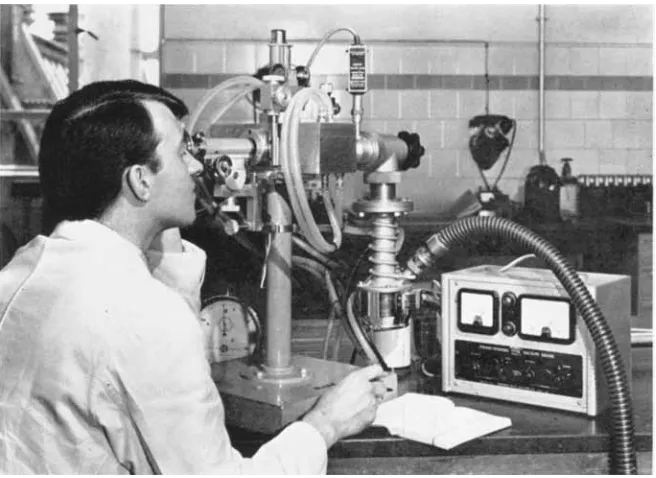
The equipment illustrated in Fig. I and
shown diagrammatically in Fig. 2 was
designed so as to permit detailed microscopic examination to be made of the way in which small glass beads melt in contact with flat plat- inum surfaces. The rhodium-platinum tape heater, which was largely self-supporting, provided a rectangular hot zone 5 cm long, 2.5 cm wide and I cm high into which test
Fig. 1 The hot stage microscope designed for studying the wetting of platinum and its alloys
by glass
specimens could be rapidly introduced. These test specimens were supported on two thin alumina tubes as shown in the
diagram. The thermocouple wire, introduced through these tubular supports, was arranged so that the hot junction came into direct con- tact with the under surface of the
platinum test specimen. The
position of this hot junction, in relation to the glass bead, can be seen in Fig. 4.
Power was fed into the heater from a low voltage transformer through water-cooled current leads. Temperature control in the heater was monitored by a thermocouple welded to its mid- point which controlled a small resistance in series with primary circuit of the transformer. The heater was provided with addi- tional support from below by an alumina knife edge, and surroun- ded by a nest of platinum
examination. The whole heater assembly was mounted in a water cooled casing machined from a solid Duralumin block. This casing, provided with quartz viewing ports, had demountable joints sealed by Neoprene “0” rings SO that tests could be made in any desired atmosphere or in vacuum.
With a ~ i - i n c l i bore oil diffusion pump fitted to the enclosure, operating pressures of
I O - ~ Torr could be maintained with the
heater at 1400’C. The volume of the
evacuated chamber was approximately two litres, leak rates after prolonged degassing being approximately 10 to 15 microns per hour.
To provide adequate working distance with reasonable magnification the vertical micro- scope was fitted with a x 15 reflecting objective. The horizontal microscope fitted with a conventional refracting objective had
a total visual magnification of approximately twenty diameters.
The
Glasses
Studied
A widely uscd plate glass, and a borosilicate glass typical of the kind employed for glass fibre manufacturc, were selected for rhis investigation. The former was Pilkington Universal Plate Glass, a soda-lime-silica glass, and the latter was a Pilkington “E”
Platinum Metals Rev., 1965, 9 , (3),
glass, a low alkali calcium-alumino-boro- silicate glass.
Contact
Angle Determinations
The contact angle referred to in this paper is the angle included between the solid surface and the tangent to the liquid drop
at the solid-liquid interface. Complete
wetting occurs when the contact angle is zero. No wetting occurs if the contact angle
is higher than 90’.
Small clean beads of glass were prepared by melting cracked fragments on a block of hard graphite in air. By melting rapidly and avoiding overheating, contamination was reduced to a minimum. Only those beads between I and 1.5 mm in diamcter were used for these determinations, as experience had shown that within these limits bead size had little effect upon the measured contact angle.
The platinum test specimens, I cm square and approximately 0.5 mm thick, were cut from rolled sheet. The test surfaces were ground and polished by conventional metal- lographic techniques, the final finish being attained by polishing on a cloth with I
micron diamond powder. After water
washing, degreasing and drying with acetone the specimens were annealed at test tem- perature immediately prior to placing of the
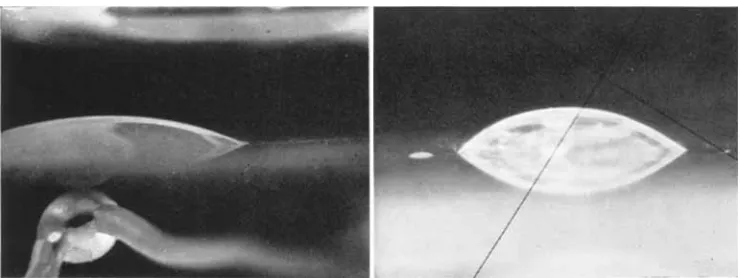
Fig. 4
of the
T y p i c a l “skirt” effect caused by retraction glass droplet on the p l a t i n u m surface at
1400°C
(x
30)glass bead. Subsequent laboratory tests
showed that pre-annealing had little effect upon the contact angles observed and one or two of the experimental points obtained with work hardened specimens are shown in Fig. 7.
The metal specimen with its associated glass bead was positioned on the specimen supports of the hot stage microscope and moved into the hot zone of the furnace which was independently controlled at the desired test temperature. The contact angle between the cLsessile” glass droplet and its supporting metal surface was measured as soon as possible after the latter had arrived at furnace temperature, and was subsequently monitored at constant temperature until the droplet had assumed stability. Equilibrium in the case of a glass such as the “E” glass was not attained until the specimen had been held at temperature for several hours, and this sluggishness was attributed initially to high viscosity.
Effect
of
Time
The changes of contact angle that occurred with time when the “E” glass was supported on pure platinum in air at constant tempera- ture are plotted in Fig. 3. At 1o3o0C the initially high contact angle of 88°C decreased rapidly and arrived asymptotically at an equilibrium value of 20’ after about thirty
minutes. The gradual advance of the glass
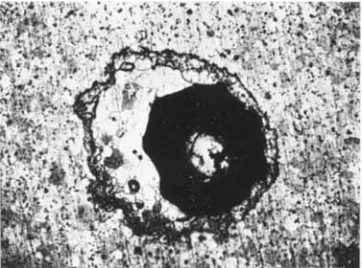
Fig. 5 A ring of debris lefi behind after breakdown of the skirt ( x 30)
bead over the platinum surface resulting from this progressive decrease of contact angle with time can readily be appreciated.
At 14oo0C, however, the contact angle, initially low, increased rapidly with time and arrived at a peak value after eight minutes. This increase of contact angle involved a
corresponding retraction of the glass bead. I n its earlier stages this dewetting process usually resulted in the formation of a skirt round the droplet similar to that shown in Fig. 4. Further retraction generally caused the skirt to break away, leaving a ring of “debris” such as that shown in Fig. 5 . These changes in contact angle are not due to changes in temperature, as determinations were only commenced after the specimens
had arrived at test temperatures. The
relatively slow changes of contact angle with time plotted in Fig. 3 can be interpreted in terms of the equilibrium contact angle curves as discussed in the next section.
The dewetted area left behind after retraction had a higher reflectivity than its surroundings. Fig. 6 shows the characteristic appearance of a dewetted specimen which had been cooled to room temperature before photographing.
Effect
of
Temperature
Curves showing the effect of temperature on the equilibrium contact angles of the “E”
Fig. 6 Characteristic appearance of the dewetted surface after the retraction of a glass bead, showing the irregular and asymetric shape of the bead and
the surrounding ring of debris ( x 20)
platinum surfaces in air are plotted in Fig. 7.
Most of the points on the curves represent the mean value of two determinations made on separate beads of glass which were heated rapidly to test temperature and held there until apparently stable conditions had been attained. The shape of these curves explains to some extent why dewetting occurs. If, for example, a specimen of “E” glass is heated rapidly to 1400T from room temperature it must pass through the
temperature region 1000 to 1200OC
where the equilibrium contact angle is low and the platinum is readily wetted. The droplet spreads, therefore, and in some way conditions the platinum sur- face. At 1400”C, however, the contact angle is very much higher and the droplet is forced to retract. The rate of
this retraction is limited to some extent by the viscosity of the glass and by its reluctance to abandon a platinum sur- face with which it has become closely related. This intimate relationship probably explains the skirt formation and its final breakdown.
While dewetting occurs at constant temperature the conditions which make dewetting possible undoubtedly arise during the rapid, transient heating period.
The dotted lines plotted in Fig. 7
represent the only test results we were able to find in the literature which were in any
way comparable to our own. Although
Cherniak and Naidus (I) studied a borosilicate and soda glass they assumed that their test specimens had assumed stable equilibrium after only thirty minutes at temperature and also used an indirect method of contact angle determination. This probably explains the apparently higher contact angles observed. Their graphs certainly provide no indication of a reversed curvature at higher temperatures.
Thermal
Hysteresis
The finding that the shiny areas left behind after retraction had properties different from those of the surrounding material suggested that fairly pronounced interaction and bonding occurred between heated plat- inum and glass and that the equilibrium finally attained reflected to some extent the prior thermal history of the sessile drop. In order to pursue this line of thought, glass beads were heated directly to temperatures
of 1400 to 1500T and held there until thermal stability had been arrived at. The contact angle was then monitored as the temperature was slowly decreased or main- tained constant at an intermediate level.
The results of one such experimental study are plotted in Fig. 8. The glass droplet was allowed to assume equilibrium at 1400OC in the usual way, after which the temperature was lowered by decrements of 50°C, sufficient time being allowed at each temperature level for the glass to assume its new equilibrium contact angle. The new equili- brium curve was almost invariant with tem- perature, no tendency for the glass droplet to retract being observed even when the temperature was lowered to 980°C.
This behaviour was interpreted as an indication that the k i t , increasing tem- perature contact angle curve did not represent conditions of true equilibrium. This con- clusion was confirmed when a specimen was heated to I 125°C and held at this temperature for sixteen hours. The contact angle gradually increased with time until, as shown by the dotted line on Fig. 8, a position of higher
equilibrium had been arrived at. The changes in contact angle observed when a platinum specimen with a bead of “E” glass was slowly heated from 1000‘ to 1500’C are shown in the same diagram. The temperature level was
increased by 50°C increments and held
constant for three hours at each level to ensure the attainment of stable equilibrium. No significant change in contact angle was observed with increasing temperature, and the curve was almost coincident with that obtained by slow cooling from 1400‘C.
AS the starting-point of this heating curve already lay near the upper cooling curve the agreement between these two sets of results might, it was felt, have been largely fortuitous. Further test specimens were therefore rapidly heated to 1050 and 1125’C and held a t these temperatures until stability had been attained. They were then slowly cooled, as shown. During this slow cooling it was expected that the contact angle would tend to increase in the direction of the upper equilibrium curve.
f- Glass
bead
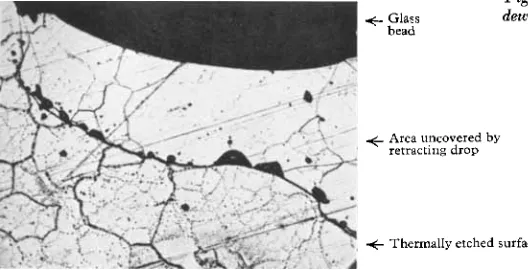
Fig. 9 Detailed topography of a
dewetted platinum surface ( x 150)
+ Arca uncovered by retracting drop
f Thermally etched surface
the glass started to dcvitrify, the tests were discontinued. The reluctance of the glass to develop an increased contact angle may have been due to its high viscosity or to the tendency to crystallise which is always present below the liquidus at 1 1 6 0 T (2). As
the estimated accuracy of contact angle determination was only f zo any slight increases of contact angle that occurred before devitrification might, of course, have been undetected.
Discussion
The interesting wetting behaviour des- cribed in the previous section is characterised by its lack of reversibility and the results cannot therefore be interpreted if the con- ventional view of an equilibrium contact angle is adhered to. Of the upper and lower contact angle curves shown in Fig. 8, for example, which represents the equilibrium condition most accurately ?
Irreversibility implies some type of per- manent change in either the glass or the platinum. At an early stage in this research platinum contamination of the glasses was suspected and then confirmed by spectro- graphic examination. The glass was supported on platinum and completely surrounded by a platinum alloy heater. The surface of the molten glass beads could be examined in great detail through thc microscopes of the instrument, and at temperatures below
IIOO'C
thin films of what appeared to be metallic crystals were frequently observed. These crystals disappeared at higher tem-peratures in a way that suggested solution in the glass.
Subsequent work showed, however, that the presence of platinum in the glass had little effect upon the wetting angle attained. Attention was concentrated, therefore, upon the nature of a platinum surface upon which glass has been melted. Fig. 9 illustrates the nature of such a dewetted surface. The grain boundaries have developed as a result of thermal etching, and the line of debris left behind by the retreating glass can be clearly
discerned. Although it was natural to
suspect that such a surface was in fact still covered with a thin film of glass, no direct evidence for this has yet been detected. The surface of the platinum has, however, been passivated in some way as it strongly resists further thermal etching.
When a fresh glass bead was placed upon a surface similar to that shown in Fig. g
and melted at IIZS'C it immediately assumed an equilibrium wetting angle appropriate to the upper curve in Fig. 8. The simple test demonstrated that the difference between the upper and lower equilibrium curves was simply due to an irreversibIe change in the
platinum surface. It also showed that
viscosity effects were not important at
It is possible that when molten glass has been in contact with a platinum surface for some length of time the chemisorbed layer of oxygen originally present at the interface
might be displaced. Such a platinum
surface would then, according to a hypo-
I IZS°C.
thesis advanced by Pask (3), react with the silicon atoms in the glass less strongly. The surface energy of the interface would increase and this would reflect itself in an increased contact angle.
Such a hypothesis does not completely explain the low change of contact angle with temperature, nor does it account for the apparently fixed and permanent character of the conditioned platinum surface unless this were protected by an undetectable, impermeable glass layer. The results of some wetting tests now being undertaken at very low partial pressures of oxygen might help to resolve some of these apparent anomalies. From the viewpoint of the technologist in the glass industry the implications of the present experimental results are perfectly clear. Pure platinum is generally employed as a batch melting crucible. The interior of such a crucible, being constantly in contact with molten glass, should remain passivated. Although the glass will change the equilibrium contact angle would correspond roughly to the upper curves in Fig. 9 and should therefore change little with temperature.
Summary and Conclusions
Contact angle determinations made in air on a specially designed hot stage microscope have demonstrated the complexity of the high temperature relationships between pure plat-
inum and molten glass. The first test
results seemed to indicate that the equilibrium contact angle, after decreasing rapidly above
900”C, arrived at a minimum close to I I O O O C and then increased with rising temperature. This effect, however, appears to be caused by irreversible changes in the characteristics of the platinum surface. Fresh glass added to platinum that has been previously con- ditioned in contact with glass at high tem- perature very rapidly assumes an equilibrium contact angle which is almost invariant with temperature. Glass melted in contact with platinum which has not received this “con- ditioning” treatment first assumes a lower contact angle and then tends to approach
the equilibrium value at a rate which depends on the temperature level. The two types of apparently stable contact angle seem to reflect differences between platinum surfaces with and without adsorbed layers of oxygen and these results suggest profitable lines for further investigation.
Acknowledgments
The glasses used in this research were supplied by Mr R. C. Jewell, of Pilkington Brothers Ltd, to whom the authors would like to express their thanks for continued interest and encouragement. Acknowledgments are also due to Mr J. Barker who carried out many of the earlier determinations.
References
I M. G. Cherniak and G. G. Naidus, J . Tech. Physics, U.S.S.R., 1957, 27 (10), 2268-2272
2 Private communication from Mr R. C. Jewell
3 J. A. Pask and R. M. Fulrath,J. A m . Ceram.
S0c.J 1962,45 (I2), 592-596
Anodic
Protection for
Sulphuric Acid
Tank
Car
The technique of anodic protection as a means of preventing corrosion has been described in this journal (Platinum Metals
Rev., 1960, 4, 17 and 86; 1963, 7, 94) and a number of successful applications of the method have been reported in the literature. An unusually interesting example of this
simple and inexpensive method has now been reported by the Anotrol Division of Contincn-
tal Oil Co, who have for some time made available suitable equipment for this purpose. For over a year one of these units has been