PREFERECES OF COLOR, SIZE, SHAPE, AD TASTE OF ORAL SOLID DOSAGE FORMS
Inas Rifaat Ibrahim*, Mohamed Izham M.I. and Mahmoud Al-Haddad
Discipline of Social and Administrative Pharmacy, School of Pharmaceutical Sciences, Universiti Sains Malaysia, 11800, Penang (Malaysia)
Summary
The purposes of this study were to investigate the most preferred oral solid dosage forms (OSDF) and the form that seems easy to swallow; preferences of color, shape, size, and taste of OSDF; and to determine possible associates with public preferences. Self-administered questionnaires were distributed among 350 individuals in Penang Island. Samples of different OSDF (capsule, tablet, caplet, and soft gel capsule) were shown to the respondents during the interview. Data were presented by frequencies and percentages for categorical variables and were analyzed by using Chi- square test at an alpha level of 0.05. Results revealed that capsule was the most preferred OSDF while soft gel seemed to be the easiest form in swallowing. Most respondents preferred OSDF to be white in color, round in shape, small in size, and without taste. A significant difference (p<0.05) was found between gender and ethnic groups toward the preferred OSDF.The most important physical characteristics of OSDF were size followed by taste, shape, and color respectively.
Key words: Color; Easy to swallow; Oral solid dosage form; Preference
Introduction
Due to their convenient use, oral solid dosage forms (OSDF) are more popular preparations nowadays (1). Their visual appearance and ease of swallowing have an effect on public preferences and acceptance of this type of pharmaceutical preparations (2). It has been agreed that the formulation of medicine, color, size, shape, and taste are related to the credibility of the treatment (3, 4). Thus, the importance of visual characteristics of OSDF has been investigated. Few reports addressed public preferences and expectations toward the appearance of OSDF have been found. Soft gel was preferred over other forms and was found to be easier in swallowing than coated tablet and tablet; white was the preferred color; the preferred shape was strongly arched circular (2, 5). Researchers stressed the importance of pill color that has been associated with specific expectancies. Red OSDF considered as strong and active while blue and green as depressants (6). Moreover, it was found that red and orange capsules were ranked as strongest while white capsules were rated as weakest (7).
Size and shape of OSDF also have been addressed recently. Koteles and Bardos reported that large oblong tablet was preferred over small and medium round tablet (8). While, Buckalew and Coffield found that capsule size is associated with the strength of medicine, a conclusion of “bigger is better” was reached (3).
Another challenging factor for many people to complain and continue their prescribed oral medication is the taste. For good compliance; taste, size, and type of formulation of oral preparations should be accepted and preferred (9).
No published data available in Malaysia regarding public preferences and expectations of OSDF. For this reason the current study was conducted to investigate the preferred OSDF and the form that seems easy in swallowing; to determine public preferences toward the physical characteristics of OSDF like color, shape, size, and taste; to determine the possible factors that might be associated with these preferences like gender and ethnic groups.
Methods Study Design
Study Tool: The questionnaire
The questionnaire consisted of four sections. The first section gathered information regarding demographic data like gender, age, and ethnic group. The second section comprised a set of questions regarding preferences of the following OSDF capsule, tablet, caplet, and soft gelatin. The third section of the questionnaire contained questions to determine the form that seems easy in swallowing on four-point scale (very easy to swallow, easy to swallow, difficult to swallow, and very difficult to swallow). The last section consisted of a list of questions regarding preference of color, shape, size, and taste of OSDF. At the end of this section, respondents were asked to rank these physical characteristics in terms of their importance to the public themselves.
Statistical Analysis
The valid data were coded, entered, and analyzed using the Statistical Package for Social Science (SPSS) version 16. Descriptive results were presented as frequencies and percentages. Chi-square test was used to compare the frequencies of cases found in the variables. Statistical significance was set at P <0.05.
Results Characteristics of Respondents
A total of 300 questionnaires out of 350 were completed successfully and returned with a response rate 87.5%. Most of the respondents were females (n= 180; 60.0%). The mean age of respondents was 37.2+ 14.4 years, with a range of 19-89 years. All demographic characteristics are presented in Table 1.
Table 1.Demographic characteristics of respondents
Characteristics n (%) {N= 300}
Male 120 (40.0%)
Gender
Female 180 (60.0%)
19-39 213 (71.0%)
40-59 70 (23.3%) Age in years
60+ 17 (5.7%)
Malay 123 (42.1 %)
Chinese 151 (50.3%)
Indian 16 (5.3%) Ethnic group
Preferences of OSDF and the Ease of Swallowing
Overall, Capsule was the most preferable OSDF by the majority of respondents (37.3%; n=112). A significant difference was found between gender preferences in which females tend to prefer capsule more than males (P= 0.018). Similarly, ethnicity found to significantly affecting on respondents preferences of OSDF (P= 0.023). Capsule was preferred by both Chinese and Malays while tablet and soft gel was the preferred form by Indians and other races as shown in Table 2.
Table 2.Gender and ethnic group preferences of OSDF
Preferred form n (%) {N= 1000} Variables
Capsule Tablet Caplet Soft gel
P- value
Male 45 (15.0%) 38 (12.75) 5 (1.7%) 32 (10.7%) Gender
Female 67 (22.3%) 39 (13.0%) 11 (3.7%) 63 (21.0%)
0.018*
Malay 53 (17.7%) 32 (10.7%) 2 (0.7%) 36 (12.0%)
Chinese 57 (19.0%) 35 (11.7%) 11 (3.7%) 48 (1.0%)
Indian 1 (0.3%) 7 (2.3%) 1 (0.3%) 7 (2.3%) Ethnic
groups
Other 1 (0.3%) 3 (1.0%) 2 (0.7%) 4 (1.3%)
0.023*
* A significant difference was detected by Chi- square test (P <0.05)
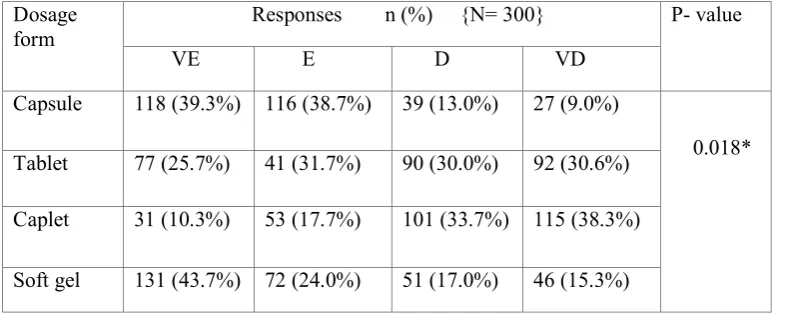
Table 3.OSDF that seems easy to swallow
Preferences of the physical characteristics
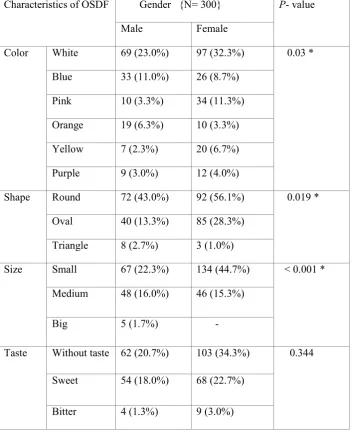
All of the respondents reported their preferences toward color, shape, size, and taste of OSDF as shown in Table 4. White was the preferred color of OSDF by more than half of the respondents (55.3%; n= 166); followed by blue (19.7%; n= 59); pink (14.6%; n=44); orange (9.6%; n= 29); yellow (9.0%; n= 27); and finally purple (7.0%; n= 21). For the shape, slightly more than half (53.4%; n=160) of the respondents preferred round shape OSDF. Other shapes preferred were oval (41.6%; n= 125), and Triangle (3.7%; n= 11). Moving to the size, the majority of respondents (67%; n=201) preferred their oral solid medication to be small in size; however, (31.3%; n= 94) of the respondents preferred medium size and (1.7%; n= 5) preferred big size OSDF.
For the taste, more than half (55.0%; n= 165) of respondents preferred their OSDF to be without taste while (40.7%; n= 122) preferred sweet taste. Only (4.3%; n= 13) preferred bitter taste. Interestingly, preferences of the physical characteristics were varied by gender in which Chi- square test detect a significant level (P<0.05) between genders and their preferences of color, shape, size but it was not the case with preferences of taste.
Responses n (%) {N= 300} Dosage
form
VE E D VD
P- value
Capsule 118 (39.3%) 116 (38.7%) 39 (13.0%) 27 (9.0%)
Tablet 77 (25.7%) 41 (31.7%) 90 (30.0%) 92 (30.6%)
Caplet 31 (10.3%) 53 (17.7%) 101 (33.7%) 115 (38.3%)
Soft gel 131 (43.7%) 72 (24.0%) 51 (17.0%) 46 (15.3%)
0.018*
Abbreviations:V, very east to swallow; E, east to swallow; D, difficult to swallow; VD, very difficult to swallow
Table 4.Gender preferences of the physical characteristics of OSDF
Gender {N= 300} Characteristics of OSDF
Male Female
P- value
White 69 (23.0%) 97 (32.3%)
Blue 33 (11.0%) 26 (8.7%)
Pink 10 (3.3%) 34 (11.3%)
Orange 19 (6.3%) 10 (3.3%)
Yellow 7 (2.3%) 20 (6.7%)
Color
Purple 9 (3.0%) 12 (4.0%)
0.03 *
Round 72 (43.0%) 92 (56.1%)
Oval 40 (13.3%) 85 (28.3%)
Shape
Triangle 8 (2.7%) 3 (1.0%)
0.019 *
Small 67 (22.3%) 134 (44.7%)
Medium 48 (16.0%) 46 (15.3%)
Size
Big 5 (1.7%) -
< 0.001 *
Without taste 62 (20.7%) 103 (34.3%)
Sweet 54 (18.0%) 68 (22.7%)
Taste
Bitter 4 (1.3%) 9 (3.0%)
0.344
With respect to the importance of the physical characteristics, slightly more than half (52.3%; n= 157) of the respondents rated the size as the most important characteristic followed by taste (40.7%; n=122), shape (13.6%; n=41), and color (13.4%; n=40) respectively as shown in Table 5.
Table 5.The importance of physical characteristics
Responses n (%) {N= 300} Dosage form
MI I NI LI
Color 40 (13.3%) 25 (8.3%) 71 (23.7%) 164 (54.7%)
Shape 41 (13.6%) 72 (24.0%) 108 (36.0%) 79 (26.3%)
Size 157 (52.3%) 105 (35.0%) 32 (10.7%) 6(2.0%)
Taste 122 (40.7%) 78 (26.0%) 69 (23.0%) 31 (10.3%)
Abbreviations: MI, most important; I, important; NI, not important; LI, least important
Discussion
Although public preferences and product acceptance have been the subjects of much marketing research but little attention was targeted on the pharmaceutical formulations and their physical characteristics. Expectations toward these physical characteristics play an important role in the medication adherence and successful therapy outcome and might be the first important factor in the choice of medicine (10). Our findings are the first in Malaysia, and one of the very few available all over the world (4).
A significant difference was found with respect to the public expectations toward the form that seems easy in swallowing. It was found previously that soft gel is the form that perceived to be easy in swallowing (5, 10).
It appeared that a preference toward the physical characteristic of OSDF is the field in which literatures are scarce. Our study revealed an interesting results in which genders have their different preferences toward a particular characteristic of OSDF except with the taste. Females tend to prefer pink color OSDF while males tend to prefer blue. In cultures, pink represents girlishness and femininity while blue is neutral and associated with clear thinking (13). Round shape and medium size were the most preferred characteristics in OSDF for both genders. A possible explanation can be driven by the easily passage of the small size and round shape OSDF through the esophagus (2, 14). Size of OSDF was rated as the first important characteristics followed by taste, shape, and color. Nearly, similar results were found by Brotherman et al. in which size was rated as the most important characteristics followed by shape, taste, and finally color (10).
Findings from this study suggest that the formulation of medicines and their physical characteristics are of high importance in encouraging patients to continue using a particular medicine. Further, they are important factors in influencing initial selection of products available in the market especially with non-prescribed medications.
Conclusion
Public have their preferences toward a particular OSDF in which capsule is the preferred one in Penang Island while soft gelatin is the form that seems the easiest to swallow. Size of OSDF is the most important physical characteristic for public to manage their choices, followed by taste, shape, and color. There are significant differences in terms of gender and ethnic group toward the preferred OSDF. Findings from this study can help the pharmaceutical firms to better understand their consumers in providing friendly products, which indirectly enhance treatment compliance. Prescribers may consider public expectations and ease of swallowing oral solid medications in continuation of the treatment and adherence programs.
Acknowledgments
References
1. Zaid A, Abu Ghosh A, Sweileh W, Al-Jabi S, Jaradat N. Chewable tablets: is this dosage form well evaluated by Palestinian health professionals?. The Islamic University Journal 2007; 5:83-94.
2. Overgaard A, Hojsted J, Hansen R, Moller-Sonnergaard J, Christrup L. Patients’ evaluation of shape, size and color of solid dosage forms. Pharmacy World & Science 2001; 23:185-188.
3. Buckalew LW, Coffield KE. An investigation of drug expectancy as a function of capsule color, size and preparation Form. J Clin Psychopharmacology 1982; 2:245-8.
4. Koteles F, Fodor D, Cziboly A, Bardos G. Expectations of drug effects based on color and sizes- the importance of learning. CEMED 2009; 3:99-107. 5. Jones WJ, Francis JJ. Soft gels: Consumer perceptions and market impact
relative to other oral dosage forms. Advances in Therapy 2000; 17:213-221. 6. de Craen M, Roos J, Vries L, Kleijnen J. Effect of color of drugs: systematic
review of perceived effect of drug and of their effectiveness, BMJ 1996; 313:1569-1570.
7. Buckalew LW, Sallis RE. Patient compliance and medication perception. Journal of Clinical Psychology 1986; 42:49-53.
8. Koteles F, Bardos Y. Expectations of drug effects based on colors and sizes of tablets. Mentalhigiene es Pszichoszomatika 2007; 8: 277–290.
9. Reginster J, Kaufman J, Gangjii V. Preference for and acceptability of two formulations of a dietary supplement containing calcium plus vitamin D3: a Randomized, open-Label, crossover trial in adult patients with calcium and vitamin D deficiencies. Current Therapeutic Research 2005; 66:23-34. 10.Brotherman DP, Bayraktaroglu TO, Garofalo RJ. Comparison of ease of
swallowing of sietary Supplement products for age-related eye disease. Journal of the American Pharmacist Association 2004; 44:587-593.
11.Bhosle M, Benner J, DeKoven M, Shelton J. Difficult to Swallow: Patient preferences for alternative valproate Pharmaceutical formulations. Patient Preferences and Adherence 2009; 3:161-171.
12.Buckalew LW, Coffield KE. Drug expectations associated with perceptual characteristics: ethnic factors. Percept. Motor Skills 1982; 55:915-918.
13.Wilknison EJ, Sherk HA. The use of visualiInformation for planning accurate steps in a cluttered environment”, Behav. Brain Res 2005; 20:270-274. 14.Channer K, Virjee J. The effect of size and shape of tablet on their esophageal