© 2016 IJSRST | Volume 2 | Issue 2 | Print ISSN: 2395-6011 | Online ISSN: 2395-602X Themed Section: Engineering and Technology
Effect of Cyclic Prefix in BER Improvement in MIMO-OFDM System
Kalpesh F. Chaudhari, Aniket J. Prajapati, Prakash N. Suthar
Electronics Department, Bhagwan Mahavir College of Engineering & Technology,Surat, Gujarat, India
ABSTRACT
In the last many years in the world as communication has created many type in the general purpose use their transmitting data , In the data transmitting their present & future condition the data transmitting needs the highly speed transmitting them. High speed data communication in the main problem is the ISI(inter-symbol interference).it is created through the highly mobile environment due ISI. A broad wireless communication channel in A multiple input- multiple output(MIMO) and orthogonal frequency division multiplexing(OFDM) combine communication technique is such a highly speedy and accuracy highly data rate. MIMO-OFDM is the 4G technologies likes use wild WI-MAX & LTE. In OFDM system in mostly aspect cyclic prefix. cyclic prefix length increases then interference is reduce. Then finally to the BER (Bit Error Rate) and the interference is the perfect solution find out through the length of cyclic prefix.
Keywords:
MIMO-OFDM, Cyclic Prefix, AWGN (Additive White Gaussian Noise) Channel, Rayleigh
Fading Channel.
I.
INTRODUCTION
Traditional single carrier modulation techniques can achieve only limited data rates due to the restrictions imposed by the multipath effect of wireless channel and the receiver complexity. High data-rate is desirable in
many recent wireless multimedia applications.
However, as the data-rate in communication system increases, the symbol duration gets reduced. Therefore, the communication systems using single carrier
modulation suffer from severe inter-symbol
interference (ISI) caused by dispersive channel impulse response, thereby needing a complex equalization
mechanism. Orthogonal Frequency Division
Multiplexing (OFDM) is a special form of multicarrier modulation scheme, which divides the entire frequency selective fading channel into many orthogonal narrow band flat fading sub channels.
The basic principle of OFDM is to split a high-rate data-stream into a number of lower rate streams that are transmitted simultaneously over a number of sub-carriers. The relative amount of dispersion in time caused by multipath delay spread is decreased because the symbol duration increases for lower rate parallel
subcarriers. The other problem to solve is the inter-symbol interference, which is eliminated almost completely by introducing a guard time in every OFDM symbol. This means that in the guard time, the OFDM symbol is cyclically extended to avoid inter-carrier interference. OFDM has several advantages like high spectral efficiency, robustness to channel fading, immunity to impulse interference, uniform average spectral density, capacity to handle very strong echoes and less non-linear distortion. OFDM is the modulation technique used in many new broadband communication systems. In recent years OFDM has emerged as the standard of choice in a number of important high data applications. OFDM is the modulation technique used in many new broadband communication systems. In recent years OFDM has emerged as the standard of choice in a number of important high data applications.
II.
METHODS AND MATERIAL
MIMO Overview
transmitter side as well as at the receiver side shown in fig.1.
Figure 1. MIMO System[3]
Spatial multiplexing requires MIMO antenna
configuration. In spatial multiplexing, a high-rate signal is split into multiple lower-rate streams and each stream is transmitted from a different transmit antenna in the same frequency channel. If these signals arrive at the receiver antenna array with sufficiently different spatial signatures and the receiver has accurate CSI, it can separate these streams into (almost) parallel channels. Spatial multiplexing is a very powerful technique for increasing channel capacity at higher signal-to-noise ratios (SNR). The maximum number of spatial streams is limited by the lesser of the number of antennas at the transmitter or receiver. Spatial multiplexing can be used without CSI at the transmitter, but can be combined with preceding if CSI is available. Spatial multiplexing can also be used for simultaneous transmission to multiple receivers, known as space-division multiple access or multi-user MIMO, in which case CSI is
required at the transmitter.[12] The scheduling of
receivers with different spatial signatures allows good reparability.
MIMO OFDM System
Different techniques are there to improve the performance of the system in MIMO system. In order to attain a diversity gain to combat signal fading or capacity gain, MIMO system can be implemented in different ways. Spatial Diversity, Spatial Multiplexing, Beam forming. In spatial diversity (SD) techniques, the transmitter sends the multiple copies of the same signal or symbols. SD technique requires a number of signal transmission paths which are known as the diversity paths and each diversity path carries the same
information. To multiplex (divide) and transmit a data stream into several paths and transmit via independent channels in space and different bits are transmitted via different antennas is the basic concept of Spatial Multiplexing (SM). At transmitter end in MIMO system, beamforming exploits the knowledge of the channel. Beamforming technique provides gain in between
capacity gain and diversity. In single-layer
beamforming, same signal is transmitted from each of Transmitting antennas with the appropriate gain and phase weighting such that the signal power at the input of receiver is maximum.
The key advantage of beamforming is to increase the received signal gain, by making signals transmitted from independent antennas add up constructively, and reduce the multipath fading effects. Signal in MIMO system is suffered from the ISI and ICI, which is responsible for the poor BER performance. To improve the BER performance, to get high efficient spectral efficiency and to get high system capacity, MIMO system is combining with the OFDM. In real situation, multipath propagation usually occurs and causes the MIMO channels to be frequency selective.
Figure 2. MIMO-OFDM System[3]
is that since low-rate modulations are less sensitive to multipath, the better way is to send a number of low rate streams in parallel than sending one high rate waveform. It divides the frequency spectrum into sub-bands small enough so that the channel effects are constant (flat) over a given sub-band. Then a classical IQ (In phase Quadrature phase) modulation (BPSK) is sent over the sub-band. A large number of closely spaced orthogonal subcarriers are used to carry data. The data is divided into several parallel data streams or channels, one for each subcarrier. OFDM transforms the frequency selective fading channels into parallel flat fading sub channel, as long as the cyclic prefix (CP) inserted at the beginning of each OFDM symbols is longer than or equal to the channel length.
Inter Symbol Interference (ISI)
Figure 3. Combating ISI using a guard period[4]
Guard Period
Basically two types are used. 1. Zero padding
2. Cyclic prefix
The Guard Period In OFDM System can be inserted in two different ways. One way is the zero padding (ZP) i.e. pads the guard interval with zeros.
The other way is the cyclic extension of the OFDM symbol (for some continuity) by insertion of CP (cyclic prefix) or CS (cyclic suffix). CP is to extend the OFDM symbol by copying the last samples of the OFDM symbol into its front.
Zero Padding
Figure 4. OFDM symbol with ZP[4]
Figure 5. ISI Effect of a multipath channel on OFDM
symbols with ZP [9]
We may insert zero into the guard interval, the particular approach is adopted by multiband OFDM (MB-OFDM) in an Ultra Wide-band (UWB) system.
Cyclic Prefix
Figure 6. OFDM symbol with CP[4]
Let TG denoted the length of CP in terms of samples. then, the extended OFDM symbol now have the duration of
III.
RESULTS AND DISCUSSIONS
Parameters Assumptions for the OFDM
BER Calculation
The BER expression for M-ary QAM signalling for AWGN channel is given below
= Q (√ ) Eq.(1)
Standard Q- function defined as
Q =
√ ∫
⁄ Eq.(2)
Flow Chart of the System without OFDM
First serial data is converted into parallel data. After that data is modulated according to modulation scheme (BPSK). After that data is transmitted through channel. When data is received first it is converted from parallel to serial data and then demodulated according to modulation scheme (BPSK). After that BER is calculated by comparing transmitted and received data.
BPSK for AWGN
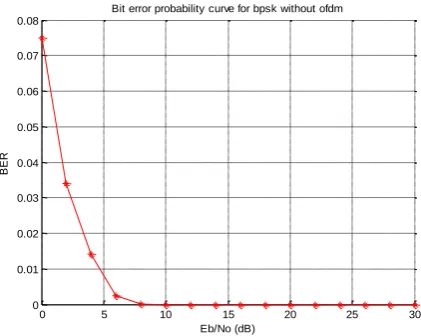
Figure 7. Bit error probability curve for BPSK Without OFDM
Fig.6 shows BER performance of BPSK modulation scheme in AWGN channel. As bit energy/noise is increasing BER is decreasing.
Flow Chart of MIMO with OFDM
First signal is modulated as per modulation scheme than serial data is converted into parallel form and after that IFFT is applied. After this CP is added again parallel data is converted into serial form and transmitted through channel. After reception first serial data is converted into parallel form and CP is removed, after that FFT is applied, again parallel data is converted into serial form and demodulated as per modulation scheme.
0 5 10 15 20 25 30
0 0.01 0.02 0.03 0.04 0.05 0.06 0.07 0.08
Bit error probability curve for bpsk without ofdm
BER
BPSK for AWGN
Figure 8. Bit error probability curve for BPSK with OFDM
In system with OFDM BER performance is improved (BER is decreased) as compared to system without OFDM.
COMPARISON
BPSK for AWGN
Figure 9. Bit error probability curve for BPSK With and Without OFDM
Fig.9 shows comparison of BPSK modulation scheme under AWGN channel with and without OFDM.
In system with OFDM BER performance is improved (BER is decreased) as compared to system without OFDM.
BPSK for Rayleigth
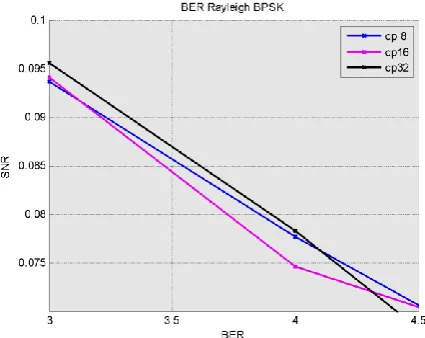
Figure 10. BPSK from Rayleigth fading
Fig.10 shows BER performance of BPSK modulation scheme in Rayleigth channel. With the Cyclic Prefix(CP) value higher is through BER decreseces.
IV.
CONCLUSION
The BER Performance of MIMO OFDM system has been without guard period and with guard period. The comparison shows that the performance with guard period is better than without guard period.The best CP length from BPSK in BER less is higher length of CP.
V.
REFERENCES
[1]. C. Poongodi, P.Ramya A, Shanmugam,(
2010).“BER Analysis of MIMO OFDM System using M-QAM over Rayleigh Fading Channel.” IEEE, pp.284-288
[2]. Kari pajukoski,(2013).“On the Selection of Guard
Period and Cyclic Prefix for Beyond 4G TDD Radio Access Network”. IEEE.
[3]. M.Jiang and L. Hanzo, July 2007, Multiuser
MIMO- OFDM for next generation wireless systems, Proceedings of IEEE. vol.95,pp.1430-1469.
[4]. Mitalee Agrawal, Yudhisthir Raut,(2012).“Effect
of Guard Period Insertion in MIMO OFDM
System” International Journal of Computer
Technology and Electronics Engineering
(IJCTEE), Volume 1 , Issue 2.
0 5 10 15 20 25 30
0 0.01 0.02 0.03 0.04 0.05 0.06 0.07 0.08 0.09
Eb/No (dB)
BER
BER for QAM using AWGN channel
[5]. Omar Daoud1, Wael Al-Sawalmeh,(2013).“Enhancing the BER of MIMO- OFDM Systems for Speaker Verification.” IEEE,SSD’13 1569677851.
[6]. Viswasom s, Murli d,(2013).“Effect of cyclic
prefix reduction on OFDM-CDMA systems”
International Conference on Microelectronics,
Communications and Renewable Energy
(AICERA/ ICMiCR).IEEE, 978-1-4673-5150-8.
Books :
[7]. B.P.Lathi,(2009). “Modern Digital and Analog
Communication Systems”. ISBN-13:
978-0195331455
[8]. J. G. Proakis, (2008). “Digital Communications”,
McGraw-Hill.
[9]. Yong Soo Cho, Jackwon Kim, Won Young Yang,
Chung G. Kang. “mimo-ofdm wireless
![Figure 1. MIMO System[3]](https://thumb-us.123doks.com/thumbv2/123dok_us/9064694.1441972/2.595.92.238.99.225/figure-mimo-system.webp)
![Figure 4. OFDM symbol with ZP[4]](https://thumb-us.123doks.com/thumbv2/123dok_us/9064694.1441972/3.595.313.541.83.375/figure-ofdm-symbol-with-zp.webp)