19
Designing Campaign Message Through The
Main Visual Elements In Character Animation
Rina Wahyu Winarni, Winny Gunarti W.W., Wirawan Sukarwo
Abstract: Animated film could be one form of media campaigns. This study designed a short animated film entitled “The Story of Three Little Girls” as a
creative strategy to help socialize the issue of human trafficking, especially for teenage girls in Indonesia. As a media campaign this animated presents visual narrative and the main characters. The visual narrative of character animation involve the visual elements, consisting of visual style of facial features, body posture, and fashion style. Qualitatively, the discussion about the visual elements using a semiotic approach to reading visual signs in the character animation. Quantitatively, this study also involving 130 students to read the meaning of the visual style. The visual narrative of character animation show the main visual elements that can build the campaign message.
Keywords: campaign message, visual elements, character animation.
————————————————————
1
I
NTRODUCTIONCases of human trafficking have become important issues in Indonesia. The United Nations noted Indonesia Indonesia as one of the countries with high human trafficking issues since become a transit point and supplier. Most victims of human trafficking are young women and children under age. They were forced to do prostitution or become laborers with low wages. In an effort to help socialize these issues to the public, researchers from the major of Visual Communication Design, Indraprasta University PGRI, South Jakarta with supported by the Indonesian Directorate General of Higher Education (Ditjen Dikti), try participating in a campaign of this social problem. The goal is to give awareness the public, especially for the young women in Indonesia in order to remain alert with the various modes of human trafficking crimes. This is a form of academic participation in finding a model of visual media communication campaign. The chosen form of media campaign is to design a short animated film. This model is considered to have a visual power in its visual elements, especially in the visual narrative that displays the characters. Visual elements in the character animation can build the perception that stirs emotions and thoughts because it is more imaginative in representing human life. Animation can provide a deeper impression to the audience (Fallon & Senn, 2007) [1]. This study created a short animated film without dialogue entitled The Story of Three Little Girls. The visual narrative is inspired by the true story that reported through mass media.
2
O
BJECTD
ESCRIPTIONThis short animated film produced in September 2014. It will be campaigned to some secondary school in three cities in Indonesia such as Jakarta as the capital of the state, then Surabaya in East Java, and Indramayu in West Java. The cities are considered to be potential as a transit and a destination target of human trafficking. The teenage girls both who live in urban and rural areas are potential target to be victims of human trafficking. As a media campaign, The Story of Three Little Girls trying to represent social issues in human life. The three main characters in the visual narrative are designd to build awareness of adolescent girls. This animation is about the character of Diana, Tari, and Ida who are victims of human trafficking. Campaign messages designed by visual elements in the character animation consisting of visual style of facial feature, body posture, and fashion style. The design of this short animation using the narrator in its telling. The focus of discussion in this study is how the visual power of visual elements in this animated characters can build an audience perception and socialize the campaign messages. This study is expected to be a model in the animated campaign to aware people about the issue of human trafficking, particularly the exploitation of teenage girls. Here is the data of production team of the animated film.
Title The Story of Three Little Girls
Type Short animated film
Duration 6-7 minutes
Produced September 2014
Story idea Winny Gunarti
Story line Rina Wahyu Winarni
Story board Yudha Pangesti
Character
animation Toni Sugiharto
Animator Matheus Ovan and Dimas S
Editing Dimas S
Director Wirawan Sukarwo
Production Visual Communication Design,
Indraprasta University PGRI.
Supported by Ditjen Dikti and LP2M Indraprasta
University
3
T
HEORYTICALF
RAMEWORK ANDM
ETHODAs a media communication campaign, the animated film has the function to convey the message through verbal and nonverbal visual language. Suprapto (2009) [2] said the __________________________
Rina Wahyu Winarni is currently senior lecturer in visual communication design major in Indraprasta University, PGRI, Jakarta 12530, Indonesia.
E-mail: [email protected]
Winny Gunarti W.W., and Wirawan Sukarwo are also senior lecturers in visual communication design major in Indraprasta University, PGRI, Jakarta 12530, Indonesia.
E-mail: [email protected] and
communication campaign aimed at providing solutions to identify and address the problems of the public. The animated film can be design to identify the human trafficking issues through its visual elements presentation. The duration of animated films for the campaign are generally about six to ten minutes. For a two dimensions (2D) type can choose the duration of 6 to 8 minutes, while for the three dimensions (3D) type are about 10 minutes (Prakosa, 2010) [3]. Character in the animated film also needs to be built in a visual narrative flow. Beiman (2007) [4] divides the group of narratives into a linear story which takes place in a sequence showing of the beginning, middle and end. And the nonlinear story that is not sequential to create effect or combined storyline. Character animation is designed by line of illustrations to form facial feature, body posture, and fashion style. It will show the physical human dimension visualization. It can be formed through a curved or straight line style to build the perception of personality, attitude, and body proportions. The used of curved lines can form facial feature or body posture that more friendly, intelligent, relaxed, shy, melancholy, doubter or clumsy, while straight line style can form aggressive, rigid, and tend to display a hard figure (White, 2009) [5]. A style of illustration in character animation is also becoming an art to describe the visual message. Most animated film using cartoon-style illustrations. The presence of illustration can build a narrative as a whole, for example through the depiction of nature, rural or urban background, buildings, home environment, school environment, the differences of space and time, and the atmosphere of the scene of the crime. The visual narrative that displays the character needs to design the main visual elements as meaningful signs which consists of:
1. Facial feature to build the perception of the character’s personality.
2. Body posture to build the perception of the character’s attitude.
3. Fashion style to build the perception of the character’s status.
This study uses a combination of methods. Qualitatively, the discussion uses a semiotic approach to read the meaning of visual elements. This is a semiotic approach from Barthes (in Fiske, 2007) [6] where the analysis apply the denotation order to read the visual signs directly as described, and the connotation order to read the meaning behind these visual signs. It can relate to the emostions of users and also to understand the cultural values of the communities. While quantitatively, data collection involving 130 students to help identify the message through visual signs. Questionnaires were randomly distributed to the visual communication design students aged 18 to 21 years at the university where the study was conducted. Visual communication design student samples can be considered to interpret the line illustrations. In addition, they are also represent a generation of teenagers who are still searching for self-identity.
4
A
NALYSIS4.1VISUAL NARRATIVE
Analysis of the film The Story of Three Little Girls will focus on the visual narrative and the main visual elements in character animation. Visual narrative in animated film should refer to the theme. Imagination can build a visual narrative about an event
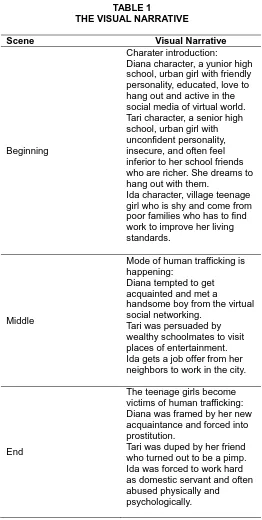
in life. The selection of this theme includes social, psychological, and cultural life of rural and urban communities. The theme in based on the cases of crimes that have occured, particularly exprerienced by adolescent girls. Visual narrative in this short animation using linear story that emphasizes the power of visual narrative in the beginning scene, middle, and end.
TABLE 1
THE VISUAL NARRATIVE
Scene Visual Narrative
Beginning
Charater introduction:
Diana character, a yunior high school, urban girl with friendly personality, educated, love to hang out and active in the social media of virtual world. Tari character, a senior high school, urban girl with unconfident personality, insecure, and often feel inferior to her school friends who are richer. She dreams to hang out with them.
Ida character, village teenage girl who is shy and come from poor families who has to find work to improve her living standards.
Middle
Mode of human trafficking is happening:
Diana tempted to get acquainted and met a
handsome boy from the virtual social networking.
Tari was persuaded by wealthy schoolmates to visit places of entertainment. Ida gets a job offer from her neighbors to work in the city.
End
The teenage girls become victims of human trafficking: Diana was framed by her new acquaintance and forced into prostitution.
Tari was duped by her friend who turned out to be a pimp. Ida was forced to work hard as domestic servant and often abused physically and psychologically.
21
Fig. 1. The Characters of The Story of Three Little Girls: Diana, Tari, and Ida.
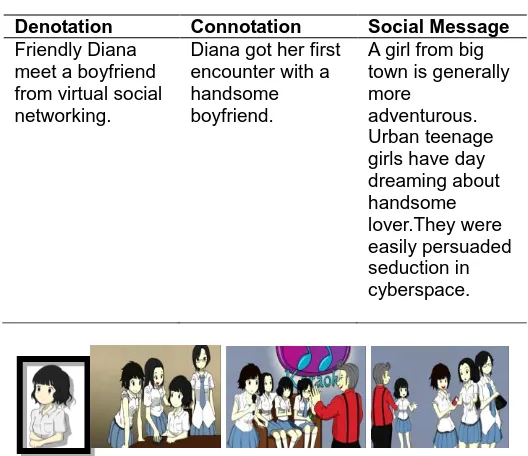
Visual narrative was illustrated through the line elements to build the characters, so that the audience can see the difference of the characters. In addition, the visual narrative can bring social message that represented by the character of Diana, Tari, and Ida as the main characters in the narrative. In the context of Denotative and connotative, visualization of the characters in the narrative can build perception and provide meaning. The reading of the visual signs in this narrative may allows the audience to read the message campaign indirectly. The reading of the sign according to the order of denotation and connotation of each character in the narrative can be seen in the following figures and tables.
Fig. 2. The Visual Narrative of Diana Character.
TABLE 2
THE VISUAL NARRATIVE MESSAGE BASED ON DIANA CHARACTER
Denotation Connotation Social Message
Friendly Diana meet a boyfriend from virtual social networking.
Diana got her first encounter with a handsome boyfriend.
A girl from big town is generally more
adventurous. Urban teenage girls have day dreaming about handsome lover.They were easily persuaded seduction in cyberspace.
Fig. 3. The Visual Narrative of Tari Character.
TABLE 3
THE VISUAL NARRATIVE MESSAGE BASED ON TARI CHARACTER
Denotation Connotation Social Message
Inferiority Tari was sitting and approached by her school friends.
Unconfident girl was persuaded by her richer friends to go some
entertainment place.
A teenage girl needs to actualize herself with the environment. She wants to go to new places such as her friends, so she was easily persuaded or tempted to.follow the leader.
Fig. 4. The Visual Narrative of Ida Character.
TABLE 4
THE VISUAL NARRATIVE MESSAGE BASED ON IDA CHARACTER
Denotation Connotation Social Message
Ida in simple clothes lived with her parents in a wooden house.
The little girl from the village who lives in poverty.
The little girls in the village who live in poverty are generally required to assist parents in order to obtain a better life. They are easily persuaded to work in the city and fooled to work as laborers with low wages.
The character of Diana, Tari, and Ida are the teenage girls who strive as human beings to fulfill their basic needs for love, self-actualization, and dream to become a better person and respected in their society. The feelings and thoughts of the girls make this animated film can built imaginative reality of human life in its environment. As cultural beings, humans have a basic instinct to meet expectations, ambitions, and dreams, so that sometimes unwittingly lose consciousness to remaint vigilant in every step.
4.2THE MAIN VISUAL ELEMENTS IN CHARACTER ANIMATION
this study surveyed a hundred and thirty students of visual communication design at the University of Indraprasta PGRI, South Jakarta who never watched the animated film but was asked to read the visual signs on the characters. They were asked to perceive wether the characters can be perceived as victims or perpetrators of crimes. The results obtained about 85 percent stated that the illustration of Diana, Tari, and Ida, as a character who represents the figure of a crime victim, only about 15 percent to the contrary. See the following table and chart:
TABLE 5
CHARACTER PERCEPTION
Diana Tari Ida
As a crime victim 103 105 110
As a criminal 24 17 16
Neutral 3 8 4
Total 130 130 130
Fig. 5. Character Perception
The perception of the characters refers to the three main visual elements: facial feature, body posture, and fashion style. The facial feature in this animation uses curved lines to depict the character of friendly, educated, shy, clumsy, and melancholy. It included to describe a posture of active, slow, and weak. Fashion style of urban girls will be described differently by fashion from the countryside girls. Quantitative data obtained that the perception of the character seen about 50 percent from the facial feature, while the rest is seen from the body posture and style of clothing, as seen in the following table:
TABLE 6
CHARACTER PERCEPTION AS A CRIME VICTIM BASED ON VISUAL ELEMENTS
Visual Elements Diana Tari Ida
Facial Feature 53 59 58
Body Posture 39 37 33
Fashion Style 38 34 39
Total 130 130 130
Fig. 6. Character Perception As A Crime Victim Based On Visual Elements
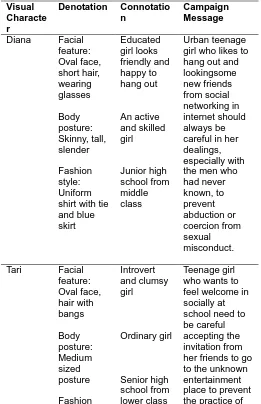
This survey also indicates that the visual style of facial feature is the main visual element that can build the perception about the personality. To read the campaign message through the visual signs in character animation can be described by the order of denotation and connotation as follows:
TABLE 7
VISUAL CHARACTER MESSAGE BASED ON MAIN VISUAL ELEMENTS
Visual Characte r
Denotation Connotatio n
Campaign Message
Diana Facial feature: Oval face, short hair, wearing glasses
Body posture: Skinny, tall, slender
Fashion style: Uniform shirt with tie and blue skirt
Educated girl looks friendly and happy to hang out
An active and skilled girl
Junior high school from middle class
Urban teenage girl who likes to hang out and lookingsome new friends from social networking in internet should always be careful in her dealings, especially with the men who had never known, to prevent abduction or coercion from sexual misconduct.
Tari Facial feature: Oval face, hair with bangs
Body posture: Medium sized posture
Fashion
Introvert and clumsy girl
Ordinary girl
Senior high school from lower class
Teenage girl who wants to feel welcome in socially at school need to be careful accepting the invitation from her friends to go to the unknown entertainment place to prevent the practice of 0
20 40 60 80 100 120
As A Crime Victim
As A Criminal Neutral
Diana Character
Tari Character
23 style:
Uniform shirt with grey skirt
prostituion.
Ida Facial feature: Thin face, long hair
Body posture: Skinny, small
Fashion style: Ordinary clothes
Shy little girl who looks sad
The body is weak
A girl from poor family
The poor ittle girl from the village has to be more carefully to receive job offer from anyone to avoid employment scams.
In the social context, the character of Diana, Tari, and Ida are representation of the lives of adolescent girls. In urban areas, a teenage girls who are still in junior high school from middle to upper society accustomed to use the technology in expanding their relationships. That was a period to meet the needs of new adventure and the first moment to fell in love with the opposite sex. In this period, the puberty teenage girls can be easily to exploit by the perpetrators. They can lapse into sexual misconduct perssuasion or become victims and kidnapping. Visualization character of Diana is a representation of the reality of teenage girls today who are using the internet to seek adventure and new friends. Similarly, the case experienced by the characters of Tari. She was a senior high school teenage girl who often feels left out in her school friends. The need for self-actualization make herself easily persuaded to follow the negative behavior of her friends. Not surprisingly, the teens like Tari character sometimes subjected to forced or tricked into prostitution activities for financial gain only. Visualization character of Tari is a representation of the reality of teenage life in the city who is looking for self-identity in her environment. While the case of character of Ida visualize that most girls under age who lived in the village were not allowed to do to school because they have to help parents find job. Parents usually favor because of poverty. The parents hope that even a young child can help improve their lives. The circumstances of the little girls from poor families are often become the target of the perpetrators of the human trafficking crime. Not infrequently, the perpetrators are people who well known by the victim whether it be relatives or acquaintances in the neighborhood. Visualization character of Ida is a representation of the reality of the lives of little poor girls in the village.
5
C
ONCLUSIONIt can be concluded that the short animated film can be an alternative media campaign in conveying social messages to the community, especially to teenage girls in Indonesia. The Story of Three Girls is a visual communication design application that can build imaginative reality of the lives of adolescent girls in cities or villages, and can simplify the complexity of the human trafficking cases through a visual narrative in character animation. Character animation through
the main visual elements consisting of facial feature, body posture, and fashion style has proven to represent the visual power of personality of the characters. In addition, the main visual elements created also able to arouse the emotions and minds of viewers. Simple visualization of the animated characters can produce not simple meanings. Visual narrative inspired by a true story also became part of the visual power of this animated film. This perception of the main characters can indirectly help build awareness within adolescent girls to always be careful on their step in society. This emerging awareness will be the basis to begin to participate in the action against the crime of human trafficking.
A
CKNOWLEDGMENTThis study was supported by and has been discussed with the reviewers from Indonesian Directorate General of Higher Education (Ditjen Dikti). We are grateful for the guidance and financial support. This study also supported by the Institute for Research and Community Service (LP2M) at University of Indraprasta PGRI, Jakarta, Indonesia.
R
EFERENCES[1] Pat Fallon, and Fred Senn, Juicing The Orange, Cara Mengubah Kreativitas Menjadi Keuntungan Bisnis yang Dahsyat. Jakarta: PT. Gramedia Pustaka Utama, pp. 48-49, 2007.
[2] Tommy Suprapto, Pengantar Teori dan Manajemen Komunikasi. Yogyakarta: MedPress, pp. 130, 2009.
[3] Gatot Prakosa, Animasi, Pengetahuan Dasar Film Animasi Indonesia. Jakarta: Yayasan Seni Visual Indonesia, Fakultas Film dan Televisi Institut Kesenian Jakarta, pp. 364, 2010.
[4] Nancy Beiman, Prepare To Board! Creating Story and Characters For Animated Features and Shorts. Focal Press, pp. 5, 2007.
[5] Tony White, How To Make Animated Films, Toni White’s Complete Masterclass on The Traditional Principles of Animation. Burlington: Focal Press, Elsevier, pp. 235-240, 2009.