Student Use Of Technology In Class:
Engaged Or Unplugged?
Claire R. La Roche, JD, Longwood University, USA Mary A. Flanigan, Ph.D., Longwood University, USA
ABSTRACT
In recent years, there has been a great deal of discussion about the need for student engagement and a meaningful connection in the classroom. With the advent of cell phones, computers and the Internet, students are more connected to, and, at the same time, more disconnected from each other than ever before. We are living in the age of exponential change and technological convergence where forms of technology speak to each other. The omnipresent cell phone is a mini-computer and according to futurist Ray Kurzweil, “What now fits in your pocket 25 years from now will fit into a blood cell and will again be millions of times more cost effective.” (Greene, 2010) A survey of 211 undergraduates was conducted in an effort to determine whether student use of technology in the classroom enhances engagement or encourages disconnection. The results are discussed and suggestions are proposed.
Keywords: Classroom Technology; Student Use of Technology
INTRODUCTION
he creation of a meaningful learning environment is the key to enhancing the educational experience. It is generally agreed that engaged students learn more and retain more of what they learn. As budgets tighten and pressure increases to deliver a high quality education at an affordable price, class enrollments have increased. To become more efficient, institutions are employing technology for these large classes. It was hoped that laptops would enhance the educational process and be key in helping to create an exceptional student-centered meaningful learning environment. However, one unintended consequence of increased class size could be that students take this opportunity to retreat – to become less likely to ask questions and engage in classroom discussions.
STUDENTS’ “IT” AND ENGAGEMENT
In recent years there has been much discussion about creating a meaningful learning environment that enables student engagement in the classroom. Kearsley and Shneiderman define engaged learning as “all student activities (that) involve active cognition processes….” (Kearsley and Shneiderman, (1999) Schlechty describes the importance of making student engagement central and describes five levels/types of responses students have to learning tasks:
“Authentic engagement. The task, activity, or work the student is assigned or encouraged to undertake is associated with a result or outcome that has clear meaning and relatively immediate value to the student— for example, reading a book on a topic of personal interest to the student or to get access to information that the student needs to solve a problem of real interest to him or her.
Ritual engagement: The immediate end of the assigned work has little or no inherent meaning or direct value to the student, but the student associates it with extrinsic outcomes and results that are of value—for example, reading a book in order to pass a test or to earn grades needed to be accepted at college.
Journal of College Teaching & Learning – First Quarter 2013 Volume 10, Number 1
Retreatism: The student is disengaged from the tasks, expends no energy in attempting to comply with the demands of the tasks, but does not act in ways that disrupt others and does not try to substitute other activities for the assigned task.
Rebellion: The student summarily refuses to do the task assigned, acts in ways that disrupt others, or attempts to substitute tasks and activities to which he or she is committed in lieu of those assigned or supported by the school and by the teacher.” (Schlectly, 2002)
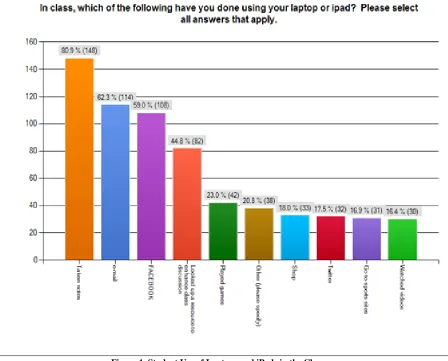
A 2012 survey of 211 undergraduate students sheds some light on how students use technology to engage or disconnect from the classroom experience. Of the students surveyed, 210 have laptops and of those, 84 do not use them in class. One student does not have a laptop. Only 8.5% of the students have iPads and of those who do, over half do not use them in class.
Figure 1. Student Use of Laptops and iPads in the Classroom
Source: La Roche 2011-2012 Student Use of Technology Survey
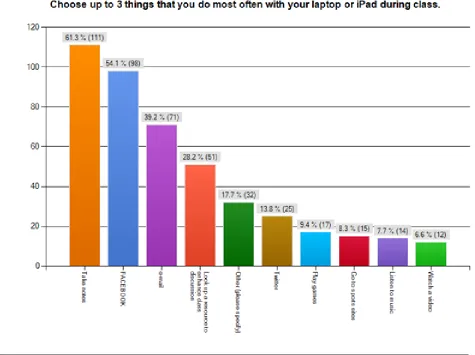
Figure 2. Top Three Activities Students Use Their Laptops or iPads for during Class
Source: La Roche 2011-2012 Student Use of Technology Survey
Journal of College Teaching & Learning – First Quarter 2013 Volume 10, Number 1
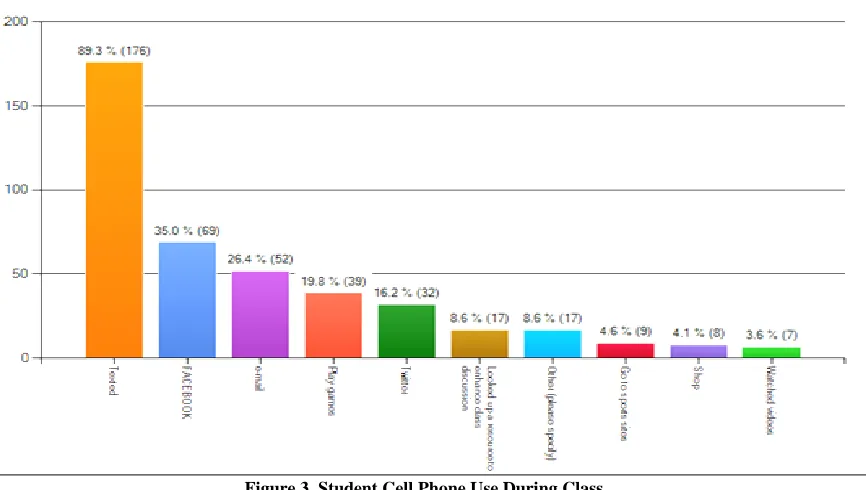
Figure 3. Student Cell Phone Use During Class
Source: La Roche 2011-2012 Student Use of Technology Survey
Of the 211 students surveyed, 208 have cell phones (98.6%) and 3 (1.4%) do not. Only 13.3% of the cell phone users powered them down during class. The remaining 86.7% of the students reported using their cell phones in class – leaving the option open to engage in retreatism. Figure 3 above indicates that the top three responses (e-mail, play games and Twitter) clearly do not enhance student engagement and include activities that enable a student to retreat or rebel.
Almost three quarters of the 208 students who own cell phones, 155 (74.5%) have “smart phones” – cell phones capable of Internet access and essentially performing like a miniature computer. Although there are a myriad of educational applications for smart phones, only 28.1% of those surveyed have found apps that are helpful with their schoolwork.
MEANINGFUL LEARNING ENVIRONMENT
While the goal of adept educators is to provide an opportunity for meaningful engagement, “(r)etreatism, passive compliance, and ritual engagement are not in themselves indicators of pathology in the classroom.” (Schlectly, 2002) Although not fully engaged in the classroom experience, “a student who is ritually engaged, passively compliant or in a retreatist mode is not necessarily “misbehaving”. It is not at all clear that anyone could tolerate—emotionally and physically—being engaged authentically all the time. Retreatism may be a resting point for a student who has otherwise been authentically engaged throughout the activity.” (Schlectly, 2002)
Figure 4. Favorite Class Format
Source: La Roche 2012 Addendum to Student Use of Technology Survey
While some researchers have proposed technology as a vehicle for engaging students, in the La Roche 2012 addendum to the Student Use of Technology Survey that included 137 of the same students surveyed in the original Student Use of Technology Survey, 56.7% (77 students) of the undergraduate business students identified their favorite class format as one that combined lecture accompanied by handouts – a low-tech classroom experience. Two-thirds of the students (56.6% + .7%+9.6%) preferred low-tech class formats that did not include PowerPoint. While 30% of the students surveyed seemed to like the lectures that include PowerPoint, only 6.6% preferred the “canned” presentation that comes with the instructor’s material.
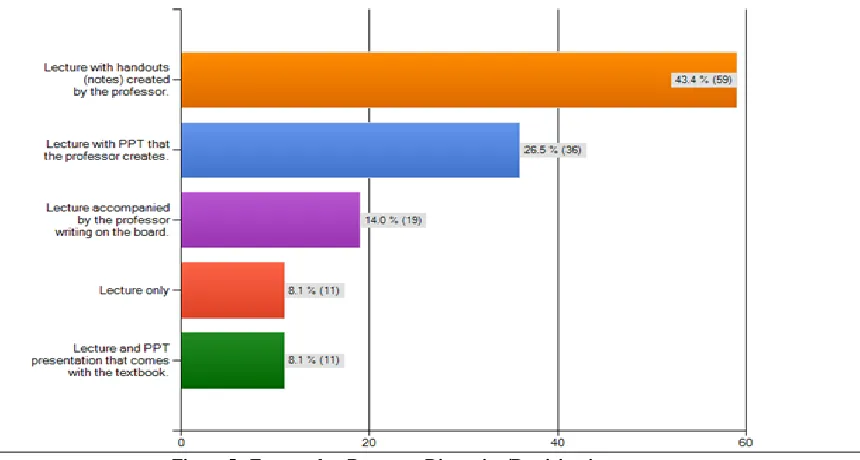
Figure 5. Format that Promotes Discussion/Participation
Source: La Roche 2012 Addendum to Student Use of Technology Survey
Journal of College Teaching & Learning – First Quarter 2013 Volume 10, Number 1
Arras, professor of Biomedical Ethics at the University of Virginia and recipient of the Outstanding Faculty Award from the State Council of Higher Education for Virginia, “…PowerPoint is the spawn of Satan. It breeds passivity in the students and it disconnects the speaker from the audience.” (Arras).
CONCLUSION
Students have a tendency to use technology as a form of retreatism in the classroom without giving much thought to the potential consequences of their actions. When asked their preference for class format, a majority of the students preferred a low-tech environment and indicated that they were most likely to ask questions and participate in classroom discussions in this environment.
While technology has the potential to enhance student engagement, it should not be used as a substitute for good old-fashioned teaching. Although a bare majority of students use laptops in class, almost all students have mini-computers disguised as cell phones that they bring into the classroom. Various solutions have been adopted by faculty and institutions to address students’ inappropriate use of technology and to reduce distractions.
Ban the use of laptops, iPads and cell phones in the classroom. This of course penalizes the student who is using the technology to enhance their educational experience by either taking notes, looking up a resource, or looking at their digital textbook.
At least one major university uses TA’s to patrol the lecture hall and if a student is using technology for an unrelated class purpose, the student is asked to leave immediately. Although this approach eliminates the distraction to other students and the professor, the student who is asked to leave gets no value from the remainder of the lecture.
Create an acceptable use policy that the students must agree to at the beginning of the semester.
Know your students…even in large lecture classes. One method that helps professors in large classes get to know students and at the same time gives students a feeling of connection is to have desktop nametags, easily visible from the lectern made at the beginning of the semester.
Unfortunately, the above first and second methods above focus on eliminating inappropriate behavior rather than encouraging student engagement that focuses on discussion of genuine ideas. The last two while not negative, can be considered helpful but not solutions. There is no one size fits all to achieve authentic engagement of students. Just as each student is different, so are the instructors. Faculty must learn what works for each class, each course...each year. However, the most important thing that a professor can do to create a meaningful learning environment is to be passionate about ideas and teaching. When a professor comes into class well-prepared with real-world examples that students can relate to, they will be more likely to be engaged and less likely to use their technology to disengage, retreat or even rebel. In conclusion, if a student is not meaningfully engaged, then the professor is not doing a good job.
AUTHORS INFORMATION
Claire R. LaRoche, Associate Professor of Business Law, B.S., College of Charleston; J.D., University of South Carolina Law School; M.B.A., College of William & Mary. E-mail: [email protected] (Corresponding author)
Mary A. Flanigan, Professor of Accounting, B.A., College of Notre Dame of Maryland; B.S., Towson State University; M.B.A., Loyola College in Maryland; Ph.D., Virginia Commonwealth University C.P.A.. E-mail: [email protected]
REFERENCES
1. Arras, John D. (2006), Teaching, it’s a Simple Game, Inside UVA, p. 8, March 31, 2006. 2. Deci, E. L. and R. M. Ryan, “The support of autonomy and the control of Behavior.” Journal of
3. Greene, Michael. Ray Kurzweil On ‘The Singularity” Future. InformationWeek.
http://www.informationweek.com/news/hardware/reviews/225701887 (accessed May 3, 2012).
4. Kearsley, G. and B. Shneiderman. Engagement Theory: A framework for technology-based teaching and learning.” http://home.sprynet.com/gkearsley/engage.htm (1999).
5. Schlectly, Phillip C. “Making Engagement Central” www.locgov/catdir/samples/Wiley032/2002001833 (2002)
Journal of College Teaching & Learning – First Quarter 2013 Volume 10, Number 1