Practical Framework for Fostering
a Positive Learning Environment
Susan L. Bannister, MD, MEda, Janice L. Hanson, PhD, EdSb, Christopher G. Maloney, MD, PhDc, Robert A. Dudas, MDd
The Council on Medical Student Education in Pediatrics continues the series about skills of, and strategies used by great clinical teachers. Great clinical teachers recognize that many things influence students’learning, including what they teach, how they teach, and where they teach.1,2“Where” refers to the learning environment. Although the term“environment”may conjure visions of trees, snow-capped mountains, and rain, the“learning environment” refers to the setting in which the curriculum exists. The learning environment includes the physical, social, and psychological context in which students learn and the overall atmosphere or culture
pervading the setting where students and clinical teachers work and learn together.3,4Although the learning environment of an institution is greatly influenced at the organizational level, this article will focus on elements under the control of individual teachers. We describe practical ways busy clinical teachers can foster a positive learning environment.
WHY A POSITIVE LEARNING ENVIRONMENT IS IMPORTANT
A positive learning environment helps students succeed,5affects their moral development,6and models
a humanistic approach to medicine.7 Recently, the Association of American Medical Colleges released a statement on the optimal learning environment.8 However, for decades, great clinical teachers have known that the learning environment affects ethical and personal development.9Orienting students leads to improved
preparedness for clinical work,10and
encouraging students to be active participants in the learning process leads to enhanced learning.11In addition, the presence of exemplary role models enhances learning.12
HOW TO CREATE A POSITIVE LEARNING ENVIRONMENT
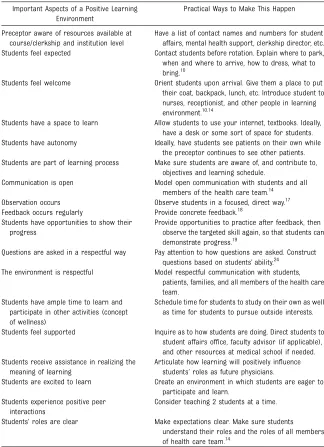
Clinical teachers foster a positive learning environment in many practical ways (Table 1). In pediatrics, students worry about“breaking”a child,
“dropping a baby,” “hurting”a child, not knowing how to relate to children, and not knowing how to examine“such a small baby”or calm a baby down.13 They also worry about the parents’ reactions, dealing with“2 things at once”(the parent and the child),
“moms yelling”at them, and not knowing what to say to parents or how to answer their questions.13
Teachers have a role in addressing these concerns explicitly, giving students practical tips in
communicating with patients and families, and examining patients in developmentally appropriate ways. Ideally, the conversation occurs at the beginning of a teacher-student
interaction (whether the start of a shift in the emergency department or the
first day of a multiweek experience). Great clinical teachers provide practical tips about working with pediatric patients and families, such as being
flexible with the order of the physical exam, adjusting the history and physical exam to the developmental age of the child, using parents as allies in the physical exam, talking to patients about their interests, getting down to the patient’s level, and appreciating the aUniversity of Calgary, Faculty of Medicine, Calgary, Alberta,
Canada;bUniversity of Colorado School of Medicine, Denver, Colorado;cUniversity of Utah School of Medicine and Primary Children’s Hospital, Salt Lake City, Utah; anddJohns Hopkins School of Medicine, Baltimore, Maryland
Dr Bannister conceptualized and drafted the initial manuscript; and all authors reviewed and revised the manuscript and approved thefinal manuscript as submitted.
www.pediatrics.org/cgi/doi/10.1542/peds.2015-1314
DOI:10.1542/peds.2015-1314 Accepted for publication Apr 22, 2015
Address correspondence to Susan L. Bannister, Department of Pediatrics, Faculty of Medicine, University of Calgary, 2888 Shaganappi Trail NW, Calgary, Alberta, Canada T3B 6A8. E-mail: susanl. [email protected]
PEDIATRICS (ISSN Numbers: Print, 0031-4005; Online, 1098-4275).
Copyright © 2015 by the American Academy of Pediatrics
FINANCIAL DISCLOSURE:The authors have indicated they have nofinancial relationships relevant to this article to disclose.
FUNDING:No external funding was secured for this study.
fun and playfulness of this patient population.13
We have organized, in a typical timeline, actions great clinical teachers take to create a positive learning environment, from before students arrive to the end of their clinical experience.
BEFORE STUDENTS ARRIVE
Fostering a positive learning environment begins before students arrive to work with a teacher. Although administrative logistics are
not a highlight of this article, knowing the course or clerkship director and how to contact him or her with questions or concerns is important. Clarifying the clerkship director’s expectations for students in clinical settings and criteria for assessment and grading prepares the teacher to explain these parameters to students when they arrive, so students know from the beginning the basis for assessment in the clinical setting.
Before they arrive, students need to be oriented regarding the location of the clinical experience and
expectations such as when to arrive, how to prepare, and what to bring.10 Students should be made aware if they are supposed to be in different locations on different days (for instance, for school visits,
multidisciplinary meetings, or grand rounds). Alerting students about the medical tools they do or do not need to bring allows the student to arrive prepared. Letting students know the types and ages of patients being seen and conditions likely encountered permits advance reading in developmental or diagnostic principles so that the student can demonstrate knowledge and be slightly more comfortable in a potentially scary setting.
YOUR TIME WITH THE STUDENT
Upon beginning a clinical experience, students need to be oriented about expectations (the teacher’s and the clerkship director’s), objectives, logistics (eg, where to store personal items, how to access the internet), and organization of the rotation (eg, whether students will see patients initially on their own, how much time should be taken per patient).10 Students should be introduced to all members of the health care team; staff and nurses need to be introduced to students and oriented to their roles so that students’purpose on the team is clear.14
Teachers who role-model respect and concern for students’well-being and learning set the stage for success.12 Creating a safe environment in which students can take risks (such as expanding the differential diagnoses), stretch their limits, learn, and grow is important.4A safe learning
environment allows learners to acknowledge their attitudes and beliefs, knowledge gaps, uncertainty, and mistakes. Humility can be a powerful tool and requires open-mindedness, a willingness to consider other views, and a readiness to learn from other perspectives. Some teachers may be reluctant to say
TABLE 1 Practical Ways Clinical Teachers Can Enhance the Learning Environment5,21–23 Important Aspects of a Positive Learning
Environment
Practical Ways to Make This Happen
Preceptor aware of resources available at course/clerkship and institution level
Have a list of contact names and numbers for student affairs, mental health support, clerkship director, etc. Students feel expected Contact students before rotation. Explain where to park,
when and where to arrive, how to dress, what to bring.10
Students feel welcome Orient students upon arrival. Give them a place to put their coat, backpack, lunch, etc. Introduce student to nurses, receptionist, and other people in learning environment.10,14
Students have a space to learn Allow students to use your internet, textbooks. Ideally, have a desk or some sort of space for students. Students have autonomy Ideally, have students see patients on their own while
the preceptor continues to see other patients. Students are part of learning process Make sure students are aware of, and contribute to,
objectives and learning schedule.
Communication is open Model open communication with students and all members of the health care team.14 Observation occurs Observe students in a focused, direct way.17 Feedback occurs regularly Provide concrete feedback.18
Students have opportunities to show their progress
Provide opportunities to practice after feedback, then observe the targeted skill again, so that students can demonstrate progress.19
Questions are asked in a respectful way Pay attention to how questions are asked. Construct questions based on students’ability.24
The environment is respectful Model respectful communication with students, patients, families, and all members of the health care team.
Students have ample time to learn and participate in other activities (concept of wellness)
Schedule time for students to study on their own as well as time for students to pursue outside interests.
Students feel supported Inquire as to how students are doing. Direct students to student affairs office, faculty advisor (if applicable), and other resources at medical school if needed. Students receive assistance in realizing the
meaning of learning
Articulate how learning will positively influence students’roles as future physicians.
Students are excited to learn Create an environment in which students are eager to participate and learn.
Students experience positive peer interactions
Consider teaching 2 students at a time.
Students’roles are clear Make expectations clear. Make sure students understand their roles and the roles of all members of health care team.14
“I don’t know”or“let’s look it up”for fear of appearing incompetent. A teacher’s willingness to admit ignorance is a powerful way to model openness to lifelong learning and build a safe learning environment for everyone.12
Teachers can build a positive learning environment by avoiding interrupting students before they
finish presenting a case and using good eye contact, a supportive tone of voice, and appreciative facial
expressions to create students’sense of safety.15Humor, when used occasionally, can motivate attention and, more importantly, can foster a safe learning environment by diffusing anxiety and tension.16
During interactions with students, several important concepts contribute to a positive learning environment: direct observation,17 formative feedback,18and open communication.14In addition, students generally want to progress during each clinical placement, and they appreciate when teachers create an environment that facilitates progress by providing targeted feedback, opportunities to practice the skills about which they received feedback, and then opportunities to demonstrate progress to their teachers.19While together with the student (whether during an emergency department shift, a few days on the wards, or several months in clinic) teachers can enhance the learning environment by being positive role models12and treating students as meaningful members of the health care team.14
AT THE COMPLETION OF YOUR TIME WITH STUDENTS
Upon completion of a shift or rotation, great clinical teachers reflect with their students to review learning points and logistical issues.20 Importantly, great clinical teachers provide relevant and meaningful summative feedback and offer concrete suggestions on how students
may improve.18The great clinical teacher also asks for feedback, for example, by asking,“how could I have made this experience more effective for you?”Discussing how concepts learned by students will enhance their future medical practice will complete the learning cycle in a positive environment.
CONCLUSIONS
Great clinical teachers take deliberate actions to foster a positive learning environment. They recognize that making the clinical setting feel safe, welcoming, and open will lead to greater learning and enhanced patient care. They appreciate that the students will, in the not-too-distant future, be their colleagues, and they treat them with the respect and support they deserve. Ultimately, the learning environment enriches the effect of the teacher.
REFERENCES
1. Bannister SL, Raszka WV Jr, Maloney CG. What makes a great clinical teacher in pediatrics? Lessons learned from the literature.Pediatrics. 2010;125(5). Available at: www.pediatrics.org/cgi/ content/full/125/5/e863
2. Dudas RA, Bannister SL. It’s not just what you know: the non-cognitive attributes of great clinical teachers.Pediatrics. 2014;134(5). Available at: www.pediatrics. org/cgi/content/full/134/5/e852
3. Genn JM. AMEE Medical Education Guide No. 23 (Part 1): Curriculum, environment, climate, quality and change in medical education: a unifying perspective.Med Teach. 2001a;23(4):337–344
4. Huang SL. Learning environments at higher education institutions: relationships with academic aspirations and satisfaction.Learn Environ Res. 2012; 15(3):363–378 10.1007/s10984-012-9114-6
5. Wayne SJ, Fortner SA, Kitzes JA, Timm C, Kalishman S. Cause or effect? The relationship between student perception of the medical school learning environment and academic performance on USMLE Step 1.Med Teach. 2013;35(5): 376–380
6. Branch WT Jr. Supporting the moral development of medical students.J Gen Intern Med. 2000;15(7):503–508 10.1046/ j.1525-1497.2000.06298.x
7. Shochet RB, Colbert-Getz JM, Levine RB, Wright SM. Gauging events that influence students’perceptions of the medical school learning environment:findings from one institution.Acad Med. 2013; 88(2):246–252
8. AAMC Statement on the Learning Environment. Washington, DC: AAMC; 2014. Available at: https://www.aamc. org/initiatives/learningenvironment/. Accessed April 3, 2015
9. Feudtner C, Christakis DA, Christakis NA. Do clinical clerks suffer ethical erosion? Students’perceptions of their ethical environment and personal development.
Acad Med. 1994;69(8):670–679
10. Raszka WV Jr, Maloney CG, Hanson JL. Getting off to a good start: discussing goals and expectations with medical students.Pediatrics. 2010;126(2). Available at: www.pediatrics.org/cgi/ content/full/126/2/e193
11. Graffam B. Active learning in medical education: strategies for beginning implementation.Med Teach. 2007;29(1): 38–42
12. Passi V, Johnson S, Peile E, Wright S, Hafferty F, Johnson N. Doctor role modelling in medical education: BEME Guide No. 27.Med Teach. 2013;35(9): e1422–e1436
13. Miller S, LoFromento MA, Curtis J. (2006) COMSEP Pediatric Physical Examination [Videofile]. Available at: mms:// 129.106.144.1/archive/ms/pedi/ PDPhysical.wmv
14. Bannister SL, Wickenheiser HM, Keegan DA. Key elements of highly effective teams.
Pediatrics. 2014;133(2). Available at: www. pediatrics.org/cgi/content/full/133/2/e184
15. Karani R, Fromme HB, Cayea D, Muller D, Schwartz A, Harris IB. How medical students learn from residents in the workplace: a qualitative study.Acad Med. 2014;89(3):490–496
16. Poirier TI, Wilhelm M. Use of humor to enhance learning: bull’s eye or off the mark.Am J Pharm Educ. 2014;78(2):27
Available at: www.pediatrics.org/cgi/ content/full/126/5/e843
18. Gigante J, Dell M, Sharkey A. Getting beyond“good job”: how to give effective feedback.Pediatrics. 2011;127(2). Available at: www.pediatrics.org/cgi/ content/full/127/2/e205
19. Seltz LB, Montgomery A, Lane JL, Soep J, Hanson JL. Medical students’
experiences working with frequently rotating pediatric inpatient attending physicians.Hosp Pediatr. 2014;4(4): 239–246
20. Murdoch-Eaton D, Sandars J. Reflection: moving from a mandatory ritual to meaningful professional development.
Arch Dis Child. 2014;99(3):279–283
21. Roff S, McAleer S, Harden RM, et al. Development and validation of the Dundee Ready Education Environment Measure (DREEM).Med Teach. 1997; 19(4):295–299
22. Dornan T, Muijtjens A, Graham J, Scherpbier A, Boshuizen H. Manchester Clinical Placement Index (MCPI). Conditions for medical students’
learning in hospital and community placements.Adv Health Sci Educ Theory Pract. 2012;17(5):703–716
23. Schönrock-Adema J, Bouwkamp-Timmer T, van Hell EA, Cohen-Schotanus J. Key elements in assessing the educational environment: where is the theory?Adv Health Sci Educ Theory Pract. 2012;17(5):727–742
24. Long M, Blankenburg R, Butani L. Questioning as a teaching tool.
Pediatrics. 2015;135(3):406–408. Available at: www.pediatrics.org/cgi/ content/full/135/3/e406
DOI: 10.1542/peds.2015-1314 originally published online June 15, 2015;
2015;136;6
Pediatrics
Susan L. Bannister, Janice L. Hanson, Christopher G. Maloney and Robert A. Dudas
Practical Framework for Fostering a Positive Learning Environment
Services
Updated Information &
http://pediatrics.aappublications.org/content/136/1/6 including high resolution figures, can be found at:
References
http://pediatrics.aappublications.org/content/136/1/6#BIBL This article cites 16 articles, 4 of which you can access for free at:
Subspecialty Collections
b
http://www.aappublications.org/cgi/collection/medical_education_su
Medical Education
following collection(s):
This article, along with others on similar topics, appears in the
Permissions & Licensing
http://www.aappublications.org/site/misc/Permissions.xhtml in its entirety can be found online at:
Information about reproducing this article in parts (figures, tables) or
Reprints
DOI: 10.1542/peds.2015-1314 originally published online June 15, 2015;
2015;136;6
Pediatrics
Susan L. Bannister, Janice L. Hanson, Christopher G. Maloney and Robert A. Dudas
Practical Framework for Fostering a Positive Learning Environment
http://pediatrics.aappublications.org/content/136/1/6
located on the World Wide Web at:
The online version of this article, along with updated information and services, is
by the American Academy of Pediatrics. All rights reserved. Print ISSN: 1073-0397.
the American Academy of Pediatrics, 345 Park Avenue, Itasca, Illinois, 60143. Copyright © 2015 has been published continuously since 1948. Pediatrics is owned, published, and trademarked by Pediatrics is the official journal of the American Academy of Pediatrics. A monthly publication, it
at Viet Nam:AAP Sponsored on August 28, 2020 www.aappublications.org/news