FORMULATION AND EVALUATION OF DISPERSABLE
TABLET OF CEFIXIME TRIHYDRATE
Sunil Kumar BG , Felix Joe.V* , Vishwanath B.A
Department of pharmaceutics,
Aditya Bangalore Institute for Pharmacy Education & Research, Bangalore- 560064.
E-mail: [email protected]
Date Received:
02-Nov-2014
Date of Accepted:
14-Nov-2014
Date Published:
19-Nov-2014
858
Abstract:
The objective of the study is to develop cefixime trihydrate orally dispersible tablet using co processed super disintegrants and comparative study with the marketed product. Cefixime trihydrate orally dispersible tablet was prepared by direct compression method using co processed super disintegrants such as cross povidone and sodium starch glycolate in different concentrations. The developed oral disintegrating tablets were evaluated for different physical chemical evaluations like drug content, hardness, friability, weight variation, wetting time, In vitro disintegration time, In-vitro drug release etc. All formulations had shown the results within the prescribed limits.
Keywords:
Cefixime trihydrate, Dispersible tablet, Direct compression, co processed superdisintegrants, Release kinetics
Introduction
Oral mucosal drug delivery is an alternative method of systemic drug delivery that offers several advantages over both injectable and enteral methods. Because the oral mucosa is highly vascularized, drugs that are absorbed through the oral mucosa directly enter the systemic circulation, by passing the gastrointestinal tract and first-pas smetabolism in the liver. For some drugs, this results in rapid onset of action via a more comfortable and convenient delivery route than the intravenous route. Not all drugs, however, can be administered through the oral mucosa because of the characteristics of the oral mucosa and the physicochemical properties of the drug.
The oral route of administration is considered as the most widely accepted route. The unique environment of the oral cavity offers its potential as a site for drug delivery. Because rich blood supply and direct access to systemic circulation, the oral mucosal route is suitable for drugs, which are susceptible to acid hydrolysis in the stomach or which are extensively metabolized in the liver.
The continuous secretion of saliva results in rapid removal of released drug and this may desire that the oral cavity be restricted to the delivery of drugs, which have a short systemic circulation.
Oral route is most preferred route by medical practitioners and manufacturer due to highest acceptability of patients. About 60% of all dosage forms available are the oral solid dosage form. The lower bioavailability, long onset time and dysphasia patients turned the manufacturer to the parenterals and liquid orals. But the liquid orals (syrup, suspension, emulsion etc) have the problem of accurate dosing mainly and parenterals are painful drug delivery, so most patient incompliance.1,2,3
859
Cefixime trihdrate is third generation cephalosporin, mainly used in treatment of respiratory, urinary, skin and soft tissue infection caused by gram positive and gram negative bacteria. Cefixime trihydrate is available in oral tablet and oral suspension forms in the market. Cefixime trihydrate is molecule which has a very low solubility in water. Therefore oral bioavailability of the tablet form is 50% less than cefixime trihydrate given intravenously. Tablets which contain 100mg and 200mg of cefixime trihydrate are available in market. Cefixime trihydrate is hydrophobic in nature and has a water contact angle greater than 900. Hence, cefixime trihydrate has a low solubility and poor disintegration in water when used in a formulation. In the prior art, several methods have been developed in order to solve the solubility problem of cefixime trihydrate in water and increase the disintegration rate and thus absorption of it. 5The aim of present work to develop a dispersible dosage form which upon dispersion in water forms a homogenous dispersion with reduced sedimentation rate, thus ensuring uniformity of dosage.
MATERIALS AND METHODS
Cefixime trihydrate was obtained as a Gift sample from Dr. Reddy’s Laboratories Limited, Hyderabad, Crospovidone, Sodium starch glycolate, Micro crystalline cellulose was obtained from S.D fine chemicals limited, Mumbai. All other chemicals and reagents used were of analytical grade.
Preformulation Studies
Preformulation testing is the first step in the rationale development of dosage forms of a drug substance. It can be defined as an investigation of physical and chemical properties of a drug substance alone and when combined with excipients. Weighed amount of drug (3mg) was mixed with 100mg of potassium bromide (dried at 40-50°C). The mixture was taken and compressed under 10-tonpressure in a hydraulic press to form a transparent pellet. The pellet was scanned by IR spectrophotometer. Similar procedure is followed for all relevant excipients used.
Preparation of dispersible tablets of Cefixime trihydrate
Cefixime Trihydrate dispersible tablets were prepared by direct compression method by using co-processed super disintegrants like Crospovidone, Sodium Starch Glycolate. Mannitol, Microcrystalline Cellulose as a diluent, Sodium saccharin as a sweetening agent, Mint as a flavor, Magnesium Stearate, Talc used as a lubricant and glidant. All the ingredients (except granular directly compressible excipients) were passed through # 60-mesh separately. Then the ingredients were weighed and mixed in geometrical order after sufficient mixing of drug as well as other components and compressed into tablets of 150mg using 8mm round flat punches on 12
station rotary tablet machine. The formulations are shown Table 1.
Evaluation of blended characteristics of cefixime trihydrate
Evaluation of Granules, 6,7,8,9 Determination of angle of repose
Angle of repose is an indication of the frictional forces excited between granule particles. It is the maximum angle possible between the surface of the pile of granules and the horizontal plane:
Tan θ = h/r Where, θ = the angle of repose
h = height of the heap of the powder r = radius of the heap of the powder
Determination of Bulk Density:
It is the ratio of total mass of powder to the bulk of powder. It is measured by pouring the weighed powder into a measuring cylinder and the volume was noted.
It is expressed in g/cm3 and is given by Bulk Density = Mass of powder
Bulk volume of the powder
Tapped Density:
It is the ratio of total mass of powder to the tapped volume of powder. The tapped volume was measured by tapping the powder to constant volume. It is expressed in g/cm3 and is given by
Tapped Density = Mass of powder Tapped volume of the powder
Hausner’s Ratio:
It indicates the flow properties of the granules and is measured by the ratio of tapped density to the bulk density.
Compressibility index (Carr’s Index):
It helps in measuring the force required to break the friction between the particles and the hopper. It is expressed in % and given by
CI = (Tapped Density – Bulk Density) × 100 Tapped Density
Compressibility index is an important measure that can be obtained from the bulk and tapped densities. In theory, the less compressible a material the more flowable it is. A material having values of less than 20% has good flow property.
860
Evaluation of post-compression parameters 6,7,10,11,12
Weight variation
The weight of the tablet being made was routinely determined to ensure that a tablet contains the proper amount of drug. The IP weight variation test is done by 20 tablets were selected randomly from each formulation after compression, weighed individually using a “Electronic weighing balance” and average weight was determined. The individual weights are compared with the average weight for the weight variation. The tablets met the IP specification that not more than 2 tablets are outside the percentage limits and no tablet differs by more than 2times the percentage limit.
Tablet hardness
The resistance of tablets to shipping or breakage under conditions of storage, transportation and handling before usage depends on its hardness. The hardness of each batch of tablet was checked by using “Monsanto hardness tester”. The hardness was measured in terms of kg/cm2. 5 tablets were chosen randomly and tested for hardness. The average hardness of 5 determinations was recorded.
Friability
Friability generally refers to loss in weight of tablets in the containers due to removal of fines from the tablet surface. Friability generally reflects poor cohesion of tablet ingredients.
Tablet thickness
Thickness of the tablet is important for uniformity of tablet size. Thickness was measured using “Vernier Callipers”. It was determined by checking the thickness of ten tablets of each formulation.
Drug content uniformity
The tablets were tested for their drug content uniformity. At randomly selected 5 tablets from each formulation were finely powdered and powder equivalent to 100 mg of Cefixime trihydrate drug was weighed accurately and dissolved in 100ml of phosphate buffer solution at pH 7.2. The solution was shaken thoroughly. The un-dissolved matter was removed by filtration through Whatman No.41 filter paper. Then the serial dilutions were carried out. The absorbance of the diluted solutions was measured at 288nm. The concentration of the drug was computed from the standard curve of the Cefixime trihydrate in phosphate buffer solution at pH 7.2.
In-vitro Disintegration time
Tablet disintegration is an important step in drug absorption. The test for disintegration was carried out in
“Electro lab USP disintegration test apparatus”. It consists of 6 glass tubes which are 3 inches long, open at the top, and held against a 10 mesh screen, at the bottom end of the basket rack assembly. To test the disintegration time of tablets, one tablet was placed in each tube and the basket rack was positioned in a 1 liter beaker containing phosphate buffer pH 7.2 as medium. The volume of medium was 900ml and temp was 37°C ± 0.2°C. The time taken for the complete disintegration of the tablets with no palatable mass remaining in the apparatus was measured.
In-vitro Dissolution studies
Dissolution testing of dispersible tablet of cefixime trihydrate was carried out with “Paddle type-II USP dissolution test apparatus” at rpm 50 and temperature 37±0.5°C both dissolution media and water. At each specified intervals of time 5 ml sample was withdrawn and replaced by fresh media. The samples were analytically tested to determine the concentration by UV spectroscopy method at wavelength of 288 nm. The % drug release was calculated using an equation obtained from the calibration curve.
Mathematical modeling of drug release profile11
The cumulative amount Cefixime trihydrate release from the formulated tablets at different time intervals were fitted to zero order kinetics, first order kinetics, higuchi model and korsmeyer-peppas model to characterize mechanism of drug release.
Zero Order Kinetics
It describes the system in which the release rate is independent of its concentration.
Qt = Q0 + K0t
Where, Qt = amount of drug dissolved in time t Q0 = initial amount of drug in the solution
K0 = zero order release constant
If the zero order drug release kinetic is obeyed, a plot of Qtversus t will give straight line with a slope of K0 and an
intercept at Q0.
First Order Kinetics:
It describes the drug release from the system in which the release rate is concentration dependent.
logQt = log Q0 + K1t/2.303
Where, Qt = amount of drug dissolved in time Q0 = initial amount of drug in the solution
K1 = first order release constant
861
kinetics, then a plot of log (Q0 - Qt) versus t will be
straight line with a slope of K1/2.303 and an intercept at t=
0 of logQ0.
Higuchi Model:
It describes the fraction of drug release from a matrix is proportional to square root of time.
Mt/M∞ = KH t1/2
Where,
Mt and M∞ are cumulative amount of drug release at
time t and infinite time,
KH = Higuchi dissolution constant reflection
formulation characteristics.
If the Higuchi model of drug release is obeyed, then a plot of Mt/M∞ versus t1/2 will be straight line with slope of KH.
Korsmeyer- Peppas Model:
The power law describes the fractional drug release is exponentially related to the release time and adequately describes the release of drug from slabs, cylinders and spheres, as expressed in following equation:
Mt / M∞ = Ktn
Log (Mt / M∞) = log K + n log t
Stability Studies36
Stability can be defined as the capacity of drug product to remain within specifications established to ensure its identity, strength, quality, and purity. The optimized formulation was subjected for stability study. The selected formulations were packed in aluminum foil in tightly closed container. They were then stored at 40ºC / 75% RH and evaluated for their physical appearance
RESULTS AND DISCUSSION
Compatibility study of drug with polymers
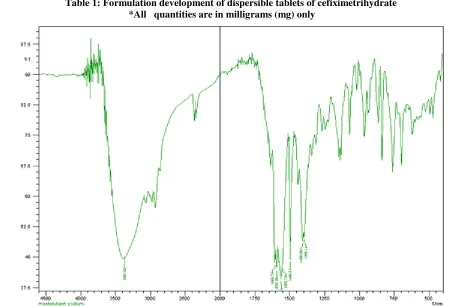
Physical mixture of drug and polymer was characterized by FTIR spectral analysis for any physical as well as chemical alteration of the drug characteristics. From the results, it was concluded that there was no interference of the functional group as the principle peaks of the cefixime trihydrate were found to be unaltered in the drug- polymer physical mixtures, indicating they were compatible chemically. Cefixime trihydrate was determined by FTIR spectra as mentioned in the Figure No 1.
Pre-compression parameters for Cefixime trihydrate tablets
Bulk density was found in the range of 0.476-0.588 g/cm3 and the tapped density between 0.555 - 0.714
g/cm3. Using the above two density data, Carr’s compressibility index were calculated. The compressibility index was found between 14.9-21.02% and the compressibility and flowability data indicated good flow properties of all powder blends. The better flow property of all powder blends was also evident from angle of repose. The angle of repose was range of 24.12°-29.56°. Angle of repose below 30º indicates good flow property. In the present study all powder blends showed good flow property. The results are shown in Table No: 2
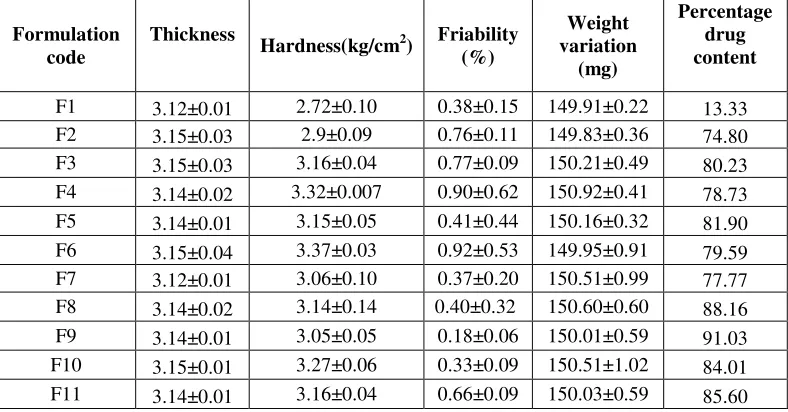
POST- COMPRESSION EVALUATION PARAMETER Thickness of tablets
All the Dispersible tablet formulations were evaluated for their thickness using Vernier calipers and the results are shown in Table No 3.Also the crown diameter of all the formulation was 8 mm
Hardness
All the formulations have an average hardness in between 2.9 to 3.4 kg/cm2 which was found to be acceptable; because these formulations have to be disintegrated on the tongue between 25 seconds to 1 minute. So excess of hardness is not favored for these formulations. The hardness for F6 (3.37±0.03 Kg/cm2) was found to be highest of all formulations and for F2 (2.9±0.09 Kg/cm2) was found to be least and control formulation F1 which shows (2.72±0.10 Kg/cm2) values respectively for the above parameters and the results were shown in Table No 3
Friability
The average percentage friability for all the formulations were between 0.18% to 0.90%, which was found to be within the limit (i.e. maximum 1%). So the maximum friability was 0.90% and the minimum friability 0.18% observed for F4 and F9 respectively and control formulation F1 which shows 0.38%values respectively for the above parameters and the results were shown in Table No 3
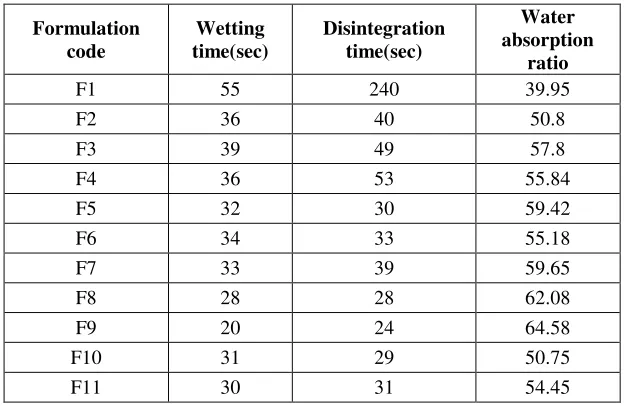
Wetting Time
The average wetting time for all the formulations was in the range of 28 to 39 seconds. The maximum wetting time of 39 seconds and minimum wetting time of 28 seconds were shown by F3 and F9 respectively and control formulation F1 which shows 55 seconds values respectively for the above parameters and the results were shown in Table No 3
Weight Variation
862
are exceeding this limit. Thus all the formulations were found to be comply with the standards given in IP and the results were shown in Table No 3
Drug Content
The range of uniformity of drug content for all formulations was 95.92%w/w to 98.79%w/w respectively and control formulation F1 which shows 93.51%w/w values respectively for the above parameters. Thus all the formulations were found to be comply with the standards given in IP and the results were shown in Table No 3
In-vitro disintegration time
The average in-vitro disintegration time for all the formulations were in the range of was 25 to 53 seconds and control formulation F1 which shows 240 seconds. The in-vitro disintegration time for formulation F9 was 25 seconds and highest disintegration time was found to be formulation F4 was 53 seconds. So the amount of water uptake and swelling will be more for this formulation F9 and this increased disintegration and the results were shown in Table No 3
Water absorption ratio
The average water absorption ratio for all the formulations were in the range of 50.75% to 64.58% and control formulation F1 shows 39.51% for the above parameters. The water absorption ratio was found to be less in formulationF10 (50.75%) and more water absorption ratio was found to be formulation F9 (64.78%). The results were shown in Table No 4
In-vitro drug release studies
As there is no specific dissolution test available for dispersible tablet of dissolution rate is studied as per USP specifications for conventional tablets with little modification. All the dispersible tablet formulations were evaluated for their in-vitro drug and the results are shown in Table 5. The maximum drug release of 91.03% was obtained from formulation F9, and minimum drug release of 74.80% shown by F2. The average drug release immediately after dispersion for all the formulations was in the range of 74.80% to 91.03%. The control formulation F1 drug release was found to be 13.3%. The formulation F9 containing co-processed superdisintegrants sodium starch glycolate:crospovidone (1:3) enhanced the dissolutionrate of fast dispersible tablets.
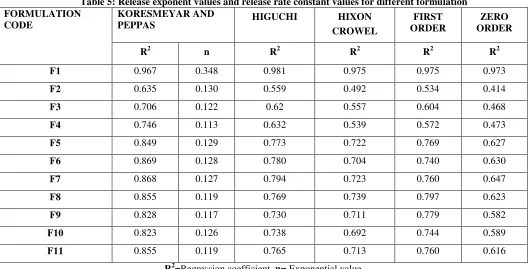
Discussion about kinetic models
Different kinetic equations (Zero order, First order, Higuchi’s, Hixson-Crowell and Koresmeyer-Peppas equation) were applied to interpret the release rate.The release obeyed first order kinetics andthe results of this investigation showed high correlation coefficient among
the formulation for first order release and the probable release mechanism was initial diffusion and the value of release exponent (n) was found to be a function of the polymer used and the physicochemical properties of the drug molecule itself and the n values was found to be in the range of 0.113 to 0.348 followed with Fickian (case I) release.
Stability Studies Results
Stability study was conducted for two best formulations selected based on in-vitro disintegration time and in-vitro drug release.. There was no significant reduction in drug release profile of formulation F9 no significant taste, colour and odour changes. The result was shown in Table 06.There was no significant variation in the drug content and in-vitro dissolution profiles after two months stability study for best formulations F9 thus specialized pickings and storage conditions are necessary for the prepared fast dissolving tablets of cefixime trihydrate. The results of the stability are given in the following Table 06. There was no significant change in taste, colour and odour. The results found to be satisfactory.
CONCLUSION
863
Table 1: Formulation development of dispersible tablets of cefiximetrihydrate*All quantities are in milligrams (mg) only
Figure 1: IR spectrum of Cefiximetrihydrate
Formulation Code F1
(CPO) F2 (1:1)
F3 (1:2)
F4 (1:3)
F5 (1:1)
F6 (1:2)
F7 (1:3)
F8 (1:2)
F9 (1:3)
F10 (1:2)
F11 (1:3)
CefiximeTrihydrate 10 10 10 10 10 10 10 10 10 10 10
Co-Processed Superdisintegrants
- 6 6 6 6 6 6 6 6 6 6
Microcrystallaine cellulose
30 30 30 30 30 30 30 30 30 30 30
Mannitol 101 95 95 95 95 95 95 95 95 95 95
Sodium Saccharin 1.5 1.5 1.5 1.5 1.5 1.5 1.5 1.5 1.5 1.5 1.5
Flavour 1.5 1.5 1.5 1.5 1.5 1.5 1.5 1.5 1.5 1.5 1.5
Magnesium Stearate 3 3 3 3 3 3 3 3 3 3 3
Talc 3 3 3 3 3 3 3 3 3 3 3
864
OBSERVED PEAKS
3535.34
1285.26
1652.77
Figure 2: IR spectrum of drug with crospovidone
OBSERVED
PEAKS
3208.45
1690.20
1022.32
Figure 3: IR spectrum of drug with sodium starch glycolate
OBSERVED
PEAKS
3431.09
1602.79
1063.10
865
Table- 2: Pre compression parameters of Cefixime trihydrate GranulesTable - 03: Post compression parameters for Cefixime trihydrate Tablets
Formulation code
Thickness
Hardness(kg/cm2) Friability
(%)
Weight variation
(mg)
Percentage drug content
F1 3.12±0.01 2.72±0.10 0.38±0.15 149.91±0.22 13.33 F2 3.15±0.03 2.9±0.09 0.76±0.11 149.83±0.36 74.80 F3 3.15±0.03 3.16±0.04 0.77±0.09 150.21±0.49 80.23 F4 3.14±0.02 3.32±0.007 0.90±0.62 150.92±0.41 78.73 F5 3.14±0.01 3.15±0.05 0.41±0.44 150.16±0.32 81.90 F6 3.15±0.04 3.37±0.03 0.92±0.53 149.95±0.91 79.59 F7 3.12±0.01 3.06±0.10 0.37±0.20 150.51±0.99 77.77 F8 3.14±0.02 3.14±0.14 0.40±0.32 150.60±0.60 88.16 F9 3.14±0.01 3.05±0.05 0.18±0.06 150.01±0.59 91.03 F10 3.15±0.01 3.27±0.06 0.33±0.09 150.51±1.02 84.01 F11 3.14±0.01 3.16±0.04 0.66±0.09 150.03±0.59 85.60
Formulation code
Bulk density (g/ml)
Tapped density(g/ml)
Hausner’s ratio
Carr’sIndex (%)
Angle of repose(θθθθ)
F1 0.526±0.094 0.666±0.120 1.26 21.02±0.03 29.56±0.04
F2 0.526±0.101 0.666±0.034 1.26 21.02±0.094 29.19±0.067 F3 0.588±0.074 0.714±0.069 1.21 17.64±0.065 27.89±0.051
F4 0.555±0.089 0.666±0.091 1.2 16.6±0.074 26.21±0.079
F5 0.476±0.093 0.588±0.113 1.23 19.04±0.093 27.97±0.084
F6 0.476±0.112 0.555±0.108 1.16 14.23±0.034 27.61±0.099
F7 0.5±0.107 0.588±0.07 1.17 14.9±0.107 25.52±0.021
F8 0.526±0.099 0.666±0.074 1.26 21.02±0.099 25.86±0.044
F9 0.5±0.094 0.625±0.043 1.25 20.0±0.102 24.12±0.042
F10 0.5260.067 0.666±0.021 1.26 20.02±0.074 27.61±0.042
866
Table -4: Evaluation Parameters of Cefixime trihydrate TabletsFormulation code
Wetting time(sec)
Disintegration time(sec)
Water absorption
ratio
F1 55 240 39.95
F2 36 40 50.8
F3 39 49 57.8
F4 36 53 55.84
F5 32 30 59.42
F6 34 33 55.18
F7 33 39 59.65
F8 28 28 62.08
F9 20 24 64.58
F10 31 29 50.75
F11 30 31 54.45
Table 5: In-vitro drug release studies of dispersible tablet of Cefixime trihydrate
Time (min)
Percentage drug release (%)
F1 F2 F3 F4 F5 F6 F7 F8 F9 F10 F11 MF
Figure 5:
Figure 6:Comparison of Optimized formulation F9 with marketed product
0
10
20
30
40
50
60
70
80
90
100
0
2
%
C
D
R
IN-VITRODRUG RELEASE STUDIES OF CEFIXIME
0
20
40
60
80
100
0
%
C
D
R
Comparison of Optimized formulation with marketed
Figure 5: In-vitro drug release studies of Cefiximetrihydrate
6:Comparison of Optimized formulation F9 with marketed product
4
Time in mins
6
8
10
12
DRUG RELEASE STUDIES OF CEFIXIME TRIHYDRATE
5
10
15
Time in mins
Comparison of Optimized formulation with marketed
product
867
6:Comparison of Optimized formulation F9 with marketed productF1
F2
F3
F4
F5
F6
F7
F8
F9
F9
868
Table 5: Release exponent values and release rate constant values for different formulationFORMULATION CODE
KORESMEYAR AND
PEPPAS HIGUCHI HIXON
CROWEL
FIRST ORDER
ZERO ORDER
R2 n R2 R2 R2 R2
F1 0.967 0.348 0.981 0.975 0.975 0.973
F2 0.635 0.130 0.559 0.492 0.534 0.414
F3 0.706 0.122 0.62 0.557 0.604 0.468
F4 0.746 0.113 0.632 0.539 0.572 0.473
F5 0.849 0.129 0.773 0.722 0.769 0.627
F6 0.869 0.128 0.780 0.704 0.740 0.630
F7 0.868 0.127 0.794 0.723 0.760 0.647
F8 0.855 0.119 0.769 0.739 0.797 0.623
F9 0.828 0.117 0.730 0.711 0.779 0.582
F10 0.823 0.126 0.738 0.692 0.744 0.589
F11 0.855 0.119 0.765 0.713 0.760 0.616
R2=Regression coefficient, n= Exponential value
Table 6: Stability studies for best formulations stored at 40ºC/75% RH
TIME
Hardness kg/cm2 Drug content In-vitro drug
release (%CDR)
F8 F9 F8 F9 F8 F9
15 days 3.14 3.05 97.87 98.79 88.16 91.03
30 days 3.12 3.05 97.57 98.33 87.91 90.82
45 days 3.13 3.01 97.22 98.05 87.07 90.55
60 days 3.1 3.0 96.9 97.77 86.84 90.00
Figure 7:Comparison of in-vitro drug release before stability with after stability of best formulation F9
0
20
40
60
80
100
0
5
10
15
%
C
D
R
TIME IN MINS
869
physical mixture of crospovidone and sodium starch glycolate used in Cefixime trihydrae dispersible tablets by direct compression method. The Cefixime trihydrate dispersible tablets were found to have enhanced dissolution rate.
REFERENCES
1. Patel Nibha K, Pancholi SS. An Overview on: Sublingual Route for Systemic Drug Delivery. Int J Res Pharma Bio Sci. 2012; 3(2): 913-923.
2. Amir H Shojaei, Sen-lin Zhou, Xiaoling Li. Transbuccal Delivery of Acyclovir (II): Feasibility, System Design and In-vitro Permeation Studies. Int J Pharm Pharma Sci. 1998; 1(2): 66-73.
3. Khairnar GA, Sayyad FJ. Development of Buccal Drug Delivery System Based on Mucoadhesive Polymers. Int J Pharm Tech Res. 2010; 2(1): 719-735.
4. http:// www.unicef.org/ supply/ files/ Dispersible_Tablets.pdf.
5. Setia A, Goyal N, Kansal S. Formulation and evaluation of Ciprofloxacin hydrochloride dispersible tablets using natural substances as disintegrates Der Pharmacia Sinica 2011;2(1):36-39.
6. Rowe RC, Sheskey PJ, Quinn ME, editors. Handbook of pharmaceutical excipients. 6th ed. Washington. A Joint Publication of American Pharmaceutical Association and The Pharmaceutical Press; 2009: p. 129-33, 208-10, 404-7, 424-8, 608-610, 663-6. 7. Bhanja SB, Ellaiah P, Roy HK, Samal BK, Tiwari S,
Murthy KVR. Formulation and Evaluation of Prindopril Sublingual Talets. Int J Res Pharm Bio Sci. 2011; 2(3):1193- 98.
8. Sindu Abraham, Basavaraj B V, Bharath S, Deveswaran R, Sharon Furtado, Madhavan V. Formulation and Optimization of Sublingual Tablets of Rabeprazole Sodium. Int J Pharm Sci Res. 2010; 5(2):50-54.
9. Bhanja Satyabrata, Hardel Danendra K, Sudhakar Muvala. Formulation and Evaluation of Fast Disintegrating Rosiglitazone Sublingual Tablets. Int J
Pharm Chem Sci. 2012;1(2): 587-593.
10. Korsemeyer RW, Peppas NA. Macromolecular and modeling aspects of swelling–controlled systems. In: Mansdrofsz, rosemann TJ, ad, Controlled Release Delivery systems. New York. Marcel Dekker; 1983: 77.
11. Shyamala Bhaskaran. Industrial pharmacy. 1sted. New Delhi. Birla Publications; 2010. pg. 46-69.