ISSN (e): 2250-3021, ISSN (p): 2278-8719
Vol. 07, Issue 11 (November. 2017), ||VI|| PP 07-11
Comparative Analysis of Selected Biomass Residues Using
Improved Sawdust Stove.
1
sani Aliyu,
2barsisa Buba
1Department of Physics, Usmanu Danfodiyo Sokoto, Nigeria 2
Department of Physics Gombe State University, Nigeria Corresponding Author:1sani Aliyu
Abstract:
Biomass energy is the type of energy produced from recently living organisms or waste agricultural residues, around two-thirds of the populations of developing countries are still primarily dependent on biofuels for domestic use. This paper present a comparative analysis of selected biomass residues, namely; rice husk, sawdust, and millet husk in enhancing cooking efficiency, using improved sawdust stove. The analysis carried out includes; control cooking test, water boiling test and burning rate using the selected biomass residue and maintaining the same stove. Similarly, mass of fuel consumed in cooking half kilogram of rice and beans for each residue were determined. The total burning test results shows that, millet husk had the highest burning rate of 0.0175 kg/min followed by sawdust with 0.0147 kg/min while the rice husk had the lowest of 0.0058 kg/min. The results indicate that rice husk waste material is averagely the best because it has the lowest burning rate, requires lesser amount of fuel per mass of cooked rice and beans and using it as fuel the stove had the highest thermal efficieny of 45% and 46% for cooking rice and beans respectively.Keywords:
Biomass residues, cooking test rice husk, sawdust, and millet husk--- --- Date of Submission: 07-11-2017 Date of acceptance: 23-11-2017 --- ---
I.
INTRODUCTION
The occurrence of persistent fuel crisis in the developing countries has drawn attention to the need for energy experts to further concentrate on producing viable alternatives and/or complements to kerosene and cooking gas for domestic cooking (Joshi and Srivastava, 2013). In most developing countries like Nigeria recycling of waste products (agricultural waste product) into useful product is rarely practice. This has led into refuse heap on our streets, drainage system and water ways, which has resulted to environmental problem such as blockage of waterways that could lead to flooding on rainy days and pollution. The potential agro residues which do not pose collection and drying problems, normally associated with biomass are rice husk, millet husk, groundnut shells and coffee husk (obtained by drying process) (Yahaya and Ibrahim, 2012).
If these agricultural waste products can be properly recycled into useful products, more goods will be made available to our society, environmental pollution and other disease attack would be greatly reduced. A renewable energy resource such as solar energy and biomass that is free, abundant, inexhaustible and environmentally friendly is the solution to the growing challenges faced by remote and rural communities in Nigeria and the world at large (Muye, 2016).Therefore the paper intends to evaluate the performance of biomass materials, sawdust, rice husk and millet husk with respect to their burning rate, comparatively analyze the performance of the stove used when applying the three samples as fuel.
II.
MATERIALS AND EXPERIMENTAL PROCEDURES
2.1 Materials
The materials used for the test includes the biomass material used as fuel (rice husk, sawdust, and millet husk), water, cooking pot, liquid in glass thermometers, watt meter, fuel/food calorimeter, measuring cylinder, weighing balance, meter rule, matches, and the improved cook stove (ICS). The specimens used during the cooking test were Rice (Oryza Sativa) and beans (phaseolusvulgaris).
2.2 Description of the ICS used
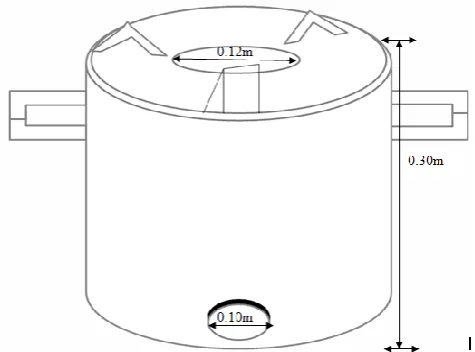
usually ignited and continues to burn around the periphery of the central hole. Figure 1.0 is a systematic diagram of the cooking stove.
Figure 1.0: A systematic diagram of the Improved Sawdust Stoves.
2.3 Determination of Calorific Value
Calorific Value is the heat liberated when a unit quantity of fuel completely burnt; it is determined using fuel/food calorimeter mode L04 -340 by Griffin and George Ltd.
2.4 Experimental Set Up
All tests were conducted at the Sokoto Energy Research Centre, Usmanu Danfodiyo University, Sokoto, Nigeria. The biomass materials used as fuel were bought from Sokoto kara market and all were assembled in the laboratory for various test. For each test, the stove was filled with waste specimen (rice husk, sawdust, and millet dusk), with the help of a metal mold which was inserted through the hole to the bottom of the stove and the shaft was held straight up while pouring each of the biomass materials (rice husk, sawdust, and millet dusk) around it. As the chamber was being filled, the fuel was compressed making it very compact for a better combustion process. When the stove was full, the top was completely covered with the stove cover. Then the mold was twisted back and forth and carefully pulled out of the packed fuel to avoid scattering of the fuel Akinbode (1996).
2.5 Water boiling test
The water boiling test is a simplified simulation of the cooking process. It intends to measure how efficiently a stove uses fuel to heat up water in a cooking pot and the quantity of emission produced while cooking in a controlled environment (Makonese et al., 2006). A simple laboratory tests was conducted to compare the performance of the three different biomass materials under the same condition. A known quantity of fuel was fed into the stove and piece of paper was used to ignite it, while a metallic pot with known volume of water was placed on the stove. 2 liters of water were used to evaluate the performance of the stove. A thermometer was inserted in the pot to measure the initial temperature and subsequent rise in every 2 minutes, until the water boiled to a steady boiling temperature i.e. boiling point. The percentage heat utilization of the three samples materials used as fuel was also measured.
2.6 Controlled Cooking test
This is based on the agreed provisional international standard, with primary objectives of comparing the amount of fuel consumed and the time spent in cooking meal with different stoves. The controlled cooking test enables the investigator to fine out the amount of fuel required to cook a kilogram of well cooked food termed as specific fuel consumption. (Danshehu et all., 1996).
Specific fuel consumption = 𝑀𝑎𝑠𝑠 𝑜𝑓 𝑐𝑜𝑛𝑠𝑢𝑚𝑒𝑑 𝑓𝑢𝑒𝑙
𝑇𝑜𝑡𝑎𝑙 𝑚𝑎𝑠𝑠 𝑜𝑓 𝑐𝑜𝑜𝑘𝑒𝑑 𝑓𝑜𝑜𝑑 (1) : - SFC = 𝑀𝑏𝑟
𝑀𝑐𝑓 Where, 𝑀𝑏𝑟 = 𝑚𝑎𝑠𝑠 𝑜𝑓 𝑐𝑜𝑛𝑠𝑢𝑚𝑒𝑑 𝑓𝑢𝑒𝑙 , 𝑀𝑐𝑓 =𝑚𝑎𝑠𝑠 𝑜𝑓 𝑐𝑜𝑜𝑜𝑘𝑒𝑑 𝑓𝑜𝑜𝑑 The time spent in cooking per kg of cooked food was determined from the relationship below.
Time spent = 𝑇𝑜𝑡𝑎𝑙 𝑡𝑖𝑚𝑒 𝑠𝑝𝑒𝑛𝑡 𝑖𝑛 𝑐𝑜𝑜𝑘𝑖𝑛𝑔 𝑇𝑜𝑡𝑎𝑙 𝑤𝑒𝑖𝑔 𝑡 𝑜𝑓 𝑐𝑜𝑜𝑘𝑒𝑑 𝑓𝑜𝑜𝑑 : - Time spent = 𝑇𝑡
Where, 𝑇𝑡= Total time spent in cooking, 𝑊𝑓 = Total weight of cooked food.
The cooking test was conducted using two samples of food stuff; rice and beans. Each of the samples were cooked using the three different biomass materials (rice husk, sawdust, and millet dusk) as fuel on the improved single hole stove.
2.7 Total Burning Test
The total burning test was carried out in order to determine the time it would take each of the biomass materials used as biofuels to burn off completely. Each of them were loaded into the stove and allowed to burn while observing the time it takes for each to burn completely and the results recorded in Table 3.0
2.8 Burning Rate
This determines the rate at which a certain mass of fuel is combusted in air. It can be evaluated (Kuti, 2009) as:
Burning rate = 𝑚𝑓
𝑡 (3) Where, mf is the mass of fuel and t is the time taken for the fuel to burn.
According to Joshi and Srivastava (2013), the higher the burning rate, the shorter the life span of the fuel. Therefore, burning rate determines the lifespan of the fuel during combustion.
2.9 Specific Fuel Consumption
This is defined as the amount of solid fuel equivalent used in achieving a defined task divided by the weight of the task. The specific fuel consumptions of the fuels were determined using equation 4, expressed by equation 4:
Specific fuel consumption = 𝑚𝑓
𝑚𝑐𝑓 (4) Where 𝑚𝑓= mass of fuel used
𝑚𝑐𝑓= mass of cooked food
2.10 Determination of the stove efficiency
In order to get at least some degree of scientific exactness, equation 5 was used for measuring the degree of efficiency of the stove. (Akinbode 1996)
𝐸𝑓𝑓=
𝑀𝑤× 𝐶𝑤 𝑇𝑓− 𝑇𝑖 + 𝑀𝑣𝑅
𝑀𝑏× 𝐻𝑐
× 100% (5)
Where 𝐸𝑓𝑓 =fuel efficiency, 𝑀𝑤 = initial mass of water in the pot (kg), 𝐶𝑤= specific heat capacity of water (4.2kJ/kg), 𝑇𝑓= final temperature of water (oC), 𝑇𝑖= initial temperature of water (oC), 𝑀𝑣=amount of water evaporated during the experiment (kg), 𝑀𝑏=mass of burnt fuel (kg), 𝐻𝑐= combustion value of fuel used (kJ/kg), R= Heat of evaporation of water at atmospheric pressure and 100oC (2256.9Kj/kg)
III.
RESULTS AND DISCUSSIONS
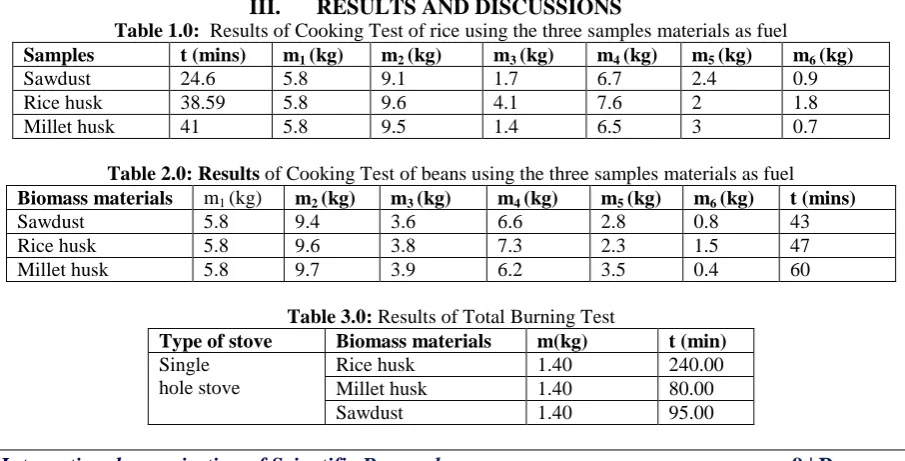
Table 1.0: Results of Cooking Test of rice using the three samples materials as fuel
Samples t (mins) m1 (kg) m2 (kg) m3 (kg) m4 (kg) m5 (kg) m6 (kg)
Sawdust 24.6 5.8 9.1 1.7 6.7 2.4 0.9
Rice husk 38.59 5.8 9.6 4.1 7.6 2 1.8
Millet husk 41 5.8 9.5 1.4 6.5 3 0.7
Table 2.0: Results of Cooking Test of beans using the three samples materials as fuel
Biomass materials m1 (kg) m2 (kg) m3 (kg) m4 (kg) m5 (kg) m6 (kg) t (mins)
Sawdust 5.8 9.4 3.6 6.6 2.8 0.8 43
Rice husk 5.8 9.6 3.8 7.3 2.3 1.5 47
Millet husk 5.8 9.7 3.9 6.2 3.5 0.4 60
Table 3.0: Results of Total Burning Test
Type of stove Biomass materials m(kg) t (min)
Single hole stove
Rice husk 1.40 240.00
Millet husk 1.40 80.00
Table 4.0. Results of Thermal Efficiency and the Burning rate during cooking test. Type of fuel Type of food
cooked
Burning rate kg/min
Thermal efficiency %
Mass of fuel used kg
Sawdust Rice 0.0976 31 2.4
Rice hudk Rice 0.0518 45 2
Millet husk Rice 0.0732 39 3
Sawdust Beans 0.6512 20 2.8
Rice hudk Beans 0.0489 46 2.3
Millet husk Beans 0.0603 41 3.5
IV.
DISCUSSIONS OF RESULTS
Tables1.0 and 2.0 showed the cooking test results; The Results revealed a significant difference. Sawdust had the fastest cooking time of 24.6 min followed by rice husk with 38.59min and millet husk had the longest cooking time of 41.0 min. The burning rates of these fuels were 0.0976 kg/min, 0.0732 kg/min and 0.0518 kg/min for sawdust, millet husk and rice husk respectively.
Table 3.0 shows the results of complete burning tests of the biomass waste. It was observed that the burning rates of these biomass waste were as follows 0.0058 kg/min for rice husk, 0.0147 kg/min and 0.0174 kg/min respectively sawdust and millet husk burns faster at 80 min and 95 min as compared to rice husk which took longer time to burn. This implies that rice husk has high energy density then sawdust and millet husk, this implies that the longer it take the burn the better fuel it is to cook i.e. it can cook more than one meal over a period of time without recharging the fuel in the stove.
Having tested the three different biomass waste materials in cooking of rice and beans the results are shown in Table 4.0 The burning rate of sawdust, rice husk and millet husk were 0.6512 kg/min, 0.0489 kg/min and 0.0603 kg/min respectively with rice husk having the lowest burning rate. More so the time taken to cook the beans on that stove were 43 minutes using sawdust, 47 minutes using rice husk and 60 minutes using millet husk respectively. The results obtained revealed that the stove had the highest thermal efficiency while rice husk was used as fuel in cooking both rice and beans. Similarly mass of fuel used and the burning rate were having the lowest values in both the two tests, when rice husks was used as fuel. Therefore, rice husk was recommended as best fuel because it had the lowest value of burning rate this fuel would cook food in a shorter period using lesser amount. The difference in the tested parameters can be explained by their differences in heating value.
V.
CONCLUSION
Generally from the results obtained the waste materials were all good fuels in different capacities also based on their burning rates as well as specific fuel consumptions of each sample used in cooking test. The test shows the performance evaluation test using rice and beans and all the biomass waste exhibits their different characteristics as shown on the tables, some cook faster than the other while some took longer time but could best use to cook more than one meal. This character is due to the fact that some waste materials are porous and allow free passage of oxygen which helps in combustion and the others are closely packed together not allowing free flow of air thereby increasing the ignition time of the fuel. Conclusively rice husk with the lowest burning rate would serve as a better fuel with longer time in cooking food compare to the others. Similarly, the development of this stove would lighten the burden of rural and urban dwellers in search for energy. It would also decrease the amount of solid waste found in our big cities and would lead to less dependence of rural and urban dwellers on kerosene and liquid petroleum gas that are very scars, expensive and not readily available all the time.
REFERENCES
[1]. Akinbode, F.O, (1996). The Development of a sawdust stove, Nig. J. Renewable Energy, 4,53-57.
[2]. Danshehu B.G., Atiku A.T. and Tambuwal A.D. (1996). Effect of Glazing on the Performance of Improved Wood-Burning Stoves. Nigerian Journal of Renewable Energy , 4(1), 15-18
[3]. Joshi M. and Srivastava R.K. (2013). Development and Performance Evaluation of an Improved Three Pot Cooking Stove in Rural Uttsrskhsnd India. Inernational Journal of Advanced research, 1(5), 596-602. [4]. Kuti O.A,. (2009) Performance of Composite Sawdust Briquette Fuel in a Biomass Stove under
Simulated Condition AU J.T. 12(4): 284-288.
[6]. Muye H.M (2016): Adoption of Solar Energy Systems in Remote and Rural Communities of Nigeria (A Review). The International Journal Of Science & Technoledge 4(1) pp 23- 28.
[7]. Yahaya D.B. and Ibrahim T.G.(2012). Development of Rice Husk Briquettes for use as Fuel. Research Journal in Engineering and Applied Sciences, 1(2), 130-133.