ISSN (e): 2250-3021, ISSN (p): 2278-8719
Vol. 05, Issue 05 (May. 2015), ||V2|| PP 52-56
Modeling for the Sensor based Open System Application
Sang Young Lee
11Department of Health Administration Namseoul University, 21 Maeju-ri, Seongwan-eup, Cheonan, South
Korea
Abstract: - Over a decade, Service-oriented architectures have seen an increasing interest of both academia and industry communities. This interest is associated with an enthusiasm of companies in different sectors and sizes for the adoption of this new paradigm due to its economic and technological benefits. SOA is a very effective response to the problems faced by companies in terms of reusability, interoperability and reduce coupling between systems that implement their information systems. This paper proposes a Modeling for Sensor Based Business Process Generation and Testing, and introduces its implementation in the BPEL. and we analyzes business process between enterprises, modeling the service-oriented business process with BPEL to realization level. Also, In this paper suggests that UML is used from high-level business problems to the process of low-level problem for Visual and effectively.
Keywords: - Business, Process, Sensor, Service-oriented architectures, System
I.
INTRODUCTION
Business process has become a core element that is indispensable in transactions within an enterprise and between enterprises. Along with the business process, there has been increasing interest in the integration of processes and the interface between enterprises, as transactions between e-marketplaces across industries become increasingly substantial. This process integration between enterprises requires that related enterprises exchange the information necessary to carry out business activities according to the given business process and that they implement a B2B interface and process. The objective of such integration is to connect the enterprise to the related transaction parties through the exchange of organized business events, including business data, in order to conduct business between enterprises[1].
In this paper, we solve the problem more visually and efficiently by providing services after analyzing and modeling them from the high-level enterprise problem to the low-level detailed process by using UML, a visual modeling language based on SOA.
II.
RELATED
WORKS
XML and Web Service standards are helping system architects to improve the definition of services and provide a consistent framework for realizing the promise of the service-oriented architecture(SOA)[2]. The evolution of Web services is at a point where designers can now start to see how to implement a true SOA. They can abstract a service enough to enable its dynamic and automatic selection and Web services are finally offering a technology that is rich and flexible enough to make SOA’s Reality[3]. Also, recently, the peer to peer approach(P2P) has been much used as a related technique for collaboration and business modeling. The P2P approach is a method that allows for efficient peer-to-peer communication without a centralized hub or server environment.
III.
MODELING
AND
IMPLEMENTATION
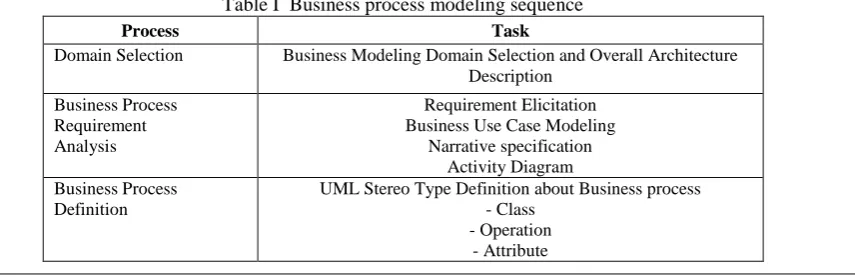
The overall process modeling sequence is described in Table 1.
Table I Business process modeling sequence
Process Task
Domain Selection Business Modeling Domain Selection and Overall Architecture Description
Business Process Requirement Analysis
Requirement Elicitation Business Use Case Modeling
Narrative specification Activity Diagram Business Process
Definition
UML Stereo Type Definition about Business process - Class
Business Process Modeling
Business Use Case Diagram Business Class Diagram
Sequence Diagram Collaboration Diagram SOA based on P2P
business process modeling
Conceptual Service-Oriented Architecture Implementation SOA based P2P business process modeling
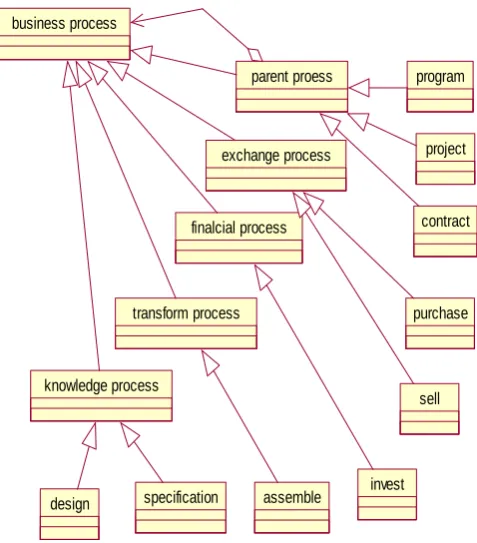
When business processes are classified into similar ones, they can be classified into 5 main processes with 8 subprocesses, as shown in Fig 1[4].
finalcial process
knowledge process
transform process
exchange process parent proess business process
program
project
purchase contract
sell
invest assemble
design specification
Fig. 1 Business process classification
creating contents
receiving a request proposal
making out a proposal
sending a proposal
preparing a contract
contract
offering contents
decision for contract
choosing contents
sending a request proposal
making a criterian
receiving a proposal
decision contents
preparing a contract
contract
supplying contents
CampanyB CampanyA
Fig. 2 Activity diagram for use case ‘contract process’
classname
<<business process>> stereo typed business process
Stereotyped business class
model view control
Business class definition by role
Stereotyped operation and attribute definition
Fig. 3 Definition of stereotype
In order to model the working business processes, 2 models are developed separately: one for stereotyped negotiation and the other designed to make P2P possible by adding the stereotyped process ID and reference ID in order to insert the identifiable ID into the pre-defined process ID. In this paper, we apply the attributes and operations defined above that can add a value to the transactions between companies. By modeling each business process between enterprises in serviceable units, the common parts between processes are applied to the interface and the P2P service centering on the interfaces is implemented. The architecture comprises XML based interfaces using WSDL and sends messages using SOAP and, by using a modeling language called UML, those units related to services are composed and modeled. In order to solve the integration issues, SOA advocates a general approach to integrating diverse systems. We give an outline of that approach here, highlighting those details pertinent to our UML modeling.
Discovering, matching, planning, Composing
Discovering, matching, planning, Composing
WebService1 WebService2
…
WebServiceN GoalSubGoal SubGoal SubGoal
Company1 CompanyN
Discovering, matching, planning, Composing
Discovering, matching, planning, Composing
WebService1 WebService2
…
WebServiceN GoalSubGoal SubGoal SubGoal
IV.
CONCLUSION
In this study, we perform UML integration modeling after analyzing the service oriented business process based on SOA. Each process is defined in the form of a peer in order to allow the process derived from the modeling of the business process to interact with other processes in the P2P mode. This paper proposes an efficient method of modeling business processes in a P2P manner based on the use of SOA throughout the modeling steps, in order to enhance the efficiency of the services. This results in the accurate modeling of an enterprise and allows for the more efficient and visual integration of processes between enterprises.
A formal specification is required for the design and implementation of the interface for the sake of the future process interoperability, and the testing of the interface focusing on the interoperability between peers should be considered for the interoperability of web services.
V.
ACKNOWLEDGEMENTS
This research was supported by Basic Science Research Program through the National Research Foundation of Korea (NRF) funded by the Ministry of Education(2013R1A1A2007598).
REFERENCES
[1] Baoan Li, Construction of Application Software for Enterprise Based on Semantic SOA and Component Oriented Technology, The 2009 IEEE International Conference on Intelligent Computation Technology and Automation, Zhangjiajie, China, Vol. 4, 2009. 120-129.
[2] Maryam Razavian, Patricia Lago, A Survey of SOA Migration in Industry, ICSOC 2011, LNCS 7084, 2011, 618-626.
[3] A. Bucchiarone, C. Cappiello, E. Di Nitto, S. Gorlatch, D. Mailänder, and A. Metzger,. Design for self-adaptation in service-oriented systems in the cloud, in European Research Activities in Cloud Computing, Cambridge Scholars Publishing, 2012.
[4] M. Sonntag and D. Karastoyanova, Compensation of Adapted Service Orchestration Logic in BPEL'n'Aspects, BPM 2011, 2011, 413-428.