A Hybrid Real-time Fault-tolerant Scheduling
Algorithm for Partial Reconfigurable System
Jinyong Yin
Jiangsu Automation Research Institute, Lianyungang, China Email: [email protected]
Boxiang Zheng
Jiangsu Automation Research Institute, Lianyungang, China Email: [email protected]
Zhongyi Sun
Jiangsu Automation Research Institute, Lianyungang, China Email: [email protected]
Abstract—Partial reconfigurable system is an architecture consisting general purpose processors and FPGAs, in which FPGA can be reconfigured in run-time. Based on the architecture, software tasks and hardware tasks that are executed on processor and FPGA respectively co-exist. In this paper, a real-time fault-tolerant scheduling algorithm is proposed to schedule software/hardware hybrid tasks. In the algorithm, the sufficient condition for schedulable hybrid tasks is derived from analyzing system operation conditions when the first deadline is missed, and rollback/recovery and TMR approaches are used respectively to schedule software subtasks and hardware subtasks for fault tolerance. The experimental results demonstrate that all deadlines of accepted hybrid tasks are met and processor’s utilization ratio is increased greatly compared with that of the exiting approaches when multiple faults occur.
Index Terms—Partial reconfigurable system, Real-time scheduling algorithm, Fault-tolerant scheduling algorithm, Software/Hardware hybrid tasks
I. INTRODUCTION
As we all know, the FPGA’s configuration information is stored in static RAM, which is easily affected by space particles and electromagnetic wave. When the static RAM is affected, the SEU (Single Event Upset) occurs and internal circuit fails. In order to avoid the serious consequences caused by system failure, we need to provide the fault-tolerant ability for FPGA to ensure that all real-time tasks’ deadlines can be met even internal partial circuit failed.
The fault-tolerant solutions for FPGA are usually divided into two categories which are based on hardware and software respectively. The first one is still thinking along the hardware redundancy which set the spare resources in the FPGA chip to achieve fault tolerance. If the resources are damaged somewhere, it will be replaced by the spare resources [1]. Doumar et al [2] proposed a solution which can move the configuration data between
the row, the column and the modules of I/O by the special designing of the SRAM. When a failure occurs, the configuration data of failure resource will be transferred to the adjacent free resources according to specific rules to make the system back to normal. The second approach is based on hardware/software coordination which firstly tests the FPGA chips and stores the damaged data in the database by software, and then the test results are read from the database to ensure that the damaged parts are not used and finally re-layout to resume normal operation of FPGA [3]. Above solutions require the system to stop working when detecting the FPGA chip which will reduce performance and flexibility of the system. So some researchers proposed schemes of online detection and dynamic reconfiguration while the system is still working [4, 5]. These solutions are mainly made for non-real-time systems offline or online fault detection while real-time tasks can not be guaranteed.
Real-time fault-tolerant scheduling is a technology which can achieve the ability of system fault tolerance through software and improve the reliability of the system with limited hardware spending. The proposed fault-tolerant scheduling algorithms [6-15] were mainly developed based on the technology of primary/backup version, and when multiple processors fail at the same time in the system, the multiple backups version is needed for each real-time task which will result in the processor utilization decrease rapidly.
To resolve the rapid decrease of processor utilization and the problem of the real-time hardware task’s fault-tolerance, this paper proposes a fault-tolerant scheduling algorithm FT-SSHTNB (Fault Tolerant SSHTNB) for real-time hardware/software hybrid tasks, the FT-SSHTNB algorithm is based on FT-SSHTNB algorithm [17].
In the system, hybrid tasks are presented by a set T={T1,T2, …,Tn} and each task Ti∈T is represented by a directed acyclic graph (DAG): Ti=(STi, Ei, Ci, Di, Pi), where STi={sti1, sti2, …, stiq} represents the hardware and software subtasks of Ti, Ei∈STi×STi represents the relationship of constraints between subtasks, Ci, Di and Pi represent the execution time, relative deadline and period of the task Ti respectively, where Di=Pi.
IPred(stik)={stij|(stij,stik)∈Ei} represents the immediate predecessor subtasks of the subtask stik, and if |IPred(stik)|=0, then the stik is defined as entry subtask .
ISucc(stij)={stik|(stij,stik)∈Ei} represents the immediate successor subtasks of the subtask stij, and if |ISucc(stij)|=0, then the stij is defined as exit subtask .
sti3
sti4
sti2 Entryi
sti1
sti5
sti6
Exiti
Hardware Subtask Software Subtask
Figure 1. Real-time task architecture.
Not lose the general case, assume that each task Ti only has an entry subtask Entryi and an exit subtask Exiti. Figure 1 shows a task’s instance which contains 8 subtasks, where rectangle presents hardware subtask and circle presents software subtask.
Let CiCP presents the sum execution time of subtasks in task Ti’s critical path; Let Cisoft presents all software subtasks’ execution time of task Ti; Let Cijtop presents the longest path from the entry subtask to the subtask stij; Let Cijbot presents the longest path from subtask stij to the exit subtask.
Subtask stij is presented by a set stij={Cij, wij, hij, typeij}, where Cij presents execution time of subtask stij, wij presents the width of subtasks, hij presents the height of subtasks, and typeij ={H, S} presents subtask’s type where H presents that stij is a hardware subtask and S presents that stij is a software subtask and if stij is a software subtask, then wij= hij=0.
Switch
Processor Processor
FPGA FPGA
…
…
…
…
(a)
(b)
Figure 2. Reconfigurable system architecture. (a) System architecture (b) The architecture in FPGA
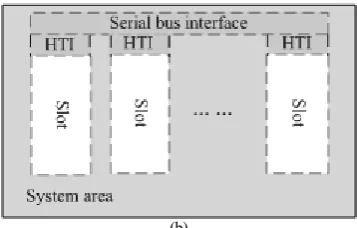
Shown in Figure 2, reconfigurable system consists of multiple processors and multiple FPGAs. Processors and FPGAs are linked together through high speed serial bus. Some free resources (Slots) are reserved for hardware tasks in FPGA, where hardware subtasks can be configured to the slots dynamically when the system is still running. The hardware subtasks can communicate with the software subtasks through the serial bus interface and hardware task interfaces (HTI).
III. FT-SSHTNB SCHEDULING ALGORITHM
FT-SSHTNB algorithm has some restrictions on the fault model and fault number. We make the following assumptions for failure model:
1) At most f computing units fail at a time, when the f+1th failure occurs, there is at least one of the former f faults has been repaired and put into operation.
2) Suppose that the interval between two failures is longer than the period of real-time tasks, namely, there is at most one failure occurs when a real-time task executes.
Definition 1: For a task Ti, if it can tolerate k failures, that is, when the failures are not more than k, task Ti can be fault-tolerant scheduled by a algorithm; when the k+1 failure occurs, the algorithm will go into the exception process, then the algorithm is called k-fault-tolerant for the task Ti[17].
Definition 2: For a task set T = {T1, T2,…, Tn}, if a scheduling algorithm is ki-fault-tolerant for task Ti, then the algorithm is (k1, k2, …, kn) - fault-tolerant for the task set T.
We can see from the fault model that FT-SSHTNB algorithm is f-fault-tolerant for each task Ti.
A. Fault-tolerance for Software Subtasks
Check Points Processor1
1 ij
Thread
Processor2
2 ij
Thread
(a)
CPi CPi+1 CPi+2
CPi-1
③ ②
①
1 ij
Thread
2 ij
Thread
(b)
Figure 3. Fault checking principle (a) Software subtask executing model (b) Check point comparison and threads synchronization.
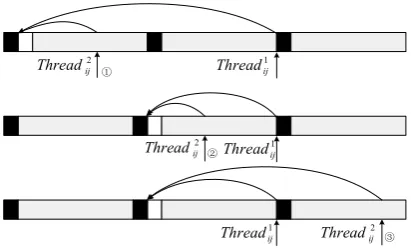
As figure 3(a) shows, each software subtask stij is correspond to two threads threadij1and threadij2 which were scheduled to two processors and executes simultaneously. By checking the consistency of checkpoint and the synchronization of the two threads, processor error and software task error can be detected. If a failure is detected, the threads are rolled back to the appropriate checkpoint.
From the point view of threadij1, fault detection process is shown in Figure 3 (b), where CPi presents the ith checkpoint, up and down arrows indicate the current position of the thread. When threadij1 is at the checkpoint CPi, if the thread threadij2 is at position , ① then thread threadij1 and threadij2 roll back to the checkpoint CPi-2; if the threadij2 is at position , then the ② thread threadij1 compares the states of checkpoint CPi-1,
and if the states are not identical, then the thread threadij1 and threadij2 roll back to the checkpoint CPi-2 at the same
time, otherwise the thread threadij1 saves the state of checkpoint CPi and continues executing; if the thread threadij2 is at position , then the thread ③ threadij1 saves the state of checkpoint CPi and continues executing.
Definition 3: When threadij1 reaches the checkpoint CPk, threadij2 will take at least sdk time to reach checkpoint CPk, we call sdk as synchronization distance at checkpoint CPk .
Definition 4: Given a constant ζ, if the sdk <ζ, threadij1 and threadij2 are synchronized at checkpoint CPk, otherwise threadij1 and threadij2 are not synchronized.
In Figure 3, the checkpoint number is generated dynamically during the execution of thread, each checkpoint number increases 1 when the thread encounters a checkpoint. The checkpoint’s state is stored as an information block and expressed as a 4-tuple ckp = {id1, data1, id2, data2}, where id1 and id2 are the current
checkpoint number of thread threadij1 and threadij2, data1
and data2 are data saved in the checkpoint. Comparison
and synchronization algorithm CmpSync is described as follows:
Step1: Determining which thread will execute the algorithm
If the thread is threadij1, then thisid = id1, otherid = id2;
If the thread is threadij2, then thisid = id2, otherid = id1;
Step2: Comparing checkpoint number
(1) If thisid > otherid, then the restore task Tre is started to recover the status of checkpoint CPi-2.
(2) If thisid = otherid, the status of checkpoint CPi-1
are compared. If the statuses are identical, then the save task Tsa is started to save the checkpoint CPi and thisid increases 1, otherwise the task Tre is started to recover the state of checkpoint CPi-2.
(3) If thisid < otherid, the task Tsa is started to save the state of checkpoint CPi and thisid increases 1.
In algorithm CmpSync, thisid and otherid are the checkpoint number of current thread and another thread respectively, If thisid > otherid, then the interval of the two threads is greater than a detection length and we can determine that the other processor fails and recovers checkpoint’s state. If thisid = otherid, then the thread is ahead of the thread on the other processor and the checkpoint is not compared, so the checkpoint will be compared and it is determined to save the new checkpoint or roll back to the previous checkpoint according to the consistency of checkpoint. If thisid < otherid, the thread is behind the thread on the other processor and the caparison of checkpoint has complete, so it is only needed to save the checkpoint’s state.
Both threadij1 and threadij2 should execute algorithm CmpSync when they reach checkpoint, so the number of execution is same, but the execution load of the algorithm CmpSync is not same, because sometimes checkpoint’s state need to be compared and sometimes not. The following theorem will prove that the load asymmetry does not lead threads threadij1 and threadij2 to lose synchronization.
Theorem 1: Threads threadij1 and threadij2 will not lose synchronization as executing CmpSync algorithm.
Proof: According to Figure 3, when the thread threadij1 encounters a checkpoint CPi under normal circumstances, the thread threadij2 may be at the position
or .When the thread
② ③ threadij2 is at position , the ② thread threadij1 compares state of checkpoint CPi-1; When
the thread threadij2 is at position , the thread ③ threadij2 compares state of checkpoint CPi-1, the thread threadij1 just saves the state of checkpoint CPi.
From the above analysis, we can see that the comparison operation of the checkpoint is always implemented by thread at ahead, so the threads threadij1 and threadij2 will not lose synchronization due to the implementation of algorithm CmpSync. □
③ ②
①
1 ij
Thread
1 ij
Thread
1 ij
Thread
2 ij
Thread
2 ij
Thread
2 ij
Thread
As shown in Figure 4, when the thread threadij1 encounters a checkpoint, the maximum rollback length of task is different according to the location of the thread threadij2.
Suppose that the detection interval length of subtasks stij is Cinij, when the thread threadij2 is at position , the ① task’s rollback length is 2Cinij + Csa + Cre; when the thread threadij2 is at position , the task’s rollback ② length is Cinij + Csa+ Cre; when the thread threadij2 is at position , the task’s rollback length is longer than ③ Cinij + Csa+ Cre but less than 2Cinij + Csa + Cre. Therefore, when the thread threadij2 is in position , the rollback length is ① the longest, and denoted as:
CijR = 2Cinij + Csa + Cre (1) Assuming that the subtask stij sets mij checkpoints and
the detection intervals are equal, that is
C
inij=1
−
ij ijm
C
,when no fault occurs during the execution of the subtask stij, the execution time of stij is:
CijN = Cij + mijCsa (2) When one fault occurs during the execution of the subtask stij, the maximum execution time of stij is:
C
ijT=
C
ijN+
C
ijR (3) When r faults occur, the maximum execution time of task Ti’s software subtask is:
S
type
st
ST
st
C
C
C
ij i ij r R ij N ij r soft i=
∧
∈
∀
⎭
⎬
⎫
⎩
⎨
⎧
+
=
∑
∑
− .max
,
(4)Checkpoints can effectively reduce the task execution time, but if the cost of checkpoint is large or too many checkpoints are set, the total execution time may be longer than the execution time with no checkpoint [16].
According to equation (3), when the task’s execution time Cij, checkpoint recovery time Cre and saving time Csa are certain, the task’s maximum execution time depends on checkpoint’s number mij.
Theorem 2: Suppose Csa < Cij, when mij =
⎥
⎥
⎥
⎤
⎢
⎢
⎢
⎡
+
1
2
sa ijC
C
or⎥
⎥
⎦
⎥
⎢
⎢
⎣
⎢
+
1
2
sa ijC
C
, the execution time of
subtask stij reaches the minimum.
Proof: Take the equation (1) and (2) into equation (3), we can get:
R ij N ij T
ij
C
C
C
=
+
= mijCsa +21
−
ij ijm
C
+ Cij+Csa+Cre.
The first order differential equation and second order differential equation of
C
ijT for mij are:ij T ij
dm
dC
= Csa -
(
)
21
2
−
ij ijm
C
, 2 2 ij T ij
dm
C
d
=(
)
31
4
−
ij ijm
C
.Because mij≥ 2 (we set a checkpoint at the entry and the exit of subtask stij respectively), so the second order
differential equation 2 2 ij T ij
dm
C
d
> 0. When the first order
differential equation ij T ij
dm
dC
= 0, that is
=
2
+
1
sa ij ij
C
C
m
, T ijC
will obtain the minimum value. As mij is a positiveinteger, so when mij =
⎥
⎥
⎥
⎤
⎢
⎢
⎢
⎡
+
1
2
sa ijC
C
or⎥
⎥
⎦
⎥
⎢
⎢
⎣
⎢
+
1
2
sa ijC
C
, T ijC
will obtain the minimum value. □B. Fault-tolerance for Hardware Subtasks
Based on the existing technology, saving and recovering circuit’s state still can not be implemented or the cost is too large, so when the hardware subtask fails, strategy of rollback/recovery should not be taken. In this paper, we use TMR technology to detect and tolerate hardware subtask’s failure.
In order to increase the utilization of reconfigurable resource, hardware subtasks with precedence constrains are partitioned into the same group and all subtasks in a group are configured into one slot. The partition algorithm is described as fellows:
Partition (Ti) {
// each while circle partition a group of subtasks while(Ti has unmarked hardware subtask) {
Group = Φ;
MaxTask =the unmarked widest subtask of task Ti; Mark the MaxTask;
Group= Group { MaxTask }∪ ;
// mark MaxTask's predecessor subtasks
CurTask= MaxTask;
while(CurTask has predecessor subtask) {
if CurTask has unmarked predecessor subtask,
then Pred = CurTask's unmarked widest
predecessor subtask,otherwise Pred = CurTask's first predecessor subtask;
if Pred is unmarked,then Group=Group {Pred} ∪
and mark Pred;
CurTask=Pred;
}
// mark MaxTask's successor subtasks
CurTask= MaxTask;
while(CurTask has successor subtask) {
if CurTask has unmarked successor subtask,then Succ = CurTask's unmarked widest successor subtask,otherwise Succ = CurTask's first successor subtask;
if Succ is unmarked,then Group=Group {Succ} ∪
CurTask=Succ;;
} } }
After the subtasks are grouped by Partition algorithm, subtasks belonging to the same group are configured to three slots at the same time. The hardware subtask stij are presented as stij1, stij2 and stij3 in three slots. By comparing the execution results of stij1, stij2 and stij3, hardware subtask stij’s error can be masked off.
C. Tasks’ Schedulability Test
According to the theorem 4-1 in paper [17], if a set of periodic tasks T = {T1, T2, …, Tn} satisfies the inequality
∑
ki=1⎡
D
k/
P
i⎤
C
isoft≤
mD
k−
(
m
−
1
)
C
kCP , then T can be scheduled by SSHTNB algorithm on m processors without fault-tolerant requirements. During the execution of task Tk, the critical path will be changed if some processors fail. So the critical path must be found when different processors fail.Theorem 3: For a set of periodic tasks T = {T1, T2,…,Tn}, if each task Ti∈T satisfies the inequation(5), then tasks set T can be f-fault-tolerant scheduled by FT-SSHTNB algorithm on m processors.
(
)
f
r
f
m
g
C
C
g
gD
C
C
C
P
D
r R kj CP k k r soft k r f R ij k i soft i k i,
,
,
,
L
0
max
1
max
1 1=
−
=
⎟⎟
⎠
⎞
⎜⎜
⎝
⎛
⎭
⎬
⎫
⎩
⎨
⎧
+
−
−
≤
+
⎭
⎬
⎫
⎩
⎨
⎧
+
⎥
⎥
⎤
⎢
⎢
⎡
∑
∑
∑
− − − = (5)Proof: Just need to prove that when f processors fail, the task set T can be scheduled by FT-SSHTNB algorithm on m-f processors.
The second term of left side in inequation 5 represents the sum of k-1 high-priority tasks’ f-r longest rollback length. During the execution of task Tk, if the Tk’s processor fails r times, then the other processors in the system at most fail f-r times. So the demands of k-1
high-priority tasks at most increase
⎭
⎬
⎫
⎩
⎨
⎧
∑
−r f R ijC
max
and thedemand of task Tk is
C
ksoft r− in one period of task T
k. Because the increase of each path of task Tk is less than or equal to
⎭
⎬
⎫
⎩
⎨
⎧
∑
r R kjC
max
, the length of task Tk’s criticalpath is at most
⎭
⎬
⎫
⎩
⎨
⎧
+
∑
r R kj CP kC
C
max
when processorsfail r times during the execution of task Tk.
According to theorem 4-1 [17], if the inequation (5)
holds, the tasks set T can be scheduled by FT-SSHTNB algorithm on m-f processors. □
D. FT-SSHTNB Algorithm Description
The SSHTNB algorithm [17] can schedule
software/hardware hybrid real-time tasks without fault-tolerant requirement. Based on this, rollback/recovery mechanism is introduced to FT-SSHTNB algorithm to schedule tasks with multiple software and hardware faults. The following part only describes the content related to fault tolerance in FT-SSHTNB and the other content is similar to SSHTNB in paper [17].
FT-SSHTNB algorithm includes two parts: static algorithm and dynamic algorithm. In static algorithm, each real-time task Ti’s fault-tolerant number ki is determined and schedulability of tasks is tested according theorem 3. Dynamic algorithm includes following parts:
Scheduling hardware subtasks:
(1) A thread threadijk is created for each subtask stijk(k = 1,2,3) , and the thread is responsible for passing parameters from processor to the hardware subtask stijk and reading the execution results from subtask stijk to processor.
(2) If two subtasks in stijk (k = 1, 2, 3) are completed, then the execution results should be compared. If the execution results are consistent, the results as the final results are accepted and the 3rd subtask is canceled; otherwise three execution results are compared.
Scheduling software subtasks:
(1) If a processor start executing the threadij1, then the other processor is notified to start executing threadij2.
(2) Suppose that threadij1 and threadij2 are executing on processor Pro1 and Pro2 respectively and threadim1 and threadim2 are executing on processor Pro3 and Pro4
respectively. If the states of threadij1 and threadij2 are not consistent or threadij1 and threadij2 lose synchronization at checkpoint, threadij1 and threadij2 will be rolled back to the pervious checkpoint and threadij1 and threadim1 are scheduled to Pro3 and Pro1. The states will be compared
again at checkpoint, if the states of threadij1 and threadij2 are not consistent or threadij1 and threadij2 lose synchronization, then the processor Pro2 fails, if the
states of threadim1 and threadim2 are not consistent or threadim1 and threadim2 lose synchronization, then the processor Pro1 fails, otherwise the subtask stij fails. E. The Analysis of Real-time Capability
Because of the reliability of computing units, all real-time systems can not guarantee each real-real-time task's deadline when some computing units fail. So we give the definition of real-time capability for a task as follows:
Definition 5: the real-time capability of a task Ti is the probability P(Ti) that task Ti can be finished within its deadline.
occurring to a computing unit within task Tk’s period Pk, and suppose the intensity of SEU flow as λ,and then the probability of the computing unit failing during task Ti executing is:
P(Xi≥1)=1- P(Xi=0)=1-e−λPk (6) Let nF represents the number of computing units that fail. Because the computing unit fails independently, the probability of q computing units failing in the same time
within a system containing M computing units during task Tk executing is:
P(nF=q)=
(
) ( )
q M P q P q
M
e
ke
kC
−
−λ −λ −1
(7) When q≤f, the task Tk can be finished within its deadline according to FT-SSHTNB algorithm, so the real-time capability of task Tk is:P(Tk)= P(nF=0)+P(nF=1)+…+P(nF=f) (8) TABLE I.
REAL-TIME CAPABILITY OF TASK TK UNDER DIFFERENT CONDITIONS
Faults number f
P(Tk)
Pk=100 Pk =200 Pk =300 Pk =400 Pk =500
0 0.951229 0.904837 0.860709 0.818730 0.778800
1 0.998814 0.995411 0.990009 0.982804 0.973987
2 0.999981 0.999854 0.999527 0.998915 0.997957
3 0.999999 0.999996 0.999985 0.999948 0.999880
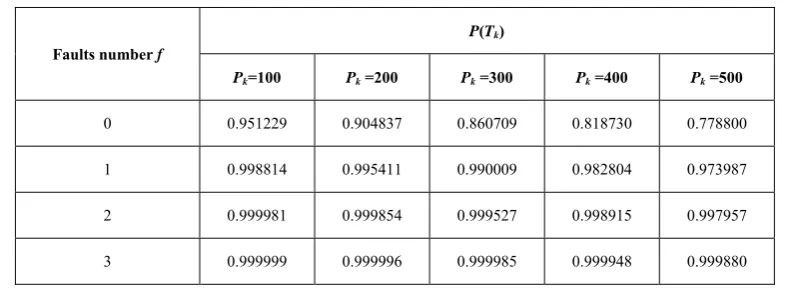
Suppose the real-time system contain 50 computing units and the SEU flow intensity λ= 10-5, the real-time
capability of task Tk is shown in table I according to formula 8.
IV. EXPERIMENTAL RESULTS AND ANALYSIS
In these experiments, we have simulated processor utilization under different conditions and compared with the related algorithms, and the results are shown in table II, table III and table IV as below.
TABLE II.
CAPABILITY COMPARISON OF FT-SSHTNB WITH RELATED ALGORITHMS
Algorithms
Items FT-RMFF HTFS Liu DABCBF FT-SSHTNB
Independent tasks √ √ √ √ √
Precedence Constraint tasks × × × × √
S/H hybrid tasks × × × × √
One processor fault √ √ √ √ √
Multi processor faults × × × × √
FT-RMFF [6] algorithm is a classic fault-tolerant
scheduling algorithm for periodic tasks base on RM scheduling algorithm; HTFS algorithm [12] uses FT-RMFF
algorithm to test the schedulability of periodic tasks and aperiodic tasks also can be fault-tolerant scheduled; DABCBF algorithm [13] improved the FT-RMFF
algorithm by deferring the execution of task’s active slave
PERFORMANCE COMPARISON OF FT-SSHTNB WITH RELATED ALGORITHMS
Algorith ms Fault numbers
FT-RMFF HTFS Liu DABCBF FT-SSHTNB
1 61.582990 59.347181 48.993356 71.990353 32.932836
2 41.051221 39.564787 32.662204 47.993568 31.870486
3 30.788416 29.673590 24.496653 35.995176 30.808136
4 24.630732 23.738872 19.597322 28.796141 29.745787
5 20.525610 19.782393 16.331102 23.996784 28.683437
Because FT-RMFF, HTFS, Liu and DABCBF algorithms adopted primary/slave copy technology, if each real-time task has multiple slave copies, these algorithms also can tolerate multiple processor failures. In this experiment, task’s execution time accords to the uniform distribution in (0, 0.5Pi] and independent software periodic tasks are fault-tolerant scheduled on 32
processors, and the scheduling results are shown in Table III. From Table III we can see that FT-SSHTNB algorithm has low processor utilization when fault-tolerant number is few, however the processor utilization of FT-SSHTNB algorithm is higher than that of other algorithms with the fault-tolerant number increases.
TABLE IV.
AVERAGE PROCESSOR UTILIZATION UNDER DIFFERENT CONDITIONS (%)
Fault numbers
Processor numbers m
8 16 32 64
0 39.820220 38.293705 36.966333 35.613902
1 36.184924 35.493393 36.533091 35.420144
2 30.142350 33.961544 34.924395 34.499440
3 26.073210 30.281818 33.183477 34.133673
4 20.432851 28.085570 32.150187 33.606462
5 15.167190 26.550720 30.587747 32.861652
Table IV shows the scheduling results of software/hardware hybrid tasks with parameters same to SSHTNB algorithm. As can be seen from Table IV, the average utilization ratio of processor decreases with the fault-tolerant number increase, however the decrease becomes unobvious with the processor number increase. For example, when there are 8 processors in the system, the processor’s utilization ratio decreases by 24.7%, however when there are 64 processors, the ratio only decreases 2.8%. The reason is that if the fault-tolerant number is f, the task set T must be scheduled on m-f processors according theorem 3. When m is few, the task’s load will too large to be scheduled on m-f processors, so the processor utilization ratio is lower.
V. CONCLUSIONS
In this paper, a method of processor and software task fault detection and tolerance is given firstly. When there are multiple processor failures, this method can effectively improve the processor utilization. Secondly, the hardware subtask fault detection and tolerance issues are researched, and each hardware subtask is configured to 3 slots in FPGA and fault tolerance is realized by TMR technology. Finally, a real-time fault-tolerant algorithm (FT-SSHTNB) is proposed to schedule software/hardware hybrid tasks. The experimental results show that FT-SSHTNB algorithm can tolerate multiple hardware failures and guarantee all real-time task deadlines to be met with low hardware cost.
REFERENCES
FPGAs by shifting the configuration data,” Proceedings of the 14th International Symposium on Defect and Fault-Tolerance in VLSI Systems, Albuquerque, NM, 1999: 377-385.
[3] Hanchek F, Dutt S, “Methodologies for tolerating cell and interconnect faults in FPGAs,” IEEE Transactions on Computers, 1998, 47(9):15-33
[4] Abramovici M, Stroud C, Wijesuriya S, et al., “Using Roving STARs for on-line testing and diagnosis of FPGAs in fault-tolerant applications,” IEEE International Test Conference, Atlantic City, NJ, 1999: 973-982.
[5] Emmert J, Stround C, Skaggs B, et al., “Dynamic fault tolerance in FPGAs via partial reconfiguration,” IEEE Symposium on Field-Programmable Custom Computing Machines, Napa Valley, CA, 2000: 165-174.
[6] Bertossi A, Mancini LV, Rossini F, “Fault-tolerant rate-monotonic first-fit scheduling in hard real-time systems,” IEEE Transactions on Parallel and Distributed Systems. l999, 10(9) 934- 945.
[7] QIN Xiao, HAN Zong-Fen, PANG Li-Ping, “Real-Time Scheduling with Fault-Tolerance in Heterogeneous Distributed Systems,” Chinese Journal of Computers, 2002,25(1): 49-56
[8] LIU Huai, FEI Shu-Min, “A Fault-Tolerant Scheduling Algorithm Based on EDF for Distributed Control Systems. Journal of Software,” 2003,14(8): 1371-1378
[9] Al-Omari R, Somani AK, Manimaran G, “A new fault-tolerant technique for improving schedulability in multiprocessor real-time systems,” Proceedings of the 15th IEEE Parallel and Distributed Processing Symposium, 2001: 32-33
[10] ZHANG Yong-Jun,ZHANGYi, PENGYu-Xing, et al., “A Multiprocessor-Based Fault-Tolerant Real-Time Task Scheduling Algorithm,” Computer Research and Development, 2000,37(4): 425-429
[11] Yang CH, Deconinck G, “A fault-tolerant reservation-based strategy for scheduling aperiodic tasks in multiprocessor systems,” Proceedings of the l0th IEEE Euromicro Workshop on Parallel, Distributed and Network-based Processing, 2002: 3l9-326.
Scheduling Algorithm of Hybrid Real-Time Tasks Based on Multiprocessors,” Chinese Journal of Computers, 2003, 26(11): 1480-1486
[13] Luo Wei, Yang Fumin, Pang Liping, et al., “A Real-Time Fault-Tolerant Scheduling Algorithm for Distributed Systems Based Deferred Active Backup-Copy,” Journal of Computer Research and Development, 2007, 44(3):521-528
[14] Luo Wei, Yang Fumin, Pang Liping, et al., “A Real-Time Fault-Tolerant Scheduling Algorithm of Periodic Tasks in Heterogeneous Distributed Systems,” Chinese Journal of Computers, 2007, 30(10): 1740-1749
[15] WU Jun, “Fault-tolerant scheduling algorithm for heterogeneous distributed control systems based on dual priorities queues,” Journal of Southeast University (Natural Science Edition), 2008, 38(3):407-412
[16] Punnekkat S, Burns B, Davis R, “Analysis of checkpointing for real-time systems,” Real-Time Systems, 2001, 20(1):83-102
[17] Yin Jinyong, “Research on Real-time Task Scheduling Algorithm of Reconfigurable System,” PhD dissertation, College of Computer Science & Technology,Harbin Engineering University,June 2010