International Journal of Research in Engineering and Science (IJRES)
ISSN (Online): 2320-9364, ISSN (Print): 2320-9356
www.ijres.org Volume 3 Issue 5 ǁ May. 2015 ǁ PP.20-31
Optimizing Shock Models In The Study Of Deteriorating Systems
Sara Modarres Hashemi, Seyed Arash Hashemoghli Sarvha, Nikbakhsh
Javadian, Iraj Mahdavi
Mazandaran University of Science and Technology, Babol, Iran
Abstract-
This research is to make a detailed study of deteriorating systems using the shock model approach. Cumulative damage models in which the damages due to various shocks accumulate and the system failure is viewed as the first passage problem of the cumulative damage process past a threshold are analyzed. We consider the cumulative damage models in a totally different perspective by considering the optimal stopping in an accumulative damage model. The stopping rule is that the cumulative damage may surpass a prescribed threshold level only with a small probability but should approach the threshold as precise as possible. Finally we analyze shock models for which the system failure is based on the frequency of shocks rather than the cumulative damage caused by them. Numerical examples and discussions are provided to illustrate the results.Key
words
- shock, threshold, cumulative damage, first passage, optimal stopping, frequency of shocks.I.
INTRODUCTION
Systems from simple electrical switches to complicated electronic integrated circuits and from unicellular organisms to human beings are subject to online degradation. The result of system ageing is unplanned failure. Systems used in the production and servicing sectors which constitute a major share in the industrial capital of any developing nation are subject to on line deterioration. From the industrial perspective the progressive system degradation and failure is often reflected in increased production cost, lower product quality, missed target schedules and extended lead time. Thus the study of deteriorating systems from the point of view of maintenance and replacement are of paramount importance.
Early models in such studies dealt with age replacement models. In such models the age of the system was the control variable and the replacement policies called “control limit policies” required to replace the system on reaching a critical age. Typical examples are pharmaceutical items, mechanical devices, car batteries, etc. If systems, on failure are replaced with new items, then the failure counting process is a renewal process. However, it may not be cost effective to replace items on failure. This is because the failure of the system could be due to reasons which are minor in nature and thus could easily be repaired or only failed components replaced in a multi component system. This brought the concept of minimal repaired maintenance in to focus. Minimal repairs restore the system to the condition just prior to failure.
The maintenance action mentioned above can be broadly classified as preventive maintenance (PM) and corrective maintenance (CM). The former is carried out when the systems is working and are generally planned in advance. PMs are done to improve the reliability of the system. On the other hand CMs are done on system failure and are unplanned. Also unplanned maintenance costs more than the planned ones.
One of the major approaches in the study of deteriorating systems under maintenance is through shock models. This approach is very useful with its wide applicability to several other diverse areas as well. In this approach a system is subject to a sequence of randomly occurring shocks, each of which adds a non-negative random quantity to the cumulative damage suffered by the system. The cumulative damage level is reflected in the performance deterioration of the system. The shock counting process (N (t); t≥0) has been characterized in the literature by several stochastic processes starting from Poisson process to a general point process. The other process of interest is the cumulative damage process (D(t);t≥0) which is given by the sum of the damages due to various shocks until t. The system failure is studied as the first passage time of the cumulative damage process past a threshold which could be fixed or random. In the following we will briefly review the literature on shock models of deteriorating systems.
II.
Literature Review
additive damage using a compound Poisson process to represent the cumulative damage. Feldman (1976) generalized this model by using a semi-markov process to represent the cumulative damage. Gottlieb (1980) derived sufficient conditions on the shock process so that the life distribution of the system will have an increasing failure rate.Sumita and Shanthikumar(1985) have considered the failure time distribution in a general shock model by considering a correlated pair {Xn,Yn} of renewal sequences withXn and Yn representing the
magnitude of the nth shock and the time interval between two consecutive shocks respectively. Rangan andEsther(1988) relaxed the constraint on the monotonicity of the damage process and considered a non-markov model for the optimum replacement of self-repairing systems subject to shocks. Nakagawa and Kijima (1989) applied periodic replacement with minimal repair at failure to several cumulative damage models. While all the damage models proposed until this period were interested in studying the failure as a first passage problem, Stadje(1991) made a refreshing departure. He studied the problem of optimal stopping in a cumulative damage model in which a prescribed level may be surpassed only with small probability, but should be approached as precise as possible. Rangan et al (1996) proposed some useful generalizations to Stadje’s model. Yeh and Zhang [(2002), (2003)] proposed geometric-process maintenance models for deteriorating systems which assumed the shock arrivals to be only independently distributed and not necessarily identically distributed.
Yeh and Zhang (2004) introduced a new model that was different from the above models and called it a δ-shock model. These models paid attention to the frequency of shocks rather than the accumulative damage due to them. They assumed the shock counting process to be Poisson. Rangan et al (2006) generalized the above model to the case of renewal process driven shocks.
The objective of the present thesis is to apply some of the existing results in shock models to different optimization problems arising in the maintenance of deteriorating systems. We have also developed a model for the first passage problem of the cumulative damage process but under restrictive assumptions. Several special cases of the models are considered and numerical illustrations provided to gain an insight into the underlying processes.
III.
CUMULATIVE DAMAGE MODELS
Cumulative damage models, in which a unit suffers damages due to randomly occurring shocks and the damages are cumulative have been studied in depth by Cox (1962) and Esary et al (1973). The damages could be wear, fatigue, crack, corrosion and erosion. Let us define a cumulative process from the view point of reliability. Consider an item which is subjected to a sequence of shocks (more loosely blows) where an item could represent a material, structure or a device. Each of these shocks adds a non-negative quantity to the cumulative damage and is reflected in the performance deterioration of the item. Suppose that the random variables {Xi; i=1,2,...} are associated with the sequence of intervals of the time between successive shocks. Let
the counting process {N(t); t≥0} denote the number of shocks in the interval (0, t]. Also suppose that the random variables {Yi ;i=1,2,...} are the amounts of damage due to the ith shock. It is assumed that the sequences {Xi;
i=1,2,...}and {Yi ;i=1,2,...} are non-negative, independently and identically distributed and mutually
independent. Define a random variable:
Z (t) = Y1 + Y2 + ...+YN(t) (1)
It is clear that Z (t) represents the cumulated damage of the item at time t.
A. CUMULATIVE DAMAGE PROCESS
In this section we will start our analysis with the cumulative damage process given by (1). The probability distribution of Z(t) can be explicitly determined in a few cases only. One such case is when the shock counting process N(t) is Poisson and the variables Yi s are specified by the point binomial distribution
given by
Yi =
1 𝑤𝑖𝑡𝑝𝑟𝑜𝑏𝑎𝑏𝑖𝑙𝑖𝑡𝑦𝑝 0 𝑤𝑖𝑡𝑝𝑟𝑜𝑏𝑎𝑏𝑖𝑙𝑖𝑡𝑦𝑞 = 1 − 𝑝
In this case whenever a shock occurs, the magnitude of the damage caused is 1 which occurs with probability p and the shock has no effect on the system with probability q.
P (Z (t)=r) = P (Y1 + Y2 + ...+ YN(t) = r)
= ∞𝑛=𝑟𝑃 Y1 + Y2 + . . . +YN(t) = r 𝑁 𝑡 = 𝑛 . P (N (t) =n)
= ∞𝑛=𝑟 𝑛𝑟 . 𝑝𝑟. 𝑞𝑛−𝑟.𝑒 −𝜆𝑡(𝜆𝑡 )𝑛
𝑛!
=𝑒−𝜆𝑡𝑝 (𝜆𝑡𝑝 )𝑟
𝑟!
Thus the cumulative damage process is also a Poisson process with mean λtp. Let the threshold damage value be Z so that the system fails when the cumulative damage process Z(t) reaches Z for the first time. Then the probability of system failure P(t) at time t can be written as
= 𝑒
−𝜆𝑡𝑝 𝜆𝑡𝑝 (𝑍−1)
(𝑍−1)! . λ p
As remarked earlier, the system performance at any time t is reflected by Z(t), the cumulative damage process at t. Thus the fluctuation of Z(t) measured by the coefficient of variation of Z(t) is an important statistical
characteristic to be monitored.
B. AN OPTIMAL REPLACEMENT PROBLEM
We consider a system that is subjected to a sequence of shocks at random intervals with random magnitudes. Let {Yn} denote the sequence of shock magnitudes and let {Xn} denote the sequence of time
between successive shocks, and N(t) the associated shock counting process. The damages due to various shocks are cumulative, so that we define the cumulative damage process Z(t) as Z(t)= Y1+Y2+...+YN(t). We also use the
notation Zj to denote the cumulative damage due to the first j shocks, so that Zj = Y1+Y2+...+Yj . It is assumed
that the system fails when the cumulative damage process, crosses a fixed threshold K for the first time requiring system replacement or repair as the case maybe. The main quantity of interest is the system failure time TK, which is the first passage time of the cumulative damage process Z(t) passed K.
The above system requires a corrective replacement at the time of failures. In practical situations it may not be advisable to run a deteriorating system until its failure as the returns might be lower when the system degrades and also corrective replacements due to failures at random times costs more. Thus a preventive replacement at a suitable time could turn out to be an optimal policy for system maintenance. We assume that our system could be preventively replaced at a lower cost without waiting for the system failure when the cumulative damage process crosses a critical value k. It is to be noted that k < K. We propose to find the optimal k* so that the long run average cost per unit time of running the system is a minimum when Xn and Yn are
exponentially distributed with parameters λ and µ respectively. We wish to observe that more complicated and more generalized models have appeared in the literature [Taylor (1975),Feldman (1976), Nakagawa and Osaki(1974)]. However we have chosen the exponential case to derive our results, as the Markovian property reduces the analysis simple. Before deriving the cost structure we present the notation used in this chapter.
C. Notations used
Yis are independently and identically distributed with distribution function G(x)=1-e-µx
P [Zj≤ x]=P [Y1+ Y2 + ... +Yj ≤ x] = Gj(x) (j fold convolution of G with itself)
P[Zj= x] = dG j
(x)=𝑒−𝜇𝑥(𝜇𝑥 )(𝑗 −1)
(𝑗 −1)! . 𝜇
X1+X2+...+Xn = Sn (Total time for the nth shock)
P(Sn ≤ t) = P(N(t)≥n) = Hn(t)=
𝑒−𝜆𝑡(𝜆𝑡)𝑛 𝑛!
∞
𝑛
c1: Cost of a Preventive Replacement
c1+c2: Cost of a Corrective Replacement
D. Cost analysis
We observe that the system renews itself with every replacement, be it preventive or corrective. Thus replacements form a renewal cycle and from the renewal reward theorem, we know that
Average cost per unit time = 𝐸(𝑐𝑜𝑠𝑡/𝑐𝑦𝑐𝑙𝑒)
𝐸(𝑙𝑒𝑛𝑔𝑡 𝑜𝑓 𝑎 𝑐𝑦𝑐𝑙𝑒)
𝐶(𝑘) = 𝑐1𝑃 𝑃𝑟𝑒𝑣𝑒𝑛𝑡𝑖𝑣𝑒 𝑅𝑒𝑝𝑙𝑎𝑐𝑒𝑚𝑒𝑛𝑡 + (𝑐1+ 𝑐2)𝑃(𝐶𝑜𝑟𝑟𝑒𝑐𝑡𝑖𝑣𝑒 𝑅𝑒𝑝𝑙𝑎𝑐𝑒𝑚𝑒𝑛𝑡)
𝐸(𝑙𝑒𝑛𝑔𝑡 𝑜𝑓 𝑎 𝑐𝑦𝑐𝑙𝑒)
Since replacements are either preventive or corrective, we have
𝐶 𝑘 =𝑐1+𝑐2𝑃 𝐶𝑜𝑟𝑟𝑒𝑐𝑡 𝑖𝑣𝑒 𝑅𝑒𝑝𝑙𝑎𝑐𝑒𝑚𝑒𝑛𝑡
𝐸 𝑙𝑒𝑛𝑔𝑡 𝑜𝑓 𝑎 𝑐𝑦𝑐𝑙𝑒 (2)
We proceed to evaluate the probability of a corrective replacement and expected time between two replacements so that C(k) could be determined.
Probability of A Corrective Replacement:
Figure1.Sample path for Corrective Replacement on Failure
Figure2.Sample path for Preventive Replacement
(Corrective Replacement) = ∞𝑗 =0𝑃[𝑍𝑗 ≤ 𝑘 , 𝑍𝑗 +1> 𝐾] (3)
Equation (3) is obtained by arguing that the cumulative damage up to the jth shock remains below the critical value for preventive replacement and the (j+1)th shock takes it beyond the threshold value K for system failure leading to corrective replacement. The summation is applied because js are arbitrary.
= 𝑃 𝑍𝑗 +1> 𝐾 𝑍𝑗 = 𝑥 𝑃 𝑍𝑗 = 𝑥 𝑑𝑥
∞
𝑗 =0 𝑘
0
= 𝑃[𝑌𝑗 +1> 𝐾 − 𝑥
𝑘
0 ]𝑃 𝑍𝑗 = 𝑥 𝑑𝑥
∞
𝑗 =0
= 𝐺 𝐾 − 𝑥 𝑑𝐺𝑘 𝑗(𝑥)
0
∞
𝑗 =0
= 𝐺 𝐾 − 𝑥 𝑑 𝐺𝑗(𝑥)
∞
𝑗 =0 𝑘
0
Noting that M(x) which is the expected number of shocks in (0, X) is given by ∞𝑗 =0𝐺𝑗(𝑥) , we obtain
= 𝐺 𝐾 − 𝑥 𝑑𝑀 𝑥 𝑘
0
= 𝜇 𝑒𝑘 −𝜇 𝐾−𝑥 𝑑𝑥
0 for the exponential density. = 𝑒
−𝜇 (𝐾−𝑘)− 𝑒−𝜇𝐾 (4)
Now turning our attention to the expected time for replacement, we note that a replacement preventive or corrective corresponds to that shock which takes the cumulative damage beyond the critical value k. If this shock corresponds to the (j+1)th shock, then the expected time for replacement can be decomposed into two intervals: the first one is the time until the jthshock during which the damage level remains below k and the time between the jth and (j+1)th shock when the system shoots above k. Mathematically
E Time for Replacement = 𝐸 (𝑡 +1
𝜆)
= 𝑡 𝐺∞ 𝑗 𝑘 − 𝐺𝑗 +1 𝑘
0 𝑑𝐻𝑗
𝑡 +1
𝜆 (5) ∞
𝑗 =0
In deriving (5), we note that the second term on the R.H.S corresponds to the expected time between two successive shocks. In the first term, while 𝑑𝐻𝑗 𝑡 corresponds to the probability that the jth shock occurs at t,
shock. Since j is arbitrary we sum over all possible j. Using the fact that the mean of the gamma density is given
by 𝑡 𝑑𝐻0∞ 𝑗 𝑡 = 𝑗/𝜆(5) reduces to
= 1/𝜆 𝑗 𝐺𝑗 𝑘 − 𝐺𝑗 +1 𝑘 +1
𝜆 ∞
𝑗 =0
=1
𝜆[ 𝐺𝑗(𝑘)] +
1 𝜆 ∞
𝑗 =0
=1
𝜆 𝜇𝑘 + 1 (6)
Now using (4) and (6) in (2) we obtain
𝐶(𝑘) = 𝜆[𝑐1+ 𝑐2(𝑒1 −𝜇 𝐾−𝑘 − 𝑒−𝜇𝐾)]
𝜆 𝜇𝑘 + 1
(7)
Simple calculus leads us to the optimal k* which minimizes (7) given by the solution of the transcendental equation
𝜇. 𝑘∗. 𝑒−(𝐾−𝑘∗)+ 𝑒−𝜇𝐾 =𝒄𝟏
𝒄𝟐 (8)
Again using some calculus we can show that the solution of (8), if it exists must be unique. It must be noted that the optimal k* given by (8) is a control limit policy.
IV.
AN OPTIMAL STOPPING PROBLEM
In the cumulative damage models of deteriorating systems, researchers were mainly interested in the time to failure of the system. This was looked upon as a first passage problem of the cumulative damage process past a threshold. Stadje(1991) in a refreshing departure from the existing models considered an optimal stopping problem in which the threshold value can be exceeded with small probability but should approach the threshold value as close as possible. As a typical application of the problem, imagine a person who is exposed to injurious environment. One may think of a cancer patient whose radiation treatment is targeted at cancer cells. However the therapy may have the side effect of killing normal cells as well. This means that the therapy should be discontinued when the number of cells destroyed, approach the target set by the medical team as close as possible. Another example is the metal fatigue in devices. Here we are interested in maintaining devices in operation as long as the amount of damage and consequently the risk of failure remain below a prescribed threshold value.
To model the above problem, suppose that shocks occur at random points of time and the random damages due to these shocks are additive. Let Yi be the random damage due to the shock i with common
distribution function F(.). Also we denote the cumulative damage due to the first n shocks by Sn, so that Sn=
Y1+Y2+...+ Yn. If K is the threshold level of the damage process for failure, then our objective is to stop the
cumulative damage process Sn , before it exceeds the level K but such that Sn is not too far apart from K, the
threshold value. Stadje(1991)posed the problem in three different ways.
A. PROBLEM 1
The problem of approaching a goal value K, as closely as possible can be formalized in the following way. Since we wish to avoid the exceeding of the goal valueK, we can reward the reached degree of closeness of Sn to K from below by a reward function f(Sn) as long as Sn< K and impose a penalty α when Sn> K. It is
assumed that the function f(.) is monotone non-decreasing and concave. Thus the mathematical problem here can be stated as follows:
Maximize 𝐸(𝑓 𝑆𝜏 𝐼 𝑆𝜏≤𝐾 + 𝛼𝐼 𝑆𝜏>𝐾 ) with respect to all stopping timesτ∈ 𝒯. Here 𝑓: 0, 𝐾 → 0,∞
is assumed to be a concave, non-decreasing function and α ∈ ℝ is a constant satisfying𝛼 < 𝑓(𝛽). I(.) is the
indicator function.
We give below only the solution to the problem. The proof can be found in Stadje(1991). Define 𝜎 𝑠 = 𝑖𝑛𝑓 𝑛 ≥ 1 𝑆𝑛 ≥ 𝑠
If
𝑓 0 ≥ 𝑓 𝑥 𝑑𝐹 𝑥 + 𝛼 1 – 𝐹 𝐾 𝐾
0
9
The stopping time 𝜎 ≡ 0 is optimal for the problem. If (9) does not hold, there is an 𝑠 ∈ 0, 𝐾 satisfying
𝑓 𝑠 = 𝑓 𝑠 + 𝑥 𝑑𝐹 𝑥 + 𝛼 1 − 𝐹 𝐾 − 𝑠
𝐾−𝑠
0
10
In this case 𝜎 𝑠 is the optimal solution.
B. PROBLEM 2
In the previous problem, suppose that our interest lies only in the degree of closeness of Sn to K, either
the distance to the threshold by some loss function, say 𝑔( 𝑆𝑛− 𝐾 ). The function g(.) is assumed to be non-decreasing and convex with g(0)=0. This problem can be mathematically cast as follows:
𝑀𝑖𝑛𝑖𝑚𝑖𝑧𝑒 𝐸(𝑔 𝑆𝜏− 𝐾 )with respect to all stopping timesτ∈ 𝒯. Here g: 0,∞ → [0,∞) is assumed to be a
convex function for which g(0)=0 and g(Sn) is integrable for all n ≥ 1.
We state below only the solution to the above problem. The reader is referred to Stadje(1991) for a formal proof. If
𝑔(𝐾) ≤ 𝑔 𝑥 − 𝐾 𝑑𝐹 𝑥 + 𝑔 𝐾 − 𝑥 𝑑𝐹 𝑥 (11)𝐾
0
∞
𝐾
𝜎 ≡ 0 is optimal. Otherwise there is an 𝑢 ∈ (0, 𝐾) such that
𝑔 𝑢 = 𝑔 𝑥 − 𝑢 𝑑𝐹 𝑥 + 𝑔 𝑢 − 𝑥 𝑑𝐹(𝑥)
𝑢
0
∞
𝑢 (12)
And 𝜎 𝐾 − 𝑢 is optimal.
We present two examples to illustrate the above problem. First we choose the shock magnitude distribution to be exponential, so that F(x) =1-e(-λx), (x ≥ 0, λ ≥ 0)and the loss function g(.) to be g(x)=x. Using (11) and (12) we conclude that 𝜎(𝐾 −1
𝜆𝑙𝑛2)is optimal if 1
𝜆𝑙𝑛2 < 𝐾; otherwise 𝜎 ≡ 0.Table 1 provides the
optimal stopping time for various values of λ and K.
As another example, we choose the loss function g(.) to be g(x)=x2 while keeping F(x) to be exponential as in the previous example. Now 𝜎(𝐾 −1
𝜆) is optimal if 1
𝜆< 𝐾; otherwise 𝜎 ≡ 0. Table 2 again provides the optimal
stopping times for specific values of λ and K.
C. PROBLEM 3
Stadje (1991) also considered another interesting constrained optimal stopping problem. He fixed some probability 𝜀 ∈ [0,1) and tried to find the optimal stopping time τ of the cumulative damage process in such a manner that probability of the damage process exceeding the threshold value K has an upper bound 𝜀.
Table1. Optimal stopping times for the loss function g(x)=x
K λ 1
𝜆ln 2 Optimal σ
0.5
0.25 4 ln 2 = 2.773 > K 𝜎 ≡ 0
0.33 3 ln 2 = 2.079 > K 𝜎 ≡ 0
1 1 ln 2 = 0.693 > K 𝜎 ≡ 0
2 0.5 ln 2 = 0.347 < K σ(K-
1
𝜆ln 2) = σ
(0.153)
2
0.25 2.773 > K 𝜎 ≡ 0
0.33 2.079 > K 𝜎 ≡ 0
1 0.693 < K σ (0.307)
2 0.347 < K σ (1.653)
5
0.25 2.773 < K σ (2.227)
0.33 2.079 < K σ (2.921)
1 0.693 < K σ (4.307)
Table2. Optimal stopping times for the loss function g(x)=x2
K λ 1
𝜆< 𝐾 Optimal σ
0.5
0.25 4 is not less than 0.5 𝜎 ≡ 0
0.33 3 is not less than 0.5 𝜎 ≡ 0
1 1 is not less than 0.5 𝜎 ≡ 0
2 0.5 is not less than 0.5 𝜎 ≡ 0
2
0.25 4 is not less than 2 𝜎 ≡ 0
0.33 3 is not less than 2 𝜎 ≡ 0
1 1 < 2 σ(1)
2 0.5 < 2 σ(3/2)
5
0.25 4 < 5 σ(1)
0.33 3 < 5 σ(2)
1 1 < 5 σ(4)
2 0.5 < 5 σ(9/2)
Thus our aim is to find the optimal stopping time τ among the class of all stopping times whose probability of threshold exceedence is ≤ 𝜀 which maximizes𝐸 𝑆𝜏 𝑆𝜏 ≤ 𝛽 . Stadje(1991) proved that the optimal
non-trivial stopping time σ(s) is specified by the equation
𝑃 𝑆𝜎 𝑠 > 𝐾 = 1 − 𝐹 𝐾 + (1 − 𝐹 𝐾 − 𝑡 )𝑑𝑈 𝑡 (13)
𝑠
0
Where 𝑈(𝑡) = ∞𝑛=1𝐹𝑛(𝑡) is the renewal measure associated with F and Fn denotes the n-fold convolution of F
with itself.
At this stage we wish to remark that the explicit determination of s is possible only in those special cases in which the renewal measure U corresponding to F(.) is known in closed form. However, from classical renewal theory one can look for approximations.
D. Numerical illustration
As an example let us choose the shock magnitude distribution to be exponential, so that F(x) = 1-e(-λx) ( x ≥ 0 , λ ≥ 0). Equation (13) implies that
𝑃 𝑆𝜎 𝑠 > 𝐾 = 𝑒−𝜆(𝐾−𝑠)
So that the equation 𝑃 𝑆𝜎 𝑠 > 𝐾 = 𝜀 has the solution 𝑆𝜀 = 𝐾 − 𝜆−1 ln 𝜀 , if this quantity is positive. Hence,
𝜎( 𝐾 − 𝜆−1 ln 𝜀 ) or 𝜎 ≡ 0 are optimal, if 𝐾 > 𝜆−1 ln 𝜀 or ≤ 𝜆−1 ln 𝜀 , respectively. Table 9 provides the
optimal stopping times for specified values of λ and K.
V.
SHOCK MODELS BASED ON FREQUENCY OF SHOCKS
Till now we have considered shock models in which the damages due to successive shocks are cumulative and the system failure was identified as the first passage problem of the cumulative damage process. However there are systems whose failure could be attributed to the “frequency” of shocks rather than the accumulated damage due to the shocks. Thus a shock is a deadly or lethal shock if the time elapsed from the preceding shock to this shock is smaller than a threshold value which could be specified or random. One can compare this with the definition of a lethal shock in a cumulative damage model as that shock which makes the damage process to cross the threshold value. This frequency based approach is more practical because the cumulative damage process is abstract and many times not physically observable. In fact many systems may not withstand successive shocks at short intervals even though the damage process is still small. This is because the time for system recovery is not sufficient.
Table3. Optimal stopping times for Exponential distribution
K λ
𝜺 ∈ (𝟏
− 𝑭 𝑲 , 𝟏) 𝜺 𝝀
−𝟏 𝐥𝐧 𝜺 Optimal
σ 0. 5 0.2 5 𝜀
∈ (0.8823 , 1)
0.882 5 0.4999 8 σ ( 0.00002 )
0.9 0.4214 4
σ ( 0.07856 )
0.999 0 𝜎 ≡ 0
0.3 3
𝜀
∈ (0.8479 , 1)
0.848 1
0.4942 7
σ ( 0.0057 )
0.9 0.3160 8
σ ( 0.18392 )
0.999 0.003 σ ( 0.49699 )
1 𝜀
∈ (0.6065 , 1)
0.606
7 0.4997
σ ( 0.0003 )
0.9 0.1054 σ ( 0.3946 ) 0.999 0.001 σ ( 0.499 )
2 𝜀
∈ (0.3679 , 1)
0.368
1 0.4997
σ ( 0.0003 )
0.9 0.0527 σ ( 0.4473 )
0.999 0.0005 σ ( 0.4995 )
2 0.2
5
𝜀
∈ (0.6065 , 1)
0.606 7 0.4999 8 σ ( 0.00002 )
0.9 0.4214 4
σ (0.07856
)
0.999 0 𝜎 ≡ 0
0.3 3
𝜀
∈ (0.51342 , 1)
0.513 7
0.4942 7
σ ( 0.0057 )
0.9 0.3160 8
σ ( 0.18392 )
0.999 0.003 σ ( 0.49699 )
1 𝜀
∈ (0.1353 , 1)
0.135
5 0.4997
σ ( 0.0003 )
0.9 0.1054 σ ( 0.3946 ) 0.999 0.001 σ ( 0.499 )
2 𝜀
∈ (0.01832 , 1)
0.018
6 0.4997
σ ( 0.0003 )
0.9 0.0527 σ ( 0.4473 )
0.999 0.0005 σ ( 0.4995 )
A Frequency Based Shock Model Rangan and Tansu (2010)
We will first give the notation used in this chapter to understand the assumptions easily.
Notation used
Z: Random variable denoting the time between two successive shocks.
gD(.) , GD(.) , 𝐺 𝐷(. ) : probability density, cumulative distribution and survivor functions of D. W: Random variable denoting time between two successive failures.
kW(t) , KW(t) , 𝐾 𝑊(𝑡) : probability density, cumulative distribution and survivor functions of W. N(t) : counting variable denoting the number of failures in (0,t].
M(t) = E{N(t)}
Lf(s) : Laplace Transform of the density function f(t). The model is governed by the following assumptions:
Assumption 1: At time t=0 a system is put in operation. The system on failure is repaired.
Assumption 2: The system is subject to shocks. The time between shocks Z is assumed to be independently and identically distributed with distribution function FZ(.).
Assumption 3: A shock is classified as a nonlethal shock if the time elapsed from the previous shock to this shock is greater than the threshold D. A shock is lethal if it occurs within D. A lethal shock results in system failure leading to its repair.
Assumption 4: The repairs of failed systems are assumed to take negligible amount of time. Assumption 5: Threshold value D is a random variable with distribution function with GD(.). Assumption 6: The shock arrival times and the threshold times are independent of each other.
Remarks
The term “shock” is used in a broad sense, denoting any perturbation to the system caused by environment or inherent factors, leading to a degeneration of the system. If shocks are due to environmental factors like high temperature, voltage fluctuations, humidity and wrong handling, then shocks due to each of such factors will arrive according to a renewal process. Thus the shock arrival process can be seen to be the superposition of independent renewal processes. Thus a poisson process will provide a reasonable approximation (Yeh and Zhang, (2004)). On the other hand, if the shocks are due to internal causes, then the renewal process is an adequate approximation. For instance, shocks could be viewed as the failure of a component in a multi-component system.
The random threshold D could be viewed as a built-in repair mechanism in the system which counters the after-effects of a shock. Thus any shock which arrives before D could prove to be lethal.
We list below some of the main results of the paper without proof. Result 1: The Laplace transform of kW(t) is given by :
𝐿𝑘 𝑠 =
𝐿𝑓𝐺 (𝑠)
1 − 𝐿𝑓𝐺(𝑠) (14)
where𝐿𝑓𝐺(𝑠) and 𝐿𝑓𝐺 (𝑠) are the Laplace Transform of the functions fZ(t)GD(t) and fZ(t)𝐺 𝐷(𝑡), respectively. Result 2: The mean and variance of W, the time between two successive failures are given by:
𝐸 𝑊 = 𝐸(𝑍)
𝑃(𝑍 ≤ 𝐷) (15)
𝑉𝑎𝑟 𝑊 = 𝐸(𝑍
2)
𝑃(𝑍 ≤ 𝐷)+
2𝐸 𝑍 𝐸 𝑍 𝑍 > 𝐷 𝑃 𝑍 > 𝐷 − 𝐸2(𝑍)
𝑃(𝑍 ≤ 𝐷)2 (16)
Result 3: The Laplace Transform of the probability generating function of N(t), the number of failure (0,t) is given by:
𝑉 𝑢, 𝑠 = 1
𝑠+
𝑢 − 1 𝐿𝑘(𝑠)
𝑠[1 − 𝑢𝐿𝑘 𝑠 ]
Result 4: The Laplace Transform of M(t)= E[N(t)] is given by:
𝐿𝑀 𝑠 =
𝐿𝑘 𝑠
𝑠[1 − 𝐿𝑘 𝑠 ] (17)
SPECIAL CASES
When the system is subjected to the same kind of shock each time, the threshold times of the system do not vary much and is likely to remain a constant, a case discussed by Yeh and Zhang (2004),Yong Tang and Yeh (2006). Under such a scenario, we consider a couple of models for different shock arrival distributions. We choose the threshold time to be a constant d, so that gd(t)=δ(t-d) where δ(.) is the Dirac delta function. Thus
𝐺𝑑 𝑡 = 0 0 ≤ 𝑡 ≤ 𝑑1 𝑡 ≥ 𝑑
Rangan and Tansu (2010) have considered the following distributions: 1. Exponential density:
𝑓 𝑥 = 𝜆 𝑒−𝜆𝑥
𝐸 𝑊 = 1
𝜆(1 − 𝑒−𝜆𝑑)
𝑀 𝑡 = 𝜆𝑡 − 𝜆𝑒−𝜆𝑑(𝑡 − 𝑑)
2. Weibull density:
𝑓 𝑥 = 𝑘
𝜆 (
𝑥 𝜆)(𝑘−1)𝑒
−(𝑥𝜆)𝑘
𝐸 𝑊 = 𝜆𝛤(1 +
1 𝜆)
1 − 𝑒−(𝑑𝜆)𝑘
Now we consider the following cases: 3. Hypo-exponential density:
𝑓 𝑥 = 𝑎1𝜆1𝑒−𝜆1𝑥+ 𝑎2𝜆2𝑒−𝜆2𝑥
where a1 and a2 are given by
𝑎1=
𝜆2
𝜆2− 𝜆1 , 𝑎2=
𝜆1
𝜆1− 𝜆2
Using equations (15) and (17) we obtain:
𝐸 𝑊 = 𝜆1
2− 𝜆 22
𝜆1𝜆2(𝜆1− 𝜆2+ 𝜆2𝑒−𝜆1𝑑− 𝜆1𝑒−𝜆2𝑑)
𝑀 𝑡 = 1
(𝜆1− 𝜆2)(𝜆1+ 𝜆2)𝜆1𝜆2 −𝜆1+ 𝜆1𝑒
−𝑡(𝜆1+𝜆2)+ 𝜆
2− 𝜆2𝑒−𝑡(𝜆1+𝜆2)+ 𝑡𝜆1(𝜆1+ 𝜆2 − 𝑡𝜆2(𝜆1+ 𝜆2)
− 𝑒−𝑑𝜆2𝐻𝑒𝑎𝑣𝑖𝑠𝑖𝑑𝑒𝑇𝑒𝑡𝑎 𝑡 − 𝑑 (𝜆2− 𝜆2𝑒−(𝑡−𝑑)(𝜆1+𝜆2)+ (𝑡 − 𝑑)𝜆1(𝜆1+ 𝜆2))
+ 𝑒−𝑑𝜆1𝐻𝑒𝑎𝑣𝑖𝑠𝑖𝑑𝑒𝑇𝑒𝑡𝑎 𝑡 − 𝑑 (𝜆
1− 𝜆1𝑒−(𝑡−𝑑)(𝜆1+𝜆2)+ (𝑡 − 𝑑)𝜆2(𝜆1
+ 𝜆2)) (18)
Note that: 𝐻𝑒𝑎𝑣𝑖𝑠𝑖𝑑𝑒𝑇𝑒𝑡𝑎 𝑡 − 𝑑 = 1 𝑖𝑓 𝑡 ≥ 𝑑
0 𝑖𝑓 𝑡 < 𝑑
4. Hyper-exponential density:
𝑓 𝑥 = 𝜆1𝑒−𝜆1𝑥. 𝑝 + 𝜆2𝑒−𝜆2𝑥. 𝑞 , 𝑝 + 𝑞 = 1
We obtain:
𝐸 𝑊 =
𝑝 𝜆1+
𝑞 𝜆2
𝑝 1 − 𝑒−𝜆1𝑑 + 𝑞(1 − 𝑒−𝜆2𝑑)
𝑀 𝑡 = 𝑝 − 1 𝜆1
1− 𝑝𝜆2 2 𝜆2 −𝑝𝜆1+ 𝑒
−𝑡 − 𝑝−1 𝜆1+𝑝𝜆2 𝑝(𝜆
1− 𝜆2 + 𝑝𝜆2
− 𝑡𝜆1 𝑝 − 1 𝜆1− 𝑝𝜆2 − 𝑝𝜆2 −𝑝𝜆1+ 𝑒−𝑡 − 𝑝−1 𝜆1+𝑝𝜆2 𝑝(𝜆1− 𝜆2 + 𝑝𝜆2
− 𝑡𝜆1( 𝑝 − 1 𝜆1− 𝑝𝜆2)) − 𝑒−𝑑𝜆2𝐻𝑒𝑎𝑣𝑖𝑠𝑖𝑑𝑒𝑇𝑒𝑡𝑎[𝑡
− 𝑑]𝜆2 −𝑝𝜆1+ 𝑒− 𝑡−𝑑 − 𝑝−1 𝜆1+𝑝𝜆2 𝑝(𝜆1− 𝜆2 + 𝑝𝜆2− (𝑡
− 𝑑)𝜆1 𝑝 − 1 𝜆1− 𝑝𝜆2 ) + 𝑒−𝑑𝜆2𝑝. 𝐻𝑒𝑎𝑣𝑖𝑠𝑖𝑑𝑒𝑇𝑒𝑡𝑎[𝑡
− 𝑑]𝜆2 −𝑝𝜆1+ 𝑒− 𝑡−𝑑 − 𝑝−1 𝜆1+𝑝𝜆2 𝑝(𝜆1− 𝜆2 + 𝑝𝜆2− (𝑡
− 𝑑)𝜆1 𝑝 − 1 𝜆1− 𝑝𝜆2 + 𝑝𝜆1(𝜆1− 𝑝𝜆1+ 𝑒−𝑡 − 𝑝−1 𝜆1+𝑝𝜆2 (𝑝 − 1)(𝜆1− 𝜆2)
− 𝜆2+ 𝑝𝜆2+ 𝑡𝜆2(− 𝑝 − 1 𝜆1− 𝑝𝜆2)) − 𝑒−𝑑𝜆1𝑝. 𝐻𝑒𝑎𝑣𝑖𝑠𝑖𝑑𝑒𝑇𝑒𝑡𝑎[𝑡 − 𝑑]𝜆1(𝜆1
− 𝑝𝜆1+ 𝑒− 𝑡−𝑑 − 𝑝−1 𝜆1+𝑝𝜆2 (𝑝 − 1)(𝜆1− 𝜆2) − 𝜆2+ 𝑝𝜆2+ (𝑡 − 𝑑)𝜆2(−(𝑝
− 1)𝜆1+ 𝑝𝜆2))) (19)
Numerical illustrations
Since the main focus of interest in our model is the time to failure of the system, we present in this section the mean failure time for various shocks arrival distributions. In order to bring out the degree of dependence of the shock arrival distribution on the mean time to failure, we consider several shock arrival distributions but all having the same mean. The cases of exponential and Weibull shock arrival distributions have already been considered by Rangan and Tansu (2010). We consider the cases of hyper-exponential and hypo-exponential distributions for illustration.
Hypo-exponential
By setting the mean of shock arrivals to 1 with λ1=3 and λ2 = 1.5, figure 3 shows the mean time to
Figure3. Plot of the mean failure time vs. threshold for Hypo-exponential case
Hyper-exponential
We also consider the case of Hyper-exponential density specified by
𝑓 𝑥 = 𝜆1𝑒−𝜆1𝑥. 𝑝 + 𝜆2𝑒−𝜆2𝑥. 𝑞
For illustration purposes we choose:
p = 0.4 , q = 0.6 , λ1 = 0.5 , λ2 = 30 so that the mean of the density function is equal to 1 as before. Figure4
shows the values of the mean failure time corresponding to various values of the threshold d.
Figure4.Plot of the mean failure time vs. threshold for Hyper-exponential case
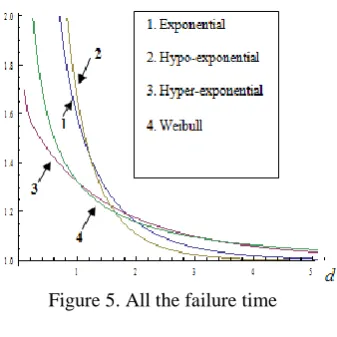
In figure 5 we consolidate all the failure time distributions in a single graph. It is observed that: i. As the threshold d tends to infinity, P(Z≤d) is equal to 1. Using (15) we conclude that lim𝑑→∞𝐸 𝑤 =
𝐸(𝑍) .
ii. As it can be seen from the figure for increasing the threshold, the curve of Hypo-exponential reaches 1 faster, and the Weibull curve reaches last.
Figure 5. All the failure time
VI.
CONCLUDING REMARKS
This research analyses various stochastic models of deteriorating systems. Since all real life systems are subject to on line deterioration and consequently its failure, this study assumes lots of significance. Though there are several approaches to this problem, we have taken recourse to the shock model approach. We have chosen specific models for illustration and application which made significant contribution in the area and viewed the problem in a totally new perspective. One of the major reasons for employing the shock model approach is that they have wide applicability in other areas as well.
1 2 3 4 5
1.0 1.5 2.0 2.5
1 2 3 4 5
1.1 1.2 1.3 1.4 1.5 1.6 1.7
d
E(W)d
E(W)REFERENCES
[1] Cox, D.R., (1962). Renewal Theory, Methuen, London.[2] Nakagawa, T., and Osaki, S., (1974). “Some Aspects of Damage Models”, Microelectronics and Reliability, Vol13, 253-257. [3] Taylor, H.M., (1975). “Optimal Replacement under Additive Damage and Other Failure Models”, Naval Research Logistics
Quarterly, 22, 1-18.
[4] Feldman R.M., (1976). “Optimal Replacement with Semi-Markov Shock Models”, Journal of Applied Probability, Vol13, 108-117.
[5] Gottlieb, G., (1980). “Failure Distributions of Shock Models”, Journal of Applied Probability, 17, 745-752.
[6] Sumita, U. and Shanthikumar, G., (1985). “A Class of Correlated Cumulative Shock Models”, Advances in Applied Probability, 17, 347-366.
[7] Rangan, A. and Esther, R., (1988). “A Non-Markov Model for the Optimum Replacement of Self-repairing Systems subject to Shocks”, Journal of Applied Probability, 25, 375-382.
[8] Nakagawa, T. and Kijima, M., (1989). “Replacement Policies for a Cumulative Damage Model with Minimal Repair at Failure”. IEEE Transaction on Reliability, Vol38, No. 5. 581-584.
[9] Stadje, W., (1991). “Optimal Stopping in a Cumulative Damage Model”, OR Spektrum, Vol13, 31-35.
[10] Rangan, A., Sarada, G. and Arunachalam, V., (1996). “Optimal Stopping in a Shock Model”, Optimization, Vol38, 127-132. [11] Yeh, L., Zhang, Y.L. and Zheng, Y.H., (2002). “A Geometric Process Equivalent Model for a Multistate Degenerative System”,
European Journal of Operation Research,Vol142 No.1, 21-29.
[12] Yeh, L. and Zhang, Y.L., (2003). “A Geometric-Process Maintenance Model for a Deteriorating System under a Random Environment”, IEEE Transaction on Reliability, Vol52, 83-89.
[13] Yeh, L. and Zhang, Y.L., (2004). “A Shock Model for the Maintenance Problem of a Repairable System”, Computer and Operations Research, Vol31, 1807-1820.
[14] Yong Tang, Ya. andYeh, L., (2006). “A Delta Shock Maintenance Model for Deteriorating System”, European Journal of Operation Research, 168, 541-556.
[15] Rangan, A., Thyagarajan, D. and Sarada, Y., (2006). “Optimal Replacement of Systems Subject to Shocks and Random Threshold Failure”, International Journal of Quality and Reliability Management, Vol.23, 1176-1191.
[16] Rangan, A. and Tansu, A., (2010). “Some Results on A New Class of Shock Models”, Asia Pacific Journal of Operational Research, Vol.27 (4), 503-515.
[17] Esary, J., Marshal, F. and Proschan, F., (1973). “Shock Models and Wear Processes”, Annals of Probability, vol. 1,627-649. [18] Ross, S.M., (1996). “Stochastic Processes”, second edition, John Wiley & Sons, New York.