A STUDY ON THE RELATIONSHIP BETWEEN PERSONALITY TRAITS AND CONSUMER COMPLAINT BEHAVIOR
Davut ELMASTAŞ
Research Assistant
Department of Business Administration Kocaeli University
Email: [email protected] Turkey
F. Burcu CANDAN Professor Doctor
Department of Business Administration Kocaeli University
Email: [email protected] Turkey
ABSTRACT
In the twenty-first century, rapid change and dramatic development in the way of doing business has caused time to pass faster and increased competition worldwide. Companies now have stopped to think traditionally. Instead, they started to care more about customers, made them their main focus point and started to give more importance to their ideas. From this perspective understanding, customers are integral in order to survive and confront competition. One of the most effective ways of understanding customers is to understand the dissatisfactions of consumers during or after shopping. In this regard in this study, it is analyzed that whether there is a relationship between the consumers’ complaint behaviors when confronted with dissatisfactions and locus of control (internal-external locus of control). According to the results, three different complaint behaviors were found. These are; passive complaint behavior which means not to complain or complain only when asked, active complaint behavior which means to complain actively and seek remedy and active complaint behavior through social media which means consumers actively complain but they want other people to hear the dissatisfaction. In this research, the chi-square independence test was used. According to results, it was found that there is a significant relationship between the locus of control and consumer complaint behaviors, and participants who have an internal locus of control mostly choose active complaint behavior or active complaint behavior through social media and participants who have an external locus of control choose passive complaint behavior.
Keywords: Consumer, Complaint Behavior, Locus of Control
Introduction
The fact that our age is the information age, the industry has reached the highest level since the days of mankind has led to the existence of alternative brands and products addressing the same needs of consumers. A customer who has dissatisfaction after a shopping made from a company can meet the same need from another one. For these and similar reasons, companies need to be more sensitive to consumers. In this context, one of the important points of the companies is to understand the
consumers.There are many ways to understand consumers. It is also important to understand what consumers like and what they are satisfied with, as well as to understand whether they are dissatisfied or not and to consider the reasons for it.
and scales used to measure personality. In the study, it was analyzed how there is a relationship between locus of control (one of the personality theories) and consumer complaints behavior. Within this scope, the locus of control scores was calculated by the questionnaire given to those who participated in the study and the reactions are measured in response to the dissatisfaction encountered. As a result, different complaint behaviors occurred and their relationship with locus of control was analyzed. Consumer Complaint Behavior
Consumer complaints, which are viewed by businesses as a problem that needs to be copied, are a matter of
considerable importance in today's competitive environment together with changing consumer expectations. There are many reasons for this. But most importantly, getting new customers in an intensely competitive environment is more important than retaining existing customers (Baer and Hill, 1994; Liu and McClure, 2001).
The complaint is defined as negative feedback from customers (Bell, Mengüç, and Stefani, 2004: 113). The concept of consumer complaints behavior can be described in the simplest terms as "the response of consumers to their dissatisfaction with the end of their consumption experience" (Jacoby and Jaccard, 1981). The fact that dissatisfaction is a starting point for the complaint to occur is the cause of these concepts to be evaluated together (Bearden and Teel, 1983; Landon and Leird 1980; Day, 1984).
Consumer complaints behavior is grouped by different researchers in different ways. According to Hirschman's
study in 1970, the consumer who encountered dissatisfaction may choose one or a few of the behaviors of exiting, articulation, and loyalty. Exit behavior may be assessed as the disuse of goods or services, stores, brands, or service providers once more after dissatisfaction in the procurement process. As another reaction, articulating a complaint represents a state of complaint to the product manufacturer, the intermediary organization that distributes the product, or other third party or individual, for reasons such as compensating for the unwanted condition of the product after the purchase, or for the refund of the money. Loyalty means that the consumer does not take any action against dissatisfaction and continues to be a customer of the goods or the service, the store or the brand.
According to taxonomy by Day and Landon (1977), a consumer who is dissatisfied may exhibit one or more of
the following behaviors: doing nothing, private action, and public action. In this grouping which is based on direct consumer behaviors, the consumer may prefer not to act against dissatisfaction. The consumer may decide to get into the act as a result of encountered dissatisfaction, as an alternative. In this case, there are two options in front of the consumer. The first is the option of special action involving the abandonment of the use of the product (boycotting or exit) and informing people around by negative communication by word of mouth and the second is the option of public actions involving the expression of the complaint to the company, application for legal remedies and complain to third parties.
In another study conducted by Singh in 1988, a consumer that encountered dissatisfaction may choose one or more of the following actions: the articulation of complaints, personal reactions, and third-party reactions. Here, the act of not doing anything is included in the act of articulating the complaint. Personal reactions consist of negative word of mouth, which is carried out by a person's own immediate surroundings not directly related to the subject of the complaint while third-party reactions include complaints to private or public complaints institutions similar to the above categorizations.
In 1990, Singh conducted another study, and the study concluded that the complaint behaviors were collected under four groups as passive behavior exhibiting persons, complaint articulating persons, angered persons and activists. Consumers who choose passive behavior consist of consumers who are least likely to take any action in case of encountering dissatisfaction. Consumers who prefer to articulate complaints generally report complaints to companies or producers who are directly responsible for their dissatisfaction, rather than exiting, having a negative word of mouth communication, and showing the behavior of complaining to third parties, and they want the problem to be solved urgently. Angry consumers may prefer to articulate their complaints to the company, but at the same time, they can use the act of exit and negative word of mouth communication method. Activists refer more than the average to the articulation of complaints, negative word of mouth communication, and third-party appeals reactions.
Concept of Personality
Although researchers have made many statements on this concept,
a definition that has been agreed upon has not yet been made.
The spiritual and general characteristics that distinguish one person from another are all referred to as personality. Whether they are invisible or intangible, it depends on them that we will or not be loved by others. Although some personality traits are innate, some personality traits can change as the person grows (Vassaf, 1975).
Personality is a concept that age-long which allows one to form as an entity, defines and distinguishes one from others. It is adopted by individuals as a lifestyle, and is developed consciously or unconsciously and includes forms of deep-rooted behavior. Personality enables one to maintain a healthy, decent, stable, mutual relationship with the environment. (Burger,2006).
There are some components that make up the personality. On the basis of these components, there are the character, temperament, and talent. The character is generally defined as the features of a person that can be
observed, evaluated, and judged by others
(Yıldızoğlu,2013:50). Temperament is generally an expression of the characteristics of one's emotional and social life (Keskin,2016:8-9). Talent is defined as the ability of a person to do a job, the ability to accomplish work in the mind and behavior areas without learning, and the whole of ability that distinguishes one person from the other (Yeni,2015:8).
Theories about Personality
There are many theories that try to explain the concept of personality. These are consisting of psychoanalytic theories, behavioral approaches, and humanistic theories. Psychoanalytic theory studies have been introduced by scientists such as Sigmund Freud, Carl Gustav Jung and Alfred Adler who have adopted a psychoanalytical approach. According to researchers who have adopted psychoanalysis theory, there are two types of personality interpretation. In the first thought, the most important factor in the formation of personality is the motivation constituted by the subconscious. In the second opinion, it is the idea which is defining the confliction between the emerging desire for encumbering and defensive mechanisms, together with this emerging motivation. (Yeni, 2015:54).
According to representatives of behavioral approaches, it behaviors that can be observed should be examined instead of examining mental states. Because science should only be interested in observable behaviors (Burger, 2006:511).
According to the humanistic approach, the field of our being and the free will is unique for every human being. There are some basic concepts in humanistic psychology. These are personal responsibility, being now and here, the individual's phenomenology and personal development.
There are also theories about personality traits as well as approach. These theories include Gordon W. Allport's Trait Theory of Personality, Raymond B. Cattel's Sixteen Personality Factors, and Henry Murray's Personality Theory, the Big Five Personality Traits Theory, and Locus of Control Theory.
According to Gordon W. Allport's Trait Theory of Personality, the distinctive features that make up the personality are constant, perpetual tendencies that allow him to adapt to his surroundings. The advantage of this theory is that it is so comprehensive that can identify everyone’s skills. The disadvantage is that it is too long and impractical to use the researches.
Raymond B. Cattel's Sixteen Personality Factors has attempted to measure the personality of individuals with less and more basic items by reducing the measures of the personality traits of the differential feature theory.
According to Henry Murray's Personality Theory, human development must be studied with the individual characteristics of the person, as well as the biological properties.
The Big Five Personality Traits Theory deals with personality in five dimensions, as externality, emotional imbalance, compatibility, self-discipline (responsibility) and developmental openness. Individuals who have the characteristics of extroverted dimension; strong in social aspect, like to be with others, chatty and ambitious (Yeni, 2015, s.24). Individuals who have characteristics of emotional imbalance (neuroticism) personality dimension have characteristics as concerned, insecure, protective, nervous and anxious (Demirci, 2003, s.49). Individuals who have compatible personality characteristics exhibit gentle, loving, flexible, friendly attitudes in social relations, desire to act together instead of competition and
includes features such as organization, carefulness, reliability, carelessness, negligence, and lack of loyalty (Tomrukçu,2008, s.17). The developmental openness personality dimension includes features such as imagination, confusion and creativity, shallowness and lack of understanding. (Tomrukçu, 2008, s.17).
Locus of Control was introduced in 1966 by Julian B. Rotter to psychology. This concept emerges as a theory of personality traits that reflect the thoughts about how effective their own, others and environmental causes are in the experienced events. It also includes thoughts about how one can lead his/her own life. Rotter divided locus of control into two groups: internal locus of control (internal controlling) and external locus of control (external controlling). Internal locus of control or external locus of control is a personality trait that affects strategies of coping with stress in people's lives (Demirkol,2013:28).
Internal locus of control means that the events that people experience and the situations that occur in their environment generally can be the result of their own supervision and that they can decide what they want to do in life. These individuals show greater sensitivity to behaviors that will contribute to them in the future than external controlling persons. They believe that environmental conditions can be changed and make efforts in this regard (Çağlayan,2015:45).
External locus of control means that people see external factors such as fate, chance, and so on as factors that reinforce behaviors. Persons with external locus of control never see themselves as the cause of their successes or failures. In their failure, they find large, complex groups independent of themselves guilty. In this case, because the individual does not think the consequences of their behavior are in their own hands, they have a low motivation and are reluctant to make efforts (Çağlayan,2015:47).
Studies on the Relationship between Personality And Consumer Complaint Behavior
There is a limited number of studies that analyze the relationship between personality traits and consumer complaints behavior. In 2012, a study was conducted by Gökdeniz, Dorukan, and Bozacı on individual factors affecting the tendency of customers to complain to the company. In this study, the problem of not communicating complaints to the company was studied theoretically and personal variables were determined that affect the tendency to complain. Analyzes were made on the data
with the questionnaire study applied to the students. The study examined the relationship between the big five personality traits theory, locus of control, self-esteem, and the tendency to complain. According to the results obtained, it was found that there is a positive and significant relationship between the internal locus of control, self-esteem and the tendency to complain (Gökdeniz, Dorukan, Bozacı, 2012).
Another study on this subject was carried out by Berry in 2012. Berry analyzed the relationship between personality traits and consumer complaints behavior. In a questionnaire made to 490 university students, four dissatisfaction cases that can be encountered were asked to consumers. The situations contained dissatisfaction confronted when receiving a restaurant service and what they were willing to do in response to this dissatisfaction was measured. In the same questionnaire, there are different scales that measure participants' locus of control, personality traits, sociality and stress level. According to the results obtained, there is no relation between the locus of control and the complaint channel preference. However, when the stress level of the consumer is evaluated together with the state of locus of control, it is revealed that these two variables are related to the consumer complaint behavior preference.
Another study conducted in 2002 analyzed customer
complaints at restaurants and the relationship of these complaints with socio-demographic characteristics, personality, and behavioral factors. It is revealed that there are 3 types of consumer complaints behavior. These are those who are not inclined to complain, those who actively complain, and those who complain by word of mouth communication. In the study, it was revealed that the behavior of complaints
by negative communication and word of mouth communication
was preferred by consumers. According to the study, consumers who have a high-stress level complain more. Consumers with low price sensitivity and ones who affected little by other consumers are less inclined to complain (Jones, McCleary, Lepisto, 2002).
Method and Scope of Research
section. This prequestionnaire has identified the products that consumers have purchased the most on the internet. In the second questionnaire, it was determined that participants with different levels of locus of control (internal vs. external locus of control) would be likely to show which complaint behaviors in the case of dissatisfaction during online shopping. The dissatisfied cases presented in the questionnaire were selected from the cases where consumers had the most complaints on the complaint sites. The questionnaire consists of four parts. In the first part, participants were asked whether they made shopping on the internet and which products they buy frequently. Questionnaires of participants who did not shop online were not taken into consideration.
In the second part, it is measured how much they agree with which behavior of complaints in case of dissatisfaction they may encounter when shopping online. In this section, 6 cases are presented that are similar to situations where consumers can encounter in real life. For each case, they were asked how well they participated in 8 different reactions with a Likert scale of 5. The 8 different reactions asked are the same for each situation.
In the third part, the locus of control scale is included. In this study, The Rotter Internal and External Locus of Control Scale were used to measure the locus of control of university students. The research was done in Turkey to university students. The adaptation of this scale to the Turkish was carried out by Dağ in 1991. There are 29 items on the scale. Six of these items were designed as fill in the blanks, the remaining 23 designed as to select one of
the options at or b. In accordance with the nature of the study, items with blank filling were removed from this questionnaire and the remaining 23 items were added. Participants were divided as the internal or external locus of control based on their answers to this questionnaire. In the reliability study performed by Rotter, the item total score correlation varied between 0.11 and 0.48, the test-retest reliability value varied between 0.49 and 0.83, and the two half-test reliability coefficients ranged from 0.65 to 0.79. In 1991 by Dağ, it was calculated that the internal consistency coefficient was 0.71, the test-retest reliability was 0.83 and the KR-20 reliability coefficient was 0.68 in the adaptation of the scale to Turkish.
Kocaeli University students who are located in the province of Kocaeli constitute the study population. A prequestionnaire was applied to 400 of these students and the products they purchased the most on the internet were identified. Then, the original questionnaire was applied to the same 400 students. The sample to be analyzed was selected according to the convenience sampling method, which is the non-random sampling method. Since 44 questionnaires were incomplete and inconsistent, 356 valid questionnaires were used for evaluation. The most important constraint of the research is that the application area is limited only to Kocaeli University students.
The research hypothesis is as follows:
H1: There is a significant relationship between locus of control and consumer complaints behavior.
Research Model
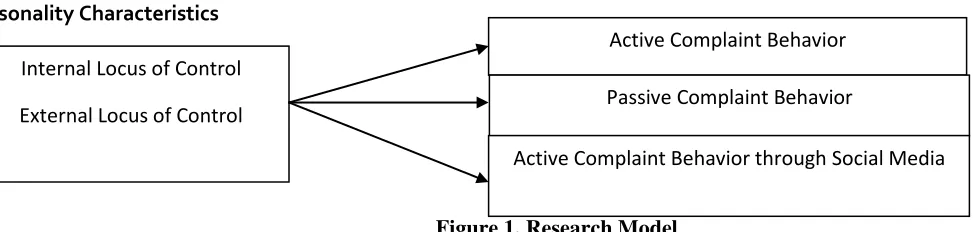
Consumer Complaints Behavior Personality Characteristics
Figure 1. Research Model
The model that shows the relationship between locus of control and consumer complaint behaviors from personality traits theories is as above.
Research Findings
Prequestionnaire Information: Internal Locus of Control
External Locus of Control
Active Complaint Behavior
Passive Complaint Behavior
In the pre-questionnaire, it was tried to determine which product or products the participants bought the most in internet shopping. Forty-three different products were
asked to participants. The results are summarized in the following table.
Table 1. Information on Prequestionnaire Results
Name Of The Product Frequency Percent
Shoes 48 % 12
Book 41 % 10,5
Flight ticket 33 % 8,25
Other products 278 % 69,5
Total 400 % 100
According to the above table, the participants mostly prefer to buy shoes with 12% over the internet. The second is book with 10.5% and the third is flight ticket with 8.25%.
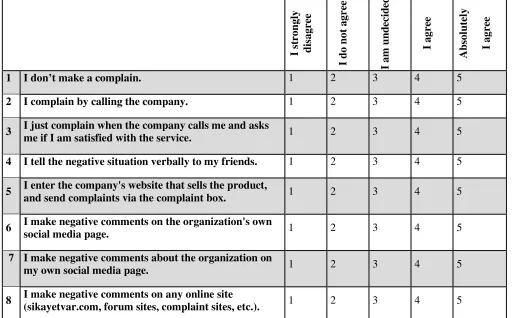
The table below contains the items that were asked at the end of each situation (scenario). The items asked for each situation are the same.
Table 2. The Items That Are Asked At the End of Each Situation
I s
trongl
y
dis
ag
re
e
I do not
agre
e
I am
un
d
ec
id
ed
I agr
ee
A
bsol
ut
el
y
I agr
ee
1 I don’t make a complain. 1 2 3 4 5
2 I complain by calling the company. 1 2 3 4 5
3 I just complain when the company calls me and asks
me if I am satisfied with the service. 1 2 3 4 5
4 I tell the negative situation verbally to my friends. 1 2 3 4 5
5 I enter the company's website that sells the product,
and send complaints via the complaint box. 1 2 3 4 5
6 I make negative comments on the organization's own
social media page. 1 2 3 4 5
7 I make negative comments about the organization on
my own social media page. 1 2 3 4 5
8 I make negative comments on any online site
(sikayetvar.com, forum sites, complaint sites, etc.). 1 2 3 4 5
Factor Analysis Results Applied for the Scales Used in the Questionnaire:
Factor analysis analyzes the relationship between multiple variables through correlation coefficients between variables and helps to convert fewer factors (Yükselen,2006:177). Factor analysis was applied to the items of each case in the study
and what their sub-dimensions could be was determined. This analysis has been applied to see if each situation is divided into different categories of complaints behavior as expected.
is the most used parameter in reliability analysis, is used. As a result of the measurement, if this value is greater than 0.60, it is assumed that the reliability of the scale is sufficient(Kayış, Aliye 2010:405; Altunışık vd., 2005:116). The fact that Cronbach's Alfa coefficient is higher than 0.80 means that the reliability is higher and that the coefficient is between 0.40 and 0.60 means that the scale is
relatively reliable (Nakip, 2006: 146). KMO (Kaiser-Meyer-Olkin) and Bartlett analysis were applied to determine whether the situations in the study were appropriate for factor analysis.
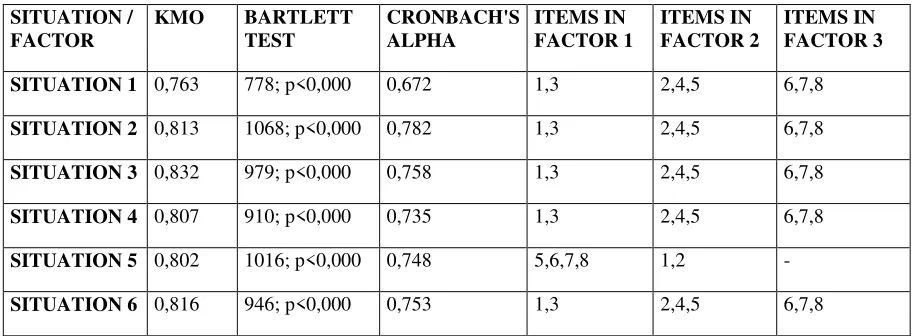
In the following table, reliability analysis, factor analysis, KMO and Bartlett Test results are seen.
Table 3. Results of Factor Analysis Applied to Situations
SITUATION / FACTOR
KMO BARTLETT
TEST
CRONBACH'S ALPHA
ITEMS IN FACTOR 1
ITEMS IN FACTOR 2
ITEMS IN FACTOR 3
SITUATION 1 0,763 778; p<0,000 0,672 1,3 2,4,5 6,7,8
SITUATION 2 0,813 1068; p<0,000 0,782 1,3 2,4,5 6,7,8
SITUATION 3 0,832 979; p<0,000 0,758 1,3 2,4,5 6,7,8
SITUATION 4 0,807 910; p<0,000 0,735 1,3 2,4,5 6,7,8
SITUATION 5 0,802 1016; p<0,000 0,748 5,6,7,8 1,2 -
SITUATION 6 0,816 946; p<0,000 0,753 1,3 2,4,5 6,7,8
From Table 3, it can be seen from the results of KMO and Bartlett Test that all situations are suitable for factor analysis. According to the results of the reliability analysis, the Cronbach Alpha value for situation 1 is 0.672, 0.782 for situation 2, 0.758 for situation 3, 0.735 for situation 4, 0.748 for situation 5 and 0.753 for situation 6. This value means that the items in each situation are reliable.
Factor analysis revealed 3 factors for situation 1, situation 2, situation 3, situation 4 and situation 6. The predictions for these three factors that arise for these five situations are the same. There are two factors for situation 5. For this reason, the situation 5 was subtracted from analyzes, and the analysis was made on the other situations. As a result of the factor analysis made, the first factor for situation 1, 2, 3, 4 and 6 includes the first and third items (items are shown in table 2). Factor 2 includes items 1, 4 and 5.
Factor 3 includes items 6, 7, and 8. In this context, in accordance with the content of items the first factor is called as passive complaint behavior, the second factor is called an active complaint behavior, and the third factor is called an active complaint behavior through social media. Chi-Square Independence Test Results:
The chi-square independence test is applied to the counting data obtained at the sorter (categorical) measurement level of non-parametric data (Gürsakal, 2013: 232). This test tests whether there is a significant relationship between
measured variables. Variables must be categorical for this test to be applied. A chi-square independence test was used to
Table
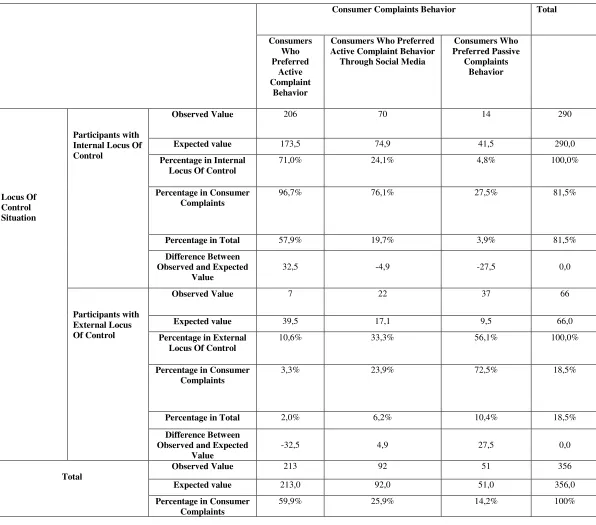
4. Locus of Control Situation * Consumer Complaints Behavior Preference Cross TableConsumer Complaints Behavior Total
Consumers Who Preferred
Active Complaint
Behavior
Consumers Who Preferred Active Complaint Behavior
Through Social Media
Consumers Who Preferred Passive
Complaints Behavior
Locus Of Control Situation
Participants with Internal Locus Of Control
Observed Value 206 70 14 290
Expected value 173,5 74,9 41,5 290,0
Percentage in Internal Locus Of Control
71,0% 24,1% 4,8% 100,0%
Percentage in Consumer Complaints
96,7% 76,1% 27,5% 81,5%
Percentage in Total 57,9% 19,7% 3,9% 81,5%
Difference Between Observed and Expected
Value
32,5 -4,9 -27,5 0,0
Participants with External Locus Of Control
Observed Value 7 22 37 66
Expected value 39,5 17,1 9,5 66,0
Percentage in External Locus Of Control
10,6% 33,3% 56,1% 100,0%
Percentage in Consumer Complaints
3,3% 23,9% 72,5% 18,5%
Percentage in Total 2,0% 6,2% 10,4% 18,5%
Difference Between Observed and Expected
Value
-32,5 4,9 27,5 0,0
Total
Observed Value 213 92 51 356
Expected value 213,0 92,0 51,0 356,0
Percentage in Consumer Complaints
59,9% 25,9% 14,2% 100%
Table 5. Chi-Square Independence Test
Value Df Asymp. Sig. (2-sided)
Pearson Chi-Square 133,080a 2 ,000
Likelihood Ratio 118,644 2 ,000
Linear-by-Linear Association 125,064 1 ,000
N of Valid Cases 356
Table 4 above contains the frequency (observed) values and the corresponding expected values. The expected value is the expected value to be obtained if there is no relation between the two variables. The relation of variables to each other increases at the same rate as the difference between the expected value and the observed value. In order to apply the chi-square test, none of the expected values should be less than 5 (Pallant, 2010: s.219-220).
The results of the chi-square independence test are in Table 5. Since the chi-square p-value is smaller than 0.05 (p = 0,000 <0,05), there is a significant relationship between the locus of control state of the respondents and the complaint behavior preference.
In Table 4, in the absence of any relationship between locus of control and complaint behavior, it is expected that approximately 174 persons with the internal locus of control will exhibit active complaint behavior. But the observed value is 206. Therefore, there is a difference between expected and observed values. In the absence of any relationship between locus of control and complaint behavior, approximately 75 people with locus of control are expected to exhibit active complaint behavior through social media. But the observed value is 70. In the absence of any relationship between locus of control and complaint behavior, approximately 42 individuals with the internal locus of control are expected to exhibit passive complaint behavior. But the observed value is 14.
In Table 4, 7 people with an external locus of control prefer active complaint behavior. However, if there is no relationship between locus of control and complaint behavior, the expected value is approximately 40. In other words, if there was no dependency (relation) between the locus of control situation and the consumer complaints behavior, approximately 40 people would have both an external locus of control and exhibit an active complaint behavior. However, in reality, it is seen that 7 people have both the external locus of control and preferred active complaint behavior. There is, therefore, a difference between the observed value and the expected value. In the same table, 22 people with an external locus of control prefer active complaint behavior through social media. However, if there is no relationship between locus of control and complaint behavior, the expected value is approximately 17. Finally, 37 people with an external locus of control prefer passive complaint behavior. However, if there is no relationship between locus of
control and complaint behavior, the expected value is approximately 10.
By the difference between the expected value and the observed value, it appears that the greatest difference exists in answerers who prefer active complaint behavior with an internal locus of control (32,5). There is also a significant difference between the external locus of control and the observed and expected values of active complaint behavior(-32,5). Secondly, the difference between expected and observed values is at least between active complaint behavior through social media and locus of control. The difference between expected and observed values of those who have an internal locus of control and prefer active complaint behavior is -4.9. The difference between expected and observed values of those who have an external locus of control and prefer active complaint behavior is 4.9. Third, the difference between the expected and observed values of consumers who have an internal locus of control and prefer passive complaint behavior is -27.5 and the difference between the expected and observed values of those who have an external locus of control and prefer passive complaint behavior is 27.5. As a result, the largest difference between the expected and observed values is seen between the active complaint behavior and the locus of control. The least difference is seen between active complaints behavior through social media and locus of control situation.
There is also a significant difference between passive complaint behavior and locus of control. Considering that the expected values are expected to occur when there is no relationship between the two variables, the significance level is less than 0.05 and an expected value is less than 5, it is seen that there is a significant relationship between participants’ locus of control situation and complaint behavior preference.
prefer active complaint behavior through social media and 56.1% prefer passive complaint behavior.
As it is seen, consumers who have an internal locus of control often prefer active complaint behavior in case of dissatisfaction when shopping online. Those consumers who have the belief that they can intervene in the events that they encountered in their lives, can either make complaints directly to the company by phone or tell their friends about the negative situation or they can tell the complaint to the company through the company's website. In parallel with this result, 96.7% of consumers who prefer active complaint behavior have an internal locus of control.
The majority of consumers (76.1%) who prefer active complaint behavior through social media have an internal locus of control. Therefore, when these participants are dissatisfied, they will either comment negatively on the social media page of the company, or comment negatively on their own social media pages, or articulate complaints at any online site that is open to everyone. These consumers want the dissatisfaction to be heard by other consumers.
The majority of consumers (72.5%) who prefer passive complaint behavior are consumers with an external locus of control. When the consumers who think that they can intervene very little in the events that they encountered in their lives or have no intervention encounter dissatisfaction, either make no complaints or only complain when the company calls them and asks their satisfaction.
Conclusion and Recommendations
The main aim of this study is to analyze the
relationship between the personality traits of the consumers and compliant behavior. There are many theories and scales that measure personality in different dimensions and different scales. In the research, the locus of control which is one of these theories was taken. In this context, in this study, it was analyzed whether there was a significant relationship between the locus of control situation and the complaint behavior preference.
As a result of the study, it was found that consumers who have an internal locus of control mostly prefer active complaints behavior and/or active complaints behavior through social media; consumers who have an external locus of control mostly prefer passive complaints behavior if they are dissatisfied after or during online shopping. In other words, if the person believes that the events
encountered in his / her life are in his / her own control and that he/she can change the events with his / her own intervention (if he/she has an internal locus of control), he / she will actively reach out to the company and actively complain in a manner which other consumers can easily see through social media in case of a dissatisfaction. But if the person thinks that he/she has never intervened in the events he/she has encountered, or he/she will have little impact on the events he/she confronts (if he/she has external locus of control), he / she will prefer not to express his / her complaint or will only complain when the company calls him/her and asks for satisfaction.
Given the results mentioned above, companies selling goods or services on the internet should carefully handle complaints management. Companies should use survey methods such as questionnaire, focus group, panel, and face-to-face communication to determine which locus of control the customer has. Based on the result that the consumers having internal locus of control actively express their complaints by articulating or through social media, companies should learn the dissatisfaction of customers who have internal locus of control during or after shopping by asking or in other ways, and make up the dissatisfaction fast and in a manner which the customer satisfaction is ensured. In this way, both the customer is satisfied and the behavior of abandoning the company is avoided and the customer who is compensated positively and urgently protects the image of the company and he/she may also communicate positively this situation through word of mouth and lead the new customers to prefer this company.
Companies only make mistakes if they consider consumers who are actively complaining and ignore
Therefore, although consumers who prefer actively complaining behavior through active or social media are more likely to damage the image of the company in terms of current and potential customers, it is also important to consider the possibility that the consumers who prefer passive complaints behavior will cause the company to lose customers by acting in the form of abandoning. For this reason, companies should learn whether their customers who prefer passive complaint behavior and mostly have an external locus of control are satisfied with the service provided by means of telephone, e-mail, mail or face-to-face communication and if there is dissatisfaction, this situation should be compensated quickly and satisfactorily. Thus, both complaints are eliminated and the consumer is satisfied and the behavior of abandoning the company is avoided.
It can be said that this study has contributed to literature. When the literature on consumer complaints
channels is examined, it is seen that in this study there is a factor that has not appeared before. Active and passive complaint behavior is the complaint behavior frequently reached and used in previous studies. However, active complaint behavior through social media emerged as a separate factor for the first time as a result of this study. Therefore, this factor needs to be analyzed with new studies.
This study was conducted on students. Making this study in more heterogeneous groups may contribute positively to the literature. In the light of these results, it would be useful for the literature to conduct a more detailed study with the scales (five factors personality theory, Cattle's stress and comfort test, CPI sociability scale, etc.) that measure personality completely or some certain personality dimensions in consumer complaints behavior.
REFERENCES
Altunışık, R., Çoşkun, R., Bayraktaroğlu, S., and Yıldırım, E., (2005). Sosyal Bilimlerde Araştırma Yöntemleri SPSS Uygulamalı. Sakarya: Sakarya Kitabevi.
Baer, R., Hill, D. J. (1994). Excuse making: A prevalent company response to complaints. Journal Of Consumer Satisfaction, Dissatisfaction And Complaining Behavior, 7, 143-151.
Bearden, W. O., Teel J. E. (1983). Selected determinants of consumer satisfaction and complaint reports. Journal Of Marketing Research, 21-28.
Bell, S. J., Mengüç, B., Stefani, S.L. (2004). When customers disappoint: A model of relational internal marketing and customer complaints. Journal Of The Academy Of MarketingScience, 32(2), 112-126.
Berry, R., (2012). How we complain: The effect of personality on consumer complaint channels. Master’s Thesis. University Of Nevada, Las Vegas.
Burger, J. M. (2006). Kişilik. İstanbul: Kaknüs Psikoloji.
Çağlayan, O., (2015). Organizasyonlarda insan yönetimi kaynakları uygulamalarının tükenmişlik üzerine etkisi: Kontrol odağı aracılık rolü. Master’s Thesis. Kayseri.
Dağ, İ. (1991). Rotter’in İç-Dış Kontrol Odağı Ölçeği (RİDKOÖ)’nin üniversite öğrencileri için güvenirliği ve geçerliği. Psikoloji Dergisi, 7, 26, 10-16.
Day, R. L., Landon, R. L. Jr. (1977). Toward a theory of consumer complaining behaviour. In Consumer And Industrial Buying Behavior. A. Woodside, J. Sheth, P. Bennett (ed.). Amsterdam: North Holland Publishing Company.
Demirci, S. (2003). Öğretmenlerde beş faktör kişilik özellikleri ile iş doyumu iş doyumu arasındaki ilişkinin incelenmesi. Master’s Thesis. Karadeniz Teknik Üniversitesi
Demirkol, M. (2013). İntihar olasılığı: Kişilik özellikleri kontrol odağı ve ölüm algısı açısından bir değerlendirme. Master’s Thesis. Ankara Üniversitesi Sosyal Bilimler Enstitüsü, Ankara.
Gökdeniz, İ., Dorukan T., Bozacı, İ. (2012). Müşterinin firmaya şikâyet etme eğilimini etkileyen bireysel faktörler üzerine uygulamali bir çalişma. Aksaray Üniversitesi İİBF Dergisi, Cilt:4, Sayı:1.
Gürsakal, N. (2013). Çıkarımsal İstatistik. Bursa: Dora Yayın.
Hirschman, E. C. (1980). Innovativeness, novelty seeking, and consumer creativity. Journal Of Consumer Research, 283-295.
Hirschman, A.O., (1970). Exit, Voice, and Loyalty: Responses to Decline in Firms, Organizations, and States. London: Harward University Press Cambridge.
Jacoby, J., Jaccard, J. J. (1981). The sources, meaning, and validity of consumer complaint behavior: a psychological analysis. Journal Of Retailing, 57(Fall), 4-24.
Jones, D. L., Ken W. M., Lawrence R. L. (2002). Consumer complaint behavior manifestations for table service restaurants: identifying sociodemographic characteristics, personality, and behavioral factors. Journal Of Hospitality And Tourism Research, 26(2): 105-123.
Kayış, A. (2010). “Güvenilirlik Analizi” içinde “SPSS Uygulamalı Çok Değişkenli İstatistik Teknikleri”. Şeref
Kalaycıoğlu (Ed.). Ankara: Asil Yayın Dağıtım.
Keskin, Emine (2016). Beş faktör kişilik özellikleri ve cam tavan engeli arasındaki ilişkiler: antalya kundu bölgesindeki beş yıldızlı oteller üzerine bir uygulama. Master’s Thesis. Süleyman Demirel Üniversitesi Sosyal Bilimler Enstitüsü, Isparta.
Landon, E. L. (1980). The Direction Of Consumer Complaint Research. Advances In ConsumerResearch Vol. 7. J. C. Olson, (ed.). Ann Arbor, MI: Association For Consumer Research, 335-8.
Liu, R. R., McClure, P. (2001). Recognizing cross cultural differences in consumer complaint behavior and intentions: an empirical examination. Journal Of Consumer Marketing, 18(1), 54-75.
Nakip, M. (2006). Pazarlama Araştırma Teknikleri ve (SPSS Destekli) Uygulamalar. Ankara: Seçkin Yayınları.
Rotter, J. B. (1966). Generalized expectancies for internal versus external control of reinforcement. Psychological Monographs, 80, (1), (Whole No. 609).
Singh, J., Widing, R. E. (1991). What occurs once consumers complain? atheoretical model for understanding satisfaction/dissatisfaction outcomes of complaint responses. European Journal Of Marketing, 25(5): 30-46.
Singh, J. (1990). A typology of consumer dissatisfaction response styles. Journal of Retailing, 66(1): 43-57
Singh, J. (1988). Consumer complaint intentions and behavior: definitional and taxonomical issues. Journal of Marketing, 52(1): 93-107.
Tekin, Ö. A. (2012). Yabancılaşma ve Beş Faktör Kişilik Özellikleri Arasındaki İlişkiler: Antalya Kemer'deki Beş Yıldızlı Otel İşletmeleri Çalışanları Üzerinde Bir Uygulama. Yüksek Lisans Tezi. Antalya
Tomrukçu, B. (2008). Beş faktör kişilik özellikleri ile iş değerleri arasındaki ilişki üzerine bir inceleme. Master’s Thesis. Osmangazi Üniversitesi Sosyal Bilimler Enstitüsü, Eskişehir.
Vassaf, B. H. (1975). Çocuk ve Gençlik Psikolojisi. İstanbul: Meb Yayınları.
Yeni, Z. (2015). Beş faktör kişilik özellikleri ile duygusal emek arasındaki ilişkinin belirlenmesine yönelik bir araştırma. Master’s Thesis. Dumlupınar Üniversitesi Sosyal Bilimler Üniversitesi, Kütahya.
Yıldızoğlu, H. (2013). Okul yöneticilerinin beş faktör kişilik özellikleriyle çatışma yönetimi stili tercihleri arasındaki ilişki. Master’s Thesis. Hacettepe Üniversitesi, Ankara.