ISSN (Online): 2320-9364, ISSN (Print): 2320-9356
www.ijres.org Volume 5 Issue 11 ǁ November. 2017 ǁ PP. 27-31
The Effect on Performance of NCR Battery for
Temperature And Rating
*
Yu Zhang,
2Bixiong Huang
2,Ying Wang
2,Dongzheng Wang
(College Of Automotive EngineeringShanghai University Of Engineering Science, Shanghai 201620, China) Corresponding Author: *1Yu Zhang
ABSTRACT:
To study the properties of NCR batteries, foreign 3.25 AH batteries serve as the research objects. The paper aims to study the median voltage,capacity of the NCR batteries under different ambient temperature and ratings;The cycle life of the battery;the relationship about OCV and SOC of the battery.As a result,the discharging median voltage of NCR batteries has a increasing tendency in a certain temperature range while decreasing tendency with the rating growing. The discharging capacity of the NCR batteries has a rising tendency as the temperature rises.On the contrary, the charging-discharging capacity of the NCR batteries has a decreasing tendency as the rating rises.Keywords:
NCR battery;temperature;rating;properties--- --- DateofSubmission:16-11-2017 Date of acceptance: 28-11-2017 ---
---I. INTRODUCTION
The lithium ion battery of ternary material has greater advantage in energy density,discharging voltage and low temperature performance. Gradually,it is widely used in smart phones,wearable devices and electric vehicles.Now,it is recognized and prompted in the field of electrical vehicles about power batteries,Tesla is one of the typical examples[1]. Recently,the temperature and rating have a great impact on the battery performance ,which gets a high attention from people.There are some papers about the type of 18650 batteries which are about LFP and NCR example,the battery’charging-discharging performance will make a decrease in low temperature environment.The charging-discharging performance of batteries will become more poor.It makes a great influence on charging and starting of the electrical vehicles. The lithium ion battery of NCR batteries become more and more popular in electrical vehicles.At the present,the articles about its performance research are less. This paper makes a more detailed research on basic performance about NCR 18650B batteries.On the one hand,it fills the gaps in the study,on the other hand,it provides a reference for the peer.As a result,we can maximize its the performance advantages and extend service life[3].
II. DESIGN OF TESTING EXPERIMENT
A.Test samples
Select eight samples(3.6V,3250mAh)which is qualified when it makes out.
B. Test method
Make a charging-discharging plan and observe the changes about median voltage,capacity of batteries under different ambient temperatures and ratings and the relationship of OCV-SOC.
C. Test facilities
(1)The computer is used to test the setting of program,the running of program and record the data. (2)The testing system of LAN DIAN is used to test the current and voltage of the batteries. (3)The incubator provides the environment which is used to test the batteries.
D. Test procedures
(1) OCV-SOCexperiment: Constant current charging(0.6A),static 1h,Constant current discharging(current is 0.6A,the discharging capacity is 0.3Ah),static 1h,cycle this procedure (Ensure the voltage is full and the discharging capacity is plus 0.3Ah every time until the discharging capacity is 3Ah).
(2)Temperature experiment: static 1h-Constant current charging(3.25A)-static 1h-Constant current discharging(3.25A)-static 1h.
III.RESULT OF THE TESTING
A. The relationship on the open circuit voltage and the state of charge for the battery
Numbers SOC(%)
1 2 3 Average
100 4.122 4.123 4.118 4.121
90 4.022 4.022 4.022 4.022
80 3.935 3.935 3.931 3.9337
70 3.858 3.859 3.857 3.858
60 3.77 3.771 3.772 3.771
50 3.657 3.656 3.656 3.656
40 3.601 3.599 3.599 3.600
30 3.55 3.553 3.553 3.552
20 3.476 3.471 3.467 3.471
10 3.354 3.356 3.353 3.354
Table.1 The relationship between OCV and SOC
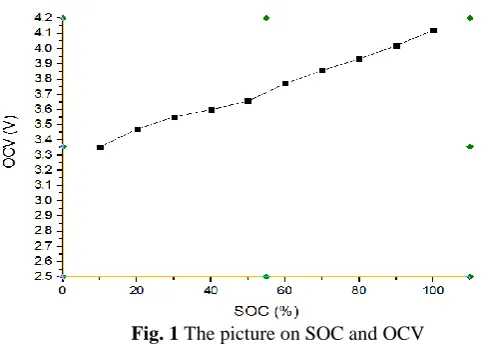
By measuring the data of SOC and OCV at 25℃(0.2C),we make the curve about the relationship of SOC-OCV.By doing some research on the performance of batteries ,the OCV is more sensitive to SOC.
Fig. 1 The picture on SOC and OCV
B. The influence on the discharging median voltage and capacity of batteries at different temperature
Numbers Temperature
1 2 3 4 5 Average
0° 3.123 3.142 3.127 3.106 3.091 3.1178
10° 3.213 3.207 3.195 3.182 3.174 3.1942
20° 3.262 3.256 3.247 3.242 3.237 3.2488
30° 3.292 3.287 3.285 3.281 3.273 3.2836
40° 3.326 3.318 3.314 3.312 3.308 3.3156
50° 3.346 3.334 3.344 3.340 3.338 3.3404
Table.2 The relationship between temperature and the median voltage
Numbers Temperature
1 2 3 4 5 Average
0° 1.350 1.237 1.097 0.967 0.859 1.102
10° 1.388 1.326 1.249 1.180 1.121 1.2528
20° 1.630 1.584 1.531 1.482 1.440 1.5334
30° 1.777 1.728 1.680 1.642 1.599 1.6852
40° 1.838 1.759 1.721 1.682 1.664 1.7328
50° 1.841 1.820 1.804 1.777 1.761 1.8006
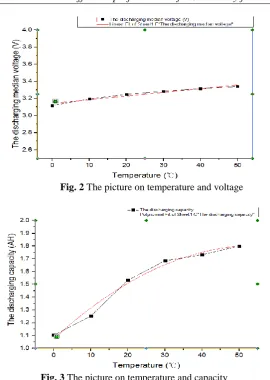
Fig. 2 The picture on temperature and voltage
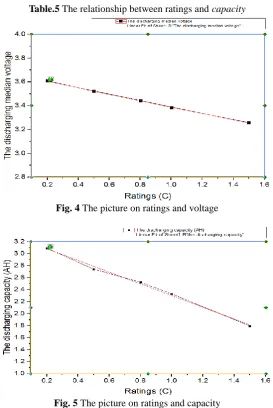
Fig. 3 The picture on temperature and capacity
The discharging median voltage is gradually increasing with the increase of the temperature.The median voltage of the battery has a better stability with the higher temperature within certain rage. The temperature has significant influence on the performance of three element battery.
In a certain temperature range, the charging and discharging capacity is lower when the temperature is lower. At 50 degrees, the charging and discharging capacity is almost 2 times of the charging and discharging capacity of 0 degrees. 0 degrees to 30 degrees, the charging and discharging capacity of the battery showes a rapid growth trend; 30 degrees to 50 degrees,the tendency still increases but slower[5].
C. The influence on the discharging median voltage and capacity of batteries at different ratings
Numbers Ratings
1 2 3 4 5 Average
0.2 3.609 3.609 3.611 3.608 3.609 3.609
0.5 3.523 3.523 3.522 3.524 3.520 3.522
0.8 3.443 3.442 3.442 3.441 3.441 3.442
1.0 3.391 3.388 3.388 3.382 3.385 3.387
1.5 3.270 3.264 3.254 2.252 2.249 3.258
Table.4 The relationship between ratings and median voltage
Numbers Ratings
1 2 3 4 5 Average
0.2 3.097 3.097 3.095 3.090 3.093 3.094
0.5 2.746 2.742 2.745 2.748 2.736 2.743
0.8 2.541 2.526 2.521 2.519 2.516 2.525
1.0 2.371 2.346 2.332 2.308 2.293 2.330
Table.5 The relationship between ratings and capacity
Fig. 4 The picture on ratings and voltage
Fig. 5 The picture on ratings and capacity
The discharging median voltage tend to decrease with the increasing rating.The discharging median voltage of batteries has also a decreasing tendency from lowewr ratings to higher ratings.The performance of discharging median voltage is more stable at the lower rating. From 0.2C to 1.5C,the discharging capacity tends to decrease with the increasing rating. Within a certain range,the battery has a better discharging performance at lower the rating.
D. The effect on discharging capacity for cycle life
The performance of the battery has tendency to decline with the increasing cycle life. The discharging capacity of the battery decreases gradually.From the picture,the SOH of battery is 80% when the cycle life is about 300 times.
IV. CONCLUSION
The three element battery is the energy system as the new energy vehicle.The temperature and rating have a great impact on the efficiency and performance of batteries. Therefore,pay more attention to their impact on the battery when use them and keep them working in an ideal temperature and rating in order to reduce the bad effects on the batteries.
REFERENCES
[1]. Horie H, Tanjo Y, Miyamoto T, et a1. Development of a lithium-Ion battery system for EV application. Preprint of JSAE Spring Lecture Series.1996;961:159-166.
[2]. Inaba M. Ogumi Z. Up-to.date development of lithium•ion batteries in Japan. Electrical Insulation Magazine, IEEE, 201 1; 10-11: 6-20.
[3]. Li Gechen.Wang Haiying. Yu Zhilong.New method for estimation modeling of SOC of battery. Software Engineering, 2009. WCSE’09. WRI World Congress on. 201)9:5:387-390.
[4]. He Hongwen,Xiong Rui, Zhang Xiaowei, et a1.State-of-charge estimation of the lithium-ion on battery using an adaptive extened kanl•man filter based on an improved thevenin model.IEEE Transactionson Energy Conversion, 2011; 60(40): 1461-1467 .
[5]. H. Wang, A.L. Rogach Hierarchical SnO2nanostructures: recent advances in design, synthesis, and applications Chem. Mater., 26 (1) (2014), pp. 123-133.
[6]. IET Transport Desk.UK Grid Capacity Sufficient for Electric Vehicles[R].England:The Institution of Engineering and Technology,1 May 2009.
[7]. Scotland WWF. The Role of Electric Vehicles in Scotland’s Low Carbon Future[R].Scotland:WWF Scotland,2010.
[8]. The Alpiq Group. Electric Vehicle Mark Penetration in Switzerland by 2020 [R].
[9]. Yu Zhang (1991-08), male, han nationality, riverside county of huaian, Jiangsu Province, master's degree, students, mainly major in lithium ion battery testing and software programing.