Research Article
CODEN: IJPNL6
DEVELOPMENT
AND
VALIDATION
OF
STABILITY
INDICATING
UV
SPECTROPHOTOMETRIC METHOD FOR THE ESTIMATION OF ZILEUTON IN
BULK AND TABLET DOSAGE FORM
K. Vara Prasada Rao
*, M. Tanuja, Y. Srinivasa Rao and T. Hemant Kumar
Department of Pharmaceutical Analysis and Quality Assurance, Vignan Institute of
Pharmaceutical Technology, Beside VSEZ, Duvvada, Visakhapatnam-530 046, India
*Corresponding author e-mail: [email protected]
ABSTRACT
A Simple, sensitive and reproducible stability-indicating UV spectrophotometric method has been developed for estimation of zileuton in bulk and tablet dosage form using ethanol as solvent. The method is based on the measurement of absorbance at 229 nm. Beer’s law is obeyed over the concentration range of 1-10 µg/ml with correlation coefficient 0.999. The method was validated for linearity, accuracy, precision, Limits of detection (LOD), Limits of quantitation (LOQ). In addition forced degradation of zileuton was conducted in accordance with the ICH guidelines. Acidic hydrolysis, basic hydrolysis, thermal stress, peroxide and photolytic degradation were used to asses the stability indicating power of the method. Extensive degradation was found in thermal condition and less degradation in photolytic condition.
Keywords: Zileuton; UV Spectrophotometric; Stability indicating.
INTRODUCTION
Zileuton[1] is chemically N-[1-benzo (b) thien-2-ylethyl]-N-hydroxyurea. It is official in USP[2]. It is indicated for the prophylaxis and chronic treatment of asthma in adults and children 12 years of age and older. It is an orally active inhibitor of 5-lipoxygenase, and thus inhibits leukotrienes (LTB4,
LTC4, LTD4, and LTE4) formation. The chemical
structure of zileuton was shown in Figure 1. According to literature, zileuton and its inactive N-dehydroxylated metabolite in plasma was determined by HPLC[3] and LC/MS-MS[4]. An UV spectrophotometric method [5] also reported for analysis in bulk and tablet formulation. Literature study reveals that so far there were no UV methods with forced degradation studies for zileuton. Present study describes UV Spectrophotometric method with forced degradation studies.
MATERIALS AND METHOD
Instrument: An Elico UV-Visible spectrophotometer
SL 210 having spectral bandwidth of 1 nm and a pair
of 10 mm matched quartz cells were used for the absorbance measurements.
Reagents and Pharmaceutical preparation: Zileuton
pure drug was procured as gifted sample from RA Chem Pharma Ltd, Hyderabad. Zileuton tablet dosage form of brand name GRILUTO CR, manufactured by Cadila Health Care Ltd, Goa was used for the analysis. All reagents and chemicals used were of analytical reagent grade and distilled water was used throughout the study. Solutions of 0.1N HCl ,0.1N NaOH and 3% w/v hydrogen peroxide were prepared in double distilled water and used for degradation studies.
Preparation of standard stock solution (100 µg/ml):
Accurately weighed quantity 10 mg of zileuton was transferred to 100 ml volumetric flask and dissolved in 10 ml of ethanol by shaking manually for 2 minutes. The volume was made up with same solvent up to the mark to give concentration of 100 µg/ml solution.
International Journal of Pharmacy
Selection of analytical wavelength: To 10 ml volumetric flask added 0.5 ml of standard stock solution and the volume was made up to the mark with double distilled water to give concentration of 5 µg/ml solution. The resulting solution was scanned from 200-400 nm which shows absorption maxima at 229 nm and graph was shown in Figure 2.
Construction of calibration curve: Aliquots of (0.1-1 ml) standard stock solution (100 µg/ml) of Zileuton were transferred into a series of 10 ml calibrated volumetric flask. The volume was adjusted to the mark with double distilled water to obtain concentrations of 1, 2, 4, 6, 8 and 10 µg/ml. Absorbance of each solution was measured at 229 nm against double distilled water as blank.
Estimation of Zileuton in tablet formulation:
Weighed accurately about 20 tablets and triturated to fine powder. Tablet powder equivalent to 100 mg of zileuton was weighed and dissolved in 10 ml of ethanol with shaking and final volume is made up to 100 ml with ethanol. This was then filtered through Whatmann’s filter paper No.41 to get concentration of 1 mg/ml solution. From this 4 µg/ml solution is prepared and taken for analysis.
STRESS DEGRADATION STUDIES OF
ZILEUTON[6]
Stress degradation by hydrolysis under acidic condition: To 1 ml of stock solution(1000 μg/ml) of zileuton, 1 ml of 0.1 N HCl was added in 10 ml of volumetric flask and the volume was made up to the mark with ethanol. Then, the volumetric flask was kept at normal condition for 90 minutes. After 60 min. time interval, 1 ml of solution was pipette out from this flask, neutralised and diluted with ethanol in order to make the volume up to 10 ml and the dilution was carried out to achieve the appropriate concentration of (10 μg/ml). This solution was taken in cuvette. For the blank, 1 ml solution of 0.1N HCl was diluted with ethanol in 10 ml of volumetric flask. After 90 minutes, again 1 ml of the solution was pipetted out from the flask and the above procedure was repeated. The absorption spectrum was run from 200-400 nm.
Stress degradation by hydrolysis under alkaline condition: To 1 ml of stock solution of zileuton 1 ml of 0.1 N NaOH was added in 10 ml of volumetric flask and volume was made to the mark with ethanol. Volumetric flask was kept at normal condition for 90 min. After 60 min time interval, 1 ml of solution was pipette out from this flask, neutralized and diluted
appropriate concentration of 10 μg/ml. The solution was then taken in cuvette. For the blank, 1 ml solution of 0.1N NaOH were taken and diluted with ethanol in 10 ml volumetric flask. After 90 minutes, 1ml of solution was again pipette out from the flask and the above procedure was repeated. The absorption spectrum was run from 200-400 nm.
Oxidative degradation: To 1 ml of the stock solution of zileuton (1000 μg/ml), 1 ml of 3% w/v of hydrogen peroxide was added in 10 ml of volumetric flask and the volume was made up to the mark with ethanol. The volumetric flask was then kept at room temperature for 15 min. For the blank, 1 ml of the 3 % w/v of hydrogen peroxide was kept at normal condition for overnight in 10 ml of volumetric flask. Both solutions were heated on boiling water bath to remove the excess of hydrogen peroxide. Finally, after 15 minutes dilutions were made from the stock solution to achieve the required concentration. The absorption spectrum was run from 200-400 nm.
Thermal degradation: Zileuton sample was taken in
a petriplate and exposed to a temperature of 70°c for 48 hours in an oven. After 48 hours, 10 mg of the sample was diluted with ethanol in order to make the volume up to 10 ml. From this solution, dilutions were carried out to achieve the appropriate concentration of 10 μg/ml and the absorption spectrum of the resulting solution was run from 200-400 nm.
Photolytic degradation: Sample of zileuton was
exposed to near ultraviolet lamp in photostablity chamber illumination of more than 1.2 million lux hours. 10 mg sample was dissolved in ethanol and volume was made up to 10 ml. From this solution 10 μg/ml was made using ethanol and the resulting solution absorption spectrum was run from 200-400 nm.
RESULTS AND DISCUSSION
The method is validated in accordance with the current ICH guidelines.
Linearity and range: Calibration graph obtained by plotting absorbance versus concentration were found to be linear in the concentration range of 1-10 µg/ml. Results are shown in Table 1 & Figure 3.
different concentrations on different days. The percentage RSD was calculated for each case and presented in Table 2. The lower value of % RSD indicates the method is precise.
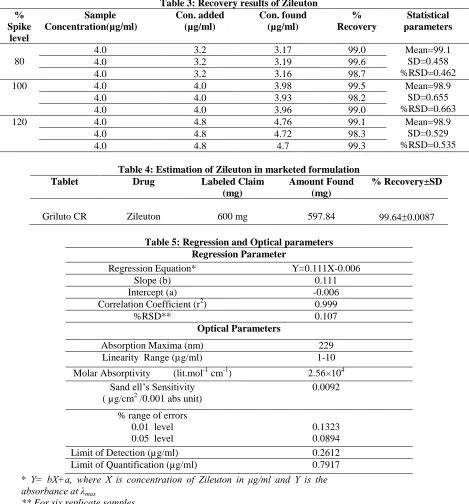
Accuracy: Accuracy of the method was determined by preparing solutions of 80%, 100% and 120% in which the amount of marketed formulation was kept constant and the amount of pure drug was varied. Solutions were prepared in triplicates and accuracy was indicated by % recovery.
Results are shown in Table 3.
Assay: Thecommercial formulation of zileuton was successfully analysed and the results was shown in Table 4.
Sensitivity: Sensitivity parameters such as molar absorptivity, sandell’s sensitivity, limit of detection and limit of quantitation are calculated. The values showed high sensitivity for the above method. The results are shown in Table 5.
.
Stability: In degradation studies zileuton showed maximum degradation in case of dry heat condition which shows less stability. Upon exposure to heat and U.V light zileuton samples were converted to yellow colour. The results for hydrolytic degradation in acidic and alkaline media, oxidative degradation,
thermal degradation and photolytic degradation were summarized in Table 6.
CONCLUSION
A simple, sensitive and appreciable stability indicating UV spectrophotometric method has been developed for quantitative determination of zileuton in bulk and tablet dosage form . The UV spectrum was scanned between 200 to 400 nm and 229 nm was selected as maximum wavelength for absorption. Beer’s law was obeyed in the concentration range of 1-10 μg/ml. Accuracy (98.9 – 99.1 %) and the method was successfully applied to the pharmaceutical dosage form containing the zileuton drug without any interference by the exipients. The method was fast and economical and it was also selective and sensitive for the desirable range. Results of the analysis were validated as per ICH guidelines and by recovery studies. Stability testing study includes the effect of temperature, oxidation, photolysis and hydrolytic. The drug is more degradation in thermal stress and less in photolytic.
ACKNOWLEDGMENTS
The authors are grateful to Dr.L.Rathaiah, Chairman of Lavu educational society for providing necessary facilities to carry out the above research work.
Table 1: Linearity of Zileuton
Concentration(µg/ml) Absorbance
1 0.1012 2 0.2104 4 0.4446 6 0.6714 8 0.8752 10 1.1190
Table 2: Intraday and Interday precision
Intraday Interday
Con. taken (µg/ml) Con. found* (µg/ml) %RSD Con. found*
(µg/ml) %RSD
Table 3: Recovery results of Zileuton %
Spike level
Sample Concentration(µg/ml)
Con. added (µg/ml)
Con. found (µg/ml)
% Recovery
Statistical parameters
80
4.0 3.2 3.17 99.0 Mean=99.1 SD=0.458 %RSD=0.462 4.0 3.2 3.19 99.6
4.0 3.2 3.16 98.7
100 4.0 4.0 3.98 99.5 Mean=98.9 SD=0.655 %RSD=0.663 4.0 4.0 3.93 98.2
4.0 4.0 3.96 99.0
120 4.0 4.8 4.76 99.1 Mean=98.9 SD=0.529 %RSD=0.535 4.0 4.8 4.72 98.3
4.0 4.8 4.7 99.3
Table 4: Estimation of Zileuton in marketed formulation
Tablet Drug Labeled Claim
(mg)
Amount Found (mg)
% Recovery±SD
Griluto CR Zileuton 600 mg 597.84 99.640.0087
Table 5: Regression and Optical parameters Regression Parameter
Regression Equation* Y=0.111X-0.006 Slope (b) 0.111 Intercept (a) -0.006 Correlation Coefficient (r2) 0.999 %RSD** 0.107
Optical Parameters
Absorption Maxima (nm) 229 Linearity Range (µg/ml) 1-10 Molar Absorptivity (lit.mol-1 cm-1) 2.56×10⁴
Sand ell’s Sensitivity ( µg/cm2 /0.001 abs unit)
0.0092 % range of errors
0.01 level 0.05 level
0.1323 0.0894 Limit of Detection (µg/ml) 0.2612 Limit of Quantification (µg/ml) 0.7917
Table 6: Results of Stress Degradation Studies
* Y= bX+a, where X is concentration of Zileuton in μg/ml and Y is the
absorbance at λmax
** For six replicate samples.
Condition Time % Degradation
0.1N NaOH
60 minutes 2.20% 90 minutes 2.29%
0.1N HCl
60 minutes 2.3% 90 minutes 2.36%
3% w/v Hydrogen peroxide 15 min. 1.81%
Figure 1: Chemical structure of Zileuton
Figure 2: UV spectrum of zileuton
Figure 3: Calibration curve of Zileuton
REFERENCES
1.Martindale - The Complete Drug Reference, 34th edition, Pharmaceutical Press, London-2005, pp807.
2.The United States Pharmacopeia. The United States Pharmacopoeial Convention, Inc., Rock Ville, MD, USA,2010, 3891-3893.
3.Granneman GR, Braeckman RA , Erdman KA. Clin Pharmacokinet, 1995; 29 (2): 1-8.
4.Ping Lu, Michael L. Schrag, Donald E. Slaughter, Conrad E. Raab, Magang Shou, David Rodrigues A. The American Society for Pharmacology and Experimental Therapeutics, 2003; 31 (11): 1352–1360.
5. Ananda Kumar K, Naresh Babu N. International Research Journal of Pharmacy, 2012; 3(12): 154-157.