Fire Hazard Location Algorithm for Large Place
Based on Wireless Sensor Network
Zhengzhou Li
.College of Communication Engineering, Chongqing University, Chongqing, China [email protected]
Yuanshan Gu, Lan Tang, Hao Luo, Gang Jin
College of Communication Engineering, Chongqing University, Chongqing, China; National Laboratory of Analogue Integrated Circuits, Sichuan Institute of Solid-State Circuits, No. 24 Research Institute of China Electronics Technology Group Corporation, Chongqing China;
China Aerodynamics Research and Development Center, Mianyang Sichuan, China Email: 875217691 @qq.com, [email protected], [email protected]
Abstract—Fire hazard monitoring and evacuation for building environments is a novel application area for the deployment of wireless sensor networks. In large place such as a marketplace, it is crucial for firefighters to know the fire hazard situation, and decide on how to best tackle the disaster. Fire sensors in the traditional fire hazard monitoring system are isolated in large place, and it results in failure to remain aware of current overall fire conditions. To improve the assessment accuracy of fire situation, a novel wireless sensor network based algorithm is proposed in this paper to detect and localize the origin of fire hazard in large place. Fuzzy artificial neural network is trained by fire signal from the wireless sensor nodes, then determine whether the fire hazard occurred and estimate its situation. The smoke and temperature diffusion models in limited space are adopted to localize the origin of fire hazard. Theory analysis and experimental results show that this fire detection and localization algorithm could more accurately assess fire hazard situation in large place, which is helpful for firefighters to take measures to exterminate fire hazard.
Index Terms—Fire hazard detection, Fire origin localization, Wireless sensor network, Fuzzy artificial neural network
I. INTRODUCTION
Fire hazard is an involved process, and is costly and dangerous because it causes extensive damage both to property and human life. It may cause a fire hazard when people don’t shut off the gas equipment and high-power electrical equipment promptly in day-to-day activities. What’s more, fire hazard, which happens in crowed public places, tends to cause greater casualties and property losses. Detecting and localizing the fire hazard timely and accurately is an effective way to prevent or mitigate lose.
In traditional fire detection system, fire sensors sensing smoke and temperature are connected by cables, and these signals are transmitted to and processed in a powerful computer, where the decision about fire hazard occurred or not is made. In the existed buildings or some
large places, these installed cables would damage the functionality and artistry of the buildings to some extent. Due to the high cost and costly maintenance, the wired network is unsuitable and inconvenient choice for fire hazard detection in large space.
performance of fire detection. Finally, the firefighters often subjectively estimate the situation of fire hazard and make fire-extinguishing decision and it could lead to missing the best opportunity to rescue life and property [10].
This paper adopts the ZigBee wireless sensor network to set up fire hazard monitoring system for information collection, and proposes a fire hazard detection and localization algorithm in large place by means of fusing fire information from multi-nodes and deducing fire source localization and fire situation. Theory analysis and experimental results show that the fire hazard detection and location algorithm could improve the performance of fire hazard detection, and can speed up fire warning to reduce property losses.
II. TOPOLOGY STRUCTURE OF FIRE HAZARD
MONITORING SYSTEM IN LARGE PLACE
Since single node has disadvantage of small coverage and poor robustness, the wireless sensor networks with multi-nodes is adopted to monitor fire hazard in this paper. This wireless networks can not only extend its monitoring coverage area and know overall fire situation in large place, but also prevent false alarm from a single node due to human misoperation, and improve warning accuracy [11-15].
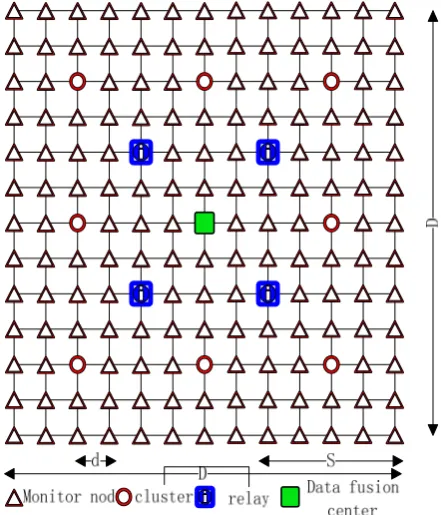
Fig. 1 Topology diagram of fire hazard detection in large place
Fig.1 is the topology diagram of fire hazard detection and location system for large place based on wireless network [16]. Considering in a large place with area of
*
D D square meters, a fire monitoring node is placed
per d meters. There is a cluster head node in each
sub-network of area within a S S* square meters. Firstly, the cluster head recognizes that which subnet node belongs to him via the short address of ZigBee network, and fuses the data from each subnet, and then
sends aggregated data to the relay node. Secondly, relay node transmits the data from each subnet to the data fusion center, where the decision whether a fire hazard occurred is made, and the fire hazard location and situation in large places are assessed [16].
III. FIRE DETECTION ALGORITHM FOR SINGLE-NODE
Fire occurred in large spaces is both random and deterministic. The randomness means the unpredictability about the time when the fire broke out, the size of fire, and the fire source location. The determinacy means that there are phenomena happening when fire hazard breaks out, such as, rising concentration of smoke, gas and carbon monoxide, twinkling flame and rising temperature. If the phenomena could be sensed by the corresponding sensors in real time, the fire hazard detection performance would be significantly improved by means of extracting the potential and stable characteristics and reasoning the variation regularity of fire propagation. However, the measuring data may be affected by background noise. In this case, the fire monitoring system should be able to intelligently cope with various environmental parameters, thereby reducing the probability of false alarm. Due to the advantages of artificial neural networks with inaccurate information parameters, it is reasonable to apply it to process the data captured by the wireless sensors for fire monitoring system [17-19].
Back Propagation (BP) neural network adopted in this paper is divided into three layers shown in Fig.2 [20][21]. The first layer is the input layer, consisting of sensor data input nodes; the second layer is the hidden layer; and the third layer is the output layer. I1 , I2 and I3 are temperature, smoke concentration and carbon monoxide concentration, respectively, and they are normalized in the range of [0, 1]. To filter the noise generated in sensor, they are preprocessed via a low pass filter. The three outputsO1, O2 and O3 represent naked flames probability, smoldering fires probability and no fire probability, respectively. The range of the three outputs are also limited in [0,1]. There are five nodes in the hidden layer according to the experience and simulation results [22]. BP neural network algorithm learns the weight factors by minimizing the total mean square error [23], the weight coefficients between the input layer and the hidden layer arewij, and that between the hidden layer
and output layer arevjk.
ij
w vjk
In Fig. 2, the weighted input of thejth node in the
hidden layer is
1 1
( ) n ij i ( 1,2,3)
i
T j w I i
=
=
å
=(1) The activation function in hidden layer adopts the continuous and differentiable hyperbolic tangent S-type function, and it is
1 ( )
1 exp( ) f x
x =
+ - (2)
Putting T j( ) into activation function, the output of
the hidden layer would be
1 1
1 ( 1,2,3,4,5)
1 exp( ( ) )
j
M j
T j q
= =
+ - + (3)
Similarly, the weighted input of the output layer is
2( ) 1 ( 1,2,3,4,5)
n
jk j
i
T k v M j
=
=
å
=(4) Therefore, the output of the output layer adopts the same S-type function to represent the probability of fire hazard.
2 2
1 ( 1,2,3)
1 exp( ( ) )
k
O k
T k q
= =
+ - + (5)
where θ1 and θ2 represent the threshold value, and they are updated constantly according to the criteria of minimanl mean square error in the gradient descent learning algorithm.
In view of the limited amount of actual fire data, which couldn’t represent all conditions of fire hazards, and limited generalization ability of neural network, there would be boundedness only using the output of the neural network to decide the fire situation. Therefore, a fuzzy reasoning decision-making layer (IF-THEN) is implemented for fire warning judgment after the neural network, and it is contributed to achieve the final fire verdict. If it cannot judge the result, the system will reacquire data again after delaying t seconds to determine whether the fire occurred or not.
Let the output variables of neural network, namely, naked flames probability P1, the smoldering fires probability P2 and no fire probability P3 as the input of fuzzy logic judgment, the judgment rules are as follows:
1 1
1 1& 2 2
1 1& 2 2 & 3 3
det 1 1& 2 2 & 3 3
naked flame P TH
smolder flame P TH P TH
STATE
no fire P TH P TH P TH
delay Ts to ect P TH P TH P TH
ì ³
ï
ï < ³
ï = í
< < ³ ï
ï
< < < ï
î
(6)
IVFIRE CONFIRMATION AND FIRE SOURCE LOCALIZATION
As discussion above, global naked fire probability, smoldering fires probability, and no fire probability can be depicted out by taking advantages of the sensor data from the respective nodes of WSN for large places as shown in Fig.1. By judging the account and location of adjacent alarm nodes, the system can further determine the current coverage of fire hazard and fire situation. it
would be conducive for the firefighters to make the most accurate fire-fighting decision at the first time and to reduce the loss of life and property caused by the fire. A. Fire source Localization based on Smoke Diffusion Field
In the early stage of fire, due to incomplete combustion of the combustible material, the fire is not very strong with billowing smoke. At this stage, the temperature of the environment is not yet fully rising to the maximum, so the smoke diffusion model can be used to get the information of ignition position at the first time [24]. There is regularity of the smoke diffusion under static wind state, and the diffusion model is shown in Fig.3. The concentration of smoke is higher at the location of the fire source, and it monotonously decreases with increasing distance apart from the origin of fire.
/
x m
/p ppm
Fig.3 Diffusion model of fire gas
In this paper, we take the environment shown in Fig.4 as the example to elaborate the fire source localization algorithm. Three smart sensor nodes are placed in the room, where the nodes named 1, 2 and 3 are placed at the inner wall of the outer side, and the fire source is placed on the floor. According to the smoke diffusion model, let the spread speed of the smoke be v (ppm/ m), and the smoke concentrations pi of the valid monitoring nodes
names 1, 2 and 3, the distance from the node to the source of fire could be calculated, ri =pi/v.
Fig.4 Indoor fire source localization model
The trilateral location method is adopted in this paper to locate the fire hazard. If the coordinates ( , , )x y z1 1 1
2 2 2
2 2 2 2
1 1 1 1
2 2 2 2
2 2 2 2
2 2 2 2
3 3 3 3
( ) ( ) ( )
( ) ( ) ( )
( ) ( ) ( )
x x y y z z r
x x y y z z r
x x y y z z r
ì - + - + - = ï ï ï - + - + - = í ï ï - + - + - = ï
î (7)
By solving the above equations, the coordinates of the fire source can be derivedog =( , , )x y z0 0 0 . If there are more than three nodes receiving the smoke information about fire hazard, the fire position based on smoke diffusion field would be more accurate.
B. Fire source Localization based on Gas Temperature Field
In the mid-late period of the fire hazard, due to complete combustion of combustible materials, the smoke concentration is lower than before and the ambient temperature rises rapidly. In this situation, the method based on smoke diffusion model can not accurately locate the fire hazard source, and the gas temperature field model is available to further determine the location of the fire source [25]. When the fire hazard broke out, the three-dimensional unstable temperature field model can be used to describe the indoor gas temperature field. The temperature field not only changes in the space, but also changes over time, and the propogation process of the temperature field can be described by a three-dimensional heat conduction partial differential equation, which is represented as the following formula.
2 2 2
2
2 2 2
T T T T
a T
t c x y z
l r
æ ö
¶ ç¶ ¶ ¶ ÷
= ç + + ÷= Ñ
¶ è¶ ¶ ¶ ø (8)
By setting the initial and boundary conditions, the indoor fire temperature propogation model is described using spatio-temporal fieldT = f x y z t( , , , ).
At the same timet0, if the fire temperature sensed by the reference nodes 1, 2 and 3 are T1 , T2 and
3
T ,respectively, the location ( , , )x y z of the fire source could be obtained by solving the following temperature propogation equations.
1 1 1 1 0
2 2 2 2 0
3 3 3 3 0
( , , , )
( , , , )
( , , , )
T f x x y y z z t
T f x x y y z z t
T f x x y y z z t
ì = - - -ï ï = - - -í ï = - - -ï
î (9)
Solving the above equations, the location coordinate of the fire source is obtained:ot =( , , )x y z0 0 0 . If there are more than three nodes receiving the gas temperature about fire hazard, the fire position based on gas temperature field would be more accurate.
In order to reduce the detection error further, the system can jointly take use of fire smoke diffusion model and the temperature diffusion model to get an approximate solution of two fire location, so that more accurate location of fire source can be obtained as the average of two values.
o=(og +ot) / 2 (10)
V. EXPERIMENTS AND ANALYSIS A. Fire Detection Probability of Single-node
By training the samples provided by European standard fire experiments for 30,000 times, the weights coefficients wij and vjk of neural network would be
gotten, and they are listed in Table.Ⅰand Table.Ⅱ,
respectively.
TABLE .I
WEIGHT COEFFICIENTSwij BETWEEN INPUT AND HIDDEN LAYERS
1j
w w2j w3j w4j w5j temperature -2.5258 -3.8553 -1.3059 2.1085 3.5102
smoke -2.6000 0.6174 -1.0543 -4.5110 -1.4072 co -2.2886 2.8149 -5.7332 0.2795 -2.9719
TABLE .II
WEIGHT COEFFICIENTSvjk BETWEEN HIDDEN AND OUTPUT LAYERS
Fire
probability Smoldering probability probability No fire
1k
v 0.3230 -0.9932 0.2068
2k
v -0.6052 1.0205 -0.3100
3k
v -2.2150 -0.8814 3.9156
4k
v -1.0485 1.2502 -0.0672
5k
v 2.4957 -2.4530 -0.9444
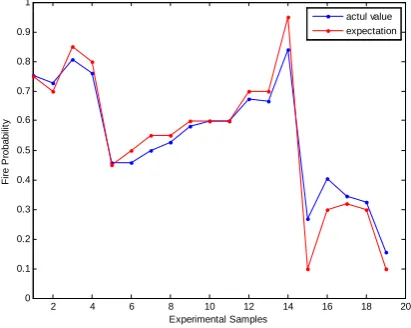
Taking advantage of neural network, the test samples are divided into two parts: one part is used for training, and the other for testing. The experiment results shown in Fig.5 indicate that the fire detection algorithm based on neural network gets good performance for the error between the actual data and the estimated data is very small.
2 4 6 8 10 12 14 16 18 20 0 0.1 0.2 0.3 0.4 0.5 0.6 0.7 0.8 0.9 1 Experimental Samples F ir e P ro b a b ilit y actul value expectation
B. Multi-nodes Fire Confirmation and Fire Source Localization
The simulated experiment was done in office building of 1,000 square meters. The space between two nodes of the wireless sensor networks is 10 meters, and a cluster node should set every 40 square meters shown in Fig.1. We can assess the performance of the system via setting different speed of flame spreading at static wind and different burning intensity. Fig.6 and Fig.7 show the situation at different conditions about 30mins after the fire broke out. In Fig.6, the static wind flame spreads at the speed of 0.2 / minm and the burning intensity is
2
50kJ / m s× .In Fig.7, the static wind flame spreads at the
speed of 0.7 / minm , the burning intensity is220kJ / m s2× .
Fig.6 Fire situation at static combustion speed of 0.2m/min
Fig.7 Fire situation at static combustion spread of 0.7m/min
Therefore, the lower the combustion spread speed and the combustion intensity is, the smaller the detected fire range is. And vice versa, the speed of the flame spread is faster and the combustion intensity is stronger, the range of fire detected is also larger.
Fig.8 Fire location error vs. fire burning intensity
After the fire hazard and its coverage are confirmed, three valid nodes, whose fire information change fastest, are chose in the confirmed area to locate the fire source collaboratively. Besides, the location error vs. fire burning intensity is shown in Fig.8.
VICONCLUSIONS
Fire hazard monitoring and evacuation for building environments is a novel application area for the deployment of wireless sensor networks. In large place such as a marketplace, it is crucial for firefighters to know the fire hazard situation, and decide on how to best tackle the disaster. This paper presents an intelligent fire hazard monitoring system for large space based on wireless sensor network, and proposes fire hazard detection algorithm based on neural network for single node, and fire hazard location algorithm using the smoke diffusion model and gas temperature diffusion model for whole wireless networks. Theory analysis and experimental results show that the fire hazard detection and location algorithm could improve the performance of fire hazard detection including accurate location, and can speed up fire warning to reduce property losses.
However, the diffusion model of smoke and temperature and the network architecture are ideal in the paper, and the model and network structure in application should be adjusted in the actual environment to improve the reliability of the system.
ACKNOWLEDGEMENT
This work was supported in part by National Natural Science Foundation of China under grant No. 61071191, Chongqing Nature and Science Fund under Grants No. CSTC2011BB2048, and Fundamental Research Funds for the Central Universities under Grant No. 106112013CDJZR160007.
REFERENCES
[1] I.F. Akyildiz, W. Su, Y. Sankarasubramaniam, and E. Cayirci. “Wireless sensor networks: a survey”, Computer Networks, Vol. 38, No. 4, 2002, pp. 393-422.
health monitoring of the golden gate bridge web.
[3] R. Szewczyk, E. Osterweil, J. Polastre, M. Hamilton, A.M. Mainwaring, and D. Estrin. “Habitat monitoring with sensor networks ”, Communication of the ACM, Vol 47, No.6, 2004, pp.34-40.
[4] Liyang Yu, Neng Wang and Xiaoqiao Meng. “Real-time forest fire detection with wireless sensor networks ”, in IEEE International Conference on Wireless Communications, Networking and Mobile Computing, Vol 2. 2005, pp.1214-1217.
[5] Yu L, Wang N, Meng X. “Real-time forest fire detection with wireless sensor networks”, IEEE 2005 International Conference on Wireless Communications, Networking and Mobile Computing,Vol. 2, 2005, pp.1214-1217.
[6] Lloret J, Garcia M, Bri D, “A wireless sensor network deployment for rural and forest fire detection and
verification”, Sensors, Vol. 9,No. 11, 2009,pp.8722-8747.
[7] LI, G., LI, H., FENG, H., WANG, Z., XUAN, Z.. “The effect of wireless sensor nodes deployment density in
forest fire monitoring quality evaluation”, Journal of
Networks, Vol. 7, No.7, 2012, pp.1116-1122.
[8] Peter Reimann, Andreas Schütze. “Fire detection in coal mines based on semiconductor gas sensors”, Sensor Review, Vol.32, No.1 ,2012,pp.47-58.
[9] Sudipta Bhattacharjee, Pramit Roy, Soumalya Ghosh, Sudip Misra, Mohammad S. Obaidat. “Wireless sensor network-based fire detection alarming monitoring and prevention system for bord-and-pillar coal mines”, Journal of Systems and Software,Vol.85, No.3,2012, pp.571-581.
[10] Dongil Han,Byoungmoo Lee. “Flame and smoke detection method for early real-time detection of a tunnel
fire”, Fire Safety Journal, Vol.44, No.7, 2009, pp.
951-961.
[11] Brini Marco, Marmo Luca. “Wireless sensor networks for
early fire detection”, Chemical Engineering Transactions,
Vol.24,No.3,2011, pp.1153-1158.
[12] Bahrepour M, Meratnia N, Havinga P J M. “Fast and accurate residential fire detection using wireless sensor
networks”, Environmental Engineering and Management
Journal, Vol. 9, No.2, 2010,pp. 215-221.
[13] Soliman H, Sudan K, Mishra A. “A smart forest-fire early detection sensory system: another approach of utilizing wireless sensor and neural networks”, IEEE Sensors, 2010, pp.1900-1904.
[14] Fok C L, Roman G C, Lu C. “Rapid development and flexible deployment of adaptive wireless sensor network applications”, 25th IEEE International Conference Proceedings on Distributed Computing Systems, 2005, pp. 653-662.
[15] Son B, Her Y, Kim J. “A design and implementation of forest-fires surveillance system based on wireless sensor
networks for South Korea mountains”, International
Journal of Computer Science and Network Security , Vol. 6, No.9, 2006,pp.124-130.
[16] Yafei Hu,Fangmin Li,Network.“Coding-based directional scheduling for fairness provisioning in wireless mesh
networks”, Journal of Computers, Vol. 8, No.8, 2013,
pp.1898-1905.
[17] Qiongfang Y, Dezhong Z, Yongli F. “Intelligent fire alarm
system based on fuzzy neural network”, IEEE
International Workshop on Intelligent Systems and Applications, 2009, pp. 1-4.
[18] Guo Q, Dai J, Wang J. “Study on fire detection model based on fuzzy neural network”, IEEE 2010 2nd International Workshop on Intelligent Systems and Applications (ISA), 2010, pp.1-4.
[19] Zhang J, Li W, Yin Z. “Forest fire detection system based on wireless sensor network”, 4th IEEE Conference on Industrial Electronics and Applications (ICIEA), 2009,pp. 520-523.
[20] Zhang Junhong,Xie Anguo,Shen Fengman.”Muti-Objective Optimization and Analysis Model of Sintering Process Based on BP Neural Network”, Journal of iron and steel research,Vol.14,No.2 ,2007,pp.01-05.
[21] Chang-Xue Jack Feng, Abhiraml C. Gowrisankar. “Practical guidelines for developing BP neural network
models of measurement uncertainty data”, Journal of
Manufacturing Systems, Vol. 25, No.4, 2006,pp.239-250. [22] Díaz-Ramírez A, Tafoya L A, Atempa J A. “Wireless
sensor networks and fusion information methods for
forest fire detection”, Procedia Technology, Vol. 3, 2012,
pp.69-79.
[23] Weiguo Zhao.“BP neural network based on PSO algorithm for temperature characteristics of gas nanosensor”, Journal of Computers, Vol. 7,No.9, 2012,pp.2318-2323.
[24] Kang Kai. "A smoke model and its application for smoke management in an underground mass transit station”, Fire Safety Journal. Vol.42, No.3,2007, pp.218-231.
[25] Rui Chen,Yuanyuan Luo. Mohanmad Reza Alsharif. “Forest Fire Detection Algorithm Based on Digital Image”,Journal of Software,Vol.8,No.4,2011, pp.628-632.
Zhengzhou Li received the B.S degree