Mobile Processes: Enhancing Cooperation in
Distributed Mobile Environments
Christian P. Kunze, Sonja Zaplata, and Winfried Lamersdorf
Distributed Systems and Information Systems, Department of InformaticsUniversity of Hamburg, Hamburg, Germany
Email:{kunze, zaplata, lamersdorf}@informatik.uni-hamburg.de
Abstract— Currently, context awareness is one of the main trends in distributed mobile computing environments. Against this background, the demand for more complex – and additionally long-term – mobile applications increases continuously. Nevertheless, most current available mobile applications – as well as their supporting middleware platforms – are still relatively monolithic and closed systems, concentrating on only short-term activities. As a conse-quence, most present appliances are still restricted to rather simple tasks and are therefore rather insufficient for more complex ones which consist of sequences of related long-term activities tied together in respectiveapplication-oriented processes. In order to overcome the resource and capability restrictions of mobile environments, such application pro-cesses may profit from, e.g., cooperation between devices in the mobile vicinity – a fact which is hardly supported by existing systems.
Therefore, this paper introduces a concept for integrating explicit support for mobile processes into mobile system infrastructures and for distributing their execution over different nodes in the network. Additionally, a corresponding middleware platform for context-aware and cooperative mobile applications is proposed. This framework has been designed and realized in the context of project DEMAC (Distributed Environment for Mobility-Aware Computing) which supports such migrating processes and helps to execute them under the restrictions imposed by realistic mobile applications. In particular, this paper proposes a correspondingprocess description languageand anexecution modelfor such mobile (business) processes.
I. INTRODUCTION
Compared to traditional distributed systems, mobile computing environments are characterized by additional requirements and limitations like, e.g., resource restric-tions or increased variability in performance and relia-bility of wireless connections [19]. To overcome such constraints, mobile computing applications can take ad-vantage of context information to break up their isolation by decreasing the distribution transparency and thus get-ting access to additional environmental data and services. Therefore, applications and middleware platforms evolved to become aware of their frequently changing vicinity and adapt and react to it accordingly and, thus, to benefit from their mobility.
This paper is based on “Mobile Process Description and Execution,” by Christian P. Kunze, Sonja Zaplata, and Winfried Lamersdorf, which appeared in the Proceedings of the 6th IFIP WG 6.1 International Con-ference on Distributed Applications and Interoperable Systems (DAIS), Bologna, Italy, June 2006. c°2006 Springer.
Currently, so-called context-awaresystems can be di-vided into four classes which describe how context infor-mation is used [4]: The first one is the class of
context-based selection which contains applications that select
their information or services based on context informa-tion, such as a tourist or museum guide in theGUIDE[7] respectivelyCyberguide [1] projects. The applications of the second class –context-based presentation– adapt the way how they present their information according to con-textual constraints. E.g. a mobile phone can switch from acoustic to optic notification of incoming calls during a meeting. The third class, which is called context-based
action, includes applications that react to context changes
(especially changes in the quality of used services) as they adapt the fulfillment of their own service accordingly. This is done e.g. in the UbiQoS project [5] where the frame rate of a video stream is adapted to the available bandwidth during its transfer. The fourth group of
context-based tagging or annotation summarizes applications
which provide the possibility to augment things or special context situations with additional information, such as in
the Stick-e Notesproject [16].
In summary, in such current systems contextawareness
and adaptabilityis, in most cases, still restricted to
sup-port more or less monolithic and ad-hoc static applications in fulfilling their momentary tasks. This means, contex-tual information about resources – like data, services or potential participants – is collected only once to create a tailored run of the mobile application. Because devices of the mobile vicinity do not cooperate in order to execute the application, available resources are determined and thus restricted by the capabilities of the executing device. Resources available by other devices remain inaccessible for the dynamic adjustment of the mobile application. As a consequence, also the complexity of applications and tasks is limited by the device‘s capabilities and its supported technologies. Hence, most existing middleware systems are rather application centric and, thus, offering assistance for basic but actually simple tasks. In order to come closer to the original vision of pervasive comput-ing [22], [23], also much more complex and eventually even unknown tasks and thus more generality must be supported by new mobile middleware systems.
on behalf of a user. This means that a mobile client is required to reach and invoke all the services needed to execute such a process. It must also be capable of handling all intermediate results – regardless of their size and relevance to the expected final output. As a consequence, it may become a single point of failure and also a bottleneck during execution time. Altogether, this means that the capabilities of a mobile client limit the quantity of possible processes to be executed.
But since the user is, in most cases, just interested in some specific effects of a process (and not in its execution or intermediate results), this effect could be eased by transferring the control flow – and with it the whole process – to other devices, if possible. In combination with the possibilities of mobile computing middleware systems to utilize context information and to cooperate, such long-time mobile processes and their distributed exe-cution provide additional efficiency to application process execution in mobile computing.
Accordingly, this paper presents a system platform that enables a new class of context-based applications which is calledcontext-based collaboration. This is done by introducing theDistributed Environment for
Mobility-Aware Computing (DEMAC) middleware framework –
which realizes such an extension – with a special focus on a new description language and execution model for
such mobile (business) processes.
The following subsections of the paper introduce the definition of mobile processes and provide a sample sce-nario to illustrate the concept of such processes. Section II addresses related work, and section III provides a closer look at the coarse system architecture, the process definition language, and the execution engine. A more technical view on the prototypical implementation of the proposed middleware and on the evaluation environment is presented in section IV. The paper concludes with a summary and an outline of future work.
A. Integrating Processes into Mobile Computing Systems The work presented here aims to extend the capabilities of mobile devices by means of cooperation with other devices in their vicinity and thus increase of their poten-tial. This is achieved by integrating distributed (business) processes into an adequate mobile system infrastructure. Such an approach is different to most existing ones of integrating processes with mobile computing devices which just extend their traditional process infrastructure by including mobile devices as process participants (cp. e.g. [18]). Accordingly, in our context, the term mobile process is defined and used as followed:
A mobile process is a sequence of (remote) ser-vices which may last over a longer period of time and span several devices during its execution. The results of the process are the effects the initiator expects from it.
In traditional mobile middleware, a process executes the application logic by explicitly assigning local or remote
services to the process‘s activities and by invoking them directly. In addition to that, in our view, such application processes may (partly) diffuse into the mobile middle-ware: They just form a stub which collects information from the user to assemble the process and its general con-ditions and to pass the mobile process to the middleware.
Moreover, as some mobile process activities may last rather long (like hours, days, or weeks) the environmental conditions of the device can change dramatically between the executions of adjacent activities and even during the execution of single activities. Therefore, a late binding
strategy to assign services is – certainly – essential but
not always sufficient. Consequently, the mobile processes as proposed here are executed based on anopportunistic
strategy: As long as the process engine of a device is able
to bind local or remote services to its current activity, it is responsible for the mobile process. However, in cases of failures or lack of respective service instances the engine is able to try to find other devices to execute the mobile process and then transfers the remaining process and its execution to one of them.
Considering the limited capabilities and resources of mobile devices, it is unlikely that one single device is able to execute a complex process entirely or that all required resources reside in its communication and capability range. Assuming that, e.g., a mobile device has to access a sequence of remote activities to obtain some data from them and that, in its direct vicinity, adequate services to perform these tasks exist, but that the mobile device cannot access them. The migration of the process provides the possibility that other devices may be capable to access the services and thus to fulfill the tasks. Furthermore, the migration opens up a new vicinity to search for other and maybe more suitable services.
As shown, such a process distribution is especially advantageous in (realistic) heterogeneous and frequently changing mobile environments where device capabilities may highly differ. Thus, such process transfer opens up additional services which were not accessible according to the traditional execution approach. This also means that the likelihood of a mobile process to be executed successfully increases substantially.
B. Example: The Mechanic Assistant
To clarify the potential of mobile processes, a short ex-ample scenario is presented. In this scenario, a mechanic of an automobile club – who assists drivers of broken-down cars on the motorway – is supported by a pda-based service application (see figure 1(a)).
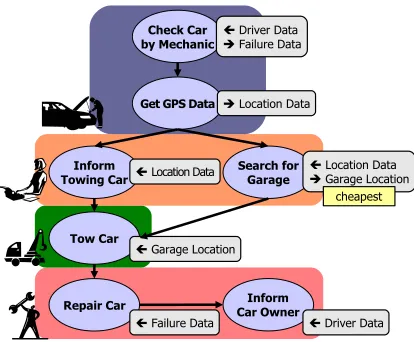
If the mechanic is not able to repair the car immediately he uses the mobile assistance application to initiate ap-propriate measures, like the towing of the car to a garage where the car will be repaired. Such required actions would cause a process of the following kind (see figure 1(b)):
The Mobile Mechanic
Car Number: Customer:
request fire brigade request towing search garage
cheapest nearest call a taxi for customer
D123 APD3
cancel done David Brown
The Mobile Mechanic
Car Number: Customer:
request fire brigade request towing search garage
cheapest nearest call a taxi for customer
D123 APD3
cancel done David Brown
(a) An Application to initiate
Mo-bile Processes (b) A Process to Recover a Broken-down Car
Figure 1. The Mechanic Assistant Application Example
be able to notify a towing car and to search for an appropriate garage. To make an optimal decision the process is enriched with non-functional data, like the fact that the customer asked for the cheapest or nearest garage. The address of the selected garage is transmitted to the towing car which then carries the broken-down car to that garage. Finally, the mechan-ics of the garage repair the car and inform the owner that he can pick it up.
In this example, the process is generated out of a template base by the application running on a PDA. During the execution of the mobile process, four roles are involved: the mechanic, the automobile club back office, the towing car, and the garage. These participants are resolved, in parts dynamically, into concrete services or servants at runtime. However, only by cooperation of these participants and the migration of the process among them, the expected results can be achieved.
Such a composed task, consisting of diverse – possi-bly distributed – subtasks, each of them depending on different environmental conditions and all of them form-ing a long-term process with manual and collaborative activities, is hardly supported by traditional middleware platforms so far.
C. Requirements for Descriptions of Mobile Processes In order to describe processes in ways which allow execution strategies as described above, an abstract pro-cess description language has to be designed: In such a view, mobile processes have rather similar requirements for their description as traditional (business) processes, these are among others: the need for the ability to express
the business logic with its data and control flow, the
participating parties(as roles or individuals), and routines
to recover from failures[14].
But in addition, they have also some specific require-ments based on the nature of mobile environrequire-ments and the opportunistic and distributed execution strategy (cp. section I-A): E.g. mobile process descriptions must be
lean and simple to run in order to save memory, CPU power, and energy resources. They also must include mechanisms to handle communication failures and the distribution of the process itself. This means especially that the state of the process and the user‘s non-functional conditions for the execution of the process must be ex-pressible. The (late) binding mechanism to assign service instances to process activities as late as possible must be integrated into the description language by using a preferably abstract notation of the desired services [10], [19].
Based on these requirements an analysis of related work and, in particular, existing process description languages are presented in section II.
II. RELATEDWORK
This paper specifically concentrates on the descrip-tion and execudescrip-tion of mobile processes. Therefore, an overview of related work in the area of mobile systems infrastructures and middleware platforms is given first – before existing approaches and techniques to express and execute long-term business processes are analyzed more extensively.
1) System Infrastructure: Since mobile process
execu-tion always relies on contextual informaexecu-tion, the context modeling and context data acquisition are crucial for the respective concepts and system infrastructure to be developed. The abstract and generic definition of context and its data as used in the Context Toolkit[8] by Dey is mainly suited for the mostly a priori unknown demands of mobile processes. Whereas the understanding provided by Schilit [20] or Schmidt [21] turned out to be too narrow to support the wide range of possible processes as required in our approach. The idea of theNEXUS project [9] to ensemble the context of an entity by federating local context clippings of entities within their particular vicinities is used in the system infrastructure to construct a global context representation efficiently.
agents [6]. However, in relation to that it differs in some important aspects: In contrast to an agent a mobile process does not contain executable code. In fact, mobile processes only provide meta-data about the structure of the described application and, thus, the estimated effects but not about the way how this behavior is achieved. In addition, they do not have a social behavior either, nor could they actautonomouslyorproactively. Nevertheless, some parts, e.g. security and privacy concerns or the need to determine the execution state, have, in principle, similar requirements and, thus, solutions.
2) Process Description: A process description
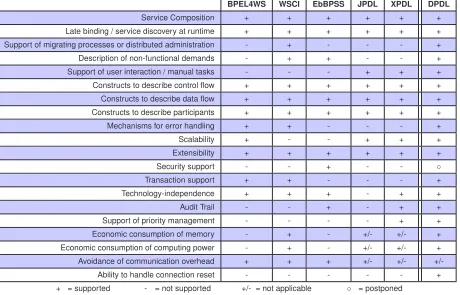
lan-guage for mobile processes has to consider aspects of distribution as well as support for high level flexibility and fault tolerance. An analysis of most prominent existing process description languages shows that the concepts and constructs provided by these languages are not in total adequate to describe highly dynamic processes on mobile distributed computing systems [25]. Table I summarizes the results of the following analysis in more detail and presents how the specified requirements are fulfilled by common process description languages, like BPEL4WS,
WSCI, JPDL, ebBPSS and XPDL. Finally, DPDL, the
proposed extended description language, is also validated against these requirements (cp. III-B).
The Business Process Execution Language for Web
Services (BPEL4WS respectively WS-BPEL)[2] is one of
the most popular approaches to describe the orchestration of activities defined as Web Services. It offers very spe-cific and powerful elements to describe activities, to link tasks and to deal with errors and transactions. Processes defined with BPEL4WS are ready to be executed but limit cooperations between business partners using the Web Service protocol stack and describing their services with the Web Service Description Language (WSDL). To overcome these restrictions, various extensions have been discussed, as there are BPEL4PEOPLE [12] to cover hu-man user interactions or BPEL-SPE to support the explicit definition of sub-processes [13]. Nevertheless, BPEL4WS process descriptions tend to become rather complex due to possible combinations of sequential blocks with graph-structured elements in order to express parallel behavior. Additionally, the definition language is developed for run-ning on a central workflow engine and does not provide concepts for distributed process execution.
As well as BPEL4WS, the Web Service Choreography
Interface (WSCI) [3] is an add-on of WSDL, but, in
contrast to BPEL4WS, it concentrates on the choreo-graphy of web services by describing a task from the individual perspective of its participating services and thus in a distributed manner. Therefore, the description itself is lean because each one is intended for only one single participant. The disadvantage of WSCI, however, is that all possible participants have to be determined in advance so the process‘s information can be distributed and a fixed compatible interface can be implemented within the WSDL description of each participant. There-fore, choreographies based on WSCI are hardly scalable,
because the description of each existing partner has to be changed whenever a new participant is inserted. If, in addition, these partners are mobile and thus may become unavailable easily, dynamic processes or ad-hoc workflows as well as often changing vicinities of mobile devices cannot be handled with WSCI.
EbBPSS is the Business Process Specification Scheme
of theEbXMLframework [17]. In particular, it is designed to describe business transactions and, therefore, it focuses on the aspect of binary collaboration between several companies. Although EbBPSS has the ability to describe quality and security issues as fixed requirements for the scheduled cooperation, it depends highly on the ebXML framework which is, in itself, too complex for most of today‘s mobile computing systems. Standing alone, it does not support the description of required constructs, such as error handling mechanisms or the possibility to in-tegrate users and different kind of services. Furthermore, the intricate extension of defined binary collaborations is inappropriate for dynamic mobile environments with more than two static participants.
A very lean description language is provided by JPDL [11], which is an integral part of the Java Business
Process Management (JBPM). JPDL supports manual
tasks, but the description of automated function logic is matched to the Java programming language. For error handling, JPDL also relies on the Java platform and, therefore, cannot be considered to be totally platform-independent.
Closest to the required concepts as mentioned above is the XML Process Definition Language (XPDL) [15], which was developed as an abstract interchange format for different workflow engines. As a meta-model it provides a very general view on processes, is open for extensions and ready for all kind of automated and manual services. On the other hand, due to its high level of abstraction, it does not provide sufficiently powerful concepts to perform distributed process execution and handle errors as well as transactions. Since XPDL is released as version 2.0 [24], it is intended to be used as a file format for the graphical notation of BPMN. However, this enhancement does not affect the original purpose of XPDL and it does not introduce any beneficial concepts to support the given requirements of mobility either.
TABLE I.
ANALYSIS OFRELATEDPROCESSDESCRIPTIONLANGUAGES ANDDPDL
BPEL4WS WSCI EbBPSS JPDL XPDL DPDL
Service Composition + + + + + +
Late binding / service discovery at runtime + + + + + + Support of migrating processes or distributed administration - + - - - +
Description of non-functional demands - + + - - +
Support of user interaction / manual tasks - - - + + +
Constructs to describe control flow + + + + + +
Constructs to describe data flow + + + + + +
Constructs to describe participants + + + + + +
Mechanisms for error handling + + - - - +
Scalability + - - + + +
Extensibility + + + + + +
Security support - - + - - ◦
Transaction support + + - - - +
Technology-independence + + + - + +
Audit Trail - - + - + +
Support of priority management - - - - + +
Economic consumption of memory - + - +/- +/- +
Economic consumption of computing power - + - +/- +/- + Avoidance of communication overhead + + + +/- +/-
+/-Ability to handle connection reset - - - +
+ = supported - = not supported +/- = not applicable ◦ = postponed
developed basically for reliable central workflow engines.
III. A MOBILEPROCESSINTEGRATIONSERVICE The deficiencies of established approaches for describ-ing mobile processes (cp. section II) motivate the develop-ment of an enhanced description language, calledDEMAC
Process Description Language (DPDL)which fulfills the
specified requirements of the previous section (cp. table I, last column). Accordingly, this section presents the most relevant features such an approach bases on: (a) the process description language for distributed processes and (b) a corresponding mobile process execution engine. But as such an engine cannot be realized without an underlying system infrastructure, subsection III-A first provides an outline of the middleware architecture as developed for that purpose in the DEMAC project.
A. A Middleware Architecture for Supporting Distributed and Mobile Processes
The decision to design a tailored system infrastructure for supporting a seamless integration of mobile processes into a mobile computing middleware evolved from the given analysis of the process‘s requirements and the respective features as offered by existing middleware approaches. Especially the close cooperation between the mobile processes and the context model to distribute and execute the processes leads to the need of a specifically adjusted model and service architecture.
The resulting system architecture is based on four basic service components (see figure 2) which are briefly described before section III-B introduces the integration of mobile processes in more detail.
1) The Communication Basis: The asynchronous
transport serviceand theevent serviceform the
commu-nication platform of the architecture and provide com-munication with both push and pull semantics. This service abstracts from concrete transport protocols – like TCP/IP, Bluetooth or IrDA. To be independent from the underpinning protocols, the transport service uses its own
addressing schema. These addresses are bound to a device and translated into concrete protocol specific addresses by the transport service. If the device is reachable by different protocols, non-functional aspects, like e.g. quality of service attributes, can be used to make an optimal choice.
2) The Context Service: The context service collects
and maintains all information about the context of the device. It acquires its knowledge either by events from the event service or by direct message exchange using the transport service. Towards the entities which use the service, it filters and partitions the information and pro-vides only the amount of data they need. These are next to quality of service parameters also information about reachable devices and their services, location parameters and data about other users and their identity. To acquire the context information, a federated approachis chosen. Every device provides only local context information. To get the overall context, the information of the devices in the environment is merged. To find and resolve devices and services in the vicinity, the context service contains a
distributed registry which uses peer-to-peer mechanisms
to obtain its knowledge.
3) The Process Service: The process service realizes
the integration of process management into the DEMAC architecture. It is comprised of two parts: The first one is a
definition languagein order to describe the mobile process
as well as the user‘s and application‘s non-functional demands (cp. section III-B). Using this language, an application is able to define a sequence of activities, inter-mediary results which must be achieved, and constraints for the execution. The second part of the service is an
execution engine for process definitions, which resolves
and executes mobile processes (cp. section III-C). It can either invoke the activities locally or delegate the process to a remote process service. When delegating a process, the description and all necessary data is transferred to the remote unit by use of the transport service. Thereby, the process service relies on the information provided by the context service to find a device providing the needed service and to enforce the non-functional demands and constraints. The execution engine‘s architecture provides the ability to extend a compact core by plugging in functional modules to adapt to the capabilities of the underlying device.
B. DEMAC Process Description Language
The DEMAC Process Description Language1 is an
XML-based description language to integrate distributed long-time processes into mobile computing systems. DPDL follows the meta-description language XPDL [15] and inherits the structure and those constructs of XPDL which turned out to be suitable for describing mobile processes.
The basic idea of DPDL is to allow a distributed handling of the process over heterogeneous systems. An
1http://vsis-www.informatik.uni-hamburg.de/projects/demac/dpdl1.0.xsd
(DPDL)
entire process may be passed on to another device to continue working on the process‘s tasks. So devices which are not capable of executing a particular task of the process can mark its latest execution state and search for other devices able to carry on at the position established so far. So, by sharing the potential of several mobile de-vices, this approach increases the likelihood of successful process execution - even under the (generally unstable) conditionals which are typical for mobile devices and applications.
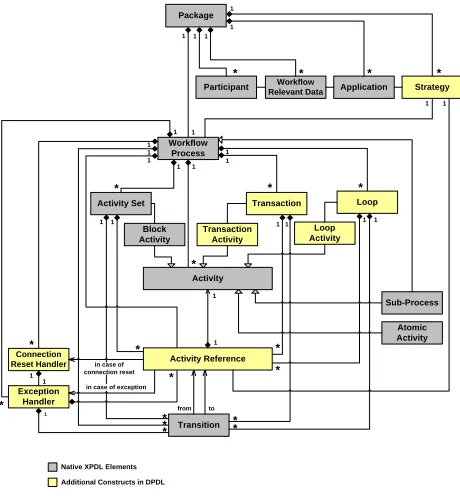
1) Meta-model and Structure: As shown in figure 3,
the basic container for the DPDL process description and all its data is a Package. A Package contains at least a single WorkflowProcess, which holds all tasks to be worked on (Activities) and the control flow as a fixed sequence to execute these tasks.Activitiescan be atomic or can be grouped to simple reusable blocks (Activity Sets), to a sequence of activities to be executed as a
Transaction or to a set of repeatable actions within a
Loop. Furthermore, an activity can represent an entire
Sub-process.
Workflow Process
Activity Set
Activity
Transition Block Activity
Sub-Process
Atomic Activity
1 1
from to *
* *
* *
Transaction
Transaction Activity
Loop
Loop Activity
* *
Exception Handler Connection Reset Handler
1
1 1 1
1
*
*
*
* *
1 1
*
*
1 1
1 1
1
1 1
Native XPDL Elements
Additional Constructs in DPDL in case of exception
Activity Reference
1 1
* 1
1
Package 1
Strategy Application Workflow
Relevant Data Participant
*
* *
11 1
*
1 1
1
in case of connection reset
Figure 3. DPDL Meta-model
To integrate non-functional criteria, the Package can also contain definitions of requirements for service qual-ities or for quality aspects of devices or networks. These requirements are modelled asStrategiesand can be bound to activities or to the entire process.
To deal with likely occurrences of errors and connec-tion resets, DPDL introduces Exception Handlers and
Connection Reset Handlers. These elements refer to
an-other set of activities which should be executed in cases where the normal execution fails.
The introduction of ActivityReferences allows reusing the description of activities within the process, for ex-ample as a part of several error handling descriptions.
the process‘s control flow. ActivityReferencesare unique within the process. They contain all information which is relevant for the execution of the activity in dependence of its position in the control flow, such as references to participants, error handling and non-functional criteria.
2) State Concept: In order to enable a distributed
process to be executed whilst maintaining the autonomy of each single participant, three different cooperation scenarios can be distinguished: First, an activity can be executed locally by an application running on the same (mobile) device. If such local applications are unavailable, the device can search for adequate services on other devices in its vicinity to execute the task remotely. In case the direct vicinity does not provide the required service, the process description can be transferred to another remote device in order to enable the execution in a different vicinity.
The phase of migration can be considered the crucial point: All progress concerning the execution of the pro-cess has to be stopped and state information has to be documented in order to provide a consistent starting po-sition to subsequently executing devices. In particular, the process cannot be transferred before all of the currently executed atomic entities are completed. This approach is advantageous because, as long as an activity can be executed locally, there is no need to search for another execution partner to accomplish this task. Furthermore, the process‘s consistency and integrity of its data must not be violated by splitting up atomic tasks.
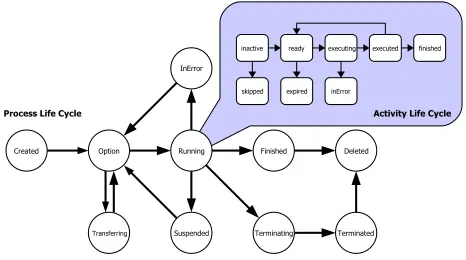
Figure 4 shows the potential life cycle of a mobile process. On the basis of a common life cycle [14], it introduces the safe stateOptionin order to define a stable point to securely transfer a process during its execution. In detail, the Optionstate offers the possibility to either execute the process in case the upcoming activity can be executed locally, or to transfer the process description to another device.
At this central point the process life cycle embeds the potential life cycle of an Activity (c.p. figure 4). The process is regarded to be in the stateRunningif activities are being executed. The state of each single activity within the process is modeled as a property of its respective unique ActivityReference, so the execution state of an activity is well-defined and the progress in processing the activities is visible for every participating device at any time during execution.
AnActivityReferenceisinactiveif preliminary activities
are not executed or conditions for the execution of the referenced activity are not checked yet. In case one or more of these conditions can not be fulfilled, the
ActivityReferenceis set to the error stateskipped. If these
conditions evaluate to true or there are no conditions defined, the ActivityReferenceis set to the stateready. It may happen that a mobile device is capable of checking the conditions of an activity, but is not able to perform the execution itself. In this case, it will possibly take some time to transfer the process description to another device and it has to be checked close to the execution if the
Figure 4. Process and Activity Life Cycles
next activity is still valid or if a defined expiration date is exceeded (error state expired). The states skipped and
expiredare also relevant for the appliance of aDead Path
Elimination. If all prerequisites are fulfilled and the actual
execution starts, the ActivityReference is set to the state
executing. The appearance of errors during the execution
will result in a general error statein error. An activity is
executed when its execution is successfully completed. It
might now be set back to the ready state to be restarted later (for example if the activity is part of a loop) or it is set to the state finished which indicates the execution of
the ActivityReferenceis terminated and finally closed.
Furthermore, a particular ActivityReferencecan be ref-erenced as a start activity to mark the next task to be executed. This relieves other participating devices of dealing with tasks which have already been finished.
3) Description of Activities and External Data:
Trans-fer and execution of processes on mobile computing systems also require an efficient use of the available amount of system memory. This means, one of the most important requirements of mobile processes is to make process descriptions as lean as possible. DPDL allows describing activities as a short but significant identifiers and supports to store data external to the actual process. For example, huge documents may be kept completely out of the description until their processing time has arrived. This is particularly suitable if the data is needed only once or is used in very few activities within the process. On the other hand, the provision of flexibility is essential in this case because the availability of devices and their connectivity may appear as a bottleneck to the dynamic integration of external features. So, it depends on the kind of application to decide whether or not obtaining data from a remote location.
might be very extensive, for example because it con-tains images or complex measured data. Furthermore, it is not necessarily needed to continue the process. Therefore, it would be adequate to store this data ex-ternally to the process description. In DPDL, the data item ”Failure Data” can be represented by an external reference in order to save memory and network costs.
Considering the description of the task itself, the generic activity ”Get GPS Data” is abstracted by
a universal unique identifier (UUID) which
repre-sents the category of adequate services to execute the respective activity, in this case obtaining GPS coordinates of the current position. To resolve ser-vices into activities, an abstract service class is in-stantiated with an arbitrary service implementation. For instance, the customer‘s car navigation system might be able to offer a Web Service to provide GPS coordinates of its position. By ways of externalizing the semantic description for executing the task, the process description is relieved of complex details, e.g. the computation of GPS coordinates or satellite adjustment. If existing, the data involved in the task (service parameter) is finally called from the process description and is mapped to the formal parameters of the generic application. The output data of the resolved service, in this case the received content of the data item ”location data” retrieved from the navigation system‘s Web Service is stored within the process.
4) Users and Devices: The integration of users and
with them the introduction of human interactions is both necessary and beneficially. Mobile devices are primarily designed to accompany (mobile) users and therefore users should be addressable not only to initiate processes from mobile devices, but also to participate in the process man-ually and to solve unexpected errors by direct interaction.
Therefore, mobile processes are highly related to tasks which require interaction with mobile participants such as users or devices or a combination of both. Special constructs are needed to describe which individuals are in-volved in which task and by what kind of communication channels these persons might be addressed or accessed. In DPDL, a participant is either totally specified or described in a generic way, e.g. by the declaration of a certain role. Descriptive properties of users (for example a digital identity) and devices (for example a unique identifier like the DEMAC transport address) can be combined to characterize a participant and help finding the required instance to execute the upcoming task.
In the example the automobile club‘s back office is a fixed participant to execute the activities ”Inform Towing Car” and ”Search for Garage”. Therefore, the process description specifies how the back office can be addressed. In the scenario, this participant could be a stationary device which should be responsible for executing the mobile process. The device can be
determined by an IP address or an arbitrary set of characteristics. Additionally or alternatively, a certain person in charge may be specified to manually super-vise the process.
5) Handling Errors and Connection Resets: Due to
the high risk of faults appearing in mobile computing systems, error handling mechanisms are essential for the execution of mobile processes. The main objective here is to provide a sufficient amount of information to be able to resolve most of the errors likely to occur and to recover from sudden connection resets and failures without depending on other resources. Therefore, the device currently responsible for the execution has to know unambiguously what to do in case the regular control flow fails. Even if the executing device itself encounters problems, it still must have the ability to recover its work from a save state or choose an alternative path to execute the process. Since alternative paths are totally dependent on the process‘s objectives, it is mandatory that the modeler of a process has the absolute flexibility to define what should happen in different erroneous situations.
DPDL supports the definition of user defined alternative paths and therefore provides special constructs to han-dle errors and unexpected situations. The description of
Exception Handlers (cp. figure 3) provides a definition
of alternative control flow constructs to be executed when an error occurs. In case of a connection reset, the communication may be either restarted, the service partner may be changed, or the activity may be skipped. The actual behavior depends on the involved applications and the specific use-case and can also be modeled as a combination of activities.
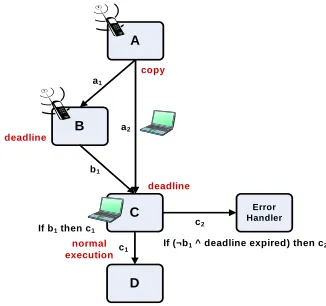
Just in case the responsible device collapses perma-nently, the execution will obviously fail. A possible so-lution to enforce fault tolerance in a rather pessimistic scenario is to integrate check points and to hold copies of the process description. For example, a parallel path can be executed on another device to control the work of its counterpart (see figure 5). If both paths cannot be joined before a specified deadline, the backup device will either carry on or initiate an error handling mechanism. Only if all of the possible recovery mechanisms fail, the user is involved in order to react to the acute problem.
6) Parallel Execution: In case there is no relevant data
dependency within the control flow, parallel paths of the process can be executed by different mobile computing systems. To share a process description, the responsible mobile device decides to execute an arbitrary parallel path and thereby sets its first ActivityReference to the state
executing. While in this state, it produces a snapshot of
A
B
copy
deadline
C deadline
D
Error Handler
normal execution
a1
a2
b1
c2
c1 If (¬b1 ^ deadline expired) then c2
If b1 then c1
Figure 5. Error Handling: Guarded Execution
In order to synchronize parallel paths, there has to be a defined meeting point, for example a stationary device. The participating devices can pass their copies of the process description to the given address. The service at the meeting point collects all incoming parallel paths belonging to a shared identifier and merges the copies to a single process description. If required, this one can be forwarded again to continue execution.
7) Integration of Non-Functional Criteria: To narrow
the selection of potentially participating devices and ser-vices according to the user‘s interests, intentions, and demands the process description may contain a set of non-functional criteria. The user who initiated a process can define a Strategy (cp. figure 3) to assert a certain level of quality throughout the execution of the process. This
way, Strategies help to ensure the user‘s goals as they
were intended originally. Each Strategycontains a set of requirements which each hold a key-value-pair consisting of an identification argument and a target value.
The scenario (cp. section I-B) shows, exemplarily, how to define a limitation of the factor ”cost” for the execution of the activity ”Search for garage”. Assuming garages near to the current position deter-mined by former activities offer electronic services to provide information about their details of repair, the parameter ”cost = cheapest” forms a strategy to select a service that fits the customer‘s interests best. From all available garages the one with the lowest costs will be picked accordingly.
Before executing an activity with specific requirements, the context service has to collect the relevant quality information, so the process service can ensure that only those services and devices are involved in the activity‘s execution which meets the specified requirements. Thus, services have to be comparable and have to offer informa-tion about their funcinforma-tional and non-funcinforma-tional properties in order to be considered for the selection procedure.
C. Mobile Process Execution
Depending on their intended purpose, mobile devices can have many different properties and a wide range of
capabilities. To integrate most mobile devices and to ben-efit from the collaboration of heterogeneous systems, the mobile process execution engine must support different levels of performance.
Therefore, the execution engine is characterized by a modular design (cp. figure 6). A core module provides basic functionality such as receiving, storing, and for-warding process descriptions. It can be run independently on less powerful devices, like PDAs or cell phones, which do not provide enough memory or computing power to execute complex tasks but are useful to transport the process descriptions to other (different) environments. The core module also provides the interface for applica-tions to initiate processes by passing the DPDL process description to the execution engine.
Core Module
Base Module Extension
Module
Extension Module
Extension Module <Security>
<User Interaction>
<Transactions>
Receive and forward process descriptions considering non- functional criteria Interprete process descriptions and
execute processes
Enhance the functionality of devices being more powerful
Figure 6. Modular Execution Engine for Mobile Processes
A more powerful base module is responsible for exe-cuting the described tasks of the process. It uses the core component to communicate with other devices and can be enhanced by further task-specific extension modules.
Extension modulesare strongly dependent on the
charac-teristics of the device, for example an additional compo-nent supporting user interaction can only be realized if the respective device has a proper user interface.
The complete set of all installed components together with the DPDL description of mobile processes realizes the DEMAC process service which can have different combinations of execution modules (c.p.figure 6).
Finally, the mobile process execution engine cooperates closely with the DEMAC context service in order to get information about the device‘s vicinity, such as available services, environmental data or its own identity. If a new process description is received by the core module, the process data is made persistent and the process‘s
Strategies are extracted from the Package. In case there
exe-cution engine within the responsible mobile device starts working on the process itself. It picks the upcomingStart
Activity, examines it and requests the context service to
find suitable services to process the task, depending on the defined Participants,Strategiesand/or Conditionsof this activity. If an adequate service for executing the upcoming activity cannot be found, the local execution engines marks the latest execution state, stops working on the process, and again requests to find an alternative device to continue. This way, sharing the different properties and potentials of context aware mobile computing systems even complex and long-time processes can be executed in a step-by-step-manner.
IV. PROTOTYPEIMPLEMENTATION ANDEVALUATION The presented concept of a middleware for mobile pro-cesses (cp. section III) has been prototypically realized for the system configuration shown in figure 7. The resulting system consists of several heterogeneous devices, operat-ing systems and communication links which are: a Linux server, a desktop PC and a laptop with Windows XP, as well as an iPAQ Pocket PC with Windows Mobile 2003. The server and the desktop PC are connected through standard Ethernet and the Pocket PC communicates with the laptop using wireless LAN. These two separated networks are connected through a Bluetooth link between the laptop and the desktop PC.
90 90 90
90 90 90
PDA WM 2003
WLAN Bluetooth
Laptop MS-XP
Ethernet Desktop MS-XP
Linux Server
Figure 7. System Configuration of the DEMAC Prototype
For this system configuration, the DEMAC middleware has been realized twice, once for the Java Platform,
Micro Edition with CDC2 / Personal Profile 1.0 and a
second time for theJava Platform, Standard Edition. The communication over (wireless) LAN is realized with the integrated functionality of the Java environments and the Bluetooth link is realized with the Avetana Bluetooth Stack and respectively with the BlueCove Stack.
The transport system of the DEMAC platform – in-cluding transport and event service as well as the process service – has been realized with their main functionality. Thus the system is able to receive process descriptions from applications, to interpret processes, and to migrate them to other devices. Also the generic context model and the management system of the context service have been realized. Only the distributed registry and the generic ser-vice factory to create proxy objects for arbitrary serser-vices in the vicinity of the mobile device have not been finished so far (i.e. in fall 2006).
2Connected Device Configuration
Because of the stringent modular design, aiming at porting the middleware from Java ME to Java SE, only a reimplementation of the platform dependent components was necessary, such as the Bluetooth communication integration or XML-parser components. Using uniform adapter components to integrate different communication protocols, allowed for a dynamic and tailored configu-ration of the DEMAC platform for the different system components through easy to use property files.
In addition, the DEMAC middleware was also used and tested in academic education. By realizing enriched applications, such as, for example, a context-aware instant messenger, the suitability of the system for developing also more ”standard” context-aware applica-tions could be demonstrated.
V. CONCLUSION
In summary, the approach of mobile processes provides a basis to support the cooperation of mostly heteroge-neous and a priori unknown devices. In this context, the paper described how to make mobile computing middle-ware platforms capable of supporting abstract descriptions as well as new execution models of mobile distributed
long-term business processes. It was assumed that, due
to (a) the distributed and cooperative nature of such pro-cesses and (b) the restrictions and specific characteristics of mobile computing environments, existing description languages and execution models for centrally coordinated processes do not suffice. Therefore, an extended, technol-ogy independentdescription languagewas proposed and a corresponding execution platformand its realization have been described in this paper.
The main contribution of this work is the definition of
theDEMAC Process Description Languagewhich extends
the XPDL meta-model by concepts for distributing and executing processes in mobile and frequently changing vicinities. It also describes the prototype realization of an
execution engine for such mobile processes. Thereby the
paper argues that the presented modular design is able to support most of the heterogeneous capabilities of typical mobile devices. Overall, these concepts lead to a new class of context-aware applications which partly diffuse into the middleware and which are executed cooperatively. This new class is respectively calledcontext-aware
coop-eration.
devices or to permit processes of others to be executed on their own devices. Therefore, concepts of encryption, authentication and privacy have to be surveyed and inte-grated as well.
As a prototypical implementation of the presented architecture has been realized already, a next step is to implement – on top of this platform – some of the project‘s use cases and sample scenarios to evaluate the architecture in more detail.
REFERENCES
[1] G. D. Abowd, C. G. Atkeson, J. Hong, S. Long, R. Kooper, and M. Pinkerton. Cyberguide: A mobile context-aware tour guide. Wirel. Netw., 3(5):421–433, 1997.
[2] T. Andrews, F. Curbera, H. Dholakia, Y. Goland, J. Klein, F. Leymann, K. Liu, D. Roller, D. Smith, S. Thatte, I. Trickovic, and S. Weerawarana. Business process execu-tion language for web services version 1.1. Specificaexecu-tion, IBM, BEA Systems, Microsoft, SAP AG, Siebel Systems, 2003.
[3] A. Arkin, S. Askary, S. Fordin, S. Jekeli, S. Kawaguchi, D. Orchard, S. Pogliani, K. Riemer, S. Struble, P. Takacsi-Nagy, I. Trickovic, and S. Zimek. Web Service Chore-ography Interface (WSCI) 1.0. Specification NOTE-wsci-20020808, World Wide Web Consortium, 2002.
[4] C. Becker. System Support for Context-Aware Computing. Habilitation, University of Stuttgart, 2004.
[5] P. Bellavista, C. Stefanelli, and M. Tortonesi. The ubiQoS Middleware for Audio Streaming to Bluetooth Device.
mobiquitous, 00:138–145, 2004.
[6] P. Braun and W. Rossak.Mobile Agents - Basic Concepts, Mobility Models, and the Tracy Toolkit. Elsevier and Morgan Kaufmann and dpunkt.verlag, 2005.
[7] K. Cheverst, N. Davies, K. Mitchell, and A. Friday. Ex-periences of developing and deploying a context-aware tourist guide: the GUIDE project. In MobiCom ’00: Proceedings of the 6th annual international conference on Mobile computing and networking, pages 20–31, New York, NY, USA, 2000. ACM Press.
[8] A. K. Dey. Understanding and Using Context. Personal and Ubiquitous Computing Journal, 5(1):4–7, 2001.
[9] F. D¨urr, N. H¨onle, D. Nicklas, C. Becker, and K. Rother-mel. Nexus–A Platform for Context-Aware Applications. In Roth, J¨org, editor, 1. Fachgespr¨ach Ortsbezogene An-wendungen und Dienste der GI-Fachgruppe KuVS, 2004.
[10] G. H. Forman and J. Zahorjan. The Challenges of Mobile Computing. Technical Report TR-93-11-03, University of Woshington, 3 1994.
[11] JBoss Company. JBoss jBPM 3.0 - Workflow and BPM made practical. Documentation, JBoss Company, 2005.
[12] M. Kloppmann, D. Koenig, F. Leymann, G. Pfau, A. Rick-ayzen, C. von Riegen, P. Schmidt, and I. Trickovi. WS-BPEL Extension for People - WS-BPEL4People, 2005.
[13] M. Kloppmann, D. Koenig, F. Leymann, G. Pfau, A. Rick-ayzen, C. von Riegen, P. Schmidt, and I. Trickovi. WS-BPEL Extension for Sub-processes - WS-BPEL-SPE, 2005.
[14] F. Leymann and D. Roller. Production Workflow - Con-cepts and Techniques. PTR Prentice Hall, 2000.
[15] R. Norin and M. Marin. Workflow Process Definition In-terface – XML Process Definition Language. Specification WFMC-TC-1025, Workflow Management Coalition, 2002.
[16] J. Pascoe. The Stick-e Note Architecture: Extending the Interface Beyond the User. InIUI ’97: Proceedings of the 2nd international conference on intelligent user interfaces, pages 261–264, New York, NY, USA, 1997. ACM Press.
[17] K. Riemer. EbBPSS Business Process Specification Schema, Version 1.01. Specification, Oasis ebXML Busi-ness Process Project Team, 2001.
[18] SAP AG. SAP Mobile Infrastructure: An Open Platform for Enterprise Mobility. Technical report, SAP AG, 2003.
[19] M. Satyanarayanan. Fundamental Challenges in Mobile Computing. InProceedings of the Fifteenth ACM Sympo-sium on Principles of Distributed Computing, 1996.
[20] B. N. Schilit, N. Adams, and R. Want. Context-Aware Computing Applications. In Proceedings of the 1st In-ternational Workshop on Mobile Computing Systems and Applications, pages 85–90, 1994.
[21] A. Schmidt, M. Beigl, and H.-W. Gellersen. There is more to Context than Location. In Proceedings of the Inter-national Workshop on Interactive Applications of Mobile Computing, 1998.
[22] M. Weiser. The Computer for the Twenty-First Century.
Scientific American, 256(3):94–104, 1991.
[23] M. Weiser. Ubiquitous Computing. IEEE Computer Hot Topics, 1993.
[24] WfMC. Process Definition Interface - XML Process Definition Language Version 2.00. Specification WFMC-TC-1025, Workflow Management Coalition, 2005.
[25] S. Zaplata. Prozessintegration in Middleware f¨ur mobile Systeme. Master’s thesis, University of Hamburg, 2005.
Christian P. Kunzeis currently a research assistant and Ph.D. candidate at the University of Hamburg, Germany. He received his diploma in informatics with a focus on distributed systems from the University of Hamburg in 2003.
He was software engineer at theSHS Informationssysteme AG
before he became a research assistant. At the moment, he holds courses and advises projects in the field of mobile and pervasive computing, which is also the main focus of his research interests.
Sonja Zaplataworks as a research assistant in the Department of Informatics, Research Group for Distributed Systems and Information Systems (VSIS), at the University of Hamburg, Germany. After finishing her training of Business Administra-tion at the Wirtschaftsakademie Hamburg in 2000, she studied computer science and received her diploma in informatics from the University of Hamburg in 2006. Currently, she is a Ph.D. candidate and is interested in the research activities of distributed workflow management.
Winfried Lamersdorfis a full professor at the Department of Informatics at the University of Hamburg and head of the de-partment as well as of theDistributed Systems and Information Systemsunit there - with specific responsibilities in the area of distributed systems.
From 1974 to 1980 he studied computer science at the Technical University of Munich and the University of Hamburg. He also spent a year as a guest scientist at the University of Maryland, USA, in collaboration with the National Institute of Standards and Technology (NIST) in Washington/DC and received his doctorate for work in the field of database languages and semantic data models in 1985.