A Five Views Framework for Evaluating Learning Service
Selection in Context-Aware Ubiquitous Learning Systems
Ines Bayoudh Saadi
*, Nesrine Ben Salah
Department of Computer Science, National Higher Engineering School of Tunis, Tunis University, Tunisia.
* Corresponding author. Tel.: +216 22737296; email: [email protected] Manuscript submitted February 20, 2016; accepted May 14, 2016.
doi: 10.17706/jcp.12.5.423-432
Abstract: Studies on the learning service selection approaches have been the subject of many researches in recent years. The works identified in the literature are developed to solve the learning service selection problem; however, these works need to have a clear view and an overview of how systems intended select services. This study details a multidimensional descriptive view of learning service selection approaches in context-aware ubiquitous learning systems through five different views. Each view captures a particular aspect of the service selection process. Then a set of facets associated with each particular aspect in order to study, understand and describe it appropriately. This work would be helpful for context-aware u-learning system developers in order to have a clear understanding of service selection process in such systems and highlight the guidelines to be applied and the means used to satisfy the needs and the requirements of the learner and the application.
Key words: Context-aware ubiquitous learning systems, learning service selection, uncertainty management, QoS, QoC.
1.
Introduction
A context-aware ubiquitous learning systems provides a learning scenario in which learners are guided to learn in a real-world situation with supports or instructions from a computer system, using a mobile device to access the digital content via wireless communications; in the meantime. Thus, the learning system will be able to detect and record the learning behaviors of the students in both the real-world and the virtual world with the help of the sensor technology and to more actively interact with the learners [1], [2]. These systems adapt their function according to the context changes. The selection of learning services based on the detected context is one of the possible adaptations that context-aware ubiquitous learning system can provide to the learner.
When dealing with this concept, it can be noticed that, according to [3], the selection of services is defined as “The stage for differentiating the services which provide the same functionality, based on quality of service”. This definition is limited to the selection based on quality of service. We improve this proposal and define the selection of service as the stage for differentiating the services which provide the same functionality based on the learner's requirements and quality assessment.
properties and characteristics that describe how a service works and how it can satisfy learners’ needs [5]-[7].
Learning services selection is a special case of the services selection which is considered by David et al., [8] as “a set of learning activities, learning resources and support facilities that are used to meet specific learning objectives.”
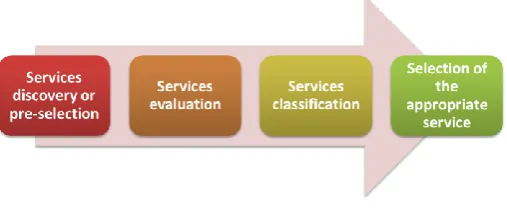
A review of various studies related to the learning services selection, allowed us to conclude that the selection process usually involves four steps: (1) Services discovery or pre-selection, (2) Services Evaluation, (3) Services classification, and (4) Selection of the appropriate service (Fig. 1).
Fig. 1. General Service selection process.
Accordingly, the diversity of services selection criteria in these works leads us to study the various approaches described, in order to evaluate and derive the limits associated with it. The key contributions of this paper are recapitulated below: (1) the proposition of a framework to evaluate the learning service selection approaches, (2) the study and the position of the learning service selection approaches against each other, and (3) their evaluation based on criteria that must be met by a learning service selection approach in a context-aware ubiquitous learning system.
The rest of this paper is organized as follows. Section 2 presents a new proposal framework for learning service selection approaches. A review of four learning service selection approaches using the proposed framework is given in Section 3. Finally, a conclusion highlighting the main results of this study and some perspectives are given in Section 4.
2.
Learning Service Selection Framework Overview
The framework with views and facets was originally proposed for system engineering and enhanced the understanding of various engineering disciplines such as information systems engineering [9], requirements engineering [10] and process engineering [11]. Other frameworks have been proposed. For instance, we can cite the one proposed in [12], where the authors evaluate context usage within ubiquitous learning systems and that proposed in [13], which focuses on the study of Web Services QoS Models.
Since the efficiency of these frameworks was proven in many domains, we therefore proposed to use this structure for the evaluation of the learning services selection approaches.
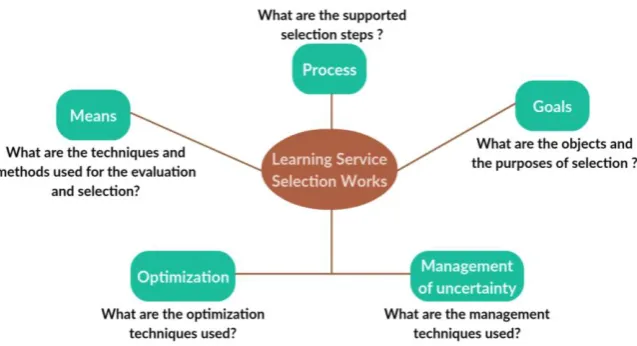
The proposed framework allows analysis of learning service selection works and compare them. It consists of five different and complementary views, each view can analyze a particular aspect of the learning service selection by asking a fundamental question.
According to [14], each view is characterized by a name and measured using a set of facets that can be decomposed into sub-facets. All facets have defined values in a domain which can be one of predefined types such as an enumerated type ({x, y, z}), a structured type (Set {x, y}), an Integer or a Boolean.
Fig. 2. Learning service selection views.
2.1. Goals View
The Goals view addresses the question “What are the objects and purposes of selection?”. It is used to indicate the intended purpose and objects to select. The different facets associated with this view are selection purpose and selection object.
2.1.1. Selection purpose facet
This facet describes the goal or the need to satisfy, through the selection of learning service. It is defined by:
Purpose = SET (ENUM {Provide a service, adapt, support learning, guide, optimize, etc.})
2.1.2. Selection object facet
This facet concerns the object to select. It is defined by:
Objects = SET (ENUM {Learning Service, Learning object, Learning content, Learning unit, service provider, learning resource})
2.2. Process View
The Process view answers the question “What are the supported selection steps?”. In this view, it is of interest to look and to describe the selection steps supported in the different works. Below are described the different facets associated with this view.
2.2.1. Triggering process facet
This facet is interested in how the process is triggered. A selection process may be triggered when the context is detected and/or when sending a query that may contain the requested functionality and /or the requirements for the application.
Thus, this aspect includes both attributes “context detection” and “query” that are described as follows:
Context detection: If the selection process is initiated upon context detection, then this attribute indicates the detected contextual elements and is described by:
Context detection = SET (ENUM {Location, Time, Preferences, Availability, needs, knowledge, Not supported})
2.2.2. Identification of the learning situation facet
A learning situation is “an interpretation of a set of contextual data, relating each one of them in order to provide some information valid in a specific time interval” [15]. It can be identified from the detected context. However, its identification allows filtering services that can be executed. This facet shows if the step of “Identification of the learning situation” is supported or not. It is defined by:
Identification of the learning situation = Boolean
2.2.3. Preselection or Service Discovery Facet
Preselection or services discovery, distinguishes the services that can be executed. This facet indicates whether the approach set out a step of preselection or service discovery in its selection process. It is defined by:
Preselection or Service Discovery = Boolean
2.2.4. Quality evaluation Facet
To switch between preselected learning services, an assessment of their qualities is necessary to satisfy the learner's needs. Similarly, the evaluation of the quality of the detected context is important to filter the uncertain or incorrect context elements. This facet defines whether the approach supports the step of quality evaluation in the selection process. It is described by two attributes.
Evaluation of the quality of context (QoC): It indicates whether the approach provides assessment of the quality of the detected context. It is defined by:
Evaluation of the quality of context = Boolean
Evaluation of the quality of service (QoS): It indicates whether the approach ensures the quality assessment of preselected services and is defined by:
Evaluation of the quality of service = Boolean
2.2.5. Selection facet
The selection of learning services is done according to their evaluated qualities. The service that satisfy the request of the learner and have the best quality will be chosen. This facet indicates whether the selection step is supported by the approach. It is defined by:
Selection= Boolean
2.2.6. Historic facet
When a learning service is selected, it can be stored in a database that contains past selection experiences. These one can be used when the system detects a similar learner query and learning situation. Thus, the service will be supplied directly. This facet indicates whether the approach considers the creation of a history of past experiences in the selection process or not. It is defined by:
Historic = Boolean
2.3. Means View
The question addressed in this view is “What are the techniques and methods used for the evaluation and selection?” The means view focuses on the different tools and methods used to assess service and context quality for the selection of learning services. It includes three aspects, namely “Preselection and Discovery”, “quality evaluation” and “selection”.
Preselection of learning services can be done through the functionality requested by the learner and/or the quality requirements he prefers. It can also be done simply by choosing services that satisfy functionality provided by the application. This facet aims to describe the methods used for screening. It is defined by:
Preselection Method = SET (ENUM {according to the features of the application, depending on the functionality required by the learner, according to the quality requirements of the learner, Not supported})
2.3.2. Quality evaluation facet
The quality assessment is carried out through the calculation of the various indicators of the quality of context (QoC) and the quality of services (QoS). This facet aims then to specify indicators used to calculate these qualities. Thus, it is split into two attributes.
QoC indicators: It includes indicators used to calculate the QoC. It is defined by:
QoC indicators = SET (ENUM {Reliability, actuality, significance, Precision, Not supported, etc.})
QoS indicators: It includes indicators used to calculate the QoS. It is defined by:
QoS indicators = SET (ENUM {Response time, precision, availability, Cost, Risk of rupture, capacity, Not supported, etc.})
2.3.3. Selection facet
Multiple methods and techniques are involved to ensure learning services selection. This facet describes the tools provided by the approaches and systems to ensure the services selection. It is defined by:
Selection Method = ENUM {AHP, fuzzy AHP, ANN, score calculation, A rule base, Cost calculation, fuzzy Topsis, Not supported}
2.4. Optimization View
The optimization view responds to the question “What are the optimization techniques used?” and describes optimization techniques defined by approaches and systems to optimize the learning service selection process.
The different facets associated with this view are described as follows:
2.4.1. Optimization facet
Once the service is selected, a historic containing past selection experiences can then be fed. This historic will be consulted in case of presence of a similar experience to optimize the selection process. This facet is used to specify whether the approach includes a step of optimization in the selection process or not.
Optimization = Boolean
2.4.2. Used techniques facet
The optimization of the selection can be achieved by various means. This facet describes the techniques used to optimize the selection process. It is defined by:
Techniques = ENUM {Case-based reasoning, heuristic methods, Not supported, etc.}
2.5. Management of Uncertainty View
into consideration and describes the methods used.
The different facets associated with this view are described in the following.
2.5.1. Management facet
This facet is used to specify whether the approach takes into account the management of uncertainty or not.
Management = Boolean
2.5.2. Level facet
This facet indicates in which level uncertainty management has been taken into account. It is defined by:
Level = SET (ENUM {The change of context, quality calculation, Not supported})
2.5.3. Methods used facet
The management of uncertainty can be achieved by different means. This facet describes the methods that are used to manage uncertainty. It is defined by:
Methods = ENUM {Bayesian networks, hidden Markov chains, fuzzy logic, fuzzy systems, confidence value, Not supported}
3.
Review of Four Learning Service Selection Approaches Using the Proposed
Framework
In this section, the learning service selection framework will be used to evaluate different work against the criteria and functions that must be provided for the selection of service.
Four learning service selection systems and approaches have been chosen: mCALS [16], QoS-based LSC for UL [17], CAMLES [18] and WoBaLearn [19].
mCALS was developed to support java programming learning, it was provided by Y. Jane Yin-Kim and J. Mike and it aims to select appropriate learning objects for learners based on their current location, their availability and their previous knowledge.
The ubiquitous learning service selection system QoS-based LSC was proposed by Huang et al., and it is effective to help teachers to choose learning services taking into account two different contexts, i.e. the optimization of the composition of QoS-based services and the unique service discovery based on the QoS.
Concerning the ubiquitous learning system CAMLES, which was developed by Nguyen, Viet Anh et al., it aims to support the learning of English and to adapt the sequence and navigation of its educational content based on a combination of previous knowledge of the learner, needs, preferences, availability, current location and time information.
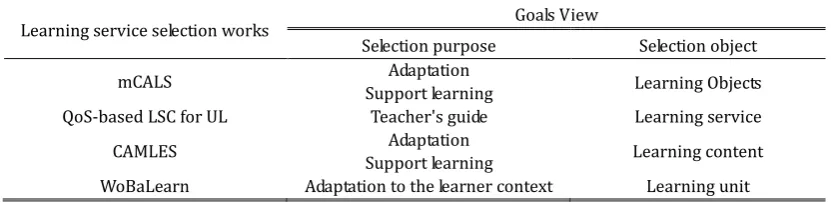
Table 1. Instantiation of Four Learning Service Selection Works to Goals View
Learning service selection works Goals View
Selection purpose Selection object
mCALS Adaptation
Support learning Learning Objects
QoS-based LSC for UL Teacher's guide Learning service
CAMLES Adaptation
Support learning Learning content
WoBaLearn Adaptation to the learner context Learning unit
Finally, we study the ubiquitous learning system WoBaLearn proposed by ZHANG Bingxue which is dedicated to learning and work-based professionals.
the selection of learning services.
Table 1, Table 2, Table 3, Table 4 and Table 5 give a comparison of these learning service selection systems and approaches.
The instantiation of the proposed framework within a list of four context-aware u-learning systems allows their evaluation by bringing out their main features and limits. Based on this evaluation, it is noticed that in terms of “Goals”, the aims and objects of the selection are different from one approach to another. The purpose of selection is generally adaptation, but it is also intended to) provide learning support. On the other hand, we can distinguish several selected objects, i.e. content, objects, services and learning units.
Table 2. Instantiation of Four Learning Service Selection Works to Process View
Learning service selection works
Process View
Triggering the process Identification of the learning situation Preselection or Service Discovery Quality
evaluation Selection Historic
Context detection Query QoC QoS
mCALS Location
Time preferences learner Yes No No No Yes No QoS-based LSC for
UL Yes
Not
supported No Yes No Yes Yes No
CAMLES Preferences Availability Location Needs Knowledge Not
supported No No No No Yes No
WoBaLearn Yes Yes No Yes No No Yes No
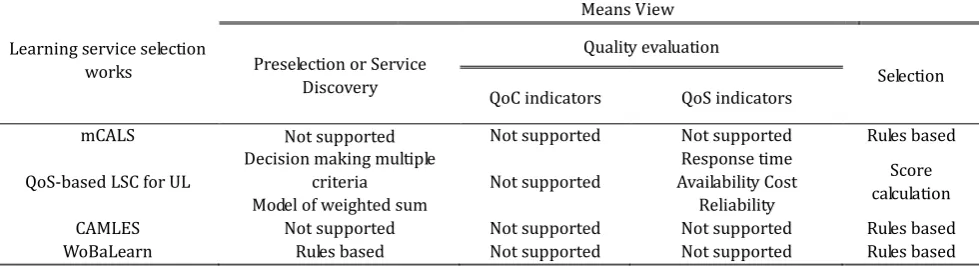
Table 3. Instantiation of Four Learning Service Selection Works to Means View
Learning service selection works
Means View
Preselection or Service Discovery
Quality evaluation
Selection
QoC indicators QoS indicators
mCALS Not supported Not supported Not supported Rules based
QoS-based LSC for UL
Decision making multiple criteria
Model of weighted sum
Not supported Response time Availability Cost Reliability Score calculation
CAMLES Not supported Not supported Not supported Rules based
WoBaLearn Rules based Not supported Not supported Rules based
According to the Selection Process view, we can conclude that the process is usually triggered by a query in most approaches and systems. We also note that in some works, regarding the detected context, the focus was only set on the location and time. Others focus, in addition to the location and time, on preferences, needs and knowledge of the learner. The rest of the works does not detail the contextual elements they detect. No work covers all selection steps.
Indeed, they are limited to select the required learning service without going through the different steps of the identification of the situation, preselection and evaluation. Moreover, even if the evaluation step is supported, these works does consider only the calculation of service quality and totally neglect the calculation of the quality of context.
Table 4. Instantiation of Four Learning Service Selection Works to Optimization View
Learning service selection works
Optimization View
Optimization Used techniques
mCALS No Not supported
QoS-based LSC
for UL No Not supported
CAMLES No Not supported
WoBaLearn No Not supported
Table 5. Instantiation of Four Learning Service Selection Works To Uncertainty View
Learning service selection works
Management of uncertainty View
Management Level Methods used
mCALS No Not supported Not supported
QoS-based LSC
for UL No Not supported Not supported
CAMLES No Not supported Not supported
WoBaLearn No Not supported Not supported
4.
Conclusion and Future Work
In this paper, the focus was maintained on studying the learning service selection. The instantiation of the framework views shows that the existing selection works have several limitations. Indeed, most of them have neglected the evaluation of QoC and have only considered QoS during the learning service selection process. Similarly, no work has included identifying the learning situation at the beginning of the process which will help in the selection phase.
As for the selection process, most of the works only support the selection step, neglecting all other stages (Preselection, Evaluation, and Classification). Finally, the different works does not seek to generate feedback to optimize their selection process.
Through the analysis of various works dealing selection in ubiquitous learning systems, we see that they have limitations when selecting and therefore the satisfaction of the learner is not assured. To overcome these limitations and to ensure a satisfactory and optimal selection taking into account the satisfaction of the learner, we need to introduce and outline a new approach for learning service selection that improves QoC and QoS through learner feedback, optimizes the learning service selection process and also manages uncertainty. So, the future direction of the research is to consider fuzzy decision making methods and case based reasoning in order to satisfy learner intentions, needs and preferences.
Acknowledgment
The authors acknowledge the support of the Tunisian CDUP (Center of Didactic and University Pedagogy).
References
[1] Ogata, H., & Yano, Y. (2004). Context-aware support for computer-supported ubiquitous learning,
Proceedings of the 2nd IEEE Int. Work. Wireless and Mobile Technologies in Education (pp. 27–34).
[2] Hwang, G. J., Tsai, C. C., & Yang, S. J. H. (2008). Criteria, strategies and research issues of context aware ubiquitous learning. Educational Technology & Society, 11(2), 81–91.
[3] Maximilien, E. M., & Singh, M. P. (2004). A framework and ontology for dynamic web, services selection.
IEEE Internet Computing, 8(5), 84–93.
[4] Foulds, E., & Frank, J. (2010). A review of multi-instance learning assumptions. The Knowledge
Engineering Review, 1–31.
survey. IEEE Multimedia, 2(2), 10–19.
[6] Buchholz, T., Küpper, A., & Schiffers, M. (2003). Quality of context: What it is and why we need it.
Proceedings of the Workshop of the HP OpenView University Association (pp. 1–14).
[7] Laplace, S., Dalmau, M., Roose, P., Laplace, S., Dalmau, M., Roose, P., & Mod, K. (2007). Kalinahia - Modèle de qualité de service pour les applications multimédia reconfigurables. Numéro Spécial Revue ISI, Conception: Patrons et spécifications formelles, 4(12).
[8] Diez, D., Malizia, A., Aedo, I., Diaz, P., Fernandez, C., & Dodero, J. M. (2009). A methodological approach to encourage the service-oriented learning systems development. Educational Technology & Society,
12(4), 138–148.
[9] Jarke, M., & Pohl, K. (1994). Requirements engineering in 2001: (Virtually) managing a changing reality.
Software Engineering Journal, 9, 257–266.
[10]Rolland, C., Ben Achour, C., Cauvet, C., Ralyté, J., et al. (1998). A proposal for a scenario classification framework. Requirements Engineering, 3(1), 23–47.
[11]Rolland, C., Loucopoulos, P., Grosz, G., & Nurcan, S. (1998). A framework for generic patterns dedicated to the management of change in the electricity supply industry. DEXA Work, 907–912.
[12]Souabni, R., & Saadi, I. B. (2014). Context-aware systems and applications. Mobile Networks and Applications, 128, 316–326.
[13]Jokha, A.-K. Y., Kraiem, Z., et al. Towards a comprehensive view of web services QoS models.
International Journal of Multimedia and Ubiquitous Engineering, 10(10), 259–272.
[14]Prieto-Diaz, R. (1991). Implementing faceted classification for software reuse. Communications of the ACM, 34(5), 88-97.
[15]Pernas, A. M., Yamin, A. C., Lopes, J. L. B., & de Oliveira, J. P. M. (2014). A semantic approach for learning situation detection. Proceedings of the 2014 IEEE 28th International Conference on Advanced
Information Networking and Applications (pp. 1119–1126).
[16]Yau, J., & Joy, M. (2008). A self-regulated learning approach: a mobile context-aware and adaptive learning schedule (mCALS) tool. International Journal of Interactive Mobile Technologies, 2(3), 52–57. [17]Huang, F. M., Lan, C. W., & Yang, S. J. H. (2008). QoS-based learning services composition for ubiquitous
learning. Proceedings of the 2008 IEEE International Conference on Ubiquitous and Trustworthy
Computing (pp. 513–518).
[18]Nguyen, V. A., Pham, V. C., & Ho, V. C. (2010). A context – aware mobile learning adaptive system for supporting foreigner learning Englis. Proceedings of the 2010 IEEE RIVF International Conference on
Computing and Communication Technologies, Research, Innovation, and Vision for the Future (pp. 1-6).
[19]Yin, C., Zhang, B., David, B., Noel, N., Chalon, R., & Xiong, Z. (2014). Design and case study of wobalearn
— A work-based learning system. Proceedings of the 2014 IEEE 14th International Conference on
Advanced Learning Technologies (pp. 77–79).
Ines Bayoudh Saadi was born in Tunis, Tunisia in 1973. She received the PhD degree in computer science 2006 from the National School of Computer Sciences, University of Manouba. From 1998 to 2002 she was a deputy chief service of Tunisia's central bank. Until 2005 she worked as an assistant professor in Higher Institute of Applied Sciences and Technology of Sousse in Tunisia. From 2005 to 2007, she worked as an assistant at the computer science Department at the National Higher Engineering School of Tunis in Tunisia. She is currently an assistant professor in the same school.
process modeling and guidance. She is a research member of the Software engineering, distributed applications, decision systems and intelligent imaging research laboratory - RIADI Laboratory since 1998. She has published about 16 papers on international conference proceedings.
Nesrine Ben Salah was born in Tunis, Tunisia in 1991. She graduated from National Higher Engineering School of Tunis, Tunis University. She got the licentiate degree in computer sciences in 2013 and the master degree in computer sciences in 2015.