www.pharmascholars.com
936
Research Article
CODEN: IJPNL6
Efficacy of ormeloxifene in dysfunctional uterine bleeding: a boon too many
*Thapa Shreya
1, Agrawal Rani Nisha
2, Chaubey Lavina
31
Junior Resident,
2Professor,
3Assistant Professor, Department of obstetrics and gynecology,
Institute of medical sciences, Banaras Hindu University, Varanasi, India – 221005
*Corresponding author e-mail: [email protected]
ABSTRACT
A prospective study was conducted after ethical clearance to evaluate the efficacy of Ormeloxifene in the medical management of DUB in a Tertiary care hospital. The study included 60 women with DUB who underwent baseline assessment and were then treated with Ormeloxifene 60 mg orally twice a week for 12 weeks, followed by once a week for next 12 weeks. The efficacy of the study drug was analyzed by comparing the baseline and post treatment PABC score, menstrual cycle pattern, haemoglobin level, endometrial thickness and satisfaction with treatment. Statistical analysis was performed using SPSS. There was statistically significant decrease in median PABC score
and endometrial thickness. The mean haemoglobin level difference was not statistically significant. The menstrual
pattern regularized in 90.4% patients. There was 100% satisfaction with the treatment. Thus Ormeloxifene, a
non-steroidal, non-hormonal agent, with its convenient dose schedule provides effective and favourable medical management option with least side effects, suitable for the treatment of DUB.
Keywords: Ormeloxifene, Dysfunctional Uterine Bleeding, Menorrhagia
INTRODUCTION
Dysfunctional Uterine Bleeding (DUB) is a state of abnormal uterine bleeding without any clinically detectable organic, systemic and iatrogenic cause. It is the most common menstrual disorder of women in reproductive age and is a diagnosis of exclusion. According to the strict definition, menorrhagia is menstrual bleeding longer than 7 days or in an amount exceeding 80 ml from normal secretory
endometrium after normal ovulation. Heavy
menstrual bleeding can also be defined as Excessive menstrual blood loss which interferes with the woman’s physical, emotional, social, and material quality of life, and which can occur alone or in combination with other symptoms. Only 40% of women with the complaint of excessive menstrual loss have it confirmed objectively the amount of menstrual blood loss is usually not proportional to the duration of bleeding or the number of sanitary pads or tampons used during menses(1).However, it may significantly impair the quality of life for many otherwise healthy women(2). Ormeloxifene, a third
generation Selective Estrogen Receptor modulator (SERM) selectively acts on estrogen receptors as agonist and antagonist in different reproductive
tissues(3). It has anti-estrogenic action on
endometrium and breast and estrogenic action on bones, vagina, liver, cardiovascular and central nervous system. The ideal therapy in perimenopausal women is one that has no uterine stimulation, prevents bone loss, has no risk of breast cancer, has a positive effect on lipids and cardiovascular system and maintains cognitive function of brain. SERM in general and ormeloxifene in particular satisfy these requirements (4,5). The aim of this study was to assess the efficacy and safety of ormeloxifene in DUB.
MATERIALS AND METHOD
This study was a prospective clinical trial conducted after Ethical clearance in the Department of Obstetrics and Gynaecology, Institute of Medical Sciences (IMS), Banaras Hindu University (BHU), Varanasi, between July 2012 and June 2014. Subjects were recruited from Gynaecology OPD of SSH,
International Journal of Pharmacy
www.pharmascholars.com
937
BHU, Varanasi. Newly diagnosed dysfunctional uterine bleeding from all age groups from puberty to reproductive and perimenopausal age group were eligible for the study. They were confirmed by Histopathological examination and by Trans Vaginal Scan (TVS) / Trans abdominal scan (TAS). Informed consent was taken from all patients for the study. Inclusion criteria were all women with irregular and or heavy menstrual bleeding age groups from adolescent to peri menopausal women who were willing to maintain Monthly record of vaginal bleeding and willing to come for regular follow up at 3 , 6 and 12 months. Exclusion criteria were pregnancy or desirous to become pregnant, Coagulopathy, medical disorders - liver dysfunction, heart disease, migraine, stroke, renal disease, hypo/hyperthyroidism, and lactating women in first 6 months of post-natal period, intake of hormonal contraception or any hormonal therapy received in last three months. History of hypersensitivity or allergy to Ormeloxifene was also excluded. A detailed history of demographic profile, obstetric history, any medical and surgical illness and detailed menstrual history regarding amount and duration of bleeding was taken. Subjective assessment of menstrual blood loss was done with pictorial blood loss assessment chart (PBAC). PABC score > or = 100 was considered as menstrual blood loss >/= 80 ml, was considered as diagnostic of menorrhagia (7). Patients were asked to maintain a menstrual diary and PBAC score was calculated from it on successive
visits. General examination and complete
Gynaecological examination was performed.
Routine investigation included Complete blood count, Thyroid function test and Blood sugar (fasting and post prandial) was done. Coagulation profile was done in young girls with puberty menorrhagia. Gynaecological examination including cervical smear was done.
A Transvaginal/ Transabdominal Ultrasonography was used to evaluate endometrial thickness, lining of endometrium and to rule out other possible cause of menorrhagia including fibroid, endometrial polyp and adnexal pathology. Endometrial sampling by using Novac’s curette (except in unmarried girls) were taken.
All patients were asked to use sanitary napkin of the same kind, not containing absorbent gel. Participants were taught to maintain a menstrual diary keeping an account of the number of pads used, soakage and passage of clots. Patients were followed at 3, 6 months on treatment and six months after stopping treatment.
The patients were treated with Ormeloxifene 60 mg orally twice a week for 12 weeks, followed by once a week for next 12 weeks. On follow up, menstrual pattern, duration and amount of bleeding was noted. PBAC score was calculated from their menstrual diary. Hemoglobin and Endometrial thickness was measured in the proliferative phase of the cycle, i.e. Day 8 - 12 of menses. Patients were also enquired about their satisfaction with the treatment at every visit.
Statistical analysis was performed using SPSS version-16. The various parameters studied during observation period were compared using Chi-square test. The critical value of ‘p’ indicating the probability of significant difference was taken as <0.05 for comparison.
RESULTS
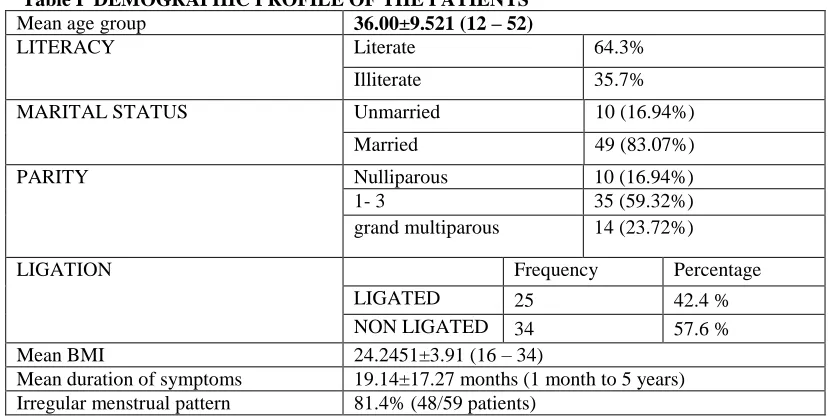
59 patients were enrolled in this group out of which 4 cases dropped out in want of surgical treatment during course of therapy and 2 patients were lost to follow up. Hence a total of 53 cases were studied to see the effect of drug. The demographic profile is given in Table I. The mean age group was
36.00±9.521. 64.3% patients were educated. 10 (16.94%) patients were unmarried whereas 49 (83.07%) were married. Based on parity, 16.94% were nulliparous, 59.32% were multiparous patients with 1- 3 living issues and 23.72% were grand multiparous patients. 25 (42.4 %) patients were tubal ligated and 34 (57.6 %) patients were not. The mean
BMI was 24.2451±3.91. The mean duration of
symptoms was 19.14±17.27 months. The menstrual pattern was irregular in 81.4% (48/59 patients).
Endometrial Biopsy was taken from all patients in the secretory phase (day 25 of menses in ovulatory cycle and any day on anovulatory cycles). 17 patients did not undergo Endometrial curettage. Proliferative Endometrium (59.3%) was the most common type of endometrial pattern followed by early and late secretory given in Table II. The menstrual pattern was irregular in 81.4% (48/59 patients) which became regular in 88.7% (47/55 patients) at the end of the study. During the treatment period all patienst became amenorrheic as shown in Table III and Figure I.
There was no significant improvement in
www.pharmascholars.com
938
evaluated at 6 months off therapy which showed a significantly improved from 320 to 60 (p=<0.001). Table IV shows the change in Endometrial thickness from 8 mm (6-10) at baseline. Initially with treatment for six months the endometrial thickness decreased to 5.60 mm (4.20-7.25) (p=<0.001). However after six months of stopping treatment it still measured the same- 5.60 mm (4.20-6.90) (p=<0.001). At the end of the study, 81.1 % had excellent satisfaction and 18.9 % were moderately satisfied and no one was dissatisfied with the treatment. This is seen in Table V.
DISCUSSION
For women with DUB who wish to retain fertility, pharmacological approaches are the only currently available options. Among the other pharmacological agents, some are effective only for anovulatory DUB, some are useful only for ovulatory DUB, and still others may be effective for both. Pharmacological agents such as NSAIDS, oral contraceptive pills,
progestins, danazol, GnRH agonists and
antifibrinolytic drugs all reduce menstrual blood loss, however, the assets are limited to the duration of treatment.
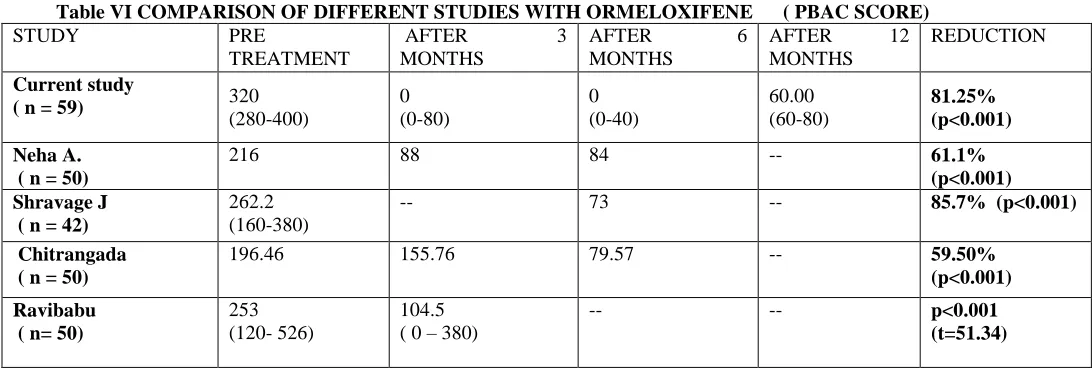
In our study we have analyzed the efficacy of Ormeloxifene in patients with dysfunctional uterine bleeding and our results suggested that there was a significant reduction of menstrual blood loss, these results are similar to other studies (8,9)
Efficacy evaluation was based on 59 patients, out of which only 53 completed treatment, 4 cases dropped out in want of Hysterectomy during course of therapy and 2 patients were lost to follow up.
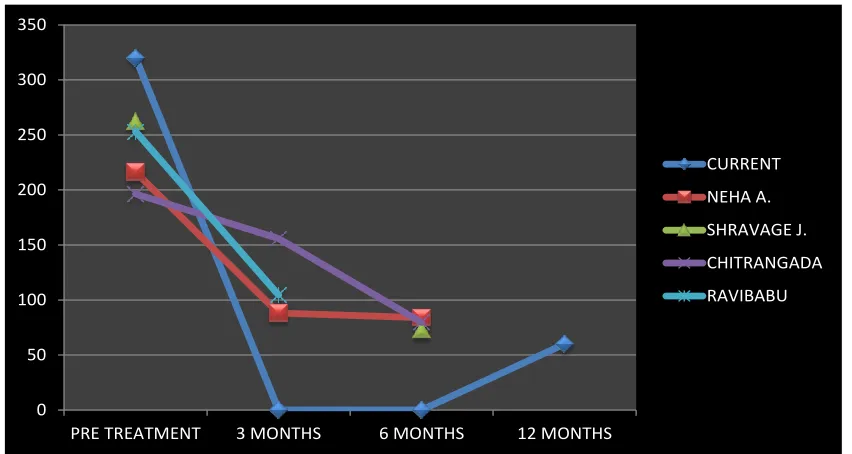
The PBAC score significantly improved from 320 to
60 in 1 year (p=<0.001). All patients on
Ormeloxifene became amenorrheic for 6 months during the treatment period. After which menstrual cycles resumed in 1-3 months of stopping the medication. The patients had a mean PBAC score of 60 (40-120) with an overall reduction of 81.25% in menstrual blood flow. Four patients did not have reduction in their menstrual flow out of which 3 patients underwent Hysterectomy after 3 months of treatment by local gynecologists and one underwent hysterectomy after 6 months of treatment.
Similar to our study, Neha A showed a 61.1%
reduction in menstrual blood loss with
ormeloxifene(9). Shravage found an 85.7% reduction
in menstrual blood loss with ormeloxifene(12).
Bhattacharjee showed a significant reduction in mean
PBAC score with Ormeloxifene (108.7 to 62.48)(10) .Chitrangada found an 59.50% reduction in menstrual
blood loss with Ormeloxifene(13) . Dadhich and
Biswas also found a significant reduction in median PBAC score, number of days of menstruation and number of sanitary napkins used after 6 months of Ormeloxifene therapy(8) (Table VI, Figure II).
In the present study, there was no significant improvement in Hemoglobin change with treatment
(p=0.057). At baseline the mean Hemoglobin was 10.10 1.63 which improved to 10.331.13 at the end of 3 months (p value =0.087) and 10.360.72 at the end of 6 months (p value of 0.162). After 12 months
of therapy Hemoglobin level was 10.540.67 (p
value= 0.057). Agarwal Nfound that the mean hemoglobin concentration significantly increased from 7.52gm% to 9.2gm% at 3 months and further increased to 10.4gm% at 6 months with ormeloxifene (p<0.01) (9). Bhattacharjee found a significant
increase in hemoglobin concentration with
Ormeloxifene(10).
Dhananjay found a statistically significant increase in hemoglobin concentration (8.26 to 10.59g/dl; p<0.001) after 3 months of treatment with ormeloxifene(11) . Amenorrhea / hypomenorrhea is a common symptom seen with ormeloxifene in different studies with a wide range of 8% to 63%(11) .
The Endometrial thickness was 8 mm (6-10) at baseline. Initially with treatment for six months the endometrial thickness decreased to 5.60 mm
(4.20-7.25) (p=<0.001). However after six months of
stopping treatment it increased to 5.60 mm (4.20-6.90) (p=<0.001). Bhattacharjee found a significant reduction in endometrial thickness(10) . Dhananjay found a statistically significant decrease in the endometrial thickness (8.36 to 4.89mm; p<0.001) after 3 months of treatment with ormeloxifene(11)
.Jyotsna did not find a statistically significant
decrease in endometrial thickness (p = 0.09) maybe due to shorter course of treatment compared to our study(12). Neha found a statisfically significant decrease in ET from 12.12 to 8.4 (p<0.05) in 6 months(9). Chitangada found a significant decrease in 3 months(13) and so did Ravibabu (p<0.001).
(Table VII, FIGURE III).
www.pharmascholars.com
939
ormeloxifene. They found no improvement in 10% cases on ormeloxifene(10) . Agarwal N found eighty-eight percent of cases showed marked subjective
improvement with ormeloxifene(9).. There was no
improvement in 6% cases with ormeloxifene.
CONCLUSION
Ormeloxifene was found to be an excellent drug in controlling dysfunctional uterine bleeding without effecting normal endocrinal and physiological parameters. It leads to a significant reduction in menstrual blood loss and a significant decrease in endometrial thickness without any major side effect.
It has a convenient dose schedule of once or twice a week and is cost effective. It can be used in any age group and is oncologically protective to the breast and endometrium. It is well tolerated and a safe alternative for medical management of DUB .
We conclude that Ormeloxifene is suitable for the treatment of DUB, in all age groups with effective therapeutic efficacy and with least side effects, study also shows that the compliance of the patient is good because of convenient dosage schedule and no need for medicine intake every day. Further studies with large sample size is needed to throw light regarding the efficacy and safety of the agent.
Table I DEMOGRAPHIC PROFILE OF THE PATIENTS
Mean age group 36.00±9.521 (12 – 52)
LITERACY Literate 64.3%
Illiterate 35.7%
MARITAL STATUS Unmarried 10 (16.94%)
Married 49 (83.07%)
PARITY Nulliparous 10 (16.94%)
1- 3 35 (59.32%)
grand multiparous 14 (23.72%)
LIGATION Frequency Percentage
LIGATED 25 42.4 %
NON LIGATED 34 57.6 %
Mean BMI 24.2451±3.91 (16 – 34)
Mean duration of symptoms 19.14±17.27 months (1 month to 5 years)
Irregular menstrual pattern 81.4% (48/59 patients)
Table II HPE OF ENDOMETRIAL BIOPSY
FREQUENCY PERCENTAGE
NOT DONE 17 28.8
PROLIFERATIVE 35 59.3
EARLY SECRETORY 4 6.7
LATE SECRETORY 3 5.08
SIMPLE HYPERPLASIA 0 0
Total 59 100
NOT DONE – Unmarried patients + Patients who did not give consent
Table III MENSTRUAL CYCLE PATTERN
BASELINE 3 MONTHS 6 MONTHS 12 MONTHS
No. % No. % No. % No. %
REGULAR 11 18.6 AM AM AM AM 47 88.7
IRREGULAR 48 81.4 AM AM AM AM 6 11.3
www.pharmascholars.com
940
Figure I MENSTRUAL CYCLE PATTERNTable IV MAIN OUTCOME PARAMETERS MEASUREMENTS
Variable Baseline 3 month 6 month 12 month
Baseline vs 3 month
Baseline vs 6 month
Baseline vs 12 month Hemoglobin 10.101.63 10.331.13 10.360.72 10.540.67 0.087 0.162 0.057 PBAC 320 (280-400) 0 (0-80) 0 (0-40) 60.00 (60-80) <0.001 <0.001 <0.001
ET 8 (6-10) 6 (5-8) 5.60 (4.20-7.25) 5.60 (4.20-6.90) <0.001 <0.001 <0.001
Table V SATISFACTION WITH TREATMENT
ORMELOXIFENE 3 months 6 months 12 months
No. % No. % No. %
EXCELLENT 40 67.8 53 89.83 45 83.33
VERY GOOD 15 25.4 1 1.69 8 14.81
GOOD 0 0 0 0 0 0
DISSATISFIED 4 6.8 4 8.47 1 1.85
Total 59 100 54 (+5) 100 53(+1) 100
( x )- Patients who underwent Hysterectomy or were lost to follow up after dissatisfaction with treatment
Table VI COMPARISON OF DIFFERENT STUDIES WITH ORMELOXIFENE ( PBAC SCORE)
STUDY PRE
TREATMENT
AFTER 3
MONTHS
AFTER 6
MONTHS
AFTER 12
MONTHS
REDUCTION
Current study
( n = 59) 320
(280-400)
0 (0-80)
0 (0-40)
60.00 (60-80)
81.25% (p<0.001)
Neha A. ( n = 50)
216 88 84 -- 61.1%
(p<0.001) Shravage J
( n = 42)
262.2 (160-380)
-- 73 -- 85.7% (p<0.001)
Chitrangada ( n = 50)
196.46 155.76 79.57 -- 59.50%
(p<0.001) Ravibabu
( n= 50)
253 (120- 526)
104.5 ( 0 – 380)
-- -- p<0.001
www.pharmascholars.com
941
0 50 100 150 200 250 300 350
PRE TREATMENT 3 MONTHS 6 MONTHS 12 MONTHS
CURRENT
NEHA A.
SHRAVAGE J.
CHITRANGADA
RAVIBABU
Figure II COMPARISON OF DIFFERENT STUDIES WITH ORMELOXIFENE (PBAC SCORE)
Table VII COMPARISON OF DIFFERENT STUDIES WITH ORMELOXIFENE ( ENDOMETRIAL THICKNESS)
STUDY PRE TREATMENT AFTER 3
MONTHS
AFTER-6 MONTHS
AFTER-12 MONTHS
REDUCTION
Current study ( n = 59) 8 (6-10) 6 (5-8) 5.60 (4.20-7.25) 5.60 (4.20-6.90) p<0.001
Neha A. ( n = 50) 12.12 9.46 8.4 --
p< 0.05
Shravage J ( n = 42) 7.81 -- 4.94 --
p=0.09
Chitrangada ( n = 50) 5.49 4.49 -- --
p<0.001
Ravibabu ( n= 50) 11.674(8 - 15.3) 9.3 (6.5 – 12) -- -- p<0.001 (t=19.6)
4 5 6 7 8 9 10 11 12 13 14
PRE TREATMENT 3 MONTHS 6 MONTHS 12 MONTHS
CURRENT
NEHA A.
SHRAVAGE J.
CHITRANGADA
RAVIBABU
www.pharmascholars.com
942
REFERENCES1. Chimbira TH, Anderson ABM & Turnbull AC. Relation between measured blood loss and patients
subjective assessment of loss, duration of bleeding, number of sanitary towels used, uterine weight and endometrial surface area. British Journal of Obstetrics and Gynaecology 1980;87(7):603-609.
2. Jakimiukm.AJ, Grzybowski W, Beta J. Dysfunctional uterine bleeding: diagnostics and treatment]. Ginekol
Pol 2008; 79:254-8.
3. Shelly W, Draper MW, Krishnan V, Wong M, Jaffe RB. Selective estrogen receptor modulators: an update
on recent clinical findings. Obstet Gynecol Surv 2008;63:163-81.
4. Singh MM. Centchroman, a selective estrogen receptor Modulator, as a contraceptive and for the
management of hormone-related clinical disorders. Med Res Rev 2001;21:302-47.
5. Osborne CK, Zhao H, Fuqua SA. Selective estrogen receptor modulators: structure, function, and clinical
use. J Clin Oncol 2000;18:3172-86.
6. Makker Annu, Tandon Indu, Goel Madhu Mati, Singh Mastan, Singh Man Mohan. Effect of
ormeloxifene, a selective estrogen receptor modulator, on biomarkers of endometrial receptivity and pinopode development and its relation to fertility and infertility in Indian subjects. Fertility and Sterility, 2009; 91 (6): 2298–307
7. Higham JM, O’Brien PM & Shaw RM. Assessment of menstrual blood loss using a pictorial chart. British
Journal of Obstetrics and Gynaecology 1990;97(8):734-9.
8. Biswas SC, Saha SK, Bag TS et al. Ormeloxifene a selective estrogen receptor modulator, for treatment of
dysfunctional uterine menorrhagia. J Obstet Gynaecol Ind. 2004;54(1):56-59.
9. Agarwal N ,Kriplani A, kulshresha V. The efficacy and safety of Ormeloxifene in the management of Menorrhagia: a pilot study. J Obstet Gynecol. 2009; 35(4): 746-52.
10. Bhattacharyya Tapan Kumar, Banerji Anusyua. Efficacy of a Selective Estrogen Receptor Modulator:
‘Ormeloxifene’ in Management of Dysfunctional Uterine Bleeding. South Asian Federation of Obstetrics and Gynecology, September-December 2010;2(3):207-211.
11. Dhananjay BS, Sunil Kumar Nanda .The Role of Sevista in the Management of Dysfunctional Uterine
Bleeding . J Clin Diagn Res. 2013 Jan; 7(1): 132–134.
12. Shravage Jyotsna, Mekhala D., Bellad MB., Ganachari MS., Dhumale HA. Ormeloxifene versus
Medroxyprogesterone Acetate (MPA) in the Treatment of Dysfunctional Uterine Bleeding: A Double-Blind Randomized Controlled Trial. South Asian Federation of Obstetrics and Gynecology, January-April 2011;3(1):21-24.
13. Chitrangada , Singh Kumar Satyajeet, Subrata Nag. A double blinded randomized controlled trial to