Developing Countries: The Case of
Jordan
Modar Abdullatif
ABSTRACT
Manuscript type: Research paper
Research aims: This study explores the main issues faced by external auditors in Jordan when auditing fair value estimates, and examines the reasons causing these issues, and their effects on the conduct of auditing.
Design/Methodology/ Approach: This study employs a qualitative approach, using semi-structured interviews with a sample comprising of experienced Jordanian auditors from the Big Four audit firms, other internationally-affiliated audit firms, and local Jordanian audit firms.
Research findings: The findings of this study show that fair value estimates have been aggressively used by some companies to overvalue their assets, especially in the areas of asset impairment and business combinations. Factors facilitating this include the lack of reliable fair value information and the weak corporate governance system. Auditors face extensive pressure from clients to accept questionable fair value estimates in an environment of low demand for high-quality audits, low audit fees, and the fear of losing clients. Auditors are also under the pressure of regulatory authorities to improve the quality of their work.
Theoretical contributions/ Originality: Theauditing of fair value estimates is an empirically under-researched area in developing countries. The introduction of International Financial Reporting
Standard (IFRS) 13 (Fair Value Measurement) places the demand that an estimate of fair value has to be reported when needed, regardless of the level of available information or market activity. Conducting a study in a developing country with an environment that is characterised by inactive markets, limited available information on fair values, and low demand for high-quality audits, can further contribute to knowledge on how fair value estimates are audited under different circumstances to those of developed countries.
Practitioner/ Policy implications: Thefindings of this study show that there is a need for regulatory authorities to put in more efforts to scrutinise the behaviour of auditors and audit clients when dealing with fair value estimates. The regulatory authorities also need to improve the conditions auditors face when auditing these estimates. Such improvements could include increasing the monitoring of fair value specialist evaluators, revising audit fee levels, and revising corporate governance regulations.
Research limitations/ Implications: This study focuses on the Jordanian environment. By expanding the research to other developing countries, and by focusing in detail on some of the issues studied in developed countries (such as how auditors assess management’s assumptions regarding fair value estimates, and how they develop their own independent estimates), a better understanding of these issues in the developing country contexts can be gained, benefitting the audit profession and contributing to literature at the same time.
Keywords: Auditing, Developing Countries, Fair Value Estimates, Jordan.
JEL Classification: M42
1. Introduction
The global financial crisis in the last decade has had some negative
economic consequences on the whole world. These consequences include a sharp decline in the activities of the world’s major economies
due to uncertainty and loss of confidence, credit tightening, fall in production and exports, and a pullback in the housing and financial sectors (Edey, 2009). The economic consequences of the global financial
crisis on the world’s major economies had also negatively impacted on the economies of other countries, as well as on the audit profession.
(Hopwood, 2009). The role, value, and independence of external auditing
were questioned, given the fact that many of the distressed financial institutions had received unqualified audit opinions (Sikka, 2009). The
conduct of the external audit was discussed due to the consequences
of the global financial crisis (see the Auditing Practices Board (APB), 2008; the Association of Chartered Certified Accountants (ACCA), 2011). As an impact of the global financial crisis, the issue of auditing
fair value estimates was widely reported as an issue of current concern for the audit profession (see the International Auditing and Assurance Standards Board (IAASB), 2008; Woods, Humphrey, Dowd, & Liu, 2009; Christensen, Glover, & Wood, 2012; Smith-Lacroix, Durocher, & Gendron, 2012; Bratten, Gaynor, McDaniel, Montague, & Sierra, 2013; Dixon & Frolova, 2013). While the concerns of auditing fair value accounting were found to be important in developed countries, their impact is likely to be relatively higher in developing countries, due to several factors such as the lack of information, the inactivity of markets, and the weak corporate governance systems. The fact that fair values
are, in general, highly subjective figures is likely to increase concerns
in terms of how they are reported and audited in developing countries. In auditing fair value estimates, auditors need to consider several issues which include the assumptions made by management to develop the estimates and the reasonableness of the estimates (Dixon & Frolova, 2013), the effectiveness of internal controls regarding the fair value estimates (Martin, Rich, & Wilks, 2006), the calculation of a material misstatement regarding the estimates (Christensen et al., 2012), and the level of assurance provided by the audit report in the presence of
fair value estimates (Bell & Griffin, 2012; Smieliauskas, 2012). These
issues become more critical when the fair value estimates are based on unobservable inputs that had been entered into estimation models which were developed by the audit client (Singh & Doliya, 2015).
The auditing of fair value estimates is an under-researched area, even in developed countries. Most of the available literature focusing on this topic has been from the USA and yet, the USA-based authors have themselves noted its paucity (Martin et al., 2006; Bratten et al. 2013). One of the main topics researched was the effect of accounting
fraud committed by Enron on auditors. Other findings of studies on
the auditing of fair value estimates in the USA include the usefulness
of a more critical analysis of fair value estimate information (Griffith,
(Fitzgerald, Wolfe, & Smith, 2015; Griffith, Hammersley, & Kadous,
2015a), unless the risk associated with the estimates is very high (Glover, Taylor, & Wu, 2016). Further to that, it is found that audit fees are more likely to increase in the presence of more complex fair value estimates (Mohrmann, Riepe, & Stefani, 2013; Ettredge, Xu, & Yi, 2014; Goncharov, Riedl, & Sellhorn, 2014). Thus far, empirical research focusing on the auditing of fair value estimates in developing countries is very rare.
An example is the study of Kumarasiri and Fisher (2011), which finds
that auditors in Sri Lanka perceive that using fair value accounting in
financial reporting is difficult due to inactive markets and the lack of
technical knowledge.
Given the very small number of studies emphasising on the auditing of fair value estimates, especially in developing countries, this study thus attempts to make contribution to this area by exploring in detail, through the use of an interview survey, the auditing of fair value estimates in the context of Jordan as a developing country. Jordan is characterised by attributes such as a small market made up of mainly family businesses with limited managerial accountability, a low demand for high-quality audits, and low audit fees. While the International Standards on Auditing (ISA) and the International Financial Reporting Standards (IFRS) are formally adopted in Jordan, full compliance with them is questionable, especially that there are relatively little negative economic consequences of the lack of full compliance (Abdullatif &
Al-Khadash, 2010). Jordan also suffers from the lack of sufficient fair
value information, with sources characterised by limited activity and
efficiency. In addition, reported information on fair value in Jordan is,
according to a survey on bankers, seen as low in reliability and prone
to financial statement fraud, while its related standards are perceived as
being ambiguous (Siam & Abdullatif, 2011). These characteristics make Jordan an example of a group of developing countries that is vastly different from developed countries where accounting and auditing standards dealing with fair value estimates are developed. Therefore, Jordan serves as an interesting setting to observe how these standards are applied.
This study was conducted about two years after IFRS 13 (Fair Value Measurement) came into effect. If the value of an item is required to be reported using fair value and yet readily available information does not exist in the market, IFRS 13 would require companies to report on
researchers, practitioners, and policy makers who are involved in issues related to auditing and accounting for fair value estimates.
The remainder of this paper is as follows. The next section reviews the literature on the audit of fair value estimates, and is followed by a review of the context of auditing in Jordan. This is followed by a
discussion of the research design, a presentation of findings, and a discussion of findings. The final section concludes with implications of the findings and recommendations for future studies.
2. Literature Review
2.1 Auditing Fair Value Estimates
Fair value is used in several areas of financial reporting. IFRS require
the use of fair value to record securities held for trading and biological assets, and to record assets at lower values if they are impaired. Fair value is also required by IFRS to initially record the assets and liabilities of an acquiree and the resulting goodwill in a business combination. IFRS also provide for the optional use of fair value to revalue investment property, intangible assets, and property, plant and equipment (Cotter, 2012).
IFRS 13 (Fair Value Measurement) (IASB, 2013) defines fair value
as “the price that would be received to sell an asset or paid to transfer a liability in an orderly transaction between market participants at the measurement date” (Deloitte IAS Plus, 2014). According to IFRS 13, the
measurement of fair value follows a hierarchy where the first priority
(Level 1) is to use unadjusted quoted prices for identical assets or liabilities in active markets. The second priority (Level 2) is to use inputs (other than quoted prices) that are observable, directly or indirectly, for the item (asset or liability), and the third priority (Level 3) is to use inputs that are unobservable for the item. Clearly, the second priority level would normally require adjustments, while the third priority level would normally require the use of valuation techniques. In this context,
IFRS 13 defines an active market as “a market in which transactions for the asset or liability take place with sufficient frequency and volume to
provide pricing information on an ongoing basis” (Deloitte IAS Plus, 2014).
value of an un-owned asset (replacement cost) (Whittington, 2015). Fair value is less complicated than other measurement bases that use present values or price indices. It is also a value that is determined by the market, rather than by the reporting entity itself (Majercakova & Skoda, 2015).
Nevertheless, the use of fair value in financial reporting is a debatable issue. Some argue for its relevance (given its reflection of market price),
its comparability (given that items are measured at the same time), and its faithful representation if an objective measurement can be achieved (Rankin, Stanton, McGowan, Ferlauto, & Tilling, 2012). Others who disagree with the use of fair value mention that it causes volatility and potential misleading reported income through recognising unrealised holding gains and losses (Rankin et al., 2012), and the subjectivity of estimation and possible moral hazard for managers (Ronen, 2008). It is argued that for fair value to be useful for transparency and comparability purposes, correct values for assets should be reported, but in practice, this is not the case (Lhaopadchan, 2010).
Auditors are required by the International Standard on Auditing (ISA) 540 (Auditing Accounting Estimates, Including Fair Value Accounting Estimates, and Related Disclosures) (IAASB, 2009) to
obtain sufficient appropriate evidence about the reasonableness of fair
value accounting estimates. According to Dixon and Frolova (2013), the audit process used for fair value estimates under ISA 540 begins with determining whether the fair value estimation is permitted or required, and then understanding how the client’s management calculated the
estimate. This process is then followed by responding to identified
sources of estimation uncertainty that can lead to the risk of material misstatements. After this, auditors have to evaluate the reasonableness of fair value accounting estimates and assess their related disclosures, and obtain written representations from the client’s management on
whether they believe that significant assumptions used in making the
estimates are reasonable (Dixon & Frolova, 2013). Generally, auditors are unlikely to face very serious issues with auditing Level 1 fair values, but problems escalate as the reported fair values move down the hierarchy levels. Level 3 valuations face the risks of errors or intentional managerial bias in the selection of an appropriate model and in the assumptions and other inputs used to estimate the fair values (Singh & Doliya, 2015).
others, the availability and reliability of evidence, the breadth of assets and liabilities that can or must be measured by fair value, and the sophistication of valuation techniques used. Woods et al. (2009) argue that auditors are facing increased risk and pressure under the fair value requirement, especially when valuation models are used by clients to
measure complex financial instruments. Smith-Lacroix et al. (2012) mention that auditors not only have to evaluate the methods used for fair value accounting, but also evaluate the expertise of the valuators who provide the information.
The audit report includes phrases which imply that it reports on
the fairness of the financial statements, and that reasonable assurance has been achieved through collecting and testing sufficient appropriate evidence. Bell and Griffin (2012) question the appropriateness of such assertions in the case of fair value estimates, arguing that it is difficult
for the auditor to provide positive assurance in the audit report (that
the financial statements present the estimate fairly in accordance with the required financial reporting framework). They suggest limiting the
responsibility of the auditor in the audit report on fair value estimates to that of providing negative assurance only (that nothing was found that suggests that the fair value provided by the client is not reasonable)
(Bell & Griffin, 2012). Smieliauskas (2012) notes that in the case of very
highly risky accounting estimates, even negative assurance cannot be provided by the auditor.
This issue with reasonable assurance comes from the fact that
auditing fair value estimates is a difficult task. The reliability of fair
value estimates is a matter of judgment, where auditors assess the reasonableness of assumptions these estimates are based on, rather than assessing the truth of facts (Dennis, 2015). Instead of dealing with facts about events that happened in the past, auditors are dealing with assumptions regarding subjective forecasts of events which are expected
to happen in the future (Griffith et al., 2015a). Auditors also have to
consider the effectiveness of the internal control system under which the fair value estimates are developed, since internal control systems are restricted by the pace of changes in fair value estimation procedures (Martin et al., 2006). Therefore, it appears that audit procedures which are aimed at verifying the amounts reported at historical cost may in many cases be inappropriate for the assessment of amounts based on accounting estimates, such as fair values. Nevertheless, fair values are
creates an unrealistic expectation that the assurance an auditor provides
on both figures is similar (Christensen et al., 2012). Christensen et al. (2012) report that the Big Four audit firms consider reasonable assurance
to mean assurance levels of as high as 90 to 95 per cent that audit procedures applied would detect material misstatements or material control weaknesses. However, they argue that, in the case of highly
uncertain accounting estimates (such as some fair value figures), such
assurance levels are not applicable.
ISA 540 mentions that to understand and assess assumptions related to reported fair value estimates, auditors may consider the nature, relevance, and internal consistency of the assumptions, and whether they are based on observable inputs (based on independent market data) and a commonly-used estimation method, or unobservable inputs (based on the entity’s own judgements) and a client’s internally-developed estimation model (IAASB, 2009). Bratten et al. (2013), however, contend that when markets for items reported at fair values are illiquid or nonexistent, even well-intentioned experts can disagree on the reported estimate or the method used to develop it. When assessing valuation models used for reporting fair values, auditors face even more risk if the capital market and other macroeconomic conditions are volatile (Bratten et al., 2013). Expanding on this, Humphrey and Woods
(2011) argue that significant definitions of fair value and significant
guidance on valuation methods and disclosures were drafted at a time when markets were stable. Thus, valuation models, when used in the
time of financial crisis, can be highly sensitive to the assumptions they are based on, and therefore lead to significantly different figures being
reported. Such models would require extensive efforts and professional judgement from auditors to verify the accuracy of the client’s processes for determining fair value estimates (Humphrey & Woods, 2011).
While fair value estimates are reported in the financial statements as point estimates, auditors may find that their evidence could lead to
a range of possible estimates, rather than a point estimate. This range may widen when more unobservable inputs are used in the fair value measurement (PCAOB, 2014). In this case, ISA 540 has stated that the
range has to be sufficiently narrowed so as to include only reasonable
material changes in account values. This problem is likely to occur more often at Level 3 fair value estimates which use unobservable inputs.
Finally, the auditor has to make a decision on whether to evaluate the assumptions over which the management’s fair value estimates
were made, or to develop the audit firm’s own fair value estimates
and compare them to those of the client. In case of the latter, the audit
firm has to decide on developing its own estimate internally or relying
on the work of independent specialists or pricing services (PCAOB, 2014). ISA 540 allows, rather than requires, the development of an audit
firm’s own estimate (IAASB, 2009), and it appears that audit firms tend
to rely on testing the client management’s assumptions, rather than on the more costly development of an independent estimate, thereby
leaving the latter as a last resort (Griffith et al, 2015a). Despite this,
producing independent fair value estimates is useful because if they
do not differ significantly from those of management, this provides
additional assurance on the appropriateness of the latter. However, if
they significantly differ, the audit firm would increase its scepticism
(Martin et al., 2006).
2.2 Empirical Evidence
While there are many empirical studies looking at fair value estimates
from a financial reporting perspective (such as their effects on profits or
security prices), detailed empirical studies emphasising on the auditing of fair values and problems auditors face when dealing with them in practice are relatively rare, even in developed countries. One of the main topics investigated in previous studies is the accounting practices of Enron regarding fair value estimates. Benston and Hartgraves (2002) highlight that Enron’s auditors appear to have easily accepted Enron’s valuations without due scepticism. Benston (2006) argues that Enron had extensively used Level 3 fair value estimation (based on internally-generated estimates, rather than market prices of same or
similar assets), thereby causing misstatements in reported figures. In
another study, Gwilliam and Jackson (2008) argue that Enron had used unreliable valuation estimates from independent third parties, and it was willing to recognise gains, but not losses, resulting from mark-to-market accounting.
Empirical studies which look at the audit of fair values include
the study of Griffith et al. (2015b). Griffith et al. (2015b) find that
they change their mindset when dealing with fair value estimates and become more deliberative by incorporating information from
a number of sources and analysing it critically. Griffin (2014) finds
that auditors are more likely to tolerate potential misstatements in
recognising fair values in the financial statements when clients provide
additional disclosures about these values. Therefore, he argues that encouraging fair value disclosures may have a negative effect on fair
value recognised figures. Fitzgerald et al. (2015) find that it is better for
auditors to develop their own accounting estimate for an item before
receiving the client’s preferred estimate for it. However, they also find
that while about 90 per cent of their sample of auditors considered the client’s reported accounting estimate unreasonable, about half of them
accepted it. Glover et al. (2016) find that when the fair value estimates
are associated with higher risk, audit partners are more likely to use their own assumptions when auditing it rather than using the client’s assumptions. Finally, in a survey of audit partners, Glover, Taylor, and Wu (2014) reveal that there is a gap between the views of auditors’ performance and regulators’ expectations with regard to the auditing of
fair value measurements, which is caused by “the lack of verifiable and
corroborative evidence, and auditors’ reliance on valuation experts due to their limited knowledge and expertise regarding complex valuation inputs, analyses, and models” (Glover et al., 2014, abstract).
In looking at the relation between audit fees and the existence of fair value estimates, Ettredge et al. (2014) report that audit fees increase with the increase of fair value estimation, especially when using Level 3 estimation. Goncharov et al. (2014) report that audit fees increase
with the difficulty of estimating fair values, and with recognising fair values in the body of the financial statements (as opposed to only disclosing them in the notes to the financial statements). Similarly, Mohrmann et al. (2013) find that audit fees increase for banks that use
more Level 3 fair values, and that the market reacts to this fee increase by considering it as an indicator of additional risk rather than as an indicator of a higher-quality audit. Finally, in a study covering 24
European countries, Alexeyeva and Mejia-Likosova (2016) also find a
positive relation between the existence of high-uncertainty fair value assets and audit fees.
lack of guidance on valuation, excessive disorderly transactions made
with related parties, market prices not reflecting true value because of
government intervention, and weak regulatory environment (Pacter, 2007). In an analysis of Slovenia as a small emerging economy, Duhovnik (2007) argues that fair value estimates may suffer from the inactivity of
the market, insufficient disclosure of related party transactions, lack of prices for similar financial instruments (given the small market size), and problems with projecting cash flows and determining an appropriate
discount rate. Alexander, Bonaci, and Mustata (2012) surveyed a sample
of valuators in Romania, and find that almost all of the respondents
mentioned that their knowledge about fair value was, at most, at a medium level. A high percentage of them also said that having to use the client’s assumptions about fair value restricted them from making their own valuations. Finally, in one of the rare studies featuring auditing fair value estimates in a developing country in Asia, Kumarasiri and Fisher (2011) report that auditors in Sri Lanka perceived factors such as inactive markets, complexity and variation in techniques employed in ascertaining fair values, and the lack of technical knowledge as issues
affecting fair value implementation in financial reporting. These auditors
said that there is need to provide adequate training and technical guidance to reduce the above concerns.
Given the very small number of empirical studies covering the auditing of fair value estimates worldwide, especially in developing countries, this study will attempt to contribute to the body of knowledge by studying this issue in a developing country, Jordan, that is
characterised by its lack of sufficient information related to fair values,
the inactivity of its markets, its family-business model of governing audit clients, and its low demand for external audits of high quality. These characteristics are discussed in the following section.
3. The Jordanian External Auditing Environment
The Jordanian economy is a relatively small market with 236 companies publicly listed on the Amman Stock Exchange (ASE) as of 23 June 2015.
These are classified according to their financial strength from first
The number of audit firms operating in Jordan is about 300,
of which the majority are very small firms, but there are also many international audit firms (Abdullatif, 2013). The Big Four audit firms operate in Jordan, and there are several other international audit firms and international alliances of audit firms represented in Jordan. Some Jordanian audit firms are full members in the international audit firms with which they are affiliated. Other firms may only act as a member of an international alliance or a representative office of an international firm. In the latter case, the audit firm has more discretion in designing its
own audit programmes and implementing them, while full membership means there is detailed guidance to follow (Abdullatif & Al-Khadash, 2010). Auditors in Jordan have a private-sector association, the Jordanian
Association of Certified Public Accountants (JACPA), which includes
in its membership licensed Jordanian accountants and auditors. Public sector regulatory authorities that have roles in monitoring and/or regulating the external audit profession in Jordan include the Jordan Securities Commission (JSC), the Companies Control Department (CCD), and the Jordan Anti-Corruption Commission (JACC).
In 1998, the JSC issued a regulation1 that requires all public listed companies in Jordan to use IFRS in preparing their financial statements,
which have to be audited under ISA (JSC, 1998). IFRS include a relatively large use of fair value reporting, and ISA require auditors to audit fair value estimates of clients. These requirements place auditors in Jordan in need of much information regarding fair value estimates that is not readily available. The only quoted market prices available in Jordan are those of shares of public listed companies. However, the value of
these quoted prices is limited by the inefficiency of the ASE (Al-Shiab
& Al-Alawneh, 2007; Ananzeh, 2014) and its inactivity, since shares of many listed companies are not trading frequently enough. Apart from the ASE price quotes, there is no active market in Jordan for any other items which IFRS require or permit the use of fair value in reporting for. The nature of audit clients and their corporate governance systems also affects the ability of Jordanian auditors to effectively audit and report on clients who report fair value estimates. Most audit clients in Jordan are closely-held, as the family-business model is popular, even in banks and other publicly listed large companies. This scenario is likely to affect the majority of audit clients in Jordan in having limited separation of ownership and management, with management having
the power to override the weak internal controls and other governance mechanisms (Hanini & Abdullatif, 2013). Moreover, the effectiveness of audit committees as a corporate governance mechanism in Jordanian public listed companies is limited, due to similar reasons (Abdullatif, Ghanayem, Ahmad-Amin, Al-shelleh, & Sharaiha, 2015). Family-business models may lead owner-managers to abuse their power under limited transparency in order to serve personal interests at the expense of non-controlling shareholders (Solomon, 2010). The factor of family
control in companies, coupled with insufficient legislation, is likely
to restrict the effectiveness of any corporate governance mechanisms (Alleyne, Weekes-Marshall, & Broome, 2014). Indeed, auditing
family-owned firms is considered to be relatively more risky than auditing other firms because of inferior internal control systems and more frequent
related party transactions (Lei & Lam, 2013).
Such a situation is likely to cause a low demand for high-quality external audits, given the low level of agency costs involved between owners and managers (Abdullatif & Al-Khadash, 2010; Niskanen, Karjalainen, & Niskanen, 2011). This phenomenon is exacerbated by high agency costs between controlling and non-controlling shareholders in closely-held companies being likely to have a relatively small effect in leading to protection of non-controlling shareholders, due to their weakness (He, 2010). This situation has caused audit fees in Jordan to
be significantly low,2 since demand for high-quality audits is low as a result of the closely-held form of business (Hay, Knechel, & Wong, 2006;
Ho & Kang, 2013; Ben Ali & Lesage, 2014), fierce competition among auditors for audit clients, ability of audit clients to switch audit firms
without serious consequences, and low level litigation and penalties against auditors who violate laws (Abdullatif & Al-Khadash, 2010). Under this audit environment, auditors in Jordan are arguably in a weak position when reporting on relatively objective items, let alone subjective ones like fair value estimates.
The use of fair value estimates in Jordan in the last decade has caused sharp changes in share prices and in the income of companies dealing with investment portfolios. During the bubble years (around 2005) banks made large income caused mainly by the fair valuation of shares, rather than by real economic performance, thereby leading to
a huge number of naive investors entering the market and later losing heavily when share prices decreased sharply (Al-Khadash & Abdullatif, 2009). The Jordanian government, through the JSC, responded to the sharp volatility of share prices that resulted from applying fair value accounting by enacting a regulation in 20083 that allowed trading securities to be valued at fair value and included in income statements,
but disallowed any optional reporting of fair value in the financial
statements (JSC, 2008). According to this regulation, the cost alternative had to be generally used for valuing investment property and property, plant and equipment (with fair values of investment property disclosed
in notes to the financial statements). In addition, companies were
disallowed from distributing unrealised gains from trading securities as dividends (JSC, 2008).
In 2011, this regulation was replaced by a new one4 that retains much of the previous requirements, but which includes a requirement which provides that unrealised holding gains from trading securities and biological assets must be disclosed as a separate component of retained earnings (JSC, 2011). While the Jordanian regulatory authorities
are able to significantly limit the use of optional fair value accounting,
any attempt to limit the use of mandatory fair value accounting (such as accounting for trading securities, impairment losses, and business combinations) will violate IFRS. Therefore, the regulatory authorities have limited discretion to restrict the practices of auditors and audit clients with regard to fair value estimates.
The years of economic boom that preceded the global financial
crisis witnessed the establishment of a relatively large number of new companies in Jordan, especially in the sectors of investment and real estate. In addition to this, some other businesses started to shift from
their formal business lines to investing significant sums in shares and
real estate5. Despite the JSC’s (2008) regulation, the lack of sufficient guidance on the application of fair value accounting, coupled by the lack of sources of information for estimating fair values, had led to the likelihood of large abuse and fair value accounting fraud (such as in performing impairment tests or in accounting for business combinations). Khan, Badrul Muttakin, and Siddiqui (2015) mention
3 Instructions on the Mandatory Policies and Standards for Re-Evaluation of Fair Value and for Disposal of Re-Evaluation Surplus.
that due to the weak governance and internal controls, low demand for
quality external audits, and low audit fees, many family firms tend to fail quickly. Indeed, during the global financial crisis, a large number
of companies in Jordan failed, and the prices of assets decreased in a manner that had caused huge sums of impairment losses to be reported (see Matar & Nauimat, 20146).7
With this happening, the audit profession came under additional scrutiny, and a new regulation (JSC, 2014)8 that requires audit firms of public listed companies to be registered with the JSC, with each firm
employing at least two auditors holding the Jordanian licence, was
enacted. The regulation also requires audit firms to rotate the head of
the audit team for each public listed company at least once in every four years, to separate their audit staff from their consulting staff for each client, and to report to the JSC any violations of law or matters which
negatively affect the company’s financial position. It also prohibits a
licensed auditor who is registered with the JSC to audit public listed companies if he/she has a relative on the company’s board of directors or its executive management, or if that relative owns a large percentage of shares in the company. The regulation also includes penalties of temporary or permanent prevention from auditing public listed companies for auditors who violate the laws (JSC, 2014). While such procedures may relatively succeed in restricting the number of auditors
and audit firms who are allowed to audit public listed companies
and enhance their quality, the effect of these procedures is limited to increasing supervision on auditors. Other matters that negatively affect the quality of auditing in Jordan, which encompass the issues of low demand for high-quality audits, weakness of auditors when confronting
clients on financial reporting disputes, and low audit fees, nonetheless,
still need to be addressed.
6 In their study of a sample of Jordanian companies which faced financial difficulties during
the financial crisis, Matar and Nauimat (2014) find that the reported profits/losses of these firms for 2010, compared to their results for 2007, were a change of -601 per cent (i.e. profits changing into significantly higher losses).
7 According to the ASE (2015), as of 23 June 2015, about 70 per cent of the companies publicly
listed on the ASE were listed on the second or third markets, rather than on the first market, with the “real estate” and the “diversified financial services” sectors having the highest percentages of companies in the second or third markets.
8 Instructions on Standards and Conditions to be Met by Auditors Qualified to Audit Parties
4. Methodology
The research approach used for this study is an exploratory qualitative approach, based on the use of semi-structured interviews. This method is considered suitable given that exact issues to ask in detail are not
known due to the lack of sufficient information on Jordan (Qasem &
Abdullatif, 2014). Semi-structured interviews allow the interviewer some control on the interview, but yet give the interviewee the ability to present his/her views and discuss them in more detail (Eriksson & Kovalainen, 2008).
The research population for this study was defined as Jordanian
auditors of high ranks (audit partner, audit manager, or equivalent titles) who have a minimum of 15 years of experience in auditing public listed companies, as these companies are more likely to use IFRS
in financial reporting and be involved in using fair value estimates
than small companies. The selection criteria for the study sample was
based on the above. Most of the audit firms in which the interviewees work have international affiliations, and all are among the largest audit firms in Jordan, in terms of numbers of clients and audit staff.
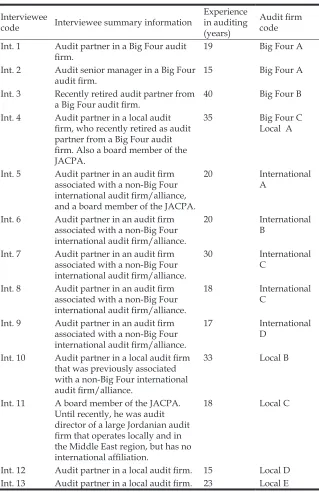
The study sample consists of 13 individuals who were all personally interviewed by the researcher. The interviewees represent three of the
Big Four audit firms, four audit firms which have other international affiliations, and five audit firms which have no international affiliation.
All the interviewees are experienced auditors, and hold titles of audit partner (11), audit director (1), or audit senior manager (1). These ranks
are typically the highest in the audit firms in Jordan. Their years of
experience in external auditing range from 15 to 40, with an average of 23.31 years. This experience is considered very important in order to get reliable information. In addition, three interviewees are JACPA board members. Details of the interviewees are presented in Table 1. The sample size used in the current study may arguably be considered as relatively small, and the initial aim was to interview
more than one individual from each firm. As this was not viable,
convenience sampling was sought, as this approach emphasises on individuals who are available, willing to be interviewed, and have the specialised knowledge needed (Hesse-Biber & Leavy, 2011). No attempt was made to increase the sample size by adding auditors from
small audit firms, as they are likely to lack sufficient knowledge of the research topic. However, the sample size is considered sufficient and
Table 1: Details of the Interviewees
Interviewee
code Interviewee summary information
Experience in auditing (years)
Audit firm code Int. 1 Audit partner in a Big Four audit
firm. 19 Big Four A
Int. 2 Audit senior manager in a Big Four
audit firm. 15 Big Four A
Int. 3 Recently retired audit partner from
a Big Four audit firm. 40 Big Four B
Int. 4 Audit partner in a local audit firm, who recently retired as audit partner from a Big Four audit firm. Also a board member of the JACPA.
35 Big Four C
Local A
Int. 5 Audit partner in an audit firm associated with a non-Big Four international audit firm/alliance, and a board member of the JACPA.
20 International A
Int. 6 Audit partner in an audit firm associated with a non-Big Four international audit firm/alliance.
20 International B
Int. 7 Audit partner in an audit firm associated with a non-Big Four international audit firm/alliance.
30 International C
Int. 8 Audit partner in an audit firm associated with a non-Big Four international audit firm/alliance.
18 International C
Int. 9 Audit partner in an audit firm associated with a non-Big Four international audit firm/alliance.
17 International D
Int. 10 Audit partner in a local audit firm that was previously associated with a non-Big Four international audit firm/alliance.
33 Local B
Int. 11 A board member of the JACPA. Until recently, he was audit director of a large Jordanian audit firm that operates locally and in the Middle East region, but has no international affiliation.
18 Local C
full sample were generally similar). This argument has been endorsed by Saunders, Lewis, and Thornhill (2016), who state that a minimum of 4 to 12 interviews is acceptable for homogenous populations.
The main topics covered by the interviews were the issues faced by auditors in Jordan when auditing fair value estimates, reasons for these issues, and their effects on the conduct of auditing. Appendix 1 lists the main interview questions which encompass these topics.
The interviews were conducted in November and December 2014. As IFRS 13 came into effect since the beginning of 2013 (IASB, 2013), the interviewees would have had about two years of experience dealing with IFRS 13 by the time of the interviews. Each interview lasted between half an hour and two hours, depending on the time allowed by each
interviewee. All the interviews were conducted at the audit firm of the
interviewee, except for one that was conducted at the interviewee’s home. The interviewees were assured that the information they provided would be used only for research purposes, and that anonymity of their
names and particulars of their audit firms would be maintained in the
published research. The interviews were manually recorded through extensive note-taking by the researcher. To enhance the reliability of
the findings, main notes taken during each interview were verified
with the interviewee towards the end of the interview to ensure their
agreement on the content and to allow them to make any modifications
if they wished.
According to Hayes and Mattimoe (2004), the choice between tape-recording or manually tape-recording interviews depends on the context of the research being undertaken. In addition, the choice of trying to persuade the interviewee to accept tape-recording, if they are reluctant, also depends on the context of the study. Hayes and Mattimoe (2004) argue that tape-recoding in such conditions may reduce the rapport between the interviewee and the researcher, and this could reduce the quality of the data collected. Moll, Major, and Hoque (2006) stress that it may be better not to tape-record interviews when the matters discussed
are sensitive or confidential, as this may negatively affect the responses
of the interviewees or lead to their refusal of being interviewed. Given that, the interviews in this study were conducted using manual note-taking only. This decision was based on the relative sensitivity of the
topic (interviewees may talk about clients and even other audit firms
comfortable, consequently leading to some interviews lasting for about two hours.
The interviews were conducted in Arabic, and data were manually transcribed in Arabic shortly after the interviews. Only the results of the analysis were translated into English for publication purposes. This approach was maintained so as to preserve the original words used by the interviewees during the course of the analysis. The content of the transcripts was analysed through a thematic analysis which groups similar words and phrases spoken by the interviewees into categories, thereby themes. These themes are presented in the following section.
5. Research Findings
This section reports on the main findings derived from the interviews.
It is divided into three subsections encompassing the three main issues emphasised by the current study. This section mainly presents the
findings, while the following section discusses these findings, taking
into account the theoretical background of the topic and the Jordanian context.
5.1 Issues Facing Auditors When Auditing Fair Value Estimates
In this study, all the interviewees reported facing extensive problems
when estimating the fair values of several items which affect the financial
statements. These are discussed below.
5.1.1 Difficulty of Assessing Reported Fair Values of Assets
The main problem emphasised by all the interviewees is the difficulty
of assessing fair values of assets that are reported by their clients. The main reason causing this problem is the lack of an active and
sufficiently regulated market for most assets, apart from listed shares,
where the market can be described as regulated but generally inactive
and inefficient. Such inefficiency causes many naive investors to follow
rumours and buy shares at highly overstated prices without studying the market. This is supported by the words of Int. 12, who said:
industry, where their shares started trading at JD 3 to JD 4. These share prices would increase sharply, before declining to about JD 0.1 during the global financial crisis.
As for other assets, all interviewees except Int. 3 said that, in general, companies select their own fair value valuation specialists and their own valuation models and their related assumptions. Auditors face huge obstacles in challenging these valuations and assumptions with a lack of reliable information and active markets. Int. 7 and Int. 8 reported
cases of firms using the fair value options provided by the International
Accounting Standard (IAS) 16 (Property, Plant and Equipment) and IAS 40 (Investment Property)to unjustifiably double their reported figures for property in their financial statements each year9. This occurrence is verified by Int. 7, who argued:
It is rare for a client to use an independent valuator to estimate the fair value of assets. In many cases, clients use a valuator who is somewhat related to them. The common goal is to exaggerate the asset values.
The introduction of IFRS 13 (Fair Value Measurement), which emphasises on the fair value hierarchy instead of the cost alternative, was seen by all the interviewees except Int. 3 and Int. 13 as a reason for enlarging the valuation problem, which is mainly caused by the lack of suitable sources of information that can assist in the estimation of fair values. This is compounded when auditors deal with the forced sale of
properties due to financial difficulties, where IFRS 13 does not consider
forced sales as orderly transactions. According to IFRS 13, forced sales would require adjustments, and yet IFRS 13 does not adequately describe how these adjustments should be made (Rankin et al., 2012). In support of this issue, Int. 5 said:
Before the days of IFRS 9 (Financial Instruments) and IFRS 13 we used to ask companies to report under the cost alternative if reporting on assets in inactive markets or shares that are temporary unlisted or not publicly listed. The emergence of IFRS 13 has put us in trouble in terms of the hierarchy system. How can we use fair value when there is a lack of information and active trading? The foundations for fair value reporting are simply non-existent.
Int. 5 also said:
After the global financial crisis, auditors know that land generally has impairment, but they cannot challenge clients because of the lack of information. What auditors actually see is the forced sale of land for an amount that is significantly less than the fair value because of the lack of liquidity. This is not fair market value.
The same issue of forced sale was mentioned by Int. 1, who said:
During the economic boom too many projects were established. After the global financial crisis, the values of land declined sharply, especially outside Amman where they were highly overvalued.
Based on the interview data, it can be said that auditors in Jordan face many challenges when auditing fair value estimates. They face
difficulties challenging the estimates presented by clients, including
the assumptions and the valuation methods used in calculating these
estimates, due to the lack of sufficient information in a market that is limited in activity and efficiency.
5.1.2 Difficulty of Assessing Impairment Losses
All interviewees except Int. 3 and Int. 12 reported experiencing problems in assessing recorded impairment values. They mentioned that most companies are reluctant to voluntarily report impairment on assets unless required by the auditor. In such cases, the client has its own valuators and makes arbitrary valuations, using arbitrary assumptions. If the auditor challenges the valuation, the client threatens to switch to
another audit firm. This issue is supported by Int. 4, who said:
The effective interest rate is very important for me in valuing goodwill. I once asked a client to use 17 per cent as an effective interest rate and the client wanted only 12 per cent. The client simply left me and went to another auditor who accepted their rate. Int. 4 also commented:
Some auditors (Int. 1, Int. 2, and Int. 9) reported other problems which were caused by valuing impairment losses, and these include the willingness of some clients to produce three or four specialist evaluation reports as a way to convince the auditor about the valuation, especially when the auditor is not convinced or knows that the assets are overvalued, but yet fears losing the client. Simultaneously, some clients were reported by some auditors (Int. 1, Int. 2, and Int. 9) to decline annual impairment checks because of the cost involved. The auditor accedes to the test being made less frequently, but this practice clearly violates IFRS requirements (Cotter, 2012). Another trick reported by Int. 11 was:
Clients do not report impairment of land and buildings individually but as a lump sum. Unless all properties are impaired, the impairment will be hidden under the lump sum approach. Auditors generally accept this.
Based on the interview data, it can be said that auditors in Jordan face problems with auditing asset fair value estimates that are reported under impairment tests which are performed by the clients. Clients seem to reject frequent impairment testing and when asked to do these tests, they provide their own valuation specialists who produce the estimates. Auditors risk losing their clients if they challenge these estimates.
5.1.3 Difficulty of Assessing Asset and Goodwill Values in Business Combinations
Another notable area of abuse found in fair value estimates as reported by many interviewees (Int. 1, Int. 2, Int. 3, Int. 4, Int. 5, Int. 6, Int. 9, Int. 11, and Int. 13) is that of business acquisitions and combinations in Jordan. The main fair value issues here are the overvaluation of assets and goodwill. In the examples related to the overvaluation of assets, Int. 11 noted the overvaluation of intangible assets (such as software).
More than one auditor (Int. 3, Int. 5, Int. 7, Int. 8, and Int. 13) reported cases of fraud by companies that had been established in the last decade and were then sold for a much higher price to another company that was owned by the major shareholder. This shareholder may easily
report highly-inflated asset prices and goodwill value and, from that, be
a result of limited regard for agency costs involving them and larger shareholders in closely-held companies (He, 2010). Another example of such violations was reported by Int. 4, who said that some companies purchased land and then entered into agreements to sell it for higher prices in the future, recording the sale and the receivable. After the
global financial crisis, the prices of these properties declined sharply
and the new buyer would then decide not to buy the land even if facing litigation, thereby resulting in impairment losses.
The overvaluation of goodwill is another problem in fair value reporting. In the case of a business combination, the value of goodwill is calculated by deducting the fair value of net assets from the total cost
of the combination investment. This means that all identifiable assets and liabilities are measured first at fair value, and the remainder of the
investment cost is allocated to goodwill (Beams, Anthony, Bettinghaus, & Smith, 2015). In the Jordanian context, where the fair value of most assets and liabilities cannot be reliably measured due to the lack of
sufficient reliable information sources, companies may be tempted
to allocate inappropriate values to assets, liabilities, and the resulting
goodwill. This implies that if a company is facing financial difficulties,
overvaluation of goodwill may be tempting as it will result in higher
reported profits, given that the depreciation charges for other assets
involved in the combination will be lower. This is supported by the words of Int. 3, who argued:
I wonder how such goodwill values appear. What type of Jordanian product has significant goodwill valued so highly?
Based on the interview data, it can be said that auditors in Jordan face problems with clients who are involved in business combinations and the values reported by such clients for the assets and related goodwill resulting from such combinations. Again, this is caused by
the lack of sufficient information in the market, which inhibits auditors
from challenging the reported values.
5.2 Reasons for Issues Facing Auditors When Auditing Fair Value Estimates
5.2.1 Lack of Sufficient Sources of Information
The main reason for problems auditors in Jordan face when auditing
fair value estimates is the lack of sufficient sources of information that
can be used to verify reported fair value estimates. All the interviewees stressed that reliable information that can inform auditors about asset values is inadequate in Jordan. This is compounded by the lack of active markets where fair values can be assessed (all interviewees), the lack
of qualified and licensed valuation specialists10 (all interviewees except Int. 3, Int. 5, Int. 6, and Int. 12), the lack of qualified accountants (for
understanding how to properly apply IFRS) (Int. 10 and Int. 11), and the bad intent of certain audit clients who tend to abuse fair value reporting in their means to deceive investors and bankers (all interviewees except Int. 5 and Int. 6). To add on this, a number of interviewees (Int. 1, Int. 2, Int. 5, and Int. 6) also questioned the soundness of IFRS requirements on fair value estimates, as compared to historical cost. This is expressed by Int. 6, who argued:
Globalisation and international trade had forced companies to use IFRS in Jordan. Otherwise, the use of historical cost for valuation is better. In Jordan, we do not have sufficient active markets or facilities to measure fair values, and this causes many problems.
Based on the interview data, it can be said that the main reason causing auditors in Jordan to have problems when auditing fair value
estimates is the lack of sufficient and reliable information which could
be used in assessing these estimates. The problem is exacerbated by some clients who exploit this lack of information by reporting incorrect
fair value estimates that had been developed by unqualified valuators.
5.2.2 Weakness of Auditors When Confronting Clients
Another reason causing auditors in Jordan to have problems when auditing fair value estimates is their weakness in confronting family-business clients, whose family-businesses are poorly governed by managers who are themselves major shareholders. These managers pressure auditors, who may give more concessions in fear of losing the clients. This issue was highlighted by some interviewees (Int. 4, Int. 5, Int. 9, Int. 10, Int. 11, and Int. 13). In addition, a few auditors (Int. 6, Int. 11, and Int. 13) argued that there should be a marked improvement in enacting
and implementing corporate governance rules to improve the auditing services in Jordan.
5.2.3 Insufficient Supervision by Regulatory Authorities
Another reason causing the problems faced by auditors in Jordan when auditing fair value estimates is low-level monitoring and supervision enforced by regulatory authorities. This issue was emphasised by several interviewees (Int. 1, Int. 2, Int. 6, Int. 7, Int. 8, Int. 10, Int. 11, and Int. 13). The problem was attributed to the limited intervention done by these authorities (although these interviewees reported a marked relative increase in the monitoring and intervention of the regulatory authorities
after the beginning of the global financial crisis, they argued that more
is needed). Indeed, most interviewees (Int. 4, Int. 5, Int. 7, Int. 8, Int. 9, Int. 10, Int. 11, Int. 12, and Int. 13) mentioned that some auditors were still accepting questionable fair value estimates of clients, despite the monitoring of the regulatory authorities. Two interviewees (Int. 10 and Int. 11) blamed the low quality of persons employed by the regulatory authorities. To demonstrate his point, Int. 11 said:
I argue that employees of the Jordan Securities Commission (JSC), the Companies Control Department (CCD), and the Jordan Anti-Corruption Commission (JACC) should have a special system for salaries and rewards. As long as these employees receive salaries similar to other government employees, these authorities will never recruit qualified personnel. Who would want to work for them if they can get a significantly higher salary working in the private sector?
On the same issue, Int. 10 said:
Based on the interview data, it can be said that while the regulatory authorities in Jordan have increased their efforts in monitoring
the financial reporting and auditing process, there is still room for
improvement. This is endorsed by several interviewees who mentioned
that the level of monitoring financial reporting and auditing is still
inadequate, and does not deter auditors from approving questionable fair value estimates.
5.3 Effects on the External Audit Profession in Jordan
Several effects on the external audit profession in Jordan have been reported by the interviewees as a result of the issues facing them while auditing fair value estimates. These are discussed below.
5.3.1 Increased Intervention by Regulatory Authorities
As a result of the problems auditors in Jordan face when auditing fair value estimates, there has been an increase in the intervention in audit
work by the Jordanian Association of Certified Public Accountants
(JACPA) and other regulatory authorities (JSC, CCD, and JACC) (all interviewees except Int. 3 and Int. 5). This increased intervention made auditors become relatively more accountable and have to increase the quality of their audits. Although the majority of the interviewees did not generally say that the intervention by the regulatory authorities is very high or that penalties are very severe (as compared with the situation in developed countries), they agree that the monitoring and supervision enforced by the regulatory authorities have increased as a result of the failures many companies experienced in the wake of the
global financial crisis, with many cases referred to the JACC for fraud
5.3.2 Switches by Some Clients to Lower-Quality Auditors
On the other hand, a number of interviewees (Int. 5, Int. 7, Int. 8, Int. 9, Int. 10, and Int. 12) held the view that the quality of auditing in Jordan has recently not improved, but rather deteriorated. This is because
as clients experience increased financial difficulties and less business activities due to the economic depression caused by the global financial
crisis, they tend to switch to cheaper auditors and/or those who may
accept some unjustified accounting choices (on fair value estimates
and other items) and choose not to qualify their opinions. With major company shareholders being family members or close relations, the
effects on share prices caused by an audit firm switch are not expected
to be high.
5.3.3 More Audit Work Despite Relatively Low Audit Fees
Regardless of whether auditing in Jordan has improved or deteriorated
in the last few years, all interviewees except Int. 3 and Int. 5 confirmed
that the increased intervention by regulatory authorities had forced them to put in more efforts into their auditing. This extra work does not commensurate with an equal increase in audit fees. Interviewees complained that audit fees in Jordan had either increased slightly (not proportionate to the increased effort and cost) (Int. 1, Int. 2, Int. 10, and Int. 13), stayed stagnant (Int. 7 and Int. 8), or decreased (Int. 4, Int. 5, Int.
6, Int. 9, Int. 11, and Int. 12) due to fierce competition among auditors, low demand for high-quality audits, and clients’ poor financial status. As an illustration, Int.1 commented that his Big Four firm used to
over-audit as a matter of being more comfortable or for educational purposes,
but has since reduced that effort significantly. Int. 4 commented that
a bank in Jordan had recently pressured its auditor to reduce its audit fee to about a third of what it was before. This view on audit fee levels is also endorsed by Int. 6, who argued:
Audit fees in recent years stayed as they were or got lower under client pressure, but audit efforts increased because of the need for more auditing to verify reported figures and because of new regulations for preventing corruption. In the long run if the government continues to make auditors carry heavy responsibilities without protecting them, the audit profession will not develop.
of the audit profession in Jordan in the long run if responsibilities and accountability continue to increase while fees stayed stagnant or even decreased. Int. 7 commented that instead of being concerned with the clients’ going concern assumption, auditors should pay more attention to their own going concern.
Table 2 summarises the main issues auditors in Jordan face when auditing fair value estimates, the main reasons causing these issues, and their effect on the conduct of auditing in Jordan.
6. Discussion
This study provides evidence that auditors in Jordan face extensive problems when auditing fair value estimates. These problems were generally raised by different interviewees, regardless of the type of
audit firm they work in. The first of these problems is traced to the lack of sufficient information in the market due to limited activity, and the lack of qualified accountants and valuation specialists. There are no
regulated markets for any assets in Jordan apart from listed shares, but
with the limited efficiency of the ASE, its ability to reflect fundamental
asset values is low (see Majercakova & Skoda, 2015). Previous literature
has indicated that the problems of insufficient market information and unqualified valuation specialists affect all countries in different extents,
but in the case of developing countries they are very major issues (Pacter, 2007; Kumarasiri & Fisher, 2011). Compared to developing countries, developed countries have better foundations for applying fair value reporting and auditing. As is evident in this study, some Jordanian companies practiced opportunistic accounting to a large extent, especially in the area of accounting for asset valuation and impairment
and business combinations. This is caused by the lack of sufficient
reliable information available in the market, which, if available, could
have been used by auditors to verify the reported figures.
The second problem auditors in Jordan face when auditing fair value estimates is their weakness in dealing with their clients, who are
mainly closely-held family firms that are generally not very interested
in high-quality auditing. As a result of this weakness of auditors, such
clients may pressure them to accept unjustified fair value estimates.
Ebaid (2016) argues that the fact that IFRS are principle-based allows for more personal judgements by audit clients, which, in turn, can be used inappropriately under weak corporate governance systems. The
In t. 1
In
t. 2
In
t. 3
In
t. 4
In
t. 5
In
t. 6
In
t. 7
In
t. 8
In
t. 9
In
t. 10
In
t. 11
In
t. 12
In
t. 13
Iss ue s f ac ing audi to rs in J or da n w he n a udi ting fa ir valu e e stim ate s Di fficult y of ass ess in g re po rte d fair va lue of ass ets
√
√
√
√
√
√
√
√
√
√
√
√
√
Di fficult y of ass ess in g im pa irmen t l os ses√
√
√
√
√
√
√
√
√
√
√
√
Di fficult y of ass ess in g a sset an d go od wi ll va lue s in busi ne ss co m bin atio ns√
√
√
√
√
√
√
√
√
Re ason s f or th ese iss ue s La ck of suff icient so urc es of in fo rma tio n√
√
√
√
√
√
√
√
√
√
√
√
√
Wea kn ess of audito rs wh en con fro ntin g c lie nts√
√
√
√
√
√
In suff icie nt supe rv isi on by re gul ato ry aut ho rities√
√
√
√
√
√
√
√
Ef fe cts of th ese iss ue s on th e con du ct of ext er nal audi ting in J or da n In crea sed in ter ve ntio n by regula to ry aut ho riti es√
√
√
√
√
√
√
√
√
√
√
√
Swi tches b y so m e clie nts to lo wer -q ua lity a udit ors√
√
√
√
√
√
M ore audit wo rk desp ite re latively l ow a udit fee s√
√
√
√
√
√
√
√
√
√
√
agency costs between owners and managers, generally weak corporate governance systems, and high audit market competition is likely to
weaken auditors when challenging the reported fair value figures
made by clients. This is because the estimates will likely be based on
unobservable inputs and assumptions which cannot be sufficiently verified, and cannot be easily challenged without risking the loss of the
client. Similar problems regarding the nature of the audit market and audit clients in Jordan were reported by Abdullatif and Al-Khadash (2010), a study conducted in Jordan several years earlier, suggesting
that this situation has not significantly improved. With a similarly
low demand for high-quality audits reported in other developing country contexts (see for example Khan et al., 2015, on Bangladesh; MohammadRezaei, Mohd-Saleh, & Ali, 2015, on Iran), it is deduced that the problems auditors in Jordan face when auditing fair value estimates can, to some extent, be generalised to other developing countries too.
With the low demand for high-quality auditing existing in Jordan, it is not surprising that interviewees would report that audit fees in Jordan have recently decreased (Int. 4, Int. 5, Int. 6, Int. 9, Int. 11, and Int. 12), remained stagnant (Int.7 and Int.8), or not increased proportionally to the level of work required (Int. 1, Int. 2, Int. 10, and Int. 13). These findings are similar to those of some studies noted in developed countries, which state that family ownership has a negative relation with audit fees (Ho & Kang, 2013; Ben Ali & Lesage, 2014). However,
they are, to some extent, different from the findings from some other studies noted in developed countries, which find that audit fees increase
with the increase of fair value estimate complications (Mohrmann et al., 2013; Ettredge et al., 2014; Goncharov et al., 2014). In the case of Jordan, the opposite is true with regard to audit fees and fair value estimate complications, despite an increase in these complications in the past
few years, given the global financial crisis.
The third problem auditors in Jordan face when auditing fair value estimates is that of related regulations. While these regulations have
been increased after the global financial crisis and auditors have become
more accountable, it is questionable whether the penalties included in the regulations are severe enough to prevent auditors from accepting
unjustified fair value estimates made by some clients. The issue of limited
negative consequences and low penalties is also reported by Abdullatif and Al-Khadash (2010), suggesting the persistence of this problem. The
not have an effect on Jordanian public listed companies’ share prices and returns. This causes audit clients not to fear auditors challenging them on their reported fair value estimates.
While the lack of sufficient appropriate evidence on fair value
estimates is an issue discussed in developed countries’ literature (IAASB, 2008; Bratten et al., 2013; Glover et al., 2014), the extent of this problem in Jordan is relatively larger due to the problems mentioned above.
Further, by comparing the findings of this study with empirical findings
from developed countries, it can be seen that the latter covers issues that are generally not mentioned by Jordanian auditors. For example,
issues such as developing the audit firm’s own independent estimate
of fair value (Fitzgerald et al, 2015; Glover et al., 2016), changing the
auditor’s mindset to better deal with fair value estimates (Griffith et al., 2015b), and increasing audit fees in specific relation to the existence
of fair value estimates (Mohrmann et al., 2013; Ettredge et al., 2014; Goncharov et al., 2014) were not mentioned by the interviewees. Other topics which had been covered in the literature focusing on developed countries, such as the level of assurance related to auditing fair value
estimates (Bell & Griffin, 2012; Christensen et al., 2012; Smieliauskas,
2012), dealing with range estimates (Christensen et al., 2012; PCAOB, 2014), and the effectiveness of internal control in audit clients with fair value estimates (Martin et al., 2006) were also not emphasised by the interviewees.
Based on the above, it can be argued that while audit practice in developed countries has moved into the details of how better to deal with fair value estimates, the audit profession in Jordan is still at a very early stage of doing that. In addition, it can be argued that the audit profession in Jordan may be less interested in getting involved with details when auditing fair value estimates due to two main reasons. The low demand by clients for high-quality auditing is one reason,
and the lack of sufficient evidence that can be used to prove that a
deliberate material misstatement is created when reporting on fair value estimates is another reason. An auditor is therefore unlikely to get
significantly harmed as a result of an incorrect judgement on reported fair value estimates. International audit firms generally promote their