DOI: https://doi.org/10.30880/ijie.2018.10.08.008
Evaluate the Expressions of Compression Strength and UPV
Relationship
Abdelmajeed Altlomate
1*, Shahiron Shahidan
2, Faesal Alatshan
1, Mohammed
Elkher
1, Nurul Izzati Raihan Ramzi Hannan
2, Sharifah Salwa Mohd Zuki
2,
Faisal Sheikh Khalid
2, Mohd Haziman Wan Ibrahim
21
Instructor, Department of Civil Engineering, Faculty of Civil Engineering, Site University, Sirte, Libya.
2Jamilus Research Center-Sustainable Construction, Faculty of Civil and Environmental Engineering, Universiti Tun
Hussein Onn Malaysia, 86400 Batu Pahat, Johor Bahru, Malaysia
Received 31 March 2018; accepted 19 November 2018, available online 29 December 2018
1. Introduction
Plans and implementation of various projects depend on the availability of construction materials, despite of the evolution of building materials used over time.[2] The concrete material still occupies on top ranking applications and its developed and improved production of concrete, dramatically with various types of concrete demand such as, foam concrete, sustainable concrete and other related material.[3]
There were many uses of concrete in the construction field, and there were various types of test methods. The traditional test (Compression test) for cubes of concrete does not fit with the modern types of concrete, also it does not provide enough indicators of the quality of the concrete in terms of loading and permanence outward appearance, therefore researchers’ efforts went to investigate new types of tests could diagnose the validity of concrete very quickly. Non-destructive tests NDT are used to determine the properties of concrete in the lab or in-situ without damaging the constructed members. The UPV is commonly used to locate the cracks, voids, steel reinforcement and cover concrete. UPV and Schmidt hammer are used to evaluate the structures initially before going with another accurate method.[4] This study contributes to a better understanding of a direct UPV method in concrete, and to widespread the technique with
more confidence. A more relationship between UPV and fcu was found. Due to the lack or research area of understanding the direct method of UPV in concrete strength, therefore this research paper will be mainly emphasized on expressions of compression strength and UPV relationship.
2. The Applications of UPV in Concrete
The technique of UPV utilized first in 1946 by the Hydro-Electric Power Commission of Ontario to check the cracks in dams in Canada.[4] The UPV is calculated from the distance between the two transducers and transit time of the pulse measured by the device as:UPV = l/t (m/s) (1)
Where l = stress wave path length and t = travel time. Compressive strength of concrete can be calculated from obtained values of UPV as it is shown in Table 1. [6-18] The UPV methods have been used widely to monitor the concrete compressive and tensile strength development or deterioration in laboratory, estimation of strength, elastic modulus, Poisson’s ratio and deterioration of in-situ concrete, assessment of in-situ concrete uniformity, detection of cracking and gaps in in-situ concrete, also an
Abstract: Ultrasonic pulse velocity method UPV has been commonly implemented to examine the mechanical properties and reliability of concrete structures. The principle of UPV is the speed of propagation of waves that depends on the density and the modulus of elasticity of the concrete. UPV is a simple and easier method of non-destructive testing (NDT) for evaluating the structures and material. The results can be rapidly achieved and data can be periodically collected from the same test points. This paper aims to find a general formula will apply for all types of concrete, wide range of ages and compressive strength. The current formulae assimilate limited numbers of experimental tests. This is because of the formula produced of these data is limited to the specimens were tested only. In this study, 575 different experimental tests between 3 and 180 days for compressive strengths ranging from about 20 to 100 MPa were collected and summarized. Moreover, the current equations have been developed to give an accurate correlation between Compressive strength and UPV. In addition, a contemporary design formula was presented.
assessment of crack depth and the measurement of layer and paving thickness in in-situ concrete.[13, 19].
3.
Methodology / Experimental Work
Data were collected for one type of ultrasonic wave velocity tests, which is a direct test method (the transmitter and receiver placed on the two faces of the opposite aspects of the model), because it is preferred to use, most widely used and most accurate. The tests were conducted depends on the British Specifications (BS 4408 and BS 1881 Part 201[20] and ASTM Specifications (ASTM C597)[17].
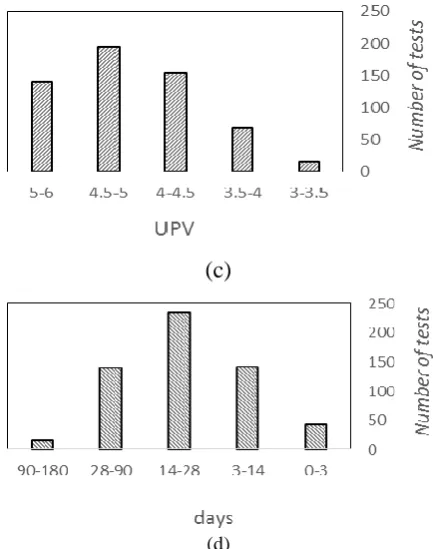
A database of 575 experimental UPV subjected to UPV test was compiled from the previous investigations. These are, Al Rawi and Al Khafagy[22], Frieh et al.[23], Habeeb and Hadi[24], Hamid and Salih[25], Haitham[8], Khlef[26], Muhammed et al.[27], Al-jaberi and Ali[28], Khalid Alhawi[29], Altlomate et al.[30], Alatshan et al.[31], Nik and Omran[32], R. Madandoust et al.[33], Bashar et al.[34], Akash Jain et al.[35] and M. Desa et al. [36] as showed in Table 1. The data of the previous experimental studies were collected in this paper covered a wide range of concrete strengths (fcu) ranging from 20 MPa to 100 MPa and most specimens have a value of UPV between 3.1 and 5.6 km/sec. Additionally, the dyes of tests ranged from 3 days to 90 days and the value w/b ranged between 0.25% and 0.55% as shown in Fig. 1 (a, b, c and d).
0 50 100 150 200 250 300
8-20 20-40 40-60 60-80 80-100
N
um
be
r o
f te
sts
f
cu(a)
(b)
(c)
(d)
Fig. 1 The relationship between the data collected and Fcu, w/c, UPV and days.
Through the previous studies [6-18] it was seen that most of researchers handled with the estimation of fcu from UPV test results as shown in Table 1. This paper aims to find a general formula will apply for all types of concrete, wide range of ages and compressive strength. Where v is speed of propagation of waves.
Table 1 represent a few numbers of experimental tests for direct UPV
No. Auther Year Current expressions
1 Jones[1] 1962 fcu=2.8 e0.53v
2 Elvery &
Ibrahim[2] 1976 fcu =0.0012 e2.27v
3 Raouf & Ali[3] 1983 fcu =2.016 e0.61v
4 Abdul-salam[15] 1992 fcu =-199+ 123v
5 Lopes &
Neponmuceno[12] 2001 fcu =0.00015 e^2.885v
6
Tumendemberel &
Baigalimaa[17] 2001 fcu =1.356* 10
-5*v2
-0.076v+111.502
7 Malhotra &
Carino[13] 2004 fcu =109.6+0.033v
8 Nash't et al.[14] 2005 fcu =1.19 e0.715v
9 Amir Al-dlemi[6] 2007 v=0.449 lnfc-1.249
10 Lawson et al.[11] 2011 fcu =0.053 e0.001v
11 Shariati et al.[16] 2011 fcu =15.533v-34.358
12 Jassim[9] 2012 fcu =0.395 e0.964v
13
Haitham Z.
4.
Results and Discussion
The Fig. 2 shows the mean value of ultrasonic pulse velocity UPV and compressive strength fcu were obtained from a total of 575 results are considered, involving different UPV ranging between 3.1 to 5.6 km/s and day tests from 3 to 90 days.
Fig. 2 Relation between UPV (Km/sec) and The Data collected
Fig. 3 Relation between UPV (Km/sec) and Compressive strength (MPa)
Fig. 3 shows the relationship between fcu and UPV for all the data collected in this study, and the best fit line representing this relationship was found to be:
fcu=0.9678e0.7947v R²=0.7199 (2)
where V and fcu are the ultrasonic pulse velocity (km/s) and compressive strength (MPa) respectively. The R2 (coefficient of determination) value was found to be 0.7199.
The Fig. 4 shows the mean value of ultrasonic pulse velocity UPV and day tests obtained for each sample, a total of 575 results are considered.
Fig. 4 Relation between UPV (Km/sec) and Age (days).
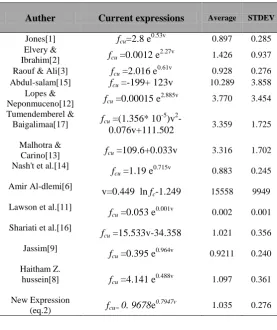
Table 2 presents the results of the average and standard deviation (STDEV) of the current expressions [6-18] and new expression (Equation 2) for direct UPV to quantify the amount of variation of a set of data were collected. Best result was found from the new expression compared with the current formulae that is because of the current formulae produced of these data is limited to the specimens were tested only.
Table 2 Comparisons between the current expressions and new expression for direct UPV
Auther Current expressions Average STDEV
Jones[1] fcu=2.8 e0.53v 0.897 0.285 Elvery &
Ibrahim[2] fcu =0.0012 e
2.27v
1.426 0.937
Raouf & Ali[3] fcu =2.016 e0.61v 0.928 0.276 Abdul-salam[15] fcu =-199+ 123v 10.289 3.858
Lopes &
Neponmuceno[12] fcu =0.00015 e2.885v 3.770 3.454 Tumendemberel &
Baigalimaa[17] fcu =(1.356* 10
-5)v2
-0.076v+111.502 3.359 1.725
Malhotra &
Carino[13] fcu =109.6+0.033v 3.316 1.702 Nash't et al.[14]
fcu =1.19 e0.715v 0.883 0.245 Amir Al-dlemi[6]
v=0.449 lnfc-1.249 15558 9949 Lawson et al.[11]
fcu =0.053 e
0.001v
0.002 0.001
Shariati et al.[16]
fcu =15.533v-34.358 1.021 0.356 Jassim[9]
fcu =0.395 e
0.964v
0.9211 0.240
Haitham Z.
hussein[8] fcu =4.141 e
0.488v
1.097 0.361
New Expression
(eq.2) fcu= 0. 9678e
0.7947v
1.035 0.276
5.
Summary
on the results presented, the following conclusion can be drawn:
• UPV tests can be considered as one of the best methods for assessing the concrete structures.
• The existing formulae as shown in Table 1 covered limited numbers of samples.
• A new general expression as shown in equation no. 2 that allows a more accurate estimate of fcu from UPV was found and can apply for a wide range of compressive strength and many types of concrete.
References
[1] J. H. Bungey, M. G. Grantham, and S. Millard, Testing of concrete in structures: Crc Press, (2006).
[2] Leman, A. S., Shahidan, S., Senin, M. S., and Ramzi Hannan, N. I. R. “A Preliminary Study On Chemical And Physical Properties Of Coconut Shell Powder As A Filler In Concrete,”
IOP Conf. Ser. Mater. Sci. Eng., Volume 160, p. 12059, (2016).
[3] A. Altlomate, F. Alatshan, F. Mashiri, and M. Jadan, "Experimental study of light-transmitting concrete," International Journal of Sustainable Building Technology and Urban Development, (2016), pp. 1-7.
[4] A. Mahmood, "Structural Health Monitoring Using Non Destructive Testing of Concrete,"
National Institute of Technology Rourkela, (2008).
[5] N. Canno, "Nondestructive testing of concrete: History and challenges," (1994).
[6] A. Al-dlemi, "Study the Properties of Foamed Concrete by Using Ultrasonic Pulse Velocity,"
IJCE-8th, (2007).
[7] R. Elvery and L. Ibrahim, "Ultrasonic assessment of concrete strength at early ages," Magazine of Concrete Research, Volume. 28, (1976), pp. 181-190.
[8] Z. H. Haitham, "Evaluation Using New Products Types of Superplasticizers (Type Glenium) and Its Effect on Workability and The Compressive Strength of Concrete in Medium Hot Weathers "
Anbar Journal for Engineering Sciences, Volume. 1st (2012), pp. 52-68.
[9] A. K. Jassim, "Prediction of Compressive Strength of Reinforced Concrete Structural Members by Using Combined Non-Destructive Tests," MSc. Thesis, Baghdad University, (2012).
[10]R. Jones, Non-destructive testing of concrete: University Press, 1962.
[11]I. Lawson, K. Danso, H. Odoi, C. Adjei, F. Quashie, I. Mumuni, et al., "Non-destructive evaluation of concrete using ultrasonic pulse velocity," Research Journal of Applied Sciences, Engineering and Technology, Volume. 3, (2011), pp. 499-504.
[12]S. Lopes and M. Neponmuceno, "Non-Destructive tests on normal and high strength concrete," in 26th Conference on Our World in Concrete & Structure, (2001) , pp. 53-66. [13]V. M. Malhotra and N. J. Carino, Handbook on
Nondestructive Testing of Concrete Second Edition: CRC press, (2003).
[14]I. H. Nash’t, S. H. A'bour, and A. A. Sadoon, "Finding an unified relationship between crushing strength of concrete and non-destructive tests," in Middle East Nondestructive Testing Conference & Exhibition, Bahrain, (2005).
[15]A. Salam, "Ultrasonic Pulse Velocity Versus Strength For Concrete In Qatar," Engineering Journal of Qatar University, vol. 5, pp. 87-93 (1992).
[16]M. Shariati, N. H. Ramli-Sulong, M. M. A. KH, P. Shafigh, and H. Sinaei, "Assessing the strength of reinforced concrete structures through Ultrasonic Pulse Velocity and Schmidt Rebound Hammer tests," Scientific Research and Essays, Volume 6, pp. 213-220, (2011). [17]N. I. R. Ramzi Hannan,, Shahidan, S., Maarof,
M. Z., and Ali, N. “Physical and Chemical Properties of Coal Bottom Ash (CBA) from Tanjung Bin Power Plant,” in IOP Conference Series: Materials Science and Engineering, (2016), Volume 160, no. 1.
[18]R. Z. A. ZM, "Assessment of Concrete Characteristics at an Early Age By Ultrasonic Pulse Velocity," Journal of Building Research, Volume. 2, pp. 31- 44, (1983).
[19]A. M. Terzić and L. M. Pavlović, "Application of results of nondestructive testing methods in the investigation of microstructure of refractory concretes," Journal of Materials in Civil Engineering, Volume 22, pp. 853-857, (2010). [20]B. British Standard, "Part 201: 1986–Testing
Concrete: Guide to the Use of Non-destructive Methods of Test for Hardened Concrete, London," British Standards Institution, (1881). [21]A. C597, "Standard Test Method for Pulse
Velocity Through Concrete," ed: ASTM International West Conshohocken, PA, (2009). [22]K. H. Al Rawi and M. A. S. Al Khafagy, "effect
of adding sisal fiber and Iraqi bauxite on some Properties of concrete," Technical Institute of Babylon, (2009).
[23]J. F. Kais, A. A. Waleed, and H. Marawan Mohammed, "Some Properties of Concrete Containing High Fraction Volume of Metakaolin " Engineering & Technology Journal Volume 32, pp. 230-248, (2014).
[24]M. H. Ghalib and M. H. Alaa, "The Effect of Sulfates in Groundwater on Some Mechanical Properties of Self-Compacting Concrete,"
[25]M. Hamid and M. Salih, "Effect of Adding Hemp Fiber on Some Properties of Concrete "
Journal of Kerbala University Volume 11, pp. 54-65, (2013).
[26]F. L. Khlef, "Proposed UPV-Strength Relationship for Concrete Subjected to Sulfate Attack " Anbar Journal for Engineering Sciences Volume 1st Engineeing Conference, pp. 114-122, (2012).
[27]H. S. Muhammed, H. A. Muhammed, and A. H. A. R. Salih, "Comparative Study of Tested Concrete Cubes by Ultrasonic Waves Using Ansys Program," Journal of Babylon University, Volume 22, pp. 497-511, (2014).
[28]L. Al-jaberi and A. M. Ali, "Evaluation of Compressive Strength by Non-Destructive Test Using Ultrasonic Pulse Velocity with Maximum Size Aggregate (10 And 20) mm," Journal of Engineering and Development, Volume 18, (2014).
[29]K. Hawi, "Effect of Superplasticizer and Limestone Filler on Fresh Concrete " Journal of Babylon University, Volume 23, pp. 27-41, (2015).
[30]A. Altlomate, F. Alatshan and F. Mashiri, "Effect of date palm fibers on the mechanical properties of concrete," International Journal of Sustainable Building Technology and Urban Development, Volume 8, pp. 68-80, (2017). [31]A. Allomate, F. Alatshan, B. Lamouchi
"Utilisation de déchets locaux pour la production d’un béton écologique," in JSFM-CMC 2015, (2015), p. 38.
[32]A. S. Nik and O. L. Omran, "Estimation of compressive strength of self-compacted concrete with fibers consisting nano-SiO 2 using ultrasonic pulse velocity," Construction and Building Materials, Volume 44, pp. 654-662, (2013).
[33]R. Madandoust, R. Ghavidel, and N. Nariman-Zadeh, "Evolutionary design of generalized GMDH-type neural network for prediction of concrete compressive strength using UPV,"
Computational Materials Science, Volume 49, pp. 556-567, (2010).
[34]B. S. Mohammed, M. Abdullahi, and C. Hoong, "Statistical models for concrete containing wood chipping as partial replacement to fine aggregate," Construction and building materials,
Volume 55, pp. 13-19, (2014).
[35]A. Jain, A. Kathuria, A. Kumar, Y. Verma, and K. Murari, "Combined use of non-destructive tests for assessment of strength of concrete in structure," Procedia Engineering, Volume 54, pp. 241-251, (2013).
[36]M. S. M. Desa, M. H. W. Ibrahim, S. Shahidan, N. S. Ghadzali, and Z. Misri, “Fundamental and assessment of concrete structure monitoring by using acoustic emission technique testing : A review Fundamental and assessment of concrete