R E S E A R C H A R T I C L E
Open Access
The challenge of planning learning
opportunities for clinical medicine: a
triangulation study in Iran
Tahereh Changiz
1, Nikoo Yamani
1and Maria Shaterjalali
2*Abstract
Background:An essential characteristics of clinical education is the need to learn a large number of practical and communication skills along with theoretical knowledge. It is challenging to design learning opportunities (LOs) for clinical setting. We aimed to determine optimal learning opportunities from the viewpoint of Medical curriculum planners, to determine the gap between the current condition and the optimal condition in medical schools, and to present feasible tactic for clinical learning opportunities.
Methods:This study comprised of three sub-studies and was conducted using triangulation. The first sub-study was performed using the Modified Delphi method with a view to identifying optimal learning opportunities. Data was collected by online focus group discussion and a questionnaire. The second sub-study was conducted with the aim of comparing the current condition and the optimal condition. Data was collected from nine medical schools across Iran using a checklist, available documents, observation, and interview. The third sub-study was conducted using an expert panel comprising of seven curriculum planners of the M.D. program. The goal of this phase was to provide feasible tactic to improve clinical education in medical schools.
Results:In the first sub-study, the participants determined all items, including student-centered learning, non-threatening learning environment, and record and management system of clinical learning opportunities as implementable learning opportunities with over 70% consensus. However, in the second sub-study, student-centered teaching methods were practiced in 33% of medical schools and the non-threatening learning
environment in 67% of the schools, while the record and management system of learning opportunities was not launched in any of the schools. From the viewpoint of the expert panel members, learning opportunities adapted to clinical contents, specification of content-based learning opportunities, and continuous supervision on learners to achieve the expected learning outcomes were among clinical learning opportunities with over 70% consensus. Conclusions:Student-centered clinical learning practices, together with virtual learning methods, can lead to clinical enhancement. Opportunities such as interactive and participatory practices should gain further consideration. Also assigning responsibility to learners and monitoring them are strategies for enhancement.
Keywords:Clinical learning opportunities, Student-centered strategy, Clinical teaching-learning methods, Student evaluation, Educational climate
© The Author(s). 2019Open AccessThis article is distributed under the terms of the Creative Commons Attribution 4.0 International License (http://creativecommons.org/licenses/by/4.0/), which permits unrestricted use, distribution, and reproduction in any medium, provided you give appropriate credit to the original author(s) and the source, provide a link to the Creative Commons license, and indicate if changes were made. The Creative Commons Public Domain Dedication waiver (http://creativecommons.org/publicdomain/zero/1.0/) applies to the data made available in this article, unless otherwise stated.
* Correspondence:[email protected]
2School of Medical Science, Islamic Azad university of Tonekabon branch, Tonekabon, Iran
Background
Clinical education is an essential component of the med-ical curriculum and a significant part of the health ser-vices education [1, 2]. A central feature of the M.D. program is the need to learn a large number of practical and communication skills along with the theoretical knowledge [3]. Learning opportunities (LOs) are pro-vided by clinical educators so that learners can obtain learning outcomes [4]. Nevertheless, to design practical LOs in the clinical settings is extremely challenging. It is because the primary goal in health care centers is to de-liver quality care to patients, and LOs are provided on the sidelines for learners who play an auxiliary role in patient care [5]. Nonetheless, as patient care in clinical settings provides an excellent opportunity for learners to acquire clinical, communication, and interdisciplinary skills and to role model after teachers, most medical stu-dents often consider clinical education as valuable [6].
The shift from the teacher-centered to the student-cen-tered paradigm and the emphasis on student learning expe-riences have been among effective strategies to create LOs at clinical settings in recent years. Ernstzen et al. enumer-ate, from their review of the literature, a number of LOs, in-cluding collaborative learning, active participation, responsibility sharing with learners in the clinical environ-ment, informing learners about the process and outcome of learning, problem solving as regards learner tasks, problem solving via actual and hypothetical patients, problem solv-ing via the cyberspace, discussion on patient case, role-play-ing with peers, case-study assignments, self-directed learning, brainstorming, article reviewing, feedback, self-as-sessment, and lifelong learning skills [5]. Alweshahi, as quoted by Stritter et al., states that students describe the teaching methods that lead to their better clinical education as a LO. Further opportunities added by Streeter et al. in-volve cases where the teacher creates a friendly environ-ment in which students are actively engaged [7]. Other studies have also shown that, from the learners’perspective, clinical learning is associated with issues such as patient management, having a responsibility in the hospital, feeling at work when in a team, working in the environment, and direct exposure to actual patients. Besides, membership in the patient recovery team, having a responsibility, prescrip-tion writing, and collaboratory learning are menprescrip-tioned as fascinating learning experiences [8,9].
However, challenges such as the limited training time at the patient’s bedside, alterations in the care system, and prioritization of the patient management and his/her treatment can complicate clinical learning and affect medical education as well as a learner’s ability to learn patient care [5]. Moreover, problems such as lack of opportunity to work independently, fewer out-patient visits, greater attention directed to specialized pa-tients, and performance of tasks unrelated to internship
responsibilities along with several other ineffectual tasks unrelated to a M.D.’s curricular goals [8] have turned LOs in the clinical setting into a challenge that requires accur-ate planning and focused attention.
Among the main factors in creating LOs in clinical settings are the design, development, and implementa-tion of opportunities adapted to educaimplementa-tional outcomes, their monitoring and evaluation, and the creation of an appropriate educational environment in the clinical set-ting. However, while there is research on the teaching-learning methods, there is a paucity of research on other dimensions of teaching LOs for the M.D. students. Thus, we were motivated to conduct this research. In this study, we first determine the optimal and feasible LOs in the clinical setting from the viewpoint of the M.D. cur-riculum planners. Subsequently, while identifying the gap between the current condition and the optimal con-dition in medical schools, we present strategies for implementing and monitoring LOs and feasible strat-egies to create them.
Methods
The present study consisted of three sub-studies and was conducted using triangulation [10,11]. The M.D. planners in Iran with the positions of vice-chancelleries of educa-tion, dean of medical schools, M.D. education deputies, and clerks and interns in all medical schools throughout the country were eligible to participate in this study. The study lasted from May 2016 to June 2018.
First sub-study
among the participants after a month. The number of respondent were 51. The final number of respondents were 54. The consensus level was to reach a frequency percentage of 70%. Lincoln and Guba’s criteria [15], group statistic, and anonymous responses by participants (in the first round), Alpha coefficients with an emphasis on internal consistency (in the second round), were used to ensure the reliability for each round.
Second sub-study
The second round was conducted in a descriptive, cross-sectional manner. The purpose of this step was to com-pare the status quo in clinical education and the optimal condition obtained from the first sub-study results and to enlist and describe the strengths and limitations of clinical education in M.D. programs across the country. The statistical population comprised of M.D. education deputies and clerks and interns across the country. Nine medical schools with different levels were selected by stratified sampling method [16]. The required informa-tion on the status quo of LOs in clinical setting was gathered through a data collection form, documents, ob-servation, and informal interviews during four months. One of the researchers conducted the observation. Par-ticipants at this stage were M.D. education deputies (9 individuals), clerks, and interns (17 individuals). To en-able comparison between the current and the optimal conditions, the forms that collected data on these situa-tions held similar items. The experts reviewed the tool to confirm its face and content validity in several stages. Reliability of the tool was determined in the previous sub-study. To examine the status quo, we analyzed the data collected on the current condition in SPSS (version 20) and the percentage frequency using descriptive statistics.
Third sub-study
The third sub-study was conducted using the nominal group technique and a panel of experts [17]. The pur-pose of this phase was to provide practical solutions for improving the clinical education of the M.D. program. The participants of this phase were seven M.D. program planners with a history of education and executive re-sponsibility from the ten national macro-region univer-sities of medical sciences and the representatives from the Secretariat of the General Medical Education Coun-cil of the Ministry of Health and Medical Education. In this phase, building on the findings of the first and sec-ond sub-studies and a review of the literature, we inte-grated the idea generation phase and round robin [18– 20] and distributed a data collection questionnaire. The questionnaire consisted of two sections including demo-graphic characteristics and items on the strategies to de-sign LOs with three policies and nine tactics on a
five-point scale. It was given to the panel members to vote. The questionnaires were repeatedly reviewed and revised by experts to confirm their content and face validity. The data from the questionnaire were analyzed in SPSS (version 20) to determine the frequency and extent of agreement. The results were categorized as implementa-ble in a short-term period (one year or less), implemen-table in the mid-term period (maximum of five years,) and non-implementable. The reliability of the research was confirmed by selecting individuals from different colleges [18] and collecting comments on anonymous forms and group responses [19].
Results
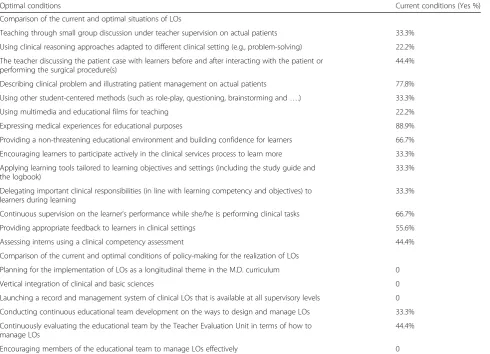
Participants of the first sub-study were 20 individuals in the first round and 54 respondents in the second round. The number of code (statements) from the first round was 91 (Table1). This section of the study has been pub-lished [21]. The second round was conducted in two sections: providing optimal LOs with 14 items and the optimal policies for implementing LOs with six items (Table2). Participants in the second sub-study were nine medical school planners from across the country and 17 clerks and interns from various medical schools. The checklist for comparing the current and optimal condi-tions had two seccondi-tions: optimal LOs with 14 items and optimal policies for implementing LOs with six items (Table3). Participants in the third sub-study were seven medical education experts from across the country. One strategy with three policies and nine tactics was exam-ined in the expert panel and categorized into the three categories of implementable in a short-term period, implementable in the mid-term period, and non-imple-mentable (Table4).
Discussion
We did not find many studies on the use of optimal LOs in medical clinical settings. In this research, we both identified the optimal LOs and determined the feasibility of these opportunities. In this section, we discuss the op-timal clinical education conditions obtained from the first sub-study in comparison with the current condi-tions derived from the second sub-study and the solu-tions derived from the results of the third sub-study in an integrative manner.
Varying LOs
Table 1Themes, categories, and subcategories of LOs
Main Category Sub-category Sub-classes
Creating learning opportunities Designing and planning LOs –
Empowerment and enthusiasm of teachers –
Educational atmosphere –
Learning strategies Effective technique
Clinical reasoning
Problem-based learning
Virtual education
Evidence-based medicine
Collaborative learning
Study guide
Supervision of students Feedback/Reflection
Continuous supervision
Evaluation Student assessment,
Learning recording tools (Logbook/Portfolio)
Table 2Optimal LOs
Learning Opportunities Efficient and very efficient %
Providing optimal LOs
Teaching through small group discussion under teacher supervision on actual patients 97.8%
Using clinical reasoning approaches adapted to different clinical setting (e.g., problem-solving) 100%
The teacher discussing the patient case with learners before and after interacting with the patient or performing the surgical procedure(s)
97.8%
Describing clinical problem and illustrating patient management on actual patients 97.8%
Using other student-centered methods (such as role-play, questioning, brainstorming and….) 95.7%
Using multimedia and educational films for teaching 95.7%
Expressing medical experiences for educational purposes 91.3%
Providing a non-threatening educational environment and building confidence for learners 100%
Encouraging learners to participate actively in the clinical services process to learn more 100%
Applying learning tools tailored to learning objectives and settings (including the study guide and the logbook)
93.4%
Delegating important clinical responsibilities (in line with learning competency and objectives) to learners during learning
95.7%
Continuous supervision on the learner’s performance while she/he is performing clinical tasks 100%
Providing appropriate feedback to learners in clinical settings 97.8%
Assessing interns using a clinical competency assessment 95.6%
Optimal policies for implementing LOs
Planning for the implementation of LOs as a longitudinal theme in the M.D. curriculum 95.6%
Vertical integration of clinical and basic sciences 78.3%
Launching a record and management system of clinical LOs that is available at all supervisory levels 86.9%
Conducting continuous educational team development on the ways to design and manage LOs 97.9%
Continuously evaluating the educational team by the Teacher Evaluation Unit in terms of how to manage LOs
95.7%
methods in workshops that build on practical and ap-plicable clinical scenarios. Among other helpful LOs is to use clinical reasoning methods such as problem-solv-ing in line with the expected objectives in rotations in clinical settings, which was followed only in two schools.
– Expert panel considered medical and educational workload of faculty members to be an obstacle to the implementation problem base learning. It seems that reducing the therapeutic activities of faculties and directing more attention to education should be an essential principle to be considered by planners at the university level.
Systematic review Kilgour et al. showed that clinical students’ viewpoint toward small group, active learn-ing methods were generally positive [22]. Beckman et al.’s research on the use of a collaborative approach to clinical education also showed that while adults prefer collaborative learning and self-learning and that a successful teacher should use facilitated discussions
to transfer knowledge and skills, teachers rarely use adult learning principles, such as encouraged interac-tions, question and answer, and meaningful feedback provision [23]. Using other student-centered methods, such as role-play and question and answer, among others, was another optimal LO practiced only in three schools. Although these interactive educational methods can be among the most straightforward and most accessible educational practices available to teachers, training is organized as a lecture by teachers in most educational clinical settings.
– However, the expert panel considered these practices as feasible, medium-term solutions to improving clinical education. Karbasi et al.’s study on the teaching of how to interact with a patient through role-playing also showed a significant increase in communication skills and care of behaviors in the intervention group [24]. Tayem et al. study showed that the perspectives of medical students toward Role- play demonstrations
Table 3Comparison between the current conditions and the optimal conditions
Optimal conditions Current conditions (Yes %)
Comparison of the current and optimal situations of LOs
Teaching through small group discussion under teacher supervision on actual patients 33.3%
Using clinical reasoning approaches adapted to different clinical setting (e.g., problem-solving) 22.2%
The teacher discussing the patient case with learners before and after interacting with the patient or performing the surgical procedure(s)
44.4%
Describing clinical problem and illustrating patient management on actual patients 77.8%
Using other student-centered methods (such as role-play, questioning, brainstorming and….) 33.3%
Using multimedia and educational films for teaching 22.2%
Expressing medical experiences for educational purposes 88.9%
Providing a non-threatening educational environment and building confidence for learners 66.7%
Encouraging learners to participate actively in the clinical services process to learn more 33.3%
Applying learning tools tailored to learning objectives and settings (including the study guide and the logbook)
33.3%
Delegating important clinical responsibilities (in line with learning competency and objectives) to learners during learning
33.3%
Continuous supervision on the learner’s performance while she/he is performing clinical tasks 66.7%
Providing appropriate feedback to learners in clinical settings 55.6%
Assessing interns using a clinical competency assessment 44.4%
Comparison of the current and optimal conditions of policy-making for the realization of LOs
Planning for the implementation of LOs as a longitudinal theme in the M.D. curriculum 0
Vertical integration of clinical and basic sciences 0
Launching a record and management system of clinical LOs that is available at all supervisory levels 0
Conducting continuous educational team development on the ways to design and manage LOs 33.3%
Continuously evaluating the educational team by the Teacher Evaluation Unit in terms of how to manage LOs
44.4%
were positive. They expressed that role- play improved competence in writing a complete prescription [25].
Multimedia and educational films were among other op-timal methods, which were used only in two schools. Plan-ners and learPlan-ners participating in the second sub-study stated that multimedia and educational films are used in limited departments. Together with other simulation methods, these methods can be applied to complement education in cases of inaccessibility or the low number of patients or at the time of risky procedures. However, it seems that utilizing multimedia requires a change in the at-titude of teachers. The expert panel considered these prac-tices as education enhancement strategies applicable in the short run. the study Kalani et al. showed that there was no significant difference between the skills gained in the two groups of video training and simulation. However, they showed that the skill level gained by these two groups is significantly different from and higher than the group re-ceiving no intervention (p> 0.05) [3].
Patient case Discussion with learners before and after interacting with the patient or performing a surgical pro-cedure was another LO that was considered optimal and applicable by our contributors. Although the participants in the first sub-study stated that they use this
educational method, an analysis of the status quo indi-cated that the tactic is used in only half of the schools (n= 4). The teaching of complete patient management is one of the essential requirements of clinical education. It seems that the non-implementation of this educational method is influenced by factors such as the fragmenta-tion of the general wards into sub-specialized ones, the rotation of the learners’ shifts and their presence in a variety of settings in relatively short periods of time, the variability of teachers, and learner rotation based on the wards’schedule. Even if it is not possible to follow a pa-tient completely, it is suggested that other clinical teach-ing methods such as small group discussion, virtual methods, and multimedia be used to follow up the patient entirely and to train the whole process of patient management. Managheb et al.’s study comparing role-playing and group discussion on the performance of interns in the transmission of bad news also showed that both group members had an increased mean score in their communication skills. However, com-paring the two methods, role-playing proved signifi-cantly more effective than the discussion method [26]. Assar et al.’s study on professionalism in education using the demonstration method showed that about 90% of interns assessed the impact of this educational process to be high or very high. Moreover, interns’
Table 4Strategies, policies, and tactics to enhance LOs
Strategy: Designing LOs tailored to each course and based on the expected competency as set in the M.D. program
Policies and tactics Short-term
(one year)
Mid-term (five years)
No feasible No idea
Policies
Adoption of an appropriate educational strategy in the M.D. curriculum to design LOs conforming to clinical contents and learners’level
42.8% 28.6% 14.3% 14.3%
Provision of continuous educational team development on the design and management of LOs 71.4% – 14.3% 14.3%
Availability of programs to continuously assess the performance of the educational team and supervision to manage LOs
57.1% 28.6% – 14.3%
Tactics
To identify the LOs in line with the contents of the clinical curriculum for clerks and interns 80% 20% – –
To implement the vertical integration strategy between clinical science and basic science in the M.D. program
14.3% 42.9% 42.9% –
To launch a record and management system of clinical LOs that is available at all supervisory levels 50% 16.7% 33.3% –
To distinguish between educational and therapeutic heath service with an aim to reduce the number of patients in educational health service and teach via collaborative learning and problem-solving
14.3% 42.9% 42.8% –
To use educational setting with various actual patients corresponding with educational objectives to show ways to manage a patient
28.6% 57.1% 14.3% –
To use multimedia and educational films to teach how to reduce clinical cases in line with educational goals
85.7% 14.3% – –
To use other student-centered educational methods (such as role-play, questioning, brainstorming and…)
28.6% 57.1% 14.3% –
To provide a non-threatening educational environment and to build confidence for learners 57.1% 14.3% 28.6% –
To continuously supervise learners to determine expected learning outcomes and to design new educational methods if necessary
performance in the emergency department showed a 68.5% reduction in the inappropriate performance after training as compared with the pre-training period [27].
Expressing experiences for educational purposes is also an optimal LO that was practiced in most facul-ties. Providing a non-threatening educational environ-ment and building confidence for learners is another beneficial LO that was followed in two-thirds of the schools. Few members of the expert panel in the third sub-study believed that incorrect criteria for the recruitment of faculties and assistants lead to the cre-ation of an inappropriate educcre-ational environment in educational settings. Nonetheless, most panel mem-bers believed that providing a non-threatening educa-tional environment would be a short-term solution to improving clinical education. Another LO was to en-courage learners to participate actively in the clinical services process to learn more, which was followed in one-third of the schools. Some interns participating in the second sub-study considered an intern’s admission in the treatment team and participation in the clinical presentation process as an opportunity to learn and gain experience. Delegating clinical responsibilities to learners in line with their clinical competencies and learning objectives were another beneficial LO, which was performed in one-third of the schools. The find-ings of this study indicated that learners were not assigned responsibilities based on the educational ob-jectives and the M.D. graduates competencies [28] in most of the schools we examined. The planners are advised to direct attention to reviewing the assign-ment of responsibilities and having continuous super-vision. Shihan et al.’s inquiry into interns’ viewpoint on clinical environment showed that assigning re-sponsibility to interns in the absence of experienced teachers and full-time staff leads to improved learn-ing, ability to make decisions, and an opportunity for clinical empowerment. Despite the empowerment of learners when they are assigned more responsibility in the absence of a senior member of the team, focus group results emphasized the importance of supervi-sion [29]. Kraft et al. also reported that 86% of the students wished to present the findings to the teacher after they had examined the patient alone, and 91% preferred to conduct a clinical examination under the supervision of the trainer [30].
The use of learning tools such as study guide and log-book was another good LO, which was followed in one-third of the schools. Regarding the use of a logbook, most planners and learners believed that this educational tool would not provide an opportunity to learn due to lack of proper supervision by the teacher on how to use the log-book. On the efficacy of internship logbooks, Movafaghi
et al.’s study demonstrated that 81% of the teachers and 83% of the students agreed that the accuracy of the infor-mation provided in logbooks was less than 60% and that students assessed the accuracy of the logbooks signifi-cantly less than the teachers did [31]. On the contrary, Kazemi et al.’s study on the effect of using a study guide on the educational status of clerks and interns showed that the total score of clerks’and interns’skills was signifi-cantly different in intervention and control groups [32].
Continuously supervision on learners’ performance during clinical tasks was another useful LO, which was performed in two-thirds of schools. However, the learners in the second sub-study agreed that educa-tors rarely have continuous supervision in some wards. On the other hand, members of the expert panel considered continued supervision of learners to assess the attainment of educational objectives a feas-ible strategy in the short term. Feedback was pre-sented in half of schools. It seems that one of the reasons why the students assessed the teachers’ super-vision as not useful was the fact that they did not re-ceive effective feedback. A study by Hem-Stokroos et al. concerning structured clinical experiences showed that all the participants considered the teacher’s supervision of student-patient interaction as a strong stimulus and feedback as a key feature to learning. Nevertheless, they also believed that supervision and feedback were rarely performed by educators [33].
Regarding the administration of the clinical compe-tency assessment (Clinical Internship Completion Test) as an opportunity for learning, our participants from four colleges believed that clinical competency assessment had enhanced learners’ performance. A study conducted on 97 US medical schools between 1993 and 1998 reported that assessment as structured supervision of the ability of clinical learners was per-formed for only 17 to 23.1% of medical interns. Nevertheless, in a recent study with medical gradu-ates, it was found that only 17 to 39% of clinical ex-aminations conducted by clinical learners were not monitored [34].
Policy-making to realize LOs
between basic and clinical sciences provided the ground for creating LOs, it was not implemented in any of the schools and, according to the panel members, it was not feasible. However, the implementation of early clinical encounter programs in some Iranian schools, as an ex-ample of the implementation of vertical integration of clinical and basic sciences, has provided satisfaction for learners.
Among other optimal policies for realizing LOs was to launch a record and management system of clinical LOs that is available at all supervisory levels, which did not exist in the schools covered in this study. In addition to providing authorities with the possibility of supervising the educational process, the LOs rec-ord system provides the conditions for sharing educa-tional experiences on developing LOs in line with educational and management objectives. However, the panel members believed that it wasn’t feasible. En-couraging educators to effectively manage LOs was another optimal policy that was not observed at the schools. Conducting continuous educational team de-velopment on the design of LOs and the continuous assessment of educational team concerning LO man-agement by educational development office of schools were one of the other policies that were practiced in about one-third of the schools. The members of the panel believed that both of these are short-term tac-tics, the implementation of which on a full scale can be recommended.
One of the limitations of this study in first sub-study was the incorporation of only the experts to learn about the optimum conditions and the lack of access to the opinions of the students and staff. The breadth and diversity of the research community in comparison with the participating sample in all sub-studies was another limitation of this study. In order to reduce impact of this limitation on the results, the participants were selected from all medical schools throughout the country. Shortage of time of the re-search participants was another limitation in the col-lection of data as the participants were infused with multiple executive, educational, and treatment respon-sibilities. We use electronic methods for reducing of this limitation.
Conclusions
Learners and the clinical LOs provided for them in educa-tional settings are among the main components of learn-ing in clinic settlearn-ings. Our findlearn-ings concernlearn-ing LOs and policies to realize LOs indicated that student-centered clinical learning techniques such as participatory learning, clinical reasoning, and virtual learning methods are opti-mal tactics that can promote clinical education. Also, LOs such as describing clinical problem on actual patients,
discussing the patient case, and expressing teachers’ expe-riences should be considered besides using interactive and participatory methods. The assignment of responsibility to learners, the direct and indirect learner supervision, the use of learning tools and clinical student assessment were other good LOs and clinical enhancement strategies, which did not enjoy a broad implementation in clinical settings. Also, planning to use learning methods adapted to the objectives in the current clinical settings. Moreover, planning to use LOs in line with the objectives of the M.D. program and clinical settings and its operational management are principles that should be taken into con-sideration by the planners of the M.D. program.
Abbreviations
LOs:Learning opportunities; M.D.: Medical Doctor
Acknowledgments
The researchers are grateful to the vice-chancelleries of education in medical universities, the M.D. program deputies of education, the clinical education deputies, and clinical students (interns and clerks) who helped us in this study.
Authors’contributions
TC and NY and MSJ developed the design of this study. All authors contributed to the analyses and writing of the paper. All authors read and approved the final version. MSJ performed statistical analyses.
Funding
The study was funded in the form of a mini-grant for cost of stationary by medical education research center, Isfahan University of Medical Sciences.
Availability of data and materials
The data that support the findings of this study are not publicly available, but can be available from the authors on reasonable request. All questionnaires and other materials are available from the corresponding author on reasonable request.
Ethics approval and consent to participate
This research is part of the research project approved under No. 395055 with the ethics code IR.MUI.REC.1395.3.55 in the Vice-chancellery for Research of Isfahan University of Medical Sciences. Since the study did not include personal data or clinical trials, approval was deemed not to be necessary. Verbal (audio recorded) and/or written consent to participate was obtained from all participants in study. This consent form was approved in medical education research center, Isfahan University of Medical Science. Also participants were informed about the study at time of data collection, and were made aware that participation in the study, which involved completing survey, was completely voluntary.
Consent for publication
Not applicable.
Competing interests
The authors declare that they have no competing interests.
Author details
1Department of medical education, Medical educational research center, Isfahan University of Medical Science, Isfahan, Iran.2School of Medical Science, Islamic Azad university of Tonekabon branch, Tonekabon, Iran.
Received: 13 April 2019 Accepted: 19 July 2019
References
2. Rowe M, Frantz J, Bozalek V. The role of blended learning in the clinical education of healthcare students: a systematic review. Med Teach. 2012;34:216–21. 3. Kalani Z, Vaziri F, Koohpayezadeh J. Comparison of the education effect in
simulated environment with educational film on acquiring midwifery students' episiotomy skill. jmed. 2016; 11 (1): 91–99; URL:http://jmed.ssu.ac. ir/article-1-665-en.html
4. Uys L, Gwele N. Editors. Curriculum development in nursing: process and innovation. 1 st ed. London and New York: Routledge; 2005.
5. Ernstzen DV, Bitzer E, Grimmer-Somers K. Physiotherapy students’and clinical teachers’perceptions of clinical learning opportunities: a case study. Med Teach. 2009;31(3):e102–15.
6. Dent JA, Harden RM. A practical guide for medical teachers. 4th ed. London: Elsevier; 2013.
7. Alweshahi Y, Harley D, Cook DA. Students’perception of the characteristics of effective bedside teachers. Med Teach. 2007;29(2–3):204–9.
8. Karimi Monaghi H, Derakhshan A, Khajedalouei M, Dashti Rahmat Abadi M, Binaghi T. Lived Clinical Learning Experiences of Medical Students: A Qualitative Approach. Iranian Journal of Medical Education. 2012; 11 (6): 635–647. URL:http://ijme.mui.ac.ir/article-1-1045-en.html
9. Roudbari M, Yaghmayi M, Zarif Houshyar J. Educational Process of Interns in Obstetrics & Gynecology Department at Zahedan University of Medical Sciences in 2002. Iranian Journal of Medical Education. 2003; 3 (2):23–31. URL:http://ijme.mui.ac.ir/article-1-163-en.html
10. Fusch PI, Ness LR. Are we there yet? Data saturation in qualitative research. Qual Rep. 2015;20(9):1408.
11. Torrance H. Triangulation, respondent validation, and democratic participation in mixed methods research. J Mix Methods Res. 2012;6(2):111–23.
12. Keeney S, Hasson F, McKenna H. The Delphi technique in nursing and Health Research. 1st ed. Oxford: Wiley Blackwell; 2011.
13. Elo S. Kynga¨s H. the qualitative content analysis process. J Adv Nurs. 2008; 62(1):107–15.
14. Hsieh H-F, Shannon SE. Three approaches to qualitative content analysis. Qualitative healh research. 2005;15(9):1277–88.
15. Lincoln YS, Guba EG. Naturalistic inquiry. New Dehli: Sage; 1985. 416pp. 16. Merdit G, Burg V, Gall J. Educational research: an introduction. Nasr A et al. 6
th ed. Tehran: Samt. 2008.
17. Waggoner J, Carline JD, Durning SJ. Is there a consensus on consensus methodology? Descriptions and recommendations for future consensus research. Acad Med. 2016;91(5):663–8.
18. Humphrey-Murto S, Varpio L, Gonsalves C, Wood TJ. Using consensus group methods such as Delphi and nominal group in medical education research. Med Teach. 2017;39(1):14–9.
19. Humphrey-Murto S, Varpio L, Wood TJ, Gonsalves C, Ufholz LA, Mascioli K, Wang C, Foth T. The use of the Delphi and other consensus group methods in medical education research: a review. Acad Med. 2017; 92(10):1491–8.
20. McMillan SS, King M, Tully MP. How to use the nominal group and Delphi techniques. Int J Clin Pharm. 2016;38(3):655–62.
21. Shaterjalali M, Changiz T, Yamani N. Optimal clinical setting, tutors, and learning opportunities in medical education: a content analysis. Journal of Education and Health Promotion. 2018;7:1–7.https://doi.org/10.4103/jehp.jehp_56_18. 22. Kilgour JM, Grundy L, Monrouxe LV. A rapid review of the factors affecting
healthcare students' satisfaction with small-group, active learning methods. Teaching and learning medicine. 2016;28(1):15–25.
23. Beckman TJ, Lee MC. Proposal for a collaborative approach to clinical teaching. Mayo Clin Proc. 2009;84(4):339–44.
24. Karbasi F, Khatiban M, Soltanian A. The Effect of Teaching Nurse-patient Communication through Role-play Method on Nursing Students’Caring Behaviors: A Quasi-Experimental Study. Iranian Journal of Medical Education. 2016; 16:120–130. URL:http://ijme.mui.ac.ir/article-1-3977-fa.html
25. Tayem YI, Altabatabaei AS, Mohamed MW, Arrfedi MM, Aljawder HS, Aldebous FA, James H, Al Khaja KA, Sequeira RP. Competence of medical students in communicating drug therapy: value of role- play
demonstrations. Indian journal of pharmacology. 2016;48(1):37. 26. managheb S E, mosalanejad N. Teaching How to Break Bad News:
Comparing Role-Play and Group Discussion on Practice of Medical Interns in Jahrom Medical School . Iranian Journal of Medical Education. 2012; 11 (7):789–797. URL:http://ijme.mui.ac.ir/article-1-1356-fa.html
27. Asar S, Haibar H, Bijanzadeh M, Tabesh H. Assessment of theater teaching methods and performance analysis in professionalism teaching to interns. Jundishapur educational development. 2016;7(3):225–30.
28. Ministry of Health and Medical Education. Document of the Capabilities of the General Medical Students in the Islamic Republic of Iran. Available from:http://scume.behdasht.gov.ir/uploads/sanad_tavanmandi. pdf. Accessed Mar 20 2016.
29. Sheehan D, Wilkinson TJ, Billett S. Interns’participation and learning in clinical environments in a New Zealand hospital. Acad Med. 2005;80(3):302–8. 30. Croft A, Carruthers D, Justice E. Undergraduate teaching in the outpatient
clinic: can we do better? Med Teach. 2012;34(8):674.
31. Movaffaghi Z, Shoeibi A, Bahari A, Khajedaluee M. The Efficiency of Medical Extern's Logbook from the Viewpoints of Externs and Faculties of Mashhad University of Medical Sciences: An Integration of Qualitative and Quantitative Methods. Iranian Journal of Medical Education. 2014; 13 (11): 950–959. URL:http://ijme.mui.ac.ir/article-1-2769-fa.html
32. Kazemi T, Khazaei T, Zolfaghari B, Sayah Z. The Effect of Using Cardiology Ward Logbook on Students Training in Birjand University of Medical Sciences. Iranian Journal of Medical Education. 2010; 10 (3):284–292. URL:
http://ijme.mui.ac.ir/article-1-1423-fa.html
33. Hem-Stokroos HHV, Daelmans HEM, Vander Vluten CPM, Haarman HJTHM, Scherpbier AJJA. A qualitative study of constructive clinical learning experiences. Med Teach. 2003;25(2):120–6.
34. Norcini J, Burch V. Workplace-based assessment as an educational tool: AMEE guide no. 31. Med Teach. 2007;29(9–10):855–71.
35. Ministry of Health and Medical Education. Medical doctor curriculum (edit 2017). Available from:http://scume.behdasht.gov.ir/uploads/
pezeshkiomoomi_96.pdf. Accessed 2 Nov 2017.
Publisher’s Note