Page 264
E-LEARNING: DELIVERING KNOWLEDGE IN DIGITAL AGE Danijela Kardaš1, Bojan Knežević1, Petar Gvero1, Robin Støckert2, Vojislav Novaković2
1University of Banja Luka, Faculty of Mechanical Engineering, Stepe Stepanovića 71, 78000 Banja Luka, Bosnia and Herzegovina
2Norwegian University of Science and Technology, Høgskoleringen 1, 7491 Trondheim, Norway
Abstract
Using modern technology, communication and collaboration are available and possible more than ever. Universities have a responsibility to offer and adapt education system to this new labor market demand. We need to prepare the student for the workplace of the future, where digital technology enables people and processes to connect and interact regardless of physical location, distance and time. Collaboration and communication are done on several types of devices and we have a mixture of social networks, work networks and learning environments. In this paper, we define the multifunctional rooms (MFR) as nodes in these networks, with a special focus on the learning space. Establishment of MFR came as a transfer of the knowledge, experience and technology from NTNU (Norwegian University of Science and Technology) to the Faculty of Mechanical Engineering Banja Luka through the project HERD QIMSEE. This paper analyzes the physical surroundings, possibilities for use but also the pedagogy and learning methods to be utilized in this learning space.
Key words: interdisciplinary, education, learning space, new technologies
1. INTRODUCTION
According to the NMC [NMC 2017] Horizon Report 2017, the key trends accelerating higher education technology adoption for the next two years are "Blended learning design" and "Collaborative learning". In a longer perspective (3-5 years), the report predicts that "redesign of learning spaces" will be one of the major trends. The defined trends in this report coincide with the basic design idea and use our multi-functional rooms (MFR), which was built to be an asset in the HERD QIMSEE project in delivering a multiform platform for communication, collaboration, and communication at Faculty of Mechanical Engineering in Banja Luka, Bosnia and Herzegovina. The main idea of the MFR was to create a flexible learning space, with a set of basic features or building blocks to support a variety of scenarios.
The last few decades, often referred to as the formative period of a new information culture, we experience a sharp increase in the role of information technology and technological content in all fields including education (Kuimova & Kiyanitsyna & Truntyagin, 2016). Today, the distinctions between distance learning and the one implemented directly in the university classroom are fading, thanks to the ICT.
The term “e-learning” reflects the integration of distance and traditional organization of the educational process on the basis of ICT (Kuimova & Kiyanitsyna & Truntyagin, 2016). The literature on e-learning implementation proves that it helps not only to deliver the content and materials of the course but also to improve student academic achievement (Islam, 2016). The aim of this paper is to present possibilities of using MFR in different scenarios with an emphasis on e-learning.
2. E-LEARNING, PROS AND CONS
Page 265
ICT-based personalized, flexible, individual, self-organized, collaborative learning based on a community of learners, teachers, facilitators, experts. Modern educational technologies and e-learning technologies are student-centered and are focused on the development of individual student resources (Matei & Vrabie 2013, Kuimova & Polyushko 2015, Ruchina et all 2015, Kimova & Burleigh & Trofimova 2016).
The development of e-learning products and the provision of e-learning opportunities is one of the most rapidly expanding areas of education and training, in both education and industry (Imel 2002). Education and training are poised to become one of the largest sectors in the world economy. E-Learning is being recognized as having the power to transform the performance, knowledge and skills landscape (Gilbert & Morton & Rowley, 2007). E-learning is viewed variously as having the potential to: improve the quality of learning; improve access to education and training; reduce the cost of education; and, improve the cost-effectiveness of education (Alexander, 2001).
E-learning has a number of advantages; it: (i) provides an opportunity for university teachers to study colleagues’ experiences, thus providing a chance of continual retraining; (ii)provides better teaching aids, their efficient, timely updating and availability; (iii) facilitates flexible asynchronous learning; (iv) provides learners with a sense of autonomy and control; (v) develops student’s ability to work independently; (vi) ensures lifelong learning by removing spatial and temporal restrictions, etc.
The disadvantages of e-learning that have been given by following (Arkorful & Abaidoo): (i) E-learning as a method of education makes the learners undergo contemplation, remoteness, as well as the lack of interaction or relation. It, therefore, requires a very strong inspiration as well as skills with to the management of time in order to reduce such effects; (ii) With respect to clarifications, offer of explanations, as well as interpretations, the e-learning method might be less effective that the traditional method of learning. The learning process is much easier with the use of the face to face encounter with the instructors or teachers; (iii) When it comes to improvement in communication skills of learners, e-learning as a method might have a negative effect. The learners though might have an excellent knowledge in academics, they may not possess the needed skills to deliver their acquired knowledge to others; (iv) E-learning may also probably be misled to piracy and plagiarism, predisposed by inadequate selection skills, as well as the ease of copy and paste; (v) Also not all fields or discipline can employ the e-learning technique in education. For instance, the purely scientific fields that include practical cannot be properly studied through e-learning. Researches have argued that e-learning is more appropriate in social science and humanities than the fields such as medical science and pharmacy, where there is the need to develop practical skills; etc.
3. HERD QIMSEE PROJECT AT FACULTY OF MECHANICAL ENGINEERING BANJA LUKA
Page 266
achieving energy and resource efficiency and/or zero emissions, application or research on new materials and new technologies for renewable energy, (v) Increase institutional quality and capacity of the WB Universities in the field of teaching staff improvement, laboratory organization and logistics, networking and supplementing expertise to match closer to the Norwegian partners, (vi) Establish and support interconnection of the WB Universities with industry and public sector in the WB region. To obtain some of the goals in the QIMSEE project listed above, Multifunctional Room (MFR) was established at Faculty of Mechanical Engineering Banja Luka.
4. MULTIFUNCTIONAL ROOMS (MFR) AND POSSIBLE SCENARIOS
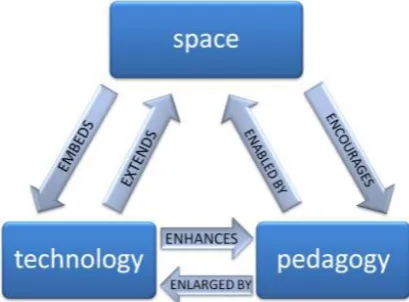
We define scenarios as activities taking place in multifunctional rooms. A set of overarching building blocks interacts and facilitates the activities. The major building blocks consist of the space, technology and pedagogy (Radcliffe 2008).
Fig. 1. Pedagogy-Space-Technology Framework, (Radcliff, 2008)
To obtain the most flexible solutions regarding change of scenarios, the tables and chairs should have the option of being moved freely around in the room. This flexibility makes it easy to switch between different learning scenarios facilitating group work, ordinary lecture, videoconference etc. Of course, the acoustics and lights must be adapted to support all these kind of activities. MFR shall accommodate a variety of teaching/learning methods and usage scenarios like group-based exercises using interactive whiteboards, laboratory exercises/simulations, videoconferences, R&D related work, blended learning, distance learning etc. In the implementation process of the MFR, the local stakeholders had different views regarding the flexibility and functions, whether to build a new room, to refurbish and old room or integration of the MFR features in already existing lab-facilities. These local decisions and concerns resulted in a set of slightly different setups and grades of flexibility, but with the same technical platform for all MFR. It is not certain that all the scenarios will be used and maybe new scenarios emerge during future use.
Page 267
4.1.Local lectures
Even though the MFR is designed for many learning activities, a rather high percentage of the usage will still be the ordinary teacher instructed scenario, where students are placed in a standard class setup and the teacher is in front of the students.
4.2.Local group work
The students may work without technology, but still, it is important to have available common work surfaces. The common workspace is also crucial when the students are using technology. The students may use available technology and can present and share content, by using different types of networked technology.
4.3.Local meetings and presentations
These local meetings scenarios are intended to create a meeting arena between Universities, local companies and the municipality. The meetings/presentations may be held without the use of technology, but on the other hand, it might be a great opportunity to show how technology might be utilized, in company presentations, etc.
4.4.Production
The multifunctional room should also be designed to facilitate preparation and production of educational material. The teacher may prepare notes on different types of software like a smart notebook or similar, to be presented on a PC/interactive projector. It is often time-efficient to "pre-make" advanced parts of simulations and figures before the session and then to complete them during the real session with the students. The documents made one the interactive projector may be stored as for instance as a pdf document and made available through a Learning Management System (LMS) so that the students can go back and repeat earlier sessions. The teacher may use the document camera to record small instructional videos with audio comments, like a derivation of a mathematical theorem. He may also use videoconference cameras together with the interactive projector, to record small teaching examples.
The room provides the option of doing different types of Audio-Visual recordings and editing, where the teacher PC is the major tool for production and distribution of material. The material may be used locally, but also in a videoconference/distance education scenario. The students, partners, companies may use the same facilities in the production of their thesis, papers, reports and other work that needs to be presented or stored locally or online with other partners in the network.
Page 268
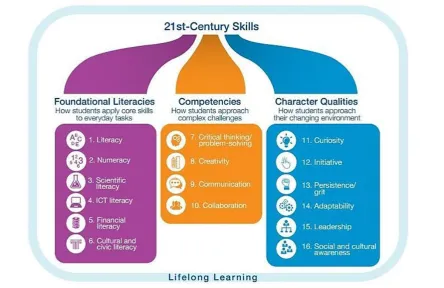
Fig. 2. 21st – Century Skills (Weforum, 2016)
4.5.Distance learning, e-learning and videoconference
There are four major scenarios which illustrate these activities. The setup of the multifunctional room is defined by the type of communication.
First, the room may be set up to receive lectures from a remote location. This may be a "one-way" transmission from teacher to students via videoconference or Skype, with no direct communication. Students are watching the session and taking notes. It could, of course, be a "two-way" communication between remote teacher and students, but then the room with the student`s needs to have microphones, good cameras to show who is asking a question, good lights to show all the students to the teacher on the remote site. In addition, a set of rules needs to be established, regarding how to behave in a videoconference etc.
The room may also be set up to transmit a live lecture to other nodes in the network via videoconference or other software like Skype/WebRTC/Zoom. The local teacher can use interactive projector/common workspace, document camera, teacher PC and other types of tools that he may need to do his session. If the session is sent to several locations simultaneously, a set of communication rules and time schedules need to be established up front. The teacher needs to be trained in both technical and pedagogical challenges, to perform well and deliver a high-quality session.
The third scenario is to prepare the room for group cooperation between different locations. First, we must establish a good quality audio-visual communication, where all the students can see and hear each other. Then provide a common workspace with interactive features to enhance the collaboration. The students may also use their own devices to communicate and share info via familiar Apps/tools.
Page 269
The MFR has features to support many types of e-learning activities both synchronous and asynchronous. The features support creation of a vast set of material to aid a blended learning environment like the production of online documents, running students response and assessment systems, video-lectures for live transmission or stored for flipped classroom scenarios, interactive online collaboration with shared workspaces. It is just up to the teacher to create a new curriculum adapted to how the 21-century students. They study anywhere, in any kind of format and at any time. The production of the new curriculum should consider these facts and make a flexible solution to cover new types of interaction, collaboration, communication and blended learning environments.
5. CONCLUSION
This paper presents an approach to education which is created as the answer to demands from nowadays society and economy. E-learning which is presented in the paper is implemented at Faculty of Mechanical Engineering and whose results encouraging. Within the project, the use of MFR can facilitate a good working environment and good starting point for communication and collaboration between students, both locally and between the nodes in the project. In addition, the MFR delivers a technical framework for universities to unite across international borders. The launch and development of e-learning in educational institutions require much effort. Existence and exploitation of MFR request:
• necessary qualified experts and teachers to introduce educational programs;
• equipment to introduce new educational programs and ensure their implementation; • qualified technical personnel to provide a smooth functioning of the equipment.
We need to inspire, train and facilitate the users/partners in utilizing these MFR rooms. This will be an ever-changing process based on and adapted to changes in education and future workplace.
REFERENCES
Alexander, S. (2001). E-learning developments and experiences. Education & Training, 43, 4/5, 240– 248.
Arkorful V., Abaidoo N, 2014, The role of e-learning, the advantages and disadvantages of its adoption in Higher Education, International Journal of Education and Research, ISSN: 2201-6333 (Print) ISSN: 2201-6740 (Online) <http://www.ijern.com/>
Gilbert J., Morton S., Rowley J. 2007, e-Learning: The student experience, J.Gilbert, S. Morton, J. Rowley, British Journal of Educational Technology Vol 38 No 4, 560–573 doi:10.1111/j.1467-8535.2007.00723.x
Islam A.K.M.N., 2016, E-learning system use and its outcomes: Moderating role of perceived compatibility: Telematics and Informatics, 33(1), 48– 55
Imel, S., 2002. E-learning - trends and issues alert. (Report No-40). Washington, DC: Office of Educational Research and Improvement.
Kuimova M.V., Polyushko D.A., 2015, Dramatization at extracurricular activities as a means to enhance foreign language teaching, International Journal of Emerging Technologies in Learning (iJET), 10(1), 72–73
Kuimova M, Kiyanitsyna A., Truntyagin A., 2016, E-Learning as a Means to Improve the Quality of Higher Education, SHS Web of Conferences 28, 01129
Page 270
Matei A, Vrabie C, 2013, E-learning Platforms Supporting the Educational Effectiveness of Distance Learning Programmes: A Comparative Study in Administrative Sciences, A. Matei, C. Vrabie, Procedia Soc Behav Sci, 93,526–530
"NMC Horizon Report 2017 Higher Education Edition", The New Media Consortium.
Radcliffe D., “A pedagogy-space-technology (PST) framework for designing and evaluating learning places,” in Learning spaces in higher education: Positive outcomes by design: Proceedings of the Next Generation Learning Spaces 2008 Colloquium, 2008, pp. 9–16.
Ruchina A.V., Kuimova M.V., Polyushko D.A., Sentsov A.E., Zhang Xue Jin, 2015, The Role of Research Work in the Training of Master Students Studying at Technical University, A.V. Ruchina, M.V. Kuimova, D.A. Polyushko,A.E. Sentsov, Zhang Xue Jin, Procedia Soc. Behav. Sci, 215, 98–101