Page 641
NON-FORMAL EDUCATION - AN IMPORTANT FACTOR FOR CREATIVE THINKING Natasha Ivanova1, Severina Ivanova2
1Medical University “Prof. d-r Paraskev Stoyanov”, 84 Tsar Osvoboditel, Varna, Bulgaria
2University Hospital “St. Marina”, 1 Hristo Smirnenski, Varna, Bulgaria
Abstract
Non-formal education is a term widely spread all over the world. It was introduced in the second half of the 20th century but in fact non-formal education has appeared in ancient times. Towards the end of the 20th century the necessity and the importance of non-formal education for the further development and enrichment of the contemporary education is completely realized by the society.
Key words: education, non-formal education, creativity, creative thinking
1. REVIEW
Short history of education
The three main concepts of learning, defined by Prof. Gendcheva from Sofia University, are as follows:
1. Life-long learning 2. Life-wide learning 3. Life-deep learning
Firstly, the major motivation of people who keep learning all life long, are the endless interest, curiosity and need to discover, to search and remember new information or gain new skills. Secondly, throughout their life people learn various social activities, participating in different social groups, which confirms the breadth of the learning process. Thirdly, the depth of learning depends on people’s personal beliefs, ideology and values combined with their social and community commitment. The combination of these three conceptions forms a totally innovative approach towards the whole learning process. The subject of this article is to communicate of a good practice concerning the non-formal education in the process of the university education.
From a historic point of view, the beginning of education dated back in the ancient times. When a human being started to educate, he began also to develop and change himself actively. The human civilization got into existence when people realized the necessity of passing cumulated knowledge from generation to generation. In the very beginning, ancient people gained knowledge in their everyday activities, without a specific goal by the method of trial and error, or in other words, they taught themselves alone. Today, this method is known as informal education (Figure 1).
Page 642
The development of human communication and passing knowledge about actions and situations gave birth of a new type of education. This type of education already has certain purpose, albeit simple. Moreover, there is an educator possessing the necessary information. The achieving of the goal is based on the personal demands of the recipient and depends also on his/her abilities, skills and potential. In this case, no definite or specific methods of education are used to reach the goal. The individual could teach him/herself on his/her own, having found the necessary information. Nowadays, this is known as non-formal education (Figure 2).
The transmission and reception of knowledge has been performed by people throughout all their life, at home or at work, during every day activities like fishing and hunting or more complicated social and cultural interactions.
Figure 3. Formal education
Thus, at a particular stage of its development, the human civilization became aware of the necessity to organize a body of special form, which can help and ease people’s lives. As this is an elaborated project with a clearly formulated goal, it requires using of objective methods and tools. The most important feature of this type of education is the leading role of the educator, a person with indispensable knowledge, abilities and teaching skills, a person that stands at a higher level than learners, who must listen and accomplish his/her instructions. Today, this type of education is known as formal education (Figure 3).
The formal education was developing simultaneously with the development of the human civilization. It got to the point when only this type of education was widely implemented, while the other two types were abandoned and neglected. Despite this fact, each individual uses all the possible ways to educate and perfect themselves, including the formal method at school, the non-formal method outside the school and the informal method throughout the everyday activities.
2. NON-FORMAL EDUCATION
Modern understanding of the non-formal education
In our highly-developed technological world the boundaries between these three types of learning have blurred drastically. The need of an appropriate education for everyone leads to incessant demand and absorption of new alternative approaches and innovative methods. In this connection, all these different kinds of learning are used simultaneously. For instance, the informal learning approaches the non-formal learning and in the same time the formal learning uses some methods of the non-formal learning. All these combinations lead to higher results of the learners. This trend is valid for all the stages of the educational system – from the nurseries to the universities.
Page 643
development of constructivism have Giambattista Vico, John Dui, Jean Piaget and Lev Vygotsky. Constructivism is based on the cognitive theory, which studies the evolution of cognition itself and cognition as a process of getting knowledge and its evaluation. The concept that the person forms his/her knowledge on the basis of its own experience and in the course of interaction with the environment is the main subject of the constructivism. Furthermore, one cannot gain knowledge without effort. The reverse is true.
Summarizing the relation between the constructivism and the non-formal education, following conclusion can be made:
The major aim of the non-formal education is not to give people easy knowledge but to motivate them to find new opportunities on the basis of their own experience, needs and abilities.
In this case, important is the need for the use of informal learning. Here however, other questions arise related to the methods used during this non-formal learning: their appropriate dosage at work, appropriate time of implementation, etc. These questions are very important and the response must be monitored throughout the practical application of informal learning.
Good practices for using of the non-formal education
This article is aimed at sharing some good practice in this connection. The author has worked out and used this practice in her biophysics and medical physics laboratory classes with first-year students of Varna Medical University. Like all courses, these particular ones consist of two parts – theory and practice. The exercises turn the theory into practice, but in order to fulfill the practical tasks successfully, the students have to be really familiar with the theory. Most people find it difficult to learn theory than to perform practical tasks. This means that they should make more efforts in this direction and respectively their stimulus should be serious enough. For the students of medicine this stimulus is especially needed by taking into account the community service work they are going to perform after graduating. Even from the beginning of their study, the students realize that their professional competency and knowledge are essential for saving human lives. However, it is in human nature to get tired, and as a result some students distract or lose interest in particular courses. Thus, very often, the first-year students of medicine do not understand the connection between physics and medicine, and the necessity of studying physics. Here comes the importance of laboratory exercises, which demonstrate this connection and give practical knowledge and train useful skills in this direction. During all these classes the figure of the lecturer is really important, due to both his/her competency in the subject and his/her pedagogical skills. By diversifying of the formal academic knowledge using methods of informal learning it was possible to successfully stimulate the effective work of the students.
How to raise the students’ efficiency while teaching the theoretical part of the laboratory exercise? The application of non-formal education during the formal one would have broken the strict, stiff structure of formality.
On the one hand, the students will be able to gain more self-confidence and train their theoretical knowledge and abilities. On the other hand, knowing enough about non-formal education and on the basis of his/her personal experience and creativity, the lecturer may work out and put into practice different methods for more efficient and comprehensive assimilation of the theoretical knowledge by the students.
These methods can be divided into two main groups: theory classes performed by the lecturer
theory classes performed by the students
Page 644 Some of the methods of the first group, are as follows:
The lecturer presents the theoretical unit, not been prepared by the students beforehand;
The lecturer presents a theoretical unit, previously prepared by the students, who are actively participating by answering questions;
The theoretical unit is presented only through the lecturer's questions and students’ answers. The questions follow the theory and all the students are asked by lecturer’s choice;
The theoretical unit has been prepared by the students in advance and they have to answer questions, writing the answers for a defined time. Then they discuss the answers and evaluate themselves;
The positives of the first method consist of the fact that the theory will be presented fully, correctly and in its logical sequence. Taking into account of the deep theoretical knowledge of the lecturer, the unit will be performed with the necessary scientific credibility and accuracy.
However, this method eliminates the communication between the lecturer and the students, who play in this case the role of passive listeners. The lecturer cannot define the level of learning. These are some of the main drawbacks of this method. Further, being in the position of passive listeners, the students might lose interest toward the presented lecture, or feel tired of all the numerous tasks that they have to fulfill in their busy schedule. The accumulated fatigue decreases the level of attention and there is a risk for the students to miss a part of the lecture or even the whole one. To be honest, some students just are in the room without listening to the lectures, whilst others use their phones for chatting with friends or for surfing the social networks.
The second method, in which the lecturer presents a lecture with the active participation of the students, allows bilateral interaction. In addition to the pros, described for the first method, in this case the lecturer has the opportunity to catch and oversee the students’ attention by discussing issues throughout the whole lecture.
Nevertheless, a few cons can be observed in this method, as well. For example, not all of the students can show the same interest towards the matter, so some will not participate actively in the communication with the lecturer. They will stay passively; keep doing their own activities, without disturbing the others. Actually, one third of the listeners take part in the exercises, while two thirds stay uninterested. This method is not the most effective in the interaction with the students.
More efficient is the Q/A practice, when the lecturer asks questions and the students answer. The major advantage of this method is that students are cautious to hear a question at any given moment, which improves the bilateral interaction. They follow the content of the lecture carefully in order to answer the next questions. The established active communication presents to the students’ possibilities not only to exercise, but also to fill in their gaps of knowledge by listening their colleagues’ explanations.
The negative side of this method is that it is time-consuming. In other words, the time for the theoretical part the laboratory classes is not long enough. In fact, the lecturer works out a set of questions suitable for a given theoretical part which are necessary for successfully performing practical tasks. Moreover, not all the students are well-prepared and they are wasting the time.
The most effective of all presented methods is the forth one – a written answering of questions and subsequent discussion of the answers. The questions follow the content of the theoretical part. The students read themselves the answers, then a discussion is held in the group. The increased efficiency of this method comes due to the active participation of all the students in the group by exchanging opinions. This catches their attention, allowing each of them to show interest towards the theoretical issues.
Page 645
Summarizing the methods where the theoretical part of the laboratory exercise is led by the lecturer, it should be noted that the effectiveness of their use is reduced. The subordinate role of the students in this case gives its negative effect. Students do not receive adequate opportunity to show their skills and capabilities. In this regard, more effective methods proved to be those in which the theoretical part is led by the students. In this situation, the students must prepare themselves for the lecture in advance. The optimal number of presenting students is between one and three. These students are in a constant contact with the lecturer, who supports them in their preparation work. The students are given the necessary contacts for communication with the lecturer.
The following methods have been tried by the author:
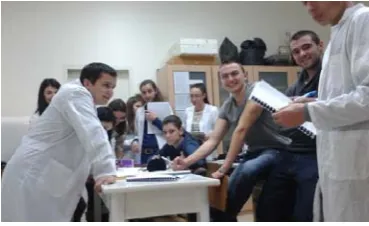
The theory is presented only by 1 to 3 leading students. The others in the group are not prepared beforehand (Figure 4);
The theory is presented in short by the chosen students by plan. They discuss in detail the theory by asking questions to the rest of the group (Figure 5);
The theory is presented in short by the chosen students. The topic is discussed in details by asking questions to the chosen students from the rest of the group;
Students selected in advance do not present the theory. They ask questions to the others during the classes to discuss the theory;
Students selected in advance do not present theory. They answer the questions by the other students of the group;
During the theoretical part, every student asks questions to the others by their choice (Figure 6); The good point of the described methods is that there is an interchange of the roles of students and lecturer. The students take the active role, while the lecturer is in the position a listener. It seems that this the most efficient way of learning.
Achieving best result is the main reason for the lecturer to search and use various methods.
Figure 4. Students explain the theory Figure 5. Student, lab leader, asking questions
Page 646
The aim is a wide field of activity to be given to the students to show up their knowledge, skills and abilities. Moreover, this is a way to increase the level of trust between the students and the lecturer. Basically, this is a great opportunity for the learners to develop their personal qualities. The presenting student increases his/her self-confidence and gets the chance to prove his abilities.
The close informal communication and trust between the students and the lecturer break the chains of the obligatory learning. The students get the opportunity to participate in the learning process led by their own interests, needs and gratification. So, the effect of this type of education is better and more efficient.
The positive side of the mentioned method is that it allows the student to express his potential. One can choose to work out a Power Point presentation or to use different kinds of software, links to referent internet sites and play them online. Another student attached by drawing and visual arts, may decide to draw and write on the whiteboard or use different models to visualize what he is explaining. Presentation and oratory skills are something that should not be neglected nowadays. The ability to attract the public attention is essential, but it is learned lifelong. The strict and logical consequence of thoughts, the correct syntax and punctuality of sentences and the scientific truth of the facts are very important, as well. Training all these skills teaches the students not only to specific scientific abilities, but also to general social interaction.
Despite the advantages, this method shows some disadvantages. Some of them are that the student can go off-topic by paying attention to some external issues instead of the important ones or focus on visualization of different processes and exceptions. Presenting the theory may last longer than needed and here comes the leading role of the lecturer to focus to the essential problems and be aware of the time distribution.
Most of the pros of the second method, in which the leading student presents the theory and asks questions to the rest in the group, are similar to those of the first one. The new task, concerning asking questions, turns out to be a really difficult one. Many students have difficulties to formulate a reasonable question, including topic, form and accuracy. They have the tendency to give very descriptive and detailed questions. Certainly, every beginning is difficult, but with time the students are getting better and better in this activity, which is significant for the job of a physician. In order to receive reasonable answers to their questions, the physicians have to ask their patients something concrete and understandable. Another trouble of the students appears to be extracting the principle issues from the details. They succeed in working out the theoretical unit in full, but not in summarizing the main points in short. To deal with this difficulty for students helps the trustful and close communication with their lecturer. Through time and by enough training all the students gain the courage, confidence and ability to do well with this challenge. Not to forget, there are always some students who have been developed these skills beforehand. They get the possibilities to show themselves up.
As a conclusion, it can be pointed out that the good sides of this method are more than the bad ones. Like cons can be considered the waste of time while waiting for answers of an unprepared student or asking of incorrect questions by the leading students.
The third method is similar to the second one. Here, the roles of students asking and answering questions are interchanged. The group asks and the leading students answer. Despite the positives and negatives of the previous method, it is important to note the high interest in asking questions. Probably, the reason is that the presenting student has to be prepared and the rest ones are in their will to provoke him. The result is a great activity during the laboratory exercises. Although the quality of the questions not so high, the leading students give exact and reasonable answers, which show their appropriate preparation beforehand. The bad aspect of this method concerns the chaotic way of the asked questions without following the content of any particular theory.
Page 647
However, there is always a risk of missing some important issues of the theory, due to the lack of a plan which will be used like a starting point and would organize the questions in the right order. The lecturer’s role is to observe the consequence of the exercises and to decrease the chaos in asking the questions. Moreover, these two methods are not acceptable at the beginning of the semester when the students do not have enough theoretical knowledge.
The last pointed method is the most chaotic of all as it is based on the interaction in the group without a leading student. It is possible to be used only in case when the students have highly-developed skills for asking questions, giving opinion and following the topic. The author has used this laboratory classes at the end of the second semester with students, who she has known and worked since the first semester of the school year. In this situation, the students and the lecturer know each other well. The students have already developed a good level of communicative skills and are able to work alone without the necessity of a leader. If the participating students are at a different level of preparation, there is a risk of failure of the theoretical part of the laboratory exercises.
3. SUMMARY AND CONCLUSION
All types of the presented methods, concerning the theory during the practical exercise of biophysics and medical physics, ought to be used carefully and need to be measured well. The efficiency and the results depend on multiple factors. The first one is high scientific knowledge and professional skills of the lecturer. Deep understanding of biophysics and medical physics is not enough. Also, long pedagogical experience in using non-formal methods of education is essential. Having both of these qualities, necessary for a successful teaching process, as well as using his/her creativity, the lecturer can meet his/her goal for increasing the efficiency of learning and training.
Secondly, the good results depend on the correct time judgment and the level of communicative skills of the students. The lecturer’s decision about the exact time of using of a particular method is very important for the success.
To summarize, the efficiency of laboratory exercises depends on the time-judgment of the lecturer and the correct choice of educating method. Also, the topic of laboratory practice, the volume of learned matter, the complexity and length of studying influence the results of using the non-formal methods. In addition, the time of the day can be an important factor for students’ attention and activity. Early in the morning more people are less hard-working, at noon the feeling of hunger is sharpened and they start making mistakes, while in the afternoon they become sleepy and inactive, and in the late evening classes they feel exhausted. All these factors must be considered by the lecturer for the choice of an appropriate non-formal method.
Based on the above, the following conclusion could be made by the author:
Non-formal methods are really important in the process of university education. However, they need to be used carefully, taking into account the students’ level of knowledge and skills, as well as the right place and time.
Page 648 REFERENCES
1. Ivanova N., 2015, Non-Formal learning in astronomy – a platform for creativity and teamwork of students, Dissertation for obtaining academic degree "Doctor", Sofia University "St. Kliment Ohridski", Sofia (in Bulgarian)
2. Gendcheva A., 2010, Non-formal education in natural science in terms of life-long learning, Himia magazine, year ХІХ, No. 2, pp. 83-96, Sofia (in Bulgarian)
3. Zhelezova D., 2008, Constructivism in the class room, Scientific papers of the Russe University, vol. 47, ser. 9, pp. 192-195, Russe (in Bulgarian)
4. Damyanova A., “Constructivism - a new education paradigm?”, e-magazine LiterNet, 10.12.2005, № 12 (73), Sofia (in Bulgarian), viewed 18 December 2015 http://liternet.bg/publish3/adamianova/konstruktivizmyt.htm