METHODOLOGIES TO DETERMINE THE RESEARCH INITIATIVE PRESENCE AND THE LEVEL OF DEVELOPMENT OF EXPLORING SKILLS IN 9-10-YEAR-OLD PUPILS
Tsvetomira Ilieva Ivanova
South-West University “Neofit Rilski,” Faculty of Pedagogy, Department of Pre-primary and Primary School Education
66 Ivan Mihaylov Street, Blagoevgrad 2700, Bulgariа
Abstract
This article presents a total of eleven methodologies to verify the research initiative presence and to establish the level of development of exploring skills among 9-10-year-old pupils in the process of studying the school subject “Man and Nature". In order to check the statistical reliability and probative results we use nonparametric statistical methods that are appropriate in this case and draw the results by categories based on the points gained.
Key words: methodology, research initiative, exploring skills, school subject “Man and Nature”
1. METHODOLOGY FOR VERIFYING THE PRESENCE OF RESEARCH INITIATIVE (THE INITIATIVE PUPILS ACCOMPLISH THEMSELVES AS RESEARCHERS)
1.1 First task:
Scientific goal of research: to diagnose the presence of initiative among pupils to involve themselves in exploring something new
Materials: a metal handbag holder
Way of conducting it:
A hidden camera monitoring is performed under natural conditions in order to study the interest in a seemingly accidentally placed object (in this case a metal handbag holder with pearls and shingles). The object is placed on the desk and the pupil is left alone in the room. The camera and recorder are activated. The time is limited to 5 minutes only.
Way of reporting and interpretation of the results:
The recording of each pupil is traced individually. The obtained results can be analyzed by three indicators (indication of interest in the object, indication of fluctuation in the interest in the object and indication on lack of interest in the object).
Indicator1: Interest in the object
5 points are granted when holding the attention to the object before the time expires; additional 3 points are granted in the case of its holding until the termination of the time limit.
Indicator 2: Fluctuation in the interest in the object
If any -3 points are given, the duration of fluctuation in the interest contributes extra 2 points.
Indicator 3: Lack of interest in the object
The diagnostics of it does not contribute any points to the rating. The results are listed in rank order.
The maximum number of points is 8 and this determines four categories.
1st category - results from 7 to 8 points - registers high degree of presence of research initiative. 2nd category - results from 5 to 6 points - refers to average degree of presence of research initiative. 3rd category - results from 3 to 4 points - reports random research initiative.
4th category - under 3 points - lack of any research initiative.
A record sheet reporting the individual results from the first task of the diagnostic methodology is made. It includes the following columns: name of the pupil; signs of interest towards the object; signs of fluctuation in the interest towards the object; lack of interest towards the object and number of points gained in accordance with the shown interest towards the object.
1.2 Second task:
Scientific goal of research: to diagnose the presence of research initiative
Materials: 7 varied illustrated situations in which there are two characters set in a relationship
The specifics of the illustrations are borrowed from the Drawing Apperception Test (DAT) of L.N. Sobchik.
Situation 1
Situation 2 Situation 3
Situation 4 Situation 5
Situation 6
Situation 7
Way of conducting it:
The work is done with each pupil individually in laboratory conditions. The pictures are shown one by one. For each of them the pupil must answer the following questions in the indicated order:
1) In place of which of the two characters do you want to be? Why so? 2) What is happening?
3) Why does it happen?
The time for the answers is not limited. The pupil’s responses are written down word for word. Way of reporting and interpretation of the results:
The results are written in an individual record sheet in the order of the questions asked and answers provided. Their rating is completed by means of awarding points. The results can be analyzed by 3 indicators (indication of understanding of the situation; reporting the presence of cognitive interest of one and indifference of the other; identification with characters).
Indicator 1: Presence of understanding of the situation
In case of presence of understanding the situation 2 points are granted. Lack of understanding no points are given.
Indicator 2: Reporting the presence of cognitive interest and other’s indifference
When reporting the presence of both 2 points are granted. Reporting only one of them is 1 point. Lack of reporting cognitive interest or other’s indifference no points given.
Indicator 3: Identification with characters
Shown certainty in the identification with character „А” brings 2 points, the same with character „Б” doesn’t bring any points. Hesitation of identification with character „А” brings 1 point while the same with character „Б” – doesn’t bring any points. Definite rejection of character „Б” brings 2 points while the same of character „А” – doesn’t bring any points.
The maximum score is 42 points. This result sets five categories 7 points each.
1st category - results from 36 to 42 points - registers high presence of research initiative. 2nd category - results from 28 to 35 points - registers medium presence of research initiative. 3rd category - results from 21 to 27 points - shows satisfactory presence of research initiative. 4th category - results from 14 to 20 points - shows poorly developed or random research initiative. 5th category - under 14 points - lack of research initiative.
An individual record sheet with the pupils’ results from the second task of the diagnostic methodology is made. It includes the following notes and comments about each situation: presence of understanding
the situation; reporting the presence of cognitive interest and other’s indifference; identification with characters and score points according to the shown indications.
1.3 Third task:
Scientific goal of research: to diagnose the presence of research initiative
Materials: 7 varied illustrated situations in which there are 2 characters, set in a relationship
The specifics of the illustrations are borrowed from the Drawing Apperception Test (DAT) of L.N. Sobchik.
(Come here to have a look!) Situation 1
(Come to me to make this experiment!)
Situation 2
(I don’t want to, it’s not interesting!)
Situation 3
(No, I am going outside to play!)
Situation 4
(Come here to have a look!)
Situation 5 (Come to me!) Situation 6
(Not me, I am not interested at all!)
Situation 7
Way of conducting it:
The work is done with each pupil individually in laboratory conditions. The pictures are shown one by one. For each of them the pupil has to name the alleged phrase of the character whose “balloon” is empty. Time for the response is not limited. Pupil’s answers are written down in individual record sheets word for word.
Way of reporting and interpretation of results:
The results are written in an individual record sheet in the order of the questions asked and answers provided. Their rating is completed by means of awarding points. The results can be analyzed by 2 indicators (indication of understanding of the situation; reporting the presence of cognitive interest of one and indifference of the other).
Indicator 1: Presence of understanding of the situation
In case of presence of understanding the situation 2 points are granted. Lack of understanding - no points given.
Indicator 2: Reporting the presence of cognitive interest and other’s indifference
When reporting the presence of both 2 points are granted. Reporting only one of them - 1 point. Lack of cognitive interest or other’s indifference – no points given.
The maximum score is 28 points. This result sets four categories 7 points each.
1st category - results from 22 to 28 points - registers high presence of research initiative. 2nd category - results from 15 to 21 points - registers medium presence of research initiative. 3rd category - results from 8 to 14 points - shows poorly developed or random research initiative. 4th category - results under 8 points – lack of research initiative.
An individual record sheet with the pupils’ results from the third task of the diagnostic methodology is made. It includes the following notes and comments: number of the situation; presence of understanding the situation; reporting the presence of cognitive interest and other’s indifference and score points according to the shown indications.
2. METHODOLOGY FOR ESTABLISHING THE LEVEL OF DEVELOPMENT OF SKILL TO DIAGNOSE PROBLEMS
Scientific goal of research: To specify the level of development of skill to diagnose cognitive problems
Way of conducting it:
Preliminary training is necessary as to make pupils learn what a question is like and to get to know how to ask different questions.
The work is individual with each pupil, statements are oral. Pupil’s answers are written down word for word. Time for answer is not specified.
Texts of the methodology:
*
SITUATION № 2.1
It’s winter holidays and Mimi’s mother decides to stay with friends in Bansko with her daughter while the father and Mimi’s brother prepare to travel to Australia where their cousins wait for them. (a modification of Kudriasheva M.G.)
What do they need to take?
Each pupil prepares independently a list with the necessary things for the luggage of the two couples travelling and reports it.
(There might be different opinions and reasons for the reaction of surprise)
I gave you one task, how did you carry it out?
How did you determine the necessary things? (a motive to realize the contradiction) Why did it happen?
What don’t you know? (a motive to formulate the problem) (It is expected to have a question like: What’s the weather like in Australia?)
*
SITUATION № 2.2
What do you think are there various animals in the desert? (a modification of Kudriasheva M.G.) (Answers as “almost none” or “none” are expected)
The teacher reads an excerpt from the scientific and popular articles.
("For the curious / Desert - Animals lie" of http://uchilishte-mechta.dir.bg/_wm/library/item.php?did=282844&df=335964&dflid=3)
"Deserts are inhabited by a wide variety of animals - insects, spiders, scorpions, centipedes, mollusca, reptiles, amphibians, birds and mammals that impress with their size and way of life. However, the number of species is limited compared to others dwelling in forests and freshwaters of zones with moderate climate. Only birds constantly are able to live in the Sahara are amounting 29 species, the same number are in the deserts of North America and in Australia they are 17.”
What did you say at the beginning?
What did you think about the desert?
What has turned out? What did you learn from the text?
What problem occurred? What do you need to understand?
(It is expected to have a question like: “How do animals survive in the desert?”) Way of reporting and interpretation of the results:
The results are written in an individual record sheet. Their rating is completed by means of awarding points. The results can be analyzed by 3 indicators (understanding and explanation of the problem; partial understanding and explanation of the problem; lack of understanding and explanation of the problem).
Indicator 1: Presence of understanding of the problem – 3 points are granted
Indicator2: Partial understanding of the problem – 2 points are granted
Indicator3: Lack of understanding of the problem – 0 points are granted
The maximum score is 6 points. This result sets three categories.
1st category - results from 5 to 6 points - registers stability in development of the skill of problem understanding.
2nd category - results from 3 to 4 points - registers instability in development of the skill of problem understanding.
3rd category - results under 3 points - shows lack in development of researched skill.
An individual record sheet with the results of the diagnostic methodology is made. It includes the following columns for each situation: understanding of the problem, partial understanding of the problem, lack of understanding of the problem.
3. METODOLOGY FOR ESTABLISHING THE LEVEL OF DEVELOPMENT OF THE SKILL FOR PRECISE FORMULATION OF THE PURPOSE OF IMPLEMENTATION OF THE EXPERIMENT
Scientific goal of research: to diagnose the level of development of the skill for precise formulation of the purpose of implementation of the experiment
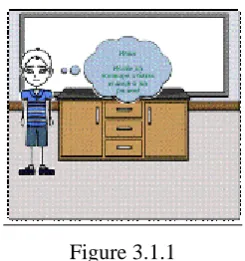
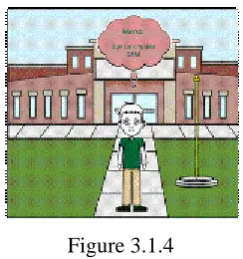
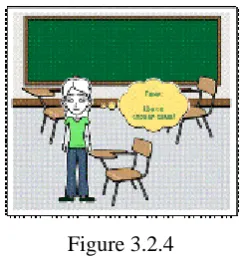
Materials: one story (with accompanying instruction and questions) and one situation requiring the pupil to make his choice of a strategy of behavior. The methodology is worked out in two similar modifications for boys and girls. The main characters in first modification are boys (figures 1.1 – 1.4), in the second - girls (figures 2.1 – 2.4).
Way of conducting it:
The work is individual with each pupil, statements are oral. Pupil’s answers are written down word for word. The time for answer is not specified.
The instruction to the story is as follows:
I am going to tell you something and you have to listen carefully because afterwards I will ask you some questions.
Story: „Ivan took the instructions manual booklet for the washing machine. He immersed himself in reading it and thought on the indication limit of laundry weight. He decided to measure 5 kilograms of clothes, put them into the washing machine in order to wash them. After the end of the wash program he decided to weigh them again”.
Answer the following questions:
What did Ivan want to understand? Why?
The instruction to situation is as follows:
I am going to tell you something and you have to listen carefully because afterwards I will ask you some questions.
Situation: The teacher assigns the task to the students to examine and verify various objects at home and to see if there is dependence (ratio) between their size and weight.
* Figures (3.1.1-3.1.4 and 3.2.1-3.2.4) are created at http://www.storyboardthat.com/
3.1 Modification for boys (first modification)
Figure 3.1.1
Ivan’s answer: “I want to talk to my elderly brother to make decision together!”
Figure 3.1.2
Kaloyan’s answer: “I won’t be able to do it alone, I will use one of others decision!”
Figure 3.1.3
Angel’s answer: “I think of something which is going to be useful for me!”
Figure 3.1.4
Mitko’s answer: “I will manage to do it alone!”
Answer the following questions:
Who of the four friends would you want to be like? Why?
3.2 Modification for girls (second modification)
Figure 3.2.1
Mimi’s answer: “I want to talk to my elderly sister to make decision together!”
Figure 3.2.2
Yana’s answer: “I won’t manage to do it alone, I will use one of others decision!”
Figure 3.2.3
Beni’s answer: “I think of something which is going to be useful for me!”
Figure 3.2.4
Leni’s answer: “I will manage to do it alone!”
Answer the following questions:
Who of the four friends would you want to be like? Why?
Way of reporting and interpretation of the results:
Both a story and а situation helps to determine the accuracy of formulation of the purpose of implementation of the experiment. Situations suggest also variations in the level of expression and independence in this formulation.
Criterion 1: Independence
Indicator 1.1: Accepting somebody else’s purpose (externally placed)
Accepting somebody else’s purpose doesn’t bring any points, hesitation brings 1 point while the refusal of accepting somebody else’s purpose is -2 points.
Indicator 1.2: Formulation of purpose in the presence of external assistance
Formulating purpose in the presence of somebody else’s assistance doesn’t bring any points, hesitation brings 1 point while the refusal of somebody else’s assistance is -2 points.
Indicator 1.3: Formulation of purpose by imitation or analogy
Formulating purpose by imitation or analogy doesn’t bring any points, hesitation for imitation or analogy brings 1 point while the refusal of it is -2 points.
Indicator 1.4: Independent formulation of purpose
Signs of independent formulation of purpose bring 2 points. Criterion 2: Accuracy of the formulation:
Indicator 2.1: Presence of accuracy – 2 points
Indicator 2.2: Lack of accuracy – 0 points
The answers to the questions provide the opportunity for meaningful analysis. In particular the answers on the question “Why?” give information about the confidence and determination of purpose formulation. This to a certain degree accompanies the independent behavior when implementing the experiment.
The maximum score points is 40. This result sets four categories.
1st category - results from 31 tо 40 points - registers high level of development of the skill for precise formulation of the purpose of implementation of the experiment.
2nd category - results from 21 to 30 points - confirms satisfactory level of development of the skill for precise formulation of the purpose of implementation of the experiment.
3rd category - results from 11 to 20 points - registers instable level of development of researched skill. 4th category - results under 11 points - shows a lack in development of researched skill.
An individual record sheet with the results of the diagnostic methodology is made. It includes separate notes on the story and situations regarding the particular criterions and indicators.
4. METHODOLOGY FOR ESTABLISHING THE LEVEL OF DEVELOPMENT OF THE
SKILL FOR HYPOTHESIS’ FORMULATION UPON DEMONSTRATIVE AND
THEORETICAL MATERIAL 4.1 First task:
Scientific goal of research: to diagnose the level of development of the skill for hypothesis’ formulation
Materials: applied below picture № 1
Picture № 1 Way of conducting it:
The work is individual with each pupil. Statements are oral. The answers are written down word for word. The time limit for assumptions is 2 minutes. Conversations are interrupted when the pupil exhaust his/her hypothesis.
Instruction to picture № 1 is as follows: Answer the next questions: Why is the turtle placed on wheels?
Who put it that way and why?
Way of reporting and interpretation of the results:
Results are written in individual records sheets and are analyzed in three indicators as follows:
Indicator 1: Easy hypothesis’ formulation: one hypothesis brings 1 point, 2 hypotheses bring 2 points and more than 2 hypotheses – 3 points.
Indicator 2: Originality of hypothesis: an unusual and original hypothesis brings 1 point, two unusual hypotheses – 2 points, more than two – 3 points.
Indicator 3: Well-grounded hypothesis: one argument brings 1 point, two arguments – 2 points, more than two arguments – 3 points. Using science hypothesis argumentation brings 3 additional points.
4.2 Second task:
Scientific goal of research: to diagnose the level of development of the skill for hypothesis’ formulation
Materials: applied below pictures (Pictures № 2/1 and № 2/2), (Guilford and Torrance’s modified subtest for creative thinking diagnostics)
* the picture below (picture № 2 /1) is downloaded from http://www.tashev-galving.com/094+KLD1744/%D0%A1%D0%B0%D0%B4%D0%B8%D0%BB%D0%BE
Picture № 2 /1 Picture № 2 /2
Way of conducting it:
Each pupil has an individual task to point as many as possible hypotheses about the use of the displayed objects on pictures № 2/1 and 2/2 including different assumptions from their ordinary usage. Instruction to pictures № 2/1 and 2/2 is as follows: Answer the next questions:
What is this used for? What else can it be used for? (the question is asked until pupils stop giving assumptions).
Way of reporting and interpretation of the results:
Results are written in individual record sheet and are analyzed in three indicators as follows:
Indicator 1: Easy hypothesis’ formulation and number of hypothesis provided: one hypothesis brings 1 point, two hypotheses bring 2 points, more than two hypotheses – 3 points.
Indicator 2: Originality of hypothesis: originality is judged as uniqueness in providing the hypotheses. As a key indicator in assessing the results is used the coefficient of originality. It shows the ratio of the amount of original assumptions and the total speculation. Thus, the coefficient of originality characterizes the development of the group in general.
Indicator 3: Well-grounded hypothesis: one argument brings 1 point, two arguments bring 2 points, more than two arguments – 3 points. Using scientific knowledge to justify the assumptions carries 3 extra points.
The maximum number of points is 30. This sets three categories.
1st category - results from 21 to 30 points - registers high level of development of skill of hypothesis’ formulation.
2nd category - results from 11 to 20 points - registers medium level of development of skill of hypothesis’ formulation.
3rd category - results up to 10 points - shows instable level of development of skill of hypothesis’ formulation.
An individual record sheet with the results of the diagnostic methodology is made. It includes separate notes regarding the particular indicators.
5. METHODOLOGY FOR ESTABLISHING THE LEVEL OF DEVELOPMENT OF THE SKILL FOR DETECTION AND TRACKING OF CAUSATION
5.1 Task № 1:
Scientific goal of research: to diagnose the level of development of the skill for detection and tracking of causation (to reveal and trace cause and effect connection)
Materials: writing materials (A4 sheets of paper and a pen)
Way of conducting it:
Preliminary instructions are necessary in order to explain to the pupils what cause and effect are. The work is done individually with each pupil, statements are written.
Instructions: Each pair of words contains one reason (cause) and one consequence (effect). Find and write the cause-word in the left column and the effect-word in the right column. Add your suggestions in case they are relevant to the school subject “Man and Nature”.
* A table with two columns is provided.
Text of the methodology:
List of words in pairs:
heat and sun; high temperatures and evaporation; melting and high temperatures; fire and blaze; temperatures under 00 C and ice; rain and clouds; clouds and snow; clouds and hail; sugar and sweet taste; salt and salted taste; smoke and smell of smoke.
Way of reporting and interpretation of the results:
Criterion 1: Distinction between cause and effect - for each correct pair of words 2 points are granted. Criterion 2: New original suggestions for cause and effect connection - for each new pair of words 3 extra points are given.
5.2 Task № 2:
Scientific goal of research: to diagnose the level of development of the skill for detection and tracking of causation (to reveal and trace cause and effect connection)
Materials: writing materials (A4 sheets of paper and a pen)
Way of conducting it:
The work is done with each pupil individually, statements are written. Instructions: Continue the hypothesis below:
1. The grass is yellow because
... Later when..., then the
grass... If it was..., then
... 2. The puddles are frozen because
... Later when..., then the
puddles... If it was ..., then
... 3. The glass is cracked because
………... Later when……..., then the
glass………...
If it was ..., then
... 4. The glass is broken because…………..
... Later when ……. ..., then the glass
…………... If it was ..., then ... 5. The grass is frosted
because……... Later when …….. ..., then the
grass... If it was ..., then
...
Criterion 1: In case the pupil finds a possible reason 2 points are granted for each correct answer. Criterion 2: In case the pupil tracks cause and effect consequence 2 points are granted for each
correct answer. Criterion 3: In case the pupil foresees the changes of conditions 2 points are granted for each correct
foreseeing. For each partial foreseeing the pupil gets 1 point. The maximum score of points is 52. They set four categories.
1st category - results above 40 points - registers very high level of development of skill for detection and tracking of causation (to reveal and trace cause and effect connection).
2nd category - results from 27 to 39 points - registers firm level of development of skill for detection and tracking of causation (to reveal and trace cause and effect connection).
3rd category - results from 14 to 26 points - registers satisfactory level of development of skill for detection and tracking of causation (to reveal and trace cause and effect connection).
4th category - result under 13 points - shows unsatisfactory level of development of skill for detection and tracking of causation (to reveal and trace cause and effect connection).
An individual record sheet with the results of the diagnostic methodology is made. It includes separate notes regarding the particular criterions.
6. METHODOLOGY FOR ESTABLISHING THE LEVEL OF DEVELOPMENT OF THE SKILL FOR DEFINITION OF RESEARCH TASK
Scientific goal of research: to diagnose the level of development of the skill to define a research task with own assumptions
Materials: 2 hypotheses in a whole text
Way of conducting it:
Preliminary instructions are necessary in order to explain to the pupils what hypothesis and research task are. The work is done with each pupil individually, statements are verbal. Answers are written down word for word. The time for answers is not restricted.
Instructions: Answer the following questions:
How can you check the presumption?
How the research task can be formulated?
What will change?
What can be done to fulfill the research task?
(During the procedure it is estimated if the pupil needs support)
Text of the methodology:
Assumption № 1: If water (in any open container) is left in the open air for a long time it will begin to evaporate.
Assumption № 2: If we make a mess of soaked pieces of torn paper and then we unroll them we will get new sheet of paper.
Way of reporting and interpretation of the results:
Each of the stories shows the level of expressions and the independent formulations of the pupils when doing their own experiments and examines the accuracy of their statements.
Criterion 1: In case of relevance of the formulated task with the assumption provided 2 points are granted, in cases of partial relevance 1 point is given.
Criterion 2: Implementation plan of the research task – for a comprehensive plan -2 points, for a partial plan – 1 point Criterion 3: Independence of opinion.
Indicator 3.1: Need of support – 1 point.
Indicator 3.2: Independent task formulation - 2 points.
The answers to the questions allow meaningful analysis. In particular, answering the question "Why" indicate the confidence and determination that accompany the onset of autonomy in formulating the task for the experiment.
The maximum score of points is 12. This sets four categories.
1st category - results from 10 to 12 points - registers high level of development of skill for definition of research task.
2nd category - results from 7 to 9 points - confirms satisfactory level of development of skill for definition of research task.
3rdcategory - results from 4 to 6 points - reports unstable level of development of skill for definition of research task.
4th category - result under 4 points - shows unsatisfactory level of development of researched skill. An individual record sheet with the results of the diagnostic methodology is made.
7. METHODOLOGY FOR ESTABLISHING THE LEVEL OF DEVELOPMENT OF SKILL TO PROPERLY ASSESS THE ONGOING EXPERIMENT
Scientific goal of research: to diagnose the level of development of the skill to properly assess the ongoing experiment
Materials: water, mud, sand, clay, a balloon, a bottle of soda-water, glasses, spoons
Way of conducting it:
Two experiments are staged to run one by one; the pupils evaluate them. The work is done in the form of individual discussion. Answers are written down word for word. The time is not set.
List of questions which the experimenter meets while observing the study:
7.1 Task № 1: To check out if the water is soluble (regarding mud, sand and clay). Instructions: Answer the following questions:
What varies during the experiment?
How is this monitored during the experiment? (a question about frequency is not asked, the frequency is monitored by the person organizing the methodology task)
How do you check if you make mistakes? (a question about the frequency is not asked, the frequency is monitored by the person organizing the methodology task)
7.2 Task № 2: To inflate a balloon with a bottle. Instructions: Answer the following questions:
What varies during the experiment?
How is this monitored during the experiment? (a question about frequency is not asked, the frequency is monitored by the person organizing the methodology task)
How do you check if you make mistakes? (a question about the frequency is not asked, the frequency is monitored by the person organizing the methodology task)
Way of reporting and interpretation of the results:
Criterion 1: Reporting the change during the experiment adds 2 points, partial reporting gains 1 point. Criterion 2: Monitoring changes during the experiment brings 2 points, partial monitoring is 1 point. Criterion 3: Correct ongoing of the experiment with 1 display of self-control adds 1 point, for more than one 2 points are granted.
The maximum score of points is 12. This sets four categories.
1st category - results from 10 to 12 points - registers high level of development of skill to properly assess the ongoing experiment.
2nd category - results from 7 to 9 points - confirms satisfactory level of development of skill to properly assess the ongoing experiment.
3rd category - results from 4 to 6 points - reports unstable level of development of skill to properly assess the ongoing experiment.
4th category - result under 4 points - shows unsatisfactory level of development of skill to properly assess the ongoing experiment.
An individual record sheet with the results of the diagnostic methodology is made.
8. METHODOLOGY FOR ESTABLISHING THE LEVEL OF FORMATION AND DEVELPMENT OF DEXTERITIES AND SKILL FOR APPLYING THEM
Scientific goal of research: to diagnose the level of formation and development of dexterities and the skill for applying them
Materials: a pin, a straw, an arrow made of cardboard, a feather, a pencil with a rubber, a long stick
Way of conducting it:
The experiment is implemented in order to diagnose the direction of the wind. A weather vane is made and while making it the movements and reactions of the pupils are observed. The work is individual. Way of reporting and interpretation of the results:
5 and 6 positive activities report very good level of formation and development of dexterities and skill for applying them.
3 and 4 positive activities report good level of formation and development of dexterities and skill for applying them.
1 and 2 positive activities report unsatisfactory level of formation and development of dexterities and skill for applying them.
A separate record sheet reporting the individual results during the research work is made. It includes notes about the following indicators: manners during the task’s implementation, independence of work, pace for work, organization of the workplace.
9. METHODOLOGY FOR ESTABLISHING THE LEVEL OF DEVELOPMENT OF THE SKILL FOR PRESENTATION OF RECEIVED INFORMATION IN SUMMARY FORM Scientific goal of research: to diagnose the level of development of the skill for presentation of received information in summary form
Materials: writing materials (A4 sheets of paper and pens), yarn, string, pack-thread, paper products, plastic materials, fabrics and wool, pieces of leather, thin twigs, sticks and stones.
Way of conducting it:
Each pupil conducts their own experiment. For this purpose the pupils observe a bird’s nest and the necessary materials for its building are prepared. These are left close to a tree. For several days pupils observe which of provided materials will be used by the birds to build the nest.
Instructions: What materials do birds build their nests from?
The pupils choose how to put down the information on their own.
Way of reporting and interpretation of the results:
Criterion 1: Variety in ways of presenting the results, including use of tables, schemes, charts or
pictures are given 2 points. For more than one form of presenting the information 4 points are granted. Criterion 2: Comprehensiveness of information contained therein:
- regarding the objects, subject of the research - 4 points for comprehensive information, 2 points for partial comprehensiveness. - regarding other objects not subject of research – 4 points for comprehensive information, 2 points for partial comprehensiveness. - acquisition of knowledge and gaining practical experience out of it - 4 points for comprehensiveness, 2 points for partially comprehensive information.
The maximum number of points is 16. This sets four categories.
1st category - results from 13 to 16 points - registers strongly expressed stability in development of the skill to present received information in summary form.
2nd category - results from 9 to 12 points - registers moderate stability in development of the skill to present received information in summary form.
3rd category - results from 5 to 8 points - registers instability in development of the skill to present received information in summary form.
4th category - result under 5 points - registers lack of development of the researched skill. An individual record sheet with the results of the diagnostic methodology is made.
10. METHODOLOGY FOR ESTABLISHING THE LEVEL OF DEVELOPMENT OF THE SKILL TO FORMULATE CONCLUSIONS IN ACCORDANCE WITH ASSUMPTIONS CHECKED
Scientific goal of research: to diagnose the level of development of the skill to formulate conclusions after checking of assumptions
Materials: a newspaper, a table, a wooden ruler
Way of conducting it:
The following text is read out loud to the students: Version 1:
“If hit with your fist on the half of the wooden ruler, protruding from the edge of the table while its other half lies on the table and is covered with a newspaper folded twice, the ruler will not be overthrown.
Course of the experiment: Place a ruler half on the table, half in the air. Place a twice folded newspaper on the half of ruler lying on the table. Hit with a fist on the half of ruler in the air.
Result: The ruler changes its position as well as the newspaper but do not fall down.” Version 2:
“The sun heats to an equal degree various objects regardless of their colour.
Course of the experiment: Sheets of paper of different colours (including black and white) are arranged at the sunniest part of the window. They are left in the sun for an hour and afterwards each pupil must touch the sheets of paper one by one.
Result: The hottest sheet of paper is the black one, the coldest - the white one.”
The work is individual, the statements are oral and the time for the answers is not limited. Instructions: Answer the following questions:
Is the assumption rejected or proved?
What conclusions can be drawn? Do you have any doubts about them?
Can they be considered valid? Why?
How can you use the conclusions?
Way of reporting and interpretation of the results:
Indicator 1: Compliance of the conclusions with the assumption. For complete compliance - 4 points are granted, for partial - 2 points are given. Indicator 2: Comprehensiveness of conclusions. If available - 4 points are granted, for partial comprehensiveness - 2 points are given.
Indicator 3: Practical use of the conclusions. If available - 4 points are granted, for partial practical use - 2 points are given.
The maximum number of points is 12. This sets four categories.
1st category - results from 10 to 12 points - registers strongly expressed stability in the development of the skill to formulate conclusions in accordance with assumptions.
2nd category - results from 7 to 9 points - registers moderate stability in the development of the skill to formulate conclusions in accordance with assumptions.
3rd category - results from 4 to 6 points registers - instability in the development of the skill to formulate conclusions in accordance with assumptions.
4th category - result under 4 points - registers lack of development of researched skill. An individual record sheet with the results of the diagnostic methodology is made.
11. METHODOLOGY FOR ESTABLISHING THE LEVEL OF DEVELOPMENT OF THE
SKILL TO RELATE THE RESULT WITH PRELIMINARILY FORMULATED
ASSUMPTION
Scientific goal of research: to diagnose the level of development of the skill to relate the result with the preliminary formulated assumption
Way of conducting it:
The work is individual, statements are oral. Answers are written down word for word. The time for answers is not set.
Instructions: Answer the following questions:
1. What did you want to check? 2. Did you check it?
3. Support it with evidence.
4. Did you enjoy checking it? Do you want to check something else? What is it?
Way of reporting and interpretation of the results:
Criterion 1: Status of the assumption: for confirmation 4 points are granted, for rejection – no points given.
Criterion 2: For adequate self-assessment 4 points are granted, for partial – 2 points, lack of assessment – no points given.
Criterion 3: Critical attitude: lack of desire for a different research course - 4 points, hesitation of desire for a different research course – 2 points, presence of such a desire – no points given.
Criterion 4: Argumentation: for comprehensive argumentation – 4 points, for partial – 2 points, lack of argumentation – no points given.
The maximum number of points is 16. This sets four categories.
1st category - results from 13 to 16 points - registers high level of development of the skill to relate the result with the preliminary formulated assumption. 2nd category - results from 9 to 12 points registers - medium level of development of the skill to relate the result with the preliminary formulated assumption. 3rd category - results from 5 to 8 points - registers the beginners’ level of the development of the skill to relate the result with the preliminary formulated assumption. 4th category - result under 5 points - registers lack of development of researched skill.
An individual record sheet with the results of the diagnostic methodology is made.
REFERENCES
Батоева, Д, Попов, Т & Драголова, Е 2007, Педагогическа и психологическа диагностика. Аскони-издат, София
Браун, СД 1994, Сапунени мехури, небесни дъги и червеи, Техника, София
Ландвеер, К 2007, Най-интересните ескперименти за деца – Книга първа, СофтПрес ООД, София
Ландвеер, К 2007, Най-интересните ескперименти за деца – Книга втора, СофтПрес ООД, София
http://www.tashev-galving.com/094+KLD1744/%D0%A1%D0%B0%D0%B4%D0%B8%D0%BB%D0%BE, viewed 19 May 2015
http://psylab.info/%D0%A0%D0%B8%D1%81%D0%BE%D0%B2%D0%B0%D0%BD%D0%BD% D1%8B%D0%B9_%D0%B0%D0%BF%D0%BF%D0%B5%D1%80%D1%86%D0%B5%D0%BF% D1%82%D0%B8%D0%B2%D0%BD%D1%8B%D0%B9_%D1%82%D0%B5%D1%81%D1%82/% D0%A1%D1%82%D0%B8%D0%BC%D1%83%D0%BB%D1%8C%D0%BD%D1%8B%D0%B9_ %D0%BC%D0%B0%D1%82%D0%B5%D1%80%D0%B8%D0%B0%D0%BB, viewed 8 December 2014
http://www.storyboardthat.com/, viewed 13 January 2015
http://uchilishte-mechta.dir.bg/_wm/library/item.php?did=282844&df=335964&dflid=3, viewed 8 February 2015