PROBLEM BASED LEARNING IN A TIMBER CONSTRUCTION COURSE Paulo Cachim1, Teresa Herdeiro2
1
RISCO & Department of Civil Engineering, Aveiro University, Portugal
2
IBIMED & Department of Health Sciences, Aveiro University, Portugal
Abstract
Following the profound changes that occur in higher education in Europe with the implementation of the Bologna Process, a multi-method of active learning in a Timber Construction course that is part of the Integrated Master in Civil Engineering degree at Aveiro University in Portugal was implemented. This learning method motivates students to become active participants in the learning process and to promote their autonomy was implemented. This is a method that includes problem-based learning, and where students research, process, discuss and apply information, with emphasis in the development of their soft skills. The quality assurance system of the Aveiro University, together with other self assessment methods used in class, were used to evaluate the satisfaction of students with the method. The results show that more than 80% of the students are satisfied with the methodology.
Key words: Problem based learning, Civil engineering, Timber construction, Bologna process
1. INTRODUCTION
Following the Bologna Declaration signed in 1999 (European-Commission 1999), the Bologna Process promoted the creation of an European Higher Education Area (EHEA) based on international cooperation and academic exchange that is attractive to European students and staff as well as to students and staff from other parts of the world (European-Comission 2010). However, besides the creation of an EHEA, the Bologna process triggered a thorough thinking about the organisation and learning-teaching methods of the study cycles and courses. This, pushed professors to organize their activities such that a more pronounced participation of students in the learning process occurs. These active learning strategies are often based on the Problem-Based Learning (PBL) method.
Curricula and teaching and learning strategies of engineering degrees and courses has often been claimed to be outdated, not student-centred, not providing sufficient design experiences, too focused on technical courses without integration of the topics and not leading to communication skills and teamwork experience. Although this may be true in the past, a lot of effort and work has been developed by professors of engineering courses to change this situation in recent years. To overcome these critics, curricula and courses have been updated and active learning strategies implemented in several places. Among these methods, PBL and innumerous variations has been one the most referenced. PBL started more than 40 years ago applied to medical schools. More recently, it started to be used in engineering education. PBL has been implemented in some engineering courses and study cycles such as Aalborg University (Aalborg, Denmark), University of Castilla-La Mancha (Ciudad Real, Spain), University College Dublin (Dublin, Ireland), University of Limerick (Limerick, Ireland) among others (Ureña et al. 2003; Mills & Treagust 2003; Anette Kolmos et al. 2007; Gavin 2011; Cosgrove et al. 2010; Steinemann 2003; Bielefeldt 2013). At University of Aveiro, PBL was also initially introduced in Health Sciences courses (Herdeiro et al. 2004). The key features of PBL, as described in (Anette Kolmos et al. 2007) are:
a) Learning is a student-centred process.
b) Problems are ill structured and complex, based on real world situations and act as a stimulus for the course, curriculum or program.
c) Instructor is mostly a facilitator.
d) Learning is performed by analysing, studying, discussing and proposing solutions to the problems.
e) Students participate in the assessment procedure.
This makes is clear that additional time is needed to prepare course materials and determine an effective student assessment procedure. Also students need to adapt to this self-directed learning. The forms of PBL traditionally used in engineering schools are often called project-based or hybrid PBL, since they differ from traditional PBL in a number of ways (Mills & Treagust 2003):
a) Project tasks take longer period of time than PBL because the projects are closer to professional reality.
b) Project work is more directed to the application of knowledge, while PBL is more directed to the acquisition of knowledge.
c) Contrary to PBL, project-based learning is usually accompanied by subject courses.
d) In project-based learning the management of time and resources by the students is very important.
e) Self-direction is stronger in project work than in PBL, because the learning process is not so directed by the problem.
Another important difference between project and problem-based learning is that in projects, at the end of the period, students have to deliver a finished product such as a design or a report and, therefore, this product is a fundamental part of the assessment system (Anette Kolmos et al. 2007). In any case, the used strategy must be adapted to local conditions. Most important thing, is that an active learning environment exists where the student play the central role of the learning process. Another important issue is that the problems are based on professional practice and could, therefore, have different solving times.
The objective of this article is to present the strategies and the results of the implementation of a multi-method of active learning in a Timber Construction course that is part of the Integrated Master in Civil Engineering degree at Aveiro University in Portugal. A learning method that motivates students to become active participants in the learning process and to promote their autonomy was implemented. This is a method that includes problem-based-learning, and where students research, process, discuss and apply information, with emphasis in the development of their soft skills.
2. THE TIMBER CONSTRUCTION COURSE 2.1 Course characterization
The Timber Construction course is an elective curricular unit of the fifth and last year of the Integrated Master in Civil Engineering. It has 6 ECTS that correspond to 162 working hours, from which, 42 are contact hours (3 hours/week). The number of students each year ranges from 10 to 30 and, typically, half of the students are mobility students. Because of this, the course is taught in English (typically courses are in Portuguese). These characteristics of the course are the same since 2007 when the Bologna Process was implemented in Portugal.
2.2 Objectives of the course
The objectives of the course can be divided into technical-scientific and social objectives. The major technical-scientific objective is that the students, at the end of the course, will be able to analyse and design timber constructions.
Regarding the social objectives, it is intended that the students acquired and/or developed skills that could facilitate their integration in the labour market and in the society. Through the combination of the syllabus and the learning and teaching methodology, the students should develop their creativity, self-confidence, autonomy and initiative based on their individual and group work capacity, and also to improve their oral and written communication skills. Their environmental consciousness should also be increased towards the use of natural and recyclable materials in construction, leading to a more sustainable world.
The course syllabus can be broadly divided in two distinct parts: the construction material and the design rules. The construction material part covers the history of timber construction, timber properties, degradation, classification, assessment, preservation of wood and wood-based products. The design rules concern the design of structural timber elements according to Eurocode 5.
2.3 Learning/Assessment activities
In the Timber Construction course a multi-method active learning strategy was used where different learning/teaching methodologies were used. The aim of them is to ensure that the students are an active part of the learning process.
For the construction material part of the course syllabus, a PBL approach was adopted where problems are presented to students and they have to solve them in groups. This allows students to improve their skills related to, for example, autonomy, group work, initiative, time management and conflict management. The solution to the problems is made through oral presentations or written reports.
Preliminary attempts that were more focused on PBL showed that, for the design of structures part, a more traditional approach to present the subjects followed by class work and a project to solve is more effective than just present the students a problem that they have to design. Therefore, for this part of the syllabus, the lectures followed by class problems and a design problem approach was used. This methods allows students to learn the design rules and then, using their autonomy, to apply them into a real design project situation, increasing their self-confidence and autonomy in problem solving. They understand that what they have learned in classes is to be used in real world situations.
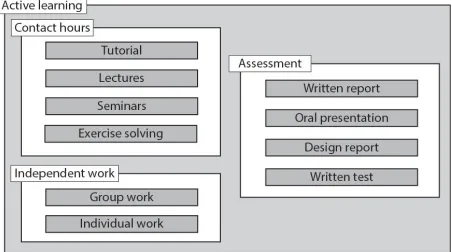
A variety of strategies are thus used in the contact hours with the students. A mix of contact hours strategies, independent work and assessment rules is used to promote an active learning environment in the course, according to Figure 1, which will be detailed in the following sections.
Figure 1. Learning/assessment activities.
2.4.1 Contact hours
The contact hours are divided into different activities during the semester (see Figure 1). In tutorial classes the students work in groups and discuss the proposed problems. The problems were analysed
in order to decide what is necessary to investigate and what is the relation with existing knowledge. The teacher acts as a facilitator, guiding the students in the intended direction.
Lecture classes are used to explain the design rules and to present and solve some exercises in order to explain how to apply the design rules. The teacher assumes a “classical” role in these classes exposing the subjects and promoting the student participation.
Following these classes, there are exercise-solving classes where the students solve, on their own, design exercises covering the different aspects of timber design.
The seminar classes, typically one or two, are given by experts and allow students to interact with experts. This gives students different perspectives of the labour market and an opportunity to ask questions and to dissipate some fears.
2.4.2 Independent work
Students perform independent work that is either individual or in groups. Because the only individual assessment activity they have is the test, a large part of this work is performed in groups. In the design report, students present all the design calculations for a simple frame or beam including all the necessary verifications and drawings such as they will do in a real design situation in practice.
2.4.3 Assessment methodology
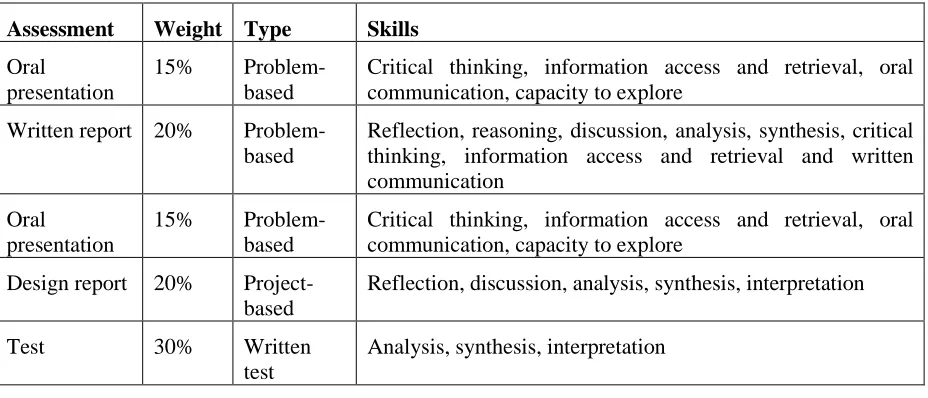
The assessment methodology is an important part of the learning process. It should be designed so that the objectives of the course could be reached by the students and should comply to 10 objectives: credibility, dialogue, improvement, participation, reflexion, regulation, challenge, sustainability, transparency and transferability (Rodríguez-Gómez & Ibarra-Sáiz 2015). To comply with these objectives multiple assessment procedures were used in Timber Construction course. Assessment procedure is clearly defined at the first class of the semester and is written in the pedagogical dossier of the course. The assessment of the Timber Construction course is defined as continuous, according to the definition used at University of Aveiro. This means that there is no final examination and that, at least, five different assessment moments/elements must exist during the semester. Table 1 summarises the types, the weights and main skills of each assessment moment. The students and the teacher perform the oral presentation assessment, while the teacher marks the other moments. It is interesting to note that the students have, initially, some difficulty in marking the works of other colleagues but during the semester this gradually disappears.
Assessment Weight Type Skills Oral
presentation
15% Problem-based
Critical thinking, information access and retrieval, oral communication, capacity to explore
Written report 20% Problem-based
Reflection, reasoning, discussion, analysis, synthesis, critical thinking, information access and retrieval and written communication
Oral
presentation
15% Problem-based
Critical thinking, information access and retrieval, oral communication, capacity to explore
Design report 20% Project-based
Reflection, discussion, analysis, synthesis, interpretation
Test 30% Written
test
Analysis, synthesis, interpretation
Table 1. Assessment activities.
During oral presentations, the other groups have to place some questions. Oral presentation criteria for assessment are content, graphical quality, presentation, answer to questions and group communication.
Oral presentations are in English what contributes to internationalization of the course and helps Portuguese students practicing a foreign language that is known worldwide. For the written report, the criteria are content, organisation, references and language.
3. STUDENT SATISFACTION
3.1 Quality assessment at Aveiro University
The Quality Assessment System of Aveiro University (SGQ - Sistema de Garantia da Qualidade) was created in 2009. The system assesses the opinion of students and professors regarding the learning environment. Regarding students, they should ask a series of questions regarding the course and a set of questions regarding the professor(s) of the course. The whole set of questions and system functioning is available at university website http://sgq.ua.pt. The answers are given in a 9-point Likert scale, from 1 (disagree) to 9 (agree).
The students must access the questionnaire but are not obliged to answer it. They can say that they do not want to answer or answer just to a number of courses. Is the number of students answering the questionnaire are less than five, the system does not validate them and the professors do not have access to the results.
3.2 Results for Timber Construction course
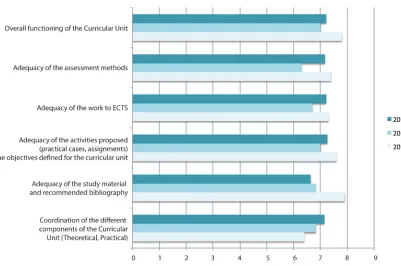
The results of SGQ corresponding to years 2011/2012, 2012/2013 and 2014/2015 are presented in Figure 2. There are no results for the 2013/2014 school year, because the number of students that answer to the system were less than five.
Figure 2. Answer of students to questions (average values).
It can be seen that, in general and despite some variations from year to year, the students are quite satisfied with the course. The answers that consistently have higher values (always above 7) are the Overall functioning of the curricular unit and the Adequacy of the activities proposed. This indicates
that the students like the active learning method used in the course. The average values of theses questions in all the courses of the study cycle are 6.41 and 6.47, respectively.
An additional item that is important is that the students consider that the number of working hours to the number of ECTS is adequate. This indicates that there is not a work overload due to the method.
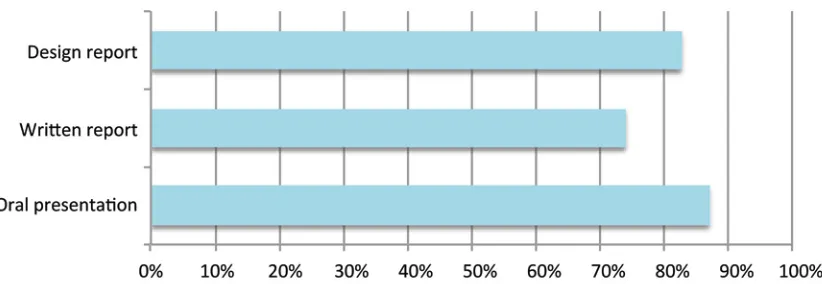
The teacher conducted an assessment of the students’ satisfaction with the assessment method in the year 2014/2015. The students answer, anonymously, in the class to an additional questionnaire, where they were asked about the importance of the assessment activities. In Figure 3, the results of the satisfaction of students are shown. A satisfied student is considered here as a student that has answered with a value of 7 or above.
Figure 3. Student’s satisfaction with assessment activities.
The students considered the written report as least adequate of the methods. This is not particularly strange in engineering students that usually do not like to write. However, even in this case 74% of the students consider it as adequate.
On the other side, oral presentations are the method that students consider more adequate. In this case 87% of the students considered the method as adequate.
4. CONCLUSIONS
This article presents the strategies and the results of the implementation of a multi-method of active learning in a Timber Construction course. The results were assessed through the use of anonymous questionnaires performed in the context of the Quality Assurance System of the university. From the period of analysis it can be concluded that:
a) The variety of learning activities motivated students and teacher due to the learning-technique that aids on transpose the theoretical knowledge to practical education.
b) The method promotes several skills of students such as autonomy, critical thinking, information access and retrieval, oral and written communication of students.
c) The teaching/learning method allowed integration of knowledge.
As a final concluding remark, the active learning method used in the Timber Construction course represents a successful and significant approach teaching and motivating students in this engineering course. In additional, and also very important, it gives students the chance to enhance their individual personal and professional skills.
REFERENCES
Anette Kolmos, A.U. et al., 2007. Problem Based Learning. TREE – Teaching and Research in Engineering in Europe. Special Interest Group B5 “Problem based and project oriented learning,”
Bielefeldt, A., 2013. Pedagogies to Achieve Sustainability Learning Outcomes in Civil and Environmental Engineering Students. Sustainability, 5(10), pp.4479–4501. Available at: http://www.mdpi.com/2071-1050/5/10/4479/htm [Accessed September 16, 2015].
Cosgrove, T., Phillips, D. & Quilligan, M., 2010. EDUCATING ENGINEERS AS IF THEY WERE HUMAN: PBL IN CIVIL ENGINEERING AT THE UNIVERSITY OF LIMERICK. In 3rd International Symposium for Engineering Education. University College Cork, Ireland.
European-Comission, 2010. European Higher Education Area, 2010-2020. , http://www. Available at: http://www.ehea.info/ [Accessed July 15, 2015].
European-Commission, 1999. Bologna Declaration.
Gavin, K., 2011. Case study of a project-based learning course in civil engineering design. European Journal of Engineering Education, 36(6), pp.547–558. Available at: http://dx.doi.org/10.1080/03043797.2011.624173.
Herdeiro, M. et al., 2004. Multi-method active learning approach: improving the educational experience in Pharmaceutical Drug Development. Indian Journal of Pharmaceutical Education and Research, 48(3), pp.16–25.
Mills, J. & Treagust, D., 2003. Engineering education—Is problem-based or project-based learning the answer? Australasian Journal of Engineering Education, 3(2), pp.2–16.
Rodríguez-Gómez, G. & Ibarra-Sáiz, M., 2015. Assessment as Learning and Empowerment: Towards Sustainable Learning in Higher Education. In M. Peris-Ortiz & J. M. Merigó Lindahl, eds. Sustainable Learning in Higher Education SE - 1. Innovation, Technology, and Knowledge Management. Springer International Publishing, pp. 1–20. Available at: http://dx.doi.org/10.1007/978-3-319-10804-9_1.
Steinemann, A., 2003. Implementing Sustainable Development through Problem-Based Learning: Pedagogy and Practice. Journal of Professional Issues in Engineering Education and Practice, 129(4), pp.216–224. Available at: http://dx.doi.org/10.1061/(ASCE)1052-3928(2003)129:4(216).
Ureña, J.M. de, Menéndez, J.M. & Coronado, J.M., 2003. Project/Problem Based Learning in Civil Engineering: the Ciudad Real (Spain) Experience. In International Conference on Engineering Education. Valencia, pp. 1–8.