Baghdad Science Journal
Vol.15(3)2018
DOI:http://dx.doi.org/10.21123/bsj.2018.15.3.0335
St-Polyform Modules and Related Concepts
Muna Abbas Ahmed
Received 3/5/2018, Accepted 26/6/2018, Published 13/9/2018
This work is licensed under a Creative Commons Attribution 4.0 International License.
Abstract:
In this paper, we introduce a new concept named polyform modules, and show that the class of St-polyform modules is contained properly in the well-known classes; St-polyform, strongly essentially quasi-Dedekind and 𝜅-nonsingular modules. Various properties of such modules are obtained. Another characterization of St-polyform module is given. An existence of St-polyform submodules in certain class of modules is considered. The relationships of St-polyform with some related concepts are investigated. Furthermore, we introduce other new classes which are; St-semisimple and 𝜅-non St-singular modules, and we verify that the class of St-polyform modules lies between them.
Keywords:
𝜅
-nonsingular modules, Polyform modules, Semi-essential submodules, St-closed submodules, Strongly essentially quasi-Dedekind modules.Introduction:
Throughout this paper, all rings are assumed to be commutative with a non-zero unity element, and all modules are unitary left R-modules. The notations V ≤eU and V ≤𝑠𝑒mU mean that V is an essential and semi-essential submodule of U respectively. A submodule V of U is called essential if every non-zero submodule of U has a non-zero intersection with V (1, P.15). A submodule V of U is called semi-essential if every non-zero prime submodule of U has a non-zero intersection with V (2). A submodule V of U is called closed if V has no proper essential extensions inside U (1, P.18). Ahmed and Abbas introduced the concept of St-closed submodule, where a submodule V of U is said to be St-closed, if V has no proper semi-essential extensions inside U (3).
In this paper, we introduce and study a new class named St-polyform modules. This type of modules is contained properly in some classes of modules such as polyform, strongly essentially quasi-Dedekind and 𝜅-non St-singular modules. An R-module U is called polyform if for every submodule V of U and for any homomorphism 𝑓: VU, ker𝑓 is closed submodule in U (4). A module U is called strongly quasi-Dedekind, if
HomR(UV, U)=0 for all semi-essential submodule V of U (5). An R-module U is called 𝜅-nonsingular, if for each homomorphism 𝑓End(U) such that ker𝑓 is essential submodule of V, then 𝑓= 0 (6, P.95). Department of Mathematics, College of Science for Women, University of Baghdad, Iraq.
E-mail: [email protected]
We define in this work a proper class of 𝜅 -nonsingular modules named 𝜅-non St-singular. We define St-polyform as follows: an R-module U is called St-polyform, if for every submodule V of U and for every homomorphism 𝑓: VU, ker𝑓 is closed submodule in V. We verify that an St-polyform module is smaller than all of the classes: polyform, strongly quasi-Dedekind, 𝜅-nonsingular and 𝜅-non St-singular modules, see remark 2, proposition 30, proposition 40 and proposition 56. Beside that we give another generalization for St-polyform modules.
This work consists of three sections. In the first section we provide another characterization of polyform modules, we show that a module U is St-polyform if and only if for each non-zero submodule V of U and for each non-zero homomorphism 𝑓: VU; ker𝑓 is not semi-essential submodule of V, see theorem 4. Also we present the main properties of St-polyform module, for example we show in proposition 7 the existence of St-polyform in certain class of modules, also we prove in the proposition 11; if W≤semV for every submodule V of U with HomR(
V
non-zero small submodule V of U, and for each
𝑓HomR(V,U); ker 𝑓 ≰eV (4). Furthermore, we introduce another generalization for St-polyform module named essentially St-polyform module, and we show in theorem 26; the two concepts are equivalent under the class of uniform modules. The last section of this paper is devoted to study the relationships of St-polyform with other related concepts such as quasi-Dedekind and some of its generalizations as well as 𝜅-nonsingular and Baer modules. We show that under certain condition an strongly essentially quasi-Dedekind module can be St-polyform, see theorem 31. Also, we give a partial equivalence between St-polyform and 𝜅 -nonsingular modules, see theorem 42. Moreover, other related concepts of St-polyform module are introduced which are St-semisimple, and 𝜅-non St-singular modules.
St-polyform modules:
In this section, various properties and anther characterization for St-polyform modules are investigated. We start by the following definition.
Definition 1: An R-module U is called St-polyform, if for every submodule V of U and for any homomorphism 𝑓:VU, ker𝑓 is St-closed submodule in V. A ring R is called St-polyform, if R is St-polyform R-module.
Remark 2: The St-polyform module is a proper class of polyform module. In fact if U is St-polyform module, then for every submodule V of U and for any homomorphism 𝑓: VU, ker𝑓 is St-closed submodule in V. Since the class of St-closed submodule is greater than the class of St-closed submodule, thus ker𝑓 is closed submodule in U; hence U is a polyform module. On the other hand, not every polyform module is St-polyform for example; Z2 as Z-module is clearly polyform module, but not St-polyform, since the identity homomorphism I: Z2 Z2 has zero kernel which is not St-closed submodule in Z2 (3).
Examples and Remarks 3:
i. Simple module is not St-polyform module. The proof is similar as proving Z2 is not St-polyform in remark 2.
ii. Z8 is not St-polyform module. In fact there exists 𝑓: (2̅) Z8 defined by 𝑓(𝑥̅) = 2̅x 𝑥̅(2̅). Note that ker 𝑓= (4̅), and (4̅) is not St-closed submodule in Z8.
iii. Epimomorphic image of St-polyform module may not be St-polyform; for example Z10 is St-polyform, while
𝑍10
(2) ̅̅̅̅ Z5. By i, Z5 is not St-polyform.
iv. Monoform module need not be St-polyform. For example, Z2 is a monoform Z-module, but it is not St-polyform as we seen in remark 2.
v. Uniform may not be St-polyform module, where a non-zero module U is called uniform if U every non-zero two submodules of U have non-zero intersection (1, P.85).
vi. Q as Z is not St-polyform. In fact Q is uniform module, hence it is semi-uniform, and the result follows by v.
vii. Z6 is an St-polyform module, since every submodule of Z6 is St-closed. So the kernel of any homomorphism from each submodule to Z6 isSt-closed. For the same argument Z10 is St-polyform.
viii. Z12 is not St-polyform Z-module.
ix. A submodule of St-polyform module may not be St-polyform, for example; by vii, Z6 is an St-polyform module, but A = (2̅) ≤ Z6 is not St-polyform, since A is simple module, which is not St-polyform as we showed in i.
The following theorem gives another characterization of St-polyform module.
Theorem 4: An R-module U is St-polyform, if and only if for each non-zero submodule V of U and for each non-zero homomorphism 𝑓: VU; ker𝑓 is not semi-essential submodule of V.
Proof: ⇒) Assume that there exists a non-zero submodule V of U and a non-zero homomorphism 𝑓:VU such that ker𝑓 is semi-essential submodule of V. But ker𝑓 ≤StcV, therefore ker𝑓=V, hence 𝑓=0 which is a contradiction. That is ker𝑓 ≰𝑠𝑒𝑚V. ∎
⇐) Suppose that there exists a submodule V of U and a homomorphism 𝑓: VU such that ker𝑓 is not closed submodule in V. By definition of St-closed, there exists a submodule W of V such that ker𝑓 ≤semW ≤ V. Consider the homomorphism
𝑓 ∘ 𝑖: W U. It is clear that 𝑓 ∘ 𝑖≠ 0, and since ker𝑓 W, then ker(𝑓 ∘ 𝑖) ≤semW (2). But this is contradict with our assumption, thus ker𝑓 is St-closed submodule of V.
The following examples are checked by using theorem 4.
Examples 5:
i. Any semi-uniform module is not St-polyform module, where a non-zero R-module U is called semi-uniform if every non-zero submodule has non-zero intersection with all prime submodules of U (2).
Proof i: Let V be a non-zero submodule of U, and 𝑓: VU be a non-zero homomorphism. Assume that U is St-polyform module, so ker𝑓 ≰sem V, hence ker𝑓 ≰sem U (2). But this contradicts the definition of semi-uniform module, thus U is not St-polyform.
ii. Z is not St-polyform Z-module. In fact since Z is semi-uniform module, so the result follows by i.
iii. Z4 is not St-polyform module. In fact if we take V=Z4 in the theorem 4 as a submodule of itself, so there exists a homomorphism
𝑓HomR(Z4,Z4) defined by 𝑓(x)=2x xZ4, note that ker 𝑓= (2̅) which is semi-essential submodule of Z4. Thus Z4 is not St-polyform module.
iv. Z⨁Z2 is not St-polyform Z-module. To show that; assume there exists a submodule V=Z⨁Z2 and a homomorphism 𝑓: VU defined by 𝑓(x, 𝑦̅) = (0,𝑥̅), where xZ, 𝑦̅Z2. Note that 𝑓≠ 0, and ker𝑓={(x, 𝑦̅) V| 𝑓(x, 𝑦̅) = (0,0)} = {(x, 𝑦̅) V|𝑥̅= 0̅}= 2Z⨁Z2, hence ker𝑓 ≤semV. So Z⨁Z2 is not St-polyform module.
Proposition 6: A direct summand of St-polyform module is St-polyform.
Proof: Let U=U1⨁U2 be a St-polyform module, where U1 and U2 are R-submodules of U. Let V1 be a non-zero submodule of U1, and 𝑓: V1 U1 be a non-zero homomorphism. Consider the following sequence:
V1 𝑓
→ U1 𝑗
→U1⨁U2
where j is an injection homomorphism. Now, 𝑗 ∘ 𝑓: V1 U, and U is St-polyform, then ker( 𝑗 ∘ 𝑓) ≰semV1. Since ker( 𝑗 ∘ 𝑓) = {v1V1| ( 𝑗 ∘ 𝑓)(v1) = 0} = {v1V1| 𝑓(v1) = 0}= ker𝑓⨁ U2, then ker𝑓⨁ U2 ≰semU. But U2 ≤sem U2, thus ker𝑓 ≰semU1 (5, Lemma(1.18)). That is U1 is St-polyform. ∎
The converse of proposition 6 is not true in general; for example each of Z10 and Z6 are St-polyform Z-modules; see 3vii, but Z10 ⨁Z6 is not St-polyform Z-module.
Recall that an R-module U is called Artinian if every descending chain of submodules in U is stationary (1,P.7). The following proposition indicates the existence of St-polyform submodules in certain class of modules.
Proposition 7: Every nonzero Artinian module has a submodule which is an St-polyform.
Proof: Let U be a non-zero Artinian module, and V be a submodule of U. If V is St-polyform, then we are done. Otherwise there exists a submodule V1 of V and a homomorphism 𝑓1: V1 V with ker(𝑓1 ) ≰St𝑉1 and ker(𝑓1 ) ≤StV2 for some proper submodule V2 of V1. Now, if V1 is St-polyform, then we are through, otherwise there exists a submodule V3 of V2 and a homomorphism 𝑓2: V3 V2 with ker(𝑓2 ) ≰St𝑉3 and ker(𝑓2 ) ≤𝑆𝑡𝑉4 for some proper submodule V4 of V3. We continue in this manner until we arrive in a finite number of steps at a submodule which is an St-polyform submodule. Otherwise, we have an infinite
descending chain VV1V2 . . . of submodules of the module U. But this is a contradiction, since U is Artinian. Therefore U contains an St-polyform submodule. ∎
Proposition 8: Let U be an R-module. If either V1 or V2 are St-polyform module, then V1∩ V2 is St-polyform module.
Proof: Assume that V1 is St-polyform module. Let V be a non-zero submodule of V1∩ V2, and let f: VV1∩V2 be a non-zero homomorphism. Consider the following sequence:
V →𝑓 V1∩ V2 𝑖
→V1
Since V1 is a St-polyform module, then ker (𝑖 ∘ 𝑓) ≰semV. But ker𝑓=ker(𝑖 ∘ 𝑓), then ker 𝑓 ≰semV. That is V1∩ V2 is a St-polyform module. ∎
Recall that an R-module U is called scalar if for any 𝑓 EndR(U), there exists rR such that 𝑓(x)=rx xU, where EndR(U) is the endomorphism ring of U (5).
Proposition 9: Let U be a faithful scalar R-module. Then R is an St-polyform ring if and only if EndR(U) is an St-polyform ring.
Proof: Since U is a faithful scalar module, then EndR(U) R (7). So if R is an St-polyform module, then EndR(U) is polyform, and vice versa. ∎
An R-module U is called multiplication for every submodule V of U there exists an ideal I of R such that V= IU (8, P.200).
Corollary 10: Let U be a finitely generated faithful and multiplication R-module. Then R is St-polyform ring if and only if EndR(U) is St-polyform module.
Proof: Since U is finitely generated and multiplication, then U is a scalar module (7), and the result follows by proposition 9. ∎
Proposition 11: Let U be an R-module. If W≤semV for every submodule V of U, such that HomR(
V
W , U) = 0, then U is a St-polyform module.
Proof: Assume U is not St-polyform module, so there exists a submodule V of U and a non-zero homomorphism 𝛼: V U such that ker𝛼 ≤semU. Define 𝜑: kerα V U by 𝜑(v+ker𝛼) = 𝛼(v) v+
ker𝛼kerα V . We can easily show that 𝜑 is well defined and homomorphism. Since 𝛼 is a non-zero homomorphism, then 𝜑 is also non-zero, thus HomR(
V
W , U)≠0. But this contradicts our assumption, therefore ker𝛼 ≰semU. ∎
Proposition 12: Let U be an R-module, and I be an ideal of R such that I annR(U), then U is St-polyform R-module if and only if U is St-St-polyform R
Proof: Assume that U is an St-polyform R-module. Since I annR(U), then it can be easily shown that HomR(V , U) = HomR
I
(V, U) for each submodule V
of U, hence the result follows directly. ∎
Recall that an R-module U is called injective if for every monomorphism 𝑓: AB where A and B be any R-modules, and for every homomorphism 𝑔: AU, there exists a homomorphism h: B U such that ℎ ∘ 𝑓 = 𝑔 (8, P.33). A module U is called quasi-injective if it is U-injective R-module (8, P.83). The injective hull (quasi- injective hull) of a module U is defined as an injective (quasi- injective) module with essential extension of U, it is denoted by E(U) (respectively U̅) (8, P.39). Clark and Wisbauer in (9) proved that a module U is polyform if its quasi-injective hull is polyform. As analogue of that, we have the following result.
Proposition 13: Let U be an R-module. If the injective hull E(U) of U is St-polyform module, then U is St-polyform module.
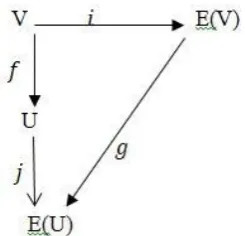
Proof: Let V be a non-zero submodule of U, and 𝑓:VU be a non-zero homomorphism. Suppose the converse is not true, that is ker𝑓 ≤semV. Consider the following Fig. 1.
Figure 1. The diagram of injective the module E(U)
where 𝑖: V E(V) and 𝑗: U E(U) are the inclusion homomorphisms. Since E(U) is injective, then there exists a non-zero homomorphism 𝑔: V U such that 𝑔 ∘ 𝑖 = 𝑗 ∘ 𝑓. It is clear that ker(𝑔 ∘ 𝑖) ker𝑔 and ker𝑓 = ker(𝑗 ∘ 𝑓). Since E(U) is an St-polyform module, then ker(𝑔) ≰semE(V). By definition of injective hull V≤e E(V), hence V≤sem E(V), and by our assumption ker𝑓 ≤semV, then by transitivity of semi-essential submodules ker𝑓 ≤sem E(V) (2). On the other hand, clearly ker𝑓 ker𝑔, therefore ker𝑔 ≤sem E(V) (2), which is a contradiction. Therefore, ker𝑓 ≰semV, i.e V is an St-polyform module. ∎
In example 3ix, we verified that a submodule of St-polyform may not be St-polyform. In the following proposition, we satisfy that under certain condition.
Corollary 14: Let U be an injective and St-polyform module. If V is an essential submodule, then V is St-polyform module.
Proof: Since V is an essential submodule of U, then E(V) = E(U) (10, Prop(2.22), P.45). But U is injective module, so U = E(U). This implies that E(V) = U. Since U is polyform, then E(V) is St-polyform. The result follows by proposition 13. ∎ Recall that a module over integral domain R is called divisible if U=rU rR (10, P.32).
Corollary 15: Let R be a division ring, and U be an St-polyform R-module. If V is essential submodule of U, then V is an St-polyform module.
Proof: Since R is a division ring, then U is an injective module (10, P.30), and the result follows by corollary 14. ∎
Corollary 16: If R is a division St-polyform ring, then each ideal of R is an St-polyform.
Proof: Let I be an ideal of R. Since R is a division ring, then clearly every ideal of R is essential. On the other hand, since every module over division ring is an injective module (10, P.30), therefore I is injective. But R is an St-polyform ring, so by corollary 14, I is a St-polyform ideal. ∎
Corollary 17: Let U be a divisible St-polyform module over P.I.D. If V is an essential submodule of U, then V is St-polyform module.
Proof: Since U is divisible over P.I.D, then U is injective (10, Th(2.8), P.35). The result follows by corollary 14. ∎
Recall that a commutative domain R is called Dedekind; if every non-zero ideal of R is invertible (10, P.36).
Corollary 18: Let U be a divisible module over Dedekind domain R, and V≤eU. If U is a St-polyform module, then V is St-St-polyform.
Proof: Since Every divisible module over a Dedekind domain is injective (10, P.36), then by corollary 14, we are done. ∎
St-polyform and Polyform modules:
In this section, we investigate the relationships of St-polyform module with polyform and small polyform modules. Besides that, we introduce another generalization for St-polyform modules. In the previous section, we verified that the class of St-polyform modules is a proper subclass of polyform modules. In the following theorems, we use certain conditions under which St-polyform module can be polyform module. Before that; an R-module U is called fully prime if every proper submodule of U is prime (2).
Theorem 19: Let U be a fully prime R-module, then U is St-polyform if and only if U is a polyform module.
Proof: ⇒) By remark 2.
homomorphism. Since U is polyform, then ker𝑓 is closed submodule in U. But U is fully prime, then ker𝑓 is an closed in U (3), hence U is St-polyform. ∎
Recall that an R-module U is called fully essential, if every semi-essential submodule of U is essential (2).
Theorem 20: Let U be a fully essential R-module, then U is St-polyform if and only if U is a polyform module.
Proof: ⇒) By remark 2.
⇐)Let V be a non-zero submodule of U, and𝑓: V U be a non-zero homomorphism. Since U is polyform, then ker 𝑓 ≰eV. But U is fully essential; therefore, ker 𝑓 ≰semV (2), that is U is St-polyform module. ∎
The following proposition shows that the class of St-polyform domain coincides with the class of polyform domain.
Theorem 21: An integral domain R is an St-polyform if and only if R is St-polyform domain.
Proof:⇒) It is obvious.
⇐) Assume that R is a polyform domain. Let I be a non-zero ideal of R, and 𝑓: I R be a non-zero homomorphism. Since R is integral domain, then ann(I)=0; that is annR(I)≰semR. Thus R is St-polyform. ∎
Hadi and Marhoon in (4) gave a generalization of polyform module as follows:
Definition 22: An R-module U is called small polyform module if for each non-zero small submodule V of U, and for each non-zero homomorphism 𝑓: VU; ker 𝑓 ≰eV.
Remark 23: Every St-polyform module is small polyform.
Proof: Since every St-polyform module is polyform, so the result follows directly. ∎
Now, we need to introduce another class of polyform modules which is bigger than polyform modules.
Definition 24: An R module U is called essentially polyform module if for each non-zero proper essential submodule V of U, and for each non-zero homomorphism 𝑓: VU; ker 𝑓 ≰eU.
We can generalize St-polyform as follows:
Definition 25: An R module U is called essentially St-polyform module if for each non-zero proper essential submodule V of U, and for each non-zero homomorphism 𝑓: VU; ker 𝑓 ≰semV.
It is clear that every St-polyform module is essentially polyform, and every essentially St-polyform module is essentially St-polyform module. Furthermore, it should be noted that the polyform module lies between polyform and essentially St-polyform module.
The following theorem gives a partial equivalence between St-polyform and essentially St-polyform module.
Theorem 26: Let U be a uniform module, then U is polyform if and only if U is essentially St-polyform.
Proof: ⇒) It is straightforward.
⇐) Assume that U is essentially St-polyform, and let V be a non-zero submodule of U, and 𝑓: V U be a non-zero homomorphism. Since U is a uniform module so V ≤eU. But U is essentially St-polyform; therefore, ker 𝑓 ≰semV; that is U is an St-polyform module. ∎
By replacing uniform module by hollow and essential submodule by small, we have the following; and the proof is in a similar way.
Proposition 27: Let U be a hollow module, then U is St-polyform if and only if U is small St-polyform. We can summarize the main results of this section by the following implications of modules:
St-polyform ⇒ Polyform ⇒ Small polyform
St-polyform ⇒ Polyform ⇒ Essentially St-polyform ⇓
Essentially polyform
St-polyform and other related concepts:
This section is devoted to study the relationships of St-polyform with some related concepts such as quasi-Dedekind and some of its generalizations, 𝜅-nonsingular, injective, extending, Baer and 𝜅-non St-singular module.
Recall that an R-module U is called quasi-Dedekind, if for every non-zero homomorphism
𝑓End(U), ker𝑓=0 (11).
Remark 28: It is worth mentioning that St-polyform modules and quasi-Dedekind modules are independent; for example the Z-module Z6 is St-polyform module see example 3vii, but not quasi-Dedekind. On the other hand, Z is quasi-Dedekind (11), but not St-polyform, see example 5ii.
Proposition 29: Let U be a semi-uniform module. If U is St-polyform then U is a quasi-Dedekind module.
Proof: Assume that U is St-polyform module, and let 𝑓End(U). If V be a non-zero submodule of U, then we have the following sequence:
V →𝒊 U→𝒇 U
The converse of proposition 29 is not true in general, for example Z2 is a quasi-Dedekind module, but not St-polyform.
Recall that an R-module U is called strongly essentially quasi-Dedekind if for each non-zero homomorphism 𝑓EndR(U), ker𝑓 ≰semU (5). Proposition 30: Every St-polyform module is strongly essentially quasi-Dedekind.
Proof: Let U be St-polyform module. Let V be a non-zero submodule of U, and 𝑓: VU be a non-zero homomorphism. By assumption ker𝑓 is not semi-essential submodule in V. In particular, all non-zero endomorphisms of U have kernels which are not semi-essential in U, proving our assertion. ∎ The converse of proposition 30 is not true in general, for example Z2 is strongly essentially quasi-Dedekind module (5, Ex (1.11)) but not St-polyform as we saw in remark 2. In the following theorem we use a condition under which the converse is true.
Proposition 31: Let U be a quasi-injective R-module then U is U is St-polyform if and only if U is a strongly essentially quasi-Dedekind module.
Proof: ⇒)By proposition 30.
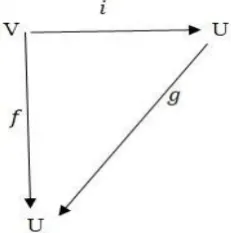
⇐) Let V be a non-zero submodule of U, and 𝑓:VU be a non-zero homomorphism. Consider the following Fig. 2.
Figure 2. The diagram of injective module U
where 𝑖: V U is the inclusion homomorphism. Since U is quasi-injective, then there exists a homomorphism 𝑔: UU such that 𝑔 ∘ 𝑖 = 𝑓. Now,
𝑔End(U) and U is essentially quasi-Dedekind; therefore, ker𝑔 ≰semU. But ker𝑓 ker𝑔, then by transitivity of semi-essential submodule, ker
𝑓 ≰semU (2), and we are done. ∎
In (3) Ahmed and Abbas proved that if every submodule of U is St-closed, then every submodule of U is direct summand. This motivates us to introduce the following.
Definition 32: An R module U is called St-semisimple if every submodule of U is St-closed. This concept is clearly a proper subclass of semisimple modules, and we can easily prove the following.
Remark 33: Every semisimple module is St-polyform module.
We think that the converse of the remark 33 is not true in general, but we cannot find example.
Definition 34: Let U be an R-module. We define St-singular submodule as follows:
{uU| annR(u) ≤sem R}
It is denoted by St-sing(U). If St-sing(U) = U, then U is called St-singular module, and U is called non St-singular if St-sing(U) = 0. ∎
Example 35: Q as Z-module is non St-singular, where Q is the set of all rational numbers, since sing(Q) = 0. For the same reason Z is non St-singular Z-module.
Proposition 36: Let U and V be R-modules. If HomR(V,U)=0 for each St-singular module V, then U is non St-singular module.
Proof: Consider the inclusion homomorphism 𝑖: St-sing(U) U. It is clear that sing(U) is St-singular module, so by assumption 𝑖=0. But 𝑖 (St-sing (U)) = St-(St-sing(U), therefore (St-sing U=0. That is U is non St-singular. ∎
Remark 37: For any submodule V of an R-module U, St-sing(V)=St-sing(U)∩V.
Proof: It is clear that St-sing(V) St-sing(U), so the result follows directly. ∎
Remark 38: By using remark 37, we can easily show that the class of St-singular module is closed under submodules.
Recall that an R-module U is called 𝜅 -nonsingular, if for each 𝑓EndR(U); ker𝑓 ≤eU, then 𝑓=0 (6, P.95). In other words, for every non-zero homomorphism 𝑓EndR(U); ker 𝑓 ≰eU. As example for this class of modules is Z-module Zp, it is 𝜅-nonsingular for every prime number P, since Zp is a simple module; therefore, all non-zero endomorphisms are automorphisms.
Remark 39: The concept of 𝜅-nonsingularity is strictly weaker than the concept of nonsingularity for modules (6, Ex(4.1.10), P.96), where an R-module U is called nonsingular if Z(U)=0, where Z(U)= {uU| annR(u)≤eR} (1, P.30).
Proposition 40: Every St-polyform module is 𝜅 -nonsingular.
Proof: Let U be St-polyform module. Let V be a non-zero submodule of U, and 𝑓: V U be a non-zero homomorphism. By assumption, ker 𝑓 ≰semV. As we take V=U, then we obtain 𝑓: U U, and ker
𝑓 ≰semU. Since every essential submodule is semi-essential (2), then ker𝑓 ≰eU, hence U is 𝜅 -nonsingular. ∎
Examples 41:
1. Every simple module is 𝜅-nonsingular (12), but not St-polyform, see example 3i.
2. The Z-module Q is nonsingular module, hence it is 𝜅-nonsingular (12). But Q is not St-polyform module, see example 3vi.
3. The Z-module U = Q ⨁Z2 is not St-polyform module. In fact if V= Z⨁(0) be a non-zero submodule of U. Let 𝑓: V U be a map defined by 𝑓(x,0) =(0,𝑥̅), where xZ. It is clear that 𝑓 is a non-zero homomorphism, then ker𝑓={(x,0)V|
𝑓(x,0)=(0,0̅)}=2Z⨁(0). We can easily verify that 2Z⨁(0) ≤semV, hence U is not St-polyform module. On the other hand, U is 𝜅-nonsingular Z-module (12).
The following proposition gives a partial equivalence between St-polyform and 𝜅 -nonsingular modules.
Theorem 42: Let U be a fully essential quasi-injective module, then U is St-polyform if and only if U is 𝜅-nonsingular provided that HomR(V,U) ≠ 0. Proof:⇒) By proposition 40.
⇐ ) Suppose that U is a 𝜅-nonsingular, and let V be a non-zero proper submodule of U. Let 𝑓: V U, Since HomR(V,U)≠0, so we can take 𝑓≠0. Consider the following Fig. 3.
Figure 3. The diagram of injective module U
where 𝑖: V U is the inclusion homomorphism. Since U is quasi-injective, then there exists a homomorphism 𝑔: UU such that 𝑔 ∘ 𝑖 = 𝑓. Now,
𝑔 EndR(U) and U is 𝜅-nonsingular, thus ker 𝑔 ≰eU. But ker𝑓 ker𝑔, thus ker 𝑓 ≰eU. Since U is fully prime, then ker 𝑓 ≰semU. ∎
Corollary 43: Let U be a fully prime injective module. Then U is an St-polyform module if and only if U is 𝜅-nonsingular.
Proof: Since every fully prime module is fully essential (2), and EndR(U) ≠ 0, then the result follows by theorem 42. ∎
Lemma 44: (11) If U is an injective module, then J(EndR(U)) = {𝑓 EndR(U)| ker𝑓 ≤eU}.
Corollary 45: Let U be a fully essential module. If U is injective and J(EndR(U)) = 0, then U is St-polyform.
Proof: Since J(EndR(U)) = 0, then It is clear that U is 𝜅-nonsingular. Since EndR(U) ≠ 0, then by theorem 42 we are done ∎
The following theorem gives some useful relationships of St-polyform ring with some related concepts. Before that, we need the following characterization of essential submodules.
Lemma 46: (10, P.40) Let U be an R-module. A submodule V of U is essential, if 0≠uU, there exists rR such that 0 ≠ ru V.
Theorem 47: Let R be a fully essential quasi-injective ring. Consider the following statements:
1. R is an St-semisimple ring
2. R is an St-polyform ring.
3. R is a 𝜅-nonsingular ring.
4. R is a polyform ring.
5. R is a semiprime ring.
6. R is a nonsingular ring.
Then: (1) ⇒(2) ⇔(3)⇒(4),(5) ⇒(4),(5) ⇔ (6) ⇒(3), (6) ⇒(4) and (5) ⇒(2).
Proof:(1) ⇒(2) By remark 33.
(2) ⇔(3) Since U is fully essential quasi-injective, then by theorem 42 we are done. (4) ⇒(3) (6, Prop(4.1.5), P.95).
(5) ⇒(3) Assume that R is not 𝜅-nonsingular ring, so there exists a non-zero homomorphism 𝜑EndR(R) with ker𝜑 ≤semR. If 𝜑≠0 then there exists 0≠xR such that 𝜑(x) = tx tR. By lemma 46 there exists 0≠kR such that 0≠xkker𝜑.This implies that 0=𝜑(xk) =x2k, hence (xk)2 = 0. But R is semiprime, therefore xk = 0 which is a contradiction. Thus 𝜑 = 0.
(5) ⇔ (6) (1, Prop(1.27), P.35). (6) ⇒(3) By remark 39.
(6) ⇒(4) (6, P.95).
(5) ⇒(2) Assume that R is not St-polyform ring, so for each non-zero ideal I of R, there exists a homomorphism 𝑓:IR such that ker𝑓 ≤semR. Since R is fully essential ring, then ker𝑓 ≤eR. The remain steps of the proof are similar of the direction
(5) ⇒(3).∎
An R-module U is called extending, if every closed submodule of U is direct summand of U (8, P.118).
Proposition 48: Let U be a fully essential module. If U is an extending module, then U is St-polyform module.
Proof:. Let 0≠V≤ U and 𝑓: V U be a non-zero homomorphism. Since U is an extending module, then ker𝑓 ≤cU, hence ker𝑓 ≤cV (1, Prop(1.5), P.18). But U is fully essential, thus ker𝑓 ≤StU, so we are done. ∎
Definition 49 (6, P.94): An R-module U is called Baer, if for every submodule V of U, annS(V) = (𝑓), where 𝑓2=𝑓EndR(U).
In order to verify the relation of St-polyform with Baer module, we need to introduce the following proposition.
Proposition 50: Every Baer quasi-injective module is polyform.
Proof: Let V be a non-zero submodule of U, and 𝑓: VU be a non-zero homomorphism. Suppose the converse; that is ker𝑓 ≤eV. Consider the following Fig. 4:
Figure 4. The diagram of injective module U
where 𝑖: V U is the inclusion homomorphism. Since U is quasi-injective, then there exists a homomorphism 𝑔: UU such that 𝑔 ∘ 𝑖 = 𝑓. Now,
𝑔EndR(U) and U is Baer, so ker𝑔 = annS 𝑔 = e, e2=e, and S= EndR(U). This implies that ker𝑔 is direct summand of U (12). Since ker(𝑖 ∘ 𝑔) ker𝑔, then clearly ker(𝑖 ∘ 𝑔)is a direct summand of V. But 𝑔 ∘ 𝑖 = 𝑓, thus ker𝑓 is direct summand of V. On the other hand, ker𝑓 ≤eV, therefore ker𝑓 =V, hence 𝑓= 0 which is a contradiction with assumption, thus ker𝑓 ≰eV. ∎
Corollary 51: For a fully prime (or fully essential) module, every Baer quasi-injective module is St-polyform.
Proof: Since in the class of fully prime (or fully essential) modules the concept of essential submodules coincides with the concept of semi-essential, so the proof is in similar of the proposition 50. ∎
Proposition 52: Let U be an extending module. If U is St-polyform, then U is a Baer module.
Proof: Since U is St-polyform, then by proposition 40, U is 𝜅-nonsingular. On the other hand, U is extending, so U is Baer (6, Lemma(4.1.17), P.97).
∎
Theorem 53: Let U be an quasi-injective module. Consider the following statements:
1. U is an St-polyform module.
2. U is a 𝜅-nonsingular module.
3. U is a Baer module.
4. U is a polyform module.
Then: (1) ⇒ (2) ⇒ (𝟑) ⇔ (4), and if U is fully prime then (4) ⇒ (1).
Proof: (1) ⇒ (2) By proposition 40.
(2) ⇒ (3) Since U is quasi-injective, so clearly U is extending. But U is St-polyform, thus U is a Baer module (6, Lemma(4.1.17), P.97).
(3) ⇔(4) Since U is Baer and quasi-injective, then by proposition 50, U is polyform. Conversely; Since U is polyform, then U is 𝜅-nonsingular (6, Prop(4.1.5), P.95). But U is quasi-injective; therefore, U is extending. So U is 𝜅-nonsingular and extending, this implies that U is a Baer module (6, Lemma(4.1.17), P.97).
(4) ⇒ (1) Since U is fully prime, then by theorem 20, we are done. ∎
Now we introduce a subclass of 𝜅-nonsingular module.
Definition 54: An R-module U is called 𝜅-non St-singular, if for any non-zero homomorphism 𝑓 EndR(U) ker𝑓 ≤semU, then 𝑓=0. In other words, for every non-zero homomorphism 𝑓 EndR(U) ; ker 𝑓 ≰semU.
Remark 55: Every 𝜅-non St-singular R-module is
𝜅-nonsingular.
Proof: Let 𝑓EndR(U) be a non-zero homomorphism. Since U is a 𝜅-non St-singular module, then ker 𝑓 ≰semU, hence ker 𝑓 ≰eU (2). Thus U is 𝜅-non St-singular module. ∎
The converse of remark 55 is true under certain condition as the following proposition shows.
Proposition 56: Let U be a fully essential module, then U is 𝜅-non St-singular module if and only if U is 𝜅-nonsingular.
Proof:⇒) By remark 55.
⇐) Assume that U is a 𝜅-nonsingular module. Let V be a non-zero submodule of U, and 𝑓EndR(U) be a non-zero homomorphism, so ker 𝑓 ≰semV. Since U is a fully essential module, then ker 𝑓 ≰eV and we are done. ∎
Proposition 57: Every St-polyform module is 𝜅 -non St-singular module.
Proof: It is similar of the proof of the proposition (40), but in this proposition we use the transitive property of semi-essential submodules (2), instead of the generalized property of semi-essential submodules.∎
We end this work by the following.
Remark 58: We can summarize the main results which were introduced in last section about the relationships of the St-polyform module with related concepts as follows:
St-polyform ⇒ strongly essentially quasi-Dedekind
St-semisimple ⇒ St-polyform ⇒ 𝜅-non St-singular ⇓
𝜅-nonsingular
Conflicts of Interest: None
References:
1. Goodearl KR. Ring Theory. Non Singular Rings and Modules. Marcel Dekker, New York and Basel; 1976. 7p.
2. Ahmed MA, Abbas MR. On Semi-essential Submodules. Ibn AL-Haitham J Pure and Applied Sci. 2015 April; 28(1):179-185.
3. Ahmed MA, Maysaa RA. St-closed Submodules. J Al-Nahrain Univ. 2015 September; 18(3): 141-149. 4. Hadi IM, Marhoon HK. S-Monoform Modules. IOSR.
2014 December; 10(6): 26-31.
5. Hadi IM, Ghawi Th. Strongly Essentially Quasi-Dedekind Modules. Ibn AL-Haitham J Pure and Applied Sci. 2012 April; 25(1).
6. Birkenmeier GF, Park JK, Rizvi ST. Extentions of Ring and Modules. Ph.D. Springer New York Heidelberg Dordrecht London; 2013. 95p.
7. Naoum AG. On The Ring of Endomorphisms of a Finitely Generated Multiplication Module. Periodica mathematica Hungarica. 1990; 21(3): 249-255. 8. Tercan A, Yucel C. Module Theory. Extending
Modules and Generalizations. Springer International Publishing Switzerland; 2016. 200p.
9. Clark J, Wisbauer R. Polyform and Projective ∑-extending Modules. Algebra Colloquium. 1998; 5(4): 391- 408.
10. Sharpe DW, Vamos P. Injective Modules. Cambridge University Press; 1972. 45p.
11. Mijbass AS. Quasi-Dedekind Modules. Ph. D. Thesis. University of Baghdad, Iraq; 1997.
12. Rizvi ST, Roman CS. On κ-Nonsingular Modules and Applications. Comm in Algebra. 2007 September; 35(9): 2960-2982.
طمنلا نم مروفيلوب ساقم
St-ةقلاعلا تاذ ميهافملاو
دمحأ سابع ىنم
لا مسق ةعماج ،تانبلل مولعلا ةيلك ،تايضاير .قارعلا ،دادغب ،دادغب
:ةصلاخلا
طمنلا نم مروفيلوب ساقم مسإ هيلع انقلطأ ميهافملا نم ديدج عون انمدق ثحبلا اذه يفٍضعب يف ًايلعف ىوتحم هنأ انهرب يذلاو
طمنلا نم ذاشلا ريغ ساقملاو ةوقب عساو دنكديد يساوك ساقم ،مروفيلوب ساقم لثم ،ةفورعملا تاساقملا فانصأ
𝜅 اذه يف ققحتلاب انمق .
طمنلا نم مروفيلوب ساقمل ةيساسلأا صاوخلا نم ةعومجم نم ثحبلا
امك .هل رخآ ًاصيخشت انيطعأو ، ساقم دوجو ىلع ةنهربلا مت
طمنلا نم مروفيلوب
طمنلا نم مروفيلوب ساقملا ةقلاع انسرد كلذك .تاساقملا نم ةنيعم فانصا يف يئزج ساقمك
تاساقملا ضعبب
طمنلا نم مروفيلوب ساقملاب ةقلاع امهل ةديدج نيموهفم ءاطعا مت كلذ ىلا ةفاضإ .ىرخلاا
طيسبلا هبش ساقملا امه ، طمنلا نم
طمنلا نم ذاش ريغلا ساقملاو
𝜅 طمنلا نم مروفيلوب ساقملا نأ انهربو ، –
St .امهنيب عقي
:ةيحاتفملا تاملكلا
طمنلا نم ةذاشلا ريغ تاساقملا
𝜅
، مروفيلوب تاساقم ،
نم ةقلغملا ةيئزجلا تاساقملا ،ةعساولا هبش ةيئزجلا تاساقملا
طمنلا -St هبش تاساقملا ، ةوقب ةعساولا ةيدناكيديدلا