Categorizing practical training programs
for new farmers: A North American scan
Laura Schreiner
aWilfrid Laurier University
Charles Z. Levkoe
b*
Lakehead University
Theresa Schumilas
cWilfrid Laurier University
Submitted March 14, 2018 / Revised May 7 and May 23, 2018 / Accepted May 23, 2018 / Published online June 28, 2018
Citation: Schreiner, L., Levkoe, C. Z., & Schumilas, T. (2018). Categorizing practical training programs for new farmers: A North American scan. Journal of Agriculture, Food Systems, and Community Development, 8(2), 9–17. https://doi.org/10.5304/jafscd.2018.082.012
Copyright © 2018 by the Authors. Published by the Lyson Center for Civic Agriculture and Food Systems. Open access under CC-BY license.
Abstract
Despite limited study, farmer training is an area of growing interest and concern among new and experienced farmers across North America. It is also an area with broad implications regarding the future of domestic food production. This paper presents findings from a community-campus partnership research study that aimed to explore,
document, and categorize existing and emergent models of practical farmer training in North America. We begin by describing the context of practical farming and the need for training
programs, followed by a discussion of our findings organized into five analytical categories along with discussion of their implications: (1) Informal farm internship associations; (2) centralized internship programs; (3) private or nonprofit course-based programs; (4) formal academic programs; and (5) independent and self-directed learning. We conclude with some implications from this study and suggest areas for future research. It is our hope that the categories presented here will provide a springboard to support the future research and development of new practical farmer training programs.
a Laura Schreiner, Centre for Sustainable Food Systems,
Balsillie School of International Affairs, Wilfrid Laurier University; 67 Erb Street West; Waterloo, ON N2L 6C2, Canada; [email protected]
b* Corresponding author: Charles Z. Levkoe, Canada Research
Chair in Sustainable Food Systems, Assistant Professor, Department of Health Sciences, Lakehead University; 955 Oliver Road; Thunder Bay, Ontario P7B 5E1, Canada; [email protected]
c Theresa Schumilas, Postdoctoral Fellow, Centre for
Sustainable Food Systems, Balsillie School of International Affairs, Wilfrid Laurier University; 67 Erb Street West; Waterloo, ON N2L 6C2, Canada; [email protected]
Funding Disclosure
Keywords
Community-Campus Collaboration; Farmer-to-Farmer Education; Farmer-to-Farmer Training; Beginning Farmers; New Farmers; North America
Introduction
Despite limited study, farmer training is an area of growing interest and concern among new and experienced farmers across North America. It is also an area with broad implications regarding the future of domestic food production. This paper presents initial findings from a community-campus partnership research study between the Food: Locally Embedded, Globally Engaged (FLEdGE)1 research collaborative, the Ecological Farmers Association of Ontario (EFAO),2 and the Collab-orative Regional Alliance for Farmer Training (CRAFT) in South West Ontario.3 The project’s goal was to collaboratively explore, document, and categorize existing and emergent models of prac-tical farmer training programs in North America. Given the paucity of published work in this field, our research is exploratory in nature, and the categories developed are intended to propose an initial typology to assist researchers, farmers, and agricultural associations in considering the develop-ment of farmer training programs. We describe practical farmer training as farmer-to-farmer educa-tion with significant hands-on and theoretical com-ponents. The emphasis was on exploring training programs for new farmers, but we also captured some programs focused on knowledge and skill development for experienced farmers. While ana-lyzing approaches to farmer training is an area of growing attention within the agricultural sector and the scholarly literature, there is very little formal research available to date. We begin by describing the context of practical farming and the need for training programs, followed by a discussion of our methodology and findings, organized into five analytical categories along with discussion of their
1 FLEdGE is a collaborative research partnership made up of
academics and community partners with the shared goal of building healthy, just, and sustainable food systems (see http://www.fledgeresearch.ca). The action research collaborative is funded by the Social Science and Humanities Research Council of Canada and structured through a series of thematic and geographic nodes across Canada and
implications: (1) Informal farm internship associa-tions; (2) centralized internship programs; (3) pri-vate or nonprofit course-based programs; (4) for-mal academic programs; and (5) independent and self-directed learning. We present this proposed typology as the first phase of our research, with the intention to lay the groundwork for further study. It is our hope that this study acts as a call to others to work with us as part of a broader census and deeper analysis. We then conclude with some implications from this study and suggest areas for future research.
A New Generation of Farmers
Farmers play a critical role in food systems, rural economies, ecological sustainability, and the social fabric of communities. As farmers age, new farm-ers are required to maintain the stability of the agricultural sector. Without clear succession plans and a cohort of skilled individuals willing and able to take up farming as a career, the future of domestic food production is in jeopardy, which precipitates a range of environmental, social, and economic implications (Brekken et al., 2016). In Canada, 55% of farm operators are 55 years or older; 20 years ago this figure was only 32% (Statistics Canada, 2017). Over the same time period, the percentage of farm operators under the age of 35 dropped from 16% to 9% (Statistics Canada, 2017). Historically, farm businesses, along with the accompanying knowledge and skills, were passed down from generation to generation within family units (Errington, 1998). The shifting pattern of succession has resulted in many new farmers coming from urban and suburban nonfarming backgrounds with little to no agricultural experi-ence (Ekers & Levkoe, 2016). Further, many of these new farmers are drawn to ecological forms of food production that integrate social justice and ecological sustainability goals with innovative forms of economic viability (Levkoe, 2017; Ngo &
internationally.
2 The EFAO was establishing 1979 to advance and explore
ecological farming methods by supporting farmer-to-farmer networks (see http://www.efao.ca).
3 CRAFT South West Ontario is a farmer-led network that
Brklacich, 2014). This phenomenon is furthered by growing interest and demand for more healthy, just, and sustainable food systems by consumers, social movements, and researchers (Blay-Palmer, 2010; Wittman, Desmarais, & Wiebe, 2011). To learn the necessary knowledge and skills, new farmers have come to depend on a range of formal and informal training programs run primarily by nonprofit organizations (Grow a Farmer, n.d.; National Young Farmers Coalition, n.d.; Niewolny & Lillard, 2010). While these types of farmer training programs can yield valuable learning experiences, research has demonstrated that they tend to be limited in educational scope and quite costly (Calo, 2017; Laforge & McLachlan, 2018). Despite the increasing interest and need for new approaches to farmer training, there has been surprisingly little research or analysis on this topic.
Methodology
This research emerged out of a recognition of the limited information on practical training for new farmers by two Ontario-based, farmer-led organ-izations. In the fall of 2016, two FLEdGE researchers (the second and third authors of this paper) were approached by the EFAO and CRAFT Southwest Ontario with a desire to better under-stand the existing models of practical farmer train-ing across North America. The research was guided by an advisory committee that met regularly to discuss the design and implementation of the research, while also evaluating and providing feedback on the findings.
Led by a master’s degree student (the primary author of this paper), the research involved an environmental scan of farmer training programs across North America using scholarly literature, grey literature, internet webpages, and suggestions from the partners involved. The purpose was to scan a diverse sample in order to develop a pre-liminary typology of farmer training programs for the benefit of academics, farmers, agriculture associations, and nonprofit organizations that hoped to develop a better understanding of the kinds of programs being run elsewhere. The scan was therefore intended to be illustrative rather than exhaustive, to capture the broad range of farmer training models in operation. The analysis was
conducted based on a thorough review of all the information collected to identify emergent patterns and create the categories. This analysis was led by the authors, and the research team verified the findings through reviews of various drafts of the proposed categories and conclusions.
and additional analysis. This is a key objective of this paper: to review current farmer training pro-grams and identify structures and successes of such programs through the eyes of the educators and learners. We believe this information will contrib-ute to the development of stronger training pro-grams for new and experienced farmers.
Five Categories of Practical Farmer Training Models
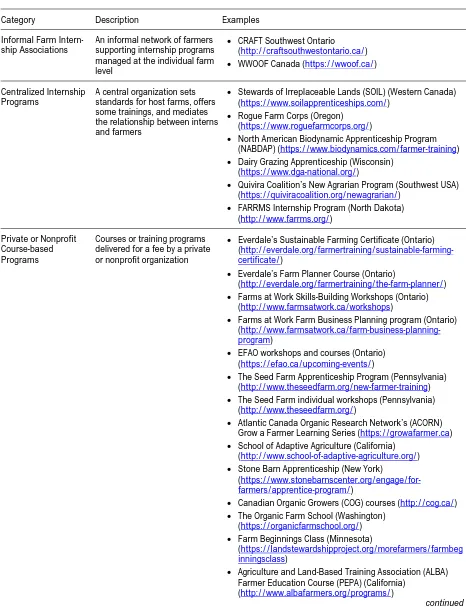
In this section we present the research findings described through the five emergent categories of practical farmer training models. Table 1 provides an overview of the categories; the programs listed are primarily focused on beginning farmers, although a small number operate programs for those who are more experienced. The categories are then described in greater detail below, along with a discussion of implications.
Category 1: Informal Farm Internship Associations
Informal associations supporting farm internships provide a network between individual farms that offer internships or other on-farm educational experiences for beginner farmers. These types of internships are typically managed at an individual farm level with little input from external educators. In most cases, the farmer and intern agree to an exchange of agreed-upon amounts and types of labour in return for a range of benefits that may include food, housing, training, and/or a small stipend or wage. In some cases, there is coordina-tion between the member farms to support farmer hosts and add value to the interns’ experiences. For example, some associations offer collective field trips, group training lessons, and social events. Some networks also facilitate initial connections between potential interns and farms. In these models, however, there are very few standards, no standard curriculum, and no mediation of the intern-farmer relationship by the association. Examples include the Collaborative Regional Alliance for Farmer Training (CRAFT) networks across North America. We identified many farms offering internships that are not part of any asso-ciation or network. These programs also fit into this category; however, studying them in detail was
beyond the scope of this research due to the high degree of variability and the difficulty in tracking them.
Informal farm internship associations are notable for delivering farmer training with low costs and minimal program administration. They are often developed by farmers using informal networks and depend primarily on the volunteer time of dedicated hosts to manage and implement the training programs. The relative popularity of this type of low-cost, low-infrastructure program in certain regions is indicative of a systemic lack of funding and structural support for practical farmer education. Informal associations rely on programs offering internships within close geographic prox-imity. While this works well in some of the more densely populated regions (e.g., located near urban centers), it may not be as viable in more sparsely populated areas. Recent studies have identified the value of practical farmer-led internship programs and have also raised some critical questions about their ethical and legal implications (for example, see Ekers, Levkoe, Walker, & Dale, 2016; Levkoe, 2017).
Category 2: Centralized Internships Programs
Centralized internship programs rely on a coordi-nating mechanism, establishing a semiformalized network between a group of farms that offer internships and other informal training opportu-nities. In the examples we analyzed, these organi-zations set minimal standards for host farms, which include curricula, work hours, compensation levels, and other benefits. The host organization also mediates the relationship between interns and farmers to some degree. For example, it serves as a third-party consult for interns if complications arise with the host farmers. In some cases, interns apply to participate directly to the central organiza-tion, which then brokers connections with the par-ticipating host farms. Generally, the central organ-ization also offers some training directly to the interns, such as workshops, farm tours, and socials. Upon program completion, trainees typically received a certificate or some type of recognition.
Table 1. Categories of Practical Farmer Training
Category Description Examples
Informal Farm
Intern-ship Associations An informal network of farmers supporting internship programs managed at the individual farm level
• CRAFT Southwest Ontario (http://craftsouthwestontario.ca/)
• WWOOF Canada (https://wwoof.ca/)
Centralized Internship
Programs A central organization sets standards for host farms, offers some trainings, and mediates the relationship between interns and farmers
• Stewards of Irreplaceable Lands (SOIL) (Western Canada) (https://www.soilapprenticeships.com/)
• Rogue Farm Corps (Oregon) (https://www.roguefarmcorps.org/)
• North American Biodynamic Apprenticeship Program (NABDAP) (https://www.biodynamics.com/farmer-training)
• Dairy Grazing Apprenticeship (Wisconsin) (https://www.dga-national.org/)
• Quivira Coalition’s New Agrarian Program (Southwest USA) (https://quiviracoalition.org/newagrarian/)
• FARRMS Internship Program (North Dakota) (http://www.farrms.org/)
Private or Nonprofit Course-based Programs
Courses or training programs delivered for a fee by a private or nonprofit organization
• Everdale’s Sustainable Farming Certificate (Ontario) ( http://everdale.org/farmertraining/sustainable-farming-certificate/)
• Everdale’s Farm Planner Course (Ontario)
(http://everdale.org/farmertraining/the-farm-planner/)
• Farms at Work Skills-Building Workshops (Ontario) (http://www.farmsatwork.ca/workshops)
• Farms at Work Farm Business Planning program (Ontario) ( http://www.farmsatwork.ca/farm-business-planning-program)
• EFAO workshops and courses (Ontario) (https://efao.ca/upcoming-events/)
• The Seed Farm Apprenticeship Program (Pennsylvania) (http://www.theseedfarm.org/new-farmer-training)
• The Seed Farm individual workshops (Pennsylvania) (http://www.theseedfarm.org/)
• Atlantic Canada Organic Research Network’s (ACORN) Grow a Farmer Learning Series (https://growafarmer.ca)
• School of Adaptive Agriculture (California) (http://www.school-of-adaptive-agriculture.org/)
• Stone Barn Apprenticeship (New York)
( https://www.stonebarnscenter.org/engage/for-farmers/apprentice-program/)
• Canadian Organic Growers (COG) courses (http://cog.ca/)
• The Organic Farm School (Washington) (https://organicfarmschool.org/)
• Farm Beginnings Class (Minnesota)
(https://landstewardshipproject.org/morefarmers/farmbeg inningsclass)
• Agriculture and Land-Based Training Association (ALBA) Farmer Education Course (PEPA) (California)
(http://www.albafarmers.org/programs/)
Formal Academic
Programs Programs run by formal aca-demic institutions, such as a college or university (although not necessarily for academic credit)
• Kwantlen Polytechnic University—Bachelor of Applied Science in Sustainable Agriculture (British Columbia) (http://www.kpu.ca/agriculture)
• Kwantlen Polytechnic University—Farm School (British Columbia) (http://www.kpu.ca/farmschool)
• UBC farm practicum and internships (British Columbia) ( http://ubcfarm.ubc.ca/students/practicum-in-sustainable-agriculture/)
• Fleming College—Sustainable Agriculture Program (Ontario) (
https://flemingcollege.ca/programs/sustainable-agriculture-co-op)
• University of Guelph Dairy Herdsperson Apprenticeship (Ontario)
(https://www.ridgetownc.com/future/programs_adh.cfm)
• University of Santa Cruz Center for Agroecology & Sustainable Food Systems (CASFS)—Apprenticeship in Ecological Horticulture (California)
(https://casfs.ucsc.edu/apprenticeship/)
• Michigan State University Student Organic Farm—Organic Farmer Training Program
(http://www.msuorganicfarm.org/)
• Center for Environmental Farming Systems—Farm Apprenticeship Program (North Carolina)
( https://cefs.ncsu.edu/academics-and-education/apprenticeships/)
• Warren Wilson College—Farm Crew (North Carolina) ( https://www.warren-wilson.edu/academics/work-program/farm-crew/)
• New Entry Sustainable Farming Project—Tufts University (https://nesfp.org/node/14)
Independent and
Self-Directed Learning Programs that involve self-directed learning experiences • Atlantic Canada Organic Research Network’s (ACORN) Grow a Farmer mentorship program (https://growafarmer.ca/mentorship/)
• Ecological Farmers Association of Ontario Advisory Service (https://efao.ca/advisory-service/)
• FarmStart’s incubator farms [no longer operating] (Ontario) (http://www.farmstart.ca/)
• The Seed Farm incubator program: Steward and Enterprise farmers (Pennsylvania) ( http://www.theseedfarm.org/farm-business-incubator)
• Farm Beginnings Journeyperson program (Minnesota) (https://landstewardshipproject.org/morefarmers/lspjourn eypersonfarmtrainingcourse)
• Maine Organic Farming and Gardening Association’s Journeyperson Program
(http://www.mofga.org/Programs/JourneypersonProgram/
tabid/228/Default.aspx)
• Agriculture and Land-Based Training Association (ALBA) Organic Farm Incubator (California)
to build recognition around one central organiza-tion’s training program than around many different individual farms. Centralizing some of the training can also help to standardize learning outcomes for participants. Centralized organizations have been developed in some regions where the legality of farm internships has come into question or where farm internships have been banned outright. For example, in Oregon, Rogue Farm Corps developed a structured farm internship program with gui-dance from the Oregon Department of Agriculture and the Bureau of Labor and Industry (Rogue Farm Corps, n.d.). This approach ensures the continuation of legal farm internships in spite of increasing concern by both farmers and policy-makers over the state of quasilegal internships.
Category 3: Private and Nonprofit Course-Based Programs
Private and nonprofit course-based programs include courses or training programs delivered (usually for a fee) by an organization other than a formal academic institution. Typically, these fall into three broad groups: (a) farm schools, which are typically based on an operational farm site offering participants an established curriculum of hands-on training; (b) organized training work-shops at other locations (typically on private farms); and (c) business planning courses, which generally operate during the nonfarming season. Farm schools are differentiated from farm busi-nesses that also offer training-focused internship programs (which would fit into categories 1 or 2) because of their primarily educational focus; some of the farm schools studied are in fact registered as educational nonprofit organizations.
Some of the programs in this category are coordinated by organizations that began as infor-mal associations (i.e., category 1) but shifted to a more formalized structure. For example, the Atlantic Canada Organic Research Network (ACORN) coordinated a three-year pilot appren-ticeship program (which would have fit into cate-gory 1 or 2) but switched to offering a series of workshops and field trips throughout the growing season on a range of topics. Organizations that changed the nature of their programming did not always explicitly articulate their reasons. The shift is
notable, however, in light of the evolving regula-tory context for nonwaged internships (Levkoe, 2017).
Maintaining funding to continue or build on existing programming is a challenge for many private and nonprofit programs. For example, the farm school model is particularly costly as it requires access to land and the maintenance of a working farm.Teaching farm programs have a difficult time recouping costs through product sales alone. Although this was not set as a criterion for this category, most of the examples we found have nonprofit status or were charitable organi-zations. This is not surprising given that there are certain financial and practical benefits to operating as a registered nonprofit. Some of these models (e.g., those where students live on site) could be quite practical in remote regions as they do not depend as heavily on proximity to other farms or an urban population to purchase produce.
Category 4: Formal Academic Programs This category includes practical training for farmers through formal academic institutions, such as colleges and universities. As the emphasis of our research was to identify programs that offer prac-tical training, examples in this category are limited to programs with significant hands-on compo-nents. For example, we do not include strictly classroom-based programs. Some programs in this category provide academic credit, diplomas, or certificates, while others focus on enrichment, employment, or summer options. In addition, some are non-accredited training programs open to the general public (e.g., internships or training programs on university- or college-based farms).
are rare, although Kwantlen Polytechnic University (British Columbia), the University of Guelph (Ontario), and Fleming College (Ontario) offer formal agricultural degrees and diplomas with significant practical components. Accredited agricultural programs fees are typically higher to accommodate the university’s tuition structure and may also be prohibitively expensive for some prospective participants.
Category 5: Independent and Self-Directed Learning
This category captures training opportunities that are independent and self-directed in nature. These models are typically used by new farmers who have some experience and are in the planning or early operational stages of establishing their own farm. They might be considered as a “bridge” or “level two” learning experience for beginning farmers who have received training already in at least one of the other categories, but still desire further sup-port and/or mentoring. Some of these models take the form of incubator farms, where new farmers rent and work a plot of land on an operational farm with some oversight. Examples in this cate-gory include Just Food’s Start-Up Farm (Ontario) and The Seed Farm’s Incubator Program (Penn-sylvania). Others function as occasional mentoring programs where new farmers find their own land, such as Atlantic Canada Organic Research Net-work’s (ACORN) Grow a Farmer Mentorship Program.
This category was deemed important to in-clude in this study, despite the fact that it typically draws “level two” or more advanced farmers, while the other categories tend to attract beginning farm-ers. The lack of access to appropriate programming or options for these not-quite-beginner farmers is a common theme in discussions of the barriers fac-ing new farmers across North America. Organiza-tions like FarmStart (Ontario), Maine Organic Farming and Gardening Association, and Rogue
Farm Corps (Oregon) all cited this barrier as a major motivator for the development of their “level two” programs.
Conclusions
This exploratory research confirms that, while practical farmer training is a significant and timely issue in North America, there is little scholarly work dedicated to describing the formats or to supporting the development of these programs. Given the strong interest we encountered from farmers, researchers, and other practitioners, more research in this area is warranted. A fuller census and further documentation and analysis of farmer training programs is needed, both within and beyond North America, to flesh out and evaluate the initial typology we have developed. This would be valuable for providing new perspectives for developing innovative practical farmer training options. In addition, a recurring census would help assess the distribution of the five program cate-gories and track changes over time. Important considerations for future research might include prospective training models, connection between farmer training and formalized education, paths to becoming a farmer, and funding and institutional support structures for all programs. A comparison of financial and institutional support for practical farmer training programs in Canada and the United States would also be valuable. It is our hope that the categories presented in this paper will provide a springboard to support this future area of research and the development of new, high quality practical farmer training programs.
Acknowledgments
We greatly appreciate the guidance and intellectual contributions from members of Collaborative Regional Alliance for Farmer Training (CRAFT) Southwestern Ontario; the Ecological Farmers Association of Ontario (EFAO); and Food: Locally Embedded, Globally Engaged (FLEdGE).
References
Blay-Palmer, A. (ed.). (2010). Imagining sustainable food systems: Theory and practice. Burlington, Vermont: Ashgate.
Brekken, C. A., Gwin, L., Horst, M., McAdams, N., Martin, S., & Stephenson, G. (2016). The future of Oregon’s agricultural land. Retrieved from Oregon State University Center for Small Farms & Community Food Systems website:
Calo, A. (2018). How knowledge deficit interventions fail to resolve beginning farmer challenges. Agriculture and Human Values, 35(2), 367–381. https://doi.org/10.1007/s10460-017-9832-6
Ekers, M., & Levkoe, C. Z. (2016). Transformations in agricultural non-waged work: From kinship to intern and volunteer labor. Journal of Agriculture, Food Systems, and Community Development,6(2), 179–183.
https://doi.org/10.5304/jafscd.2016.062.010
Ekers, M., Levkoe, C. Z., Walker, S., & Dale, B. (2016). Will work for food: Agricultural interns, apprentices, volunteers, and the agrarian questions. Agriculture and Human Values, 33(3), 705–720. https://doi.org/10.1007/s10460-015-9660-5
Errington, A. (1998). The intergenerational transfer of managerial control in the farm-family business: A comparative study of England, France and Canada. The Journal of Agricultural Education and Extension,5(2), 123–136.
https://doi.org/10.1080/13892249885300241
Grow a Farmer. (n.d.). Grow a Farmer apprenticeship and mentorship program:National resources. Retrieved from
https://growafarmer.ca/national-resources/
Laforge, J. M., & McLachlan, S. M. (2018). Environmentality on the Canadian prairies: Settler‐farmer subjectivities and agri‐environmental objects. Antipode, 50(2), 359–383. https://doi.org/10.1111/anti.12362
Levkoe, C. Z. (2017). Engaging the tensions of ecological internships: Considerations for agroecology and sustainable food system movements. Agroecology and Sustainable Food Systems,42(3), 242–263.
https://doi.org/10.1080/21683565.2017.1347120
National Young Farmers Coalition. (n.d.). Training opportunities. Retrieved from
http://www.youngfarmers.org/practical/training-and-helpful-organizations/
Ngo, M., & Brklacich, M. (2014). New farmers’ efforts to create a sense of place in rural communities: Insights from southern Ontario, Canada. Agriculture and Human Values,31(1), 53–67. https://doi.org/10.1007/s10460-013-9447-5 Niewolny, K. L., & Lillard, P. T. (2010). Expanding the boundaries of beginning farmer training and program
development: A review of contemporary initiatives to cultivate a new generation of American farmers. Journal of Agriculture, Food Systems, and Community Development,1(1), 65–88. https://doi.org/10.5304/jafscd.2010.011.010
Rogue Farm Corps. (n.d.). Our mission. Retrieved from https://www.roguefarmcorps.org/mission/
Statistics Canada. (2017). Table 004-0017 - Census of agriculture, number of farm operators by sex, age and paid non-farm work, Canada and provinces, every 5 years (number). CANSIM (database). Retrieved from
http://www5.statcan.gc.ca/cansim/a26?lang=eng&retrLang=eng&id=0040017&&pattern=&stByVal=1&p1=1&p 2=-1&tabMode=dataTable&csid=