Submitted21 November 2016 Accepted 21 March 2017 Published27 April 2017
Corresponding author Mauricio González-Chang, Mauricio.GonzalezChang@lin colnuni.ac.nz, mauriciogonzalez [email protected]
Academic editor Dezene Huber
Additional Information and Declarations can be found on page 12
DOI10.7717/peerj.3213
Copyright
2017 González-Chang et al.
Distributed under
Creative Commons CC-BY 4.0
OPEN ACCESS
Ecological and pest-management
implications of sex differences in scarab
landing patterns on grape vines
Mauricio González-Chang1, Stéphane Boyer2, Marie-Caroline Lefort1,2,
Jerry Nboyine1
and Steve D. Wratten1
1Bio-Protection Research Centre, Lincoln University, Christchurch, Lincoln, New Zealand 2Environmental and Animal Sciences, Unitec Institute of Technology, Auckland, New Zealand
ABSTRACT
Background. Melolonthinae beetles, comprising different white grub species, are a
globally-distributed pest group. Their larvae feed on roots of several crop and forestry species, and adults can cause severe defoliation. In New Zealand, the endemic scarab
pestCostelytra zealandica(White) causes severe defoliation on different horticultural
crops, including grape vines (Vitis vinifera). Understanding flight and landing be-haviours of this pest can help inform pest management decisions.
Methods. Adult beetles were counted and then removed from 96 grape vine plants from
21:30 until 23:00 h, every day from October 26 until December 2, during 2014 and 2015. Also, adults were removed from the grape vine foliage at dusk 5, 10, 15, 20 and 25 min after flight started on 2015. Statistical analyses were performed using generalised linear models with a beta-binomial distribution to analyse proportions and with a negative binomial distribution for beetle abundance.
Results. By analysingC. zealandicasex ratios during its entire flight season, it is clear that the proportion of males is higher at the beginning of the season, gradually declining towards its end. When adults were successively removed from the grape vines at 5-min intervals after flight activity begun, the mean proportion of males ranged from 6–28%. The male proportion suggests males were attracted to females that had already landed on grape vines, probably through pheromone release.
Discussion. The seasonal and daily changes in adultC. zealandicasex ratio throughout its flight season are presented for the first time. Although seasonal changes in sex ratio have been reported for other melolonthines, changes during their daily flight activity have not been analysed so far. Sex-ratio changes can have important consequences for the management of this pest species, and possibly for other melolonthines, as it has been previously suggested thatC. zealandicafemales land on plants that produce a silhouette against the sky. Therefore, long-term management might evaluate the effect of different plant heights and architecture on female melolonthine landing patterns, with consequences for male distribution, and subsequently overall damage within horticultural areas.
SubjectsAnimal Behavior, Ecology, Entomology, Zoology
INTRODUCTION
White grubs (Coleoptera: Scarabaeidae: Melolonthinae) are a widely distributed group of herbivorous insects feeding on a variety of plant hosts around the world (Jackson & Klein, 2006). Their larvae feed on plant roots, leading to severe damage to commercial crops and pastures (Jackson & Klein, 2006;Frew et al., 2016), as well as to natural forests and forestry plantations (Švestka, 2006;Švestka, 2010). Some melolonthines do not feed as adults, like
Leucopholis lepidophora (Blanchard) (Kalleshwaraswamy et al., 2016) andPhytholaema
herrmanni(Germain) (Durán, 1954), while others cause minor plant defoliation. These
includeSchizonyza ruficollis(F.) (Kulkarni et al., 2007) andHolotrichiaspp. (Kulkarni et al., 2009) in India,Hoplia philanthus(Füessly) in Belgium (Ansari et al., 2006), andPhyllophaga
cuyabana(Moser) in Brazil (Oliveira & García, 2003). However, dramatic defoliation can
also occur. In Eastern Asia,Ectinohoplia rufipes(Motschulsky) adults can severely defoliate ornamental trees around golf courses, as well as in gardens and parks (Kim et al., 2013). In Central and Western Europe, adult defoliation by Melolontha melolontha (L.) and
Melolontha hippocastani(F.) has led to severe defoliation on different horticultural crops,
such as grape vines (Vitis vinifera (L.)) and forest trees, respectively (Jackson & Klein, 2006;Reinecke et al., 2006;Švestka, 2006;Švestka, 2010). Such defoliation also has been recorded in New Zealand, whereCostelytra zealandica(White) attacks several horticultural crops, including tamarillo (Solanum betaceum(Cav.)), avocado (Persea americana(Mill.)), blueberries (Vaccinum corymbosum(L.), strawberries (Fragaria xananassa(Duchesne)), kiwifruit (Actinidia chinensis (Planch)), and grape vines (Binfield, 1933;Blank & Olson, 1982;Blank, Olson & Bell, 1983;East, Willoughby & Koller, 1983;East & Holland, 1984). Sometimes, severe defoliation can occur (Blank, Olson & Bell, 1983;East, Willoughby & Koller, 1983;Blank, 1992), leading in some cases to prophylactic application of synthetic insecticides to reduceC. zealandica damage. Nowadays, the use of such an approach is discouraged due to the environmental and human health problems related to their use (Reganold & Wachter, 2016).
The importance of the defoliation produced by melolonthines has promoted investigation of their plant colonization patterns, subsequently leading to work on their flying and landing behaviour. In Melolonthinae, after landing on their host plants, females attract males by releasing sex pheromones (Henzell & Lowe, 1970) or by the release of green leaf volatiles (GLV) produced after feeding on plant foliage (Harari, Ben-Yakir & Rosen, 1994;Reinecke, Ruther & Hilker, 2002a), or both acting together (Reinecke et al., 2002b; Reinecke et al., 2006). However, inMaladera matrida(Argaman), males land on their plant hosts before females. By feeding on their host plant, GLV are released attracting the females to where feeding occurs (Harari, Ben-Yakir & Rosen, 1994). Observations onC. zealandica flying behaviour have suggested that females land before males on shrubs and trees (Farrell & Wightman, 1972). After landing, males are attracted to those plants by the female pheromone, identified as phenol (Henzell & Lowe, 1970). Although the effects of phenol on male attraction are well understood forC. zealandica(Henzell & Lowe, 1970;Unelius et al., 2008;Marshall et al., 2016),M. melolontha,M. hippocastani(Reinecke et al., 2006), and
ratio at the landing phase of its daily plant colonising activity. In addition, no research has reported the trends in sex ratio throughout the entireC. zealandicaflight season for any agricultural or natural system. We hypothesized that females arrive on V. vinifera before males. Therefore, the aims of this work were: (i) to quantifyC. zealandicasex ratio throughout its seasonal and daily flight period; and (ii) to correlate adult abundance with sex ratio through its seasonal and daily flight activity.
MATERIAL AND METHODS
Study sites
This work was conducted in the Marlborough region of New Zealand. In this area, two commercial vineyards were chosen. One in the Awatere Valley (41◦440S; 173◦520E) owned by Kono Beverages, and another close to Blenheim city (41◦330S; 173◦550E) that belongs to Wither Hills. These locations are situated in homogeneous landscapes generally dominated by conventionally-managed vineyards. To reduce the effect of conventional management practices on the interpretation of the observations described below, organically-managed vineyard blocks (cv. Pinot Noir) were chosen at both sites. The sizes of the blocks were 6.12 and 4.58 ha in the Awatere Valley and Blenheim, respectively. Grape vines were 14 and 15 yr old in the Awatere Valley and Blenheim, respectively. Plant spread along the vine row was 1.8 m between each other. During the study period, from late October to late November 2014 and 2015, no pesticides or herbicides were applied on those blocks, apart from sulphur, which was applied to control fungal diseases. In New Zealand, organic vineyard areas, including headlands, inter-row and under-vine areas are covered by a mixture of ground covers that mainly comprise ryegrass (Lollium perenne (L.)), white clover (Trifolium repens(L.)), and fescue (Festucaspp.).
AdultC. zealandicasampling
Sampling was carried out every day duringC. zealandicaflight season. In the Marlborough area, individuals start flying from the end of October until the end of November (Farrell & Wightman, 1972). Within the October to November period, adults initiate flight 20 min after sunset, flying for approximately 26 min (M González-Chang, 2016, unpublished data). During their flight activity, adults land on grape vine foliage and then feed and mate, staying on the grape vines for at least 3 h (M González-Chang, 2016, unpublished data). Based on this landing behaviour, adults were counted and then removed from 96 plants at both study locations from 21:30 until 23:00 h. These plants had a mean height of 1.5 m, and were consecutively sampled along the vine row over three consecutive rows. Sampling started along the row at the edge of a vineyard block to 50 m from the edge, sampling 32 plants on each row. The row sampling method was performed at the Awatere Valley during 2014 and 2015 and in Blenheim only on 2015.
Seasonal sex ratio
from October 26th until December 1st. Individual polyethylene bags were used to collect the beetles, so samples were not mixed between days or locations. Using a 50 ml cylindrical plastic container, a sub-sample was taken from each bag for sex ratio analysis. Within this sub-sample the ratio was analysed by randomly sexing 20 individuals. This procedure was repeated three times for each day. The proportion of males (M) over females (F) for each sampled day was obtained after taking a mean of the three measurements. This proportion was calculated as M/(M+F). Days without flight activity were removed from further sex-ratio analysis. The separation of males from females was carried out using the morphological characteristics proposed by Kain (1972)andKelsey (1965). Using a stereomicroscope (Carl Zeiss), the distal-ventral section of the abdomen was examined for male characters, including a shallow depression in the centre of the sixth abdominal sternite (Kelsey, 1965), and the presence of parameres through the pygdium (Kain, 1972). Female characters included the presence of colleterial glands, as two spherical dots in the fifth sternite, and two genital sclerites situated at each side of the vulva (Kain, 1972).
AdultC. zealandicaremoval to determine daily sex-ratio patterns
To investigate the dynamics of sex-ratio changes on grape vine foliage during the flight season, adult beetles were successively removed from the grape vines at different periods during 2015. At both sites, adults were removed from the grape vine foliage at dusk at 5, 10, 15, 20 and 25 min after flight started. One plant at the edge of each vineyard block at both locations was used for this experiment. This plant was not included in the 96 plants used in the seasonal sex-ratio determination explained above. Adults were visually counted on the selected grape vine and then removed by hand at each time period. When the number of adults collected exceeded 60, 20 individuals were sub-sampled three times from those samples. The mean of the sub-sampled was used for further statistical analyses. This daily sequential adult removal was performed from November 2 to 28 and November 14 to 28 at Blenheim and the Awatere Valley, respectively. Days without flight activity, because of adverse weather, were removed from further sex-ratio analysis. The mean proportion of males and total adult numbers at each sampling day at each time interval were considered as replicates.
Statistical analyses
0 5 10 15 20 25 30 35
0.
5
0
.6
0
.7
0
.8
0.
9
1
Days after flight begun
P
ro
po
rt
io
n
of
m
a
le
s
Figure 1 Costelytra zealandicasex-ratio (proportion of males) on 35 d after its flight begun, from
Oc-tober 27th to November 30th at the Awatere Valley in 2014.The beta-binomial GLM (solid line) ad-justed to each proportion during the flight season is presented with its respective confidence intervals (dashed lines). The proportion of males is reduced through time (slope= −0.08;z= −4.8;p<0.001). Days without flight activity during the season were removed from this analysis.
post-hoc analysis (Venables & Ripley, 2002) after fitting a GLM with a negative binomial distribution and a logarithmic link function at each sampling site. Negative binomial GLM and Tukey’s tests were performed using the R packages ‘‘MASS’’ and ‘‘multcomp’’, respectively. All statistical analyses were performed using the statistical software R v.3.2.5 (R Core Team, 2016).
RESULTS
Seasonal sex ratio
In the Awatere Valley in 2014, a total of 36,369 adults were sampled, while in 2015 only 6,111 were collected. During 2015 in Blenheim, 14,731 adults were collected. Sex-ratio was not statistically correlated with beetle abundance through the flight season in the Awatere Valley during 2014 (ϕ=0.02;p=0.92) nor in 2015 (ϕ= −0.35;p=0.12).
However, at the Blenheim site, this correlation was positive and significant (ϕ=0.51;
p<0.01). In the Awatere Valley the proportion of males decreased through time during 2014 (slope= −0.08;z= −4.8;p<0.001) and in 2015 (slope= −0.02;z= −2.6;p<0.01).
A similar result was observed in Blenheim during 2015 (slope= −0.03;z= −4;p<0.001).
5 10 15 20 25
0
.35
0
.4
0
0
.4
5
0.
50
0
.55
0
.6
0
0
.6
5
Days after flight begun
P
ro
po
rt
io
n
of
m
a
le
s
Figure 2 Costelytra zealandicasex-ratio (proportion of males) on 25 d after its flight begun, from
November 7th to December 1st at the Awatere Valley in 2015.The beta-binomial GLM (solid line) ad-justed to each proportion during the flight season is presented with its respective confidence intervals (dashed lines). The proportion of males is reduced through time (slope= −0.02;z= −2.6;p<0.01). Days without flight activity during the season were removed from this analysis.
AdultC. zealandicaremoval to determine daily sex-ratio patterns
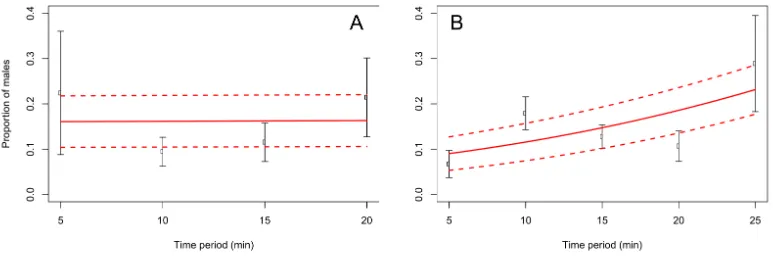
When adults were removed from the grape vine foliage every 5 min after flight activity started, the proportion of males increased through the 5–25 min time interval at Blenheim (slope=0.06;z=2.12;p<0.05), but not at the Awatere Valley (slope=0.001;z=0.03;
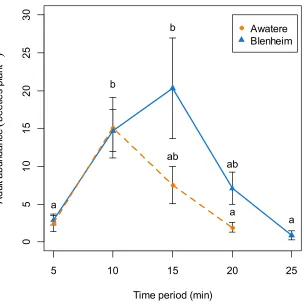
p=0.98) (Fig. 4). Tukey contrasts showed that adult numbers significantly increased
between 10 and 15 min after flight occurred at both sites, and then decreased to initial levels between 20 and 25 min after it started (Fig. 5). In the Awatere Valley, flight activity completely ceased 25 min after begun, while in Blenheim it stopped after 30 min. No correlation was found between adult abundance and the sex-ratio during each time period evaluated at Blenheim (ϕ= −0.1;p=0.87) or in the Awatere Valley (ϕ= −0.8;
p=0.2).
DISCUSSION
0 5 10 15 20 25 30 35
0
.3
0
.4
0
.5
0.
6
0
Days after flight begun
P
ro
po
rt
io
n
of
m
a
le
s
Figure 3 Costelytra zealandicasex-ratio (proportion of males) on 37 d after its flight begun, from
Oc-tober 26th to December 1st close to Blenheim city in 2015. The beta-binomial GLM (solid line) adjusted to each proportion during the flight season is presented with its respective confidence intervals (dashed lines). The proportion of males is reduced through time (slope= −0.03;z= −4;p<0.001). Days without flight activity during the season were removed from this analysis.
the sex-ratio differed between the two locations. These results are discussed in terms of this insect’s behaviour. The implications of these results on sustainableC. zealandicacontrol in vineyards also are discussed.
Seasonal sex-ratio trend
Figure 4 Proportion ofC. zealandicamales, after adult removal from a single grape vine plant at 5 min periods after daily flight activity begun, at the Awatere Valley (A) and Blenheim (B). The beta-binomial GLM (solid line) adjusted to each proportion during those time periods is presented with its respective confidence intervals (dashed lines). In the Awatere Valley (right), male proportion did not change during C. zealandicadaily flight activity (slope=0.001;z =0.03;p=0.98), but in Blenheim (left), it increased through the daily flight time period (slope=0.06;z=2.12;p<0.05). Error bars are two-standard errors.
temporal and spatial variability of melolonthine sex-ratio, which might be determined by environmental conditions (Sánchez, 2008;Gempe & Beye, 2011). Previous studies suggested
thatC. zealandicamales appear seasonally before females do (Kelsey, 1951;Pottinger, 1968;
Farrell & Wightman, 1972). Early male appearance might have important evolutionary consequences for the survival ofC. zealandicabecause as soon as the females emerge, males are already present for mating (Kelsey, 1951;Durán, 1954;Harari, Ben-Yakir & Rosen, 1994;Kalleshwaraswamy et al., 2016). The evolutionary advantage of early male emergence is in agreement with the results presented in this work, as a higher proportion of males were found at the beginning of the flight season at both studied years and locations. The reduction in male numbers through time might be associated with a reduction in female pheromone production towards the end of the flight season, as pheromone effects on male attractiveness have been well studied in C. zealandica(Henzell, 1970;Unelius et al., 2008;Marshall et al., 2016). Recently, it has been suggested that phenol, the main sex pheromone inC. zealandica(Henzell, 1970), is produced by a mutualistic bacterium
Morganella morganii(Brenner) in its colleterial gland, which is biosynthesized from the
amino acid tyrosine (Marshall et al., 2016). In general, insect protein synthesis decreases with aging (Levenbook, 1986), and tyrosine in particular has been shown to decrease with age in other insects likeBombyx mori(L.) (Lepidoptera: Bombycidae) (Osanai & Kikuta, 1981). Considering that theC. zealandicaflight season lasted for around 4 wk, from late October to late November at the studied vineyards, females that landed on the grape vine foliage at the end of that period might already have ceased to synthesize their pheromone due to aging, reducing the number of males attracted to them.
5 10 15 20 25 0 5 1 0 15 2 0 25 3
Time period (min)
A d u lt ab u n dan ce
b eet le s pl an t 1
Awatere Blenheim a b b ab ab a aFigure 5 Adult abundance duringC. zealandicadaily flight activity at different 5-min time periods,
for beetles that landed on a single grape vine plant at the Awatere Valley (dashed line) and Blenheim (solid line) sites. Tukey contrasts are presented as different letters above each dot. Different letters repre-sent significantly differences among the different time periods, but not between studied locations. Error bars are two-standard errors.
were males. Conversely, at the same location during 2015, only 37% of the adults were males at their November 19 peak (1,039 individuals). In Blenheim, 55% of them were males at their November 6 peak (1,966 individuals).
Adult removal and daily sex-ratio trends
Costelytra zealandicaflight activity has been divided in two phases (Kelsey, 1951;Pottinger,
males found when adults were removed from the grape vines never exceed 28%. In fact, 10-min after flight begun, only 9 and 18% of the removed adults were males at the Awatere Valley and Blenheim, respectively. Remarkably, an identical two-phase flight behaviour has been described before for Phyllopertha horticola(L.) (Coleoptera: Rutelinae) (Schneider, 1962) and forP. herrmanni(Durán, 1954). Also, similar landing behaviour where female melolonthines arrive before males on plant foliage has been reported forM. melolontha,
M. hippocastani (Reinecke, Ruther & Hilker, 2002a) andP. cuyabana(Oliveira & García,
2003). In the Awatere Valley (2015), the proportion of males did not change throughout their daily flight activity, which lasted for 25 min. However, in Blenheim (2015) male proportion increased throughout their daily flight period, which totally ceased 30 min after flight begun. These differences in adult abundance and flight length at dusk could be related to the two-fold increase in adult numbers found in Blenheim compared to the Awatere Valley.
Female behaviour and plant silhouettes
Considering that males are attracted to females that have already landed on their host plant, through pheromone communication (Henzell & Lowe, 1970) and/or plant volatiles (Reinecke, Ruther & Hilker, 2002a), the mechanisms by which females locate host plants have relevance to pest management. Different authors have proposed that female host finding in Melolonthinae is through the visual recognition of the tallest plant silhouettes in the sky (Durán, 1954;Schneider, 1962;Farrell & Wightman, 1972;Oliveira & García, 2003). A study in Brazil showed thatP. cuyabanafemales preferred tall soybean and corn plants for landing and mating (García, Oliveira & de Oliveira, 2003). Recent work suggests that plant location byC. zealandicafemales might be mediated by the contrast that plant silhouettes produce in the sky (M González-Chang, 2016, unpublished data). Males also might use visual cues in the sky for orientation at some extent, but more research is needed, as no evidence for the latter exist so far. Thus, additional research investigating the addition of tall plant species at the edge of crops could have management values, especially if the tall plants can divert females from landing further into the crop area, and in turn, deterring males from the crop.
Implications for sustainable C. zealandicamanagement in vineyards
in trap design that led to low capture efficiency (Unelius et al., 2008). Another negative factor of using phenol is its high toxicity for humans (Shadnia & Wright, 2008;Unelius et al., 2008). Instead, if females can be attracted to a host plant outside the crop, the overall numbers of adultC. zealandicalanding on the crop could be reduced, along with subsequent reduction in plant damage (M González-Chang, 2016, unpublished data). The mechanisms behind femaleC. zealandicahost location remain unknown with literature only suggesting that females might locate host plants by their contrast against the sky at dusk (Farrell & Wightman, 1972). Despite those assumptions, it cannot be ignored that females can also be attracted to different floral plant volatiles, as demonstrated for P.
horticola(Ruther, 2004). Furthermore, the potential contribution of GLV, released from
adult feeding (Reinecke et al., 2002b), may influence seasonalC. zealandicapeak activity and abundance, because peak damage coincides with peak flight activity in the middle of the flight season (East, Willoughby & Koller, 1983). In this work, the peak of abundance was registered during the middle of the flight season. Thus, the chemical ecology underlying
C. zealandicareproductive behaviour needs further investigation. Another approach could
evaluate the contribution of native New Zealand vegetation within or outside the vineyard (Shields et al., 2016), as non-crop vegetation could provide visual silhouettes and organic volatiles to further attract males or females. Although the establishment and growth of those native plants in horticultural areas will take time, native plants could contribute to a long-term sustainableC. zealandicapest management strategy, with potential enhancement of local functional biodiversity and biological conservation that need to be further addressed (Isaacs et al., 2009).
CONCLUSIONS
The proportion of C. zealandica males landing on the grape vine foliage decreased throughout the flight season during 2014 and 2015 at two New Zealand locations. Blenheim (2015) was the only site where increases in sex-ratio (male-biased) were correlated with increases in overall adult abundance. The sex-ratio correlation with adult abundance might be related to spatial and temporal landscape variations in sex-ratio between Blenheim and the Awatere Valley, although landscape factors were not measured here. When adults were removed daily from the grape vines at several time periods after their flight activity begun, a female-biased sex-ratio was recorded. The female-based sex-ratio suggests that females land on the plant foliage before males, subsequently attracting them by the release of their phenol sex pheromone. The grape vine colonization sex-driven dynamics during adultC.
zealandicaflight activity presented in this work might contribute to management useful in
reducing the damage of this endemic New Zealand pest on several horticultural crops, and eventually in other scarabaeids with similar flight behaviour around the world.
ACKNOWLEDGEMENTS
ADDITIONAL INFORMATION AND DECLARATIONS
Funding
The New Zealand Winegrowers partly funded the 2015 sampling season. This research was done as part of M.G. Chang’s PhD programme, funded by a Callaghan Innovation Scholarship (KNZLP1201) and Kono Beverages. The funders had no role in study design, data collection and analysis, decision to publish, or preparation of the manuscript.
Grant Disclosures
The following grant information was disclosed by the authors: New Zealand Winegrowers.
Callaghan Innovation Scholarship: KNZLP1201. Kono Beverages.
Competing Interests
Author Steve D. Wratten is an Academic Editor for PeerJ. The authors declare there are no competing interests.
Author Contributions
• Mauricio González-Chang conceived and designed the experiments, performed the
experiments, analyzed the data, wrote the paper, prepared figures and/or tables.
• Stéphane Boyer and Marie-Caroline Lefort wrote the paper.
• Jerry Nboyine performed the experiments, wrote the paper, reviewed drafts of the paper.
• Steve D. Wratten conceived and designed the experiments, contributed
reagents/mate-rials/analysis tools, wrote the paper, prepared figures and/or tables, reviewed drafts of the paper.
Data Availability
The following information was supplied regarding data availability: The raw data has been supplied as aSupplementary File.
Supplemental Information
Supplemental information for this article can be found online athttp://dx.doi.org/10.7717/
peerj.3213#supplemental-information.
REFERENCES
Ansari MA, Casteels H, Tirry L, Moens M. 2006.Biology ofHoplia philanthus(Col.,
Scarabaeidae, Melolonthinae): a new and severe pest in Belgian turf.Environmental
Entomology35:1500–1507
DOI 10.1603/0046-225X(2006)35[1500:BOHPCS]2.0.CO;2.
Binfield RE. 1933.Grass grub in strawberry beds.New Zealand Journal of Agriculture
Blank RH. 1992.Research on pastoral and horticultural pest control in Northland helps to avoid problems with insecticide use.New Zealand Entomologist15:76–80
DOI 10.1080/00779962.1992.9722633.
Blank RH, Olson MH. 1982.Grass grub adults defoliate tamarillos in Northland.
Proceedings of the New Zealand Weed and Pest Control Conference35:27–31.
Blank RH, Olson MH, Bell DS. 1983.Screening insecticides to protect tamarillo against
grass grub adults.Proceedings of the New Zealand Weed and Pest Control Conference
36:111–115.
Crawley M. 2007.The R book. Chichester: John Wiley and Sons.
Cribari-Neto F, Zeileis A. 2010.Beta regression in R.Journal of Statistical Software
34:1–24.
Durán L. 1954.La biología del Phytoloema herrmanni Germ. y mención de otros
escarabeidos perjudiciales a la agricultura en las provincias australes de Chile.Revista
Chilena de Historia Natural54:5–20.
East R, Holland PT. 1984.Control of grass grub in blueberries.Proceedings of the New
Zealand Weed and Pest Control Conference37:228–230.
East R, Willoughby BE, Koller MS. 1983.Defoliation by grass grub beetles in Waikato
orchards.Proceedings of the New Zealand Weed and Pest Control Conference
36:151–155.
Farrell JAK, Wightman JA. 1972.Observations on flight and feeding activity of adult
Costelytra zealandica(White) (Col.,Scarabaeidae) in Nelson province.New Zealand
Journal of Agricultural Research15:893–903DOI 10.1080/00288233.1972.10421644.
Fisher RA. 1930.The genetical theory of natural selection. London: Oxford University Press, 143.
Frew A, Barnett K, Nielsen UN, Riegler M, Johnson SN. 2016.Belowground
ecol-ogy of scarabs feeding on grass roots: current knowledge and future direc-tions for management in Australasia.Frontiers in Plant Science 7:Article 321
DOI 10.3389/fpls.2016.00321.
García MA, Oliveira LJ, De Oliveira MCN. 2003.Aggregation behavior ofPhyllophaga
cuyabana(Moser) (Coleoptera: Melolonthidae): relationships between sites chosen
for mating and offspring distribution.Neotropical Entomology 32:537–542.
Gempe T, Beye M. 2011.Function and evolution of sex determination mechanisms,
genes and pathways in insects.BioEssays33:52–60DOI 10.1002/bies.201000043.
Grün B, Kosmidis I, Zeileis A. 2012.Extended beta regression in R: shaken, stirred, mixed, and partitioned.Journal of Statistical Software48:1–25.
Hamilton WD. 1967.Extraordinary sex ratios.Science156:477–488
DOI 10.1126/science.156.3774.477.
Harari AR, Ben-Yakir D, Rosen D. 1994.Mechanism of aggregation behavior in
Maladera matridaArgaman (Coleoptera: Scarabaeidae).Journal of Chemical Ecology
20:361–371DOI 10.1007/BF02064443.
Henzell RF. 1970.Phenol, an attractant for the male grass grub beetle (Costelytra
zealandica(White)) (Scarahaeidae: Coleoptera).New Zealand Journal of Agricultural
Henzell RF, Lowe MD. 1970.Sex attractant of the grass grub beetle.Science
168:1005–1006DOI 10.1126/science.168.3934.1005.
Isaacs R, Tuell J, Fiedler A, Gardiner M, Landis D. 2009.Maximizing
arthropod-mediated ecosystem services in agricultural landscapes: the role of native plants.
Frontiers in Ecology and the Environment 7:196–203DOI 10.1890/080035.
Jackson TA, Klein MG. 2006.Scarabs as pests: a continuing problem.Coleopterists Society
Monograph5:102–119DOI 10.1649/0010-065X(2006)60[102:SAPACP]2.0.CO;2.
Kain WM. 1972.Identification of the sexes inCostelytra zealandica(Coleoptera: Scarabaeidae).New Zealand Journal of Science15:85–87.
Kalleshwaraswamy CM, Adarsha SK, Naveena NL, Sharanabasappa. 2016.Adult
emer-gence pattern and utilization of females as attractants for trapping males of white grubs,Leucopholis lepidophora(Coleoptera: Scarabaeidae), infesting areca nut in India.Journal of Asia-Pacific Entomology 19:15–22DOI 10.1016/j.aspen.2015.11.004.
Kelsey JM. 1951.Grass-grub and grass caterpillar control.New Zealand Journal of
Agriculture83:113–122.
Kelsey JM. 1965.Note on morphological differences between sexes of adultCostelytra
zealandica(White).New Zealand Journal of Science8:173.
Khan Z, Midega C, Pittchar J, Pickett J, Bruce T. 2011.Push–pull technology: a
conser-vation agriculture approach for integrated management of insect pests, weeds and soil health in Africa.International Journal of Agricultural Sustainability9:162–170
DOI 10.3763/ijas.2010.0558.
Kim JJ, Choo HY, Jung YH, Lee SM, Park J-J, Lee DW. 2013.Life history and population
dynamics ofEctinohoplia rufipes(Coleoptera: Scarabaeidae) on Korean golf courses.
Journal of Asia-Pacific Entomology16:379–384DOI 10.1016/j.aspen.2013.04.004.
Kulkarni N, Chandra K, Wagh PN, Joshi KC, Singh RB. 2007.Incidence and
manage-ment of white grub,Schizonycha ruficollison seedlings of teak (Tectona grandisLinn.
f.).Insect Science14:411–418DOI 10.1111/j.1744-7917.2007.00168.x.
Kulkarni N, Paunikar S, Joshi KC, Rogers J. 2009.White grubs,Holotrichia rusticaand
Holotrichia mucida(Coleoptera: Scarabaeidae) as pests of teak (Tectona grandisL. f.)
seedlings.Insect Science16:519–525DOI 10.1111/j.1744-7917.2009.01289.x.
Levenbook L. 1986. Protein synthesis in relation to insect aging: an overview. In: Collatz K-G, Sohal RS, eds.Insect aging. Strategies and mechanisms. Berlin: Springer-Verlag, 200–206.
Marshall DG, Jackson TA, Unelius CR, Wee SL, Young SD, Townsend RJ, Suckling DM.
2016.Morganella morganiibacteria produces phenol as the sex pheromone of the
New Zealand grass grub from tyrosine in the colleterial gland.The Science of Nature
103:Article 59DOI 10.1007/s00114-016-1380-1.
Méndez-Aguilar MDJ, Castro-Ramírez A, Alvarado R, Pacheco-Flores C, Ramírez-Salinas C. 2005.Eficacia de dos tipos de recolecta para registrar la diversidad de melolóntidos nocturnos (Coleoptera: Scarabaeoidea).Acta Zoológica Mexicana
Oliveira LJ, García MA. 2003.Flight, feeding and reproductive behavior ofPhyllophaga
cuyabana(Moser) (Coleoptera: Melolonthidae) adults.Pesquisa Agropecuaria
Brasileira38:179–186DOI 10.1590/S0100-204X2003000200003.
Osanai M, Kikuta S. 1981.Age-related changes in amino acid pool sizes in the adult silk-worm,Bombyx mori.Experimental Gerontology16:445–459
DOI 10.1016/0531-5565(81)90026-7.
Pottinger RP. 1968.Comments on the ecology of grass grub and porina caterpillar.
Proceedings of New Zealand Grassland Association30:102–112.
R Core Team. 2016.R: a language and environment for statistical computing. Vienna: R
Foundation for Statistical Computing.
Reganold JP, Wachter JM. 2016.Organic agriculture in the twenty-first century.Nature
Plants2:Article 15221DOI 10.1038/NPLANTS.2015.221.
Reinecke A, Ruther J, Hilker M. 2002a.The scent of food and defence: green leaf volatiles and toluquinone as sex attractant mediate mate finding in the European cockchafer
Melolontha melolontha.Ecology Letters5:257–263
DOI 10.1046/j.1461-0248.2002.00318.x.
Reinecke A, Ruther J, Mayer CJ, Hilker M. 2006.Optimized trap lure for male
Melolon-thacockchafers.Journal of Applied Entomology130:171–176
DOI 10.1111/j.1439-0418.2006.01041.x.
Reinecke A, Ruther J, Tolasch T, Francke W, Hilker M. 2002b.Alcoholism in
cockchafers: orientation of maleMelolontha melolonthatowards green leaf alcohols.
Naturwissenschaften89:265–269DOI 10.1007/s00114-002-0314-2.
Ruther J. 2004.Male-biassed response of garden chafer,Phyllopertha horticolaL., to leaf alcohol and attraction of both sexes to floral plant volatiles.Chemoecology
14:187–192DOI 10.1007/s00049-004-0271-7.
Sánchez L. 2008.Sex-determining mechanisms in insects.The International Journal of
Developmental Biology52:837–856 DOI 10.1387/ijdb.072396ls.
Schneider F. 1962.Dispersal and migration.Annual Review of Entomology7:223–242
DOI 10.1146/annurev.en.07.010162.001255.
Shadnia H, Wright JS. 2008.Understanding the toxicity of phenols: using quantitative
structure-activity relationship and enthalpy changes to discriminate between possible mechanisms.Chemical Research in Toxicology 21:1197–1204DOI 10.1021/tx800058r.
Shields M, Tompkins J-M, Saville DJ, Meurk CD, Wratten S. 2016.Potential
ecosys-tem service delivery by endemic plants in New Zealand vineyards: successes and prospects.PeerJ4:e2042 DOI 10.7717/peerj.2042.
Švestka M. 2006.Distribution of tribes of cockchafers of the genusMelolonthain forests of the Czech Republic and the dependence of their swarming on temperature.
Journal of Forest Science52:520–530.
Švestka M. 2010.Changes in the abundance ofMelolontha hippocastaniFabr. and
Melolontha melolontha(L.) (Coleoptera: Scarabeidae) in the Czech Republic in the
Unelius CR, Townsend RJ, Mundy DC, Manning LM, Jackson TA, Suckling DM. 2008.
Comparisons of traps and lures for monitoring grass grub,Costelytra zealandica.New
Zealand Plant Protection61:215–221.
Venables WN, Ripley BD. 2002.Modern applied statistics with S. New York:
Springer-Verlag.
Zarbin PHG, Leal WS, Ávila CJ, Oliveira LJ. 2007.Identification of the sex pheromone
ofPhyllophaga cuyabana(Coleoptera: Melolonthidae).Tetrahedron Letters