e-ISSN: 2278-7461, p-ISSN: 2319-6491
Volume 7, Issue 9 [September 2018] PP: 47-54
Development Of Aluminum–Silicon Alloy-Silicon Carbide
Particulate Reinforced Composite For Automobile Brake Disc
Application
Ugwuoke J.C
1, Agbo A.O
2, Anioke S
3And Onoh G.N
41,2,3 Department of Metallurgical and Materials Engineering,Enugu State University of Science and Technology,
Enugu, Nigeria. 4
Department of Electrical and Electronics Engineering,Enugu State University of Science and Technology, Enugu, Nigeria
Corresponding Author:Ugwuoke J.C
ABSTRACT:Metal Matrix composites have been used commercially in the automotive industries parts manufacture particularly because of its strengthto weight ratio. Aluminum alloy-silicon carbide composites play dominant role in this regard due to their enviable properties. In this work Al-Si alloy matrix was reinforced with different weight proportions of silicon carbide, SiC, (150-200 um) particulates (5, 10, 15, 20, 25, 30, wt %), using stir casting technique.
Mechanical and thermal properties of the cast samples were studied by corresponding testing methods. Results generated show that silicon carbide particulate reinforcement enhanced the properties studied in comparison to the base matrix Al-Si alloy. Also increase in the proportion of the reinforcement resulted to corresponding increase in majority of the properties studied. This work shows that composites formulated from Al-Si/SiCp are good candidate materials for developing automobile brake disc.
KEYWORDS:MMC, AMC, Al-Si, SiC, Stir casting
--- --- Date of Submission: 15-11-2018 Date of acceptance:29-11-2018 --- ---
I.
INTRODUCTIONAluminum alloy Matrix composites have been considerably applied in industries such as automobile, aerospace and military due to their high strength to weight ratio, good wear resistance, stiffness, improved electrical and thermal properties, good plasticity, ductility and good corrosion resistance.
Particulate reinforced aluminum matrix composites increase considerably the strength and hardness of the aluminum and its alloys.The introduction of the particulates also may lead to little reduction in plasticity and ductility.
In the composite formulation, the matrix phase (aluminum and its alloys) forms a percolating network, while the reinforcements are normally ceramics particles such as SiC, and Al2O3 [1].Rohatgi and co-workers [1], also stated that the properties of aluminum matrix composites (AMCs) can be tailored by varying the nature of constituents and their volume fractions.
Aluminum matrix composites material systems offer superior combinations of properties that supersede that of any existing monolithic material. The AMCs have been successfully employed in numerous structural, non-structural and functional applications in various engineering sectors. The major driving force for the application of AMCs in these sectors are their service performance, environmental and economic benefits [2].
Brake discs(rotors) are typical examples where AMCs make a difference in automotive applications. In weight reduction, AMCs rotor design can provide 50 to 60% reduction in comparison to gray cast iron [2]. Equally AMCs rotors offer superior mechanical properties and practical performance than gray cast iron. Also, since weight reduction is unsprung, it also reduces inertial forces, providing an additional benefit in fuel economy [3].
The braking operation in vehicles develop frictional heat which results in an occasional uneven temperature distribution on the brake disc, thereby inducing severe thermal distortion. The degree of increase or decrease in this thermal distortion is a function of the frictional heat developed as the operational conditions of the brake disc changes. As the distortion reaches threshold limit, the brake disc experience mechanical failure and rupture results [4]. The mechanical properties of brake disc are known to be functions of composition and microstructure [2,5]
II.
EXPERIMENTAL PROCEDURE 2.1.Materials and ProcessingThe Materials used in the development of this composite materials are aluminum silicon (Al-11.4wt %Si) alloy which is the matrix and Silicon Carbide particulates (SiCp), the reinforcement material. The chemical composition of the matrix in as cast form is shown in Table 1. The reinforcement material is coated with alumina (Al2O3) to enhance its wettability by the matrix. Particle size of the SiCp is in the range of 150-200 um.
2.2.Alloy Production
Alloy preparation was done using crucible furnace, by melting pure aluminum and adding the alloying elements wrapped with aluminum foil into the melt. The melt is then superheated to a temperature of 720oC, stirredcontinuously by stainless steel stirrer for 10 minutes. A permanentmould made of stainless steel is preheated to a temperature of 300°C and the molten alloy was cast into it.
2.3.Composite Development
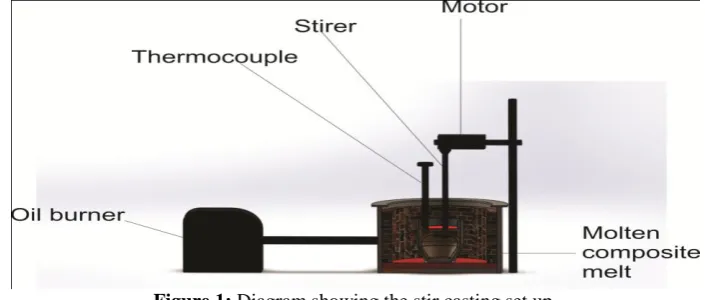
Composite material were developed using certain ratios of the base alloy and silicon carbide particles. Table 2 shows the percentage of the alloy and SiCp for the composite formulations. In formulating a particular composite, the required quantity of basealuminum alloy is cut into small pieces (pebbles), preheated to 250°C and half of it is placed in the crucible inside the furnace, the alumina coated SiCp is spread on the top and the remaining half is used to cover the SiCp. This arrangement is shown in figure 1.This sandwich or double layer feeding mechanism helps to improve the wettability of SiCpinto the matrix alloy. The mix was then heated to molten temperature of 600-700°C, stirred at 110 RPM, then finally superheated to 750°C, stirred again for 15 minutes degassed and cast into permanent moulds.
2.4.Mechanical Testing
Some samples for tensile testing were machined according to ASTM D638 standard. The tensile test were conducted on an Ingstron automated machine which plotted the stress-strain graph.
Also samples for Izod impact testswere machined according to ASTM D256 standard. The samples were notched to a depth of about 3mm at an angle of 45°, thereafter they were tested for impact strength in an Izod machine.
The samples for compressive tests were machined according to ASTM E9-09 standard, after which the tests were done on a MosantoTensometer.
A Rockwell hardness tester on “B” scale was used to determine the hardness values of the alloy and composites samples according to ASTM E18-79provision. The hardness tester has ball indenter diameter of 1.56 mm, minor load of 10 kg and major load of 100kg and hardness value of 101.2 HRB as the standard block. The mating surfaces of the indenter, plunger rod and test samples were well cleaned of dirt, scratches and oil before the test and the testing machine was then calibrated using the standard block.
The thermal conductivity of the alloy and composite samples were measured using Lee Disc’s apparatus, and the results recorded.
Figure 1: Diagram showing the stir casting set up
III.
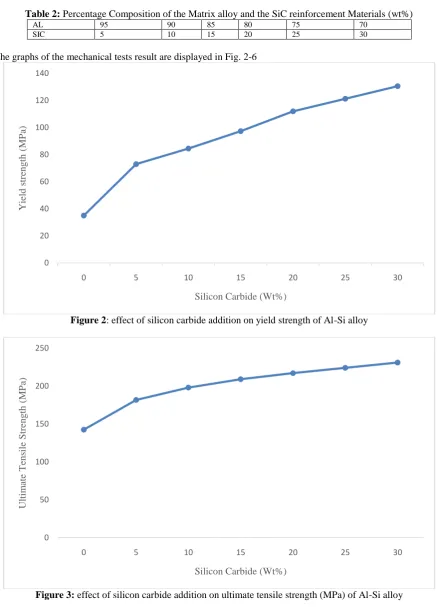
RESULTSTable 2: Percentage Composition of the Matrix alloy and the SiC reinforcement Materials (wt%)
AL 95 90 85 80 75 70
SIC 5 10 15 20 25 30
The graphs of the mechanical tests result are displayed in Fig. 2-6
Figure 2: effect of silicon carbide addition on yield strength of Al-Si alloy
Figure 3: effect of silicon carbide addition on ultimate tensile strength (MPa) of Al-Si alloy
0 20 40 60 80 100 120 140
0 5 10 15 20 25 30
Yield
s
tr
en
g
th
(
MP
a)
Silicon Carbide (Wt%)
0 50 100 150 200 250
0 5 10 15 20 25 30
Ultim
ate
T
en
sile
Stre
n
g
th
(
MP
a)
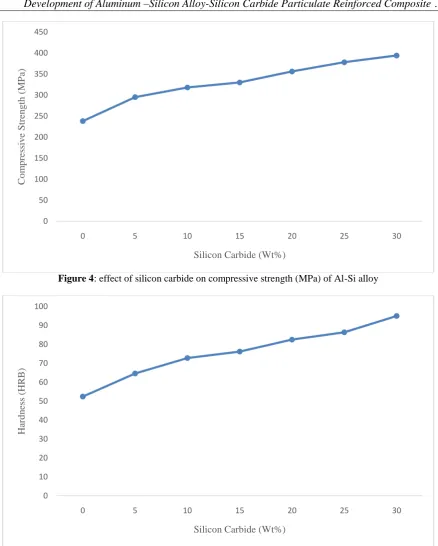
Figure 4: effect of silicon carbide on compressive strength (MPa) of Al-Si alloy
Figure 5: effect of silicon carbide addition on hardness of Al-Si alloy
0 50 100 150 200 250 300 350 400 450
0 5 10 15 20 25 30
C
o
m
p
ress
iv
e
Stre
n
g
th
(
MP
a)
Silicon Carbide (Wt%)
0 10 20 30 40 50 60 70 80 90 100
0 5 10 15 20 25 30
Har
d
n
ess
(
HR
B
)
Figure 6: effect of silicon carbide addition on impact on energy of Al-Si alloy
Figure 7: thermal conductivity of the alloy and composite samples
0 5 10 15 20 25
0 5 10 15 20 25 30
Im
p
ac
t E
n
er
g
y
(
Jo
u
les)
Silicon Carbide (Wt%)
0 20 40 60 80 100 120 140 160
0 5 10 15 20 25 30
T
h
er
m
al
C
o
n
d
u
ctiv
ity
(
W
/m
k
)
IV.
DISCUSSIONS 4.1 Yield, Tensile and compressive strengthsIn Fig. 2 and 3, the yield strength and ultimate tensile strength of the Al-Si-SiCcomposites increased with increase in the percentage SiCpto 30wt % SiCp. The higher values of yield strength and ultimate tensile strength obtained at 30wt% SiCp are attributed to the uniform distribution of the SiCp in the composites as seen in the microstructure. The inter-particle distance is smaller as shown in the microstructure.Also the compressive strength of the composites increased with increase in the percentage SiCp as shown in Fig. 4.
The greater enhancement of the strength properties of these composites is due to good distribution of the SiC as well as low degree of porosity, which leads to effective transfer of applied load to the uniformly distributed strong SiC particulates. Other important factors that contribute significantly in the high strength of the composites is the grainrefinement and the strong multidirectional thermal stress at the Al-Si/SiCp interface. The SiC particles have grain refining strengthening effect. This grain refining strengthening mechanism is enhanced with increasing weight fraction of SiCp because they act as the heterogeneous nucleation sites for Al-Si alloy.
Also the coefficient of the thermal expansion (CTE) values of the matrix and the reinforcement ceramic particles vary. This difference generates thermally induced residual stresses and increases dislocation density during rapid solidification encountered in the casting process. By Orowan mechanism the SiC particle acts as barriers to the dislocation motion near the particles in the matrix. The increase in the weight fraction of the particulates gradually enhance this effect of particles in the matrix. [6]
4.2 Hardness
From the Fig. 5, the hardness values of the cast composites increased as weight percent of SiCp increases from 5wt% to 30wt% in the alloy. The hardness of Al-Si/SiCp composite increased from 52.4 HRB for the control sample to 95.0 HRB for sample with 30wt% SiCp. This is due to the even dispersion of the increased percentage of the hard and brittle ceramic phase (SiCp) in the ductile Al alloy matrix. [7]
4.3 Impact Energy
Fig. 6 is a graphical display of the effect of reinforcement content on the impact energy of Al-Si matrix alloy. The graph shows that increase in the silicon carbide content gradually decreases the impact strength of the Al-SiC/SiCp composite materials. The impact strength decrease from 20.6J at 0wt% SiCp to 11.70J at 30wt % SiCp. This degradation on the impact energy of the composite could be attributed to the brittle nature of the reinforcement material (SiCp) since the unreinforced Al-Si alloy registered the highest impact energy. It also depicts that the matrix alloy is tougher than the composites developed.
4.4 Thermal conductivity
The thermal conductivity of the aluminum alloy silicon carbide composites samples as shown in Fig. 7 was observed to increase with increase in the weight percentages of particulate SiCp up to 20wt %. The decrease in conductivity at above 20wt % SiCp may be attributed to casting defects such as porosity and coarsening in the silicon carbide morphology in the matrix of aluminum alloy.
4.5 Microstructural Analysis
Fig. 1-6 show the microstructure of as cast Al-Si matrix alloy and Al-Si-SiCp composites with different weight percentages of SiCp. The composite micrographs show some discontinuities and reasonable uniform distribution of the reinforcements in the respective matrix. The white background in the alloy matrix while the features are ceramic phase (SiCp). These structures agreed with the continuous interlaced phases studied by other researchers [8,9].
V.
CONCLUSION From the results of the studies it is possible to conclude with the following;The aluminum alloy composites containing different amounts of silicon carbide particles (SiCp) were successfully produced by stir casting method.Coating the SiCp with alumina (Al2O3) particles as well as double layer or sandwich mechanism of charging the materials in the furnace improved wettability and facilitated homogenous distribution of the reinforcement in the matrix.
The uniform distribution of the SiC particles in the microstructure of the composites is responsible for the improvement in the mechanical properties.
The strengths and hardness of the composites increased with percentage increase in reinforcement while the impact strength decreased with reinforcement increase.
The Al-Si-SiC MMC with 15 to 25wt % SiC provide good combination of mechanical and the thermal properties and could be good candidate materials for brake disc that can efficiently and effectively compare with gray cast iron.
ACKNOWLEDGEMENT The authors wish to thank TETFUND for sponsoring this research.
REFERENCES
[1]. Rohatgi, P.K, Asthemia, R and Das, S. 1986, The Wetting of Ceramic Particle by Molten Metals Matrix Composites, International Materials Reviews, vol.31,No3
[2]. Maleque, M.A, Dyuti,S and Rohman,M.M. Materials Selection Method in Design of Putomotive Brake Disc, proceedings of World Congress on Engineering, 2010, vol.111 WCE 2010 June 30-July 2, 2010, London U.K
[3]. Adebsi, A.A, Maleque, M.A and Rahman, M.M. Metal Matrix Composite Brake Rotor: Historical Development and Product Cycle Analysis. International Journal of Automotive and Mechanical Engineering (IJAME) vol. 4,pp471-480, July-December 2011 [4]. Hassan, S.Fand Gupta, M. 2005, Development of High Performance Magnesium Nano-Composites using Nano-Al203 as
Reinforcement”, Materials Science and Engineering A Vol.392 pp.163-168
[5]. Chun-Ping Ye, Wengsing Hwang and Chien-Hen Lin, “Numerical Simulation on Hardness Distribution for a FC 250 Gray Cast Iron Brake Disc Casting and Experimental Verification,’’ Materials Transaction, vol 50 No 11 (2009) pp 2584 to 2592, 2009. The Japan Institute of Metals.
[6]. Mazahery, A and Shabani, M.O Characterization of Cast A3556 alloy reinforced with nanoSiC composite” Transactions Nonferrous Metals society of China, 22, (2012) pp 275- 280
[7]. Sinda, M; Dwivedi, D.D; Singh, L and Chawla, V (2009). Development of Aluminum Based Silicon Carbide Particulate Metal Matrix Composites. Journal of Minerals and Materials Characterization & Engineering, 8 (6), 455 --- 467.
[8]. Rohatgi, P.K, Yarandi, F.M. and Lui,Y. Proceedings of International Symposium on Advances in Cast, 1988.