Comparative Analysis of different Materials for Pallet
Design using ANSYS
Abdullah Waseem, Ahmad Nawaz
*, Nauman Munir, Bilal Islam, Sahar Noor
*For Correspondence: Department of Mechanical Engineering, CECOS University, Peshawar, Pakistan
Email: [email protected]; [email protected]
Abstract
--
Pallets are used mostly in storing heavy and large items in different industries across the globe. Reason for using pallet is to ensure safe material handling and storage of the material. Wooden pallets are usually used in industry. But wood is unfortunately not suited by environmental conditions in Pakistan. Hi Tech Plastic Industry, Wah Cantt is an industry that manufactures pallets for different defense related organizations in Pakistan. In this research a pallet is designed and analyzed by comparing various materials on Pro-E and ANS YS respectively. Analysis is done by considering uniformly distributed static force on pallet. From the results obtained from analysis done on pallet using ANS YS suggests that PVC made pallets are excellent in comparison to other pallets because of less deformation in shape as compared to other material pallets used in this analysis.IndexTerm--
Wooden pallet, Hi Tech Plastic Industry, Comparative study using Pro-E and Ansys.
1.0 INT RODUCT ION
Pallets are used in different industries for different purposes . But mostly, the purpose of pallet is in material storage, material handling of heavy parts and transporting cargos [1,4]. Pallets are usually made of wood, plastic and metals [5,7] a lot of research is being conducted on wood pallet and metal pallets.
According to D.Nicholas, M.G.Kim, C.Pittman, T.Schultz and L.Ingram Jr. [8] wood pallets are unsuitable in military applications because it’s difficult to wash away or remove different chemical constituents and warfare agents by using standard decontamination Procedure. Instead he impregnated the wood with polyurethane resins and subjected the pallet to different tests i.e bending test, Full Deck, Loading Test, Rigid Drop, Impact test (these tests are used by US Army in different applications). But polyurethane is capable of causing severe environmental and health problems due to evaporation of isocyanate from the resin.
T.S. Khoo [7] commented on wood pallet as degradable due to environmental changes and effects. Secondly, method for fastening the members in wood pallets is not very effective. Thirdly, more wood pallet production means more forest depletion. Fourthly, they are also exposed to severe fungal
attacks especially in humid conditions like in Malaysia and Indonesia.
Khoo et all [7] suggests to manufacture pallet from wood saw dust and recycled plastic (recycled Poly-Propylene) composite. Pallet was manufactured by us ing the composite of saw dust and recycled Poly-Propylene material. Results were obtained by Ansys and actual experiments. Both results showed contradiction due to possible error in experimentation as stated by T. S. Khoo himself. E. Soury and A. Behravesh [9] commented on wood plastic composites as tedious in manufacturing because of possibility of wood burning due to rapid injection of plastic. This problem can occur if injection molding process is used instead of using extrusion process. Secondly, Soury et all [9] also identified that Wood Plastic composites used in market are heavy weight and not suitable for use in industries.
Soury et all [9] used micro genetic algorithms technique to get optimized design of pallet. With the help of genetic algorithm he succeeded in obtaining an optimized design for Pallet by taking in consideration mass and deflection. But problem in this design is that it requires extreme labor training and vigilance, temperature control of extrusion material as Soury et all [9] selected process of extrusion for manufacturing wood composite pallet.
P. Eggy Zwolinski and Daniel Brissaud [10] think that product should be made with such a material that is recycled easily and is reusable also. Reusable means the material that can be used in same application or some other application. Wood once degraded cannot be used again. Similar is case with steel and aluminum pallets. The properties of steel are deteriorated i.e strength and stiffness are decreased. Plastics on the other hand are recyclable [9].
lightweight aluminum composite material in storing LED’s. In defense industries it is not suitable to use these pallets because of very heavy load as compared to LED’s.
2.0 PROBLEM ST AT EMENT
To find a suitable light weight material from which we can easily manufacture pallet with simple process like extrusion and needs less energy extruder. It should be economical, light weight and must bear high tensile loads. For this an appropriate material should be selected to manufacture Pallets for bearing load of 45KN or 45000 N. This is the load which pallet has to withstand.
2.1.1 Methodol ogy
Method used for solving this problem involves comparative analysis of different materials and their properties. After that light weight and single material has been selected in this research project on the basis of comparative study results. 3 D Model of pallet is drawn in Pro E software by selecting suitable pallet type and dimensions (Pro-E Version 5.0). Software model has been saved in .iges file and uploaded in Ansys software for analysis.
Static Structural analysis is done on the 3D Model of pallet in Ansys. After results have been obtained from Ansys. The conclusion will be based on answering various questions.
whether the desired material to be used for pallet is suitable for manufacturing of pallets?
Whether this material is recyclable and reusable?
Whether this material withstands high tensile loads?
Whether this material be used in mass production of pallets?
2.1.2 Ansys Software
Ansys is software usually used to find the effects of different loads on a surface which is designed in Pro-E, Solid Works, AutoCAD, Autodesk inventor by saving them in iges file. The basic purpose of this software is to simulate the results of practical loading situations to find out whether a specific material is strong enough to withstand a specific load or not.
S.H. Masood and S. Haider Rizvi [12] analyzed Wood Pallet Composite using Pro Mechanica. Results obtained from Pro Mechanica were displayed. But Pro Mechanica takes much more time as compared to Ansys. In some complicated geometries Pro Mechanica is unable to analyze the profile.
Mounir Hamdi et all [13] used simulation software on a certain geometry excluding holes, chamfers and other features. Features like holes, fillets and chamfers make the mesh refine and enhance the processing time.
Vincent Manet [14] tested effect of uniform pressure on simply supported sandwich beam to compute stresses and defection. Manet [14] used Ansys 5.0 software for complete analysis.
Johann Rannou and Anthony Gravouil [15] used simulation technique for analyzing crack propagation in material.
2.2 Pallet Design & Analysis
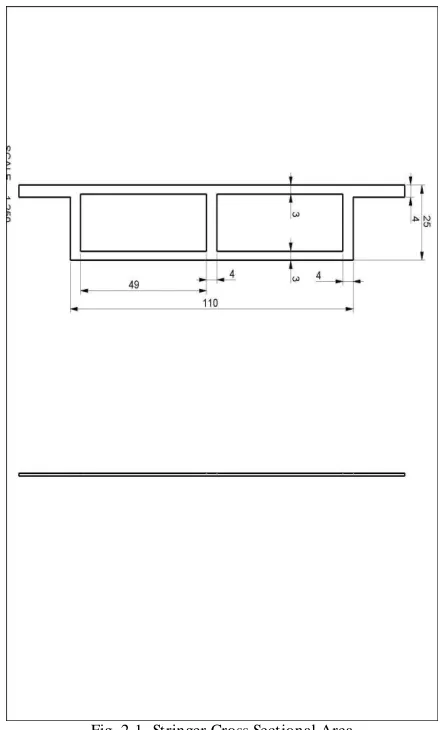
According to Khoo et all [7] pallets can be mainly categorized as a) stinger pallet, b) Block Pallet c) Four Way Pallet d) Panel Deck Pallets. In this paper we selected Stinger Pallet to be designed for our system. It was designed using the following dimensions. Stringer design and dimensions are given in the figure 1.1. The size for pallet selected on the basis of the size of product to be placed on pallet. Size is taken as 1200mm X1200 mm X 150mm.
Fig. 2.1. Pro E Model of Pallet
Fig. 2.2. Ansys Meshed Model
Fig. 2.3. Static Force of 45000N on Pallet
Input includes a Pallet having dimensions
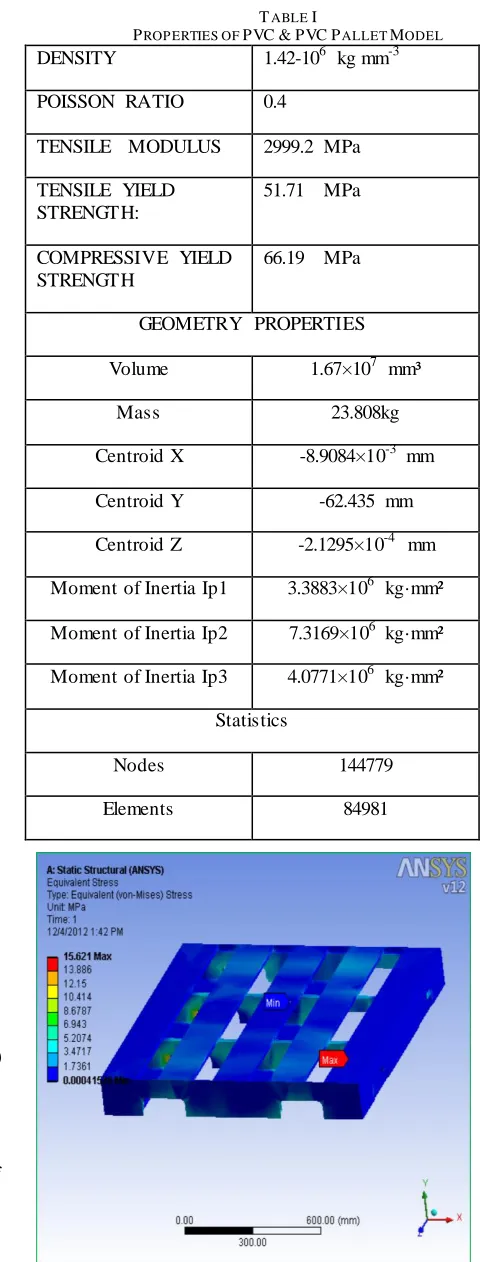
1200mm×1200mm×150mm. Second input is load of 4500 Kg or 45000 KN. All the Mechanical Properties of materials are also included as inputs (Density, Poisson Ratio, Tensile and Compressive strengths ). It is to be applied on simulated model of pallet using different materials. First material to be tested is PVC or Poly Vinyl Chloride. Different properties of PVC are given inside the table. They are inserted manually while volume, mass, moment of inertia, centroids, nodes and elements are calculated by ANSYS Software itself.
TABLE I
PROP ERTIES OF PVC&PVCPALLET MODEL
DENSITY 1.42-106 kg mm-3
POISSON RATIO 0.4
TENSILE MODULUS 2999.2 MPa
TENSILE YIELD STRENGTH:
51.71 MPa
COMPRESSIVE YIELD STRENGTH
66.19 MPa
GEOMETRY PROPERTIES
Volume 1.67×107 mm³
Mass 23.808kg
Centroid X -8.9084×10⁻³ mm
Centroid Y -62.435 mm
Centroid Z -2.1295×10⁻⁴ mm
Moment of Inertia Ip1 3.3883×10⁶ kg·mm²
Moment of Inertia Ip2 7.3169×10⁶ kg·mm²
Moment of Inertia Ip3 4.0771×10⁶ kg·mm²
Statistics
Nodes 144779
Elements 84981
Fig. 2.5. Deformation in PVC Pallet TABLE II
PROP ERTIES OF PE&PEPALLET MODEL
DENSITY 9.5×10⁷ kg mm-3
POISSON RATIO 0.42
TENSILE M ODULUS 1100M Pa
TENSILE YIELD
STRENGTH:
25M Pa
COM PRESSIVE YIELD
STRENGTH
0 M Pa
GEOM ETRY PROPERTIES
Volume 1.67×107 mm³
M ass 15.713 kg
Centroid X -2.3016×10⁻³ mm
Centroid Y -62.753 mm
Centroid Z 1.9219×10⁻¹⁴ mm
M oment of Inertia Ip1 2.2343×10⁶ kg·mm²
M oment of Inertia Ip2 4.8265×10⁶ kg·mm²
M oment of Inertia Ip3 2.6907×10⁶ kg·mm²
Statistics
Nodes 112311
Elements 68017
Fig. 2.7. Von-Mises Stresses in PE Pallet
Fig. 2.6. Deformation in PE Pallet TABLE III
PROP ERTIES OF PC&PCPALLET MODEL
DENSITY 1.2×10⁶ kg mm-3
POISSON RATIO 0.37
TENSILE M ODULUS 2200M Pa
TENSILE YIELD
STRENGTH:
62.8 M Pa
COM PRESSIVE YIELD
STRENGTH
80 M Pa
GEOM ETRY PROPERTIES
Volume 1.67×107 mm³
M ass 19.89 kg
Centroid X -2.3016×10⁻³ mm
Centroid Y -62.753 mm
Centroid Z 1.9219×10⁻¹⁴ mm
M oment of Inertia Ip1 2.8223×10⁶ kg·mm²
M oment of Inertia Ip2 6.0966×10⁶ kg·mm²
M oment of Inertia Ip3 3.3987×10⁶ kg·mm²
Statistics
Nodes 112311
Fig. 2.8. Von Mises Stresses in PC Pallet
Fig. 2.9. Deformation in PC Pallet
Fig. 2.10. Von mises Stresses in HDPE Pallet
TABLE IV
PROP ERTIES OF HDPE&HDPEPALLET MODEL
DENSITY 9.7×10⁻⁷ kg mm-3
POISSON RATIO 0.42
TENSILE MODULUS 3378 MPa
TENSILE YIELD
STRENGTH:
28 MPa
COMPRESSIVE YIELD
STRENGTH
2.2 ×10⁻⁵ MPa
GEOMETRY PROPERTIES
Volume 1.67×107 mm³
Mass 16.004 kg
Centroid X -2.3016×10⁻³ mm
Centroid Y -62.753 mm
Centroid Z 1.9219×10⁻¹⁴ mm
Moment of Inertia Ip1 2.2813×10⁶ kg·mm²
Moment of Inertia Ip2 4.9218×10⁶ kg·mm²
Moment of Inertia Ip3 2.7473×10⁶ kg·mm²
Statistics
Nodes 112311
Elements 68017
TABLE V
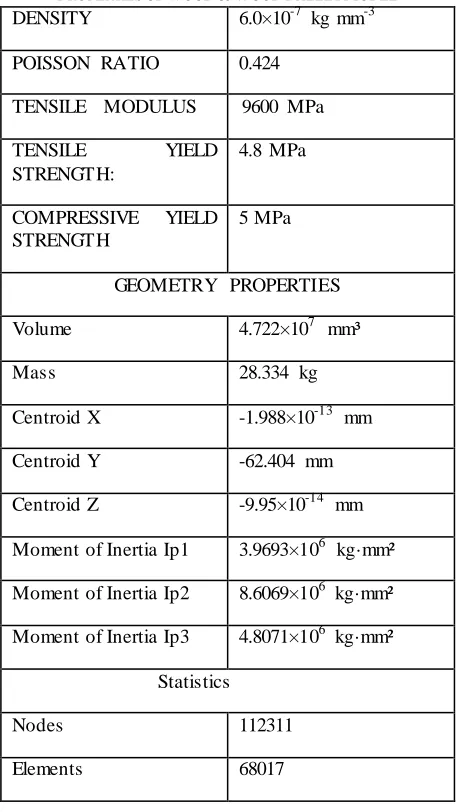
PROP ERTIES OF WOOD &WOOD PALLET MODEL
DENSITY 6.0×10⁻⁷ kg mm-3
POISSON RATIO 0.424
TENSILE MODULUS 9600 MPa
TENSILE YIELD
STRENGTH:
4.8 MPa
COMPRESSIVE YIELD
STRENGTH
5 MPa
GEOMETRY PROPERTIES
Volume 4.722×107 mm³
Mass 28.334 kg
Centroid X -1.988×10⁻¹³ mm
Centroid Y -62.404 mm
Centroid Z -9.95×10⁻¹⁴ mm
Moment of Inertia Ip1 3.9693×10⁶ kg·mm²
Moment of Inertia Ip2 8.6069×10⁶ kg·mm²
Moment of Inertia Ip3 4.8071×10⁶ kg·mm²
Statistics
Nodes 112311
Elements 68017
Fig. 2.12. Von Mises Stress in Wood Pallet
Fig. 2.13. Deformation in Wood Pallet
3.0 COMPARAT IVE ANALYSIS &DISCUSSION S
As output response of three inputs we got Simulated Mass, Simulated Volume, Simulated Moment of Inertia, Centroid of three axis (X,Y,Z), and the outputs that we selected for results i.e Total Deflection of Pallet by using different Materials and stresses generated in each type of material from which pallet can Possibly be manufactured. Comparative analysis means to compare different materials on considering various aspects and results. Comparison has been done by comparing Outputs i.e Stresses, total deflection and simulated mass .
Pallet and stinger sizes are same in Poly Vinyl Chloride (PVC), Polycarbonate (PC), High Density Polyethylene (HDPE) and Poly Ethylene (PE) and in case of wood (maple red) Keeping the geometry and dimensions of pallet same for all the materials all the materials are compared with each other by comparing their stresses, deflection and simulated mass computed by ANSYS Software.
TABLE VI
COMPARISON OF MAT ERIALS ON BASIS OF ANSYS RESULT S
S.No Material Simulated Mass
Deflection (mm)
Stress (mPa)
1 PVC 23.00 Kg 1.017 16.036
2 PE 15.20 Kg 7.889 16.036
3 PC 19.89 Kg 4.117 16.036
4 HDPE 16.00 Kg 2.568 16.033
5 Wood 28.33 Kg 0.4534 16.036
researchers’ i.e chemical degradation, termites and other parasites can damage wood, and several reasons other for not using wood based pallets.
From these results PVC is considered based on minimum deflection out of 4 plastic materials. It can easily withstand 45000 N or 45KN. PVC recyclable in for usage in other applications. PVC can withstand high tensile loads (evident from simulation results). Finally, mass production is possible using PVC material.
3.1 Scope & Limitations
With the help of this research it will be helpful in selecting the materials for a specific application. So without losing so much energy and money one can decide whether to select a certain material or not. This research will help in establishing a method of selecting materials on the basis of their behavior shown by different materials when subjected to different inputs.
Software analysis needs maximum parameters or inputs to be interpreted very concisely. Sometimes the software results can differ from the practical results.
4.0 ACKNOWLEDGEMENT S
Special Thanks to all the management team of Hi- Tech Plastics Industries, Wah Cantt, Wah (the company manufacturing pallets of wood but now want to manufacture light weight pallets ). They immensely supported us in identifying needs and requirements of this research.
5.0 FUT URE WORK &RECOMMENDAT ION
In future further work can be conducted by manufacturing extrusion die and pallet. The tests should be conducted in real and those results should be analyzed with these simulated results.
Secondly, all standard tests i.e bending, full deck, rigid drop, impact test of stringer can be conducted by simulation softwares and practically by conducting different standard tests and experiments.
Thirdly, these pallets can be tested in storage systems and comparative results like Ahmad et all [16] can be obtained using statistical tools.
Fourthly, PVC can be mixed other with plastics to give it high impact strength.
REFERENCES
[1] Patricio MA, Maravall D. A Novel (2007), “generalization of the gray-scale histogram and its application to the automated visual measurement and inspection of wooden pallets.” J Image Vision Comput, 25, pg 805–16.
[2] Pallet reduction and reuse technical appendices;1996.<http://www.ciwmb.ca.gov/Packaging/wood/pall ets.doc
[3] Lebowitz CA, Baaklini GY. (1996) “ Nondestructive evaluation of materials & composites”. Bellingham: SPIE Publication; [4] Kabir MF, Schmoldt DL, Araman PA, Schafer ME, Lee SM.
(2003) “ Classifying defects in pallet stringers by ultrasonic scanning. J Wood Fiber Sci, 35, Pg:341–350.
[5] Mcoy M. Pallets that make the extra trip, New York; 2003. <http://www.mmh.com>.
[6] Company.e.Pallets.<http://www.5es.co.uk/reverse_logistics/rtp/rtp _types/ pallets.htm>.
[7] Khoo T S, Ratnam MM, Abdul Khalil HPS. (2008) Wood filler (WF)–recycled polypropylene (RPP) composite pallet: study of static deformation using FEA and shadow moire. J Reinf Plast Compos, 27, Pg1733–1744.
[8] D. D. Nicholas, Moon G. Kim, C. U. Pittman Jr. , T . P. Schultz , L. L. Ingram Jr, F. R. A. Kabir, L. Wasson , L. Wang & M. Ivankoe (2007). Polyurethane resins-treated wood pallets which are decontaminable of chemical warfare agents”. Journal of Wood Chemistry and T echnology 21, no 3, Pg 263-283.
[9] Soury E, Behravesh A.H *, Rouhani Esfahani E, Zolfaghari A. (2009)“Design, optimization and manufacturing of wood–plastic Composite P allet” Materials and Design 30, pg 4183–4191 [10] Peggy Zwolinski, Daniel Brassuad (2008), “ remanufacturing
strategies to support product design and redesign” Journal of Engineering Design 19, no. 4. Pg. 321-335
[11] Kim Y.H , Eum S.H , Bae C.W , Han J.W, Jo Y.D, Bae S.Y (2010) “Development of lightweight composite pallets for assembly line of LCD's and PDP's”, Advance Composite Materials 19, Pg 55-62 [12] Masood S.H , Haider Rizvi. S (2006) “ An investigation of pallet design using alternative materials for cold room applications”, Int J Adv Manuf T echnol, 29, Pg 1-8
[13] Mounir Hamdi, Nizar Aifaoui, Borhen Louhichi & Abdelmajid BenAmara (2012), “Idealization of CAD model for a simulation by a finite element method” European Journal of Computational Mechanics/Revue, 19, no 4, Pg 419-439
[14] Vincent Manet (1998) “T he use of Ansys to calculate sandwich structures” Composites Science and Technology, Elsevier, 58 Pg 1899-1905
[15] Johann Rannou, Anthony Gravouil, Alain Combescure (2012), “A multi-grid extended finite element method for elastic crack growth simulation” European Journal of Computational Mechanics/Revue, 16, no 2, Pg 161-182
[16] Ahmad Nawaz, Bilal Islam, Naeem Khattak, Sahar Noor (2012) “Comparison of Polyester and Araldite Impregnated Ignition Coils using SQC”, International Journal of Engineering & T echnology, IJENS Publishers, 12, no 6, Pg 28-36
C orre sponding Author