Optimizing Value and Risk Based on Client Expectation in Construction Industry
using Intelligent Algorithm: A Case-Study in New Zealand
Wei Zhang
College of Civil Engineering and Architecture, Zhejiang University of Technology, Hangzhou, Zhejiang, China. Email: [email protected]
Article Received: 25 October 2017 Article Accepted: 30 December 2017 Article Published: 14 February 2018
INTRODUCTION
A major issue in construction industry is that when the costs decrease, the risks increases at the same time (Havard,
2002). Hessami et al. (2017) recommended an iterative process in which the scope, cost estimate, and project
timeline are progressively developed during each of decision-making stages (Hessami, et al., 2017). Since all
companies need to decrease costs to sustain, it is required to employ a reliable model for estimation of the risk.
According to the findings of Hessami et al. (2017), it became apparent that private companies, local governments
and MPOs can all benefit from more rigorous and streamlined project development procedures (Hessami, et al.,
2017). There are lots of ways to achieve this goal. Mathematical modeling is one of the most reliable (Omigbodun,
2001). Mathematical modeling, specially intelligent algorithm, has a wide range of application. For example, Chu
et al used PSO-ANFIS to predict the wax amount which is produced in the oil pipes (Chu, Sasanipour, Saeedi,
Baghban, & Mansoori, 2017), or Torabi et al applied Neural Network to estimate the wind power production
(Torabi, Kiaian Mousavy, Dashti, Saeedi, & Yousefi, 2018). While there are a vast number of other examples that
can be used, but there is not lots of instances in construction, particularly when there is some points about the
clients’ decision making (Kenley, 2003).
During the late 1990s to the early 2000s a substantial number of houses were built in New Zealand using methods
and materials that could not withstand the weather conditions of New Zealand. The calamity resulted in a
combination of contributing factors involving the design of the building, the installation of materials, the change in
requirement in untreated timber used in construction, the increase in insulations installed in timber framing and the
trend to build Mediterranean styled building using monolithic cladding systems. The problem with such
construction is that once water or moisture penetrates through certain cladding systems, if there are no cavities
between the cladding and the framework, the water becomes trapped and cannot easily escape or evaporate.
A B S T R A C T
New processes and materials pose benefits to architects, designers, and builder and home owners as such change mean the cost of building was lower and in some cases home building projects were able to be completed faster. However as with new processes and materials emerge, new training is required to fully utilize them allowing construction projects to gain added value. The goal of this paper is to illustrate how value management and risk management can be applied to manage the expectation of clients in construction projects. To achieve our goal, first it is shown that with the new ability of clients being able to access information regarding to new materials and processes, they can incorporate more than before in specifying particular materials and processes in the design and construction of the building increases. Then a novel model is provided using Intelligent Algorithm to maximize value and minimize the risk based on client expectation.
In addition, a change in the New Zealand Standards for timber treatment in 1998 allowed the use of untreated
kiln-dried timber to be used in wall framing. When this untreated timber comes in contact with water for a long
period of time, the timber will begin to rot. In 2002 the Building Industry Authority appointed a Weather tightness
Overview Group to investigate the cause of the leaky homes crisis in New Zealand. In their findings, they pointed
out the main factors that contributed to the cause of the leaky homes but no one factor was identified as the single
cause of leaky buildings.
Main factors causing leaky buildings
The trend to build Mediterranean styled buildings using monolithic cladding systems
Poorly designed features such as:
Recessed windows
Flat roofs with narrow or no eaves
Two or more stories
Solid balustrades and balconies that just extend out from the walls which causes penetration through the
external claddings
Insufficient details in the approved documents, which are produced to help people meet the requirements of
the New Zealand Building Code.
Lacking of technical knowledge and skills when houses are designed, detailed and built. Modern systems
require far greater level of detail, care and skill.
Untreated kiln-dried timber is susceptible to rot when water penetrates the building envelop.
The leaky home crisis is a systematic failure of a new building style trend, poor design features, insufficient
building requirements, and the lack of technical knowledge to design, detail and construct buildings. The media in
effect had an influence on the style of housing that was new to New Zealand's traditional designed houses. It is also
during this period when manufacturers of building materials begun to market their products directly to the
consumers; the end users and owners of buildings. Companies such as the Winstone Wallboards Ltd began to
market their products to the general public; their advertisings of gypsum plasterboard by-passed the construction
industry and directly to the owner. Similarly the makers of Pink Batts, Tasman Insulation New Zealand Limited
also began major marketing campaigns to target home owner and potential home owners to incorporate their
building products in the construction of houses. The lack of implementation to ensure adequate and safe designs
while builders and contractors lacked knowledge regarding to the building product and its application could have
contributed to the leaky building crisis.
Although this changing in construction product marketing was not a cause of the leaky home crisis, it nevertheless
have increased the awareness of building products for clients and this increased their ability and persistence to
specify particular building products or processes, therefore changing the expectation of the outcome of the
CLIENT EXPECTATION
Client's expectation of construction projects have changed over time in parallel with the changes in technology,
especially in the advancements in information systems and marketing campaigns for construction materials.
Nowadays manufacturers of building products advertise and market their products directly to the potential clients
of construction projects. Good examples of these can be seen on the television media, manufacturers such as
Winstone Wallboards Ltd market their gypsum plasterboard for walls and ceilings, while Tasman Insulation New
Zealand Limited market their insulation products more commonly known as Pink Batts. This new marketing
strategy from construction material manufacturers means that they have effectively by-passed the distribution
industries and the building and construction industries in the value chain for the supply of building materials
(Omigbodun, 2001).
This marketing strategy allowed consumers who are the potential clients of construction projects to have more
knowledge of the building products available and be aware of the potential benefits of particular building products.
In conjunction with the internet, manufacturers can distribute product information and specification online. Before
these changes in marketing and internet sources, construction products were selected and presents to the client by
the project team. Compare to now, clients have products in mind before initiating a construction project. They also
have in mind the advertised visual aesthetics and performance of the products giving clients an overall expectation
of the construction prior to the meeting with the design team (Atkin, Borgbrant, & Josephson, 2003).
Construction clients are committing something they cannot see until it is completed. The challenge for the project
team is translating client needs into design requirements and subsequent critical characteristics. Failing to
understand client needs is the issue that creates the largest gap between client expectation and client satisfaction.
The second largest gap is held by project delivery being on time. The new marketing strategy could potentially
create a gap between client expectation and client satisfaction as the visual aesthetics and performance of the
product can only be achieve if it was installed in a particular way for under certain circumstances (Atkin,
Borgbrant, & Josephson, 2003). Such gaps could potentially become points of conflict throughout the construction
project and finally reaching the completion and the client's expectation on the project may not be achieved.
If clients are educated by the design team as to what to expect during the design and construction of the project and
the standards a design team must offer, then minor divergence can then be view as part of the design process and the
efforts could be directed toward resolving those routine problems understandingly and effectively. Clients who are
unfamiliar with the trials and adversity of a major project should be educated on the process prior to the design and
construction stages. Doing so will facilitate the clarification of client's expectation and allow clients to adjust their
Clients have four main expectations on construction projects. They are the expectation on scope, cost, time and
quality. All of these expectations are defined, estimated, planned and specified during the design phase of the
project. It is therefore critical for the project team to identify the client's expectations at the beginning of the design
phase so that it could work towards the client's expectations. Once the construction phase of the project begins,
there would be little room for adjustments on the focus of meeting client expectation. By that stage, the project team
are adhering, monitoring, controlling and managing the expectations that were set during the design phase.
Client's preconceived expectations on construction projects are highly skewed by the marketing strategies
employed by manufacturers. Manufacturers often advertise their product's performance under optimum conditions
and they have a tendency to omit risks that are associated with the product. This is the main contributor to client's
expectations as they have a visualization of how the product performs but in some cases, these products may not be
able to perform at their optimum level due to the environment of the project location, the installation, application
and the maintenance of the product.
Client's expectations over the cost of projects have changed over time. Clients expect costs to be kept at a
minimum, however most clients are unaware of the so-called costs that are involved in a construction project and
the overall whole lifetime cost of buildings. The trends towards 'green' buildings are a good example, the aim of
sustainable buildings, the so called 'green' buildings are to reduce the impact of the building's operation on the
environment and this in sequence usually reduces the consumption of energy of buildings. Sometimes clients are
too focus on the capital cost, that they fail to recognize the benefits of the reducing the whole life cost of the
building through the slight increase in capital expenditure.
Time is another important expectation from customers; sometimes the most important expectation. The idea of
prefabrication allows construction time to be reduced, as components are made off-site and are brought to the
construction site for assembly. However there is a limit as to how many elements of the construction can be
prefabricated and the trend to more complex projects which requires a finer level of design detail and thus
contributing to the length of construction time.
CLIENT NEEDS
Satisfying client needs is a vital requirement for construction projects. As construction projects are induced by the
client needs; but often the project outcomes fails to satisfy them. There are many reasons for this, for the design
team the challenge is to comprehend client needs, which should be revealed during the briefing stage of the project
(Atkin, Borgbrant, & Josephson, 2003). Potential clients of the construction industry are too large and varied group
for any meaningful detailed classification to be prepared. Nevertheless an understanding of clients is aided by a
broad categorisation (Knipe, Van der Waldt, Van Niekerk, Burger, & Nell, 2002). As different clients from
different categories will have different needs for it to initiate a construction project. For example:
A industrial client would build factories and expect a gain on productivity
A public client is expecting a social investment gain from a new school.
When the client is satisfied that there is a need for a project, it will then undertake a feasibility study to ascertain
whether the project meets all of the objectives of the client (Havard, 2002).
CLIENT'S OBJECTIVES
The most important feature of any building project should be the client's objective in embarking on the construction
of the project. The need for the project will normally have risen from some demand arising from the client
organisation's primary activities as stated before. The needs of clients are stimulated by the environment of their
organisation, which presents opportunities to which they respond. Such external stimulus may be economic forces,
which give the opportunity for profit, or sociological forces, which presents the chance to respond to a social need,
but usually they are a combination of different forces in which the client must respond to as the result of the need to
survive. Above this, clients also respond in order to expand as a result of drive and motivation.
The effect of forces in the client's environment will therefore trigger the start of the construction process. Although
it may not be realised at the time that a project is needed and at that stage it is unlikely that any members of the
project team will be involved. When it becomes apparent that a construction project is needed to satisfy the client's
objectives, the brief begins to form. A common major problem is that the project team will normally not be
involved at this early stage and a number of important decisions which may inappropriately constrain the design of
the project may have been made by the time they are brought in (Atkin, Borgbrant, & Josephson, 2003).
Once the objectives are met, the three qualities of a project must then be prioritized to demonstrate the client's
preference. To some clients, if the priority is to keep costs down, then a delay may not matter too much. However to
other clients, time may be an absolute priority - for example a hotel development is scheduled for completion to
meet seasonal increase in trade. These three qualities in turn represent the client's expectation of the output of the
project, therefore it is vital to communicate with the clients to discover how the client has prioritized these qualities.
Clients often perceive the brief as a reasonably detailed statement of what they require, but it is important that the
strategic level of the brief is not overlooked at the expense of detail. The client's priorities must be clearly
established and are communicated to the project team. It may well be that there is conflict within the client's
organization regarding priorities, but the project team must be confident that it has interpreted the balance properly.
To achieve this it will have to understand the client's organization, its decision-making process and where the
highest authority lies (Kenley, 2003).
CHANGING EXPECTATIONS
Drivers of change in client expectation:
New trend in property ownership
Growing project complexity
Due to higher need requirements and technological advancements in material standardization, construction
methods, techniques and technologies. (quality and cost expectation)
Influence of life cycle costing
Cost of repairs and maintenance
Influence of alternative materials and systems
Shrinking business and project cycles
Shortening of the hypothetical supply chain of building materials (cost and quality expectation)
Commoditization of products and services
Specific products and trade specialist as a first tier contractor
External stakeholder power
Clients’ knowledge base is expanding
Suppliers focus
Scarce human resources
Ethical agenda
Green buildings (to reduce energy consumption and effects of global warming)
Time is a finite resource, especially with the new trend of increases in numbers of investment properties, clients of
construction projects demand their projects to be completed on time for peak market trading. This in effect
translates to the increasing expectation for construction projects to be completed on time and method of fast
tracking will be employed to ensure deadlines are met. Communication requirements in complex projects are
overwhelming in comparison to more traditional projects and there is a requirement for a great deal of interaction
and negotiation (Kelly & Male, 1993). The increase complexity will add time to the project duration.
CLIENT EXPECTATION AND PROJECT MANAGEMENT
The general definition of construction project management is said to be the planning, co-ordination and control of a
project from conception to completion on behalf of a client. This requires the identification of the client's objective
in terms of utility, function, quality, time and cost, and the establishment of relationships between resources,
integrating, monitoring and controlling the contributors to the project and their output, and evaluating selecting
alternatives in pursuit of the client's satisfaction with the project outcome (Omigbodun, 2001).
Client expectation begins with the briefing process. Briefing is seen as a singular event at the beginning of the
projects by the client; however this is not the case. Briefing is a process, where requirements are systematically
written down and this will be updated as required. This means that while the project proceeds and client's awareness
of the project increases, the ability to make changes reduces as the project progresses (Atkin, Borgbrant, &
Josephson, 2003). The recommendation is that briefing is a process running throughout the construction project, by
Clients nowadays simply expect too much from the design teams; they expect perfection. Any minor delays, added
costs or design changes are taken as a sign of incompetence on the part of the architect, engineer or project
manager.
Managing client expectations is the key to avoiding unnecessary confrontations, demands and claims. Perfection is
impossible to achieve, therefore the best approach to ensure that the client is making realistic expectations about the
project and its outcomes (Mirmohammadsadeghi & Aghdami Thani, 2005). Communication is vital to this process.
Communication should take place continuously throughout the project especially in the beginning. Stress that
perfection is unattainable at any price and errors and omissions are common parts of the design and construction
process.
Clients must understand that they can only expect a standard of care that is provided with the managing or design
service. These services are provided with the ordinary degree of skill and care that would be used by other
reasonably competent practitioners of the same discipline under similar circumstances and conditions. The
'standard of care' is a concept drawn from English Common Law doctrine. The doctrine holds that the public has the
right to expect services provided will be have done so with a reasonable normal, careful and prudent manner. In
other words, being perfect is not required as long as the service provided was done so with a reasonable due skill
and care (ACEC Oregon, 2008). Goals to achieve perfection however should still be set to give the project team a
clear direction and allow for measure of performance if necessary.
RISK MANAGEMENT
Design projects are inherently risky. Every project is different in some way and this carries with it uncertainties.
Risk is the term used to describe the amount of uncertainty and number of threats that exist or potentially exist in a
project (Ramroth, 2006). Risks can be technical, physical, commercial or environmental (Kenley, 2003). Managing
risk is one of the most important tasks for the construction industry as it affects the project outcomes (Atkin,
Borgbrant, & Josephson, 2003). This outcome is closely tied in with the output of the project; and at the most basic
level, the building and construction industry is recognised by its output (Havard, 2002). Client's expectation on risk
should be made known to the design team and in turn, the project risks should be communicated to the client. Doing
so will reduce any misunderstanding and possible confrontations.
Management of risk is an ongoing process throughout the life of the project, as risk will be constantly changing.
Risk management plans should be placed to deal quickly and effectively with risks if they arise. It is important to
work as an integrated project team from the earliest possible stages on an open book basis to identify risks
throughout the team's supply chain.
Risk management in construction projects involves:
Establishing and maintaining a joint risk register, agreed by the integrated project team
Establishing procedures for activity managing and monitoring risks throughout the project and during
occupation on completion
Ensuring that members of the team have the opportunity to engage in a dialogue that will promote
agreement of an appropriate allocation of risk.
Updating risk information throughout the life of the project
Ensuring control risk by planning how risks are managed through the life of the project to contain them
within acceptable limits
Allocating responsibility for managing each risk with the party best able to do so
A common risk management process should be understood and adopted at all levels within the integrated project
team, and the risk register regularly reviewed and updated throughout the project lifecycle. Investment in
developing the brief is often cut; however, this will likely lead to delay and cost overruns further on in the project
due to changes and potential misunderstandings. Making risks known to the client can help them develop and
prepare budgets for the project and this allows the project team to assess the client's expectation on risk. When
preparing the budget, it should comprise of two elements of cost, a base estimate and risk allowance. A risk
allowance should be included in the budget for the project to cover the potential financial impact of the client's
retained risks as estimated in the risk analysis.
Risks inherent in the maintenance and demolition of a facility should be considered during design development and
the decisions about risk kept on the register for future reference. This inherent risk should be included in the whole
life costing of the building. Risk management arrangements should include risk allocation that:
Is clear and unambiguous
Achieves best value for money
Represents a fair balance between risk and control
Does not create conflict of interest in those required to give independent advice to the client.
Contracts are a way to reduce risks as it is used to reduce uncertainty. Mutual agreements regarding to the project
must be stated in the contract. Contracts between businesses have evolved to take on various roles (Ramroth, 2006):
Recoding the deal that has been agreed and the rights and obligations of the parties.
Providing sanction for non-compliance, or incentive to comply
Offering sets of procedures that the parties should follow
Catering for uncertainty by deciding in advance how parties will bear the risk on unforeseen events.
VALUE MANAGEMENT
Value management is the process in which the functional benefits of a project are made explicit and appraised
investment by an organization on a temporary activity to achieve a core business objective within a programmed
time that returns added value to the business activity of the organization (Kelly, Making client values explicit in
value management workshops, 2007). Value management is a structured, multi-disciplinary group
decision-making process that encourages the enhancement of the value of a project, process or product in a manner
consistent with the business goals of the stakeholders and client needs. Value management enables stakeholders to
define and achieve their need through facilitated workshops that encourage participation, teamwork and end user
buy-in. Stakeholders are people who have a real interest in the outcome of the project. Stakeholders of construction
projects could be promoters, owners, financiers, supervisors, planners, engineer, constructors, operators, user and
neighbors.
The focus of value management is on function value for money, it is not necessarily to reduce cost. Though
reducing cost could be a by-product of the value management activities (Office of Government Commerce, 2007).
Value means ensuring that the right choices are made about obtaining the optimum balance of benefit in relation to
cost and risk, and in its broadest sense, is the benefit to the client. However with value management, it should be
recognized that improving the whole-life project value sometimes will require additional initial capital expenditure.
The buildability and maintainability of the facility are central to its long-term value. Value management is a very
low cost with high benefit exercise. The greatest benefit from applying value management to a project is when it is
integrated into the project development plan, with workshops programmed to take place.
If integrated into the project management methodology early in the project development the cost can be almost
negligible, because of the reduced need for subsequent reviews and opportunities for substituting VM for some of
the routine appraisals and quality audits that are always necessary (Hammersley, 2002).
CLIENT'S BENEFIT
The client is the party that benefit from the long-term operation of the building and therefore should lead the
process from inception to the completion of the building. However it is suggested that clients are not interested in
technological correctness. The designer on the other hand has the technological competence, but handling all the
interdependencies to reach an optimal technological solution can sometimes lead to long design durations;
affecting the clients expectation on the duration of the project. The designer may also have little knowledge on how
to produce the design to a finished product. This production knowledge and skill lies with the contractors and
subcontractors, often designers rely too heavily on the assumption that the design product is easy to produce.
Apparently no single party is fully capable of leading, but rather a group of individuals can stand a better chance of
succeeding (Atkin, Borgbrant, & Josephson, 2003).
To increase client's benefits the following key criteria should be made possible:
Clients should have enough time to increase their knowledge of the project outcome, based on their requirement
Designers should have sufficient time to convert client requests into key technical criteria
Designers should have enough time to investigate the interdependencies of the technical criteria in the building
system
Contractors and subcontractors, when required, should have the ability to view the impact of decisions regarding
constructability
As identified earlier, the client comprehends the product increasingly as the process proceeds. This suggests that
even though it is hard to manage, it should be possible to review the requirements of the client in order to produce a
building that satisfies.
WHAT IS VALUE
Value management is concerned with what value actually means within a particular context, agreeing a clear
statement of objectives and ensuring that solutions are consistent with the project objectives (Atkin, Borgbrant, &
Josephson, 2003).
In value management, value is the level of importance that is place upon a desired function, or combination of
functions.
Value is improved by increasing the worth of the functions relative to the cost (Atkin, Borgbrant, & Josephson,
2003). Value is assumed to be enhanced when the same functions are provided at a lower cost, and also when more
desired functions are provided at the same cost. It is also proposed that value is achieved when client satisfaction
improves when the same level of resources are invested. In other word, Value is proportional to the ratio of function
over cost, where a project’s function is defined as what it is expected to do. Alternatively, the term “performance” can be used instead of the term “function.”
VALUE ENGINEERING
After a brief definition of value, it is a good time to explain Value Engineering and the importance of it. Value
Engineering (VE, or Value Analysis) is a management technique that seeks the best functional balance between
cost, reliability and performance of a product, project, process or service. There are several reasons that value
engineering plays an important role in today's construction world. Below, you can see some of those reasons:
Value Engineering has saved the private industry and governmental agencies many $Billions since its
inception in 1947.
The VE approach promotes the philosophy of “Do the Right Thing Right the First Time.”
VE aims at achieving the lowest life cycle cost meeting or exceeding all the functional requirements and
criteria such as quantity, quality, safety, durability and sustainability
Value Engineering applies a combination of creative and analytical techniques to identify alternative ways to
performance. Achieving these alternatives has a systematic approach; in order to achieve them, Function Analysis
Systems Technique (FAST) is used. The application of Function Analysis differentiates Value Engineering
from other problem solving approaches.
HOW DO WE DETERMINE VALUE?
As it was explained before, value is proportional to the ratio of function over cost. In the value engineering process,
determination of value has a great importance. Now, the question is "how do we determine value?". Since the value
engineering is a systematic approach, the answer to this question is easy and there is a determined approach to do
that. First, it should be considered that the process of determination of Value may be an informal
management/design decision process or a rigorously formal review/selection process.
In order to do this process, there are 3 key questions regarding the function that we can ask:
What must it do? (primary requirements, basic needs)
What else will do that? (develop alternatives)
What's the best alternative? (select the best, optimum option)
It is important to know that Larry Mile defined 6 questions on a function which are:
What is it?
What does it do?
What must it do?
What does it cost?
What else would do the job?
What does that cost?
VE aims at achieving the lowest life cycle cost meeting or exceeding all the functional requirements and criteria
such as quantity, quality, safety, durability and sustainability.
FUNCTION ANALYSIS
The next thing that should be explained in the VE process is the function analysis and how it should be done. The
function analysis contains 5 steps:
1. Listen to users: The first step is going and talk with users. it is important to go and talk with the people who are
related to the items that we want to do VE for. These users could be the owner, workers, managers, etc.
2. Identify functions: The next step is identifying functions based on the data which is collected in the prior step. It
is necessary to categorize all the functions related to each items to the basic function, secondary function, etc. It
makes it easier to find the best alternatives for each item. In this step, all the constraints that are available for each
3. Evaluate functions: Then, the functions that were identified in the last step are evaluated to give us a better
understanding.
4. Develop function costs: Based on the evaluation of the function, the function costs are developed in this step.
5. Develop alternatives: Finally, some alternatives are found with regards to the information that are collected.
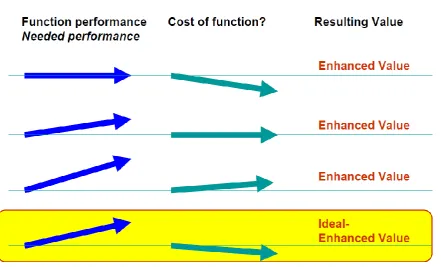
The intent of developing alternatives in this step is improving value of a function. There are several ways to boost it.
Value is achieved by improving function and maintaining cost; by maintaining function while reducing cost; or by
improving function while reducing cost. VE can be defined as an analysis of a project’s functions directed at
improving performance, reliability, quality, safety, and life-cycle cost. The figure below can explain how we can
improve value of a function in the best way.
Figure 1. The relation among value, cost & performance
VALUE ENGINEERING OBJECTIVE
It is vital to know that the objective of value engineering to utilize a systematic approach, to identify the required
functions and deliver the project at the lowest possible cost, keeping the design intent unchanged.
There are some expectations that are developed before and in the process of doing the value engineering. In order to
meet the objectives of value engineering it is important to know these expectations which are:
1. Reduction on construction costs
2. Lower life cycle costs (Financial, social & environmental)
3. Improved operational performance
4. Reduced maintenance costs
As you can see the majority of the expectations that are related to the value engineering process are about the costs
and reduction in all kinds of costs. Therefore, it can be helpful to know when is a good time to do the value
engineering in order to save the most amount of money and reduce the costs.
MATHEMATICAL MODELING
In this part, a mathematical model is created to maximize value and minimize the risk based on client expectation.
The model is originated from the one proposed by Saeedi (Saeedi, 2017) to make an integrated closed-loop supply
chain Model.
The main structure of the model
The objective function of the model refers to the minimization of costs and is defined as equation 1.
)
(
min
1
Ss m M s S j J
st j s j S
s p P j J st pj s pj st pi S
s p Pi I s pi K k st mk s mk S
s m Mj J st mj s mj S
s m Mn N st mn s mn S
s m Mp P st mp s mp S
s l Lm M st lm s lm
S s k Kl L
st kl s kl S
s ij Jk K
st jk s jk S
s s S j J k K
st jk s jk J j st jj s jj P
p n s S i I j J
st ij s ij nt n pt p M m mt m K k kt k T t
U
h
x
c
x
c
x
c
x
c
x
c
x
c
x
c
x
c
Q
cq
x
c
Q
cq
x
c
y
f
y
f
y
f
y
f
Z
(1)Second objective function: This target refers to the minimization of risk.
∑ ∑ ∑ ∑ ∑ ∑ ∑ ∑ Limitations:
K k st l stkl
d
l
L
s
S
t
T
x
,
,
level
allquality
S
s
L
l
r
x
ls Mm s
qs
lm
,
,
,T
t
S
s
M
m
x
Bk
x
L l st lm st K k stmk
,
,
T t S s M m x Bj x L l st lm st J j stmj
,
T
t
S
s
M
m
x
Bi
x
L l st lm st I i stmi
,
,
T
t
S
s
M
m
x
Bn
x
L l st lm st N n stmn
,
,
T
t
S
s
K
k
x
x
Q
x
Ll m M
st mk st kl J j st jk st
jk
,
,
)
(
T
t
S
s
J
j
Q
x
x
x
x
stjjK k st jk P p st pj M m st mj I i st
ij
,
,
T
t
S
s
J
j
Q
Q
U
K k st jk st jj stj
,
,
Expressions 4 to 12 guarantee that all customers’ demands are satisfied.
Solution algorithm
In this study, the multi-objective swarm optimization algorithm based on Pareto archive was proposed to solve the
model. The proposed structure of multi-objective PSO was presented to optimize these objective functions
considered in the model. The purpose of designing the above method is to achieve more optimal solutions or Pareto.
In order to evaluate this algorithm, its output was compared to NSGA-II algorithm based on the comparative
parameters of quality, diversity, and uniformity.
CONCLUSION
Changes in client expectation have come about through changes in the new trend in property ownership, shrinking
business cycles and increase in client's knowledge and power to specify particular building materials and processes.
Such changes have affected client expectation so much that if it is not managed properly it could lead to
confrontation, conflict and ultimately client dissatisfaction. Client expectations can be managed by risk and value
management; as such processes will make client expectations explicit through continuous communication and
realigning client expectation to a realistic level. Understanding client's needs and requirements are vital to
understanding their expectation, therefore client expectations must be examined and agreed to by the project team
from the beginning of the project to maximize the benefits of managing client expectation..
REFERENCES
Atkin, B., Borgbrant, J., & Josephson, P.-E. (2003). Introduction, in Construction Process Improvement. Oxford,
Chu, Z.-Q., Sasanipour, J., Saeedi, M., Baghban, A., & Mansoori, H. (2017). Modeling of wax deposition produced
in the pipelines using PSO-ANFIS approach. Petroleum Science and Technology, 1974-1981.
Havard, T. (2002). Contemporary property development. London: RIBA Enterprises.
Hessami, A. R., Sun, D., Nejat, A., Odreman, G. J., Zhou, X., & Saeedi, M. (2017). Enhanced Cost Estimating and
Project Development Procedures for MPOs. Kingsville, Texas: Texas A&M University Kingsville (TAMUK).
Retrieved from https://library.ctr.utexas.edu/hostedpdfs/tamuk/0-6929-s.pdf
Hessami, A. R., Sun, D., Odreman, G. J., Zhou, X., Nejat, A., & Saeedi, M. (2017). Project Scoping Guidebook for
Metropolitan Planning Organization Transportation Projects. Kingsville, Texas: Texas A&M University Kingsville
(TAMUK).
Kenley, R. (2003). Financing construction: Cash flows and cash farming. London: SPON Press.
Knipe, A., Van der Waldt, G., Van Niekerk, D., Burger, D., & Nell, K. (2002). Project management for success.
Heinemann.
Mirmohammadsadeghi, A., & Aghdami Thani, M. R. (2005). Studying obstacles in utilization of value engineering
in construction industry of Iran. The 2nd National VE Conference. Tehran, Iran.
Omigbodun, A. (2001). Value engineering and optimal building projects. ASCE Journal of Architectural
Engineering, 7(2), 40-43.
Ramroth, W. (2006). Project Management for Design Professionals. Kaplan Business.
Saeedi, M. (2017). Presenting a Novel Integrated Closed-loop Supply Chain Model by Considering Social
Responsibility. Asian Journal of Applied Science and Technology, 1(8), 125-134.
Torabi, A., Kiaian Mousavy, S., Dashti, V., Saeedi, M., & Yousefi, N. (2018). A New Prediction Model Based on