JETIR1604057 Journal of Emerging Technologies and Innovative Research (JETIR) www.jetir.org 300
Emerging Wireless Technologies: A Comparative
Analysis
1Deepan Bhavsar, 2Himanshu Patel, 3Hardik Modi
1Student, 2Assistant Professor, 3Assistant Professor
Electronics and Communication, CHARUSAT, Anand, India
Abstract— In every application or every system, data transmission is an unavoidable part of it. Moreover, data transmission is necessary for further data processing and evaluation, and different wireless technologies fulfill this purpose. This paper gives brief information about various wireless technologies also, it provides a comparative analysis of them based on different aspects and their characteristics. On the basis of the analysis, this paper will provide the vision to use a particular technology as per the requirement of the application. In this world of technologies, comparative analysis is necessary to use these technologies at their maximum.
Index Terms—IEEE, Bluetooth, Wi-Fi, ZigBee, WI-Max, NFC, Ultra-wideband, Infrared, WBAN, RF module, BLE. __________________________________________________________________________________________
I. INTRODUCTION
At the earlier time, the wired methodology is used to establish a connection between two or more nodes or components. It is convenient when an application needs short range communication and between very limited nodes like two or three nodes. But as the number of node increases or the range between them increases, the wired method becomes very untrustworthy, untidy and complex method, which is very hard to handle at the time of maintenance or when any problem occurred. Many of these industrial applications are served by fieldbus systems [14]–[18]. It's also having some definite issues as described below. The prime drawback of wired technology is mobility or portability, and the major reasons for this are need of power outlets to run them and the physical length of the wires. Additionally, sometimes it gets a very bulky system and a really tiresome chore to manage it. One more annoyance of it is wires get damaged easily, so every time it should be replaced. Furthermore, it is an expensive method and very much time consuming. To overcome all of these shortcomings of the wired methodology, the wireless communication technologies comes into the picture.
Even though wireless communication has been used since 1876, the wireless technology is now being extensively used to convey information from one node to another. It uses mediums like radio waves, microwaves, infrared waves. With the help of wireless technology we can send out data over long distances without any kind of trouble and which is more trustworthy and expedient compared to wired methodology. In addition, sensors and actuators can be monitored and controlled easily. Moreover, it makes the system more portable and flexible, which is the greatest benefit of this methodology. Furthermore, expansion of the system can be done easily. In industry, several types of devices, sensors, data collection devices and many more are connected in different ways via various protocols, if this is done using wireless technology than it can replace all the physical limits of wires.
A variety of IEEE standards and protocols are used for wireless communication like Bluetooth, Zigbee, RF modules, infrared and many more. It is used in many areas like industrial, commercial, home use, health care, Smartphone, laptops and many other fields. The particular wireless standard is being chosen as per the requirement and specification of the product or the application. For example, Bluetooth is used in Smartphone, laptops, home automations, music players, etc. where several meters of range and data transfer in tens of MBs are required.
The following section is going to present various wireless IEEE standards and their comparative analysis based on their characteristics and their use cases.
II. WIRELESSTECHNOLOGY
Wireless communication is used all around the world. People can stay in touch with the help of cellular networks. In the industrial field various wireless standards are used as per the requirements. Different wireless standards are as listed below:
The residual segment of the paper is going to present the wireless schemes listed above the and their comparison based on their parameters.
RF module
Bluetooth (IEEE 802.15.1) Wi-Fi / WLAN (IEEE 802.11) ZigBee (IEEE 802.15.4) Infrared
Near Field Communication Wi-Max (IEEE 802.16) Ultra Wideband
JETIR1604057 Journal of Emerging Technologies and Innovative Research (JETIR) www.jetir.org 301 A. RF Module
A band of frequency ranges from 3KHz to 300GHz is known as Radio Frequency. RF module (Radio Frequency module) is an electronic circuitry which is used to "put on the air" and "take delivery of" real time data from one node or device to another. 315 MHz, 433.92 MHz, 868 MHz and 915 MHz are the available radio frequencies for commercial use of RF modules which are as per the national and international rules and regulation. Various signal modulation techniques are used like Amplitude Shift Keying (ASK), Frequency Shift Keying (FSK), Direct Sequence Spread Spectrum (DSSS) and Frequency Hopping Spread Spectrum (FHSS), from which ASK is best suitable for digital data. RF module can be categorized into four types: Transmitter, Receiver, Transiver and System On Chip (SoC). The data transfer rate is ranging from 1kbps to 10kbps. It conveys data in the range of 100 meters in open space. Furthermore, it contains a very low level power consumption and also having ease of access. At most of the places, RF communication has replaced Infrared communication due to its rigid necessity of "line of sight" communication, in contrast RF module does not need this kind of fulfillments. Moreover, it can work for long ranges and does not get affected by other radio modules unlike IR modules.
Radio Frequency communication is having a wide collection of application area. It can be applied to various applications like vehicle monitoring, telemetry, Remote control, small range wireless network, wireless home security system, robotics, radio tag reading, wireless fire protection system and other countless number of applications.
B. Bluetooth
Bluetooth has first come into the picture in 1998 with the Bluetooth Special Interest Group (SIG) and considered as a technology. And up to 2006 it has been installed in about 1 billion devices. Bluetooth is standardized as IEEE 802.15.1 standard, which is generally used for short range communication. It works on 2.4 to 2.485 GHz frequency of the ISM band having 79 channels separated by 1 MHz [5].
Bluetooth technology works on the principle of "Master-Slave". In which, Piconet channel is created and communication begins between modules [4]. Communication can be established only after the Master device invoke the process. Every device containing its Global ID, which gets exchanged among them and the connection gets established after it. In [6][19], it has described that how actual communication is getting done and various issues related to it. Data transmission is done in the form of packets, which are transmitted by Frequency Hopping Spread Spectrum (FHSS). After every transmission of data packets, signal hops to another frequency, which avoid the interference. Furthermore, this technology is having some adorable features like it is very simple yet effective technology. Additionally, it consumes very less power and also available at very economical price.
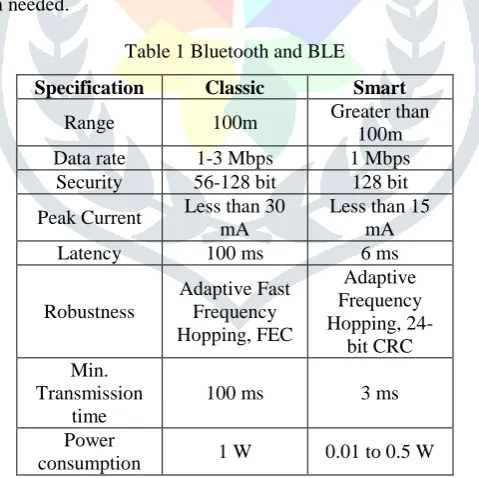
Bluetooth Low Energy (BLE) also known as Bluetooth Smart and Bluetooth 4.0 is the latest version of Technology which consumes much less power than the former version. It is used for new applications like Healthcare, security, fitness and many more. Table given below provides comparisons between Bluetooth "Classic" and Bluetooth "Smart". Where we can see that nearly 50% power consumption needed.
Table 1 Bluetooth and BLE
Specification Classic Smart
Range 100m Greater than
100m Data rate 1-3 Mbps 1 Mbps
Security 56-128 bit 128 bit
Peak Current Less than 30 mA
Less than 15 mA
Latency 100 ms 6 ms
Robustness
Adaptive Fast Frequency Hopping, FEC
Adaptive Frequency Hopping,
24-bit CRC Min.
Transmission time
100 ms 3 ms
Power
consumption 1 W 0.01 to 0.5 W
Sometimes, Bluetooth Technology gets encountered with pairing error, yet it contains a very wide range of application like wireless networking between laptop, computers and mobile, other wireless peripherals like mouse and keyboard, Bluetooth headsets for mobile phones, media transfer between electronic devices, Wireless control of manipulator [3], Data logging equipment, and many more.
C. Wi-Fi
JETIR1604057 Journal of Emerging Technologies and Innovative Research (JETIR) www.jetir.org 302 regulation of the US Federal Communication Commission (FCC). These both frequencies are the part of the ISM band and also they are free to use.
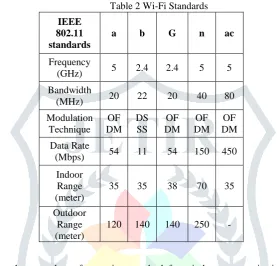
Wi-Fi uses radio waves to transmit information for wireless communication between devices or internet access. To establish a communication, there are two devices are required, namely (i) Wireless adapter (ii) Wireless router. In the earlier days, there was no security of data in WLAN communication, anyone can easily trace data or make interference during transmission. But in today's era, three major standards are applied for the security purpose which are: (i) Wireless Equivalent Privacy (WEP) (ii) Wi-Fi Protected Access (WPA) (iii) Wi-Fi Protected Access-2 (WPA-2). WEP uses 40 or 104 bit encryption and WPA provides authentication. WPA-2 is an advance version of WPA, which uses 128 bit encryption methods. Wi-Fi uses 2.4 or 5GHz high frequency so that it can carry more data. IEEE 802.11 also contains various sub standards, which are as follows: The given table gives comparative vision about various IEEE 802.11 versions. We can use Wi-Fi to share internet, to share files, to share resources between PCs and much more.
Table 2 Wi-Fi Standards
IEEE 802.11 standards
a b G n ac
Frequency
(GHz) 5 2.4 2.4 5 5
Bandwidth
(MHz) 20 22 20 40 80
Modulation Technique
OF DM
DS SS
OF DM
OF DM
OF DM
Data Rate
(Mbps) 54 11 54 150 450
Indoor Range (meter)
35 35 38 70 35
Outdoor Range (meter)
120 140 140 250 -
D. ZigBee
With every new day, there are lots of emerging standard for wireless communication. According to the need or specification of the application one has to use specific technology. In the industrial and medical applications, the need is for low data transfer is required. So that, Zigbee alliance provided IEEE 802.15.4 standard. The main and very fundamental difference in between Bluetooth, Wi-Fi and Zigbee is the former both are used to transfer lager data file like media files and the IEEE 802.15.4 is suitable when communication is Infrequent, smaller packet sizes are used, and power consumption is an issue [8][20].
Zigbee works on radio standards and 2.4 GHz, 900 MHz, 868 MHz unlicensed band frequency. Due to low power and low data rate its range is limited from 10 to 100m. Its having data rate of 250kbps. Due to energy efficiency, it provides long battery life [10]. One of the leading feature of Zigbee is, it supports mesh networking. Here, each node is connected with different pathways. In this topology, each and every node is capable to know location of self. With the help of routing table any node is being able to select a best suitable path for communication. Here, with the help of ad-hoc routing and mesh topology provides better stability.
Data transfer in Zigbee technology takes place in two modes: (i) Beacon mode (ii) Non-beacon mode. Generally, in beacon mode data is being sent to the network at the very definite period, so that at the rest of the time Zigbee stays in the power saving mode. At the particular time it wakes and sends data and again goes to the sleep, so it provides long battery life and low power consumption. In the contrast, Zigbee has to stay awake all the time, because here transfer of data is not periodic in the non-beacon mode.
Zigbee technology works on Direct Sequence Spread Spectrum (DSSS), due to which it is having very low latency. It requires very low duty cycle, so it is providing very long battery life. Furthermore, it provides various network topologies like point to point, point to multipoint, mesh network topology and it is also providing provision to make "Personal Area Network" (PAN). That is why it is the best for sensor networking in industrial and medical application. It provides security and application services which can work on PHY layer and MAC layer [1]. To use Zigbee technology is very much safe and secure, because it provides 128-bit encryption method to get security from data collision, interference, and trespassing. The best thing one can say about Zigbee is it supports 65000 nodes in network topology.
Zigbee is used in various applications like automation, Automatic meter reading, Medical devices, lighting control, building automation and many more thanks to a very low cost and long battery life.
E. Infrared
JETIR1604057 Journal of Emerging Technologies and Innovative Research (JETIR) www.jetir.org 303 In this technology, it requires an infrared port to transmit and to receive the data. This technology provides bi-directional communication. It is usually used in TV remote control and cheap mobile handsets. Its range is about 1 to 10 meters.
Infrared technology is having features like, it is very economical, very low power consuming, highly secure, portable, immune from noise yet contains simple circuitry. But in the contrasts it has some limitations too. It requires line of sight communication, any obstacles between infrared modules causes interference in the communication which results in the failure in several cases. It is only available for short range communication, which is affected by light, climate and atmospheric conditions. It provides data rates about 4 Mbps.
F. Near Field Communication (NFC)
Near Field Communication (NFC) is the wireless technology that allows mobile devices to vigorously work together with additional mobile devices. NFC is a communication technology, which is used for a very short range communication. It can be used in smartphone to share data, for this one has to take two devices closer within 4 cm. In the NFC, an active device can read an inactive device or tags [9], and thus one can establish a communication bridge between them. It works at 13.56 MHz, which is an unlicensed ISM radio frequency band. Furthermore, the data transfer rate is ranging from 106 to 424 kbps. NFC makes available flawless medium for the recognition protocols that authenticate the protected transfer of data [13].
Near Field Communication can take place in three modes: (i) card emulation (ii) reader/ writer (iii) peer to peer. In the first mode smartphone can act like smart card and make payments, in second one it can read or write NFC tags and in the third mode two NFC device can interact with each other and convey information.
With the help of NFC technology smartphone can make payments and work like a wallet, so that it makes payment more secure in order to retailer does not come in the physical contact of card information.
G. Ultra Wideband
As its name says, in Ultra-Wideband technology information is spread over a large spectrum with a high bandwidth and a low power spectral density. Due to low power spectral density it is secured from interference with other radio frequencies, and with the help of high bandwidth which is greater than 500 MHz it can carry large data. UWB uses the 3.1 to 10.6 GHz frequency band [11] [12]. In this technology, we can share spectrum with other users too. Furthermore, rules and regulation are made by the Federal Communications Commission (FCC) and it can be used as high rate personal area network (PAN).
It is generally known as pulse radio, but FCC defined it as an antenna transmission because its signal exceeds 20% of fractional bandwidth. In conventional systems, transmission is made by increasing or decreasing the level of amplitude, frequency or phase, in the contrast in this technology transmission takes place by generating radio energy at specific time interval. In the pulse based UWB, pulses are very short, so they do not overlap each other. But it is still having multipath propagation problem.
It is mainly used in "see through wall" application, means it is used in the radar imaging technique, because it is having the very efficient spatial capacity around 1013 bits/m2. It can also be used in short range indoor application. Furthermore, it can be used where ever PAN topology is required.
H. Wireless Body Area Network
IEEE 802.15.6 standard is known as WBAN. It is mainly created for low power, short range and highly reliable medical and healthcare application [7]. Furthermore, WBAN uses ISM band and other frequency band which is allowed for medical purpose. It provides data transfer rate about 10 Mbps. It can work on a range of about 2-5 meter and allows 256 nodes. It uses star network topology for the communication process. A key layer which is used for data communication is MAC layer.
With the help of this technology, it can send notification before the heart attack occurs from the observations of change in vital signs. Also, it can inject insulin in the diabetic patient's body.
The WBAN technology contains three various levels of security (i) unsecured communication (level 0) (ii) authentication but no encryption (level 1) (iii) authentication and encryption (level 2). For the communication, there must be same security level at both host and node. Following to it a temporary key is generated which is used for communication and can only be used once.
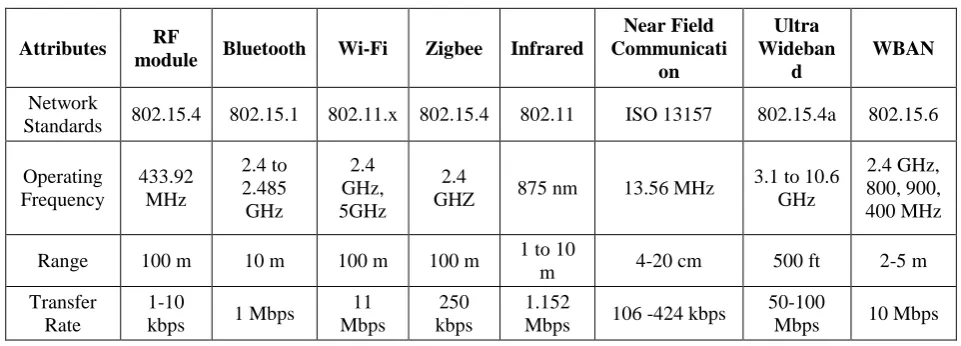
The below table will provide comparative analysis of different technologies.
Table 3 Comparison Between Wireless Technologies
Attributes RF
module Bluetooth Wi-Fi Zigbee Infrared
Near Field Communicati
on
Ultra Wideban
d
WBAN
Network
Standards 802.15.4 802.15.1 802.11.x 802.15.4 802.11 ISO 13157 802.15.4a 802.15.6
Operating Frequency
433.92 MHz
2.4 to 2.485 GHz
2.4 GHz, 5GHz
2.4
GHZ 875 nm 13.56 MHz
3.1 to 10.6 GHz
2.4 GHz, 800, 900, 400 MHz
Range 100 m 10 m 100 m 100 m 1 to 10
m 4-20 cm 500 ft 2-5 m
Transfer Rate
1-10
kbps 1 Mbps
11 Mbps
250 kbps
1.152
Mbps 106 -424 kbps
50-100
JETIR1604057 Journal of Emerging Technologies and Innovative Research (JETIR) www.jetir.org 304 Modulation
Technique
ASK, OOK, FSK
GFSK
BPSK, QPSK, CCK
BPSK Pulse ASK PPM BPSK,
QPSK
Cost Low Low High Low Low Low Low Low
Power Low Low High Low Low Low Low Low
III. CONCLUSION
This paper presents a comparative analysis of a variety of wireless technologies for short range communication. Each technology is best for their sort of applications, addition to it, each one has its own pros and cons, which comes into action as per the requirement of the application or the product. In this growing world, wireless communication has become very economical yet very much effective, and easy to implement as compared to conventional wired technology. From the comparative analysis, Wi-Fi is best for internet sharing and large media file transfer. On the other hand, Infrared and NFC is best for extremely short range communication, yet they are highly secure. Following to it, UWB technology can be used in radar application and WBAN has been specifically designed for healthcare and medical application to make Wearable Sensor Network. Bluetooth is used in laptops and smartphones for communication purpose. If an application needs low data rate, low power consumption and very small sized data transfer, then Zigbee comes into the picture. Moreover, it is the most reliable technology in industrial application and for sensor networking.
REFERENCES
[1] Hu Guozhen. "Key Technologies Analysis Of ZigBee Network Layer", 2nd International Conference on Computer Engineering and Technology, vol. 7, pp. 560-563, IEEE 2010
[2] Sanjeev Dhawan. "Analogy of Promising Wireless Technologies on Different Frequencies: Bluetooth, WiFi, and WiMAX", 2nd International Conference on Wireless Broadband and Ultra Wideband Communications, IEEE 2007.
[3] Yabin Liu, Shouqian Yu, Weihai Chen, Wei Li, "Wireless Communication Technology Based on Bluetooth and its Application to a Manipulator", IEEE International Conference on Industrial Informatics, pp. 1251-1256, 2006.
[4] Pravin Bhagwat, "Bluetooth: Technology for Short-Range Wireless Apps". IEEE Internet Computing, pp. 96-101, May-June 2001.
[5] Rajeev Shorey, Brent A. Miller, " The Bluetooth Technology: Merits and Limitations". ICPWC, pp. 80-84, 2000.
[6] Mrs. Pratibha Singh, Mr. Dipesh Sharma,Mr. Sonu Agrawal, " A Modern Study of Bluetooth Wireless Technology", International Journal of Computer Science, Engineering and Information Technology (IJCSEIT), Vol.1, No.3, pp. 55-63 August 2011.
[7] Mohammad Ghamari, Harneet Arora, R. Simon Sherratt, William Harwin, " Comparison of Low-Power Wireless Communication Technologies for Wearable Health-Monitoring Applications", IEEE 2015 International Conference on Computer, Communication, and Control Technology, April 21-23, 2015, Malaysia, pp. 1-6.
[8] Andreas Willig, Kirsten Matheus, Adam Wolisz, " Wireless Technology in Industrial Networks", Proceedings of the IEEE, Vol. 93, No. 6, June 2005, pp. 1130-1151.
[9] Manas Pulipati, K. Phani Srinivas, "Comparison of Various Short Range Wireless Communication Technologies with NFC", International Journal of Science and Research (IJSR), India, Vol 2, Issue 4, pp. 87-91 April 2013.
[10] M. H. Fotouhi Ghazvnii, M. Vahabi, M. F. A. Rasid and R. S. A. Raja Abdullah, "Energy Efficiency in MAC 802.15.4for Wireless
Sensor Networks", IEEE 2008 6th National Conference on Telecommunication Technologies, 26-27 August 2008, pp. 289-294.
[11] Aiello, G. Roberto, and Gerald D. Rogerson. "Ultra-wideband wireless systems, " Microwave Magazine, IEEE, June 2003, pp. 36-47.
[12] Porcino, Domenico, and Walter Hirt, "Ultra-wideband radio technology: potential and challenges ahead", Communications Magazine, IEEE, July 2003, pp. 66-74.
[13] Agrawal, Pankaj, and Sharad Bhuraria, "Near field communication", SETLabs Bridfings, 22 Feb 2016, pp. 67-74. [14] J. R. Pimentel, Communication Networks for Manufacturing. Englewood Cliffs, NJ: Prentice-Hall, 1990.
[15] N. P. Mahalik, Ed., Fieldbus Technology-Industrial Network Standards for Real-Time Distributed Control. Berlin, Germany: Springer, 2003.
[16] P. Pleineveaux and J.-D. Decotignie, “Time critical communication networks: Field buses,” IEEE Network, vol. 2, no. 3, pp. 55–63, May 1988.
[17] J.-D. Decotignie and P. Pleineveaux, “A survey on industrial communication networks,” Ann. Telecomm., vol. 48, no. 9, p. 435ff, 1993
[18] R. Zurawski, Ed., The Industrial Information Technology Handbook. Boca Raton, FL: CRC, 2005. [19] J. C. Haartsen, “The Bluetooth radio system,” IEEE Pers. Commun., vol. 7, no. 1, pp. 28–36, Feb. 2000.