E-ISSN 2308-9830 (Online) / ISSN 2410-0595 (Print)
3I, Algorithm for Object Learning Production
KHADIJA ACHTAICH1, HABIB BENLAHMAR2 and NACEUR ACHTAICH3
1, 3
Analyze, Modeling and simulation Laboratory, LAMS, Faculty of Sciences Ben M’Sick, Hassan II,
Mohemmadia University, Casablanca, MOROCCO
2
Information Technologie and Modélisation Laboratory, TIM, Faculty of Sciences Ben M’Sick, Hassan II,
Mohemmadia University, Casablanca, MOROCCO
E-mail: [email protected], [email protected], [email protected]
ABSTRACT
Learning object is THE main component to propose an optimal, specific, personal learning content. It allows several scenarios depending on the learner profile, learning context and the device specifications. The same learning object can be used and reused in different contexts. In this article, we present the 3I algorithm to optimally produce the learning objects. We describe the three steps to have a finished, ready to use learning object.
Keywords:
Learning Object, 3I algorithm, Context, Profile, Learning Content.
1 INTRODUCTION
Learning object is THE main component to propose an optimal, specific, personal learning content. It allows several scenarios depending on the learner profile, learning context and the device specifications. The same learning object can be used and reused in different contexts. In this article, we present the 3I algorithm to escort learning content creator in learning object creation process, from the very beginning when the learning material is not adapted to an electronic or mobile learning, to the state of having a ready to use learning object.
2 LEARNING OBJECT
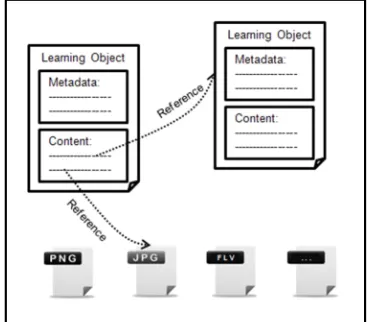
The "Institute of Electrical and Electronics Engineers," defines the learning object as "any entity, digital or non-digital, which can be used, re-used or referenced falling on technology supported learning". A generic design of the learning object was proposed by Achtaich.K, AL (2012). A learning object must have a universal unique identifier. The generic design of learning objects is mainly built from two parts:
Contents: The concrete Learning contents in the learning object. It could have a hierarchical
structure. The contents are organized in XML elements or links that reference other learning objects.
Metadata: Are learning objects characterizing data, it describes the learning object according to both syntactic and semantic aspects. It will give the future learning system all needed information to be able to organize learning object in different learning contexts. Metadata can’t be exploit as learning content.
Even if the 3I algorithm is applicable to produce learning object for any electronic or mobile learning, in this paper we present in the examples, the specific case of syntactical language learning.
3 3I ALGORITHM
The objective is to propose an easy way to escort learning content creator to optimally create learning object, from the very beginning when the learning material is not adapted to an electronic or mobile learning, to the state of having a ready to use learning object.
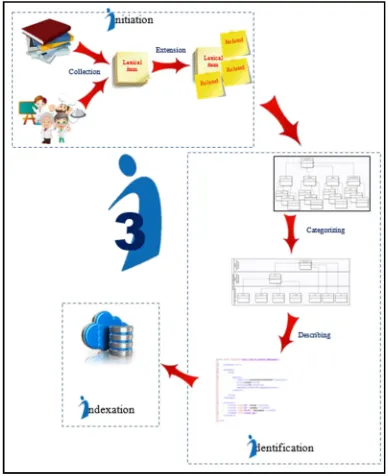
The 3I algorithm is a three steps formula: Initiation – Identification – Indexation.
Fig. 2. 3I algorithm steps
4 INITIATION
In this level, we build our own dictionary. We first collect a maximum of taxonomies. Some languages are easier than others in collecting specific dictionaries (mainly for the languages with limited official use). To come to produce the content, we go through two phases:
4.1 Collecting information
This step is meaningful for the languages with limited use, with no official specific dictionaries.
The usefulness of this step is to collect a maximum of input lexical items. Depending on the language, we collect from different dictionaries, from research works, from specialists and from native language speakers. In this article we choose the Tamazight language for the examples.
The Tamazight language is spoken in several African countries, including Morocco, Algeria, Tunisia, Libya, Egypt, Mauritania, Mali and Niger. In Morocco, Tamazight language is legitimate since October 17, 2001 and official since July 2011.
For each lexical item we keep the following information:
Lexical item in Tamazight language written in Tifinagh alphabet.
The dialect of the Lexical item (Tachelhite, Tamazighte or Tarifite)
The French translation
The definition proposed in French
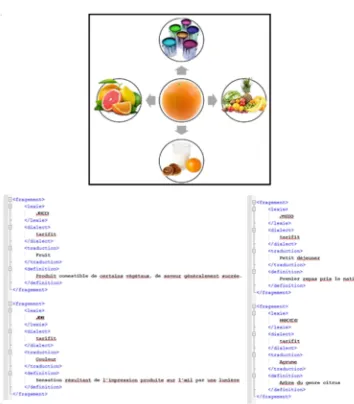
We propose to store in XML file as shown in this example for “orange” lexical item:
Fig. 3. Example of lexical item storage
4.2 Collecting information
Once the collecting done, we move to extend the Lexical items dictionary. The extend aims to expand the list of fragments to ensure their reuse within the different granularity of learning objects. 3I algorithm defines three extend types:
4.2.1 Globalize extend
From the original Lexical item, we list Lexical items globalizing semantically the original Lexical item. We retake the “orange” example above. “Orange” may be linked semantically with lexical items: “Citrus”, “Fruits”, “Colors”, and “Breakfast”.
Fig. 4. Example of globalize extend
4.2.2 Split extend
From the original Lexical item, we list Lexical items semantically included in the original Lexical item. We retake the “orange” example above. To “orange” are semantically linked lexical items: “Skin”, “Seeds”.
We store the new Lexical items just as below:
Fig. 5. Example of split extend
4.2.3 Area extend
Always from the original Lexical item, we list the “neighbors” Lexical items. It’s all Lexical items related to the original Lexical item from a point of view.
If we consider “orange” from the “fruits” view, we can find “Apple”, “Banana”, “Pear”, etc. If we consider “orange” from the “breakfast” view, we can find “Bread”, “Milk”, “Honey”, etc.
We store the new Lexical items just like before:
Fig. 6. Example of area extend
5 IDENTIFICATION
We remind that all the lexical items previously collected from the same original item. Obviously we’re only show the concept, the list is not exhaustive.
This step requires specialist intervention for optimal structuring. We present in this section the result, not the process. The process highly depen-dent on specialist.
5.1 Categorizing lexical items
5.1.1 Dependency tree
With the help of the specialists, we build a dependency tree. Each lexical item is linked semantically to others. For example:
Fig. 7. Dependency tree
Depending on the point of view, many dependency trees can be proposed:
Fig. 8. Dependency tree 2
5.1.2 From lexical item to Learning Object
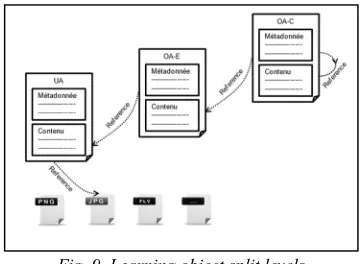
From now on, we stop talking about the lexical items, and start the learning object designation. Achtaich.K, AL (2013) proposes three levels of learning objects; learning unit (LU), elementary learning object (eLO) and complex learning object (cLO), depending to the granularity level.
Fig. 9. Learning object split levels
With specialists’ validation, we summarize all below:
Table 1: Lexical items granularity
Lexical item Granularity
Orange LU
Fruit eLO or cLO
Citrus eLO
Breakfast eLO or cLO
Skin LU
Seeds LU
Apple LU
Banana LU
Pear LU
Milk LU
Bread LU
Honey LU
Fig. 10. Example learning object split levels
5.2 Applying metadata
After the production of content, creating XML files and categorization of learning objects, all remains to complete the learning objects.
Mobile Learning Object Metadata (MLOM) is a data model published by Achtaich.K, AL (2013), encoded in XML, and used to describe a learning
object and similar digital resources used to support language mobile learning. We propose the use of XSD files to assist the MLOM metadata creation. Two types of editors can be involved depending on the category meaning:
Syntax Section: The editors of this section are the creators of the learning object, this concerns the metadata related to the learning object itself as category "meta-metadata", "rights", etc.
Semantic Section: The editors of this section are specialists in the field of learning object content. It describes the content of the learning object. We quote the "keywords", the category "Educational", etc.
Metadata can be stored on the same XML file or a separate file, referenced in the learning object (mainly in case the content of the learning object is an audio or video file). Both cases are shown in the following examples:
Fig. 1. Learning object metadata example
After assigning the corresponding MLOM, learning objects have become formal, complete and ready for use. It only remains to be stored and indexed in a database.
6 INDEXATION
supports audio and video files; useful to manage heterogeneous data.
The choice should be based on data needs and contexts use. It should respect the following:
Learning objects are stored in many XML files. Metadata are well structured.
Must build several indexes to enhance query performance
Contents are texts or references to external media fragment
XML files are used and reused later
From all above, we decide to consider native databases to store and manage XML files, and relational database to store learning object index.
7 CONCLUSION
In this article we describe the 3I algorithm; a three steps algorithm to produce learning objects for a contextual, language, electronic or mobile learning. In initiation; we build our own dictionary; collect a maximum of taxonomies and extend the lexical items. For identification, with the help of specialists, we categorize the learning objects and apply metadata from MLOM 1.0 metadata. The algorithm ends with indexation when we choose native file repositories to store XML files and relational databases to manage the indexes.
8 REFERENCES
[1] Sharples, M. (2002). Disruptive devices: mobile technology for conversational learning. International Journal of Continuing Engineering Education and Life Long Learning, 12(5), 504-520.
[2] Trifonova, A., & Ronchetti, M. (2003). A general architecture for m-learning.
[3] Motiwalla, LF. (2007) Mobile learning: A framework and evaluation. Computers & Education, 49 (3), pp 581-596.
[4] Anani, A. (2008) M-learning in review: Technology, standard and evaluation. Journal of Communication and Computer, 5 (11), pp 1-6.
[5] Nordin, N., Embi, MA, & Yunus, MM. (2010). Mobile learning framework for lifelong learning. Procedia-Social and Behavioral Sciences, 7, 130-138.
[6] Chu, H. C., Hwang, G. J., Tsai, C. C., & Tseng, J. C. (2010). A two-tier test approach to developing location-aware mobile learning systems for natural science courses. Computers & Education, 55(4), 1618-1627.
[7] Ozdamli, F., & Cavus, N. (2011). Basic Elements and characteristics of mobile learning. Procedia-Social and Behavioral Sciences, 28, 937-942.
[8] Georgieva, ES, Smrikarov, AS, & Georgiev, TS. (2011). Evaluation of mobile learning system. Procedia Computer Science, 3, 632-637.
[9] Gikas, J., & Grant, MM. (2013). Mobile computing devices in Higher Education: Student perspectives on learning with cellphones, smartphones & social media. The Internet and Higher Education, 19, 18-26. [10]Corral, L., Sillitti, A., & Succi, G. (2012).
Mobile multiplatform development: An experiment for performance analysis. Procedia Computer Science, 10, 736-743.
[11]Martin, S., Diaz, G. Plaza, I. Ruiz, E. Castro, M., & Peire, J. (2011). State of the art of frameworks and middleware for mobile and ubiquitous learning Facilitating development. Journal of Systems and Software, 84 (11), 1883-1891.
[12]Nordin, NM, Hamzah, MI, Yunus, MM, & Embi, MA. (2010). the mobile learning environment for the in-school administrators Service. Procedia-Social and Behavioral Sciences, 7, 671-679.
[13]Benbunan-Fich, R., & Benbunan, A. (2007). Understanding user behavior with new mobile applications. The Journal of Strategic Information Systems, 16 (4), 393-412.
[14]Achtaich, K., Benlahmar, H., & Achtaich, N. Language Mobile Learning Design: The Tamazight Language.