E-ISSN 2308-9830 (Online) / ISSN 2410-0595 (Print)
SAT: Simulated Annealing and Tabu Search Based Routing
Algorithm for Wireless Sensor Networks
Robab Mohammadi1 and Hossein Boroumand Noghabi2
1, 2
Department of Electrical, Computer and IT Engineering, Zanjan Branch, Islamic Azad University,
Zanjan, Iran
1
[email protected], [email protected]
ABSTRACT
Wireless sensor networks that formed by gathering a large number of small sensor nodes are used in various fields. Choosing a suitable route for the transmission of data from the source to the destination can be effective in reducing energy consumption. There are different algorithms for routing in wireless sensor networks. But using an algorithm that helps us to choose a less power consuming path is very important. In this paper, we propose a simulated annealing based routing algorithm (SAT) to determine an optimal path from the source to a destination in wireless sensor networks. Creating neighbor paths is performed with the help of tabu search algorithm. Simulation for various networks is done with different number of nodes in which the sensor nodes are spread with balance and randomly. The results show a reduction in energy consumption and improvements of average length of distance in transferring information, in comparison to tabu search algorithm.
Keywords:Wireless Sensor Network, Simulated Annealing (SA),Energy Consumption, Routing, Meta Heuristic Algorithms.
1 INTRODUCTION
Wireless sensor networks involve a distributed collection of wireless sensor nodes with sensing, processing abilities, which are deployed in the field to the occurrence to be monitored. The key duty each of these sensor nodes is to sense, gather and process data and then send the processed data to the sink node. Sensor nodes in these networks are limited in terms of their battery capacities and in most of cases, it is not probable to recharge or modify batteries. Energy efficiency and network lifetime is the most important factor, which needs individual concentration while designing routing protocols for wireless sensor networks. Also due to node desolation or battery depletion changes of the network topology is constantly changing. The most important subjects while designing routing protocols for WSN are energy awareness, scalability and optimal resource management [1]. The major design purpose in wireless sensor networks is transmitting information from a source to a destination, in addition to raising the lifetime of these networks.
Sensor networks are used in various fields because of their benefits. These networks are made up of many small nodes, which have limited energy. On the one hand, advances in manufacturing technology in small ICs, on the other hand, the development of wireless communication technology cause designing of sensor network. The arrangement and design of the wireless sensor network is a very important trait of these networks. The performance of the protocol can affect the energy spent for sending of the information. Despite advances in this type of networks, sensor nodes are still dependent on low power batteries for their energy, due to the large number, small size and placement of contingency. One of the most important issues in these networks is the management of sensor network's energy, in a way that they can reach the objective for which they are planned. In fact, ways of reducing energy consumption is the most important requirement in sensor networks [2].
include restrictions on the amount of energy, bandwidth, memory, buffer size, processing power and power transmission. In this context, power is of great importance. Recently, new perspectives have been proposed in the field of using thermal energy which is made of electrical components, to increase network energy [4].In this paper, we propose a energy-efficient routing algorithm based on simulated annealing (SAT) to minimize energy consumption by selecting the appropriate path from a source node to a destination node. The main objective of this algorithm is to expand the lifetime of wireless sensor networks by decreasing energy consumption. In this paper, using simulated annealing algorithm for optimization of energy consumption parameters and routing will be done. We use the tabu search algorithms to create neighbor paths. Proposed algorithm begins with a random initial solution and desired temperature and in multiple iterations, with controlled changes in responses, moves toward an optimal solution . In each iteration with a small change in solution, a neighborhood is created. Also temperature as well as a cooling pattern is reduced. If the neighborhood obtained, was better than the current answer is accepted as an answer and algorithms move toward it.
The remainder of this paper is organized as follows. In Sect. 2 related work is discussed in detail. System model is presented in Sect. 3. In Sect. 4 the background for the understanding of the simulated annealing approach is provided. Sect. 5 the proposed algorithm is presented. Experiment results are shown in Sect.6. And finally conclusion is given in Sect.7.
2 RELATED WORK
In this section, a number of routing algorithms for wireless sensor networks are presented.
Azharuddin et al. [5] proposed a distributed energy efficient and fault tolerant routing algorithm for WSNs. When the cluster head is failure, this algorithm rebuilds connectivity among the nodes. In this paper, Weibull distribution method used for fault model.
Adnan et al. [6] presented a Trust and Energy aware Routing Protocol (TERP) that creates use of a distributed trust model for the identification and classification of misbehaving nodes. This routing protocol contains a compound routing function consisting of trust, remaining energy, and hop count of neighbor nodes in making routing determinations. These features help to establish and balance energy consumption between nodes. Also it causes routing data using shorter paths.
AlShawi et al. [7] suggests a novel routing protocol for wireless sensor network to increased network lifetime. This protocol uses a synthetic approach consist of fuzzy and A-star algorithm. The optimal route is calculated on the basis of remaining nodes energy. Also the base station schedules the routing according to the information acquired from the nodes.
Chelloug et al. [8] the objective of this paper is to find the optimal path for the reception probabilities by simulated annealing algorithm. To increase the lifetime of a WSN opportunistic routing is used together with random linear network coding. They provide two approaches: improving wireless performances by using transmission opportunities and avoiding coordination between nodes.
Güney et al. [9] in this paper, combined two mathematical programming formulations together under a single model. This algorithm work in two levels, in up level, the best sensor positions are sought by tabu search, and determining sink positions and data paths are solved efficiently in the low level.
Delavar et al. [10] proposed a distributed balanced routing algorithm for optimizing the cluster distribution. This approach aims to decrease the energy consumption by balancing the use of energy between nodes. Their method could implement a choosy state by using a local and distributed threshold detector.
Guo et al. [11] have presented a reliable multicast protocol in wireless networks. Energy efficiency and high throughput is the most important feature of this protocol. By using opportunistic routing, multicast power is significantly improved. Simulation results show that CodePipe compared with MORE and Pacifier protocols, extends the performance.
Semchedine et al. [12] in this paper a tabu search based routing protocol is proposed to route the data from the sensor to the sink. This method uses a cost function to select next sensor in data routing. In TSRP, when the sensor senses an event, it sends it to one of its neighbors selected based on the cost function. This cost function (inspired from the ant colony method) depends to the residual energy and the visibility of all the neighbor sensors compared to the sink.
resilience, by creating multiple routes from the source node to the Base Station.
Xia et al. [14] in this paper proposed a routing algorithm based on unequal clustering theory for wireless sensor network. The main objective of this approach is to balance the energy consumption among sensor nodes. This algorithm optimizes and innovates in two views: cluster head selection and clusters routing. Results for proposed algorithm are shown that new algorithm leveling the energy consumption between sensor nodes and improves the link quality.
3 SYSTEM MODEL
A wireless sensor network can be defined as a weighted undirected graph G (V, E), Where, V is the set of sensor nodes and E is the set of links between these nodes [15]. In the wireless sensor network, each node has a collection of neighbors who have been within range of the wireless nodes [16]. In simulations, one of the network nodes is considered as the source node, and another node is considered as destination node. The purpose is to find the optimal path between these two nodes. The two nodes are selected randomly among the network nodes. Routing starts from the source node and the next node is selected by the current node at each stage, until the destination node is reached. All sensor nodes have the same energy at the beginning. Because the energy used for transportation of data packets on the network is more impressive than other energy sources such as energy consumption required for sensing or processing information, other factors are ignored in the energy model. We consider Energy model for sending a bit on the transmitter as follows [16, 17]:
{ ( ) ( ) ( ) ( )
(1)
In the above equation d stands for the distance from the transmitter to the receiver. stands for power consumption in electronic components. And and stand for energy consumed per bit for amplifier of transferring packet depending on the distance of transmitter and receiver [18, 16]. Receiver energy consumption is obtained from the following equation:
( ) ( ) (2)
4 SIMULATED ANNEALING
The SA algorithm is a meta-heuristic search of simple and effective way in solving combinational optimizing problems. Of course, SA has expanded to solve steady problems. The simulated annealing method simulates the gradual cooling process to solve an optimization problem. The objective is similar to the energy of a matter that should be minimized with the help of defining an implicit temperature. In this case, temperature is a controllable parameter in algorithm. The SA algorithm is based on the physical mechanism of cooling metals, in which the metal is first heated and then cooled slowly, so that a solid crystal structure is formed. Strength of the Structure depends on the speed of cooling metal [19]. SA and other innovative algorithms start to work with an initial response which is created creatively. Then a neighbor answer, that causes improvement in the objective, is selected and it continues until other improvements don't happen in the objective function. Actually, a meta-heuristic algorithm is an innovative method that is able to search solution space in order to reach an optimum response [20, 21]. The general structure of simulated annealing method is shown in Algorithm 1.
Algorithm 1 (Simulated Annealing)
Procedure simulated annealing() Input: cooling schedule
S=S0; /*S=solution*/
T= ; /*Initial Temperature*/ Repeat
Repeat/*fix Temperature*/ Generate a random neighbor s'; ( ) ( )
If
Else accept s' with a probability exp( ⁄ );
Until Equilibrium condition T=g(T);
5 PROPOSED ALGORITHM
In many cases suitable routing can increase the lifetime of the network. Because of the importance of these networks in the field of Information technology, many studies have been conducted that improve the performance of these networks. We aim is to provide energy-efficient algorithm. The proposed algorithm is combines the meta-heuristic, simulated annealing and tabu search. We depict the proposed algorithm (SA), in detail in this section. First, with helped algorithms A* we create a primary route from source to destination. Then we identify the neighboring paths between source node and destination node with the help of tabu search algorithm. And we choose the optimal path with the help of simulated annealing algorithm. Details of the Algorithm are explained clearly in the following part.
5.1 Primary path
To find the primary path from the source node to the destination node use from the A*algorithm [22]. The primary route, that is found by A* algorithm is called, . We consider equal to and equal to .
( 3 )
( )
The algorithm by combining g (n) (the cost of getting from the source node to the current node) and h (n) (the estimated cost of current node to destination node) evaluates the nodes. The purpose of this algorithm is to find out the lowest amount for the following function:
( 4 ) f(n)=g(n)+h(n)
In equation of 3, is the primary path and is the energy consumption in primary path, and is the optimal path, is the energy consumption in optimal path.
Objective Function
In this algorithm, the aim is to find out a path with the lowest cost. In equation of 5, z is the total distance traveled from the source node to the destination node. Also i, j is the two nodes of the network nodes which are located in the path between nodes of source and destination. We proposed this algorithm with objective of minimizing the sum of distance from the source node to the destination node.
(
5 )
∑
5.2 Mechanism of establishment of the neighborhood routes
We create neighbor paths via following way and call it . And ( ) is calculated for each neighbor route.
( 6 )
Method Find out neighbor routes: it is assumed that the neighbor candidate list for each node includes, the nodes that is in sensing range of the node. First, we consider the source node as the current node and call it S. Then, the next-hop node of the current node is considered as tabu node and is called T. In fact, the T node is considered as tabu node, tabu node in the process of creating the neighbor paths is not considered as the route nodes. After determining the two nodes S and T, the phase 1 runs.
Phase 1
To choose a node for the next stage, we select a node among the existing nodes that has the highest amount of all neighboring nodes for function 7.
(
7 ) ( )
Where Ej is the initial energy of node j (j is a node in candidate list of node i) and dij is the distance between node i and j [16].
If multiple nodes with f(x) were identical, one of which closer to the destination node will be selected. The selected node at the end of this process is considered as the current node to continue the algorithms. With selecting current node in this process, Phase 1 will be performed.
Phase 2
Establishment of the second neighborhood solution:
Consider the path which is produced in the initial response. We choose the first hop in this direction as the first hop of the second neighbor solution. The second node in primary path is considered as second node for the second neighbor path. We consider this node, as a current node and call it S, and we consider the next node in primary path as tabu node and call it T. Then we run phase 1 to choose a node for next step. By revealing the next step, phase two will continue until it reaches to the destination node. The second neighbor response is also made by reaching the destination node.
Establishment of the i'th neighborhood solution is similar to establishment of the second neighborhood solution. This process continues until n-1 neighbor solution for the initial solution is achieved. n is the number of steps of the initial path. For example, if the initial path is composed of four steps, three neighbor routes can be calculated for it.
Using the mechanism of accepting new candidate answers, we decide whether to accept new candidates answer or not. In other words, calculation of the difference between the energy level for initial answer ( ) and neighbor solution generated( ), and is calculated for objective function.
( ) (8) ( ) (9)
is the difference between the objective function of current solution and neighbor solution .Above process is repeated for each of the neighbor routes.
Estate1
If, Then, improve energy levels
System. The primary response is omitted, and neighbor response is accepted.
Estate2
If, )lack of improvement in
neighbor solution), then ( ) is compared with a random number between zero and one. If it is larger than the random number, then the neighbor solution is replacing the current answer.
5.3 Setthe initial temperature (T0)
In the proposed algorithm initially starts from a high temperature, to cover of any new neighbor solutions. We in this algorithm, set = 1000.
5.4 The process of temperature reduction
The Law (function) of temperature decrease:
( 10 )
In the above equation, is a constant number and less than 1, considered usually between 0.5 and 0.99.
5.5 The number of repetitions at each temperature
To achieve balance in any temperature, a number of repetitions should be performed. We use a static strategy, in which the number of iterations is determined before the algorithm starts. The number of repetitions is presented in Table 1.
5.6 The termination condition of algorithm
When the number of iterations in the inner loop reaches to the desired number, the inner loop is carried out and reduces the temperature. In theory, when the temperature approaches to zero, the simulated annealing algorithm terminated. Here stopping criterion is getting to one, or there is not improvement in the solution found.
6 SIMULATION RESULTS
Table 1: Simulation parameters
values Parameter
0.6
100*100 Network size
n=20,40,60,80,100 Node numbers
100,400 number of iterations in
outer loop
0.5j E
50nj
0.0013pJ/
10pJ/
87.0m
20m R
1
1000
Network size is100*100. Numbers of sensors are selected of Set {20, 40, 60, 80, 100}. And energy, all the sensor nodes equaled are considered with each other. The primary node energy is 0.5, and the nodes are distributed randomly. The wireless communication radius of sensors set to 20 m [23, 24]. Sensor network consider a square planar environment, the nodes are randomly distributed in the environment. The nodes are supposed without moving, the nodes are expansion equally to cover the whole area.
Fig. 1. Average length of paths
Fig. 2. Comparison of iteration in outer loop with computational time
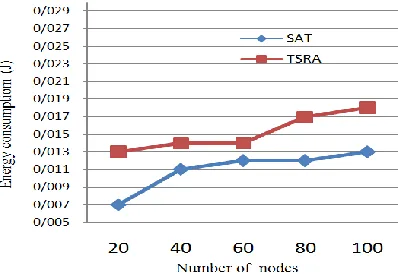
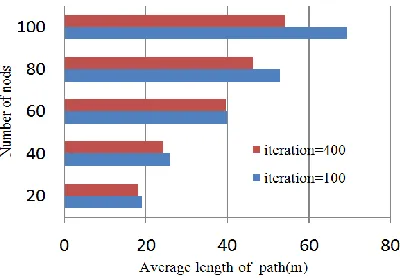
As Fig. 1 shows, the average length of path in the SAT algorithm is lower than TSRA algorithm. Fig. 2 shows the maximum number of repetitions in the outer loop has a significant impact on time. But in finding the optimal path has little impact. So in the networks that time is crucial, we should be sufficient to replicate the low, and reduce the computational time.
Fig. 3. Average energy consumption
Fig. 4. Comparison of iteration in outer loop with lengths of path
7 CONCLUSION
In this paper, we proposed an algorithm to determine an optimal path based on simulated annealing in wireless sensor networks. In the proposed algorithm used of two meta-heuristic algorithm ،simulated annealing and tabu search. Compare the proposed algorithm with the tabu search algorithm. We repeated network simulation by changing the number of nodes in the network and conditions of algorithm. We used average results to compare with the tabu search algorithm. The results show that the use of simulated annealing algorithm in selecting optimal neighboring route and the initial route reduces the power consumption in wireless sensor network routing. The simulation results of the two compared algorithms, which are randomly generated for different networks represent that the performance of the proposed algorithm is improved.
8 REFERENCES
[1] A. Jain, B.V.R. Reddy, “Ant Colony Optimization Based Orthogonal Directional Proactive–Reactive Routing Protocol for Wireless Sensor Networks,” Springer Science, Wireless Personal Communications, 2015 . [2] N. A. Pantazis, S. A. Nikolidakis , D. D.
Vergados, “Energy-Efficient Routing Protocols in Wireless Sensor Networks: A Survey,” IEEE
COMMUNICATIONS SURVEYS &
TUTORIALS, vol. 15, no. 2 pp. 551-591,2013. [3] N. Enami, R. A. Moghadam, A. Haghighat, “A
Survey on Application of Neural Networks in Energy Conservation of Wireless Sensor Networks,” Springer-Verlag Berlin Heidelberg, vol. 84, pp 283–294,2010.
[4] V. Thayananthan, A. Alzranhi, “Enhancement of energy conservation technologies in wireless
sensor network,” Procedia Computer Science,Vol. 34,pp. 79-86, 2014.
[5] Md. Azharuddin, P.K. Jana, “A distributed algorithm for energy efficient and fault tolerant routing in wireless sensor networks,” Wireless Netw. Wireless Networks, 21(1), 251–267, 2014.
[6] A. Adnan , K. Abu Bakar , M. Ibrahim Channa , K. Haseeb, and A. Waheed Khan, “A trust aware routing protocol for energy constrained wireless sensor network,” Telecommunication Systems,vol. 61, pp. 123-140, January 2016. [7] I. S. AlShawi, L. Yan, W. Pan, and B. Luo,
“Lifetime enhancement in wireless sensor networks using fuzzy approach and A-star algorithm,” IEEE Sensors Journal, vol. 12(10), pp.3010–3018, 2012.
[8] S. Chelloug, M. Benmohammed, “Simulated Annealing for Maximizing the Lifetime of Sensor Networks under Opportunistic Routing,”International Conference on
Broadband , Wireless Computing,
Communication and Applications(BWCCA), IEEE Computer Society, pp.14-19,2012. [9] E. Güney, I. K. Altınel, N. Aras, and C. Ersoy,
“A tabu search heuristic for point coverage, sink location, and data routing in wireless sensor networks,” Evolutionary computation in combinatorial optimization ,vol. 6022, pp. 83– 94, Springer Berlin Heidelberg,2010.
[10]A.G. Delavar, J. Artin, M.M. Tajari, “RCSDN: a Distributed Balanced Routing Algorithm with Optimized Cluster Distribution,” International Journal of Computer and Electrical Engineering, vol. 4, August 2012. [11]P. Li,, S. Guo, S. Yu, and A. V. Vasilakos,“
Reliable multicast with pipelined network coding using opportunistic feeding and routing,” IEEE Transactions on Parallel and Distributed Systems ,vol. 25(12), pp. 3264– 3273,2014.
[12]F. Semchedine, L. Bouallouche-Medjkoune, L. Bennacer, N. Aber, and D. Aïssani, “Routing protocol based on Tabu search for wireless sensor networks,” Wireless Personal Communications, Springer US, vol. 67(2),pp. 105–112,2012.
[13]C. Velasquez-Villada, Y. Donoso, “ Multipath Routing Network Management Protocol or Resilient and Energy Efficient Wireless Sensor Networks,” First International Conference on Information Technology and Quantitative Management (ITQM), Elsevier B.V., Procedia Computer Science, vol. 17,pp. 387-394,2013. [14]H. Xia, R. Zhang, J. Yu, Z. Pan, “
Unequal Clustering And Connected Graph In Wireless Sensor Networks,” International Journal Of Wireless Information Networks , Springer ,Pp. 1-10, March 2016.
[15]D. Cheng, Y. Xun, T. Zhou, and W. Li, “ An energy aware ant colony algorithm for the routing of wireless sensor networks,”Intelligent Computing and Information Science, vol. 134, pp. 395–401, Springer Berlin Heidelberg, 2011.
[16]H. Orojloo, A. T. Haghighat, “Energy A Tabu search based routing algorithm for wireless sensor networks,”Wireless Networks, Springer US, pp. 1-14, 2015.
[17]V. T. Quang, T. Miyoshi, “Adaptive Routing Protocol with Energy Efficiency and Event Clustering for Wireless Sensor Networks,” IEICE TRANSACTIONS on Communications, Vol. E91–B, No. 9, pp. 2795-2805,2008. [18]Y. K. Tamandani, M. U. Bokhari, “SEPFL
routing protocol based on fuzzy logic control to extend the lifetime and throughput of the wireless sensor network,” Wireless Networks, vol. 22, Springer US,pp. 647-653,2016. [19]J. Doreo, p. Siarry, , A. Petrowski, and E.
Taillard ,“Metaheuristics for Hard optimization,” Springer-Verlag,2006.
[20]S.H. Chagas, J.B Martins, LL. De Oliveira, “Genetic algorithms and simulated annealing optimization methods in wireless sensor networks localization using artificial neural networks,” In: Proceedings of IEEE 55th international midwest symposium on circuits and systems, pp. 928–931, 2012.
[21]T. Hussain , S.J. Habib, “Optimization of network clustering and hierarchy through simulated annealing,” in Proceedings of the 7th IEEE/ACS International Conference on Computer Systems and Applications (AICCSA ’09), pp. 712–716, May 2009.
[22]S. Russel, , P. Norvig, “ Artificial intelligence: A modern approach (2nd ed.) ”, Prentice Hall Series in Artificial Intelligence, 2003.
[23]S. Chelloug, M. Benmohammed, “ Simulated Annealing for Maximizing the Lifetime of Sensor Networks under Opportunistic routing,” Seventh International Conference on
Broadband, Wireless Computing,
Communication and Applications, IEEE Computer Society, pp. 14-19, 2012.