e-ISSN: 2278-7461, p-ISSN: 2319-6491
Volume 5, Issue 3 [February 2016] PP: 24-28
Beneficial Use of Municipal Solid Waste Ash In Sub Base In Road
Costruction
Mr. Sandesh R. Patil, Prof. Sharad S Bachhav, Prof. D.Y. Kshirsagar
M.E (Civil) S.S.V.P.S.C.O.E North Maharashtra UniversityAssociate. Prof. Civil Department S.S.V.P.S.C.O.E North Maharashtra University H O D Civil Department S.S.V.P.S.C.O.E North Maharashtra University
Abstract: Municipal solid waste ash is a rapidly increasing due to increase of Municipal solid waste. Now days the Municipal solid waste ash can is used product throughout the world for construction. It is versatile and durable. About 256 Million tons of Municipal solid waste ash generated and mostly it can be disposed in landfill or low lying areas. It has problem to the environment organization to pressure the professional community to lower the amount of Municipal solid waste ash being discarded as well as to find out the use of Municipal solid waste ash recycled. The Municipal solid waste ash for various applications, in relation the recycling of Municipal solid waste ash as a component in soil gives Municipal solid waste ash a sustainable partly alternative to make its economical. The proposed study of utilizing Municipal solid waste ash in soil as partial replacement of soil particles and material, which offers important benefits related to strength of soil as well as it is eco-friendly. If the Municipal solid waste ash cannot be decomposed it can be harmful for human beings as well as environment. This problem can be greatly eliminated by reusing Municipal solid waste ash as soil replacement. Moreover, reusing waste materials in construction can also reduce the demand of the natural resources materials. In this project attempts have been made to partially replace the soil with equal combination by 5% interval up to 20% replacement.
I.
INTRODUCTION
World present produces at around approximately 2378 Million Tons of Municipal solid waste ash. When India at present 256 Million Tons of ash were used in as road base material and used as Portland cement replacement in concrete and other application. The remaining had to bed disposed of as waste and landfill. Disposal of Municipal solid waste ash in this manner is not only wasteful it is costly because of the lack of landfill space and stringent environmental policy. The beneficial use of Municipal solid waste ash in road construction is the preferable option for safe and economical utilization of millions tons of Municipal solid waste ash. There is a critical need to find new methods for using fly ash for its highest and best use.
Soil is probably the most extensively used construction material in the world. It is only next to water and concrete as the most heavily consumed substance and about four billion tones being used every year. Sufficient amount of free soil of required quality and quantity are not easily available. For that reason large amount of trees are cut now for obtaining more soil for road construction which causes great environmental danger.
Due to rapid economic growth and urbanization, huge quantity of Municipal solid waste ash is being generated and creating a tremendous harmful to public health. Though the beneficial use of municipal solid waste ash in road construction material has been known for many decades, it is still not yet fully utilized. The major obstacles to further use of Municipal solid waste ash are the large variation in physical and chemical properties. Continuous increase in demand of roads and other side production municipal solid waste ash on another, it would be of great help if these two demands and supplies can be related. If a use of municipal solid waste ash as road material may be the solution. In addressing these concerns and other environmental issues relating to the disposal of municipal solid waste ash by products because of economic advantages, mixtures of municipal solid waste ash and soil are now very commonly used in road construction.
The volume of municipal solid waste ash, produced worldwide exceeds their current utilization and it is widely believed that their utilization will increase with increasing realization of the environmental benefits associated with such use. This will immensely help in the protection of environment and leads to used in construction. Now a day’s municipal solid waste ash generated high quantity due to rapid increase in municipal solid waste after the incineration of municipal solid waste creating a municipal solid waste ash is harmful for living organism because it can be placed a low lying areas or undeveloped areas. Municipal solid waste ash contain less amount of harmful substances, pollutants due to the store on open ground of municipal solid waste ash due to its occurs diseases also affect the environmental condition. The municipal solid waste ash it cannot be safe for store open ground and like that areas and the other hand construction activity can be increases day by day the various construction techniques, methods as well as materials can be improved.
quantity of municipal solid waste can be increase. Most of the times the municipal solid waste ash it can be placed as a open areas or dumped into the landfill sites. These both methods are not desirable because municipal solid waste ash makes them environmentally unfriendly. There is a huge potential for using municipal solid waste ash in road construction and the municipal solid waste ash is easily available at very few which makes in road construction economical as well as reduce impact on environment. When municipal solid waste ash are used in road construction cost will minimized as possible.
The municipal solid waste ash can is exhibit characteristics similar to that of soil on the other hand the present challenge to road engineer is to produce high performance of sub-base materials also economically as well as less used of natural resources or material. Municipal solid waste ash can is partly used with soil without disturbing its properties at lowest possible cost.
II.
MATERIALS AND METHODS
Municipal solid waste ash is the most significant by product from Municipal solid waste incineration plant. It accounts 85-95% of the solid products resulting from Municipal solid waste incineration.
In India, Municipal solid waste ash is mainly land filled, but utilization of residue is preferred for disposal in accordance with waste management policy of government. In this study, some alternatives for utilization of Municipal solid waste ash over the soil and their impact were impact was investigated. Since Municipal solid waste ash is a fine and compactable material, it shows a high potential as an soil substitute in road construction applications.
A typical road pavement consist of layers from the top drying surface wearing course, base course, sub-base course and sub grade course. Each layer requires a material with very specific physical and geotechnical properties. (S.C.Rangwala).
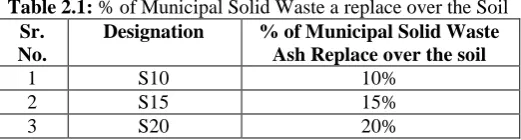
This study is aimed at determination of the proper use of the Municipal solid waste ash in road construction. The prime aim of this experimental work is to study the use of municipal solid waste ash in some percentage over the natural soil used in sub-base in road construction. Following samples are used for experimental work using different percentage of municipal solid waste ash in soil.
Table 2.1: % of Municipal Solid Waste a replace over the Soil
Sr. No.
Designation % of Municipal Solid Waste
Ash Replace over the soil
1 S10 10%
2 S15 15%
3 S20 20%
The study was to determine the geotechnical properties of Municipal solid waste ash with soil. The following test were carried out soaked CBR test, Unsoaked CBR test, Unconfined compression strength test, permeability test, Liquid limit test, Plastic test.
III.
RESULTS AND DISCUSSION
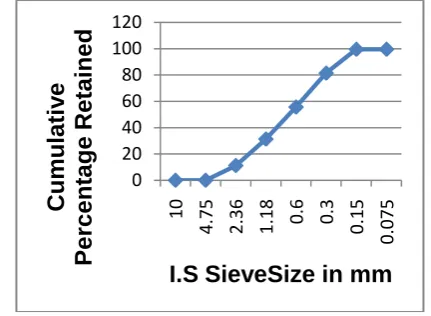
Grain size Distribution- The grain size distribution of the constituents was nearly same for soil and Municipal solid waste ash. Grain size distribution is a parameter that plays an important role in some properties and and accurate data are required for other physical and geotechnical tests. Figure 3.1 shows the grain size distribution of natural soil and figure 3.2 shows the grain size distribution of Municipal solid waste ash. From figure 3.1 coefficient of uniformity (cu) and coefficient of curvature (cc) is 5.75 and 1.08 respectively. From figure 3.2 2.29 and 1.29 which is acceptable. Furthermore there are several requirements for the grain size distribution of the material to have no correct stability for reuse in roads.
Fig.3.1: Particle Distribution for Natural Sand
0 50 100 150
80 60 30 10
4.75 2.36 0.425 0.075
Cumu
la
tiv
e
P
e
rc
e
nt
a
ge
…
No grains larger than 45mm, almost fulfilled with 0 % above 63 mm. Maximum 15% larger than 31.5mm, fulfilled as 0.1%
Maximum 9% less than 0.063mm, fulfilled as 0.5% below 0.075mm Specific Gravity-
The specific gravity of natural soil sample can be obtain is 2.86 and specific gravity of Municipal solid waste ash is 1.99 respectively.
Water content of natural soil sample can be obtain 43.12% and Municipal solid waste ash is 16.45%
Fig.3.2: Particle Distribution for Municipal solid waste ash
3.1 Geotechnical Properties of Municipal solid waste ash
The geotechnical properties of the Municipal solid waste ash shown in Table 1. Table 1. Table 1 shows the geotechnical properties value obtain during the test replacement of Municipal solid waste ash over soil in % like 10% (s-10), 15% (s-15), 20% (s-20). The CBR test results for soaked samples the CBR value of natural soil sample 5.91, s-10= 5.38, s-15= 5.98 , s-20= 4.84. The CBR test results for unsoaked samples the CBR value of natural soil sample 20.15, s-10= 18.49, s-15= 20.16 , s-20= 18.16. From this value it clear that the replacement of 15% Municipal solid waste ash over the soil can not affect the soaked and unsoaked CBR values. The maximum CBR values achieved at 15% replacement it can be increased 1% CBR value for soaked and unsoaked samples. It can be decreases with further increases in replacement % of Municipal solid waste ash. According to Ministry of Road Transport and Highway (MORTH) and Indian Road Congress.(IRC) 15% replacement of Municipal solid waste ash over the soil it is acceptable for sub-base material, sub grade material and filling materials.
Table 3.1 Geotechnical properties
Properties Natural soil S-10 S-15 S-20
Soaked CBR test % 5.91 5.38 5.98 4.84
Unsoaked CBR test % 20.15 18.49 20.16 18.16
Unconfined compression Strength test kn/m2
249.01 131.91 246.40 197.31
Permeabilty test cm/sec 4.96x10⁻³ 8.33x10⁻³ 5.57x10⁻³ 6.51x10⁻³
Liquid Limit test % 49.32 52.23 50.12 51.38
Plastic Limit test % 20.50 18.00 20.52 18.00
S-10 = 10% replacement of Municipal solid waste ash over the soil. S-15 = 15% replacement of Municipal solid waste ash over the soil. S-20 = 20% replacement of Municipal solid waste ash over the soil.
Results of the Unconfined compression strength test also presented in table 3.1 Unconfined compression strength test value for natural soil is 249.01, s-10= 231.91, s-15= 246.40 , s-20= 197.31 from this value it clear that replacement of 15% Municipal solid waste ash gives slightly nearer to the natural soil value. Result of permeability test for natural soil is 4.96x10⁻³, s-10= 8.33x10⁻³, s-15= 5.57x10⁻³ s-20= 6.51x10⁻³ this results indicate that the Municipal solid waste ash replacement over the soil is a free draining material. The optimum permeability value achieved at 15% replacement (s-15) over soil.
Results of liquid limit test obtain for natural soil is 49.32%, s-10= 52.23, s-15= 50.12 , s-20= 51.38 from this results the replacement of 15% of Municipal solid waste ash can not affect the property of liquid limit. The optimum liquid limit achieved at 15% replacement (s-15) Municipal solid waste ash and then it can be decreses further increase in % of Municipal solid waste ash.
0 20 40 60 80 100 120
10
4.75 2.36 1.18 0.6 0.3 0.1
5
0.075
Cumu
la
tiv
e
P
e
rc
e
nt
a
ge
Reta
ine
d
Result of plastic limit test obtain for natural soil is20.50, s-10= 18.00, s-15= 20.52, s-20= 18.00 from this results replacement of 15% (s-15) Municipal solid waste ash over the soil can not affect the property of plastic limit test value. The optimum plastic limit achieved at 15% replacement Municipal solid waste ash over the soil.
IV.
CONCLUSION AND FUTURE SCOPE
In this paper the experimental results are presented to evaluate the feasibility of utilizing of Municipal solid waste ash as soil replacement as a road construction.
The soaked and unsoaked CBR test, unconfined compression strength test, permeability test, plastic limit test, liquid limit test on prepared soil specimen evaluated and concluded that all test results are increases with increase in Municipal solid waste ash at 15%. There after slight decline in strength for 20% due to excess amount of Municipal solid waste ash. The higher strength in 15% addition is due to sufficient in amount of Municipal solid waste ash available with soil.
The specific gravity of natural soil is 2.86 and Municipal solid waste ash is 1.99 respectively. Municipal solid waste ash is a light weight material from the specific gravity compared to natural soil and gravel.
Replacement of 15% replacement (s-15) Municipal solid waste ash in natural soil the soaked CBR and unsoaked CBR test result is 5.13% and 20.225 respectively. Municipal solid waste ash is well graded and compactable material that can be used as a strong sub base material from the result of CBR value.
The Unconfined compression strength test result for replacement of 15% Municipal solid waste ash in natural soil is 249.40kn/m2 from this results Municipal solid waste ash is a fairly stable and durable material comparable to natural soil.
The permeability test result of 15% replacement of Municipal solid waste ash over the soil is 5.57x10⁻³ cm/sec from this test value 15% replacement (s-15) Municipal solid waste ash over the soil is quite comparable to natural soil. Free draining material that can prevent buildup of pore water pressure in sub base materials. Replacement of 15% Municipal solid waste ash in natural soil the liquid limit test result is 50.12% and Replacement of 15% Municipal solid waste ash in natural soil plastic limit test result is 20.50%.
Municipal solid waste ash is slightly increases the strength with 15% municipal solid waste ash over the soil replacement.
Municipal solid waste ash replace 15% over the soil (s-15) has suitable geotechnical properties and it has qualities that can possibly be used in road construction.
With further experimental study 15% Municipal solid waste ash replacement over the soil (s-15) is similar characteristics to natural soil it is an advantage to possibly be a substitute material.
4.2 FUTURE SCOPE
The generation of Municipal solid waste ash increases day by day and the other hand demand of construction material is more. The natural resources material used in construction is limited and development of construction rapidly increasing. Municipal solid waste ash will be generally dumped or landfill on ground, so the challenges are to reutilize the municipal solid waste ash will be possible by obeying new concept.
In various constructions sector Municipal solid waste ash can also be helpful for making of bricks, cement material, concrete ingredients, mortar etc. Where there will be requirement more strength and minimum use of natural resources in that situation is also helpful the municipal solid waste ash.
V.
CONCLUSION
In this report experimental results are presented to evaluate the feasibility of utilizing of Municipal
solid waste ash as soil replacement as a road construction. The soaked and unsoaked CBR test, unconfined compression strength test, permeability test, plastic limit test, liquid limit test on prepared soil specimen evaluated and concluded that all test results are increases with increase in Municipal solid waste ash at 15%. There after slight decline in strength for 20% due to excess amount of Municipal solid waste ash. The higher strength in 15% addition is due to sufficient in amount of Municipal solid waste ash available with soil. The following conclusion will be drawn.
1 Replacement of 15% Municipal solid waste ash in natural soil the soaked CBR test results is 5.13%. 2 Replacement of 15% Municipal solid waste ash in natural soil the soaked CBR test results is 20.22%
3 Replacement of 15% Municipal solid waste ash in natural soil the unconfined compression strength test result is 249.40 KN/m2.
4 Replacement of 15% Municipal solid waste ash in natural soil the permeability test result is 5.57x10⁻³ cm/s. 5 Replacement of 15% Municipal solid waste ash in natural soil the liquid limit test result is 50.12%.
6 Replacement of 15% Municipal solid waste ash in natural soil plastic limit test result is 20.50%.
8. From the cost analysis the replacement of municipal solid waste ash over the soil reduce the cost of construction without affecting the property of soil.
REFERENCES
[1]. Alicia Moral, Francisco Sinis, Jesus Hervas and Analia Cerda “Variability of Environmental Properties of MSWI bottom Ash as Alternative Aggregate in Road Construction” Second International Conference on Sustainable Construction Materials and Technologies, June 30,2010, pp 1-11.
[2]. Charles H.K. Lam, Alvin W.M.Ip, John Patrick Barford and Gardon Mckay, “Use of Incineration MSW Ash: A Review”, Sustainability, 2010, pp 1943-1968
[3]. Dr. Punmia B.C, Ashok Kumar Jain and Arun Kumar Jain, “Soil Mechanics and Foundation”, Laxmi Publications (P) LTD.
[4]. Eva Rendek, Gaelle Ducom and Patrick Germain, “Carbon di oxide Sequestration in Municipal Solid Waste Incinerator (MSWI) Bottom Ash”, Journal of Hazardous Material B-128, 2006, pp 73-79.
[5]. G.M.Kirkelund, A.S.Joergensen, T Ingeman Nielsen and A. Villumsen, “Characterization of MSWI Bottom Ash for Potential Use as Subbase in Greenlandic Road Construction”, 4th International Coference on Enginnering for Waste and Biomass Valorisation, September 10- September 13, 2012, pp-835-840. [6]. Hashim Mohammed Alhassan and Ahmed Musa Tanko, “Characterization of Solid Waste Incinerator
Bottom Ash and the Potential for Its Use”, International Journal of Engineering Research and Applications. (IJERA), Vol. 2, Issue. 4, July-Agust, 2012, pp. 516-522.
[7]. Indian Road Congress (IRC: SP:84,2014).
[8]. Izquierdo Maria, Vazquez Enric, Querol Xavier, Barra Marilda, Lopez Angel and Plana Felicia, “Use of Bottom Ash from Municipal Solid Waste Incineration as a Road Material”, International Ash Utilization Symposium, Center for Applied Energy Research, 2001, pp. 516-522.
[9]. Katrin Rubner, Frank Haamkens and Olaf Linde, “Use of Solid Waste Incinerator Bottom Ash as Aggregate in Concrete”, European Geosciences Union General Assembly, April 15 – April 20, 2007, pp. 1-2.
[10]. Md Safiuddin, Mohd Zamin Jummat, M.A. Salam, M.S. Islam and R. Hashim, “Utilization of Solid Wastes in Construction Materials”, International Journal of the Physical Sciences, Vol. 5 (13), 18 Octomber 2010, pp. 152-1963
[11]. Ministry of Road Transport and Highway, Third Revision. (MORTH).
[12]. Mohammed Muazu Abdulani, “Municipal Solid Waste Incineration Bottom Ash as Road Construction Material” AU.J.T, 13 (2), October 2009, pp. 73-79.
[13]. Niklas Hansoon, Anders Lagerkvist and Holger Eck, “Utilization of Waste Incineration Bottom Ash in Bound Construction Materials”, ASH Stockholm, January 25- January 27, 2012, pp. 1-8.
[14]. Paul Frogner Kockun, Jan Erik Lindquist, Karl-Johan Loorents and Maria Arm, “Microstructure of Aged MSWI Bottom Ash in Road Construction”, Wapson Conference Proceedings, 2012, pp. 1-4.
[15]. Samuel P. Lucido and Willard Wilson, “Bituminous Pavement Constructed with Municipal Solid Waste Combustor Ash: Construction, Performance and Economic Issues”, 10th North American Waste to Energy Conference, ASME-2002, pp. 225-239