(General article)
Cloud Computing: A General Review
Niyati Bansal* , Alpna Dahiyaa, Madhu and Ajit Noonia
Accepted 11 July 2012, Available online 1Sept 2012
Abstract
“Cloud” computing – a relatively recent term, builds on decades of research in virtualization, distributed computing, utility computing, and more recently networking, web and software services. It implies a service oriented architecture, reduced information technology overhead for the end-user, great flexibility, reduced total cost of ownership, on-demand services and many other things. This paper discusses the concept of “cloud” computing, some of the issues it tries to address, deployment models, various architectures and a “cloud” implementation.
Keywords: “cloud” computing, virtual computing lab, virtualization, utility computing, end-to-end quality of service
1. Introduction
What is Cloud Computing?
1Cloud computing can be defined as the use of computer
technology that harnesses the processing power of many inter-networked computers while concealing the structure that is behind it. This is what creates the backbone of the networks that we access today. While this technology has been around for some time, they way that people within IT organizations view cloud computing has changed because of the flexibility it can now give them through providing services and applications for users to apply it in what is known as the back office. The origins of the term “cloud” can be traced to the concealing nature of this technology’s framework; the system works for users yet they really have no idea the inherent complexities that the system utilizes. What they do not realize is that there is a massive amount of data being pushed globally in real time to make these applications work for them, the scale of which is simply amazing. The idea of connecting to the cloud in fact is something of a familiar notion among technologists today because it has become a popular buzzword among the technology media. The only thing users need to be concerned about is the terminal that they are using and whether or not it is connected to the internet so that they can have access to the tools that the cloud can provide. Unknown to many people is that much of the structure in the information technology industry today is now done within a cloud computing environment or is moving towards that end. A slow migration towards this has been going on for several years, mainly due to the infrastructure and support costs that go into standalone
* Corresponding author's email: [email protected]
hardware. It is also due to the economies of scale in larger data centers providing enhanced performance and processing power. This can be attributed as well to the shift of emerging technologies on the internet towards vast amounts of data that need to be mined, parsed and organized for users to easily understand.
The Idea Behind Cloud Computing
The major benefit of the concept behind cloud computing is that the average user does not require a computer that is extremely powerful to handle complex database indexing tasks that server farms can. Instead, with the use of broadband, users can easily connect to the cloud, which would commonly be referred to as the point of contact with the larger network. With this point of contact, cloud computing users from all across the world can reap the benefits of enormous processing power without major capital or technical know-how. While this concept was explored in the mainframe days of the 1960s, it was not until huge infrastructure investments in broadband were made in the late 1990s that cloud computing as it is utilized today could become possible. The heavy consumption of bandwidth that encompasses the internet of today is what makes the technology work, as previously networks were much less dynamic due to slow upload and download speeds that were available at the time. The global economy has made a large shift and as opposed to being manufacturing based, an era of information is now prevalent. Information will someday itself become a commodity just like manufactured goods are today, and a server farm could be thought of as the modern equivalent of a factory. This new “factory” is the engine behind information growth driving data processing and capacity to become less of a factor in terms of cost. International Journal of Engineering, Science and Metallurgy
It’s an idea that is being explored, and these new data centers that are being constructed are just like factories, with information becoming the commodity of the future. Another major factor that changed the landscape was the idea that multitudes of cheap computer hardware could be harnessed to create a vastly networked data center just as good as a smaller amount of more expensive, higher quality server hardware. While it was once the conventional wisdom that expensive servers stood less risk of failure, when you have thousands of low cost servers employed in a data center the chance of an outage of service to users is just as diminished as the latter option. Having this much power in terms of data capability creates a flexibility in information that has never before been seen until today. The largest technology companies currently are capturing this concept and making available information that can help make our lives easier and more convenient. For companies, it helps them to become more efficient and profitable.
Key Characteristics of Cloud Computing
The most important element in play for cloud computing is the server structure. This plays a major role as it is the brains behind the entire processing environment. For cloud computing the hardware in the server environment does not necessarily need to be high end. (Armbrust, M; Fox, A., Griffith, R., Joseph, A., Katz, R., Konwinski, A., Lee, G., Patterson, D., Rabkin, A., Zaharia, (2010) Rather, the key benefit of this technology is the ability for an organization to harness the power of cheap hardware on a larger scale as opposed to using a smaller amount of servers that are higher grade in quality. It is helpful for the global organization to have cloud computing capabilities because it allows all of their users to have access to information from any computer when needed, which can help prevent lost data or bad organization of digital files. This makes an organization have true portability, and can allow for better data security if all the information can be stored on the cloud away from potentially prying eyes. It also can help break down the command structure in an organization into many nodes located across the globe, which is an organizational style that is becoming quite popular as businesses are trying to integrate globally and have more flexibility at the same time.
The fact that all of the information for a client is hosted in one physical site also allows for hardware and software to be managed more efficiently by a specialized on-site team who can then take care of managed specifics; for Example, the updating of hardware and software. In effect, this process is much more seamless because there are no outages required in the cloud. Only portions of processing power are down, and the average user would have no idea that anything was going on, nor would they
care. Along those lines is that this managed-care of the technology hardware is something that companies are
What Cloud Computing Really Is
In simplistic terms, cloud computing can be broken down to a browser based application that is hosted on a remote server. To the average user, that is all he or she really needs to know about cloud computing. But there is a lot more to it than just that. What cloud computing really represents is huge: it’s a way for small organizations to compete with much larger ones, it’s a way to save a lot of money and it’s a way to utilize energy efficiency in operations. Cloud computing as it relates to Internet technology is all around us. When we access our email, when we search for information, we are using the power of processing technology that exists at a distant location without us knowing about it. In fact, even the most basic computer applications require a network connection these days to do simple tasks. As an example, the thesaurus function within Microsoft Word (Jeff Kaplan, 16/08/2008) requires a network connection to look up alternative words. In effect, the cloud provides networked users with an extension of their own machine. As long as a user is connected to the internet, the power of cloud computing comes into play and many benefits can be reaped. One example would be processing power. Applications can be run on the fly from a terminal machine when processing power is not a concern; the only thing that users need to worry about would be their bandwidth connection and its reliability on the network. One of the biggest benefits would be storage. Server farms possess massive amounts of storage. An example of this would be the free email services that are available on the web. Often times these email services offer a large amount of storage to their users because it is cheap for them to do so by using the available space that is in the cloud. This is a characteristic that is to be noted, because the prevalence of cheap storage on server farms will benefit users immensely in the future. One major benefit of this is data loss prevention. With the cloud managing data across a multitude of networked computers the chance of data loss becomes less likely and is indeed a feature that cloud computing companies tout to their potential clients.
Deployment models
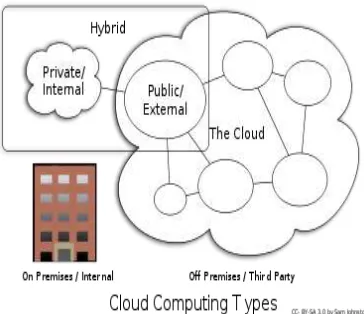
Public cloud
A public cloud is one based on the standard cloud computing model, in which a service provider makes resources, such as applications and storage, available to the general public over the Internet. Public cloud services may be free or offered on a pay-per-usage model.
Community cloud shares infrastructure between several organizations from a specific community with common concerns (security, compliance, jurisdiction, etc.), (Jeff Kaplan, 16/08/2008) whether managed internally or by a third-party and hosted internally or externally. The costs are spread over fewer users than a public cloud (but more than a private cloud), so only some of the cost savings potential of cloud computing are realized.
Figure 1 Cloud Computing Types
Hybrid cloud
Hybrid cloud is a composition of two or more clouds (private, community, or public) that remain unique entities but are bound together, offering the benefits of multiple deployment models. It can also be defined as multiple cloud systems that are connected in a way that allows programs and data to be moved easily from one deployment system to another.
Private cloud
Private cloud is infrastructure operated solely for a single organization, whether managed internally or by a third-party and hosted internally or externally.
They have attracted criticism because users "still have to buy, build, and manage them" and thus do not benefit from less hands-on management essentially "[lacking] the economic model that makes cloud computing such an intriguing concept".
ARCHITECTURE
Figure 2 Cloud computing sample architecture
Cloud architecture, the systems architecture of the software systems involved in the delivery of cloud computing, typically involves multiple cloud components communicating with each other over a loose coupling mechanism such as a messaging queue.
The Intercloud
The Intercloud is an interconnected global "cloud of clouds" and an extension of the Internet "network of networks" on which it is based.
Cloud engineering
Cloud engineering is the application of engineering disciplines to cloud computing. It brings a systematic approach to the high level concerns of commercialisation, standardisation, and governance in conceiving, developing, operating and maintaining cloud computing systems. It is a multidisciplinary method encompassing contributions from diverse areas such as systems, software, web, performance, information, security, platform, risk, and quality engineering.
Benefits of Cloud Computing
There are immense benefits from utilizing cloud computing. Of course, with any new technology there will be inherent risks, but companies that intend to provide cloud computing resources will tout many features that can benefit organizations using cloud technology to become more efficient organizations.
Flexibility
With the idea of a “server rental” model in place, it is easier to become more flexible in terms of technology resources. The reason is that businesses are able, with cloud computing, to have lateral options when it comes to technology. They can decide how much storage space to use, and how much processing power is required. While working to update software applications, the process can be pushed out much faster and more efficiently. Administrators can choose when to update an application enterprise-wide all in real time. It is up to them and how much they want to spend on IT with cloud technology.
Scalability
per gigabyte to rent than to own the infrastructure outright. Cyclical and seasonal businesses would be a great fit for the rent-a-server structure that cloud computing avails to the. One cyclical business, like tax preparation, would be able to utilize their resources within the first six months of the year – when they are busy – and then retract their usage instantly when they are not needed.
Capital Investment
Companies who anticipate a huge surge in cloud usage over the next few years are investing hundreds of millions of dollars into infrastructure for massive server farms. Many of them don’t really even know what it will all be used for specifically, but they know that the need will be there in the next couple of years. IT spending takes a large portion of money out of general funds that companies could use for other pressing business needs such as marketing, research and development and human resources. With cloud computing, many rudimentary IT purchases for things like hardware are no longer an issue as long as that task or set of tasks can be performed by the cloud. Since much of the equipment will sooner or later be obsolete, why not let cloud vendors deal with the problem?
Portability
In today’s global economy organizations need to have people on the ground, far from headquarters, to manage things. With cloud computing technology, organizations are able to use their computing power wherever their people are as long as users are able to access thin clients. Thin client access is pretty much available everywhere that companies do business today, so this should not even be an issue. With thin client technology the scale of geography and time variation is flattened somewhat and this allows companies that are trying to globally integrate to be able to be more flexible than ever before.
Cloud Computing Drawbacks
Along with any technology that is new and cutting edge, there are potential downsides that are to be expected out of cloud computing. These types of issues need to be seriously looked at by organizations that are going to rely on outside resources to handle complex tasks. While the benefits seem immense, professionals in IT always have to consider the negatives that may develop down the road (Bernard Lunn, 14/08/2008).
Dependability
For those planning on providing cloud resources to their customers, they will need to project an image that shows
that they can be very reliable, to the level of the electric utility model. Energy is a very dependable resource outside of force majeure and cloud computing vendors must strive for the same level of service, included in their SLAs. This could be a problem for companies that rely on the cloud to keep critical business functions up and running. One solution around dependability would be to plan around the most critical functions to be hosted from within the company while much of the non-critical processing can be done through a cloud vendor. This approach requires some planning but can be beneficial.
Security
Being able to keep important data secure has always been a priority in IT, but with a technology that takes information outside of the virtual secure walls most corporations have up will raise red flags. The usage of thin clients could possibly be high-jacked if people are carless with data. Also, SLAs will need to have provisioning within them that directly specifies how cloud computing providers plan on protecting data. This could become a lawsuit-threatening issue someday soon if companies are not careful. With reports coming out all the time about data being lost or stolen and the rise in identity theft as the result of stolen data this could be a huge deal breaker for some companies hoping to utilize cloud technology. The idea of “private clouds” is a term that had been coined to help ease people’s concerns. But until vendors are able to easily classify what that means many technologists are going to remain concerned about the feasibility of cloud computing to secure data which is private and should not be out in the open.
Little or no Reference
Because of privacy concerns, cloud vendors for the most part are unable or unwilling to present case studies about companies that are currently using their services. As a matter of fact, there are very few large companies that are publicly reporting their usage of cloud computing at a large scale level. This leaves many organizations feeling shy about using cloud computing resources as of yet even though it has become popular terminology in the tech world. So the other two disadvantages of this technology are compounding along with the fact that very few companies are reportedly using the technology cause the entire cloud movement some problems. It may be possible that the smaller start-up companies will have to take advantage of some larger ones before they begin to adopt cloud computing.
Major Components to Cloud Computing
The application itself, which is the component that end users will spend most of their time using, is hosted on severs that are remote from the user and can be run in real time from a thin client that hosts the application through a web browser. The majority of applications that are hosted on clouds are run via browsers. This has major benefits in that there is no installation of the application, no maintenance required and support issues are streamlined because the software is hosted on a machine that is dedicated to that software so there is no worry of external influences of the thin client on the software itself. Cloud applications are also referred to as software as a service (SaaS), software plus service or data as a service (Reuven Cohen, 15/09/2008).
Client
The client, or thin client, is generally a web browser such as Mozilla Firefox or Microsoft Internet Explorer. A newcomer has been Google’s Chrome, which brings an interesting discussion into play as to how much the web browser that is known as today will become more powerful. It may soon be able to disseminate dynamic application interfaces so that it becomes more of a portal or perhaps an operating system in and of itself. It should also be noted that there are other types of thin clients out there. For example, in the mobile telephone environment Apple’s iPhone or Google’s Android (Bernard Lunn, 14/08/2008) platforms run a suite of applications that can be considered run from the cloud. Also certain web sites can be termed clients, for example Facebook, where there are thousands of applications available for its users to utilize. This in effect may be a sort of “virtual client” itself that has yet to be defined.
Infrastructure
The infrastructure of cloud computing is comprised of computer hardware and the buildings that contain that hardware. As discussed before, the hardware consists of cheap, mass produced server technology which has become prevalent in the computer industry today. The server environment itself is running virtualization technology which means that inside the server farm it is irrelevant how many specific machines there are. Rather, it make more sense to run software that can harness the machines’ inherent multiple processing power so that the cloud companies can reap more benefits out of each customers processing ability. One newer infrastructure process is known as paravirtualization. Paravirtualization utilizes more than one machine, and often several machines, to emulate one process. Although IBM has done this in the past, the concept has changed somewhat and it was known as using a “parallel workstation”. The company most famously using this technology is Amazon with their Elastic Compute Cloud.
Platform
The cloud platform is referring to the way that applications can be deployed, most likely the name derived for by Platform as a Service (PaaS). Also the name solution as stack service comes to mind as well. This would include the web application frameworks that are out there such as the language Ruby on Rails, which is an open source web application format. Some other examples of the cloud platform is Force.com, Salesforce.com’s proprietary PaaS service, the Google App Engine which runs off of Python and the web hosting service Mosso. All of these are examples of how platforms can potentially be run in the cloud environment today (Michael Coté, 30/09/2008).
Service
Service is referring to what users can reap from their cloud experience. To date there are a ton of services out there on the Internet for users to take advantage of. Some of them are quite unique, while others enhance services that were already out there. One of the most popular services in recent years that uses cloud computing would be mapping services. A few examples include Yahoo Maps, Google Maps, and Mapquest. These services require a lot of database storage. They also need a lot of processing power to perform tasks such as giving people accurate directions. Another service requires a lot more back office tasks, and that is payment services. These payment processors require a lot of processing power to accurately do the accounting that is required in the background for deposits and withdrawals. Two of the most popular payment services include both Paypal and Google Checkout.
Storage
Physical storage can be expensive for companies looking to expand their storage needs. It is cheaper to go with the cloud to be able to expand and collapse as the business dictates. One of the biggest features of cloud computing is in fact storage. The main reason is that in hardware terms storage devices are the first ones to fail on a computer. By using cloud technology it is more redundant in the respect that companies can rest assured that their data is indeed safe. Cloud vendors will usually be able to provide service level agreements to let their customers know that their data is safe.
Processing Power
available at the cost of around ten cents per server per hour. Companies are able to use this type of capacity for a number of things: namely testing out new markets, and trying out new applications over the web. Some opponents of cloud computing contend that there will not be a benefit for large corporations to use cloud technology but to use their own in house servers. The reality, however, is that most corporate servers are left unused during off peak hours. Therefore, they are wasting valuable processing resources that are available.
References
1. (Bernard Lunn, 14/08/2008) Cloud Failures Are Serious -
Time to Revisit P2P?
http://www.readwriteweb.com/archives/google_failures_se rious_time_t.php
2. (Michael Coté, 30/09/2008) How cloud computing will
change capacity management
http://searchdatacenter.techtarget.com/tip/0,289483, sid80_gci1332796,00.html Cloud Computing: Could Customer Service Be Its Waterloo?
3. (Jeff Kaplan, 16/08/2008)
http://seekingalpha.com/article/91261-cloudcomputing-could-customer-service-be-its-waterloo Amazon.com adds support options for cloud computing
4. (Nancy Gohring, 17/04/2008)
http://www.infoworld.com/article/08/04/17/amazoncloud-services_1.html
5. (Reuven Cohen, 15/09/2008) http://web2.sys-con.com/node/674934 Harnessing the power of 'clouds'
Spencer Kelly, 20/06/2008
http://news.bbc.co.uk/1/hi/programmes/click_online/7 465386.stm
6. (Spencer Reiss, 21/03/2008)
http://www.wired.com/techbiz/it/magazine/16-
05/mf_amazon?currentPage=3 IBM Expands R&D In China
7. (Michael Singer, 14/10/2008)
http://www.informationweek.com/news/services/saas /showArticle.jhtml?articleID=211200449 Google and the Wisdom of Clouds
8. (Stephen Baker, 13/12/2007)
http://www.businessweek.com/magazine/content/07_52/b4 064048925836.htm
9. Ko, Ryan K. L.; Jagadpramana, Peter; Mowbray, Miranda; Pearson, Siani; Kirchberg, Markus; Liang, Qianhui; Lee, Bu Sung (2011). "TrustCloud: A Framework for Accountability and Trust in Cloud Computing".Proceedings of the 2nd IEEE Cloud Forum for Practitioners (IEEE ICFP 2011), Washington DC, USA, July 7-8, 2011.
10. Ko, Ryan K. L. Ko; Kirchberg, Markus; Lee, Bu Sung (2011). "From System-Centric Logging to Data-Centric Logging - Accountability, Trust and Security in Cloud Computing". Proceedings of the 1st Defence, Science and Research Conference 2011 - Symposium on Cyber Terrorism, IEEE Computer Society, 3-4 August 2011, Singapore.
11. Rich Miller (2008-05-02). "IBM, Google Team on an Enterprise Cloud". DataCenterKnowledge.com. Retrieved 2010-08-22.