International Journal of Multidisciplinary and Scientific Emerging Research
©2014 IJMSER, All Rights Reserved
Available at http://www.ijmser.com/ (ISSN 2349 – 6037)
998| Int. J. of Multidisciplinary and Scientific Emerging Research, Vol.3, No.2 (December 2014)
Head Movement Based Feeder System for the Physically Challenged Using PSoC
N. S. Aishwarya Lakshmi, Engineer Trainee C-DOT Alcatel Lucent, Chennai
Suresh R. Norman, Associate Professor at SSN College of Engineering, Kalavakkam
S. Aparna, Pursuing MS in University of Florida
S. Divya, Engineer Trainee Infosys, Chennai
Accepted 04 December 2014, Available online 08 December 2014, Vol.3, No.2 (December 2014)
Abstract
The aim of our project is to assist the physically challenged people with feeding, based on their head movements. In our project, PSoC (Programmable System on Chip) is used to develop the system along with a NXT microcontroller. PSoC proximity sensor is used to detect head movements. Also, the LEDs on the Cypress-3 PSoC kit can be lighted up, one by one, as the head gets closer to the sensing antenna of PSoC. The LED outputs are converted to an electrical signal using a light sensor present in Lego Mindstorm and is given as an input to initiate the operation of robotic arm. The safety of the user is an important factor to be considered since the robotic arm operates near the user’s face. Hence the Ultrasonic sensor is used to stop the robotic arm movement, when it reaches approximately 25cms from the patient’s face. The touch sensor is placed near the cheeks of the person and on its activation, it will resume the robotic arm movement towards the patient’s mouth. The next operation of the touch sensor returns the robotic arm to its initial position and the robot assisted feeding process continues thus. Lego Mindstorms is used for the design of a robotic arm. Thus, we will design a robotic feeder system for the physically challenged without the intervention of nurse/ attender taking the safety of the person into consideration.
Keywords: PSoC, Lego Mindstorms, robotics, sensors, motors.
1. INTRODUCTION
Robotics is the branch of technology dealing with the design, construction, operation, structural disposition, manufacture and application of robots. Robotics is related to the sciences of electronics, engineering, mechanics, and software. Robotic technology finds varied applications in the fields of health, security sectors, ministry etc.
Advanced robotics is at the forefront ofRobotic Process Automation. While designing the robot system for our project, we worked hard to achieve the best balance between robotic system capital expenditure and process improvement.
Embedded systems are control systems that are designed around a microcontroller which integrates on-chip program memory, data memory (RAM), and various peripheral functions, such as timer and serial communication. Most embedded control products must have special requirements, such as cost effectiveness, low power, high efficiency, and high level of system integration.
Robotic technology has been used in the health-care sector for several years, both to help surgeons operate
more efficiently and to allow doctors to check in on their patients even when they are kilometres apart. One important application of such robots is in assisting the physically challenged in their day to day life.
The prime motive of our project is to assist people suffering from quadriplegia. Quadriplegia, is paralysis caused by illness or injury to a human that results in the partial or total loss of use of all their limbs, which means that both sensation and control are lost. It is caused by damage to the spinal cord at high level.
Our project is head movement based robotic system for physically challenged people to assist them in feeding using a PSoC sensor. This full featured PSoC starter kit has an array of sensors, I/O’s, softwares, and projects so as to speed up and simplify our working with this powerful design methodology.
999| Int. J. of Multidisciplinary and Scientific Emerging Research, Vol.3, No2 (December 2014) communications and a 100*64 LCD display. Also, NXT
includes 3 motors with in-built rotation sensors. The graphical programming language, NXT-G is simple, but complete enough to be usable. The compatibility features and huge inventory of parts of LEGO are some of the reasons why it is such an attractive choice for construction in our robot feeder project.
Thus our project will enable the people suffering from quadriplegia to feed themselves without depending on a nurse or an attender, while safety considerations are met to the fullest.
Here are some examples of how a robotic feeder is being used in the current scenario:
[1] Meal Buddy - It is the world's first 4 Axis Robotic Assistive Feeder, which is designed for people living with disabilities. It combines robotic technology and personal features to create an electronic assistive feeder.
[2] "My Spoon" is another such robot released during a demonstration of healthcare robots in Tokyo. People with disabilities can operate it with a joystick with their jaw, hands, or feet.
[3] Six necessary requirements for an effective feeding support system as mentioned in
“Development of feeding support system and its quantitative estimation” are:
Possible to eat various kinds of foods.
Provides a suitable quantity of food.
Prevent food spills.
Does not require a significant amount of time to eat.
Safe and easy to operate.
[4] According to a survey investigating disabled people’s opinion about robot aids, almost 50% of the subjects feel that a robotic arm would have a positive effect on the level of care they would need. Only 4.5% feel negative about this effect. Furthermore, 86% of the subjects feel that they would be able to achieve new things in their life and especially 66% think that the possibility of grasping and releasing objects is important to them.
2. PROJECT OUTLINE
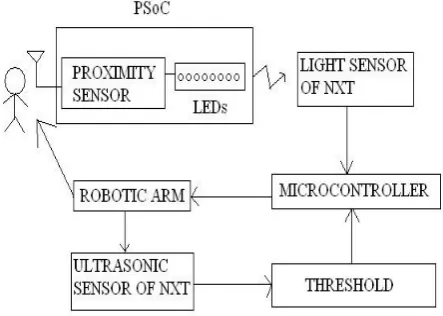
The basic block diagram of the project is shown in the figure below. There are 2 major steps involved.
[1] First is to sense the head movements using PSoC (Programmable System on Chip) proximity sensor. The proximity sensor can detect slight movements and closeness of the object.
[2] Second the safety of the user is an important factor to be considered since the robotic arm operates near the user’s face. Hence the Ultrasonic sensor is used to stop the robotic arm movement, when it reaches approximately 25cms from the patient’s face.
Figure 1: Block Diagram of Implemented System.
3.LEGO MINDSTORMS
Lego Mindstorms NXT is a programmable robotics kit released by Lego in late July 2006. It replaces the first-generation Lego Mindstorms kit, which was called the Robotics Invention System. It comes with the NXT-G programming software, but a variety of unofficial languages exist, such as NXC, NBC, leJOS NXJ, and RobotC. A new version of the set, the new Lego Mindstorms NXT 2.0, was announced in January 2009, featuring a color sensor and other upgraded capabilities. This set is available in the UK, German, and U.S.
3.1Sensors
Sensors provide feedback to a system telling it where it is or how it’s doing. The NXT has several types of sensors designed specifically for it, and backward compatibility to the old RCX sensors. All the sensors are well documented by LEGO, but we mention additional characteristics and show the internal construction of the sensors.
1. Light sensor: It enables our robot to distinguish between light and dark, and also determines the light intensity of PSoC Output LEDs. The light intensity is set at 52.
2. Ultra sonic sensor: This sensor helps our robot to judge the distances and see where the objects are. It also detects an object and determines its proximity in inches or centimetres. We have set the threshold for proximity sensor as 25 cms. 3. Touch sensor: Detects single or multiple button
presses, and reports to the intelligent NXT Brick. Based on the touch, the robotic arm will resume the scooping of food.
3.2 NXT-G programming
1000| Int. J. of Multidisciplinary and Scientific Emerging Research, Vol.3, No2 (December 2014) wirelessly using Bluetooth. Files can also be copied
between two NXT bricks wirelessly, and some mobile phones can be used as a remote control. Up to three NXT bricks can communicate simultaneously via Bluetooth when users created programs are run.
The retail version of the kit includes software for writing programs that run on Microsoft and Macintosh personal computers. The software is based on National InstrumentsLabVIEW and provides a visual programming language for writing simple programs and downloading them to the NXT Brick. This means that rather than requiring users to write lines of code, they instead can use flowchart like "blocks" to design their program.
NXT-G v1.0 is the programming software that comes bundled with the NXT. There are two different programming interfaces. One is included with the retail and educational kits and the other can be purchased separately. This software is adequate for basic programming, such as driving motors, incorporating sensor inputs, doing calculations, and learning simplified programming structures and flow control.
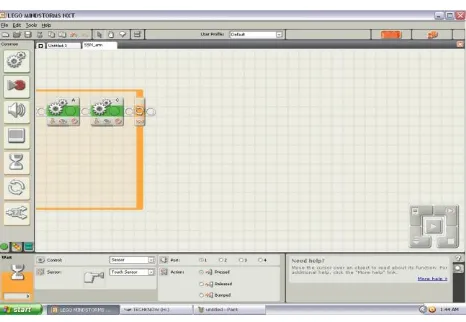
Figure 2: Program for Robotic Arm.
Figure 3: Program for Robotic Arm Continued.
4. PSoC
PSoC (Programmable System-on-Chip) is a family of
integrated circuits made by Cypress Semiconductor. These
chips include a CPU and mixed-signal arrays of configurable integrated analog and digital peripherals.
Our project uses the Proximity antenna that is available in PSoC which works on the principle of capacitive sensing. This proximity antenna detects the slight head movements of the user’s head.
Proximity detection is performed by a proximity antenna acting as a capacitive sensor. The proximity antenna consists of a wire connected to the proximity connector on the board. Upon power up, the board establishes a baseline capacitance value of the board along with the antenna attached to it. This is used as a reference value of capacitance and is called the parasitic capacitance of the board. When a conductive object such as a human finger is brought close to the antenna, the overall capacitance of the board changes. This change in capacitance determines the proximity of the finger to the antenna. An increase in capacitance corresponds to the finger being closer to the antenna. This is used to light up the LEDs based on the proximity of the finger to the antenna. The number of LEDs turned on increases as the proximity of the finger increases. To establish the parasitic capacitance, the antenna must be connected to the board before power up. The baseline for capacitive sensors is updated continuously by the firmware. This accounts for any changes in environmental conditions during the operation.
The steps for lighting LEDs in PSoC according to the distance between the antenna and position of head are:
1. Initially, all the output LEDs of PSoC remain turned OFF.
2. At the far most position, where the antenna begins to sense any conducting object, the MSB bit of the LED is turned ON.
3. At the mid position, when the distance between the conducting object and the antenna is around 10cm to 12 cm approximately, half of the output LEDs is turned ON.
4. When the conducting object remains at very close proximity to the antenna, say 1cm or less, all the LEDs are turned ON.
1001| Int. J. of Multidisciplinary and Scientific Emerging Research, Vol.3, No2 (December 2014)
5. IMPLEMENTATION OF ROBOTIC ARM
The model for robotic arm is built using Lego Mindstorms robotic tool kit. Three motors are used.
1. Motor A is fixed at bottom and can be rotated in clockwise and anti-clockwise directions.
2. Motor B is fixed above motor A and using gear and a rotatable table. This motor can move up and down.
3. Finally a motor C is fixed on the top and is primarily used for scooping food. A plastic spoon is fixed to this motor.
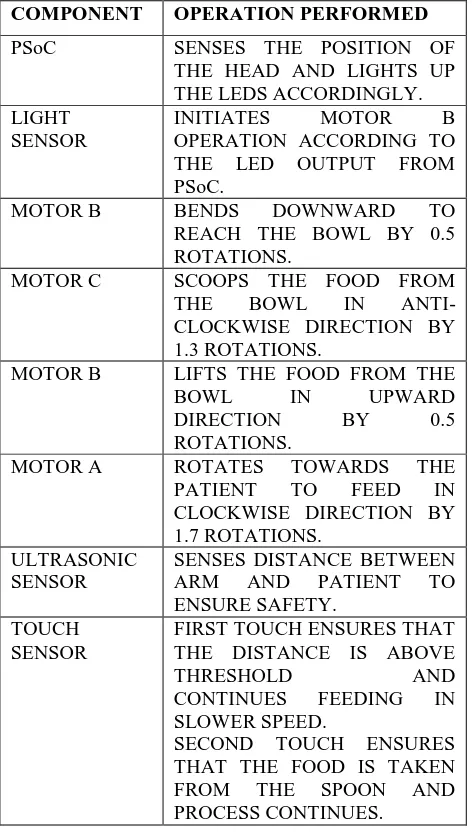
The algorithm for implementing the robotic arm is given in the form of a table below.
COMPONENT OPERATION PERFORMED
PSoC SENSES THE POSITION OF THE HEAD AND LIGHTS UP THE LEDS ACCORDINGLY. LIGHT
SENSOR
INITIATES MOTOR B OPERATION ACCORDING TO THE LED OUTPUT FROM PSoC.
MOTOR B BENDS DOWNWARD TO
REACH THE BOWL BY 0.5 ROTATIONS.
MOTOR C SCOOPS THE FOOD FROM THE BOWL IN ANTI-CLOCKWISE DIRECTION BY 1.3 ROTATIONS.
MOTOR B LIFTS THE FOOD FROM THE
BOWL IN UPWARD
DIRECTION BY 0.5 ROTATIONS.
MOTOR A ROTATES TOWARDS THE PATIENT TO FEED IN CLOCKWISE DIRECTION BY 1.7 ROTATIONS.
ULTRASONIC SENSOR
SENSES DISTANCE BETWEEN ARM AND PATIENT TO ENSURE SAFETY.
TOUCH SENSOR
FIRST TOUCH ENSURES THAT THE DISTANCE IS ABOVE
THRESHOLD AND
CONTINUES FEEDING IN SLOWER SPEED.
SECOND TOUCH ENSURES THAT THE FOOD IS TAKEN FROM THE SPOON AND PROCESS CONTINUES.
Table 1:
After the second touch sensor operation, the robotic arm moves to the initial position and resumes its operation from the beginning until the NXT brick is powered.
The major advantages of this system when compared to other existing systems are as follows:
1. Simplicity of operation. 2. Initial cost.
3. Future adaptability.
4. Ability to function at the necessary levels.
The following picture shows the final model of the robotic assistive feeder system.
Figure 5: Picture Showing the Final Model of Robotic Feeder.
6. FUTURE SCOPE
The constraint in using Lego is in the availability of only three output ports and four input ports. More number of motors can be added by using another NXT brick and then communicating between the two bricks using Bluetooth. A wireless connection between a computer and a NXT or from one NXT to another NXT can be established using Bluetooth. Programs can be transferred between NXT and PC or one NXT can be controlled by sending it messages from another NXT. This improves the flexibility of the system.
7. CONCLUSIONS
Service robotics is a fast growing field. One of its applications is the development of robotic assistants for elderly or disabled people. The World Health Organization states that several actions like carrying, grabbing, picking up and moving objects may be achieved by robots. Through this project we have efficiently designed a robotic aid for people suffering from quadriplegia and assist them in feeding without the intervention of a nurse or any other attender. At the same time the safety of the user operating on the wheel chair is taken into consideration.
REFERENCES
[1] Virginia T.Byrd, Joey. K. Parker,”Design of a robotic feeder”, System Theory, 1993. Proceedings SSST '93, IEEE/ Twenty-Fifth Southeastern Symposium.
1002| Int. J. of Multidisciplinary and Scientific Emerging Research, Vol.3, No2 (December 2014) Automation, 1995. Proceedings., 1995 IEEE
International Conference at Tokyo.
[3] Hiroshi Kobayashi, Kentaro Konishi, “Development of feeding support system and its quantitative estimation”, Intelligent Robots and Systems, 2006 IEEE/RSJ International Conference.
[4] Ali, A.S. Madariaga, M.G. McGeary, D.C. Pruehsner, W.R. Enderle, J.D., “The assistive robotic arm”, Bioengineering Conference, 2007. NEBC '07. IEEE 33rd Annual Northeast.