Frank Wai-ming Tam
Chinese University of Hong KongMotivation in Learning a Second Language:
Exploring the Contributions of Family
and Classroom Processes
This study looks at how family and classroom factors influence second-language learning at the junior secondary level in schools in Hong Kong. It employed an ecological
perspective to look at how family-level factors and classroom-level factors uniquely combine to influence students’ learning motivations in second-language learning. Nineteen secondary schools with over 2,200 secondary 1 and 2 students and their family members participated in the cross-sectional survey used for the research. Findings suggest that both teachers’ instructional behaviors and peer victimization norms in the classroom play a moderating role in the association between family processes and students’ motivation to learn English. It is suggested that the result of this research has important implications for home-school relations in Hong Kong as well as the restructuring of the school process to create a more supportive and nurturing environment for learning and teaching.
Cette étude porte sur l’influence des facteurs familiaux et pédagogiques sur l’apprentissage d’une langue seconde par des élèves du secondaire (premier cycle) à Hong Kong.
S’appuyant sur une perspective écologique, nous avons étudié l’interaction des facteurs liés à la famille et ceux liés à l’école qui influencent la motivation des élèves pour apprendre une langue seconde. La recherche s’appuie sur enquête transversale à laquelle ont participé 19 écoles secondaires avec plus de 2 200 élèves au secondaire 1 et 2 et les membres de leur famille. Les résultats donnent à penser que les pratiques pédagogiques des enseignants d’une part et les normes relatives à la victimisation par les pairs en classe d’autre part jouent un rôle modérateur dans l’association entre les facteurs familiaux et la motivation des élèves pour apprendre l’anglais. Il est proposé que les résultats de cette recherche a d’importantes répercussions sur les rapports foyer/école à Hong Kong, ainsi que sur la restructuration des processus scolaires visant la création d’un milieu plus encourageant et stimulant pour l’apprentissage et l’enseignement.
One of the weaknesses of the current literature on school effectiveness is the lack of understanding of how various levels of analysis (e.g., school, classroom and individual levels) uniquely and interactively contribute to student out-comes (Hoglund & Leadbeater, 2004; Kennedy & Mandeville, 2000; Bryk & Raudenbush, 1992). Hence despite the accumulation of knowledge about what contributes to the academic achievement of students and the relative impor-tance of the influence of home, school, and community, we still fall short of a convincing model of how the social environment in the family and school setting combine to influence learning (Riordan, 1997). In particular, if learning is taken to be a complex mental process comprising intention formation, task generation, action implementation, and outcome evaluation, then researchers
Frank Wai-ming Tam is currently serving as an assistant professor in the Department of
should be concerned as much with how this complex learning process is influenced by the social environment constructed by the linkages between family and school as with the relative importance of home and school effects (Pintrich, 2004).
The purpose of this study is to explore how the interaction of family and classroom factors affects students’ motivation to learn a second language. I hypothesize that classroom conditions moderate the effects of family processes on students’ learning motivation (East, 1987). Based on Bronfenbrenner’s (1979) ecological model of human development, the classroom can be con-ceived as the meso-system that connects the family and the school (Olson, 1995). The classroom is a social setting where norms and expectations of family and school converge and parents and teachers interact while trying to maxi-mize opportunities for the students. The classroom also provides the primary milieu for students’ social interactions. The family factors in this study include parental involvement and socioeconomic background. The classroom factors include instructional behaviors and peer victimization norms.
There has been a wealth of research on students’ affective performance in second-language learning (Berger & Bradace, 1982; Dörnyei, 2000; Gardner, 1985), and how family processes affect their motivation and performance (Ec-cles, Wigfield, & Schiefele, 1998; Suárez-Orozco & Suárez-Orozco, 1995), but only recently have researchers started to explore how classroom processes influence the effects of family processes on student performance (Bellmore, Witkow, Graham, & Juvonen, 2004; Chang, 2004; Hoglund & Leadbeater, 2004). It is by trying to explore how the social environment impinges on the students, in particular their emotional state, that one begins to gain insight into which aspects of environment and which mechanisms enhance or degrade psychological effects of success, and why students with inadequate social support are less well equipped to deal with the in-school demands and frustra-tion resulting from failure in school.
Motivation for Learning the English Language
Learning usually progresses through a mental process that involves initial planning and goal-setting, intention formation, task generation, action im-plementation, action control and outcome evaluation (Dörnyei, 2000, 2001; Hickey, 1997). When one talks about sustained, long-term activities such as learning a second language, the learning process is even more complicated. Students often need a warm and supportive family and classroom environ-ment to learn a second language (Gardner, 1985).
Commis-sion, 2005). In order to maintain a trilingual, biliterate schooling system that recognizes the commensurability of spoken Cantonese, Putonghua, and English, and written standard Chinese and English, the government has intro-duced a number of measures since 1997. Some of these include implementing a medium-of-instruction policy that restricts the number of English-medium secondary schools, providing resources for the hiring of native speakers to teach in primary and secondary schools, restructuring the English-language curriculum so that students can be engaged more actively in language use, and introducing a new public examination format that includes spoken English. Thus although English is only considered a second language in the secondary school curriculum, it is actually occupying a privileged position in terms of allocated time in the curriculum, staffing of English teachers, and prerequisite for university entrance (Lin, 2006).
Many parents, however, would much prefer their children to learn the English language than the Chinese language, even if it is at the expense of their cultural heritage, because they think that English may enhance their children’s future learning and future career (Berry & McNeill, 2005; Carkin, 2005). How-ever, not many parents are proficient enough in English to provide direct home support to their children for learning the language, and not many parents want to communicate with their children in English at home. In fact, because most of the population in Hong Kong is Chinese who will not normally use English unless they are communicating with foreigners or otherwise need to, there is little chance for young people to practice the language at home or in the community. As a result, many students fall under great pressure and feel isolated (Biggs, 1996; Watkins, 1996). If learning a language in school does not progress smoothly and students cannot draw satisfaction from their perfor-mance in it, they may develop a poor learning attitude in the subject (Marsh, Hau, & Kong, 2002) such as feeling bored with learning English, uninterested in English, scared of learning English, or self-destructive about their poor standards.
inter-nal energy on learning and achieving goals for a longer period than those with surface motivation.
Gardner (1985) points out that students’ determination to learn a second language is influenced by their effort expended in learning, desire to learn, and attitudes toward the activities involved in learning, and these three com-ponents are reflected in students’ motivational intensity. He further suggests that motivation in second-language learning is also reflected in a learner’s orientation. Students who employ mastery goals and learn a second language with deep motivation tend to belong to an integrative orientation that is char-acterized by learners’ wanting to learn about, interact with, or become closer to the second-language community.
Although Hong Kong attaches great importance to the teaching and learn-ing of English as a second language, society as a whole, and schools in par-ticular, have not provided a nurturing environment for students to learn the language. Therefore, whether students will develop an integrative orientation and learn English with deep motivation will depend on the nature of parent-child interaction in the family, as well as what goes on inside the classroom.
Family Influence on Students’ Learning Motivations
Although the influence of family socialization patterns on student’s achieve-ment has been well established, there appears to be a general belief that these patterns are more relevant in shaping their affective performances such as attitudes, self-concept, motivation, and causal attributions (Eccles, 1993; Gon-zalez-Pienda et al., 2002; Wentzel, 1999; Wigfield & Eccles, 1992). The assump-tion behind this is that when students are aware of how they use their cognitive processes and strategies, parental behaviors can influence their learning habits and emotional disposition (Hokoda & Fincham, 1995; Klebanov & Brooks-Gunn, 1992; Reynolds & Walberg, 1992).
This study looks at how parental involvement and socioeconomic back-ground affect children’s affective performance. Parental involvement in a fami-ly is the degree to which the parents invest attention, advice, support, interest, values, and care in children. Obviously some minimum degree of adequate structure in the family is necessary, but the investment process is grounded in the parent-child relationship. Coleman and Hoffer (1987) used the term func-tional deficiency in families where there is an absence of strong relations be-tween children and parents despite their physical presence in the household. Hence a family may be structurally adequate, with both parents present, but functionally deficient when they are seldom home or are abusive. Parental involvement in schools is signified by a high degree of interconnectedness between students, parents, and teachers. For example, encouragement, atten-tion, comfort, trust, identity, order, and discipline in schools are important resources students need in order to learn effectively. In a school in which teachers and parents have a joint interest in the well-being of the students, the school becomes a functional community (Epstein, 1995).
competence (Belsky, 1980). Studies on the effects of poverty on children’s educational outcomes establish that material deprivation is unfavorable to child development and school performance (Duncan & Brooks-Gunn, 1997; Garrett et al.). Parents’ educational background, which is an important com-ponent of socioeconomic background, although closely related to family in-come, is an important family human resource that can contribute to child development in both direct and indirect ways (Parcel & Dufur, 2001). In an achievement-oriented society, most parents tend to have high expectations for their children in academic performance. Yet it is those parents with higher socioeconomic background who have more means, both physical and human, to provide educational support for their children such as engaging a private tutor or themselves acting as tutors and to keep children in school longer (Bourdieu, 1986).
Classroom Influence on Students’ Learning Motivations
In addition to family factors, there is increasing evidence that classroom norms also play a critical role in students’ development (Wang, Haertal, & Walberg, 1990). A number of researchers have also asserted that any interaction between family and classroom contexts in the socialization of students is also a sig-nificant factor (Barth, Dunlap, Dane, Lochman, & Wells, 2004; Bellmore et al., 2004; Chang, 2004; Hoglund & Leadbeater, 2004). One explanation for this is that students from certain family contexts may be group misfits in that their behavior is inconsistent with group norms (Wright, Gianmarino, & Parad, 1986). Another explanation is that parents may change their patterns of socialization in reaction to the perceived social norms of the classroom. For example, some parents may involve themselves more in their children’s school life when they learn that their children are exposed to an atmosphere of peer victimization in the classroom (Tam, in press).
This investigation looks at two factors that are considered salient in the classroom. These are instructional behaviors and peer victimization norms. In the classroom, teachers’ instructional behavior influences learners’ perceptions and attitudes in the most direct and significant manner (Brophy & Good, 1974). Dörnyei (2000) suggests that teachers’ supportive behaviors in a second-lan-guage classroom are closely linked to students’ affective performance in three ways. The first is the use of instructional strategy in classroom interactions. This includes helping learners establish learning goals, designing class work that enables learners to apply what they have learned, and using interesting ways of presenting the lesson. The second aspect is the use of supportive feedback, which includes encouraging learners who have made progress in learning, providing feedback to learners about their learning progress, and helping them reflect on their own learning methods. The third is giving physi-cal and emotional support, which includes teaching the learners patiently and arranging sufficient time to teach each lesson.
their lunches, and spend their free time before class, during recess, and after school in this room. Teachers may change from lesson to lesson, but students stay in the same room throughout the day even if an adult is not present.
During early adolescence, parents and teachers are the significant persons on whose behaviors students model themselves. Their peers also serve as significant reinforcers and models of behaviors (Osborne, 2004). Peer influence is particularly strong in learning a second language because language is a tool that one uses to express individuality and group identity (Ellis, 1992). For example, students may hesitate to converse in a second language if their peers make jokes about their second-language accents. Adaptive behaviors such as prosocial interactions and task-oriented learning behaviors are more likely to increase if these behaviors are reinforced in the classroom. Similarly, class-rooms with a high incidence of poor academic achievement or deviant social behavior are likely to perpetuate such maladaptive behaviors, and these can easily become a behavioral norm in the classroom. Osborne (2001) suggests that the development of norms of peer victimization in the classroom may signify a process where students have developed a weak identification with academic performance in school. Hence the ethos, the behaviors of teachers and peer norms of the classroom provide the social context in which learning and interpersonal interactions take place.
Method Sample
This study uses a cross-sectional survey conducted in 2002 using a systematic sampling method. The data were taken from a large-scale research project that I conducted on first- and second-language learning in secondary schools in one of the 19 school districts in Hong Kong. The district was mainly populated by working-class to lower-middle-class families. According to government statis-tics, there were 22 secondary schools in the district, operating 121 secondary 1 (grade 7) classes, with a total of 4,672 students, and the same number of secondary 2 (grade 8) classes, with 4,888 students, giving an average class size of 38.8 and 40.5 respectively.
All 22 secondary schools were invited to join the survey, but only 19 agreed to do so. Using random selection, one third of the secondary 1 and 2 students enrolled in these schools were selected to complete the Form A survey—the questionnaire for assessing affective performances, and another one third selected to complete the Form B survey—the questionnaire for assessing class-room processes. They were asked to complete the survey in a designated period in the school hall or their classrooms, in order to prevent copying. The students who completed the questionnaire for assessing affective performan-ces were also asked to take the Parents’ surveys home for their parents to complete and return the next day.
Parents’ survey. Classroom process measures collected from Form B were aggregated at the classroom level, and I retained only those aggregates with a minimum of three students in a class. The total of 194 classes provided suffi-cient information for classroom-level analysis.
Measures
This study explores the interaction of family and classroom factors on students’ motivation to learn a second language. Figure 1 presents the conceptual diagram of the study. Three sets of survey questionnaires were used. Form A contains instruments for assessing students’ affective performance in English, which form the dependent variables of this study. Form B contains instruments for assessing classroom processes. The Parents’ survey contains instruments for assessing family processes. Descriptions of the survey instrument are pro-vided in the Appendix. The following section describes the individual scales and properties of the survey instruments.
Students’ Motivation for Learning English
The instrument for students’ learning motivation was adapted from Biggs’ (1992) Learning Process Questionnaire (LPQ). The original version contains 36 items for each of the surface, deep and achieving motivations subscales, and surface, deep, and achieving strategies subscales contain six items. The LPQ was originally published in 1979 and was later translated and published in Chinese (Biggs, 1979, 1992). Norm tables of the LPQ had been developed both in Australia and Hong Kong, and reliability had been reported to be within a range of 0.5 to 0.8. For the purpose of the present study, I selected five items from the deep motivation scale. Respondents are asked to rate each item on a five-point scale ranging from totally agree (5), agree (4), no opinion (3), disagree (2) to totally disagree (1). The alpha reliability of the deep learning motivation scale is 0.7064.
Family Processes
Parental involvement in school is based on Ho’s (1995) concept that parents can be involved in two domains of activities in school. One domain is involvement in school activities, and the other is involvement in decision-making. There are six items in each domain. Respondents are asked to rate their level of involve-ment on a five-point scale ranging from always (5), most of the time (4), sometimes (3), seldom (2), never (1). Alpha reliability of the composite scale reported in this study is 0.9301.
Table 1
Demographic Descriptions of the Sample
Form A Form B Average age
Male Female Male Female Mean SD
Secondary one 556 574 542 598 12.84 0.85
Secondary two 567 539 539 582 13.81 0.86
Socioeconomic background of the family is a composite score based on two variables: monthly household income and average educational level of parents. For the monthly household income, respondents are asked to provide informa-tion on a nine-point scale ranging from $5,000 or less (1), 5,001 to 10,000 (2), 10,001 to 15,000 (3), 40,001 to 45,000 (9) in Hong Kong dollars. For the educa-tional level, respondents are asked to provide information on a 10-point scale ranging from no formal education (1), primary education (2), junior secondary (3), senior secondary (4), matriculation (5), vocational school (6), vocational school (diploma level) (7), community college or sub-degree programs (8), university degree (9), graduate school (10). Socioeconomic background of the family is the average of the standardized values of the monthly household income and average educational levels of parents.
Classroom Processes
Teachers’ instructional behavior is adapted from Dörnyei’s (2000) model of teacher behavior in the classroom, which focused on three aspects of instruc-tional behavior. The first is the use of various instrucinstruc-tional strategies to help students in the classroom. The second is the use of supportive feedback to students. The third aspect is on giving physical and emotional support to students. Respondents are asked to rate each item on a five-point scale ranging from always (5), most of the time (4), sometimes (3), seldom (2), never (1). Alpha reliability of the composite scale reported in this study is 0.8245.
Peer victimization is conceptualized as the extent to which a student’s classmates have participated in victimization behaviors in school in the current school year. There are six items in this scale and they are all designed specifical-ly for the present study. Behaviors described in these items are common vic-timization behaviors in Hong Kong secondary schools. Respondents are asked to rate each item on a five-point scale ranging from very often (5), many times (4), sometimes (3), seldom (2), never (1). Alpha reliability of the composite scale reported in this study is 0.8511.
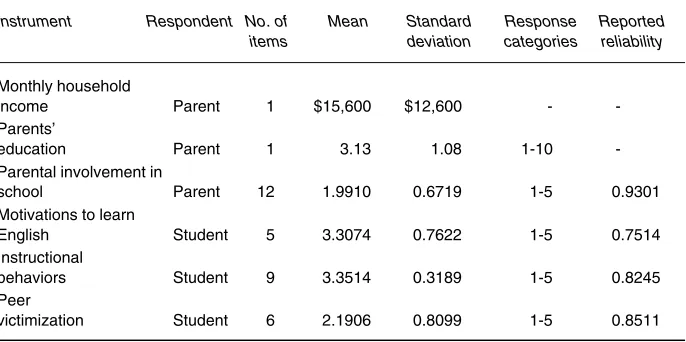
The properties of these instruments, their means and standard deviations, number of items, number of response categories, and reported reliability are summarized in Table 2.
Statistical Model
This study employed a two-level model for statistical analysis (Bryk & Rauden-bush, 1992) using the Hierarchical Linear Modeling 5 developed by Scientific Software International (Bryk, Raudenbush & Congdon, 1996). The perfor-mance of students was considered to be a function of the individual-level and classroom-level variables. A 2-level model was employed because it is assumed that there is an aggregated effect at the classroom level that influences the performance of students and these classroom-level variables may interact with individual- level variables. Thus in each class,
yij = β0j = β1jχ1ij+ … + βkj χkij + rij (1)
variance. An assumption of this model is that the in-class regression coeffi-cients will vary across classes and that this variation will be related to the aggregated level 2 characteristics. For each of the parameters in Equation 1, there is a between-class model:
βkj = γk0 + γk1z1j + … + γkpzpj + ukj (2)
where zpj (p=1, … p class-level variables) represents class characteristics, the βp terms represent coefficients relating level 2 characteristics to in class slopes and will be reported as the fixed part of the model. The parameter ukj is level 2 random error assumed to be normally distributed with mean 0 and finite variance.
The hierarchical linear model normally has a nested structure—individuals nested in social units such as classes. The biggest advantage of a hierarchical model over a single-level model is that in the latter case such as data treated at class level, lower level data will be averaged to provide mean classroom-level scores, hence variations at the lower levels will be totally ignored but in the hierarchical model, variations at all levels are retained.
Results
Table 2 reports the means and standard deviations of the variables. In some of these variables, the means deviate greatly from the conceptual means, some-times close to two standard deviations. These include parental expectation, parental involvement in school, and peer victimization norms. This suggests that parents in Hong Kong in general are not much involved in their children’s schools and that young persons’ norms of peer victimization are not serious. The fact that parents have little involvement in their children’s schooling is considered a normal behavior pattern for Chinese parents. Also, the mean monthly household income of HKD15,600 (approx. US$2,000) is considerably lower than the reported average household income of HKD18,705 in Hong Kong in 2001 (Census and Statistics Department, 2006).
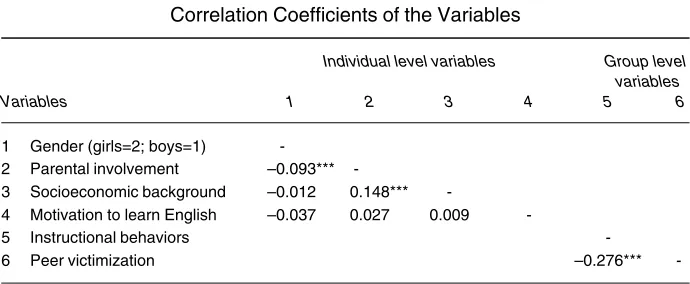
Zero-order correlation was conducted between the variables at the in-dividual level and the group level separately, and these are reported in Table 3.
Table 2
Summary of the Descriptive Properties of the Survey Instruments
Instrument Respondent No. of Mean Standard Response Reported items deviation categories reliability
Monthly household
income Parent 1 $15,600 $12,600 -
-Parents’
education Parent 1 3.13 1.08 1-10
-Parental involvement in
school Parent 12 1.9910 0.6719 1-5 0.9301
Motivations to learn
English Student 5 3.3074 0.7622 1-5 0.7514
Instructional
behaviors Student 9 3.3514 0.3189 1-5 0.8245
Peer
Learning motivation is not significantly related to the socioeconomic back-ground of the family and parental involvement in school. School effectiveness studies have consistently revealed that socioeconomic status is the most impor-tant family background variable (Alexander et al., 1982) and only in develop-ing and less-developed countries is the relationship attenuated (Fuller & Heyneman, 1989). In this study, the lack of contribution of socioeconomic status of the family to the learning motivation of students may suggest that socioeconomic background of the family is closely related to academic achieve-ment, but is not an effective measure for predicting youngsters’ motivation in learning English.
Sex (male=1, female=2) is significantly related to parental involvement. The fact that parents tend to participate more in a boy’s schooling may be explained in two ways. In the same age cohort boys tend to be less mature than girls and hence need more attention from their parents even at the junior secondary level. Also, in a male-dominated society such as China and Hong Kong, parents tend to put more resources into boys’ upbringing than that of girls because boys are the heirs in the family. Finally, instructional behaviors and peer victimization are significantly related to each other. This may suggest a close connection between peer victimization and its negative influence on students’ perception of instructional behaviors, as suggested by social control theory (Hirchi, 1969).
Multilevel Regression: Base Model
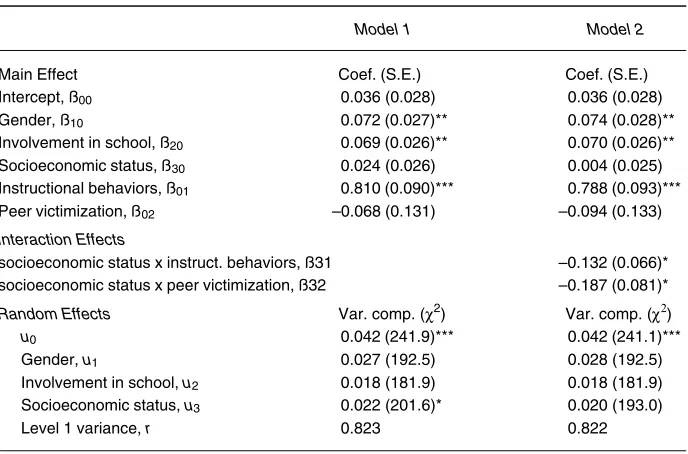
The multilevel analysis of the affective performance of students in English language employed both the family-level variables (SES and parental involve-ment) and classroom-level variables (instructional behaviors and peers’ antiso-cial behaviors) as independent variables, and motivation in learning as the dependent variable. All variables were standardized measures before being entered into the equation. Table 4 (Model 1) shows the result of the basic model without interaction effect, with gender being controlled by including it in the equation.
Main effects. Consistent with the correlation table in Table 3, none of the family variables contributes significantly to learning motivation. Furthermore, the classroom variable that contributes significantly to learning motivation is
Table 3
Correlation Coefficients of the Variables
Individual level variables Group level variables
Variables 1 2 3 4 5 6
1 Gender (girls=2; boys=1)
-2 Parental involvement –0.093***
-3 Socioeconomic background –0.012 0.148***
-4 Motivation to learn English –0.037 0.027 0.009
-5 Instructional behaviors
-6 Peer victimization –0.276***
instructional behaviors. Instructional behaviors contribute positively to learn-ing motivation (β=0.810, p<0.005). These figures show that the support of the English teacher such as in helping students establish learning goals, using interesting ways of presenting the lesson, giving supportive feedback, provid-ing emotional support to the students, and so forth will have an important effect on students’ learning motivation. Peer victimization does not contribute significantly to students’ learning motivation. Because peer victimization is the extent to which a student’s classmates have victimized other students in the current school year aggregated at the class level, it may not have a direct effect on learning. However, the close relationship between peer victimization and instructional behaviors shown in Table 3 suggests that peer victimization norms may have an indirect effect on learning, and this may be an issue that could be explored further.
Random part. The presence of significant contributions in the random part of a multilevel model suggests that there may be subtle relationships between the independent and dependent variables. There may be several reasons for a significant contribution from the random part. Some common reasons are the unequal distribution of variance in the model, unequal distribution of variance among the classes, or a nonlinear relationship between the independent and dependent variables. For example, in Table 4 it is shown that family rela-tionship contributes significantly to learning motivation at the individual level. Yet a significant contribution of socioeconomic background in the random part (r=0.022, χ2=201.97, p<0.05) suggests that the variance of the socioeconomic
background-learning motivation slope is not distributed evenly, and one of the possibilities is that interaction effects may be taking place. Therefore, in the following section, interaction effects of the multilevel regression are explored for those variables that have a significant contribution in the random part.
Multilevel Regression: Interaction Effects
Interaction effects are perhaps more interesting and insightful than the main effect because these show the complex interactions of the various social ecological systems. After adding the interaction terms, the level 1 variance component was reduced from 0.823 to 0.822, which means that only a small portion of the variance is explained by the interaction term. The proportion of variances explained in the final model was 13.1%, 5.1% of which was explained by personal and family-level factors, and 8.0% was classroom-level factors. Table 3 (Model 2) shows the result of the multilevel regression, with interaction between individual level and classroom level included in the analysis.
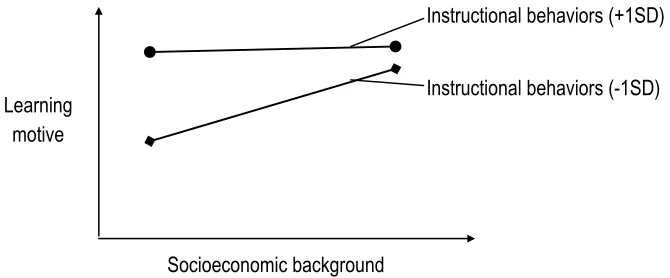
and little emotional support), learning motivation is positively related to the socioeconomic background of the students. However, for classes with strong instructional behaviors, the contribution of socioeconomic background of the students to learning motivations is reduced. In other words, learning motiva-tion can be sustained for students regardless of socioeconomic background if the instructional behaviors are strong.
Interaction of peer victimization with socioeconomic background contrib-utes negatively to learning motivations (β=–0.096, p<0.005). Again this sug-gests that there may be a differential peer victimization effect on family background. Figure 3 is a plot of regression lines for socioeconomic back-ground as a function of learning motivations for students with strong and weak peer victimization norms. The two lines in the plot are two groups of classes with strong and weak peer victimization norms. Although both lines
Table 4
Family and Classroom Effects on Learning Motivation
Model 1 Model 2
Main Effect Coef. (S.E.) Coef. (S.E.)
Intercept, ß00 0.036 (0.028) 0.036 (0.028)
Gender, ß10 0.072 (0.027)** 0.074 (0.028)**
Involvement in school, ß20 0.069 (0.026)** 0.070 (0.026)**
Socioeconomic status, ß30 0.024 (0.026) 0.004 (0.025)
Instructional behaviors, ß01 0.810 (0.090)*** 0.788 (0.093)***
Peer victimization, ß02 –0.068 (0.131) –0.094 (0.133)
Interaction Effects
socioeconomic status x instruct. behaviors, ß31 –0.132 (0.066)* socioeconomic status x peer victimization, ß32 –0.187 (0.081)*
Random Effects Var. comp. (χ2) Var. comp. (χ2)
u0 0.042 (241.9)*** 0.042 (241.1)***
Gender, u1 0.027 (192.5) 0.028 (192.5)
Involvement in school, u2 0.018 (181.9) 0.018 (181.9)
Socioeconomic status, u3 0.022 (201.6)* 0.020 (193.0)
Level 1 variance, r 0.823 0.822
*p<0.05; **p<0.01; *** p<0.005.
Figure 1. Conceptual model of the study.
84
Family processes Parental involvement Socioeconomic background
Motivation to learn English as a second language
Classroom processes Instructional behaviors Peer victimization
Figure 1 Conceptual model of the study
Figure 2. Plot of socioeconomic background against learning motive for good and poor instructional behaviors.
Instructional behaviors (+1SD)
Instructional behaviors (-1SD) Learning
motive
Socioeconomic background
peer victimization (+1SD) peer victimization (-1SD) Learning
motive
Socioeconomic background
Figure 3. Plot of SES against learning motive for classes with strong and weak peer victimization norms.
have positive gradients, the line that represents the weak peer victimization norm has a larger gradient than and is above the line that represents strong peer victimization norms. The explanation for this may be that for classes where there is an absence of the peer victimization norm, a positive contrib-ution of socioeconomic background on students’ learning motivations does exist. However, for classes where the peer victimization norm is strong, the learning atmosphere may be so poor that students’ motivations for learning are much reduced and the expected association between socioeconomic back-ground and learning motivations is significantly reduced.
Discussion
In understanding the learning motivations of children, this study draws on an ecological framework to outline the varied but intertwined ecosystems where family and school interact and reinforce one another in creating a social sup-port system. Multilevel analysis technique is employed to assess the unique and interactive effects of family- and classroom-level variables on the learning motivation of junior secondary students. Two family-level variables and two classroom-level variables are identified as key factors that affect children’s learning motivations and learning strategies.
The findings provided modest support for my hypotheses that the contrib-ution of family processes in students’ affective performance is moderated by the social contexts of the classroom. Socioeconomic background contributed
Figure 2. Plot of socioeconomic background against learning motive for good and poor instructional behaviors.
Figure 3. Plot of SES against learning motive for classes with strong and weak peer victimization norms.
Motivation in Learning a Second Language
85
Parental involvement Socioeconomic background
Motivation to learn English as a second language
Classroom processes Instructional behaviors Peer victimization
Figure 1 Conceptual model of the study
Figure 2. Plot of socioeconomic background against learning motive for good and poor instructional behaviors.
Instructional behaviors (+1SD)
Instructional behaviors (-1SD) Learning
motive
Socioeconomic background
peer victimization (+1SD) peer victimization (-1SD) Learning
motive
Socioeconomic background
Figure 3. Plot of SES against learning motive for classes with strong and weak peer victimization norms.
24 Family processes
Parental involvement Socioeconomic background
Motivation to learn English as a second language
Classroom processes Instructional behaviors
Peer victimization
Figure 1 Conceptual model of the study
Figure 2. Plot of socioeconomic background against learning motive for good and poor instructional behaviors.
Instructional behaviors (+1SD)
Instructional behaviors (-1SD) Learning
motive
Socioeconomic background
peer victimization (+1SD) peer victimization (-1SD) Learning
motive
Socioeconomic background
Figure 3. Plot of SES against learning motive for classes with strong and weak peer victimization norms.
positively to motivations in learning English for students in classrooms with a weak norm of peer victimization, but a strong norm of peer victimization in the classroom tends to weaken this association. In the light of these findings, in the following section, I discuss the unique and interactive contributions of ecologies of family and classroom to student learning. I also consider the implications of these findings for school effectiveness.
Classroom Influences
Consistent with my hypotheses, the effect of teachers’ supportive behaviors has both a direct effect and an interactional effect on students’ learning motiva-tions. Supportive behaviors by teachers tend to benefit everybody in the class-room regardless of their social background. The absence of these supportive behaviors from teachers tends to penalize students coming from low socioeco-nomic backgrounds, causing them to be even more at risk (Slavin, Karweit, & Madden, 1989). This finding is consistent with the school effectiveness litera-ture that indicates that schools seem to play a more significant role in improv-ing the learnimprov-ing opportunities of students comimprov-ing from disadvantaged families than those coming from mainstream families (Teddlie, Stringfield, & Reynolds, 2000).
Contrary to common expectations but confirming my hypotheses, the norm of peer victimization in the classroom has no direct effect on students’ affective performance, but its effect on students’ motivation for learning English is only indirect through interaction with their social background. This study provides evidence to support the fact that the peer victimization norms moderate the relationship between students’ socioeconomic background and their motiva-tion for learning English. The contribumotiva-tion of peer victimizamotiva-tion norm as a classroom-level variable is important because most of the existing studies tend to treat peer victimization as an individual-level variable, and seldom use it at the group level to predict individual outcomes, ignoring the effects of be-havioral norms on the learning atmosphere of the classroom (Bellmore et al., 2004).
On the whole, the findings of this study are consistent with the person-en-vironment fit hypotheses that strain will probably develop when there is dis-sonance between environmental opportunities and demands and the temperament of the person (East, 1987). The findings demonstrate that certain classroom social contexts such as teachers’ supportive behaviors are more conducive to a normative relationship between family processes and learning outcomes, whereas other contexts such as peer victimization norms are less conducive to such a relationship.
Family Influences
The absence of a direct association between socioeconomic background and students’ learning motivation but the presence of moderating effects of class-room social contexts on their relationship suggests that the effect of socioeco-nomic background on students is both profound and subtle. It has been shown that the contribution of socioeconomic level of family is responsible for only 10% of the behavioral and academic difficulties of children (Lipman, Offord, & Boyle, 1995). In other words, even if family poverty were eliminated, there would only be a maximum of 10% reduction in the number of children experi-encing difficulties in schools. Hence the findings of this study suggest that the social contexts of a classroom may pose a bigger risk than socioeconomic background to the affective performance of students.
Implications
In the light of the fact that teachers’ instructional behaviors and peer victimiza-tion norms have moderating effects on the contribuvictimiza-tion of family processes to students’ learning motivation, teachers and school administrators should pay more attention to the social lives of students in the classroom. In particular, effective measures should be implemented to ensure that the classroom is free of aggression and victimization, and education programs should be designed to help students develop a prosocial attitude and positive peer relationships. Also, preservice and inservice teacher training programs should pay more attention to enabling teachers to develop instructional skills that are conducive to learning motivation, as well as skills in classroom management and ways of developing a supportive and nurturing relationship with the students.
Limitations
be-cause this study is an ex post facto design using a cross-sectional survey method to investigate an interactional phenomenon, the prediction power is severely limited and no causal relationship can be inferred (Kerlinger & Lee, 2000).
References
Alexander, K.L., Riordan, C., Fennessey, J., & Pallas, A.M. (1982). Social background, academic resources, and college graduation: Recent evidence from the National Longitudinal Survey. American Journal of Education, 90, 315-333.
Ames, C. (1992). Classrooms: Goals, structures and student motivation. Journal of Educational Psychology, 84, 261-271.
Barth, J.M., Dunlap, S.T., Dane, H., Lochman, J.E., Wells, K.C. (2004). Classroom environment influences on aggression, peer relations, and academic focus. Journal of School Psychology, 42, 115-133.
Bellmore, A.D., Witkow, M.R., Graham, S., & Juvonen, J. (2004). Beyond the individual: The impact of ethnic context and classroom behavioral norms on victims’ adjustment. Developmental Psychology, 40, 1159-1172.
Belsky, J. (1980). Child maltreatment: An ecological integration. American Psychologist, 35, 320-335. Berger, C.R., & Bradace, J.J. (1982). Language and social knowledge: Uncertainty in interpersonal
relations. London: Edward Arnold.
Berry, V., & McNeill, A. (2005). Raising English language standards in Hong Kong. Language Policy, 4, 371-394.
Biggs, J.B. (1979). Individual differences in study processes and the quality of learning outcomes. Higher Education, 8, 381-394.
Biggs, J.B. (1992). Why and how do Hong Kong students learn? Using the Learning and Study Process Questionnaires. Education Paper 14, Faculty of Education, University of Hong Kong. Biggs, J.B. (1996). Western misperceptions of the Confucian-heritage learning culture. In D.A.
Watkins & J.B. Biggs (Eds.), The Chinese learner: Cultural, psychological and contextual influences (pp. 45-67). Hong Kong: Comparative Education Research Centre.
Bourdieu, P. (1986). The forms of capital. In J. Richardson (Ed.), Handbook of theory and research for the sociology of education (pp. 241-258). New York: Greenwood.
Bronfenbrenner, U. (1979). The ecology of human development. Cambridge, MA: Harvard University Press.
Brophy, J., & Good, T. (1974). Teacher-student relationships: Causes and consequences. New York: Holt, Rinehart and Winston.
Bryk, A.S., Raudenbush, S.W. (1992). Hierarchical linear models: Applications and data analysis methods. Newbury Park: Sage.
Bryk, A.S., Raudenbush, S.W., & Congdon, R. (1996). Hierarchical linear and nonlinear modeling with the HLM/2L and HLM/3L programs. Chicago, IL: Scientific Software International, Inc. Carkin, S. (2005). English for academic purposes. In E. Hinkel (Ed.), Handbook of research in second
language teaching and learning (pp. 85-98). Mahwah, NJ: Erlbaum.
Census and Statistics Department. (2006). Domestic households by monthly domestic household income, 1991-2001. Government of Hong Kong Special Administrative Region.
Chang, L. (2004). The role of classroom norms in contextualizing the relations of children’s social behaviors to peer acceptance. Developmental Psychology, 40, 691-702.
Coleman, J.S., & Hoffer, T. (1987). Public and private high schools. New York: Basic Books.
Dörnyei, Z. (2000). Motivation in action: Towards a process-oriented conceptualization of student motivation. British Journal of Educational Psychology, 70, 519-538.
Dörnyei, Z. (2001). Teaching and researching motivation. Harlow, UK: Pearson Educational. Duncan, G.J., & Brooks-Gunn, J. (Eds.). (1997). Consequences of growing up poor. Russell Sage
Foundation.
Duncan, G.J., Brooks-Gunn, J., & Klebanov, P.K. (1994). Economic deprivation and early childhood development. Child Development, 65, 296-318.
East, P.L. (1987). Social processes in early adolescents’ adjustment: Adolescent-peer group fit, peer relations, and peer social support (temperament). Unpublished doctoral dissertation, Pennsylvania State University.
Eccles, J.S. (1993). School and family effects on the ontogeny of children’s interests,
Eccles, J.S., Wigfield, A., & Schiefele, A. (1998). Motivation to succeed. In W. Damon & N. Eisenberg (Eds.), Handbook of child psychology (5th ed., pp. 1017-1095). New York: John Wiley & Sons.
Education Commission. (2005). Review of medium of instruction for secondary school and secondary school place allocation. Available:
http://www.e-c.edu.hk/eng/reform/resources/full_version-eng(27%20Jan)- FINAL.pdf, February 2005
Ellis, R. (1992). Second language acquisition and language pedagogy. Philadelphia, PA: Multilingual Matters.
Epstein, J. (1995). School, family and community partnerships: Caring for the children we share. Phi Delta Kappan, 76, 701-712.
Epstein, J. (2001). School, family and community partnerships: Preparing educators and improving schools. Boulder, CO: Westview Press.
Fuller, B., & Heyneman, S.P. (1989). Third-world school quality: Current collapse, future potential. Educational Researcher, 18(3), 12-19.
Gardner, R.C. (1985). Social psychology and second language learning. London: Edward Arnold. Garrett, P., Ng’andu, N., & Ferron, J. (1994). Poverty experiences of young children and the
quality of their home environments. Child Development, 65, 331-345.
Gonzalez-Pienda, J.A., Nuñez, J.C., Gonzalez-Pumariega, S., Alvarez, L., Roces, C., García, M. (2002). A structural equation model of parental involvement, motivational and aptitudinal characteristics, and academic achievement. Journal of Experimental Education, 70, 257-287. Hickey, D.T. (1997). Motivation and contemporary socio-constructivist instructional perspectives.
Educational Psychologist, 32, 175-193.
Hirchi, T. (1969). Causes of delinquency. Berkeley, CA: University of California Press.
Ho, S.C. (1995). Comparison of different definition and impact of parental involvement. CUHK Education Journal, 23(1), 38-68.
Ho, S.C., & Willms, J.D. (1996). Effects of parental involvement on eighth grade achievement. Sociology of Education, 69(1), 126-141.
Hoglund, W.L., & Leadbeater, B.J. (2004). The effects of family, school, and classroom ecologies on changes in children’s social competence and emotional and behavioral problems in first grade. Developmental Psychology, 40, 533-544.
Hokoda, A., & Fincham, F.D. (1995). Origins of children’s helpless and mastery achievement patterns in the family. Journal of Educational Psychology, 87, 375-385.
Huston, A.C. (1991). Children in poverty: Child development and public policy. New York: Cambridge University Press.
Kennedy, E., & Mandeville, G. (2000). Some methodological issues in school effectiveness research. In C. Teddlie & D. Reynolds (Eds.), The international handbook of school effectiveness research (pp. 189-205). London: Falmer Press.
Kerlinger, F.N., & Lee, H.B. (2000). Foundations of behavioral research (4th ed.). Fort Worth, TX: Harcourt College Publishers.
Klebanov, P.K., & Brooks-Gunn, J. (1992). Impact of maternal attitudes, girls’ adjustment, and cognitive skills upon academic performance in middle and high school. Journal of Research on Adolescence, 2, 81-102.
Lareau, A. (2003). Unequal childhood: Class, race and family life. Berkeley, CA: University of California Press.
Lin, A. (2006). Beyond linguistic purism in language-in-education policy and practice: Exploring bilingual pedagogies in a Hong Kong science classroom. Language and Education, 20, 287-305. Lipman, E., Offord, D., and Boyle, M. (1995). What if we could eliminate child poverty? The
theoretical effect on child psychosocial morbidity. Social Psychiatry Epidemiology, 31, 303-307. Marsh, J., Hau, K.T., & Kong, C.K. (2002). Multilevel causal ordering of academic self-concept
and achievement: Influence of language of instruction (English compared with Chinese) for Hong Kong students. American Educational Research Journal, 39, 727-763.
Ng, S.W. (2006). The micro-politics of home-school collaboration: Power! Instruments! Partners! HK Educational Research Journal, 21(1), 131-151.
Olson, D.H. (1995). Family systems: Understanding your roots. In R.D. Day, K.F. Gilbert, B.H. Settles, & W.R. Burr (Eds.), Research and theory in family sciences (pp. 131-153). Pacific Grove, CA: Brooks/Cole.
Osborne, J.W. (2001). Unraveling underachievement among African-American boys from an identification with academics perspective. Journal of Negro Education, 68, 555-565. Osborne, J.W. (2004). Identification with academics and violence in schools. In E.R. Gerler, Jr.
Parcel, T.L., & Dufur, M.J. (2001). Capital at home and at school: Effects on student achievement. Social Forces, 79, 881-912.
Patterson, G.R., & Dishion, T.J. (1985). Contributions of families and peers to delinquency. Criminology, 23(1), 63-79.
Pintrich, P.R. (2004). A conceptual framework for assessing motivation and self-regulated learning in college students. Educational Psychology Review, 16, 385-407.
Reynolds, A.J., & Walberg, H.J. (1992). A structural model of science achievement and attitude: An extension to high school. Journal of Educational Psychology, 84, 371-382.
Riordan, C. (1997). Equality and achievement: An introduction to the sociology of education. New York: Longman.
Slavin, R.E., Karweit, N.L., & Madden, N.A. (1989). Effective programs for students at-risk. Boston, MA: Allyn and Bacon.
Suárez-Orozco, C., & Suárez-Orozco, M. (1995). Transformation: immigration, family life, and achievement motivation among Latino adolescents. Stanford, CA: Stanford University Press. Tam, W.M. (in press). The effect of peer victimization on learning: Evidences from Hong Kong.
Journal of School Violence, 7.
Teddlie, C., Stringfield, & Reynolds, D. (2000). Context issues within school effectiveness research. In C. Teddlie & D. Reynolds (Eds.), The international handbook of school effectiveness research. London: Falmer Press.
Wang, M.C., Haertal, G.D., & Walberg, H.J. (1990). What influences learning? A content analysis of review of literature. Journal of Educational Research, 84, 30-43.
Watkins, D. (1996). Learning theories and approaches to research: A cross-cultural perspective. In D.A. Watkins & J.B. Biggs (Eds.), The Chinese learner: Cultural, psychological and contextual influences. Hong Kong: Comparative Education Research Centre.
Wentzel, K.R. (1999). Social-motivational processes and interpersonal relationships: Implications for understanding motivation at school. Journal of Educational Psychology, 91, 176-197. Wigfield, A., & Eccles, J.S. (1992). The development of achievement task values: A theoretical
analysis. Developmental Review, 12, 265-310.
Wright, J.C., Gianmarino, M., & Parad, H.W. (1986). Social status in small groups:
Individual-group similarity and the social “misfit.” Journal of Personality and Social Psychology, 50, 523-536.
Zusho, A., Pintrich, P.R., & Cortina, K.S. (2005). Motivations, goals, and adaptive patterns of performance in Asian American and Anglo American students. Learning and Individual Differences, 15, 141-158.
Appendix Survey Instruments Students’ Learning Motivation in English
I find that learning English can give me a feeling of satisfaction. When I am engaged, the learning of English will become interesting.
I found some of the topics in English Language really excite me and cause me to spend time in learning. I think my English teacher should help me develop my own way of seeing things.
Even when other people may know more than myself, I should still say what I think is right. Parental Involvement in School
I will participate in the seminars organized by the PTA. I will participate in the volunteer work of the school.
I will participate in the parent-child activities organized by the PTA. I will participate in the annual meeting of the PTA.
I will participate in the work of the PTA committee. I will participate in parent consultation meetings. I will voice out my opinions about operations of the school.
Teachers’ Instructional Behavior
Our English teacher helps us set learning targets.
Our English teacher designs class work to enable students to apply knowledge.
Other than normal direct instruction, our English teacher uses a variety of instructional approaches to teach us. Our English teacher delivers the lesson in a lively manner.
Our English teacher encourages students who have made progress. Our English teacher reminds us to examine our learning methods. Our English teacher gives feedback to us about our progress. Our English teacher is very patient when teaching us. Our English teacher allows sufficient time to teach each lesson.
Peer Victimization
Threaten fellow classmates