e-ISSN: 2278-067X, p-ISSN: 2278-800X, www.ijerd.com
Volume 10, Issue
8
(
August
2014), PP.01-09
Hardened Properties of Concretes made with Micro Silica and
Alccofine-A Performance Optimization based Comparative Study
1
Praveen Nayak S,
2H. S. Narashimhan,
3Raghunandan V.Kadaba,
1PG Student, Department of Civil Engineering, Malnad College of Engineering (VTU), Hassan-573201, India
2Associate Professor, Department of Civil Engineering, Malnad College of Engineering
(VTU), Hassan-573201, India
3Manager, Civil-Aid Techno clinic Private Limited, A Bureau Veritas Group Company
Banasshankari 2nd stage, Bangaluru- 570070, India
Abstract:- Large scale production of cement is causing environmental problem on one hand and depletion of
natural resources on the other hand. This threat to ecology has lead to research to use industrial byproducts as supplementary cementitous materials in making concrete.
In the present study, an attempt has been made to investigate the hardened properties of concrete by using micro silica and alccofine in varied proportions. The main parameters investigated in this study is addition of micro silica and alccofine, by keeping maximum cement content 450kg constant and water content constant 144 kg for all mixes. The slump of concrete was practically kept around 100 ± 10mm for all the concrete mixes considered in this study. Both Micro Silica as well as Alccofine were added to concrete mixes in the following incremental proportions as addition to cement content, namely by 0.0, 3.34, 6.68, 10.02, 13.36 and 16.70% respectively. This thesis presents a detailed comparative experimental study using micro silica and alccofine, on hardened properties like compressive strength, flexural strength, splitting tensile strength and impact test.
Keywords:- Micro Silica, Alccofine, Hardened concrete properties, dosage, flexural strength, impact test.
I.
INTRODUCTION
Concrete is an artificial conglomerate stone made essentially of Portland cement, water, and aggregates. While cement in one form or another has been around for centuries, the type we use was invented in 1824 in Britain. Producing one tonne of cement requires about 2 tonnes of raw materials and releases 0.95tonne (≈ 1 tonne) of CO2. The global release of CO2 from all sources is estimated at 23 billion tonnes a year and the
Portland cement production accounts for about 7% of total CO2 emissions.
Supplementary Cementitious Materials (SCM)
In its most basic form, concrete is a mixture of Portland cement, sand, coarse aggregate and water. The principal cementitious material in concrete is Portland cement. Today, most concrete mixtures contain supplementary cementitious materials that make up a portion of the cementitious component in concrete. These materials are generally by products from other processes or natural materials. They may or may not be further processed for use in concrete. Some of these materials are called pozzolans, which by themselves do not have any cementitious properties, but when used with Portland cement, react to form cementitious compounds. Other materials, such as slag, do exhibit cementitious properties. For use in concrete, supplementary cementitious materials, sometimes referred to as mineral admixtures, need to meet requirements of established standards. They may be used individually or in combination in concrete. They may be added to the concrete mixture as blended cement or as a separately batched ingredient at the ready mixed concrete plant.
Some examples of these materials are listed below.
Fly Ash
GGBS(Ground Granulated Blast Furnace Slag)
Metakoline
Micro Silica
Alccofine
II.
EXPERIMENTAL PROGRAM
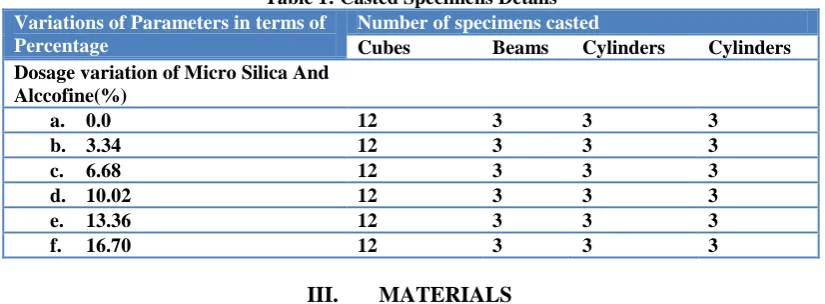
The aim of the experimental program is to compare the properties of concrete made with microsilica and alccofine, used as supplementary cementing materials. The various tests performed on concrete samples are discussed in this chapter, followed by a brief description about mixture proportion design and curing procedure adopted. Following mechanical properties of concrete have been discussed: mechanical properties such as hardening properties compressive strength, flexural strength, splitting tensile strength, impact resistance. Cubes of 150mm size was used for compressive test, beam 700mmx150mm was used foe flexural strength, cylinders of 150mm diameter and 300mm length for split tensile test and 150mm diameter and 64mm length for impact resistance test were casted. All the specimens were water cured for 28 days at room temperature and were tested in surface dry condition. Each value of the results presented in this paper is the average of three test samples.
Table 1: Casted Specimens Details Variations of Parameters in terms of
Percentage
Number of specimens casted
Cubes Beams Cylinders Cylinders
Dosage variation of Micro Silica And Alccofine(%)
a. 0.0 12 3 3 3
b. 3.34 12 3 3 3
c. 6.68 12 3 3 3
d. 10.02 12 3 3 3
e. 13.36 12 3 3 3
f. 16.70 12 3 3 3
III.
MATERIALS
This section will present the chemical and physical properties of the ingredients. Bureau of Indian Standards (IS) and American Society (ASTM) procedures were followed for determining the properties of the ingredients in this investigation.
A. Cement: Ordinary Portland cement 53 grade of ACC brand was used corresponding to IS standards. The
specific gravity of cement was 3.15
B. Fine Aggregate: The sand used for this study was natural river sand. The sand passing through 4.75mm sieve was used. The sand conforms to grading Zone II as per IS: 383-1970(Reaffirmed 2011).
C. Coarse Aggregate: Crushed granite stones of size 20mm and 12.5mm with equal proportions were used as
coarse aggregate.
Table 2: Characteristics of Fine Aggregate
1. Specific gravity 2.61
2. Water absorption 1.96
3. Sieve Analysis
IS Sieve Designation
Qty. retained
Cumulative % Requirement as per
IS:383-1970(Reaffirmed 2011)
Retained Passing Zone II
4.75mm 0.050 5.0 95.0 90-100
2.36mm 0.095 14.5 85.5 75-100
1.18mm 0.252 39.7 60.3 55-900
600 micron 0.193 59.0 41.0 35-59
300micron 0.278 86.8 13.2 8-30
Table 3: Combined Sieve Analysis of 20mm and 12.5mm Coarse Aggregate
1. Shape Angular
2. Specific gravity 2.69
3. Water absorption 0.2
4. Sieve analysis:
Cumulative sieve size(mm)
Cumulative % passing 20mm
Cumulative % passing 12.5mm
Cumulative % passing when 20mm and 12.5mm
are mixed in the ratio 50:50
Requirements of cumulative % passing for 20 mm graded aggregates
as per
IS:383-1970(RA 2011)
40 mm 100.0 100.0 100.0 100
20 mm 90.90 100.0 95.5 95-100
12.5 mm 2.30 90.6 46.5 -
10 mm 0.0 57.0 28.5 25-55
4.75 mm 0.0 0.0 0.0 0-10
D. Micro Silica: Micro silica also called as silica fume, is another material that is used as an artificial pozzolanic admixture. It is a product resulting from reduction of high purity quartz with coal in an electric arc furnace in the manufacture of silicon or ferrosilicon alloy. Silica fume rises as an oxidised vapour. It cools, condenses and is collected in cloth bags.
Table 4: Laboratory test results on Silica fume(Micro Silica) Physical and Chemical properties.
Chemical Test Physical Test
Parameters tested Test conducted (% by mass)
Requirements As per IS 15388:2003
Parameters tested Test
conducted
Requirements As per IS 15388:2003 SiO2 content 93.80 85 min. Specific gravity 2.11 Not Specified
CaO content 1.52 Not specified Fineness as surface area, m2/kg
21000 15000 min
Moisture content 0.68 3.0 max. Compressive strength at 7 days as % over control sample
106 85 min.
Loss of Ignation 1.02 4.0 max Over size percent retained on 45nmicron IS sieve
0.2 10 max
Total Alkalis( as Na2O Equivalent)
1.02 1.5 max
Alumina 1.17 Not specified Lime Pozzalanic test 16.5 ASTM C 593
Iron Oxide 0.84 Not specified
E. Alccofine: Alccofine is obtained by quenching molten iron slag (a byproduct of iron and steel-making) from a blast furnace in water or steam, to produce a glassy, granular product that is then dried and ground into a fine powder.
Table 5: Laboratory test results on Alccofine Physical and Chemical properties.
Chemical Test Physical Test
Parameters tested Test
conducted
Requirements As per
Parameters tested Test
conducted
Requirement s As per SiO2 content (% by
mass)
31.34 85 min.
IS 4032:1985
Specific gravity 2.86 IS 1727:1967
CaO content(% by mass)
31.97 Not specified Fineness as surface
area, m2/kg
13000 Not specified
Moisture content(% by mass)
0.12 1.0
BS 6699:1992
Compressive strength at 7 days as % over control sample
105 85
IS
BS 6699:1992 Over size percent retained on 45nmicron IS sieve
1 ASTM C
1240 Total Alkalis( as
Na2O Equivalent)
(% by mass)
0.65 1.5 max
IS 4032:1985
Chloride(% by mass) 0.014 0.10max
BS 6699:1992 Lime pozzalainc
test
15.5 ASTM C 593
Iron Oxide(% by mass)
1.40 Not specified
F. Water: potable water is used for mixing and curing of the concrete mixes. The properties of water are tabulated below;
Table 6: Water Properties Sl.
No.
Particulars Constituents
determined
Stipulations of IS:456-2000 (Reaffirmed in 2011)
1. Qty. of 0.02 N NaOH required to
neutralize 100 ml. water using phenolphthalein as an indicator.
0.5 ml Shall not be more than
5 ml.
2. Qty. of 0.02 H2 SO4 required to
neutralize 100 ml. of water sample using mixed indicator.
22.0 ml Shall not be more than
25 ml.
3. Inorganic Solids 340.88 mg/l 3000 max.
4. Sulphates as SO4 24.0 mg/l 500 max.
5. Chlorides as Cl 48.6 mg/l 500 max. for RCC
2000 max. for PCC
6. Suspended Solids 48.0 mg/l 2000 max.
7. Organic Solids 197.0 mg/l 200 max.
8. pH Value 7.80 Shall not be less than 6
E. Chemical Admixture: Super plasticizer of normal type high range water reducer of BASF Glenium B233,
was used to increase the workability. The optimum dosage of super plasticizer was around 0.4-1.5% per bag of cement which has been determined by using marsh cone test and physical test on admixtures.
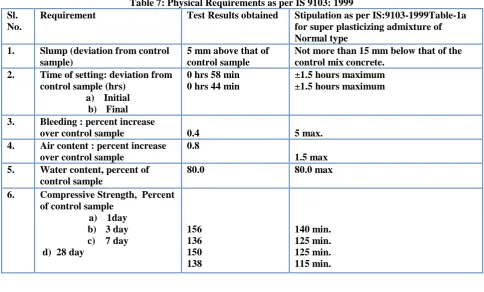
Table 7: Physical Requirements as per IS 9103: 1999 Sl.
No.
Requirement Test Results obtained Stipulation as per IS:9103-1999Table-1a
for super plasticizing admixture of Normal type
1. Slump (deviation from control
sample)
5 mm above that of control sample
Not more than 15 mm below that of the control mix concrete.
2. Time of setting: deviation from
control sample (hrs) a) Initial
b) Final
0 hrs 58 min 0 hrs 44 min
±1.5 hours maximum ±1.5 hours maximum
3. Bleeding : percent increase
over control sample 0.4 5 max.
4. Air content : percent increase
over control sample
0.8
1.5 max
5. Water content, percent of
control sample
80.0 80.0 max
6. Compressive Strength, Percent
of control sample
a) 1day
b) 3 day
c) 7 day
d) 28 day
7. Flexural Strength, Percent of control sample
e) 3 day f) 7 day g) 28 day
125 125 115
110 min. 100 min. 100 min.
8. Length change, percent
increase over control sample (28 days)
0.000 0.010 max.
IV
MIX PROPORTIONS (IS 10262:2009)
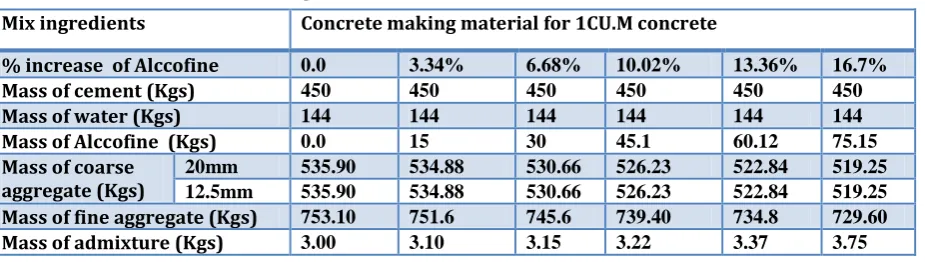
Note: Mass of cement 450 kg/m3 and mass of water 144 kg/m3 were kept as constant for all the mixes. All
the mixes are designed in order to achieve a slump of 100 mm ± 10 mm.
Table 8: Design mix with addition of different % of Alccofine.
Table 9: Design mix with addition of different % of Micro Silica.
V.
DISCUSSION ON RESULTS
The test on hardened concrete was carried out according to the relevant standards wherever applicable. Experimental resultsobtained are tabulated and are used for discussion.
1. Test for Compressive Strength, Technical Reference: IS: 516 – 1959 (Reaffirmed 2013) Mix ingredients Concrete making material for 1CU.M concrete
% increase of Alccofine 0.0 3.34% 6.68% 10.02% 13.36% 16.7%
Mass of cement (Kgs) 450 450 450 450 450 450
Mass of water (Kgs) 144 144 144 144 144 144
Mass of Alccofine (Kgs) 0.0 15 30 45.1 60.12 75.15
Mass of coarse aggregate (Kgs)
20mm 535.90 534.88 530.66 526.23 522.84 519.25
12.5mm 535.90 534.88 530.66 526.23 522.84 519.25
Mass of fine aggregate (Kgs) 753.10 751.6 745.6 739.40 734.8 729.60
Mass of admixture (Kgs) 3.00 3.10 3.15 3.22 3.37 3.75
Mix ingredients Concrete making material for 1CU.M concrete
% increase of Micro Silica 0.0 3.34% 6.68% 10.02% 13.36% 16.7%
Mass of cement (Kgs) 450 450 450 450 450 450
Mass of water (Kgs) 144 144 144 144 144 144
Mass of Micro Silica (Kgs) 0.0 15 30 45.1 60.12 75.15 Mass of coarse
aggregate (Kgs)
20mm 535.90 532.52 526.44 520.51 511.44 507.9
12.5mm 535.90 532.52 526.44 520.51 511.44 507.9
Mass of fine aggregate (Kgs) 753.10 748.20 739.8 731.4 718.60 713.8
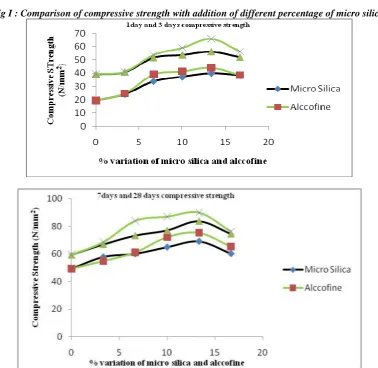
Table10:Variation of compressive strength with addition of different percentage of micro silica
% Variation of cementitious materials
Compressive Strength (N/ mm2)
Micro Silica (No of days) Alccofine (No of days)
1 day 3 days 7 days 28 days 1 days 3 days 7 days 28 days
0.0 19.5 39.3 49.2 59.2 19.5 39.3 49.2 59.2
3.34 24.3 40.9 57.8 66.8 24.8 41.0 54.8 68.5
6.68 34.0 51.8 60.1 73.3 39.0 53.7 61.1 84.1
10.02 37.4 53.8 64.9 77.1 41.3 59.0 72.2 87.1
13.36 40.0 56.3 69.1 83.8 44.1 65.8 75.3 90.1
16.7 38.5 52.1 60.2 74.5 38.5 56.2 65.2 76.2
Fig I : Comparison of compressive strength with addition of different percentage of micro silica.
2. Flexural Strength, Technical Reference: IS: 516 – 1959 (Reaffirmed 2013)
Table10:Comparison of flexural strength between different percentage Micro Silica and Alccofine.
Sl.no % increase of cementitious materials
Flexural Strength(N/mm2)
Micro Silica Alccofine
1. 0.0 5.5 5.5
2. 3.34 6.5 6.9
3. 6.68 7.1 8.1
5. 13.36 7.9 8.8
6. 16.7 7.0 7.8
Fig II: Comparison of flexural strength between different percentage Micro Silica and Alccofine.
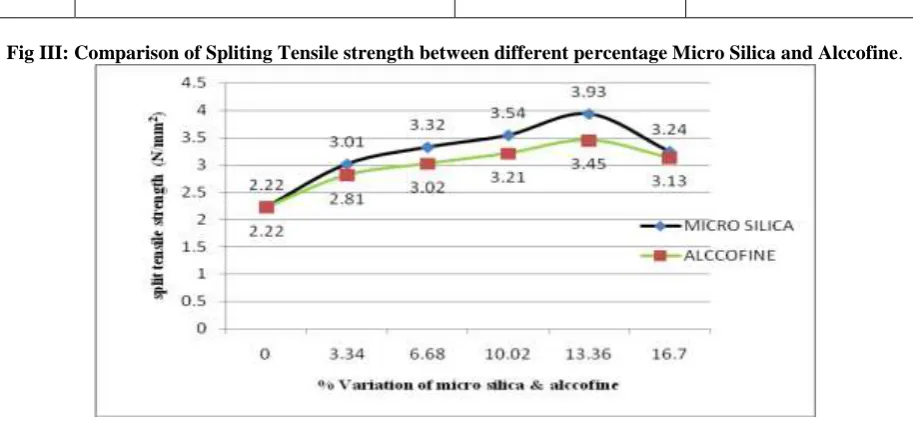
3. Splitting Tensile Strength of Concrete, Technical Reference IS 5816: 1999(Reaffirmed2103)
Table 11: Comparison of splitting strength between different percentage Micro Silica and Alccofine.
Sl.no % increase of cementitious materials
Splitting Tensile Strength (N/mm2)
Micro Silica Alccofine
1. 0.0 2.22 2.22
2. 3.34 3.01 2.81
3. 6.68 3.32 3.02
4. 10.02 3.54 3.21
5. 13.36 3.93 3.45
6. 16.7 3.24 3.13
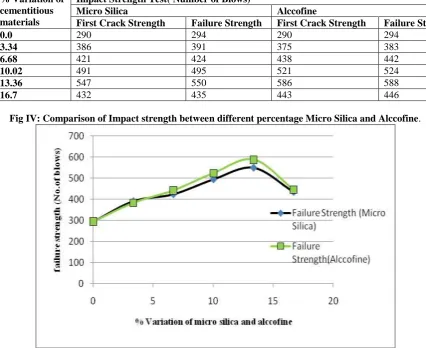
4. Impact Test (drop-weight test), FRC under Fatigue and Impact Loading, Laboratory Development Method
The number of blows that causes first crack is recorded as first crack strength; the number of blows that causes disc to fail is recorded as failure strength at 28 days.
Table 12. Comparison of Impact strength between different percentage Micro Silica and Alccofine.
% Variation of cementitious materials
Impact Strength Test( Number of Blows)
Micro Silica Alccofine
First Crack Strength Failure Strength First Crack Strength Failure Strength
0.0 290 294 290 294
3.34 386 391 375 383
6.68 421 424 438 442
10.02 491 495 521 524
13.36 547 550 586 588
16.7 432 435 443 446
Fig IV: Comparison of Impact strength between different percentage Micro Silica and Alccofine.
VI. CONCLUSION
Following are the observations made from the study of using micro silica and alccofine in concrete.
From the above study, it can be inferred based on
The compressive strength, flexural strength, splitting tensile strength and impact strength test results that both micro silica and alccofine when added to concrete,exhibit maximum values of each property at around 13.36% addition level beyond which, further addition tends to reduce the performance of concrete with respect to mentioned properties.
Compresive strengths of alccofine are better than micro silica at the same addition level of concretes.Compressive strength increases with addition of micro silica and alccofine upto 13.36% addition level/replacement level and then starts decreasing.
Flexural strengths performance of alccofine is higher than the micro silica. The optimized content of both micro silica and alccofine was found to be at around 13.36% addition level based on the study.
The behavior of splitting tensile strengths of concrete with micro silica is better compared to concrete with alccofine at the same addition level.
REFERENCES
[1]. Dilip Kumar Singha Roy, Amitava Sil, “Effect of Partial Replacement of Cement by Silica Fume on Hardened Concrete”, International Journal of Emerging Technology and Advanced Engineering, ISSN 2250-2459, Volume 2, Issue 8, August 2012.
[2]. Nausha Asrar, Anees U. Malik, et al., “Corrosion studies on micro silica added cement in marine environment”, Research& Development Centre, Saline Water Conversion CorporationP, Kingdom of Saudi Arabia.
[3]. B. Sabet Divsholi, B. Kondraivendhan, et al., “effect of ultra fine slag replacement on durability and mechanical properties of high strength concrete”, 36th Conference on Our World in Concrete & Structures Singapore, August 14-16, 2011.
[4]. M. Shariq, J. Prasad, A.K. Ahuja, “Strength development of cement mortar and concrete incorporating GGBFS”, Asian journal of civil engineering vol.9 2008 pp.61-74.
[5]. Venu malagavelli, “ High performance concrete with ggbs and robo sand”, Department of Civil Engineering, BITS, Pilani Hyderabad ,International Journal of Engineering Science and Technology, Vol. 2(10), 2010, 5107-5113.
[6]. Mohammad Abdur Rashida, Mohammad Abul Mansurb“Considerations in producing high strength concrete”,Journal of Civil Engineering (IEB), 37(1) (2009) 53-63.
[7]. Impact Test (drop-weight test), FRC under Fatigue and Impact Loading, Laboratory Development Method (Fiber Reinforced cement composites, Perumal swamy N Balaguru and Surendra P Shah, MCGraw Hill International Editions; Civil Engineering series 1992).
[8]. M.S. Shetty, “Concrete Technology: Theory and Practice”, published by S.Chand and Co Ltd, (Reprint 2008).
[9]. Neville A.M., “Properties of concrete”, Third edition, 1981, ELBS, London.
[10]. IS 456:2000, “Plain and Reinforced concrete-code of practice”, BIS, New Delhi, India.