Volume 3 Issue 1 – March 2015 8 ISSN : 2319-6319
Voice based Wheel Chair for Physically
Challenged
Ravi Teja Ch.V
Assistant professorDepartment of Electronics and Communication Engineering Anurag college of engineering, hyderabad, Telangana, India
P.Shekar
B.Tech. StudentDepartment of Electronics and Communication Engineering Anurag college of engineering, hyderabad, Telangana, India
S.Roja
B.Tech. StudentDepartment of Electronics and Communication Engineering Anurag college of engineering, hyderabad, Telangana, India
S.Hariprasad Reddy
B.Tech. StudentDepartment of Electronics and Communication Engineering Anurag college of engineering, hyderabad, Telangana, India
Y.Bhargavi
B.Tech. StudentDepartment of Electronics and Communication Engineering Anurag college of engineering, hyderabad, Telangana, India
Abstract- Physically challenged and old people those who face many problems in life have to be dependent on a third person to move from one place to another. Many scientists have been working for this solution for a long time. The invention of wheel chair is a great boon to them but it still restricts their motion. In order to make their life a bit easier, many developments in wheel chairs came into existing such as electric-powered, gesture based etc.,. Voice controlled wheel chair can be made using HM2007 voice recognition kit.
Keywords: P89V59RD2BN microcontroller, wheelchair, motors, HM2007 voice recognition kit.
I.INTRODUCTION
The main objective is to designa system which provides solution for the physically handicapped (challenged) people those who can’t move by themselves, using speech commands by interfacing the Speech Recognition kit (HM2007) with microcontroller and wheel chair.
The voice commands are given to the speech recognition kit with the help of mic and the wheel chair moves according to the given directions. The movement of the wheelchair is controlled by the motors and motor drivers connected to the wheels of the chair. The interfacing between speech recognition kit and motors is done by microcontroller. Here in this project the microcontroller used is P89V51RD2BN. This concept was taken in this paper to reduce the human efforts in driving a wheelchair.
Volume 3 Issue 1 – March 2015 9 ISSN : 2319-6319 A. Block Diagram–
The main objective is to designa system which provides solution for the physically handicapped (challenged) people those who can’t move by themselves, using speech commands by interfacing the Speech Recognition kit (HM2007) with microcontroller and wheel chair. The Mic is provided to the person sitting on the wheel chair.HM2007 speech recognition kit registers the commands and forward them to the microcontroller. Microcontroller takes commands from speech recognition kit and passes them to the motor drivers. Motor driver receives the commands from microcontroller P89V51RD2BN and moves the motors according to them. The motors are connected to the wheels of wheelchair.
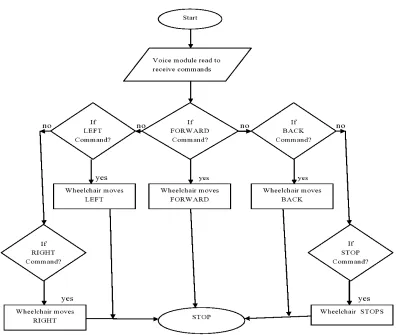
B. Algorithm steps–
The working of the project can be explained in the following steps:
Step 1: Initially 5v power supply is given to the HM2007 speech recognition kit, P89V51RD2 microcontroller and motor drivers.
Step 2: voice module is ready to receive the commands.
Step 3: If the given voice command is LEFT then the wheel chair moves left side. Step 4: If the command is RIGHT the wheel chair moves right side.
Step 5: If the command is FORWARD the wheel chair moves forward. Step 6: If the command is BACKWARD the wheel chair moves backward. Step 7: If the command is STOP the wheelchair stops moving.
Figure 1 voice based wheel chair block diagram 5V Power
Supply
5V Power Supply
5V Power Supply
Motor 1
P89V51RD2 Micro-controller
Mic Motor Drivers
HM2007 Speech Recognition kit
Volume 3 Issue 1 – March 2015 10 ISSN : 2319-6319 Flow chart-
Volume 3 Issue 1 – March 2015 11 ISSN : 2319-6319 D. Hardware Implimentation –
Power supply
9v or 12v battery is used for giving power supply for voice module, controller and motor driver. 7805 regulator IC is used to give constant dc 5v output which is given as operating voltage for the voice module, controller as well as motor driver.
Voice module
HM 2007 is a single chip CMOS voice recognition LSI circuit with the on-chip analog front end, voice analysis, recognition process and system control functions. HM2007 is a speech recognition kit which is used to train voice commands for the wheel chair operations. Voice module consists of 8 output pins D0-D7. Whenever a command is given, the binary value of the address where that particular command is trained, is given to the output pins D0-D7.
Command Trained Address Voice Module Output (D0-D7)
Forward 02 0000 0010
Backward 08 0000 1000
Left 04 0000 0100
Right 06 0000 0110
Stop 05 0000 0101
Micro controller
The P89V51RB2/RC2/RD2 are 80C51 microcontrollers with 16/32/64 kB flash and 1024 B of data RAM. A key feature of the P89V51RB2/RC2/RD2 is its X2 mode option. The design engineer can choose to run the application with the conventional 80C51 clock rate (12 clocks per machine cycle) or select the X2 mode (six clocks per machine cycle) to achieve twice the throughput at the same clock frequency.The output pins of voice module is given to port 1 of microcontroller (P1.0-P1.7) and the output of microcontroller comes from port 2 (P2.0-P2.3) as per the program. The output pins of the microcontroller are connected to input pins of motor driver.
Motor Driver and Motors
Hercules 6V-16V, 20Amp Motor Driver has built-in current sensing capability. It can take up to 30A peak current load and can be operated up to 20 KHz PWM. Motor driver can be interfaced with 3.3V and 5V logic levels. Motor driver has built-in protection from under / over voltage, over temperature and short. . The DC Gear motor, consisting of a DC electric motor and a gearbox, is at the heart of several electrical and electronic applications. Precision Micro drives have been designing and developing such high quality mini DC gear motors in an easy-to-mount package for a range of products and equipment.Motor driver is used to drive the two DC motors for the wheelchair movements. The output of controller is given to the inputs of motor driver and depending upon the inputs given to the motor driver the motor output pins rotates the motors by which the wheelchair moves.
Voice Module inputs (D0-D7) Motor Outputs
Forward 02 0000 0010 1010
Backward 08 0000 1000 0101
Left 04 0000 0100 1001
Volume 3 Issue 1 – March 2015 12 ISSN : 2319-6319
Stop 05 0000 0101 0000
III.EXPERIMENT AND RESULT
Figure 1. Figure 2. Figure 3. Figure 4.
Figure 5. Voice based Wheel chair for physically challenged
(a)
Volume 3 Issue 1 – March 2015 13 ISSN : 2319-6319
(c)
(d) .
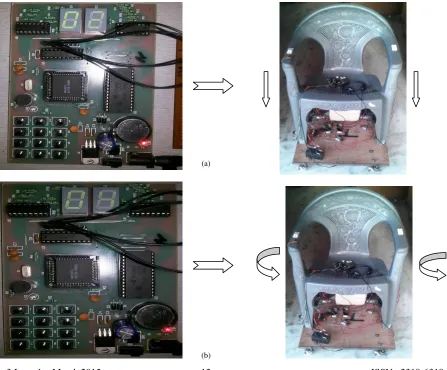
(e) (a).When FORWARD voice command received the wheel chair moves forward. (b).When LEFT voice command received the wheel chair moves left.
Volume 3 Issue 1 – March 2015 14 ISSN : 2319-6319
(e). When STOP voice command received the wheel chair stops moving.
IV.CONCLUSION
The paper has been successfully designed and tested. It has been mainly designed in order to reduce human effort in driving a wheelchair. Many existing systems has discussed about the wheelchairs and has proposed many methods for reducing their efforts. But still there is a difficulty in moving a wheelchair manually. So, in order to avoid that difficulty, instead of controlling the wheelchair electrically or by gestures, our project succeeded in moving the wheelchair using voice commands. When the voice commands are given by the disabled person sitting on the wheelchair, using HM2007 speech recognition kit the commands are received, and according to those commands the motors will move which in turn moves the wheel chair.
REFERENCES
[1] R. Gadalla, "Voice Recognition System for Massey University Smarthouse," M. Eng thesis, Massey University, Auckland, New Zealand, 2006.
[2] L. R. Rabiner and R. W. Schafer, Digital Processing of Speech Signals, New Jersey, US: Prentice Hall Inc, 1978.
[3] B. Yukesekkaya, A. A. Kayalar, M. B. Tosun, M. K. Ozcan, and A. Z. Alkar, "A GSM, Internet and Speech Controlled WirelessInteractive Home Automation System," IEEE Transactions on Consumer Electronics, vol. 52, pp. 837-843, August 2006. (Pubitemid 44593712). [4] L. Albarez , R. Horowitz and P. Li "Link Layer Vehicle Flow Controller for the PATH AHS Architecture", Proceedings of the 13th IFAC
World Congress, vol. Q, pp.207 -212 1996 .
[5] M. Broucke and P. Varaiya "The Automated Highway System: A Transportation Technology for the 21st Century", Proceedings of the 13th IFAC World Congress, vol. Q, pp.141 -146 1996
[6] W-S. Chee , S. Patwardhan and M. Tomizuka "Lane Change Maneuvers: Experimental Study", Advanced Automtive Technologies 1995, vol. 56, pp.79 -84 1995
[7] R. K. Douglas "Fault Detection and Identification for Advanced Vehicle Control Systems", Proceedings of the 13th IFAC World Congress, vol. Q, pp.201 -206 1996
[8] S. Shladover "Review of the State of Development of Advanced Vehicle Control Systems (AVCS)", Vehicle System Dynamics, vol. 24, pp.551 -595 1995