Applications of Fractional Calculus-Some
Case Studies
A.Sandhya
Department of Mathematics V.R.Siddhartha Engineering College Vijayawada, Andhra Pradesh, INDIA
Abstract: In this paper we give some case studies of the fractional calculus methods that are useful to solve various problems occurring in Science, Engineering and Industry.
Mathematics Subject Classification: 26A33
Key words: fractional derivative, fractional integrals, differintegrals
I. INTRODUCTION
In a letter to L`Hopital in 1695 Leibnitz raised the following question: "Can the meaning of derivatives with integer order be generalized to derivatives with non-integer orders?" L`Hopital was somewhat curious about that question and replied by another question to Leibniz: "What if the order will be 1/2?" Leibnitz in a letter dated September 30, 1695 the exact birthday of the fractional calculus! replied: "It will lead to a paradox, from which one day useful consequences will be drawn." The question raised by Leibnitz for a fractional derivative was an ongoing topic for more than 300 years. Many known mathematicians contributed to this theory over the years. After RIEMANN-LIOUVILLE and GRUNWALD -LETNIKOV derive their definition respectively.
aDtαf(t) =
aDt α
f(t) =
[x]-integer part of x
II. A THOUGHT EXPERIMENT
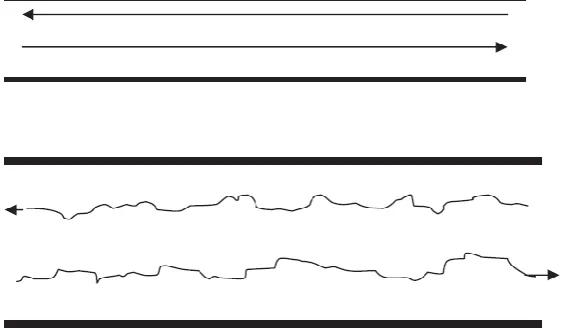
From an aircraft, we can see the city roads and observe the vehicular traffic movement. The vehicle seems to move in a straight line. Therefore, as an observer, we draw the velocity curve by simple one order integer
derivative of displacement and find that it maps a straight line. In FIGURE1, the pair of straight lines gives the velocity trajectory of the upstream vehicle and downstream vehicle, as observed in macroscopic scale. The same vehicle when looked with enlarged view tells us its continuous movement but to avoid road heterogeneity it travels in zigzag fashion. The curve in the lower frame of FIGURE1 maps this picture. Here the scale is enlarged. The velocities for upstream and downstream vehicles are not pair of straight lines, but follow a continuous, nowhere differentiable curve. So will the dx/dt give the true picture of velocity or will it be d1+αx/dt1+α, where 0 < α < 1, give the representation of the actual zigzag pattern is the thought experiment. Now the question about the dimensions of velocity, in the thought experiment when defined as fractional derivative of displacement, is the matter of another thought. In the present understanding, as per uniform time scales, the quantity dx/dt is velocity, and d2x/dt2 is the acceleration; however, the quantification of d1:23x/dt1:23 is hard to visualize. This fractional differentiation is in between velocity and acceleration, perhaps a velocity in some transformed time scale, which is non-uniform enriching thought for physical understanding of fractional quantities. The nature of zigzag pattern shown is somewhat called fractal curve, actually a continuous and nowhere differentiable function. The relation of fractal dimensions and fractional calculus is an evolving field of science at present. The macroscopic view presented above gives a thought of explanation of discontinuity and singularity formations in nature, in classical integer order calculus. Can fractional calculus be an aid for explanation of discontinuity formation and singularity formation is an enriching thought experiment.
III. APPLICATIONS OF FRACTIONAL CALCULUS-SOME CASE STUDIES
1. Nuclear Reactor Neutron Flux Description 2. Battery as Fractional Order System 3. Diffusion Model in Electrochemistry
4. Fractional-order multipoles in electromagnetism 5. Tensile and Flexural Strength of Disorder Materials
6. Modeling the Cardiac Tissue Electrode Interface Using Fractional Calculus 7. Application of Fractional Calculus to the sound Waves Propagation in Rigid Porous materials
8. Application of fractional calculus in the theory of viscoelasticity 9. Fractional differentiation for edge detection
10. Application of Fractional Calculus to Fluid Mechanics
1. Nuclear Reactor Neutron Flux Description [2]
The neutron balance description in nuclear reactor is defined by transport theory. The basic transport equations are then approximated by several coupled differential equations. One of the simplified approximation of the reactor representation given to engineers is the neutron diffusion equation sets in multi-energy group or single-energy group. In all these diffusion equations, the leakage term has Ficks law of diffusion, where the neutron flux is assumed to be a point quantity. For larger reactor representation, several of these diffusion equations are formed and modelled by region to region coupling coefficients. Engineering science then proceeds on these approximates to obtain reactor transfer function model, and then various control system analyses are done. For complex systems, the integer models of the reactor may not suffice and thus a fractional order model for obtaining flux profile or kinetics may describe the complex reality better. The argument is similar to that described for heat transfer model [chapter2.4 in 2] where distributed and complex parametric spreads and size factor are described better by fractional transient heat transfer equation.
2. Battery as fractional order system [2]
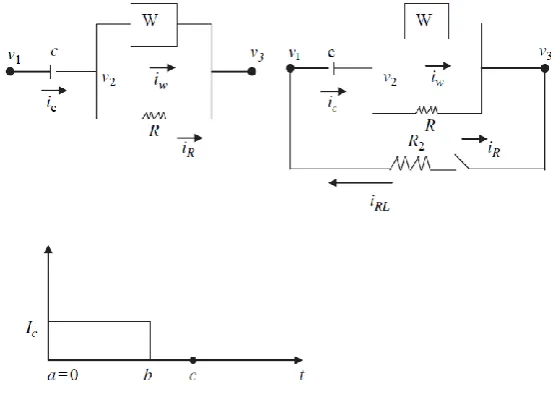
Later the load drawing usage phase .FIGURE 2.gives diagram of battery circuit charging, discharging phase circuit and the charge current profile. Here constant current charging is assumed. The block W represents Warburg impedance of electrode – electrolyte interface.
Figure 2. Battery charging, discharging circuit, and charging current profile
3. Diffusion Model in Electrochemistry [2]
One of the important studies in electro chemistry is the determination of concentration of analysed electro active species, near the electrode surface. The characteristic describing function is found experimentally as m(t) = 0Dt-0.5 i(t); which is the fractional(half) integral of the current. Then the subject of interest is to find surface Concentration Cs(t) of the electro active species, which can be evaluated as
Cs(t) = C0 - k(0Dt-0:5 i(t)) ; where k = 1/(nAF√D),
Here A being electrode area, n number of electrons involved in the reaction, D is the diffusion coefficient and F is the Faraday constant.C0 is the uniform concentration of the electro active species throughout the electrolyte medium, at the initial equilibrium situation characterized by constant potential at which the electrochemical reaction is possible.
The relationship is derived from the classical diffusion equation = D , for (0 < x < ∞) and t > 0
With C(∞; t) = C0; and C(x, o) = C0; and x=0 =
(similar equation for lossy semi-infinite transmission line and heat flux Studies) Some interesting points are listed below:
1) m(t) is characteristic intermediate between the current i(t) and the charged passed q(t).The charge passed is an integral
q(t) = 0Dt-1 i(t).This hints at non conservation law of charges, as m(t) manifests
2) The kinetics of the electrode process and the surface property of the electrode (alluding to heterogeneity) are not assumed.
3) Instead of classical diffusion equation it is possible to model with fractional order diffusion equation as:
0Dt-α C(x; t) = D with 0 < α < 1
then the surface concentration will be related to mα(t) =0 Dt α/2
4. Fractional-order multipoles in electromagnetism. [4]
It is well known that the axial multipole expansion of the electrostatic potential of electric charge distribution in three dimensions is
ϕn(r) = Pn(cosθ) (1)
where q is the so-called electric monopole moment, ε is constant Permittivity of the homogeneous isotropic medium,
r= Pn(cosθ) is the Legendre function of integer order n .In particular, the electrostatic potential functions for monopole (20), dipole (21) and quadrupole (22) are, respectively, given by
ϕ0(r) =
ϕ1(r) =
ϕ2(r) = P2(cosθ) (2)
Engheta [3] generalized the idea of the integer-order multipoles related to powers of 2 to the fractional-order multipoles that are called 2-poles.He obtained the potential function for 2αpoles (0 < α < 1) along the z-axis, in terms of the Riemann-Liouville fractional derivatives in the form
ϕ2α(r) = Pα(- )-∞Dzα( ), r= (3)
where l is a constant with dimension of length so that the usual dimension of the resulting volume charge density is Coulomb/m3. Evaluating the fractional derivative (3) yields the following result for the electrostatic potential:
ϕ2α(r) = Pα(- ) (4)
where Pα(x) is the Legendre function of the first kind and of fractional degree α When α = 0, α = 1 and α = 2, the potentials (4) reduce to those given by (2).
5. Tensile and Flexural Strength of Disorder Materials [5]
One particular focus of study in the mechanics of solids is the apparent 'size effect' that occurs in some building materials, particularly those that are aggregates, such as concrete. Although classical solid mechanics dictates that the strength of a material is largely (if not completely) determined by the material properties of that material, and so that scaling should not present a change in relative strength. The size effect however has been a demonstration of how aggregate materials, namely concrete do indeed have strength dependent on the scale of the structure and thus do not follow the rules of classical (and dare i say integer-order) solid mechanics. In [5], the authors discuss how the microstructure of such aggregate materials have been in the past successfully modelled by fractal sets rather than traditional geometric sets. The dimension of the fractal sets used to model these structures is also of primary importance as it determines the scaling, and ultimately the sizing effects for that particular material. Fractional calculus is deemed appropriate and necessary for the study of these models as ordinary integer order calculus is ill-equipped to differentiate the fractal functions at work.
The authors take this contention to use with a tensile and flexural analysis of a 2D section of concrete. From experimentally tested results of the composition and stress reactions of concrete, they determine that the microstructure may be approximated by a fractal Cantor set of dimension α= 0.5. They compute through use of fractional calculus the tensile and flexural strength of their specimen, and indeed find fractal dimension related dependencies on size that simply do not agree with a classical analysis. These formulas are shown below.
(σu)flexural = 2 ( ) (σu)tensile (6)
It is the hope of the authors of [5] that their study into the strength of materials with microstructures easily approximated by fractal sets will open the door to a more mathematically rigorous formulation of stressand load relationships. In their own words, "Here, on the one hand, we demonstrate one origin of a stress concentration on fractal sets, viz, the heterogeneity of the aggregates in the concrete. On the other hand, given the existence of the concentration of the stress on a fractal set, we develop a way to make first principle calculations of various strengths. For this purpose we use the concept of fractal integrals. We hope that these will pave the way for more general treatment of these questions."
6. Modeling the Cardiac Tissue Electrode Interface Using Fractional Calculus[7]
The tissue electrode interface is common to all forms of bio potential recording (e.g., ECG, EMG, EEG) and functional electrical stimulation (e.g., pacemaker, cochlear implant, deep brain stimulation). Conventional lumped element circuit models of electrodes can be extended by generalization of the order of differentiation through modification of the defining current-voltage relationships. Such fractional order models provide an improved description of observed bio electrode behaviour, but recent experimental studies of cardiac tissue suggest that additional mathematical tools may be needed to describe this complex system.
7. Application of Fractional Calculus to the sound Waves Propagation in Rigid Porous Materials[8]
The observation that the asymptotic expressions of stiffness and damping in porous materials are proportional to fractional powers of frequency suggests the fact that time derivatives of fractional order might describe the behaviour of sound waves in this kind of materials, including relaxation and frequency dependence.
8. Application of fractional calculus in the theory of viscoelasticity [9]
The advantage of the method of fractional derivatives in theory of viscoelasticity is that it affords possibilities for obtaining constitutive equations for elastic complex modulus of viscoelastic materials with only few experimentally determined parameters. Also the fractional derivative method has been used in studies of the complex moduli and impedances for various models of viscoelastic substances.
9. Fractional differentiation for edge detection [10]
In image processing, edge detection often makes use of integer-order differentiation operators, especially order 1 used by the gradient and order 2 by the Laplacian. This paper demonstrates how introducing an edge detector based on non-integer (fractional) differentiation can improve the criterion of thin detection, or detection selectivity in the case of parabolic luminance transitions and the criterion of immunity to noise, which can be interpreted in term of robustness to noise in general.
10. Application of Fractional Calculus to Fluid Mechanics [11]
Application of fractional calculus to the solution of time-dependent, viscous-diffusion fluid mechanics problems are presented. Together with the Laplace transform method, the application of fractional calculus to the classical transient viscous-diffusion equation in a semi-infinite space is shown to yield explicit analytical (fractional) solutions for the shear stress and fluid speed anywhere in the domain. Comparing the fractional results for boundary shear-stress and fluid speed to the existing analytical results for the first and second Stokes problems, the fractional methodology is validated and shown to be much simpler and more powerful than existing techniques.
IV. ACKNOWLEDGEMENT
REFERENCES
[1] T. Hagglund and K. J. Astrom, PID controllers: Theory, Design, and Tuning, ISA-The Instrumentation, Systems, and Automation Society (2nd edition), (1995).
[2] K. Kiong Tan, W. Qing-Guo, H. Chang Chieh and T. Hagglund, Advances in PID Controllers, Advances in Industrial Control, Springer- Verlag, London, (2000).
[3] S. P. Bhattacharyya Aniruddha Datta and M.-T. Ho, Structure and Synthesis of PID Controllers, Springer- Verlag, London, (2000). [4] I. Podlubny, Fractional-order systems and PID -controllers, IEEE Trans. Automatic Control, vol. 44, (1999), pp. 208-214.
[5] A. Oustaloup, F. Levron, B. Mathieu and F. M. Nanot, Frequencyband complex noninteger differentiator:Characterization and synthesis, IEEE Trans. Circuits Syst.,I, vol. 47, (2000), pp. 25-39.
[6] Fractional Calculus: History, Dentitions and Applications for the Engineer Adam Loverro Notre Dame, IN 46556, U.S.A. May 8, 2004 [7] R. L. Magin, Modeling the Cardiac Tissue Electrode Interface Using Fractional Calculus Journal of Vibration and Control, Vol. 4, No.
9-10, 1431- 1442 (2008)
[8] Z. E. A. Fellah, C.Depollier, Application of fractional calculus to the sound waves propagation in rigid porous materials: Validation via ultrasonic measurement, Acta Acustica vol.88(2002)34-39
[9] E. Soczkiewicz, Application of fractional calculus in the theory of Viscoelasticity Molecular and Quantum Acoustics Vol.23,397- 404(2002)
[10] B. Mathieu, P. Melchior, A. Oustaloup, Ch. Ceyral, Fractional differentiation for edge detectionFractional Signal Processing and Applications Volume 83, Issue 11, Pages 2285-2480 (November 2003)