A Smart Security for Child Safety
P.Soundarya1, M.Nivetha Kumari2 and J.Jayachitra3
1
Student, Information Technology, IFET College of Engineering, Villupuram, India.
2Associate Professor, Information Technology, IFET College of Engineering, Villupuram, India. 3Senior Associate Professor, Information Technology, IFET College of Engineering, Villupuram, India. Email: [email protected], [email protected]2, [email protected]3
Article Received: 24 January 2018 Article Accepted: 27 February 2018 Article Published: 08 April 2018
1.INTRODUCTION
In a shocking revelation, a government specially made survey has found that more than 53% of children in India are
subjected to sexual abuse, but most don`t report the assaults to anyone. It also found that every child have been
physically abused. Relatives and persons known to the child or in a position of trust and responsibility were found
to be the perpetrator’s of child abuse in the country. In Delhi, eighteen children go missing every day on average.
Only a few are traced and restored to their parents. Nowadays, children are facing more threats in this society. The
harassment towards child`s are increasing day by day as like harassment towards adults and women. Recently, the
murder of seven year old Hasini from Chennai has set across shock waves.
She went missing from her apartment and two days later she was found dead and severely abused. Another
shocking incident just after the 7 year old girl Hasini`s death, three year old girl was being sexually beaten and in
Chennai. She was found in a garbage yard with her mouth was gagged by rags. These all incidents happened against
child made us to develop such a Smart security for child safety. It will help the child`s who are all feeling in security
in external environments as well as it will helps them preventing from danger and to alert the parents while in
danger. Smart security for child safety is an innovative safety application for child and anyone who needs
assistance in an urgent situation.
Children in all over the world are facing a lot of physical harassment and kidnapped by anyone. There is a need of
advanced child security system to provide the safety measure in public places as well as travelling alone through
public transports. This project provides a new model for the child security in public places which aims to provide
A B S T R A C T
the 100% safe environment. Childs security is a critical issue in today’s world and it is very much needed for
everyone over such an issue.
2.LITERATURE REVIEW
The Kid Safety Wearable Device is undertaking depicts the idea of a brilliant wearable gadget for little children.
The reason for this gadget is to enable guardians to find their kids easily. Wi-Fi and Bluetooth seem, by all
accounts, to be a problematic medium of report between the parent and kid. Consequently, the focal point of this
paper is to have a SMS content empowered correspondence medium between the youngsters' wearable and the
parent as the earth for GSM portable correspondence is relatively present everywhere. At the point when Child is
press the catch SMS sent to Parent gadget. UV radiation and SOS utilized optional gadget measure actualized was
utilizing a splendid SOS Light and misery alert ringer introduce on the wearable gadget which when actuated by the
guardians by means of SMS content should show the SOS flag brilliantly and sound a caution which an observer
can without much of a stretch spot as an indication of pain. Vehicle Tracking System for Children Safety Using
RFID, GPS, GSM, This Project comprises of RFID labels and perusers which are intended to investigate the
passage and exit of a man in a vehicle. Every individual is relegated with a label which holds the exact points of
interest. When he/she enters the vehicle, the peruser peruses the individual's tag and stores the points of interest of
passage and exit. This data is told to the concerned specialist through SMS utilizing GSM. The proposed
framework encourages to think about the territory where the vehicle has crossed the way utilizing RFID. The GPS
innovation associated with this framework helps in securing reports on understudy's ongoing area.
3.MODULES
1. Flexi Force Sensor
2. Temperature Sensor
3. MEMS Accelerometer
4. Alert Module
3.1.FLEXI FORCE SENSOR
Since this is a security framework, GPS watch ought to be constantly joined to the observed Child and evacuating
or harming this gadget ought to be controlled. To accomplish this, a Flexi-Force Sensor is appended to the back of
the gadget and it detects the grasp power of the gadget with the client skin. The gadget will send a SMS to the
specialists if the gadget gets altered or expelled by any methods. To debilitate this security bolt highlight an
approved Child Parents could essentially empower or incapacitate Wearable unit utilizing a Mobile Keypad.
3.2.MEMS ACCELEROMETER
MEMS (Micro-Electro Mechanical System)- based accelerometers are gadgets that measure the best possible
wearable gadget could detect this and caution the focal unit by means of remote correspondence which thus will
send area and in addition kid every last Activity data are screen and show it
3.3.TEMPERATURE SENSOR
The term temperature sensor, with electrical thermometers, depicts a unit from at least one temperature sensor
components and a use particular defensive layer, which can comprise of, for instance, association head, neck tube,
thermo well or a hand grasp. The sensor component incorporated with the temperature sensor takes the genuine
estimation and proselytes the deliberate temperature into an electrical flag.
3.4.ALERT MODULE
Because of the lower control nature of the gadget the remote radio correspondence standard, IEEE 802.15.4 is
chosen for this task. In excess of one SMS and area can be sent in the event that it needs to. The technique
encourages us to make any measure of predefined security zones inside a zone which isn't practical with human
securities.
4.HARDWARE REQUIREMENTS
The hardware requirements may serve as the basis for a contract for the implementation of the system and should
therefore be a complete and consistent specification of the whole system. They are used by software engineers as
the starting point for the system design. It should what the system do and not how it should be implemented.
1. Arduino UNO
2. MEMS Sensor
3. Temperature Sensor
4. Bluetooth TXR
5. GPS Receiver
6. LCD display
7. RGB Light
4.1.SOFTWARE REQUIREMENTS
The software requirements document is the specification of the system. It should include both a definition and a
specification of requirements. It is a set of what the system should do rather than how it should do it. The software
requirements provide a basis for creating the software requirements specification. It is useful in estimating cost,
planning team activities, performing tasks and tracking the teams and tracking the team’s progress throughout the
development activity.
1. Operating system : Windows 07/ 08
2. Software : MPLAP X IDE
5.SYSTEM ARCHITECTURE
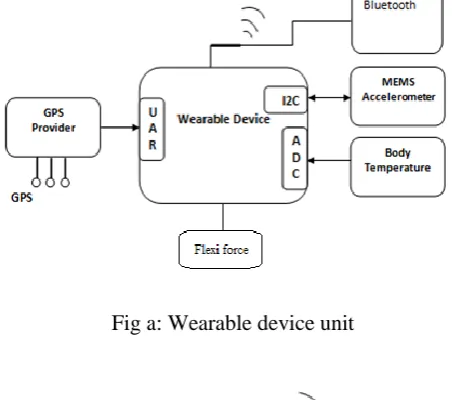
Child tracking is mainly based on two units GPS watch unit and Android monitoring unit. The GPS wearable
device unit contains a GPS receiver, Flexi Force Sensor, Temperature Sensor, MEMS accelerometer. This device
unit is attached to the hands of the Child. Using the GPS receiver we can monitor the movement of the students and
child. This GPS receiver will work under the control of GPS satellite and then if the device unit is removed or gets
tampered the Flexi Force Sensor will alert the authority with the help of Bluetooth Connection with Android App.
This Flexi Force is available in the bottom of the watch which makes a grip we can monitor while they removing
the watch unit from the hand. MEMS accelerometer present in the device unit is used for monitoring the sudden fall
and Attack of the Child and child stages. This device unit will send the signals to the Android monitoring unit with
Bluetooth communication. The fig.a, fig.b shows
Fig a: Wearable device unit
Fig b. Wireless Lamp Display
If the child crosses the given border line the signals will be send to the monitoring unit using the GPS receiver
present in the GPS device unit. The monitoring unit sends location to the Android Phone. Removing the device unit
from the hand or gets damaged is prohibited. If it happens, it will alert the authority using the Flexi Force Sensor. If
the children go inside any dangerous zone present inside the school campus it can also be monitored using the GPS
receiver. Sudden fall or Attack of the Child can also be monitored using GPS device unit. It will send Help Request
6.RESULT AND DISCUSSION
6.1 CHILD STATUS
6.2 WEARABLE DEVICE UNIT
7. CONCLUSION
This security Wearable Device will keep the child safe and also the abusement against the child will be decreased.
The parent of child will get continuous update about their child status so that they cannot afraid about their child
when they are not being with the child. This will create some fear to the persons those who all involving in
harassment and child trafficking. As like well-known proverb “Prevention is better than cure”, this application will
prevent the child from harassment and kidnapping.
REFERENCES
[1] Muthukumaran. N and Ravi. R, 'Hardware Implementation of Architecture Techniques for Fast Efficient
loss less Image Compression System', Wireless Personal Communications, Volume. 90, No. 3, pp.
1291-1315, October 2016, SPRINGER.
[2] Muthukumaran. N and Ravi. R, 'The Performance Analysis of Fast Efficient Lossless Satellite Image
Compression and Decompression for Wavelet Based Algorithm', Wireless Personal Communications,
Volume. 81, No. 2, pp. 839-859, March 2015, SPRINGER.
[3] Muthukumaran. N and Ravi. R, 'VLSI Implementations of Compressive Image Acquisition using Block
Based Compression Algorithm', The International Arab Journal of Information Technology, vol. 12, no. 4,
pp. 333-339, July 2015.
[4] Muthukumaran. N and Ravi. R, 'Simulation Based VLSI Implementation of Fast Efficient Lossless Image
Compression System using Simplified Adjusted Binary Code & Golumb Rice Code', World Academy of
Science, Engineering and Technology, Volume. 8, No. 9, pp.1603-1606, 2014.
[5] Nitin Shyam, Narendra Kumar ,Maya Shashi, Devesh Kumar, SMS Based Kids Tracking and Safety
System by Using RFID and GSM, International Journal of Innovative Science, Engineering & Technology,
Vol. 2 Issue 5, May 2015.
[6] Ruban Kingston. M,Muthukumaran. and N, Ravi. R, 'A Novel Scheme of CMOS VCO Design with reduce
number of Transistors using 180nm CAD Tool', International Journal of Applied Engineering Research,
Volume. 10, No. 14, pp. 11934-11938, 2015.
[7] Muthukumaran. N and Ravi. R, 'Design and analysis of VLSI based FELICS Algorithm for lossless Image
Compression', International Journal of Advanced Research in Technology, Vol. 2, No. 3, pp. 115-119,
March 2012.
[8] Manoj Kumar. B and Muthukumaran. N, 'Design of Low power high Speed CASCADED Double Tail
Comparator', International Journal of Advanced Research in Biology Engineering Science and
Technology, Vol. 2, No. 4, pp.18-22, June 2016.
[9] N. Muthukumaran, 'Analyzing Throughput of MANET with Reduced Packet Loss', Wireless Personal
Communications, Vol. 97, No. 1, pp. 565-578, November 2017, SPRINGER.
[10] P.Venkateswari, E.Jebitha Steffy, Dr. N. Muthukumaran, 'License Plate cognizance by Ocular Character
Perception', International Research Journal of Engineering and Technology, Vol. 5, No. 2, pp. 536-542,
[11] Deepali M. Bhavale, Ms. Priyanka, S.Bhawale, Ms. Tejal Sasane, Mr. Atul S. Bhawale International
Journal of Advanced Research in Computer Engineering & Technology Volume 5, Issue 8, August 2016
[12] N. Muthukumaran, Mrs R.Sonya, Dr.Rajashekhara and Chitra V, 'Computation of Optimum ATC Using
Generator Participation Factor in Deregulated System', International Journal of Advanced Research Trends
in Engineering and Technology, Vol. 4, No. 1, pp. 8-11, January 2017.
[13] Keziah. J, Muthukumaran. N, 'Design of K Band Transmitting Antenna for Harbor Surveillance Radar
Application', International Journal on Applications in Electrical and Electronics Engineering, Vol. 2, No. 5,
pp. 16-20, May 2016.
[14] Akhil. M.S and Muthukumaran. N, 'Design of Optimizing Adders for Low Power Digital Signal
Processing', International Journal of Engineering Research and Applications, Vol. 5, pp. 59-65, March