
IJIRT 146582
INTERNATIONAL JO URNAL OF INNOVATIVE RESEARCH IN TECHNOLOGY942
Robust Security Using Code Level Approach for Iris
Recognition
Ms.S.Nigila
1, Mrs.Dr.G.Gandhimathi
21
M.E Communication systems
,Department of ECE, Parisutham Institute of Technology & Science,
Thanjavur
2
M.E,P.hd, Professor, Department of ECE, Parisutham Institute of Technology & Science, Thanjavur
Abstract- Matching heterogeneous iris images in less con-strained applications of iris biometrics is becoming a challenging task. The existing solutions try to reduce the difference between heterogeneous iris images in pixel intensities or filtered features. In contrast, this paper proposes a code-level approach in het-erogenous iris recognition. The non-linear relationship between binary feature codes of heterogeneous iris images is modeled by an adapted Markov network. This model transforms the number of iris templates in the probe into a homogenous iris template corresponding to the gallery sample. In addition, a weight map on the reliability of binary codes in the iris template can be derived from the model. The learnt iris template and weight map are jointly used in building a robust iris matcher against the variations of imaging sensors, capturing distance and subject conditions. Extensive experimental results of matching cross-sensor, high-resolution vs low-high-resolution and, clear vs blurred iris images demonstrate the code-level approach can achieve the highest accuracy in compared to the existing pixel-level, feature-level and score-level solutions.
Index Terms- Homogenous iris, score-level solutions.
I. INTRODUCTION
Biometric is an automated methodology to uniquely identify human based on their physiological and behavioral characteristics. A lot of biometric characteristics have been proposed for authentication purpose. Traditionally, the biometric method can be categorized into two types: behavioral-based method and physiological based method. In behavioral based method perform task of authentication based on their behavioral characteristics, such as, keyboard typing, signature, gait and voice. the main problem with behavioral based method they all have large variation, can’t cope with and can be difficult to measure because of influences such as illness or
stress. The Implementation of behavioral based method less cost. Physiological-based method perform authentication by means of his and her physiological characteristics such as, face, fingerprint, hand geometry, iris or DNA. In general physiological based methods are more stable than methods in behavioral category because non-alterable of physiological based method.
II. IRIS BIOMETRICS
The idea of using iris as a biometrics is over 100 years old. However the idea of automating iris recognition is more recent. In 1987, flom and safir obtained a patent for an unimplemented conceptual design of automated iris biometrics system. Image processing techniques can be used to extract unique iris pattern from a digitized image of the eye, and encode it into a biometrics template, which can be stored in a database later. This biometrics template contains an objective mathematical representation of unique information stored in the iris, and comparisons to be made between templates. When a subject wishes to be identified by an iris recognition system eye is first photographed and then a template is found and the subject is identified, or no match is found and subject remains unidentified. In addition, iris recognition system works in the two modes: verification and identification.
IJIRT 146582
INTERNATIONAL JO URNAL OF INNOVATIVE RESEARCH IN TECHNOLOGY943
III. METHODOLOGY
This proposed system a code-level algorithm that embeds the heterogeneous iris codes of probe images into the space spanned by gallery-state codes. Such that the distance between heterogeneous iris images after mapping approximates the distances in homogeneous spaces. To the best of our knowledge, this is the first attempt on a general framework for heterogeneous iris recognition using code-level information mapping. However, the formulation of non-linear relationship between iris codes of heterogeneous images is difficult, and the only code-level approach proposed in the literature is our initial work about LR iris recognitiona.
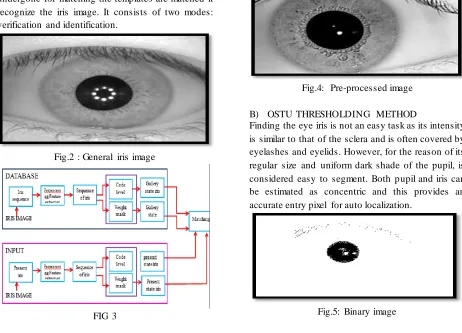
When a subject wishes to be identified by an iris recognition system eye is first photographed, and then a template created for their iris region. This template are separated into two parts code can be mapped and weight mask can be calculated separately stored in a database. The process can be repeated for an present state iris image the comparison has been done separately for code vector and weight vector the template has been undergone for matching the templates are matched it recognize the iris image. It consists of two modes: verification and identification.
Fig.2 : General iris image
FIG 3
A) PRE-PROCESSING
The iris image is first resized to a particular size. The noises in the frames reduce the quality of the frames. Each frame are considered as images. In order to improve the quality of the images we normally employ some filtering operations. Median filter is used for filtering. The median filter considers each pixel in the image in turn and looks at its nearby neighbors to decide whether or not it is representative of its surroundings. Ins tead of simply replacing the pixel value with the median of neighboring pixel values. The median is calculated by first sorting all the pixel values from the surrounding neighborhood into numerical order and then replacing the pixel being considered with the middle pixel value. In image processing, it is often desirable to be able to perform some kind of noise reduction on an image or signal. The median filter is a nonlinear digital filtering technique, often used to remove noise. Such noise reduction is a typical pre-processing step to improve the results of later processing (for example, edge detection on an image).
Fig.4: Pre-processed image
B) OSTU THRESHOLDING METHOD
Finding the eye iris is not an easy task as its intensity is similar to that of the sclera and is often covered by eyelashes and eyelids. However, for the reason of its regular size and uniform dark shade of the pupil, is considered easy to segment. Both pupil and iris can be estimated as concentric and this provides an accurate entry pixel for auto localization.
IJIRT 146582
INTERNATIONAL JO URNAL OF INNOVATIVE RESEARCH IN TECHNOLOGY944
Fig.6: Inverted Binary image
C) SEGMENTATION
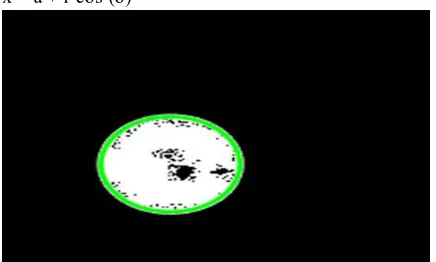
The general Hough transform can be used to detect geo-metric shapes that can be written in parametric form such as lines, circles, parabolas, and hyperbolas . The circular Hough transform can be used to detect the circles of a known radius in an image. The equation of a circle can be written as
r2 = (x a)2 + (y b)2
Where r is the radius of the circle and a and b are the center coordinates. In parametric form, the points on the equation of a circle can be written as follows: x = a + r cos (ѳ)
Fig. 7: segmented iris image
D)FEATURE EXTRACTION
In machine learning, pattern recognition and in image processing, feature extraction starts from an initial set of measured data and builds derived values (features) intended to be informative and non-redundant,
facilitating the subsequent learning and
generalization steps, and in some cases leading to better human interpretations. Feature extraction is related to dimensionality reduction.When the input data to an algorithm is too large to be processed and it is suspected to be redundant then it can be
transformed into a reduced set of
features.Determining a subset of the initial features is called feature selection.The selected features are expected to contain the relevant information from the input data, so that the desired task can be performed by using this reduced representation instead of the complete initial data.
Fig.8: Feature Extracted Iris Image
E)CODE LEVEL MAPPING
PCA is a useful statistical technique that has found application in field such as face recognition and image compression, and is a common technique for finding patterns in data of high dimension. It involves a mathematical procedure that transforms a number of (possibly) correlated variables into a (smaller) number of uncorrelated variables called principal component. The first principal component accounts for as much for as much of the variability in the data as possible, and each succeeding component accounts for as much of the remaining variability as possible. Depending on the field of application, it is also named the discrete Karhunen-Loeve transform (KLT), the Hoteling transform or proper orthogonal decomposition (POD).PCA was invented in 1901 by Karl Pearson. Now it is mostly used as a tool in exploratory data analysis and for making predictive models. PCA involves the calculation of the eigenvalue decomposition of a data covariance matrix or singular value decomposition of a data matrix, usually after mean centering the data for each attribute. The results of a PCA are usually discussed in tens of component scores and loadings. CA is the simplest of the true eigenvector-based multivariate analyses. Often, its operation can be thought of as revealing the internal structure of the data in a way which best explains the variance in the data. If a multivariate dataset is visualized as a set of coordinates in a high- dimensional data space (1 axis per variable).
IJIRT 146582
INTERNATIONAL JO URNAL OF INNOVATIVE RESEARCH IN TECHNOLOGY945
Step 2: Subtract the mean.
Step 3: Calculate the covariance matrix.
Step 4: Calculate the eigenvectors and eigenvalues of the covariance matrix. Since the covariance matrix is square, we can calculate the eigenvectors and eigenvalues for this matrix. These are rather important, as they tell us useful information about our data.
Step 5: Choosing components and forming a feature vector
Step 6: Deriving the new data set
Fig.9: Code Generated
F) MATCHING
We divide the image into small processing blocks (32 by 32 pixels) and perform the Correlation .The correlation is one of the most common and most useful statistics. A correlation is a single number that describes the degree of relationship between two variables. When the images are compared with it then
the correlation becomes autocorrelation.The
resolution which must be greater than 0.7.
G)FLOWCHA RT
H) IMAGE PROCESSING TOOLBOX IN
MATLAB
Image processing toolbox provides a comprehensive set if reference- standard algorithms, functions, and apps for image processing, analysis, visualization, and algorithm development. It can perform image analysis, image segmentation, image enhancement, noise reduction, geometric transformations, and image registration. Image processing toolbox supports a diverse set of image types, including high dynamic range, giga pixel resolution, embedded ICC profile, and topographic.
Visualization functions and apps explore images and videos, examine a region of pixels, adjust color and contrast, create contours or histograms, and manipulate regions of interest. The toolbox supports workflows for processing, displaying, and navigating large images.
Oculus Rift
At the top of the price range, Oculus Rift plans on being the gold standard of Virtual Reality HMDs. Specifically designed for video gaming, it has a high field of view, delivering the very best in immersive virtual experiences.
IV. RESULTS
IJIRT 146582
INTERNATIONAL JO URNAL OF INNOVATIVE RESEARCH IN TECHNOLOGY946
major advantage of our system is create a robust security by generating and features has been extracted to match.
Original Image
Gary scale image output
Binary Image Output
Inverted Binary Image Output
Noise Removed Image Output
IJIRT 146582
INTERNATIONAL JO URNAL OF INNOVATIVE RESEARCH IN TECHNOLOGY947
Code Level Output
Success Authentication
Authentication failure
REFERENCES
[1] P. Stavroulakis and M. Stamp, Handbook of
Information and Communication Security.
Springer, 2010.
[2] N. Ratha, J. Connell, and R. Bolle, An Analysis of Minutiae Matching Strength. Springer Berlin Heidelberg, 2001, vol. 2091, book section 32, pp. 223–228.
[3] K. Martin, L. Haiping, F. M. Bui, K. N. Plataniotis, and D. Hatzinakos, “A biometric encryption system for the self-exclusion scenario of face recognition,” IEEE Systems Journal, vol. 3, no. 4, pp. 440–450, 2009.
[4] A. Jain, A. Ross, and U. Uludag, “Biometric template security: Challenges and solutions,” in 13th European Signal Processing Conference, EUSIPCO05, 2005, pp. 1–4.
[5] J. Daugman, “How iris recognition works,” IEEE Transactions on Circuits and Systems for Video Technology, vol. 14, no. 1, pp. 21–30, 2004.
[6] S. Venugopalan and M. Savvides, “How to generate spoofed irises froman iris code template,” IEEE Transactions on Information Forensics and Security, vol. 6, no. 2, pp. 385– 395, 2011.
[7] J. Galbally, A. Ross, M. Gomez-Barrero, J. Fierrez, and J. Ortega- Garcia, “Iris image reconstruction from binary templates: An efficient probabilistic approach based on genetic algorithms,” Computer Vision and Image Understanding, vol. 117, no. 10, pp. 1512–1525, 2013.
[8] K. Park, D. Jeong, B. Kang, and E. Lee, A Study on Iris Feature Watermarking on Face Data. Springer Berlin Heidelberg, 2007, vol. 4432, book section 47, pp. 415–423.
[9] A. Hassanien, A. Abraham, and C. Grosan, “Spiking neural network and wavelets for hiding iris data in digital images,” Soft Computing, vol. 13, no. 4, pp. 401–416, 2009.
[10]S. Majumder, K. J. Devi, and S. K. Sarkar, “Singular value decomposition and wavelet-based iris biometric watermarking,” IET Biometrics, vol. 2, no. 1, pp. 21–27, 2013 [11]M. Paunwala and S. Patnaik, “Biometric
IJIRT 146582
INTERNATIONAL JO URNAL OF INNOVATIVE RESEARCH IN TECHNOLOGY948
watermarking,” Machine Vision and
Applications, vol. 25, no. 1, pp. 263–275, 2014. [12]J. Kim and H. Jun, “Vision-based location
positioning using augmented reality for indoor navigation,” IEEE Trans. Consum. Electron., vol. 54, no. 3, pp. 954–962, Aug. 2008.
[13]J. B. Kim, “A personal identity annotation overlay system using a wearable computer for augmented reality,” IEEE Trans. Consum. Electron., vol. 49, no. 4, pp. 1457–1467, Nov. 2003.
[14]S. Kasprzak, A. Komninos, and P. Barrie,
“Feature-based indoor navigation using
augmented reality,” in Proc. 9th Int. Conf., ACM Intell. Environ.,2013, pp. 100–107.
[15]A. Mulloni, H. Seichter, and D. Schmalstieg, “Handheld augmented reality indoor navigation with activity-based instructions,” in Proc.13th Int. Conf. Human Comput. Interact. Mobile Devices Serv., 2011, pp. 211–220.
![Development of Extractive Spectrophotometric Method for the Determination of Cobalt (II) With Schiff Base 2-[(2-Hydroxyphenylimino) Methyl]-4-Nitrophenol](data:image/gif;base64,R0lGODlhAQABAIAAAP///wAAACH5BAEAAAAALAAAAAABAAEAAAICRAEAOw==)