(General article)
Pumping System Performance: An Empirical Case Study
Nishant Aggarwala*, Dinesh Khandujaa
aDepartment of Mechanical Engineering, National Institute of Technology, Kurukshetra(136119) Accepted 11 July 2012, Available online 1Sept 2012
Abstract
Proper selection of a tube well viz. submersible type, diesel run type, electricity run type is essential for good life of tube well & its appropriate utilisation. There are certain factors which affect the water distribution in the tube wells. The present study in the Roorkee tehsil of Hardwar district, Uttarakhand, has been taken to meet out the objectives related to performance evaluation of pumping systems. The relevant data & information related to ground water pumping system has been collected from the field. The data has been utilised to analyse the existing pumping systems for which various parameters namely owner’s details, tube well details including the year of installation, total cost incurred, boring & pipe depth, pipe material, manufacturing place etc. & pumping unit details including the input/ output power, voltage supply, current supply, rated frequency, rated efficiency have been taken. Paper shows the use of various tubewell types in 8 villages of Roorkee tehsil & comparing the average boring depths & average output power incurred from them. Precising the water table values at different places & how the table has lowered down with time. Comparing various parameters like operation & maintenance, performance appraisal, interaction factor, quality & use of solar powered pumping systems among 8 villages. No. of pumps used, of which how many are defective or dry & the various methods to improve their efficiencies.
Keywords: Pump efficiency, boring depth, output power, per capita land owned, per capita in tubewell, submersible, diesel run & electricity type tubewell, maintenance, performance.
1. Introduction
1When many people think of a water source, they think of lakes, rivers and streams; in other words, surface water. However, of all of the usable freshwater in the world, approximately 97% of it is groundwater. According to the United Nations, 10 million cubic kilometres of water are stored underground. The United States Geological Survey states that there is about 4.2 million cubic kilometres of water within 0.8 kilometre of the earth’s surface. Environment Canada cites a study that estimates that all of the groundwater in the world would cover the surface of the earth to a depth of 120 metres, while all of the surface freshwater would only cover the earth to a depth of 0.25 metre! While groundwater estimates can vary, scientists agree that there is a lot of water under the earth’s surface! Mody J.D (1989) gave “Role of customers in Development of Submersible Pumps”; Pant, Niranjan. (1986) detailed Farmer's organization in large irrigation projects; Dunne, T. and L. Leopold, 1978, discussed “Water in Environmental Planning”.A well drilled in Summer, normally shows a low yield which is
*Corresponding author's email: [email protected]
likely to improve in the monsoon. Similarly, a well drilled in October may even become dry in summer.
Pump performance
The work performed by a pump is a function of the total head and of the weight of the liquid pumped in a given time period. Pump shaft power (Ps) is the actual horsepower delivered to the pump shaft, and can be calculated as follows:
Pump shaft power
PS = Hydraulic power hP / Pump efficiency (ηpump )
or
Pump efficiency
ηpump = Hydraulic power / Pump shaft power
Pump output, water horsepower or hydraulic horsepower (hp) is the liquid horsepower delivered by the pump, and can be calculated as follows:
International Journal of Engineering, Science and Metallurgy
Hydraulic power
hp = Q (m3/s) x (hd – hs in m) x ρ (kg/m3) x g (m/s2) /
1000
Where: Q = flow rate hd = discharge head hs = suction head ρ = density of the fluid g = acceleration due to gravity
Study area
Climate
The climate of the area is tropical monsoon with four distinct seasons: Summer- March to May, Monsoon- June to September, Post-monsoon-October to November & Winter- December to February marked. Climate is composite, hot during summer, cold during winter & humid during monsoon season. Average maximum & minimum temperatures in January are 20.2 0C & 6.5 0C & corresponding temperatures in July are 37.6 0C & 23 0C. The average annual sunshine duration is 2800 hrs.
Rainfall
The area forms part of semi-arid tract & receive rainfall by south-west monsoon season. The annual rainfall is about 1050 mm. out of which major amount occurs during south west monsoon in the months of June to September.
Soil Type
In the Roorkee tehsil, the soil type is alluvium, sandy loam to clay loam. The topography has played a more dominant role than climate & vegetation in the formation of the soils.
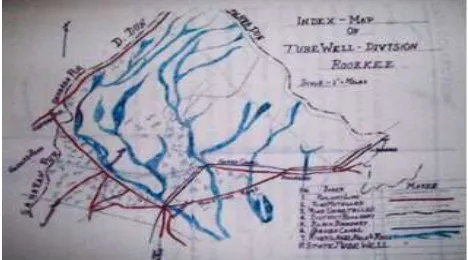
Figure 1: Map of Study Area- Roorkee
Agriculture
There are 2 cropping seasons namely KHARIF from June to December & RABI from December to May in practice. The major Kharif crops are paddy, maize & main Rabi crop is wheat. Sugarcane is also extensively cultivated. The largest area is covered by wheat followed by sugarcane, paddy, maize, pulses, groundnut & cotton. Production of sugarcane provides good commercial prospects. Irrigation plays an important role in bringing more area under cultivation. Tube wells & canals are the important source of irrigation in the area.
Figure 2: Centrifugal Pump Characterstics (Efficiency curves)
Figure 3: Comparative study of average boring depth (feet) & average output power (KW) for the 8 villages
Data collection
The 8 different villages are- a) Landhaura, b) Dhandera, c) Bhagwanpur, d) Nagla imarti, e) Kaliyar, f) Laksar, g) Manglaur, h) Gurukul narsan
Figure 4: Strata chart of tubewell at IIT roorkee campus Amod Kunj behind church, IIT Roorkee
Figure 5: Comparative Average boring depth (feet) for 8 villages
Results & discussions
General
The present study in the Roorkee tehsil of Hardwar district, Uttarakhand, has been taken to meet out the objectives related to performance evaluation of pumping systems. The relevant data & information related to ground water pumping system has been collected from the field. The data has been utilised to analyse the existing pumping systems for which various parameters namely owner’s details, tube well details including the year of installation, total cost incurred, boring & pipe depth, pipe material, manufacturing place etc. & pumping unit details including the input/ output power, voltage supply, current supply, rated frequency, rated efficiency have been taken. Water discharging capacity is larger for the diesel pump type tube well running for a larger time without any fatigue.
Pumping system evaluation
in a year with very high rated efficiencies. This is easily found out in Dhandera, Laksar & Landhaura. As the water level is going down day by day, shallow wells are now costly & obsolete. So, the submersible pumps are now widely popular due to their simplicity of design & low cost.
Benefits faced by the farmers using the submersible pump tube wells in the villages like Gurukul-Narsan, Kaliyar are:-
1. Higher overall efficiency.
2. Reduction in civil works with no foundation, pump house, security etc.
3. Self-priming since submerged.
4. Noise & smoke free operation & thus prevents environment from noise & air pollution. 5. Elimination of 2 stage pumping.
6. Can be operated by generator sets in remote areas. 7. Lighter in weight hence easier to install.
8. No need of periodic lubrication.
Operation & Maintenance
The routine operation of the tube well is done by the
secretary (security guard) as there is no other
operator for the tube well. As regards the upkeep of
the distribution system, it has been decided that each
beneficiary will clean and maintain the field channel
irrigating his field. In addition, in the case of loop
'B', the outlet presidents are also responsible for the
safety and upkeep of outlets and other water
distribution micro structures. Maintenance of
submersible type tube wells & open type tube wells
is maximum while the maintenance of diesel type
pump tube well is the least with least lubrication
required but its negative point is high air pollution
due to smoke coming out.
Performance Result
With better water management, there is a crop diversification from traditional to modern cropping patterns. High performance is for the diesel type pump tube well with maximum water discharging capacity & can work for the maximum time in an year with very high rated efficiencies.
Quality of Local Leadership
The local leadership tries to take all sections of water users, representing basically different caste affiliations with them. The secretary is a cool and persuasive person
who rises above caste and factional affiliations in matters of management of the tube well society. Thus, taking various factional and caste groupings with him has been a hallmark of the quality of the management leaders, particularly of the secretary. According to the Executive Engineer, the deep attachment and affinity of the secretary with the tube well on account of close physical proximity of the main tube well structure and ownership of large land holdings in the tube well by his family members have greatly contributed to the success of the spread of ground water pumping systems. This scenario is easily found out in Dhandera, Laksar & Landhaura.
Greater Interaction with Support Agency Staff
A high degree of interaction and more frequent contacts between the officers and the farmers is another factor responsible for the success of Groundwater Pumping System (GWPS). Officers have been holding several meetings with the farmers, both with respect to their present strategy and future plan. It has been found that the initial encouragement and guidance from senior officers and the close involvement of the field staff to educate, aid and advise the farmers is taken up, for such water cooperatives to succeed. This scenario is easily found out in Gurukul-Narsan, Laksar, Landhaura & kaliyar.
Solar Powered Groundwater Pumping System
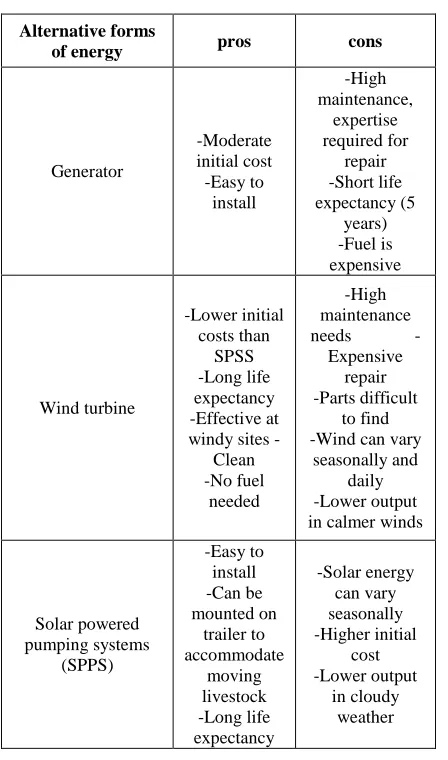
Table 1 Pros & Cons of Alternative Forms of Energy
Alternative forms
of energy pros cons
Generator -Moderate initial cost -Easy to install -High maintenance, expertise required for repair -Short life expectancy (5 years) -Fuel is expensive Wind turbine -Lower initial costs than SPSS -Long life expectancy -Effective at
windy sites
-Clean -No fuel
needed
-High maintenance needs
-Expensive repair -Parts difficult
to find -Wind can vary
seasonally and
daily -Lower output
in calmer winds
Solar powered pumping systems (SPPS) -Easy to install -Can be mounted on trailer to accommodate moving livestock -Long life expectancy -Solar energy can vary seasonally -Higher initial cost -Lower output in cloudy weather Conclusions
The study has led to the following conclusions:
Out of various types of pumps, centrifugal pumps are the most popular for water wells which can be sub-divided into 2 categories:-
1. Shallow well pumps used to lift water from depths of less than 7.5m,
2. Deep well pumps used to lift water from depths exceeding 7.5m.
The pump fails to pump the water when the head required is increased due to draw-down during the summer season.
Pumps made by Kirloskar oil engines ltd. Pune are waterproof. Pump life is high as they are casting graded & SS-410 shaft which does not rust.
The plot of average boring depth (feet) shows that the average bored depths are nearly the same with the highest in Landhaura & Bhagwanpur regions with 164.75 feet.
The plot of average output power supply (KW) shows that the average power supply is nearly the same with the highest of 11.475 KW in Laksar.
SPPS & other alternative pumping type of system can rarely be installed in India as we are not having a complete knowledge about this project so as to install in different parts of our country. Still as a matter of fact, in villages like Gurukul-Narsan, Landhaura, Kaliyar, where there is large population of tube well users with well-equipped technologies, SPPS can extend its arms to provide more sophisticated & beneficial irrigational & drinking facilities.
Out of all the 64 pumps, 16 pumps are not working satisfactorily & needs new machinery.
Options to improve energy efficiency of pumps and pumping systems are:
Operate pumps near their best efficiency point (BEP)
Modify pumping system and pumps losses to minimize throttling.
Ensure availability of basic instruments at pumps like pressure gauges, flow meters.
Adapt to wide load variation with variable speed drives or sequenced control of multiple units.
Avoid operating more than one pump for the same application.
Use booster pumps for small loads requiring higher pressures.
To improve the performance of heat exchangers, reduce the difference in temperature between the inlet and outlet rather than increasing the flow rate.
Repair seals and packing to minimize water loss by dripping.
Balance the system to minimize flows and reduce pump power requirements.
Avoid pumping head with a free-fall return (gravity), and use the siphon effect.
Conduct a water balance to minimize water consumption, thus optimum pump operation.
Avoid cooling water re-circulation in DG sets, air compressors, refrigeration systems, cooling towers feed water pumps, condenser pumps and process pumps.
In multiple pump operations, carefully combine the operation of pumps to avoid throttling.
Replace old pumps with energy efficient pumps.
To improve the efficiency of oversized pumps, install variable speed drive, downsize / replace impeller, or replace with a smaller pump.
Optimize the number of stages in multi-stage pump if margins in pressure exist.
Regularly check for vibration to predict bearing damage, misalignments, unbalance, foundation looseness etc.
References
1. Agarwal M.D.; “Testing procedures of centrifugal & submersible pumps”; Mech. Engg. Deptt, Shri Govindram Seksaria Institute of Technology & Science, Indore. 2. Dunne, T. and L. Leopold, 1978, “Water in Environmental
Planning”, W. H. Freeman and Company, New York, NY. 3. GOUP, December 1993. Performance evaluation of the
State. Tube wells handed over to cooperative societies (in Hindi), Lucknow, India: Public Tube wells Research, Planning, Design and Supplies Circle.
4. Harsh-barger and Associates, 1974, “Report on Water Development in the Fort Huachuca Area”, U.S. Army Corps of Engineers, Report on Water Supply, Fort Huachuca and Vicinity, AZ.
5. Mody J.D; “Role of customers in Development of Submersible Pumps”; Seminar on submersible pumps- Perspectives of Appropriate Technology, Bhopal; Indian Pump Manufacturers Association, Bombay (1989). 6. New Mexico Water Resources Research Institute
(NMWRRI), 2001, “Trans-International Boundary Aquifers in South-western New Mexico”, New Mexico State University, Las Cruces, NM.
7. Pant, Niranjan. 1986. Farmer's organization in large irrigation projects. Economic and Political Weekly, XXI, 51 A-171-A-175.
8. Pool, D. R. and A. L. Coes. 1999, “Hydro-geologic Investigations of the Sierra Vista Sub watershed of the Upper San Pedro Basin, Cochise County, Southeast Arizona”, USGS Water Resources Investigations Report 99-4197.