Brain Computer Interface (BCI) Based Smart Wheelchair Control
Sumathi.D1, GuruPrakash.S2 and Vibin Mammen Vinod3
1,2,3Department of ECE, Kongu Engineering College, Erode.
Email: [email protected], [email protected]2, [email protected]3
Article Received: 01 March 2018 Article Accepted: 09 April 2018 Article Published: 28 April 2018
1. INTRODUCTION
SPINAL or vertebral column is the most important part in our body where the major functions are to protect the
spinal cord, nerve root and also the internal organs. Spinal cord injury occurs when there is any damage to the spinal
cord that blocks communication between the brain and the body. When the spinal cord injured, a person‟s sensory,
motor and reflex messages are affected and may not be able to function as usual. The higher the level of injury, the
more dysfunction can occur. This may result in partial or complete paralysis of the body as well as complete
paralysis of the arms and legs. For persons with a highest level of Spinal Cord Injury (SCI), they are only able to
control a muscle movement from a neck and above. To gain an independent mobility, a power electrical wheelchair
with an alternative or hands free interface is crucial since normal joystick is not viable anymore. The medium can
be developed by utilizing information generated from eyes, tongue, voice and brainwave. Nikhil Shinde and Kiran
George proposed a new design of “Brain-Controlled Driving Aid for Electric Wheelchairs”. In this paper a BCI
based electric wheelchair driving aid design that utilizes mental concentration (EEG signals) and eye blinks (EMG
signals) of the user, is used. The design incorporates a safety controller with peripheral safety sensors that override
the user command and stop the wheelchair when it detects an obstacle in its path [7].The experimental results show
that the average success rate for detecting blinks needed to change the direction of the wheelchair was 85%.
Subjects took an approximately 50 seconds to drive a predefined path of approximately 20 feet. This kind of
wheelchair can categorize as an intelligent wheelchair as it operate base on computer interface. Imran Ali Mirza,
Nikhil Sharma designed a new design which is “Mind-Controlled Wheelchair using an EEG Headset and Arduino
Microcontroller”. An attempt has been made to propose a thought controlled wheelchair, which uses the captured
signals from the brain and eyes and processes it to control the wheelchair. Electroencephalography (EEG)
technique deploys an electrode cap that is placed on the user‟s scalp for the acquisition of the EEG signals which
are captured and translated into movement commands by the arduino microcontroller which in turn move the
wheelchair [2].The information that collected from the action of eyes, tongue, voice or brainwave then will be
A B S T R A C T
Electroencephalography (EEG) based wheelchair driving system, one of the major applications of brain-computer interface (BCI) that allows an individual with mobility impairments to perform daily living activities independently. Brainwaves are produced by synchronized electrical pulses from masses of neurons communicating with each other. Brainwaves are detected using sensors placed on the scalp. The brain wave signals are analyzed using Neurosky mind wave mobile. Human brain consists of millions of interconnected neurons. The patterns of interaction between these neurons are represented as thoughts and emotional states. It‟s not easy for the disabled and elderly people to maneuver a mechanical wheelchair, which many of them normally use for locomotion. Hence there is a need for designing a wheelchair that is intelligent and provides easy maneuverability. In this paper, a model has been made to propose a wheelchair, which uses the captured signals from the brain and processes it to control the wheelchair. Electroencephalography (EEG) technique deploys an electrode that is placed on the user‟s scalp for the acquisition of the EEG signals which are captured and translated into movement commands by the arduino microcontroller which in turn move the wheelchair.
process to drive the movement of wheelchair to left, right, forward or reverse. The possibility of moving in an
autonomous way gives user with severe impairment conditions a remarkable physical and psychological sense of
well-being. In recent years, it can be observed a growing of interest in Brain Computer Interfaces (BCI) system for
medical and multimedia applications. BCI is a device to provide direct interface between human brain and
computer. The users just need to think of movement in order to drive the system. Keun-Tae Kim and Seong-Whan
Lee designed a “Towards an EEG-based Intelligent Wheelchair Driving System with Vibro-tactile Stimuli”. This
paper uses a Steady-State Somatosensory Evoked Potential (SSSEP) paradigm, which elicits brain responses to
vibro-tactile stimulation of specific frequencies, for a user‟s intention identification to driving a wheelchair [3].
This wheelchair in mainly based on a subject concentrated on one of vibro tactile stimuli (attached on left-hand,
right-hand, and foot) selectively for driving wheelchair (corresponding to turn-left, turn-right, and
move-forward).Therefore the usage of BCI is one of the prominent devices for enabling the severe impairment user
to control wheelchair based on the signal obtained from the brain.
1.1.Brain Computer Interface (BCI)
A Brain Computer Interface (BCI) often called a Mind-Machine Interface (MMI) or sometimes called a Direct
Neural Interface (DNI), Synthetic Telepathy Interface (STI) or a Brain Machine Interface (BMI) is a direct
communication pathway between the brain and an external device. BCIs are often directed at assisting, augmenting
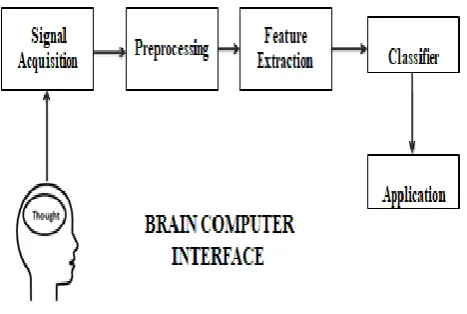
or repairing human cognitive or sensory-motor functions. Figure 1 shows the basic blocks in the BCI interface.
Humans‟ brain is filled with neurons, individual nerve cells connected to one another by dendrites and axons.
Every action like think, move, feel or remember something make neurons are at work. That work is carried out by
small electric signals that zip from neuron to neuron as fast as 250 mph. The signals are generated based on the
differences in electric potential carried by ions on the membrane of each neuron. The signals then can be detected,
interpreted to what they mean and use them to direct a device of some purpose.
Fig. 1. Brain Computer Interface
The immediate goal of BCI research is to provide communications capabilities to severely disabled people who are
totally paralyzed or „locked in‟ by neurological neuromuscular disorders, such as amyotrophic lateral sclerosis,
human brain and the computer. In order to develop the BCI system, the feasible technique should be studied. BCI
systems are broadly classified into invasive and non-invasive techniques. Lee.W.T, Nisar.H, Malik.A.S, Kim Ho
Yeap had developed “A Brain Computer Interface for Smart Home Control”. The Electroencephalographic (EEG)
signals recorded from the brain activity using the Emotiv EPOCH headset where interfaced with the help of mouse
emulator to a Graphical User Interface (GUI) on the computer screen [9]. The user will use this GUI to control
various devices in a smart home. The user will select his desired application using a raise of an eyebrow (or a smirk,
or a combination of actions if needed and to increase the sensitivity of the system), that will cause a mouse click on
the desired control.
Monika Rana and Ramandeep Singh proposed a system which will use “Smart Homes for a Better Living Using
Bluetooth Communication Based on Atmega Microcontroller”. The embedded system is connected to appliance in
home and it is ready to receive control through Bluetooth receiver. This paper [5] consists of two parts. (a) Android
application, used for communicating with the controlling circuit through Bluetooth channel. (b) Electronic
controlling circuitry, consists of a microcontroller, a Bluetooth module, relay driver IC along with relays which will
switch electrical loads on the circuit and to switch the power supply. The android device sends a command which is
received by the receiver of the Bluetooth module and forwards it through its USART serial interface to the
microcontroller. After receiving the command, the microcontroller performs the necessary action.
1.2.Electroencephalography (EEG)
EEG is the first non-invasive neuron imaging technique discovered which is used for measuring the electrical
activity of the brain. EEG signals are detected from the scalp and contain noise as a result of electrical interference
and movement of electrodes. Applying a large number of EEG channels may include noisy and redundant signals
that degrade the BCI performance and also involve a prolonged preparation time that directly impacts the
convenience in the use of the BCI. Therefore, selecting the least number of channels that yield the best or required
accuracy can balance both needs for performance and convenience.
1.3.EEG Electrode Brain Channel
Typically, in BCI study, electrode locations are selected arbitrarily from scalp area corresponding to the motor
cortical region to record the electrical activity of the brain. It is well known that the variation of the surface potential
distribution on the scalp reflects functional activities emerging from the underlying brain. This surface potential
variation then can be record and the voltage of electrodes can be measure, which are then filter, amplify, and record.
Electrodes conduct voltage potentials as microvolt level signals, and carry them into amplifiers that magnify the
signals approximately ten thousand times.
The use of this technology depends strongly on the electrodes positioning and the electrodes contact. For this
reason, electrodes are usually constructed from conductive materials, such as gold or silver chloride including a
conductive gel that will apply between electrode and scalp to maintain an acceptable signal to noise ratio. The gel
based electrode system however have difficulties on the need of long montage time and the need to wash the user‟s
hair after the recording.
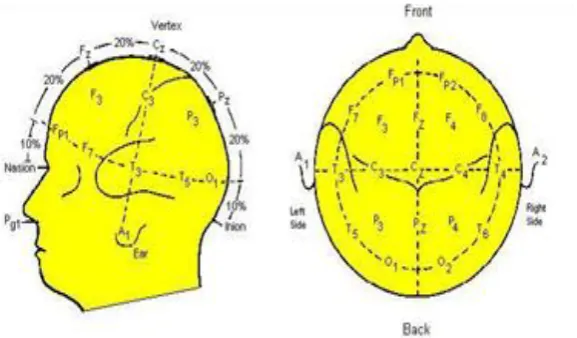
Therefore, the dry electrode system will be used to reduce the electrode- skin impedance. Figure 2 shows the
location of electrode according to International 10/20 System. Each site has a letter to identify the lobe and a
number or another letter to identify the hemisphere location. The letters F, T, C, P, and O stand for Frontal,
Temporal, Central, Parietal and Occipital. Even numbers (2, 4, 6, 8) refer to the right hemisphere and odd numbers
(1, 3, 5, 7) refer to the left hemisphere. The z refers to an electrode placed on the midline.
1.4.Data Acquisition
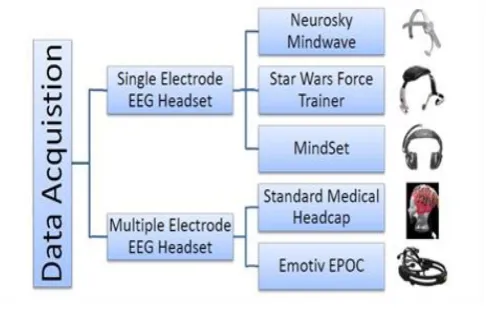
Single electrode headsets, such as the Neurosky Mind wave, were inexpensive and simple. Most devices had an
accessible Software Development Kit (SDK) so development would be relatively simple. The systems also include
built-in electrical noise reduction software/hardware, and utilize embedded (chip level) solutions for signal
processing and output. The dry electrodes can measure brain waves millimeters from the scalp and thus can easily
be worn over hair. Figure 3 shows an illustration of all of the options for data acquisition devices.
2. PROPOSED WORK
In recent years, it can be observed a growing of interest in Brain-Computer Interfaces (BCI) system for medical and
multimedia applications. BCI is a device to provide direct interface between human brain and computer. The users
just need to think of movement in order to drive the system. Therefore the usage of BCI is one of the prominent
devices for enabling the severe impairment user to control wheelchair. For this project an Electroencephalogram
(EEG) signal generated from single electrode that placed on the forehead will be used as a controller to initiate
user-intention command. Meditation levels and eye blinks are detected from the EEG signal. The aim of this work
is to use parameters gathered by the headset to move the wheelchair in the directions the user wants, the main being
attention and meditation. The proposed methodology involves using the wheelchair to move around using neuron
signals. The specific objectives are:
1. To design a Brain Computer Interface based wheelchair for physically impaired people.
2. To acquire and process the EEG signal from non-invasive BCI (Neurosky Mind wave) device using Arduino
Software.
3. To analyze the EEG signal in term of attention and meditation level by using their peak and average value.
2.1. Problem Statement
Every year, around the world, between 250000 and 500000 people suffer a spinal cord injury (SCI) and severe
impairments. The majority of spinal cord injuries are due to preventable causes such as road traffic crashes, falls or
violence. The damage of spinal cord and nerve root may effect from incomplete to total dysfunction.
Conventionally, most people with severe impairments conditions are unable to control their electrical wheelchair
using a standard joystick. A complete paralysis of the body severe impairment people as well as complete paralysis
of the arms and legs cause the power wheelchair with alternative interface is needed. Limited physical movement
above the fourth cervical vertebra typically no single alternative interface provides a comprehensive solution to the
control wheelchair. Therefore this project will develop the BCI system based on EEG signal to control wheelchair
so that the patients can use their brain to move the wheelchair without any assistant. Figure 4 shows the proposed
system block diagram.
2.2. Scope and Advantages
The scopes of this study are:
1. Use the Neurosky Mind wave of single electrode EEG headset to capture the brain signal.
2. Constraint of six basic wheelchair‟s movement which are start, stop, left, right, forward and reverse.
3. Use Arduino software to analyse the collected data.
2.3. Advantages of Proposed System
1. Easy to handle, since uses the simple concentration and blink to control.
2. Suitable for all kind people especially Elderly people and physically disabled people.
3. Less power consumption.
4. Wireless control.
5. Less interference due to encoding techniques.
6. Less deviation and high sensitivity.
7. Flexible hardware changes.
3. HARDWARE DESCRIPTION
Hardware requirements for the proposed system:
1. NeuroSky Mindwave Mobile Headset
2. HC-05 Bluetooth Module
3. Ardunio Mega &nano
4. Model of Electronic Wheel chair
3.1.Neurosky Mindwave Mobile
NeuroSky, Inc. is a manufacturer of Brain-Computer Interface (BCI) technologies for consumer product
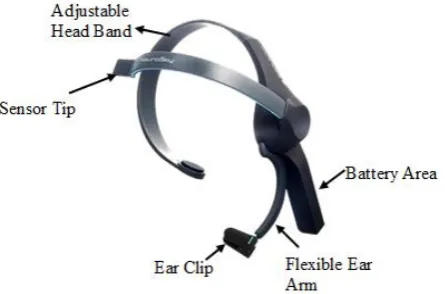
applications, which was founded in 2004 in Silicon Valley, California. Figure 5 shows the Neurosky Mindwave
Mobile. The company adapts Electroencephalography (EEG) and Electromyography (EMG) technology to fit a
consumer market within a number of fields. NeuroSky technology allows for low-cost EEG-linked research and
products by using inexpensive dry sensors.
The systems also include built-in electrical “noise” reduction software/hardware, and utilize embedded (chip level)
solutions for signal processing and output. When NeuroSky has released direct-to-consumer products, such as the
MindSet and the MindWave, they are typically designed for maximum flexibility of use through third party and
open source content. The NeuroskyMindWave Mobile safely measures and outputs the EEG power spectrums in
the form of alpha waves, beta waves, etc., NeuroSkyeSense meters (attention and meditation) and eye blinks. The
device consists of a headset, an ear-clip, and a sensor arm. The headset‟s reference and ground electrodes are on the
ear clip and the EEG electrode is on the sensor arm, resting on the forehead above the eye (FP1 position). It uses a
single AAA battery with 8 hours of battery life.
3.2. HC-05 Bluetooth Module
HC-05 module is an easy to use Bluetooth SPP (Serial Port Protocol) module, designed for transparent wireless
serial connection setup. Two work modes: order - response work mode and automatic connection work mode, and
three work roles (Master, Slave and Loopback) at the automatic connection work mode. When the module is at the
automatic connection work mode, it will follow the default way set lastly to transmit the data automatically. When
the module is at the order-response work mode, user can send the AT command to the module to set the control
parameters and sent control order.
3.3. Arduino Mega & Nano
3.3.1. Arduino Mega 2560
The Arduino Mega 2560 is a microcontroller board based on the ATmega2560. It has 54 digital input/output pins
(of which 15 can be used as PWM outputs), 16 analog inputs, 4 UARTs (hardware serial ports), a 16 MHz crystal
oscillator, a USB connection, a power jack, an ICSP header, and a reset button.
It contains everything needed to support the microcontroller; simply connect it to a computer with a USB cable or
power it with a AC-to-DC adapter or battery to get started. The Mega 2560 board is compatible with most shields
designed for the Uno and the former boards Duemilanove or Diecimila. The ATmega2560 on the Mega 2560
comes preprogrammed with a bootloader that allows you to upload new code to it without the use of an external
hardware programmer.
3.2.2.Arduino Nano
The Arduino Nano is a small, complete, and breadboard-friendly board based on the ATmega328 (Arduino Nano
3.x). It lacks only a DC power jack, and works with a Mini-B USB cable instead of a standard one. The Arduino
Nano can be powered via the Mini-B USB connection, 6-20V unregulated external power supply (pin 30), or 5V
regulated external power supply (pin 27). The power source is automatically selected to the highest voltage source.
Each of the 14 digital pins on the Nano can be used as an input or output, using pinMode(), digitalWrite(), and
4. MODEL OF ELECTRONIC WHEELCHAIR
4.1. Working Principle
Wheel chair consist of two LED, Red LED is used to indicate the sensor is ready or not and Green LED is used to
select the wheelchair direction.
Forward
Backward
Left
Right
After the selection of direction, Green LED is off and tries to make the attention. The wheelchair moves the
selected direction. Attention goes less than threshold value, wheelchair is stopped. Again choosing the direction is
done by the help of Green LED. Figure 6 shows the circuit diagram of a wheelchair.
4.2. L293D-Motor Driver
The L293D works on the concept of typical H-bridge, a circuit which allows the high voltage to be flown in either
direction. L293D is a driver circuit which allows the rotation of both the motors simultaneously either clockwise or
anticlockwise direction.
Fig. 6. Circuit Diagram of Wheelchair
In a single L293D IC there two H-bridge circuits which can rotate two DC motors independently. Due to its size
Arduino projects. Figure 7 shows the L293D pin configuration. The L293D is also a key component in larger 'motor
driver' boards available premade for hobbyists.
Fig. 7. L293D Pin Configuration
4.3. DC Motor
Two DC motors are attached to the rear wheels of the wheelchair simulator. These motors rotate with the speed of
100 revolutions per minute. For the movement of wheelchair in forward or backward direction both the motors will
rotate but in opposite directions. For left or right movement one motor is in one direction and another motor is in
opposite direction.
5. RESULT AND DISCUSSION
Fig. 8. Model of Wheelchair
Wheel chair consist of two LED, Red LED is used to indicate the sensor is ready or not and Green LED is used to
select the wheelchair direction and figure 8 shows the model of wheelchair. Figure 9 indicates that the device is
ready.
1. Forward
3. Left
4. Right
Fig. 9. Indication of the Device is Ready
After the selection of direction, Green LED is off and tries to make the attention. The wheelchair moves the
selected direction. Attention goes less then threshold value, wheelchair is stopped. Again choosing the direction is
done by the help of Green LED. Figure 10 shows that the both LED are in on condition.
Fig. 10. Red and Green LED is on Condition
6. CONCLUSION
Using this proposed system the signals were sent from the headset to the arduino in order to instigate movements in
the wheelchair based on the inputs from the brain. With the Implementation of above hardware architecture a
wheelchair could be controlled successfully. This wheelchair uses two motors for its movement. Although this
system is very raw it is a step towards brain-controlled movement. The movement of the wheelchair will be solely
configured to the signals generated by the mind. User based or specific modules can be created thus generating a
unique footprint. It uses upcoming and ever evolving technology that will enable easy and manageable iterations.
people who suffer from paralysis of the upper torso for placement/adjustment of the headset. Exact thoughts cannot
be measured using the current headset.
7. FUTURE WORK
An obstacle in the way could be detected automatically by the wheelchair forcing it to stop. Acceleration sensors
could be added onto the wheelchair to calculate the amount of acceleration tilt to help navigate on ramps and slopes.
The wheelchair could be integrated with head movements to control factors such as speed and brakes. Arduino
efficiently controls drivers and drivers are able to communicate with motors. With more modifications this system
could be converted to real system which can support the lives of amputees.
REFERENCES
[1] Eyad M. Hamad, Samer I. Al-Gharabli, Munib M. Saket, and Omar Jubran (2017), „A Brain Machine
Interface for command based control of a wheelchair using conditioning of oscillatory brain activity‟,
Engineering in Medicine and Biology Society (EMBC), 39th Annual International Conference of the
IEEE.
[2] Imran Ali Mirza, Amiya Tripathy, Sejal Chopra, Michelle D‟Sa, Kartik Rajagopalan, Alson D‟Souza,
Nikhil Sharma (2017), „Mind-Controlled Wheelchair using an EEG Headset and Arduino Microcontroller‟, Technologies for Sustainable Development (ICTSD), International Conference.
[3] Keun-Tae Kim and Seong-Whan Lee (2016), „Towards an EEG-based Intelligent Wheelchair Driving
System with Vibro-tactile Stimuli‟, IEEE International Conference on Systems, Man, and Cybernetics.
[4] Ling Li, Lei Xiao, and Long Chen (2009), „Differences of EEG between Eyes-Open and Eyes-Closed
States Based on Autoregressive Method‟, Journal of electronic science and technology of China, vol.7,
no.2.
[5] Monika Rana1, Ramandeep Singh(2014), „Smart Homes for a Better Living Using Bluetooth
Communication Based on Atmega Microcontroller‟, International Journal of Research in Engineering and
Technology, Vol. 03, Issue: 06.
[6] NeuroSky, NeuroSky Website, http://developer.neurosky.com/
[7] Nikhil Shinde and Kiran George (2016), „Brain-Controlled Driving Aid for Electric Wheelchairs‟,
Wearable and Implantable Body Sensor Networks (BSN), IEEE 13TH International Conference.
[8] Ozan Gunaydin, Mehmed Ozkan (2013), „Design Of A Brain Computer Interface System Based On
Electroencephalogram (EEG)‟, Proceedings Of The 4th European DSP In Education And Research
Conference.
[9] Wei Tuck Lee, Humaira Nisar, Aamir S. Malik, Kim Ho Yeap (2013), „A Brain Computer Interface for
Smart Home Control‟, IEEE 17th International Symposium on Consumer Electronics (ISCE), Universiti